It used to happen all the time. I’d be out in public, with my son, at the grocery store, zoo or bagel shop. A friendly person would ask,
Babysitting today?
And I want to punch someone. Or punch something else. Or cry.
Instead, I grit my teeth, and reply with masked fury, in a moderately loud and determined voice:
I am not babysitting. I am parenting. This is my own son. We do this all the time.
Then, I mutter under my breath:
Idiot.
I don’t get this remark anymore, now that my kid is approaching ten years of age. Instead, I can see that when I’m hanging out with my kid on a Saturday morning, folks could be jumping to a couple other conclusions. One might be that I have partial custody and am getting in “quality time,” or that I’m letting mom sleep in because she’s worked so hard parenting during the week. They might not jump to these conclusions. But one that is less likely is the truth, is that I’m parenting while my spouse is working.
I regularly get asked about my field research. I go to one place in the rainforest for weeks at a time, during which I am supervising students, working in the field and lab, and am generally really busy.
Do you take your wife down with you?
What is odd, is that people rarely ask if she joins me. They ask if I’m taking her. I do take students down. But if my wife were to go, I wouldn’t be “taking” her. She’d be making the time to come along. I think, “She’s not a possession for me to bring along as I please wherever I go. We both have things to do you know.” Instead, I reply:
No, she’s busy working. I don’t think she can blow so much time to go to watch me work or to volunteer as my field tech. Also, someone has to take our kid to school and feed him, so I’m rather grateful to her to cover for me while I’m gone. She has come down a few times, for some vacation before or after my work, though we’d rather vacation somewhere new when we have the chance. Actually, this summer my kid’s coming along for a couple weeks and I’m looking forward to that.
I’m more inclined to give people a free pass, because most people — even other scientists — can’t really imagine what it’s like down at the field station where I work, nor what I do from moment to moment. Nevertheless, it does seem absurd that someone would think my wife could just drop everything and join me as an accessory.
The bottom line is that If I was a woman, nobody would be asking me if I “take my husband” to the rainforest while I was working. Nobody would ask me if I was “babysitting” my own child if they saw me with him in a jogging stroller at the zoo.
These remarks don’t make me a victim of bias, other than the fact that I find them annoying. These remarks actually have the false presumption that I am the beneficiary of bias.
The unfortunate truth is that these mistaken assumptions have a real basis. Why do I really want to punch someone when they ask if I’m babysitting? Because most of the other guys at the grocery store with their kids probably are babysitting their own children.
Many families that I know well have one parent employed full-time, with the other part-time or not at all. In those cases, the division of parenting and household labor makes sense. In dual-career couples, though, it’s far too often that the guy ends up not holding up his end of the marital bargain.
I don’t know if my wife would tolerate it if I didn’t do my fair share of parenting. She presumably would be annoyed, but if I just abdicated my responsibility, then she would have no choice to pick up the slack. It would be the same the other way around, if she didn’t do her share of the parenting then I would have to.
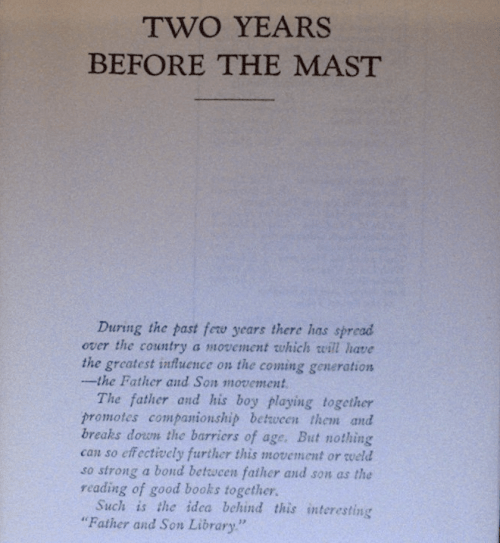
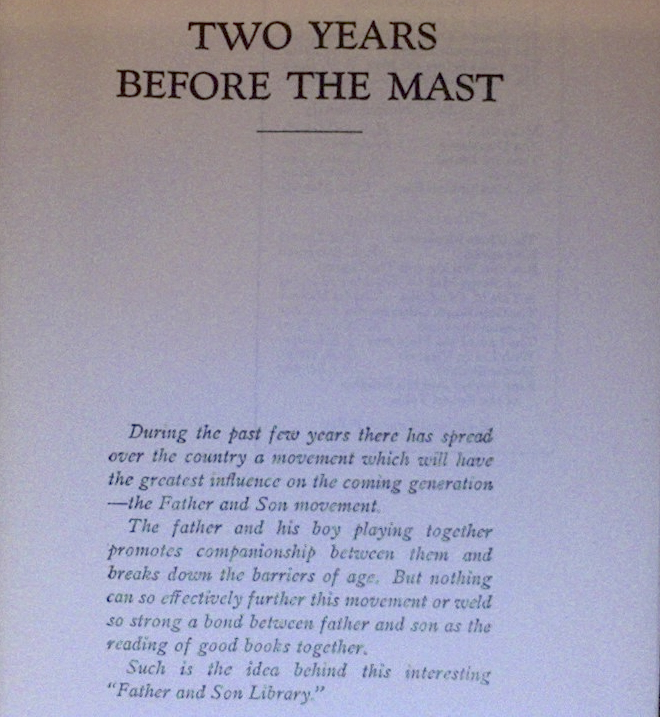
This is title page of the book that I’m reading with my kid now, from a 1927 printing. Even back then, the token role of fathers in their children’s lives was promoted, perhaps even more robustly than in today’s parenting culture that still emphasizes the role of mothers over fathers.
In our culture, in dual-career couples, many fathers feel perfectly free to let the mothers do more than their fair share. This rarely happens the other way around.
I don’t look at the arc of history and see the need for systemic progress. It would be great if our jobs made more accommodations for working families and the entire NSF work-life balance agenda is great. But this is not the root of the problem, and you can’t fix it by simply giving women more slack or more time or more money. Those fixes just make it less worse.
I see individual people making bad decisions. I see men who choose work over family voluntarily, and I also see some women who step in and parent without giving their spouses the opportunity to carry the load. The problem starts once a dual-career family lets one spouse assume more responsibility than the other one.
In my family, we’re not equal, but I think we are equivalent. I have to admit that I rarely do our laundry. On the other hand, I spend an equivalent amount of time cooking. I would hope that if a behaviorist were scoring my house with an ethogram, that we’d come out relatively even with respect to domestic duties. The number of nights that I’m out for social affairs or volunteering match hers. (I do teach nights a couple times per week, though that often means that I get other mornings and evenings. It evens out.)
More importantly, we come out equivalent on parenting. I hold this as a point of pride, but it really should not be a point of pride. It should be the status quo, at least when both parents are working as much as the other.
The fact is that women are doing more parenting than their spouses, in most dual-career couples. This is not caused by biology or by the system. It’s caused by individual men screwing up.
I am tired of the trope that biological differences between genders makes women expend more time parenting than men. For most academic work (aside from dealing with reagents, and some fieldwork, and medical complications), women are capable of working for nearly the entire time they are pregnant. A few weeks after giving birth, in some cases, women are as physiologically capable of working as men. The one factor that continues is milk production. However, pumping can often work well and formula isn’t exactly evil. (For what it’s worth, my wife went back to work full time after six weeks and we never spent a dime on formula.)
The only biological difference that causes women to parent more is that men might be more likely to be born as jerks that let their wives’ careers suffer because they are inadequate parents.
Just because women are the producers of milk, shouldn’t that mean that men can just as easily step up to the plate and contribute in other ways?
Especially in academia, men have plenty of latitude to do their fair share of parenting compared to other careers because it’s so flexible. Women partnered with someone working a typical non-academic inflexible job also can get lots of spousal support, from a partner that is available to cover mornings, evenings and weekends.
I essentially took six months off to parent full-time, aside from Tuesdays when Grandma stepped in for us. Did this hurt my career? Actually, it did. I was at a Catholic university at the time, and my male Dean expressed concern about my request for paid parental leave (as clearly specified in faculty handbook), because that was intended only for mothers and not fathers. He told me that he understood my dilemma because he had five children of his own and he never missed a day of work. That conversation was not good for my career.
My point is that there is no inherent biological reason that mothers, more than fathers, may have more negative repercussions at their work because of parenting, because both are equally capable of doing so. There may be sexist reasons that transcend scheduling and effort, like I experienced, but that’s not going to stop me from doing my job as a parent.
(As a side note, have you ever looked inside Parenting magazine? It should be renamed Mothering magazine. There is always a column about fathers, but it is always, without exception, about how women can convince their husbands to do something like change a diaper once in a blue moon or do bedtime reading.)
The only biological difference that makes women parent more is that some men are assholes. These men don’t fulfill their duties to their spouses or they demonstrably care less about raising their families on a day to day basis.
If you tell me that women have more problems at work because of they have more parenting obligations than their spouses, then I tell you: their spouses are doing it wrong. And the women are doing it wrong because they’re accepting less than 50% from their spouses.
As you can tell, I get mad when gender is conflated with work-life balance issues. This is probably a chip on my shoulder from being a dad and spouse that did his fair share, in an environment where this is a rarity.
If you want to fix the dual-career couple inequity issue with respect to parenting, the first step is to tell women to not marry men who don’t parent enough. Women should not be spending more time parenting than their partners if they’re both living in the same house and both working full time. How many times and ways do I have to write this? Apparently, it is a lot, because it doesn’t seem like anybody else is saying it.
Of course, in our country there is so little systemic support, from the government, our own workplaces and our extended families, that we have a greater stress placed on working parents overall. This is not a gender issue, it’s a parenting issue.
If a married woman says that she has a greater challenge at her job because of the time demands of parenting, then she needs to hear that the problem is not the system, it’s her spouse. The problem might be her spouse’s boss, but I’m not convinced that this is a rampant problem. Perhaps this should be the main problem, but right now it isn’t.
I avoid these conversations because I it never has ended well when I’ve told a guy that he needed to spend more time parenting. And I don’t have the temerity to tell a woman that she picked a crappy husband who isn’t willing to accept 50% of the parenting load. (Now, I can just tell people to read my blog post about it and be done with it.) I’m not sure how to implement change when the necessary change requires individual responsibility on the part of others. We can raise sensitive males that understand their roles as partners. Hopefully, I’m doing that by example.
For me, it’s not a problem, because hanging out with my kid is the best thing in the world. I can’t conceive how a man would think otherwise about his own kids. I was lucky that my academic career gave me the flexibility to shut down my research program for a spell, so that I could be at home with my baby. (This I could do because I was at a teaching institution. With a big lab, and pressure for grants and pubs, it wouldn’t have happened that way, and daycare would have started earlier or we would have relied on extended family, both of which also would be fine options.) If I didn’t have that flexibility, I wouldn’t demand it of my wife. We’d solve it together, and it wouldn’t involve sacrificing her career.
There are substantial issues involving sexism in the sciences and academia, independent of parenting. That’s a separate issue, and one that I’m not addressing here. Perhaps I’m addressing it by claiming overtly that it is a separate issue — that parenting should not be a gender issue, and it’s only an issue in dual-career families in which the man is a wretched bum.
Every time I see a story or hear a person remark, “it’s great and inspiring that this woman can be a scientist and a parent” I get mad. You know what? That statement can apply to me, too, aside from the fact that I’m a man. I do just as much parenting as my spouse. My “success” or the lack thereof, that is tied to my status as a parent and a researcher, should represented in equal measure as it is for female scientists. (This would be different, of course, for single parents or those who have demonstrably jerky husbands.)
If you think that notion isn’t broadly applicable to all men, that’s because you think that many male scientists with kids are deadbeats. I might agree with you on that. The father-scientists I’m working with now seem to be dedicated and supportive of both their kids and their spouses, but that’s not the norm. My non-academic father friends are also doing their 50%, or their share depending on the family employment situation, but then again, I feel like I can’t relate to most guys, in part because of a fundamental difference in values. I can accept that some guys would be nuts for basketball, or have a specific religious belief, or drive a fuel-inefficient vehicle. But not parent 50%? That’s a dealbreaker.
If a man says that his full-time job doesn’t allow him the time or flexibility to do what needs to be done as a parent, and that’s why his wife is doing more parenting, I call bullshit. A woman would never say that she is incapable of doing what is necessary to be a good parent. A man should never be able to get away with saying something like that.
That just means that you don’t have the courage to tell your work that you prioritize your family over the job, and it means that you’re letting your wife do that and take the damage to her career as a result. That’s cowardice.
If there’s going to be a change, then men have to stop being cowards and start parenting. Men can address this problem by accepting the same career risks of parenting that are being endured by their partners. Until that happens, any progress is a mirage.

 Small Pond Science