The underground network of folks self-medicating with gut parasites.
Reinventing biostatistics education for basic scientists. Continue reading

The underground network of folks self-medicating with gut parasites.
Reinventing biostatistics education for basic scientists. Continue reading
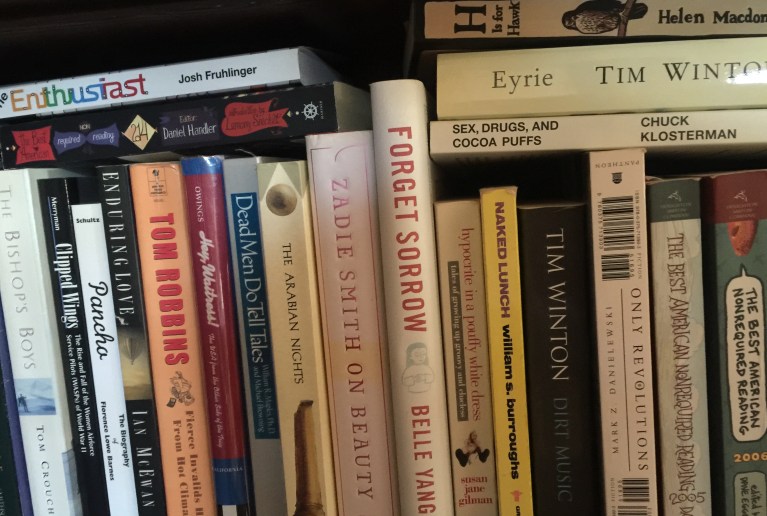
“America’s early aerospace engineers ignored computers because they considered programming to be women’s work.”
Can the liberal arts save the sciences?
What happens when a husband and wife take the exact same job. Continue reading

Things the world’s most and least privileged people say. Including “I don’t vote — the system is too corrupt!”
A comprehensive and entrancing visualization of wind, weather and ocean conditions around the world. A data-rich lava lamp.
NIH gave an endowment to San Diego State University. Not a grant or a contract, but an endowment. This is a thing?
How to build a society of equally involved parents Continue reading
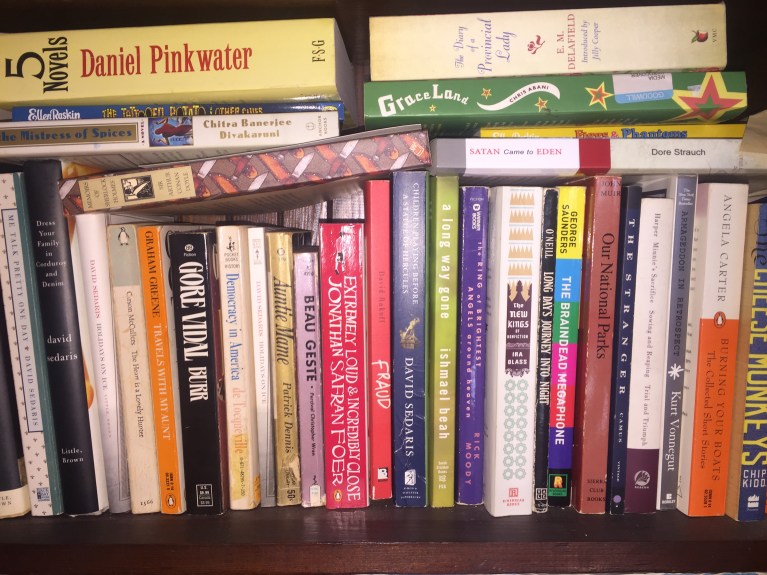
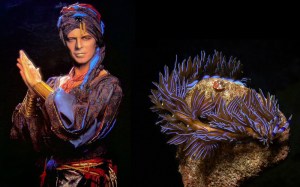 Who wore it better? David Bowie or nudibranch? This is fabulous, in the classic sense of the word.
This is a compelling read about the most accomplished woman climber of Everest. And the compelling part isn’t so much about Everest.
Pros and cons of teaching in an active learning classroom.
The tighter the money, the less innovative the science. This is a convincing argument. Continue reading
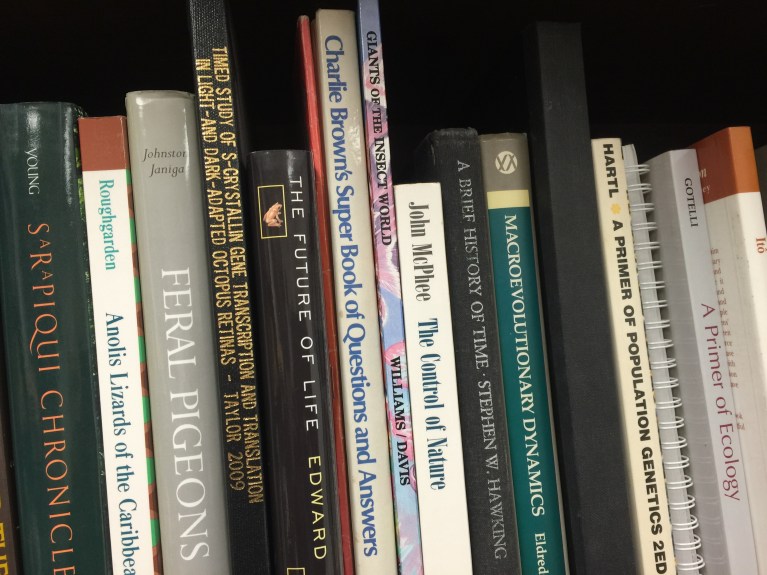
“Natural history: an approach whose time as come, passed, and needs to be resurrected.”
A reconsideration of “new conservation.” Also, if you’re not familiar, this has an explanation of what “new conservation” is. Man, conservation biology is an ideological and theoretical and practical mess. Holy crap. I’m not a fan of Mongabay for a variety of reasons, but this seems worthwhile.
This has really made the rounds because it’s fascinating, if not a surprise: Continue reading
Cards against humanities. You read that right, not humanity, Humanities.
This Puliter Prize-winning story by Kathryn Schulz about The Really Big One that will arrive in the Pacific Northwest. The letter for its entry into the Pulitzer competition said, “Schulz’s piece brings the seismological science to you, making it as plain and painless as a cake recipe. Yet it also leaves you with a visceral sense of what a full-margin Cascadian earthquake could feel like–and what its human toll could be. No surprise that the story has at last focused public attention on the need for precautionary measures. As of this writing, the piece–many months after publication–remains perched high on our Web site’s Most Read list. ‘The Really Big One’ brilliantly demonstrates how feature writing–drawing upon reporting, research, and most of all, the well-judged potency of prose–can rock our world.” So, yeah, read this article.
College professors aren’t that creepy. (Notwithstanding recent revelations from UC Berkeley further down this list.) Obviously, clowns are creepy. Gotta disagree about taxidermists though.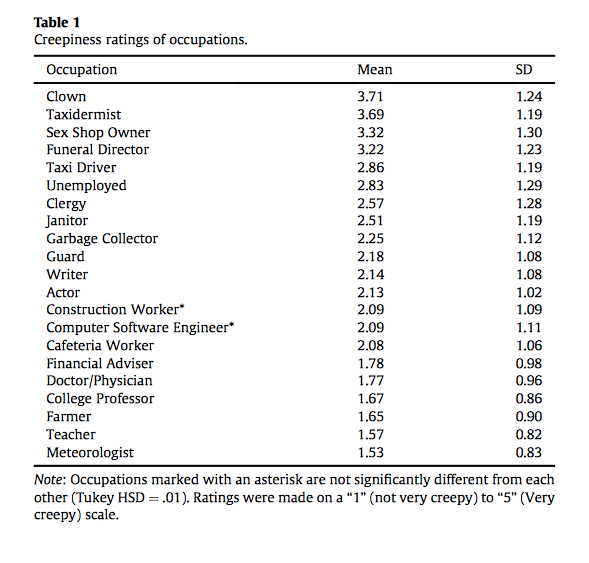
“Mistakes I’ve made as an early career researcher”
A recent story in the New York Times is explaining how it looks like that Chinese go at digging a canal across Nicaragua looks unlikely. Thank goodness, as this would’ve been an environmental tragedy.
Chic in Academia: Assembling affordable outfits for professional women Continue reading
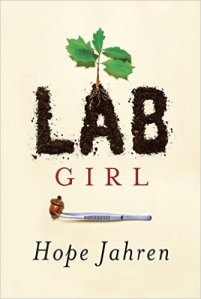 Have you ordered a copy of Hope Jahren’s Lab Girl yet?
Here’s my review on Goodreads. A more professional review comes from the head of book reviews at the New York Times, who raved about it. And this is not a woman who raves about books. She says: Lab Girl “does for botany what Oliver Sacks’s essays did for neurology, what Stephen Jay Gould’s writings did for paleontology.” Continue reading
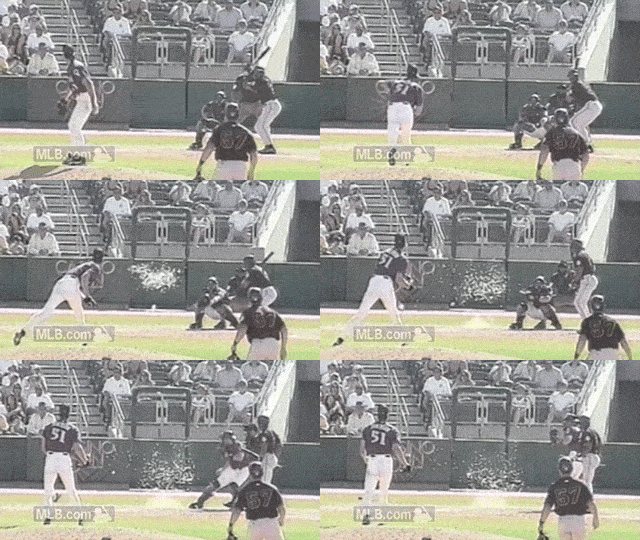
Can you believe it’s been fifteen years since Randy Johnson vaporized a mourning dove with a 100 mph fastball? Here are some ornithologists looking back on this unfortunate chance encounter.
This student adds a woman in science to Wikipedia every time she’s harassed online. This keeps her busy.
Time management is the key to happiness: “Organization saves time mostly because it averts crises.” I think this is not an overstatement.
A grading rubric for job talks at small liberal arts colleges. This meshes with my experience pretty well. Continue reading
 Kapow! Ecology. A weekly comic strip featuring ecological research, by Luke O’Loughlin.
“To reduce sexual harassment in scientific training, scientists should embrace the norm that trainers not date trainees.”
Did predation spark the Cambrian explosion? Continue reading
In 1951, The Explorers Club in Manhattan had a big fancy dinner, with a main course of mammoth, which was found frozen in Alaska. Some claimed it might have been giant ground sloth. Well, some of that meat was saved in a museum, and was just sequenced, so we found out which one it was. It turns out it was neither an extinct mammoth nor an extinct ground sloth. But it was an endangered species.
I’ve found the toy I want to print for myself with a 3D printer.
Nalini Nadkarni reflects on surviving a fifty foot fall from the forest canopy. Continue reading
A lecture from the lectured. This is a superb piece from students responding to that op-ed piece in the New York Times, which said that lecturing is all that and a bag of chips, whereas active learning stinks like poo.
Why your students forgot everything on your powerpoint slides.
Ten easy ways you can support diversity in academia.
An astrophysicist at Caltech, who sexually harassed his own students, was put on unpaid leave with additional major consequences. The story about what he did is flabbergasting. He fired his own student because he fell in love with her:
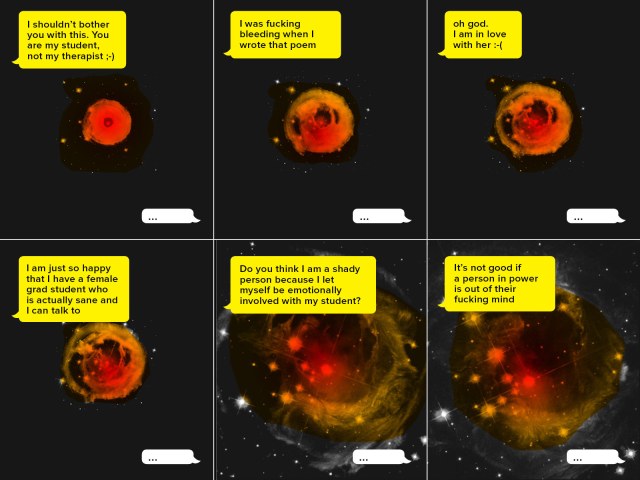
These are texts from the sexual harasser to his graduate student; the image is from the linked Buzzfeed article.
What does the Paris Agreement mean? After a a few decades of knowing about the greenhouse effect as a real and serious thing, we as a species we are now finally trying to do something about it. Here are the three things I want to share about the Agreement:
A blog post by an economist with a detailed-enough take on the actual substance of the Paris Agreement, a little deeper than what you’d get in the newspaper.
How did the Paris agreement happen? This is a story about the French Foreign Minister and his masterful approach to negotiation.
Brenda the Civil Disobedience Penguin explains the Paris climate agreement: “The interesting thing is not so much what is in this agreement but the fact that they made it at all. It is the first time the voice of the climate movement has outweighed that of the fossil fuel lobby. And the free market is finally following the money.”
Meg Urry published an important commentary in Nature:
Every major criterion on which scientists are evaluated, for hiring, promotion, talk invitations or prizes, has been shown to be biased in favour of (white) men. These include authorship credit, paper citations, funding, recruitment, mentoring and tenure.

Short answers to hard questions about climate change. This is the best short summary of the state of our knowledge that I think I’ve read lately. Definitely built for sharing.
A conversation about writing, between Osita Nwanevu and Ta-Nehisi Coates.
A conversation about space and science between Chris Hadfield and Randall Munroe.
A conversation about climate change between Bill Clinton and Neil deGrasse Tyson. This is good stuff. Continue reading
Teaching grownups how to eat. How to acquire an actual taste for healthful food after you become an adult.
The AAUW reports that 91% of campuses reported zero incidents of rape in 2014. That’s a problem. Because that number is obviously wrong, so underreporting needs to be addressed. Continue reading
If you haven’t been watching the news lately, you might not have noticed that the United States is in the midst of a national moment in which university students are speaking and acting out in response to the perennial marginalization of minorities. I imagine more things will emerge, but here is the rundown from a few campuses:
At Mizzou, years of administrative disregard for an environment that minimizes and threatens black students came to a boil with a particularly hateful action that was met with the same do-nothing attitude by the President and the Chancellor. The football team went on strike, and then, in a jiffy, the President and Chancellor stepped down. Since then, protests have grown. Here’s a clear take on the strike at Mizzou this from Dave Zirin, who writes about the intersection of sports and politics. (also, HK and I talk about the Mizzou situation at length in the Not Just Scientists episode coming out this weekend) Continue reading
The New York Times published a stunning piece about what is happening to the Greenland ice sheet. It’s an extraordinary piece of journalism and a really important read. Especially if you live somewhere that’s not too far above sea level.
How to Not Drop Out of Grad School. Like everything else I’ve read in Mary Anning’s Revenge, this is great. It’s about how to take care of yourself, and be a happy and balanced person. Working long hours consistently doesn’t make you more productive.
The Odds That a Panel Would ‘Randomly’ Be All Men Are Astronomical
The Frontiers series of journals is now on Beall’s list as a possible predatory series of journals. Here’s a long take on the how/why/what of this move. Beall’s List of predatory publishers — created and run by a rogue librarian — is a useful service for academia, but I am reluctant to even mention, much less endorse, the List because it’s clear that Beall really doesn’t understand the distinction between predatory publishing and open access publishing. Or, if he does understand the distinction, he is deliberately conflating the two because of his social and political views on the value of the for-profit scientific publishing industry. It’s a hot mess and I hope that someone — Retraction Watch maybe? — can step in to keep tabs on predatory publishers instead of leaving these judgments to a source as specious as Beall.
Tools for Change in STEM identifies the two biggest things that need fixing to increase the representation of women.
Daylight Savings is a dumb idea, I say. Why do we still have it? One reason is that Big Candy sells more candy at Halloween.
The new head of the University of North Carolina system is bad, bad news for higher education: “For those of us who think that universities exist for academic purposes — to teach academic knowledge and skills, to pass on academic virtues, and to sustain academic research — the stakes could not be higher.”
Empirically Testing a Three-Step Intervention to Increase Faculty Gender Diversity in STEM. If your department is hiring and you don’t have the gender ratio you should have, then this looks like a very useful guide to make the change we need. Seriously. If you’re on a search committee, print this out and give it to everybody else. Why? “Searches in the intervention were 6.3 times more likely to make an offer to a woman candidate, and women who were made an offer were 5.8 times more likely to accept the offer from an intervention search.”
A nice explainer why we need diversity in science published in The Hill. So some congressional staffers are now more enlightened. (By the way, why it is that they are “staffers” and not “staff?”) Also, the ideas in here are good for boilerplate for your broader effects section. But if you’re like 89% of people, then your broader impacts aren’t targeting underrepresented groups.
The so-called Freshman 15 might be because of bad sleep patterns.
“Many reviewers reject papers for pseudoreplication, and this occurs more often if they haven’t experienced the issue themselves. The concept of pseudoreplication is being applied too dogmatically and often leads to rejection during review.” Really? I’m not inclined to buy this idea. (First of all, reviewers don’t reject papers, editors do! It might sound like a mere semantic difference but does show a lack of appreciation for how the editorial process works, which is the focus of the article.) How often do papers get seriously dinged because the experimental system isn’t amenable to highly replicated units? In my experience — as reviewer, editor, and author — reviewers are understanding of the notion that some kinds of systems can’t be perfectly replicated, because they are taking place in someone else’s plantations or in streams, or habitat fragments that are scarce or difficult to access. Really, this is keeping good science from getting published? Hmmm.
“’You can’t infer process from pattern’ is just one of those things people like to say because they think it makes them sound rigorous and clever. It’s a slogan. Politicians like to bandy these about, and sometimes, we scientists do too. Real rigour and cleverness don’t lie in slogans; they lie in careful thought that recognizes the complexity of nature.”
Six myths about a teaching persona. This is a really good list if you’re wondering what kind of persona that you should be adopting with your students.
Do you know anybody who complains that the approach to math in common core is dumb? Here’s a straightforward explainer why the “new math” in Common Core is way better, and how Americans have been learning math as kids makes no sense and deprives the chance to develop number sense. (If you’re not familiar with Common Core, it’s a new set of standards for K-12 education in the United States, that emphasizes problem-solving and integrative thinking, and definitely an improvement over what we’ve been doing. It’s not a panacea but it does provide teachers more latitude to teach effectively as these are less prescriptive standards and emphasize critical thinking and problem-solving. You might hear trash talk about Common Core standards, but rarely from those who are in charge of teaching it. Implementation varies, of course.)
George Saunders on his development as a writer. (And if you haven’t read anything else by Saunders, it’s amazing stuff, put it on your list. I’d say start with The Braindead Megaphone. And Saunders’s commencement speech is up there with David Foster Wallace’s commencement speech.)
Monkeys compensate for small gonads by being more loud and annoying. (Here is the press release.)
How Back To The Future‘s vision of the future was off. We don’t have that middle class that Marty and his kids were living in. The neighborhood-of-the-non-horrible-future was filmed pretty close to where I live, and this article in the LA Times really resonated with me.
The New York Times published a hideous op-ed that criticized a strawman version of active learning in higher education. It had a fair amount of the get-off-my-lawn-kids-need-to-sit-down-and-listen BS. She only addressed the educational needs of marginalized students in one line, and then in the subsequent line dismissed those concerns as inconsequential. Josh Eyler was up to the task of debunking the false claims in this op-ed. What to think about whether or not to lecture or do active learning? I think we should listen to The Little Professor on this matter.
Why white parents don’t choose black schools.
Dinosaurs teach kids certain things about the monsters they will encounter: that scary things look scary, that scary things are dead, and also that scary things are exciting and anthropomorphic. Dinosaur fights suggest a singular, definitive battle, like a dragon, something you see coming from a mile away, ready yourself for, slay, and move on from. When, of course, real problems are the opposite: boring, small, creeping, not singular but sprawling. And: extant. A grown-up problem is nothing if not alive.
Why is academic writing hideous? “Academics play an elitist game with their words: They want to exclude interlopers.”
Have a great Halloween weekend, y’all.
Poster session drinking game for the Society for Vertebrate Paleontology meeting.
Machines get broken. Human social systems don’t “break.” Academics should get back to discussing our systems and conventions in a more sophisticated manner.
The hardest part of academia? Moving.
Wow, Lou Reed was horrible.
Whereas Tom Petty wasn’t horrible, (and picked up a heroin addiction when he was 50, which he kicked.) This is an interesting interview. Almost as interesting as Chrissie Hynde’s interview on NPR, which needs to be listened to rather than read.
California signed into law a ban on the use of the R-word for school mascots. There were four schools still using it, and they are (sadly) clueless about why it’s racist. It’s stunning how they just don’t get it. Anyway, this article about the how these schools are taking the loss of their mascot is informative and a bit tragic, but worth reading if only because the last two paragraphs are just so painfully ironic, in a “I can’t believe this isn’t The Onion” kind of way.
A protocol for data exploration to avoid common statistical problems‘.
What it’s like to earn a living as a professional subject in clinical trials. This is not a good thing for medical research.
Did you see that story going around, about how an evil scientist saw a rare bird for the first time and then killed it? It took off without any context, and it was implied that this was a rare or endangered species, which is not the fact at all. It’s locally common, just in a really remote corner of the Pacific, and it just hadn’t made its way into a collection, which is really important. Here is an explanation from the person who did the fieldwork, which is a remarkably even-keeled, genuine, and nonjudgmental response to the trashy story you might have had to see on facebook.
Gotta love having an intellectual President. Barack Obama interviews Marilynne Robinson for the New York Review of Books. Just because he can.
Still anonymous, from the exceptional Women in Astronomy blog.
On serial sexual harassment: The Long Con
(By the way, if you’re inclined to hear more from me and HK Choi about the Geoff Marcy situation and his long history of harassment at UC Berkeley, it’s the bulk of the next Not Just Scientists episode that will that launch on Monday.)
A museum from the hometown of William Carlos Williams hosts a reception for all of the people that he delivered throughout his career as a pediatrician. You know, in his spare time when he wasn’t writing poetry. Love this.
Huh. The director of NSF has a blog that gets updated quite frequently.
It looks like there was at least one major omission in the Nobel Prize for DNA repair.
Speaking of which, The Folly of Big Science Awards.
Here is a story about a scientist serving as an observer on a fishing vessel who disappeared under suspicious circumstances.
These are hands-down the best lab manual/exercises for invertebrate zoology. At least, that I’m aware of.
The need for more professors of color: No matter what an institution does or how committed it is, the goal of developing an inclusive and equitable environment for students requires a diverse faculty.
While we’re on the topic: Being marked for speaking truth to power.
From the files of “No shit, Sherlock”: Publish or perish may discourage innovate research, a study suggests.
Is Snoopy a narcissist that destroyed Peanuts halfway into its 50-year run?
Should we do blind analysis, to reduce bias?
Dan Janzen is interviewed in La Nacion, the paper of record in Costa Rica, about the waning passion for conservation in Costa Rica. These stories you hear about enlightened conservation ethic in Costa Rica? Those might be relictual. (Note, the article is in Spanish.)
How to recommend reviewers when you submit a paper? This is more insightful than you might think, about the set of people you might suggest: “Give a list of people who aren’t the obvious “usual suspects” in the broad field. In terms of seniority, focus on mid-career (e.g. Associate Prof. level in the U.S. rank scale is often ideal); junior faculty or even postdocs can also be great if they’ve done interesting and insightful work in your area. Often younger researchers do the best reviews, and the ideal is someone who’s had enough experience to develop vision and perspective, but who still has the time in their life to commit to doing a thoughtful review. The perfect name is one to which my response will be ‘Ah ha, of course! I hadn’t thought of her, but she’d be great.’ Give me three of those, and I will be grateful and impressed. Never a bad way for the editor to feel when he’s beginning the process of determining your paper’s fate.”
Seeds that act like dung to get moved around by dung beetles.
This is an outrage: when women are hired into biomedical research positions, they get just a small fraction of the startup costs that men get. What the hell.
And probably not a surprise to those in the know: Harvard has trouble keeping women on the faculty: (who they call “female faculty.” Like the Ferengi. “The report details a trend in the departure of female faculty members before they stand for full-time tenure review. Last academic year, only 66 percent of women up for the final tenure review—which determines whether or not junior faculty members will be promoted to full-time, tenured professors—actually stayed at Harvard through that review, compared to 78 percent of men, a difference the report calls ‘troubling. In interviews with tenure-track women who were leaving Harvard, administrators found a “striking” reason that they left was an uncomfortable culture in their respective departments, according to the report.” (emphasis mine)
If you saw this story, you could totally predict I would be linking to it: Prison inmates beat a Harvard debate team. Yes, in a debate.
I’m not posting those two previous ones in a row to pick on Harvard at all. I just thought I’d put my two Harvard links next to one another. For reals.
The NSF Division of Environmental Biology blog dispels some myths. One biggie, they say, is that the only difference between the PI and the Co-PI, in their eyes, is who does the paperwork. Huh. Do panelists and reviewers know this?
Why schools should exclusively use free software. (This has a little too much ethical absolutism, and clearly doesn’t choose to look through the eyeglasses of others, but anyway, here you go.)
Some sexist tropes in The Martian (book). I heard the book is amazing, and heard the book is horrible. Clearly a bimodal distribution of responses. I haven’t heard anybody claim it’s fine literature, though. A ripping science yarn, sure.
Why ancient Rome matters to the modern world.
Insect taxonomists have some bunched up undergarments over the description of a species without a voucher. This is not unprecedented, but nonetheless isn’t a good precedent to repeat.
Do you know who discovered that VW was cheating on its emissions? Researchers at West Virginia University, who were working on a $50K grant. In addition to the previous link from the Atlantic, here’s the shorter NPR story.
‘This Goes All the Way to the Queen‘: The Puzzle Book that Drove England to Madness
Does your field station have a guide for responding to sexual harassment and sexual violence? Here’s one from Kathleen Treseder that will be in use with UC Irvine facilities. And UC Irvine has an Equity in Fieldwork initiative.
Now we have video footage of the squirrel that officially (?) has the world’s fluffiest tail. And rumor has it that it is a predator of deer. In all seriousness.
Ta-Nehisi Coates was picked for an extraordinarily well-deserved MacArthur Fellowship. Here is a hilarious interview with him about how he is a certified “genius.”
Lower test scores for students who use computers often in school, 31-country study finds.
Gangolf Jobb wrote Treefinder, software that you use to build evolutionary trees using data from genetic sequencing. Americans are forbidden from using his software because of imperalism. And most western and northern European nations are forbidden because of their immigration policies. In addition to the software manual, the Treefinder site has some primo xenophobic ranting that can’t found on any other phylogenetic software website, at least not that I’m aware of. Yikes.
Jerry Coyne, evolutionary biologist, atheist activist, and blogger, officially announced his promotion to Professor Emeritus. He reflects at length on his career, the state of science today, and his plans for retirement. One tidbit in there that raised my eyebrows is that he was able to renew his grant from the NIH for thirty years of consecutive funding. Another other thing that piqued my interest is that over the course of those thirty years of funding, he had four graduate students. His two big pieces of advice for junior scientists? Work hard, and don’t engage in “gratuitous co-authorship” on the papers produced by members of your lab. I guess with his extensive record of mentoring so many students over the length of his career, he’s earned the right to give that advice.
On an entirely unrelated note, check out this very brief youtube that shows the change in the age structure of NIH grantees between 1980 and 2010:
Nine Ways to Improve Class Discussions
It sounds insane that the US and China might go to war. But in the history of civiliations, a shift of power as big as this one has almost always been associated with war. Are conditions any different now or are we destined to fall into “Thucydides’s Trap?” This is a really interesting read.
The grass may look greener: a post by David Baltrus about being a microbiologist in a research institution that doesn’t have a microbiology program to house the many microbiologists at the university. He’s dealing with intellectual isolation issues that those of us in teaching-focused institutions deal with, and it has good insights. (My university just hired a microbiologist. So now, we have one microbiologist in the whole university. I bet she can relate to this.) My experience has been that if a colleague is in a different building, or a different floor of the same building, they might as well be across town or on a different continent.
What one college discovered when it stopped accepting SAT/ACT scores
Four behaviors I had to overcome to move forward in my career. Robert Talbert explains that his teaching went through a progression of phases, each improving his teaching. The post in which he explains these professional transitions is pure gold. I think a lot of the ideas in there crystallize the central message about respect for students that underpins the ideas about teaching on this site:
- Moving from unprofessionalism to being a professional.
- Moving from the reflex of assigning blame to the process of solving problems.
- Moving from having it be about me and my personality, to having it be about students’ lives.
- Moving from thinking of students as objects to students as human beings.
Math with Bad Drawings: What does probability mean in your profession?
The “doomsday” seed vault in Svalbard has been opened for use, because of the crisis in Syria.
Amid budget fight, Illinois State Museum prepares to close. This is tragically shortsighted.
The shockingly racist campus salute for USC’s student body president
“Don’t tell me what’s best for my students,” finally a take about trigger warnings with adequate nuance that seems to pretty much reflect what I think, for what it’s worth.
I was chatting with some people the other day who hadn’t heard of the term “microaggressions.” If you have been inclined to dismiss this term, or the ideas associated with it, this explainer might just change your mind, I hope.
“Remembering the Vela Incident” – did you know about the nuclear test in the south Indian ocean, from a joint Israel-South Africa venture — or was it something else? An interesting mystery that persists.
Three universal New Yorker cartoon captions that work with every New Yorker cartoon.
Philip Morris knew that smoking caused cancer and COPD back in the 1950s. And Exxon precisely knew how their product was causing climate change long, long before Al Gore started to write Earth in the Balance and before anybody else was talking about climate change.
If you can handle the p-word, this is a really informative interpretation of the extreme wealth that pervades the administration of elite universities and what that means for us and our students.
“Why I don’t recommend the Pomodoro technique” Endorsed.
How to Dress in Academia and Not Feel Like You’re Dead Inside.
How can p = 0.05 lead to wrong conclusions 30% of the time with a 5% Type 1 error rate? – this is a rebuttal to a paper that I linked to in recent months. Good stuff.
This Trump situation is depressing. Or is it? “Donald Trump Is Saving Our Democracy”
Choosing the Best Approach for Small Group Work
If I had to identify the best blog about academia, I wouldn’t pause before saying it is Tenure, She Wrote. The recent story about Title IX, which I would classify as a must-read if I thought it’s my business to actually tell you what to read, is just one of the many amazing things that come from the folks who run that shop.
If you’re an ecologist who hasn’t been pointed to the blog of Manu Sanders, I’m rectifying that situation. Here’s a recent post about art history, in a series about the importance of humanities in science.
The Heartbreak of Watching Richard Dawkins Implode
Putting kids into college: Here’s a story about a family that hired a college admissions advisor.
First things first: I’d like to share that I just launched a new podcast series, Not Just Scientists. It’s not associated with this site at all, though we might occasionally discuss a topic I link to here. I’m doing this with HK Choi, a buddy in my department. I’m pretty excited about it. It’s a conversation between HK and myself about things happening in science, and in not-science, and we have plans to interview guests who are doing interesting stuff. New episodes will launch every two weeks – the first one is up. It involves the discovery of Homo naledi, the biology and biogeography of lice, what you say at parties when people ask what you do for a living, and more. It’s not a high-production affair (like, say, Radiolab), but we’re in this for the long haul and we will be getting even better as we continue. Feel free to join us at the start, and if you like it, please spread word.
Bringing back a forest. How we are bringing the American Chestnut back after Chestnut Blight did them in. This is beautifully written and goes into great detail. Here’s hoping that we’ll see recoveries of the American Elm and the American Ash. Or maybe we should stop giving trees the common name “American [tree].” and that won’t tempt invasive pathogens into taking them away from us.
Teaching is not exactly brain surgery, is it?
A professor at Memorial University of Newfoundland is refusing to wear a transmitter to help one of her hearing-impaired students. Her reason? Religion. She apparently made a deal with the university twenty years earlier so that she could be exempted from using these devices.
Just a heads up, if you report academic misconduct of your collaborators on federally funded research, you may not qualify for federal protection as a whistleblower, and retaliation at work can come swift and hard without recompense.
Fathers who serve as the “primary parent.”
The five second rule is bunk. In microbiological terms, it’s much better to eat food off of a carpet than a wood floor or tile.
“Audubon painted a bunch of birds that no one has seen since. We explore the most likely options behind the mystery birds.”
“The HMS Erebus and a sister ship left England in 1845 to find the Northwest Passage. They were never seen again — until a team of Canadian searchers discovered the wreckage in the Arctic last year. What followed was a dispute over the facts of, and credit for, the historic find.”
Did I mention that Not Just Scientists is free on the iTunes store?
Is teaching an art or science? For that matter, what about the practice of medicine nowadays?
HK Choi, my podcast pal, writes in his blog about the History of Molecular Biology:
Few would argue the position that The Double Helix holds in the history of [molecular biology]. Its influence cannot be overstated. Every biologist, chemist and physicist I have ever met – and many others besides – has read the it (it doesn’t hurt that it is a short, breezy read). Entire books have been written to defend those it besmirches. Scientific lives and careers have been colored by its often unfair and grotesque characterizations. The history of molecular biology – or should I say more accurately, the manner in which molecular biologists view the history of their own field, has been framed by its narrative – the thesis that the elucidation of the physical structure of DNA formed the culminating, climactic moment of a nascent science – Griffith, Avery, Chargaff mere preamble; Hershey and Chase, Meselson and Stahl the supporting evidence; recombinant DNA, the Human Genome Project, biomedicine in general and the history of humankind the consequence. Watson’s book is testament to the power of narrative. The relentlessness of story gobbles everything in its path; and protestations and contrary evidence and mitigating circumstances become mere handwaving, as ineffectual as it is pathetic. Some have argued that the book is as great an accomplishment as the discovery itself.
Just in case you want to learn about the Campaign Against Sex Robots. Really.
This is just brilliance from McSweeney’s: An Interactive Guide to Ambiguous Grammar.
Did you hear, I started a podcast! A PODCAST! Not Just Scientists.
A drum that’s worth beating continuously: There is no excuse for how universities treat adjuncts.
From Talking Heads to Talking Students: Driving the paradigm shift in science education. If you can overlook the use of the phrase “paradigm shift” then this can be useful.
How to be a URM grad student. It’s written for physics/astro, but works far more broadly, and goes far beyond the boilerplate stuff that you tend to see on the topic. It’s written by
Chanda Prescod-Weinstein, who is also worth a follow on twitter.
Rethinking the University Classroom: Ban the podium-style lecture, not the laptop.
My long journey to student-centered learning.
Time versus debt: why these students chose community college.
From R1 to CC: 3 Things I Wish I Had Known About Community College Careers
Exploring the advantages of rubrics. Why is it that some people just reflexively hear ‘rubric’ and think that they’re bad or dumb or not constructive or a waste of time? All of the arguments that I hear against them are never student-centered. Okay, fine, let’s say a rubric doesn’t help you grade better or more fairly. (I find that hard to be believe, and the research says it’s not true, but okay, fine, I’l accede that point.) What a rubric does more than anything else is help students write better. It gives students a very clear indication of the things that matter to you. Do you want your students to write more clearly, makes sure that they use topic sentences, don’t have typos, follow length guidelines, make clear logical arguments, have enough background research, cite material appropriately? Do you want students to think originally? Is there something else you want from your students? If so, then put it in the rubric and then they’ll do it because their grade depends on it. (For context, what I wrote about rubrics earlier.)
“Let’s be more frank with colleagues and students: Being head of undergraduate studies was an eye-opener for Stephen Curry”
Here’s a non-paywalled article from the Chronicle: When it comes to startup for biomedical researchers, women get totally screwed over. If you ever wondered how negotiations can be gendered, here you go. Wow.
“The problem in American education is not dumb teachers. The problem is dumb teacher training.”
This is an entertaining light read, “How I used science to fight back and [defeat] my insurance company.”
On the moral qualities of teaching and pedagogical content knowledge. What’s the difference between the knowledge in your discipline, and “pedagogical content knowledge”? This is one piece of of edu-jargon that in my opinion is connected to a useful idea, and this is a good place to start. Pedagogical content knowledge is, in short and probably badly put, the information about teaching about a topic. Someone can be brilliant in (say) immunology, and be highly versed in teaching, but still know bupkis about how to teach immunology.
“A teacher gets inside the mind of a serial cheater—and is dismayed by what she learns.” I’ve said this before, I’ll keep saying it, and people keep denying it even thought the science is very clear. Cheating is rampant, even in our own classes. Cheating is the norm. That’s a fact we have to own.
From the desk of an intolerant nincompoop: “All scientists should be militant atheists.” Actually, despite the odious title, the contents of the piece aren’t so bad, basically arguing that scientists need to argue for the use of evidence with respect to everything. I guess this guy can’t accept the fact that people aren’t inherently rational.
“Economic diversity is within the power of any top university. The question is whether the university’s leaders decide it’s a priority.” This is in the context of what reads like PR piece for the University of California system in the New York Times. These campuses half the fraction of first-generation college students at the California State University, and they cost more than twice as much. But they rate higher in ‘college access’ rankings because their graduation rates are a lot higher. Most of the students in the CSUs don’t even have UCs on their radar because they didn’t have access to a high school that would prepare them to get in, or they can’t come close to affording it – the CSU is still too expensive for most of our students. The UCs definitely are an engine lifting up incomes, but it’s not so much serving the people in poverty as the people in families struggling above the edge of poverty, in a state that is expensive to live in. For context, I almost went to a UC myself 26 years ago, but it was too expensive for my (lower middle class) family and the need-based financial aid from a private small liberal arts college was cheaper and required us to borrow less money. Let’s be clear — the UCs are not for California’s low income students — but they still do play a role in class mobility.
More numbers about which colleges enroll first-generation students. Who looks good in this? Me! Well, my university, which is second-highest among public universities in the nation. The top five in that category are all Cal State universities.
Is it time to tax the endowments of extraordinarily rich universities? This article starts with the quip that Harvard is a Hedge Fund with a university as a tax shelter. By the time you’re done reading this, you might well agree.
The Atlantic has always been a solid outfit, I mean always because they’ve been around for so long. And now they’re doing science right. Read this and tell me you’re not inspired to love the vision.
Creativity, play, and science.
…and even more from Stephen Heard, about why he’d rather teach non-majors.
The lab decalogue. (If you’re unfamiliar with western religion, that’s the ten commandments. But there actually are eleven here.)
Walter White apparently made the ugly Pontiac Aztek cool again. I mean for the first time.
How do you handle sharing and educating about environmental change when conditions are often so devastating?
This is hilarious. An Australian rugby player covers an American football game.
This is the most epic humblebrag about being 4.0 student.
The cost of private colleges isn’t skyrocketing. It’s just that the sticker price is getting inflated, and then you get a discount from the dealer. I suppose this is one way that income inequality is playing out in a less-than-horrible way, that obscenely wealthy people are subsidizing people who need discounts. But come talk to me in five years as my kid is preparing to go to college. (I can’t even begin to get my head around that idea about that idea now.)
Elizabeth Kolbert explains what it will look like if we burn all of the world’s fossil fuels.
Does the Anthropocene have to be a fatal vision?
“We aim to counterbalance current dystopic visions of the future that may be inhibiting our ability to move towards a positive future for the Earth and humanity. We will do this by soliciting, exploring, and developing a suite of alternative, plausible “Good Anthropocenes” – positive visions of futures that are socially and ecologically desirable, just, and sustainable. We expect that any “Good Anthropocene” that emerges will be radically different from the world as people know it today. Yet we also know that these futures will be composed of many elements already in existence, which we call “seeds’, which could combine in unique and surprising ways to create an almost unimaginable future.
More than two centuries ago, Humboldt surveyed the vegetation on Chimborazo, a huge volcano is what is now called Ecuador. These folks went back and redid Humboldt’s survey and wrote about it in PNAS. And surprise, things are shifting upslope. It’s a very cool study.
Speaking of Humboldt, I just picked up a copy of Andrea Wulf’s brand new book, “The Invention of Nature: Alexander von Humboldt’s New World.” If you’re not familiar with Humboldt, he was a naturalist who travelled the world, back when it wasn’t so easy to do that kind of thing, and his work is at the foundation of so much that happened since his time. Foundational to what people often think of as the foundations for the study of nature. I can’t quite recommend the book yet, as I haven’t read it, but I’m excited to get to it. But I’m mentioning it now because I have a feeling I won’t get to it until the holidays roll around.
There are fewer black men heading to med school in the US now than there were 40 years ago. Not just a smaller percentage, a smaller absolute number.
Noam Ross just successfully defended his PhD thesis at UC Davis. And his exit talk had a gorgeous flyer:
http://twitter.com/noamross/status/641655871907368960
“Donald Trump is the new face of white supremacy,” says hate crime expert. “Before you think this article is ‘just one liberal’s opinion,’ let me briefly say I have dedicated my life to studying racism.” It’s a more worthwhile read than you normally would think. I almost didn’t click through when I saw this and I’m glad I did. It’s really educational. Considering I’m white and all, I realize I didn’t know much about how the white supremacy movement works in the US.
There was an interesting article in the Chronicle of Higher Education about how the University of Georgia is throwing down millions of dollars to hire adjuncts in order to dramatically lower class sizes. But I’m not linking to it because it has a paywall. Yeah, I’ll link to some paywalled things, but not from the Chronicle. So there.
“It’s often said, for example, that contingent faculty are less valued because they are teachers rather than researchers and the academy privileges research. This is not true. The academy values neither teaching nor research when it is produced by the lower caste, and both (though to varying degrees) when it is produced by the higher caste. The teaching of all contingent faculty is often judged to be inferior simply because contingent faculty are contingent.”
The Hipster Bar Menu Generator. Actually it says Brooklyn bar but you get the idea.
Here’s an interesting “citizen science” project using people and their cell phones to measure air pollution. By the way, I put “citizen science” in quotes because I just think it’s not a good phrase. First, whether or not you’re a citizen shouldn’t be a barrier to joining this kind of project, if you have a green card or are on a visa or undocumented, you’re still wanted. In communities where “citizen science” projects are most needed is where this term is most likely to be marginalizing. What to use instead? I have no idea. The field of “informal education” has a similar problem. People just don’t know what it is. But what’s a better phrase to use? “Out of school time education?” Ugh, that’s worse.
I think the Smart Girls movement/organization by Amy Poehler is spectacular, especially celebrating that girls can be awesome by being themselves. But then there’s this video series that they’re sponsoring which is just, in one word, wrong. Katie McKissick, the artist behind Beatrice the Biologist, does a great job with the delicate matter of expressing reservations about this series. It’s interesting that some legitimate and otherwise not-subject-to-poor-judgement science educators have been involved. But I suppose work like this pays the bills. I’m not in a position in which I’ve been offered money to appear in a video series that glorifies drinking to preteen girls in the context of a science infotainment video, so I can’t say I’d do differently.
This visualization is worth five and half minutes:
If 12-year-olds Anissa Weier and Morgan Geyser knew that the internet character they worshipped was a fantasy, why did they want to kill their friend for him? Save this for the weekend, brew a hot beverage and curl up with this one.
How did Ashley Madison hide the fact that they were scamming would-be-cheating men with female robots? Actually, they were horrible at hiding it. And some guys sought legal remedies. But of course most would just pay and slink away.
Have a great weekend.
And, oh, if I haven’t mentioned it yet, I started a podcast.
The time I became a father in the same week my tenure portfolio was due, from Liberal Arts Ecologists.
You’re an insect curator. Cool! So what is it you do?!
Saving species experts from extinction
How should a professor be? 22 suggestions, including many great ones.
The NSF Division of Environmental Biology is typically in top blogging form. Lately, they’ve told us how how to write and what they want to see in annual and final reports. Since the reporting system recently shifted over from Fastlane to Research.gov, this is a good time to consider the what, how and why about what goes in there. (And I’ll be making some offering to the Lab Goddess in the hopes that this will still be a problem of mine a few years from now.)
Weeks ago, NSF announced that they have scaled back the scope of NEON, the ambitious National Ecological Observatory Network. They didn’t cut the funding allocation to NEON, but just discovered that there were bigger financial and logistical constraints than initially anticipated. What to think of this? Well, in short, I think budgets gonna budget. A more informative view about changes in NEON comes from 16 presidents of the Ecological Society of America, which was published yesterday.
Our obsession with metrics is corrupting science
Research metrics have made rivalry part of higher education’s DNA
I Am Biased and So Are You: thoughts on funding and influence in science
Sexism in science leads to willful blindness
Oh my gosh the first paragraph of this review of Franzen’s latest novel pins him down in a way I have primordially conceived but couldn’t really express:
Probably no one alive is a better novelist than Jonathan Franzen, and this is frustrating because his novels are awful, excellent but awful, books you read quickly and remember ponderously, books of exhaustive craft and yet a weird, spiraling cluelessness about the data they exhaustively collate. They analyze the wave frequency but don’t hear the sound. They are full of people who talk and act exactly as you imagine such people would talk and act in real life…
(And for the record, as a human being, Franzen is a verified putz.)
Here is an incredibly helpful post in Dynamic Ecology for new parents and parents-to be, about pumping at work. (Dads, this is for you too, as presumably you’re on bottle cleaning and management, and probably involved with Picov Andropov.)
If you’ve ever had the misfortune of going to or from Los Angeles through LAX, you probably noticed this historic airport was designed around the car, but not for contemporary quantities of cars. The design is particularly non-amenable to modernization. But here’s a big design that can help make LAX work more like a regular international airport.
Oliver Sacks has died. The New York Times obituary is a good one. One thing I learned, that surprised me a bit, is that he was a super-duper workaholic. Spent all his time thinking about work.
If you have any black students, or any students who are women, or any learning disabled students. Or anybody who isn’t a white male. Please do them, and yourself, a favor and read this explainer of stereotype threat if you don’t think you’re an expert on stereotype threat. It’s amazing how massively student performance can be affected merely by how assessments are perceived.
‘Love Becomes a Funeral Pyre’ review: The rise and fall of the Doors. Huh. I had no idea Jim Morrison was just a horrible person.
Using Active Learning to Teach Concepts and Methods in Quantitative Biology: “We describe some of the recent initiatives to develop hands-on activities in quantitative biology at both the graduate and the undergraduate levels. Throughout the article we provide resources for educators who wish to integrate active learning and technology into their classrooms.”
Teaching a class all about On the origin of species
The Case for Teaching Ignorance
10 Things This Instructor Loves
Taking My Parents to School — this is a wonderful read about the experience of first generation college students, and food for thought because odds are you’re teaching at least a few.
Is the tech sector in a bubble again? Hell yes, we are in a bubble.
On turning down the startup job:
The startup world, or at least the ones making the majority of the noise, have their heads up their own ass and don’t realize it stinks. They’re solving problems for the top 5% of the population. How can I get poor people to do my chores? How can I get people to drive me around without having to pay them health insurance? How can a drone deliver my toilet paper within 15 minutes while the person who fulfilled my order sits at her desk crying because she’s working a 15-hour day and can’t take time off to get that lump in her chest looked at. This is known as the service economy. Where entitled white boys figure out how to replicate their private school dorm experience for life.
“I Had a Baby and Cancer When I Worked at Amazon”
Next time someone asks me what it’s like being an Associate Editor, I’ll point to this post, which has the lowdown.
“An organic chemist I know tells her doctors that she is a professor of Southern literature whenever she is in the hospital.” Herein lies some interesting thoughts about the education of doctors.
This is not a surprise at all, the but data themselves are fascinating: That Ashley Madison site had no real women using the site. And they invented a bunch of women for men who paid more than a little money to fantasize that they could actually use this website to cheat on their spouses.
How understanding the prisoner’s dilemma can help bridge liberal and conservative differences. You know about that class that had an extra credit problem, in which students had to choose to Hawk or Dove for extra credit points? This is an interesting rationale.
Why is the US number one in mass shootings? The American Dream.
Japan is serious about getting rid of the humanities and social sciences.
How Common Core Can Help in the Battle of Skills vs. Knowledge
This 50-Cent Paper Microscope Could ‘Democratize Science’ – if you ignore the hyperbole, this is a mighty fascinating and inexpensive tool.
Here’s a consequential convergence of gay rights, sports, and intercultural understanding (or the lack thereof): It was only in 2013 that the US saw the first openly gay athlete playing in a major league team sport. The pioneer was Robbie Rogers, who starts at left back for the LA Galaxy (whose stadium happens to be on my university campus, which has its perks). That was a big signing for the team, but a more recent big signing has inadvertently introduced an ethnically charged anti-gay element into the fan base of the Galaxy. In perhaps the biggest leap ever in Major League Soccer, the Galaxy just brought on board the Mexican international star Giovani Dos Santos. Who seems to be a perfectly nice guy. This is a huge coup for the league, and also for the Galaxy which has caught the eye of many Mexican soccer fans in LA who up until now looked to the south and to Europe to follow the game. And they’re coming to the stadium to cheer on Gio and the Galaxy. But, there’s this thing that Mexican fans do when they’re at a soccer game. When the opposing keeper takes a goal kick, the crowd shouts “puto.” Which, no matter how you slice it, is an anti-gay slur. (I haven’t been to a game since Gio was signed, and now, well, I’m not so thrilled about the idea.) I’m sure a lot of the people who do this, don’t think consider it to be the horrible anti-gay insult that it is. The Galaxy doesn’t want to alienate the Mexican fans they just paid several million dollars to attract, but they also don’t want the league to take a step back after having made some substantial progress towards equity and inclusion — the work environment for gay and ethnic minority athletes in the US is much, much better than in Europe. It’s critical for the Galaxy and the league to shut the lid on this practice of hurling an anti-gay slur at the opposing team. How do you get fans to stop doing something they’ve been doing for so long, that some think is a part of their culture? In Europe, teams and their supporters have been punished for racial abuse by being forced to play future home games to an empty stadium. I hope Major League Soccer heads in this direction if a kinder, gentler educational approach doesn’t work.
Do you list job talks on your CV as invited talks? I used to, then pulled them, but it seems at least in biology that people tend to? Here’s the start of a discussion on the topic, click through to see the extended and interesting conversation that follows:
Last, a set of spectacular artwork featuring butterflies and moths gets published, after being hidden away more than a century.
Have a nice weekend, which is a 3-day weekend in the US. (So I’m not planning on posting on Monday.)
So many great things came my way this week, I’ve had to unload them a week early. Enjoy!
A survival handbook for teaching large classes. This is good stuff.
As a professor, here are five really simple things you can to do help single parents in your classes. Keep in mind you might have a single parent among your students but not be aware of it!
Maybe there is no such thing as renaissance person. Maybe these people are merely expert in an unrecognized speciality.
Simon Garnier explains how the big four in football made sports predictable. (For Americans and Aussies, he’s talking about soccer.) If you watch the EPL on occasion and enjoy statistics, this is a wonderful read.
Some months ago, a video about predatory ants carrying millipedes with daisy chains went viral. This inspired an investigation that has now gone through peer review, and the natural history story itself is mighty cool, and well worth watching and reading.
Five big ideas that don’t work in education. This is not gobbeldygook.
Speaking of certain kinds of ideas in education, Joan Strassmann is teaching statistics differently. In her class, understanding probability, distributions, and statistical concepts is getting passed over, so that students can jump right into knowing how to do analyses.
Oliver Sacks writes about the Day of Rest, as he sees his life coming to its last chapter.
The general secretary of the international Astronomical Union, and amateur butthead, chose to praise women by explaining that they have a special gift in being more caring and more dedicated educators.
That Netflix parental leave policy just got even worse. Not all Netflix workers will get unlimited parental leave.
Here’s your feel-good light happy human-interest story if you need one. A barber that gives kids free haircuts if the kids read to him.
Matt Might — who has a penchant for writing the best explainers ever — just wrote an inspiring “How to get tenure” piece. It’s most definitely worth reading (as are all of his articles on his site). He explains how he handled some tremendous challenges and stresses, and emerged all the better by focusing not on tenure, but instead on the transcendent things that really matter. (In that message, it bears resemblance to the story from a Harvard professor about how she got tenure by not worrying about it.) I am reluctant about recommending this as a piece of how-to-get-tenure advice because on that count, it’s an a posteriori explanation. If you’re trying to decide about what really matters in life, then in my opinion Dr. Might is spot on. If you’re trying to decide how to handle your life balance as a pre-tenure faculty member, then this could be good advice. But it wouldn’t be good advice about how to get tenure, per se. If you can’t be happy and well-adjusted in the six years before tenure, then you probably can’t do that afterwards either. Dr. Might didn’t get tenure because he didn’t worry about it, he got tenure because he performed exceptionally. That exceptional performance happened either because, or in spite of, his insistence on the right priorities. Choosing family as a top priority is necessary to be happy and healthy and well-adjusted, but it’s not a ‘how-to’ for tenure. I don’t think that Might is suggesting that his recipe for tenure is one for us to follow in order to get tenure. I think his message is that worrying about bad consequences can prevent us from focusing on doing what is most necessary and most constructive. He’s saying you can get tenure without driving yourself insane by following academic norms, and if you reject those norms you can still get tenure. On the other hand, rejecting those norms doesn’t necessarily get you tenure.
Since I mentioned that Harvard professor ‘treat your job like a postdoc’ advice piece from two years ago that everybody but me loved, I might as well re-share my misgivings that I wrote back when it came out.
It didn’t make the rounds as much, but just as enjoyable as Might’s “How I got tenure story” is this one from Holly Dunsworth, which might have more directly practical utility for those of you on the tenure track.
What’s in John’s Freezer? A visit to the bird collection in the LA Natural History Museum.
Since I know a variety of people at University of Illinois Urbana-Champaign, I’ve been hearing about the continued horribleness of their now-former chancellor, Phyllis Wise, who just stepped down (or wasn’t allowed to so she could get fired) because of a scandal emerging from the Salaita affair. That’s was the newly-hired professor who was fired before getting to campus because he said things on twitter about Isreal and Palestine that the Chancellor didn’t like. Anyway, Wise made a point of deliberately conducting university business on her private email because she knew what she was doing was wrong. Here’s a recent take on it, if you want the salacious details.
Fivethirtyeight (that’s Nate Silver’s shop, better known as the presidential election stats dude) has an explainer about p-hacking. It shows how you can come to essentially opposite conclusions using the same dataset if you look hard enough, and explains how people often come to erroneous conclusions because of the way they handle data and they way they think about their experiments. I’m planning on including it in my biostats course this semester.
The AAAS Vision and Change report for undergraduate biology education is out from a conference they held last year. I haven’t read it, it looks like a tome with more self-congratulatory content than constructive examples, but that’s just what I saw from a quick browse, so go ahead and make up your own mind.
This year’s Burning Man has a huge number of bugs. (Mirids, I hear.) And people are freaking out, but really there’s no reason to freak out.
You probably heard how Ashley Madison got hacked. Ashley Madison is a site that married people pay a not-small amount of money to, to find other married people so they can have sex with one another. Now a lot of people have access to all of the email addresses (and more) on their website. This will result in some interesting consequences, with victims well beyond the people whose names appear in the database. Here’s a rundown on what the consequences of this data breach will mean.
Biodiversity conservation: the key is to not eat meat. Just putting it out there. It’s hard to argue with the numbers.
Mike the Mad Biologists dons a tinfoil hat but, well, data are data. It is hard to argue with the numbers, and I didn’t scrutinize it myself but I am never willing to underestimate the depth of nefariousness in electoral politics in the US.
Here is a love letter to PLOS One – an overly optimistic summary of the perverse incentives in the academic publishing environment in science.
While we’re on perverse incentives, this piece in PNAS hits home:
When universities publically brag that we are “Xth in federal research spending,” it is akin to an airline proclaiming, “we use more gasoline than any other airline!” or “we spend more per year transporting our passengers!” Consider the appearance and potential consequences if other segments of the national budget advertised in the same way: “The Army outspent the Navy and National Guard combined in 2015!” These proclamations offer nothing about what the public received for its money. Although winning grants is an exciting and necessary benchmark for researchers, the public’s interest is the degree to which we advance science with this massive investment.
Writing a doctoral dissertation improvement grant for NSF? Here are some very useful pieces of information and tips, including actual reviews of successful and unfunded proposals.
This essay about how British universities pick students is a great companion to the thing that I wrote earlier about NSF graduate fellowships being a part of the inequity problem in science.
Why botany matters in college. When I have taught an intro course on the ‘evolution and diversity of life,’ I spent more time on the evolution of plants than the evolution of animals, despite being an animal person (and also, an animal myself). So much of what happens in this world is tied to understanding precisely how plants reproduce, and how it came to be that they capture oxygen from the air and convert it into tissue, and how the changes in the environment have driven the changes in the biology of plants. So many biologists really don’t get how the alternation of generations in plants happens, and what the various parts of plants are. Understanding this isn’t just knowing stuff about organisms, it’s about understanding how our soil and air is the way it is. How this Earth breathes.
About writing clearly in academia: “I start the class with an exercise. I take a random page from a prestigious scholarly journal and make them compute the average number of words in each topic sentence. Then I take a page from whatever Jill Lepore New Yorker article happens to be my favorite and have them do the same. The last time I did this, the average for the “prestigious” journal was 46 words (versus 15 for The New Yorker), a number so outrageous that, whatever goals the author had in mind, communication wasn’t one of them.”
Last, I wanted to provide a very short report after finishing Ta-Nehisi Coates’s Between the World and Me. It was a short read, but I still learned a lot from it. (I wrote earlier that it was “revelatory.” Then I read the quote on the back from Toni Morrison and found that she convergently used the term “revelatory.” So I’m a little proud of myself that I have at least I have that much in common with her.) There are two specific thoughts I want to share about this book. First, if you’re trying to get your mind around what it is to be a black man in the United States — or what it is like to raise a black son in these United States — then this book communicates that experience. Second, one thing I didn’t expect to find in this book, but was a major piece, was the transformative power of higher education. Coates’s life, and his view on the world, was changed by college. He is very frank and transparent about his own evolution. It’s amazing to see how professors and fellow students can change one another’s lives because of what a university is designed to be. I don’t think that is the point of his book, but as a person who works with college students all the time, it’s great to reflect on his story from that angle.
Okay, I said that was the last thing but it wasn’t. More on Coates: Here’s a great interview between him and Roxane Gay. She asked him about what it means to be an ally (as the term itself and how it is used can be not so helpful, as Alex Bond explains), and he summed up clearly why he’s not so jazzed about the ‘ally’ thing in a way that really put logical clarity to vague notions that I’ve been feeling. By saying that you’re an ally, that’s tacitly saying that it’s not your problem:
RG: How can allies best serve as allies? What is an ally? Are they needed?
TC: I don’t know. I think it’s probably terribly important to listen. It’s terribly important to try to become more knowledgeable. It’s important to not expect that acquiring of that knowledge — in this case of the force of racism in American history — to be a pleasant experience or to proceed along just lines. They certainly don’t proceed that way for black people. It’s going to be painful. Finally I think one has to even abandon the phrase “ally” and understand that you are not helping someone in a particular struggle; the fight is yours.
Have a great weekend.
If this piece of writing doesn’t move you, then you must be a very very heavy object: Oliver Sacks, the periodic table, and mortality.
Museum dioramas are inspirational, if not educational. And “endangered as the animals they contain.”
Beatrix Potter was a mycologist.
You really can be an academic parent and “have it all,” so long as that notion of all is realistic. This is a moving and inspirational post from Tenure, She Wrote.
And for men to have it all, let’s realize that all includes being a responsible parent? Dads need to bring more of home to work.
Isn’t it amazing that Netflix is giving its employees unlimited parental leave? Well, no. That “unlimited” leave reflects a unhealthy work-obsessed environment that is not good for families. It would be truly healthy if they actually gave employees a year or six months or some specific time, rather than “as much as you think you need” which is not so good. Here’s an insightful take from the inside.
And what’s the more hideous thing about the Netflix policy? Only their fancy-dandy white collar workers get parental leave. What about the regular working stiffs in the warehouses? Fuck them, said Netflix.
What really is a food web, anyway? You talk to different people and they have fundamentally different notions about what one is. (And you talk to K-12 teachers, who often have food webs featured heavily in the curriculum, you get something even different!) Here’s a review about the evolution of the idea of food web in ecology.
The Ecological Society of America announced that it is moving its publications over to the mega-publisher Wiley. This doesn’t seem to sit well with some advocates of “open science” – this post by Russ Mounce seems to provide a full summary of the misgivings.
I don’t have those misgivings. I think the shift to Wiley will strengthen society finances, and keep things sustainable as the publishing industry evolves. I agree that it would be a very good thing for all scientific papers to be instantly available to everybody as soon as they were published, and that it is a bad thing that anybody hits a paywall whenever they want to access a paper. Ecology and its sibling journals (aside from Ecosphere) have always had a paywall, of course, and this paywall has actually been growing in size as subscriptions to the journal have been sliding. [Correction – all ESA journals have been, and remain, “green open access,” meaning that you can’t get them for free from the journal but authors can self-archive them. Which means you can get them for free from the author or from a site like google scholar which will find self-archived articles. This is ESA’s current deal with Wiley. So really, nothing has changed.] This switch to Wiley isn’t removing that paywall, but will allow libraries that have agreed to the evil Wiley bundle to be able to include ESA journals. So it’s anticipated that more people will be able to get Ecology than if the switch did not happen. So why didn’t ESA just go open access instead of shift over to Wiley? That’s a remarkably naive question that doesn’t take into account the financial aspects of publishing and marketing a journal, and the razor-thin financial margins on which academic societies usually operate. I don’t think anybody can predict what the publishing landscape will look like ten years from now, and thought the big publishers like Wiley, Springer and Elsevier are going through what the music industry went through ten years ago, where things will evolve is hard to see. But going open-access would greatly increase author costs, and considering how many students and postdocs publish in ESA journals, it’s not financially reasonable to ask them to assume those publication costs (which frankly are more than the price tag associated with PeerJ). As things sort themselves out, I think ESA is doing well and ride the financial wave of the big publishers for a while, who actually don’t make a profit off of society journals anyway. If there is any real crime here, it’s not failing to go open access, which currently is not financially viable. It’s using the name of ESA to sustain the legitimacy of an endangered corporate financial predator.
Yes! Putting the Ph back in PhD
Here is an interesting short explainer about how the contemporary way we eat meat was driven by the US military.
A recently-finished undergrad has tips for new ones.
I just finished Steve Martin’s Born Standing Up. (It’s funny, I was just about to buy it at the Festival of Books, but on an uncommon whim I decided against it. Then after moving away from the booth, saw it was in the stack of books my spouse bought. So it was meant to be.) Martin wrote a memoir about how he became famous as a stand-up comic, in an era when comedy clubs didn’t really exist. His insights about how he built his career, and how he took more than a decade to hone his craft, can be really informative to scientists. The way that you become popular as a comic isn’t that different than how you become popular as a scientist. Seven years ago, Mike Kaspari read the book right after it came out and wrote a post about it. It’s no coincidence that the quotes that he pulled out convergently tugged at me.
The liberal arts degree has become tech’s hottest ticket, allegedly.
Some points for students about technology in the classroom. Here are some non-tech-phobic thoughts about how students might consider how they use technology in the classroom to help themselves learn, or do do well in class (which is not the same thing of course).
“To the [UW] Eau Claires of the world, I say, keep fighting. No disrespect to Madison, or Boston, or New York City, but sometimes things look different from here. It would be nice to see that acknowledged before terrible decisions were made.”
White dreadlocks as cultural appropriation.
How do we build a diverse scientific community? Here’s a place to start:
Latino women and Black men had the highest levels of discouragement— half in the sample for both groups.
And who were the worst offenders?
Their college professors! Almost half of those pointed to their college professors as the chief source their discouragement, and 60 percent reported they experienced dissuasion in college. African-American women were dissuaded the most by their professors — an alarming 65 percent.
George Washington University — (I’m sorry, it’s actually The George Washington University) — is no longer requiring standardized test scores for applicants. Before you think it’s about increasing diversity, evening the playing field, and just generalized sanity, keep in mind that the more parsimonious explanation is that they’re just gaming the university rankings, by attracting more applications and increasing their rejection rate.
A very high quality and easy-to-follow explainer about the fact of evolution from the BBC. Good for teaching non-majors, or alienating your creationist family members on Facebook.
The story about a renegade fishing vessel chased around the whole world by people committed to bringing them to justice, and to stop the illegal exploitation of the world’s fisheries. My gosh this was a good story and also a great lesson about the loosey goosey state of things once you leave the land.
Here is a great well-animated 4-minute explainer video about El Niño. Which actually is not as simple as people realize
There was yet another op-ed in the New York Times that sought to mock the idea of a university, or something like that I guess. Forget the original, but this response is worthwhile.
Reddit gonna reddit: “I fabricated some data for a term paper. My professor wants to publish it with me. What do I do?” Just in case that thread gets deleted or certain things get removed, here’s the web archive of as of Thursday morning.
On being the only one in the room.
This is the best thing I’ve ever read about the danger of DWB, by Tressie Cottom.
Why IFLScience is anti-science
In a public relations coup, the meth lab explosion at the NIST has actually not been in the news! This is the only update I could find, which is intriguing.
Why we work so much. Accompanied with interesting data.
Wait, so General Chemistry doesn’t help you do more advanced chemistry?
People who work with arthropods in biodiversity and community ecology projects often fail to store vouchers. The crustacean people are particularly bad about it. This is problematic. (And yeah, I think I’m part of this problem.)
Why being a straight A student isn’t necessarily a good thing.
Suicide on campus and the pressure of perfection.
Most climate models have most of southern Florida underwater in a hundred years. Yet the people in Miami are acting like this isn’t even happening. It’s totally bizarre. And it’s particularly problematic because the whole city is on porous limestone, so levies and similar machinations won’t do the trick. Here’s a story from The Guardian about the state of denial in Miami, which already is experiencing major problems from the tides.
Classroom observations are only really useful if the observers are capable and appropriate for evaluating. Considering that almost no college faculty are trained in pedagogy, who is qualified to evaluate teaching at the university level?
Just in case you somehow haven’t yet seen the Key & Peele Teaching Center video:
And not least by any means, is Ta-Nehisi Coates’ new book, Between the World and Me. I’m halfway through it now, and I’m finding it revelatory.
Have a great weekend.
Some fundamental lessons from ten years of sciencing.
You know you want to look at this church shaped like a chicken.
A meth lab at the National Institutes of Standards and Technology exploded. I imagine more news will be forthcoming. I don’t know what is driving NIST employees in exurban Maryland to operate a meth lab.
A librarian is caught after having stolen more than hundred masterworks of art from his institution, and replacing them with his forgeries. His defense? Everybody else is doing it.
Workaholism isn’t a valid requirement for advancing in science.
When the end of human civilization is your day job. This is a great piece that discusses how scientists handle, think, feel, and discuss climate change, in Esquire. (Better than the testosterone-laden books-for-dudes list that came out in Esquire.) But the best thing I’ve ever read about how to feel and talk about climate change came from Hope Jahren.
The myth that academic science isn’t biased against women. This is an information-laden explanation why that PNAS paper (which claimed that the bias problem in hiring is over!) is just really off target.
There’s been a long-growing academic issue here in southern California that’s now amounted to a pretty big stink-up. USC has always been known as a place that has good athletic programs, but not so much for academic excellence, notwithstanding the fact that wealthy people who graduate from the so-called “University of Spoiled Children” often end up in powerful positions, and then go on to hire their fellow Trojans. Despite the social capital of USC, it’s alway been considered as an academic minnow compared to UCLA and pretty much every other major research institution in the region. (Not that I feel good about slighting one kind of fish over another.) But in the past decade, things have changed for USC, they’ve really stepped up their game in attempting to fix what was their miserable academic reputation. Lately, people are actually speaking highly of their academic programs. They’ve done this on a short time scale, and a big part of this strategy has been to absorb pre-existing facilities and programs. The latest poach is a research group from UCSD, that runs a huge Alzheimer’s research program. UCSD isn’t just letting USC take the whole program that easily, though. Says the provost of USC, “I don’t want San Diego to feel like the University of Southern California is being some threat.” This comes one year after USC attempted to subsume the Scripps Research Institute, in a secret deal with Scripps administration. The plan only ended at the last minute because someone leaked the news out to faculty before the deal was finalized. So, USC is basically trying to cash in its huge endowment to buy an academic reputation over a very short period of time. Which for people who care about reputations, I guess that’s fine, but the problem about doing this too quickly is that you end up screwing over people who are currently in the system.
So the career/editorial section of Science is just totally f’ed up. But Nature is noticeably less horrible. Especially this piece about how science professors need leadership training. So, so much this.
Also, this comment in Nature about improving undergraduate science education is a really great blog post. I mean, um, peer-reviewed publication in Nature. Same difference, right?
A book review of Field Notes for the Alpine Tundra. I don’t have plans to get up to the tundra anytime soon, but the review sure makes me want to pick up this book.
Why it’s not a good idea to kill venomous snakes in your yard. Just imagine the productive conversation this would lead to on Facebook.
A listicle of ten myths about teaching computer science.
This is a good post about the need to recalibrate the professional expectations of those into graduate school. Grad school is research training and a low-paid job, and also preparation for a great number of other things, if you go about it that way.
David Raup recently died at the age of 82. If you’re not familiar with his contributions to our understanding of the history of life, this obituary is a great explainer.
What do climate deniers talk about when they meet and talk about climate? It’s all pretty weird, apparently.
This transcript of the conversation that led to Sandra Bland’s arrest is infuriating and heartbreaking. This is the first chapter of an actual tragedy. But if you read it line by line as you would a screenplay, then you can feel the hate and racism oozing from the police officer. What makes this all the more horrible is that this happens every day in America. Let’s keep paying attention to this, to emphasize that black lives matter.
On a related note, renowned putz David Brooks penned a confoundingly ignorant review of Ta-Nehisi Coates’ new book. Here’s a great piece making fun of Brooks’s review. Here’s another one that explains how, if not why, Brooks is such a dumb person. I haven’t read the book itself, I am looking forward to it.
Are you heading to China but don’t know if the government firewall will let you use a certain website? Here’s a site you can use to test things out ahead of time.
How do you measure a scientist?
What happens when you talk about salaries at Google.
Have a great weekend.
Liberal arts college, or celebrity baby name?
The New Yorker has a great piece about the backyard biodiversity work being done by the entomologists of the Natural History Museum of LA County.
Carl Zimmer on writing about science: “Imagine you’re a crime reporter writing a story about a shooting at a nightclub. Now imagine that none of your readers know what a gun is.”
Speaking of which, Ed Yong does a masterful writeup about a remarkable new discovery involving endosymbiosis.
Science is an art. You’re damn right it is!
Science students need the liberal arts.
“…A post about structural biases I’ve perceived within the NSF Biology system…They also aren’t inherently bad or need to be fixed, they just exist based on the pool of reviewers/panelists and timing of the grant cycles.”
Caroline Tucker has a nice review of a recent paper about a Periodic Table of Niches. If you think about convergent evolution – and how can you be an ecologist who sees the world and not be obsessed? – this post and the associated paper (Winemiller et al.) are good brain food.
Public higher education in the US used to be free or really cheap. Oregon is helping take a step back to where we used to be.
What overparenting looks like, from a Dean’s perspective.
A cool spatial data visualization (aka, a map) of logbook entries from ships of the 1700s and 1800s.
I’m behind the times, but I just heard about DORA, the San Francisco Declaration on Research Assessment. In short, it’s a concrete declaration to evaluate research based on its content and merit, not where it was published. Worth learning about.
And, PNAS says some convincing words about how they’re more interested in impact, not impact factor.
Meat is a complex health issue but a simple climate one.
There is a humorous and fascinating “Shit Academics Say” twitter account. This is the backstory in the Chronicle of Higher Education.
The job market is not a lottery. Saying you got ‘lucky’ allegedly perpetuates a pervasive and damaging myth.
Dynamic Ecology has just passed the three year mark. Brian, Jeremy and Meg wrote a post reflecting on what they’ve learned from writing for the site, and what surprised them. It’s a really interesting read, at least it was for me, as I’ve had a highly convergent set of thoughts and experiences. Seriously, if you want to know what I think about my experience blogging, then just go ahead and read what all three of them wrote. If you’re thinking about investing a nontrivial amount of time into blogging, then I imagine you’d have the same feelings as well.
Sports and politics-of-sports writer Dave Zirin explains why he’s done defending women’s sports.
Profiling Alex Morgan: routine sexism and a little plagiarism from FIFA.com
Nature covers the crisis facing North American herbaria.
How things are not necessarily 100% peachy right after tenure.
How can you be colorblind and racist? This is how.
A paean to the arctic and its insects.
Why we still collect butterflies.
Colleges and universities can’t have it both ways: “the institutions that are going to successfully navigate the transition that higher education is undergoing will be those that can most quickly figure out who they are and how they can best fulfill their niches. Those who try to continually operate under the rules of the old system likely have bleak futures.”
“You Draw It: how family income predicts college experience.” Both the tool, and the associated fact, is fascinating. And of course a source of worry.
“Science is about the future.” A worthwhile short comic about the measurement of scientific worth.
On a related note, “The Nobel Prize is bad.”
What it’s like as a “girl” in the lab.
This story is precisely why the public needs to understand natural history. Or at the very least, to be able to differentiate bear from non-bear.
A post about increasing your chances of getting funded by NSF. The short version is: work your ass off. But this post tells you specific ways to work your ass off in a way that increases your odds.
Here is a problem-solving puzzle that is interesting. I saw this in the context of a few facebook conversations, and the selection of people correctly ‘solved’ the puzzle and those who didn’t correctly ‘solve’ it was fascinating to me.
Data Scientist Jessica Kirkpatrick writes about confronting her own racism.
Contingency is now the exploitative norm in higher education rather than the exception.
Another piece that explains why using slide shows for teaching is horrible and why people still keep using it.
Take a video tour of E.O. Wilson’s office.
College is not a commodity. Stop treating it like one.
That’s all, folks. You might have noticed that it’s been a while since a recommended reads post, which normally comes out on alternating Fridays. Well, I took a vacation. A real vacation. For two whole frickin’ weeks which I didn’t work at all, except for remote advising of students conducting fieldwork. It was glorious. (If you want see some of the cool stuff I saw, natural beauty and kitsch, from northern California and Oregon, you can find them on Facebook or Instagram.)

Here’s a post from Methods in Ecology and Evolution with the Top Ten Tips for Reviewing Statistics. I do wish people who review my stuff consistently followed these guidelines.
One of the most special things I’ve read in a while. About teaching, love, parenting, grief, and Pixar.
Crap Wildlife Jobs got featured in Nature.
Chris Buddle shares his reflections one year into his service as a “Deanlet,” a term he says he picked up from me. (I picked it up from Mo Donnelly, tropical herpetologist extraordinaire at FIU.)
This interview in Science with a dual-career couple about their job story is fascinating. And the part about their salaries is a doozy.
More evidence that active learning trumps lecturing.
It is very sad news to report that Rafe Sagarin, a marine ecologist, died in an accident this last week. Jarrett Byrnes, in his blog, wrote a passionate memorial for Dr. Sagarin.
I’m betting that you’ve heard about the messed-up “advice” from former AAAS president Alice Huang to a postdoc who is getting regularly ogled by her advisor: “I suggest you put up with it, with good humor if you can.” A lot has been written about this. All I have to say is that pretty much all advice says more about the person offering it than the recipient of the advice. (Which is why I do my best to avoid offering advice in these pages.) If you are interested in how the scientific community responded to Alice, Central Command for the “Don’t Ask Alice” responses is at Tenure, She Wrote.
I don’t give advice, but I sometimes link to self-avowed advice. Such as this excellent piece: Career Advice From an Oldish Not-Quite Geezer. It’s about making sure that you don’t hit the tail end of your career and realizing you had the wrong priorities.
“Why blogging is key to the future of higher ed.” Okay, the title for is dumb. But forgive the author, who probably didn’t write the title. The article itself is interesting if you’re interested in student writing.
As the token female member of this action-adventure team, my job is to kick.
CalArts — a relatively highfalutin’ arts school in the LA area — switched to a gender-blind admissions process for its animation program. And they were surprised to find they mostly accepted women!
Gender equality at work depends on gender equality at home:
The impact of the top leadership is profound; changing your workplace culture is going to be an uphill battle unless your management is committed to the idea that it’s a mistake to sacrifice part of the talent pool for reasons completely unrelated to the jobs being performed.
A paper in Biological Conservation claims that peer review is not a crapshoot. Or that’s what they say they can test with their data and that’s their conclusion.
Tenure, She Wrote wrote about supporting other people’s students.
Quality doesn’t have to come from exclusivity: what happened when a highly selective school in stopped being highly selective but still focused on educational quality.
The Good Enough Professor points out how the higher education funding situation is bad for both STEM and humanities faculty. But the way we are prepared to respond to the crisis differs. Below is a snippet, but go on and read the whole thing.
Everyone is feeling the constriction of publicly funded higher education. As grant money dries up alongside state budgets, STEM faculty and liberal arts faculty alike are coping with dwindling resources. The difference is, non-liberal-arts faculty confront this reality with the tools they already have ready to hand: the capacity to explain why people should pay for what they have to offer.
Jeff Ollerton looks critically at a disagreement in the pages of Science about pollinator declines. He also wonders about the role of conservation biologists as political activists.
While we’re at it, Charley Krebs is asking if Conservation Biology is a science. He’s got a better case than you might initially imagine:
Now this is certainly a silly question. To be sure conservation ecologists collect much data, use rigorous statistical models, and do their best to achieve the general goal of protecting the Earth’s biodiversity, so clearly what they do must be the foundations of a science. But a look through some of the recent literature could give you second thoughts.
This is a fascinating study that quantified the amount of effort that it takes to write grants, and what actions that grant-seekers should take based on the probability of getting money. The take-home message is that with funding rates below 20%, you pretty much have to spend all of your time looking for money. That’s true, but the math behind it is instructive.
Along the same lines, this article in the LA Times lays out a crystal clear case for how funding for basic science in the US is really really horrible. Man, this is grim when you look at the long term trends. If you choose to read very few things about the science funding crisis, I recommend this one.
If you want something done, give it to a busy person. Then, the busy person becomes becomes miserable:
A new paper by a team of researchers from Duke University, University of Georgia, and University of Colorado looks at not only how extremely competent people are treated by their co-workers and peers, but how those people feel when, at crucial moments, everyone turns to them. They find that responsible employees are not terribly pleased about this dynamic either.
What is model organism Arabidopsis thaliana actually like outdoors?
How temporary economic downturns result in permanent career setbacks for college graduates.
Every little thing about this piece of writing: College students are not customers, is great. As is pretty much everything that Schuman writes. Even on the rare occasion when I disagree with her.
In 1910, the United States—its population exploding, its frontier all but exhausted—was in the throes of a serious meat shortage. But a small and industrious group of thinkers stepped forward with an answer, a bold idea being endorsed by the likes of Theodore Roosevelt and The New York Times. Their plan: to import hippopotamuses to the swamps of Louisiana and convince Americans to eat them.
This New York Times piece on the absurdity and danger of extraordinarily high salaries for university administrators is on the mark. Yeah, this isn’t new news. But it’s important to keep focusing on it.
You know the spam from fake conferences and predatory journals? Wouldn’t it be interesting if someone collected those emails for a whole year and studied them?
“If you’ve ever assessed whether ΔAIC>2 you have done something that is mathematically close to p>0.05.” Brian McGill has a spot-on lament about how AIC isn’t being used as it was originally intended, and how it hasn’t really improved the ability to infer things in ecology.
An argument for more blinded and impartial experiments in Ecology, from a paper in Frontiers in Ecology and Evolution. But really, we can’t look at the Frontiers journal series to learn about impartiality and unbiased science. (Keep in mind this story, though, is brought to you from Science about a journal affiliated with Nature. But it appears the facts are facts and this wasn’t originally broken by Science.)
Congrats! You have an all male panel! The ‘road to tenure’ one is particularly rich.
Life is truly amazing and its capacity to surprise us seems to be limitless. A tremendous story about wharf borers. If you like natural history, you’ll love this.
On a related note, the opah is warm-blooded.
Harry Greene shared his three tips about how to become a naturalist.
Meg Duffy explains why she’s “out” as a mom in science.
What ecology labs do you remember from when you were a student?
What, specifically, can institutions and people actually do to foster equity for women in science? This is a great list.
Girls With Toys. Kudos to Kate Clancy.
Telling men with a gender bias to grow a pair.
What’s up the women-in-science all the time in these links? This is why. This is a powerful read.
UC Santa Cruz doesn’t support student activism like they used to.
Theory in population biology, or biologically inspired mathematics?
Why grant funding should be spread thinly.
“Kid who got in to every Ivy League school is going to the University of Alabama — and it’s a brilliant decision” Meanwhile, I’m thinking, that’s a lot of applications to fill out. Looks like he’s ready for the academic job market!
Saving paper by spending time — a switch to electronic grading.
A paper in PNAS from several months ago had some fundamental errors in how the data were handled, leading to an unsupported conclusion. And the person who detected this error shared it on twitter, with a detailed figure showing the error. And the authors who got called out on twitter are upset. It violates “social norms” they say. Huh? I suppose they could have written a letter to the editor, waited to go back and forth and all that. Or they could just be more open with their findings and share it immediately.
There was an frustratingly myopic thinkpiece in the New York Times discussing what it means to be a professor. It yearned for the good ol’ days when students were better students and professors were inspirational and weren’t focused on customer service. And lots more bullshit like that. There have been a lot of responses, and the ones that I read and liked were from Kevin Gannon and Melonie Fullick. The one from Daniel Drezner is okay, too.
Has a rich donor asked your Dean to fire you? If you work at the University of Oklahoma, that might be the case.
A scientific paper studying the travel traumas of Tintin.
I mentioned in the last rec reads that the University of Western Australia gave a fancy position and lots of money to anti-environmental wackadoodle Bjorn Lomborg. It turns out they changed their mind. Protest sometimes works.
I’ve talked with other writers who’ve had experiences with Wired. My experience is not unique. So as far as I can tell, they don’t cover the future. They produce a white male fantasy of the future. Which isn’t surprising. But I’m still allowed to be disappointed. Because for awhile there, I thought someone was telling me, “If you have something to say, you have the platform.” And I was going to take it.
Stuffheads like this make professors look bad. But there are people out there to redeem us, like this.
If you’re a bloggery person, then this from Claire Potter about her ten years of blogging might interesting.
“5 things every data scientist should know about Excel.” Those aren’t my own words, for what it’s worth.
Stacey Patton, who always writes great things, discusses teaching evaluations.
How to convince a libertarian to support aggressive action to limit carbon pollution.
A tediously accurate scale model of the solar system. A lesson in scale, and visualizing data, and beauty.
Do university really want their professors to be public scholars? Really?
The messy business of deciding what math biologists take in college. There are a lot of biology professors who think that statistical literacy is secondary. This drives me nuts.
“For the love of God, rich people, stop giving Ivy League colleges money.” A thing that I wrote related to this is here.
An introduction to behavioral economics, or why people don’t make rational sense.
As summer rolls around, this story about vacation, kids, work, and parenting might sound familiar. In some communities, when kids get out of school, it’s really hard on the parents.
What the heck do they put in denatured ethanol, and how and why did they start doing this? “The little-told story of how the U.S. government poisoned alcohol during Prohibition with deadly consequences.”
Here’s a really worthwhile new paper from The Journal Formerly Known as Conservation Ecology: “Unstructured socializing time, education for daring exploration, and cooperation with the arts are among the potential elements. Because such activities may be looked upon as procrastination rather than work, deliberate effort is needed to counteract our systematic bias.”
When I first went to Costa Rica as a graduate student in 1995, The National Institute of Biodiversity (INBio) was full of gleaming promise as a privately-supported venture to catalog, explore, share and profit from the country’s biodiversity. In recent years, it’s been slowly shutting down, and now it’s kaput. Here’s a good story of the ascent and atrophy of INBio from, Scientific American. [update: I’ve been informed that there are a number of factual errors and bias issues in this article, that frankly hadn’t occurred to me when I linked to it. Now that they were pointed out, I definitely see them. Caveat emptor.]
Here is one of the most hilarious things I’ve seen in a long time: “Cambridge, we have a problem.” It’s a news story in Boston when Harvard and MIT don’t get a prestigious NASA grant. Even though, as the article points out, that it doesn’t even seem that the institutions even applied for the grant! Yes, that’s right. there’s a whole article in the Boston Herald about how it’s an outrage that MIT didn’t get a grant that it didn’t apply for.
The NSF Division of Environmental Biology outdoes itself again with a big summary of numbers about per-person success rates. Because some PIs get multiple awards, the awards statistics can be confusing. These data fix that problem. One thing that caught my eye: men are more than 70% of the participants of DEB grants.
Community colleges are great for people who are clearly on a well-paved trajectory for a four-year university. For those who aren’t, though, not so much. “Enrolling in a four-year college brings large benefits to marginal students.”
What is the relationship between student performance and their evaluations of the professors who taught their prerequisite courses? The more students dislike your course, the better they do in future semester. At least according to this paper (actually I didn’t read it, but according to the blog post that cites the NPR report of this paper, that’s the take-home.)
Student effort declines as the average grade increases.
Open peer review: a randomised controlled trial. Signed reviews are, very very slightly, better in quality.
Two scientists die while conducting Arctic fieldwork, because of the thin ice that they were out there to document.
Here’s an interesting conversation between developmental biologist Sean B Carroll and EO Wilson.
How to become a(n) ________ologist. The post says “arachnologist,” but it just as easily be any any other organism. Next time a parent asks you, “my kid wants to study X, and what should I do?” – this link can help that conversation.
Even more from Arthropod Ecology: Do students who complete an exam more quickly (or more slowly) do better on the exam? Chris Buddle’s answer is “no.” (I actually did the the same thing several years ago for a few exams, and in contrast, I consistently found an overt negative relationship between the completion sequence and exam score. In that course, the time allotted for the final exam was rather long, and I found that students who were unprepared would just spend a lot of quality time with the exam with the hope that enlightening might strike before they handed it in. Those who prepared were just, “bam – bam – bam – I’m done.” If you’re curious, my exams were about 4-5 pages of short-answer responses, and some problem-solving sections. Unlike Chris, I don’t have the data to share with you.)
Mythbuster Adam Savage has a great prescription of for STEM education: Bring back shop.
Planning your field work? Have you thought about safety?
The New York Times is still pretty good. But man, they don’t just understand California. Exhibit A and Exhibit B. Does LA suck or does it rock? Make up your mind, folks. (Anyhoo, the NY Times still does a good job with other stuff. Like this gorgeously illustrated piece about Messenger’s mission to, and collision with, Mercury.)
Instead of the NY Times, learn more about Los Angeles from filmmaker Werner Herzog and why he chose LA as his home. And also about how and why he chose to end Grizzly Man as he did. And about how nonchalantly he took getting shot while getting filmed for an interview with the BBC.
While we’re talking about LA — it turns out that >80% of nail technicians here are Vietnamese. That’s not a surprise, but is it really true that this is the case because of Tippi Hedren? And just for current context, there are ethical misgivings about nail salons.
Here’s a nice story from BBC about how one species of ant excavates really well, with some good video. (But you can ignore the pitch about how successful digging is part of the success of an invasive species. That’s just a dumb part of the sales pitch. For all we know, non-invaders dig just as well.)
From last year, here’s a great backstory about Maryam Mirzakhani, who was awarded the Fields Medal in 2014. If you know a girl who loves math but doesn’t feel good at it (does anybody feel they know enough math?), this could serve as some inspiration.
Here’s an important post about Gender Issues in Taxonomy – more than just Latin. If science has a gender problem, then systematics has a big big gender problem.
If you’re reading this site, then you also probably have heard elsewhere about the outrageously sexist review that one scientist got from the editors of PLOS ONE. It’s summarized here in a story from Science. Considering how bias in reviews like this isn’t an extreme rarity, it’s interesting how this one picked up so much steam. I’m guessing it’s because one specific argument of the reviewer (about how women are less vigorous than men) are so absurd and offensive and bizarre. An additional negative consequence of this affair is that PLOS ONE might be requiring reviewers to be non-anonymous. That would just require the sexist reviewers to hide their bias more effectively, meanwhile making the environment more difficult for junior scientists. Ugh. But as people point out, if you’re asked to do a review non-anonymously, then you don’t have to say yes. Then again, that’s not a good way to win the favor of influential editors, either :(
As for the outrageous PNAS paper that erroneously declared a bias in favor of women in STEM hiring decisions, this is the wittiest and most-spot on response. Meanwhile the authors of the original piece have chosen to respond to the great number of critical replies, the majority of whom are women. However, the authors somehow only chose to respond to the male critics. Huh? That irony itself speaks volumes.
Here is a summary of a good conversation about informal science education.
The anticlimax of finishing your dissertation.
Ta-Nehisi Coates on the Baltimore uprising. (This event resonates on my campus. We were essentially created as a university fifty years ago, in the aftermath of the Watts Rebellion. The campus was put in a huge patch of undeveloped land, just two blocks from Compton, to provide higher education for a community that has historically been denied access. We — as an institution — are a tangible example of a positive community response to uprisings that manifest from systemic violence and murder by police. Creating our university obviously didn’t fix the problem of police violence against black men — the LA uprising in 1992 was a response to the acquittal of the police who assaulted Rodney King. By remembering that we were united with the charge of rectifying a diffuse systemic illness, we are able to have higher expectations of ourselves and our broader community.)
Faculty mentoring faculty: Relationships that work (and those that don’t.): “If mentoring between colleagues happens in the context of relationships, then that explains why structured mentoring programs are only intermittently successful.”
 Small Pond Science