On pseudonymity and making a difference in the world (updated)

Standard
New York City

New York City

My favorite pseudonymous person out there, without a doubt, is Banksy.

If you aren’t familiar with Banksy, check out some of his work. It’s spectacular. I’m not a professional art critic so I won’t say more about why this body of work rocks. Banksy’s work can speak for itself.

Because of his primary medium – public structures – people who own these structures are making huge profits by selling his work to private individuals though he designed it to be seen in public.

I don’t think he imagined several years ago, that a public wall would be removed from a structure so that his stencil graffiti would be sold at auction as fine art. I think it’s kind of awesome – a work of art highlighting the profiteering nature of humanity – that graffiti can become so valuable so quickly. The irony is delicious, that graffiti is undesirable by a property owner, unless it can be sold.

Banksy’s work is, arguably, a victim of its success, in that it is taken from the public after it is made.

The art of Banksy features a set of criticisms that are best seen broadly by the public. It is successful as social commentary, and the whole point of it, I would guess, is that they get seen by people.

If Banksy were not pseudonymous, he could create all kinds of public art, that would be far more likely to stay intact. But that’s not the way he rolls. In my opinion, part of the beauty of the work is the the lack of clarity in its origin, and that Banksy creates wealth out of a patch of wall that otherwise would be overlooked.

Since we don’t know who Banksy is, it’s easier for me to imagine that he is speaking for many of us. On the other hand, because we don’t know who Banksy is, it’s been said that he lacks credibility. I don’t think that’s true, but to many, without an identity his work is always going to have the same credibility of all other graffiti artists who are, technically, tagging illegally. I think his credibility comes from the great art itself, but that’s not a universally held notion.

I think there is a ceiling to how much difference Banksy can make in the world, because of his pseudonymity. I don’t think the social impact of something like Picasso’s Guernica could be matched by any single work by Banksy because the origin of the message matters along with the artist itself. We all might like to say that a novel, a painting, or a scientific paper can and should be seen on its own without looking at the creator. But, really, who the creator is matters, a lot. We know Banksy by his work, that’s not quite the same. The veil matters. People will think that he doesn’t have any skin in the game. In Banksy’s case, the veil is part of the art itself.

Closer to my own realm, some of the louder voices on the internet about life in science come from a cadre of pseudonymous science bloggers.

They don’t blog about their own science, because, well, then the veil would be lifted from the pseudonym. There are many real concerns that the pseudonymous science bloggers have, about life balance, gender equity, federal funding policies, research transparency, academic misconduct, and other stuff, including shoes.

This might be obvious, it wasn’t initially to me: a pseudonym makes a blog more personal.

This week, one topic that’s come up among pseudonymous bloggers is the fact that things are a lot harder for women in science compared to men, especially for those who have kids. These pseudonymous people seem to want change in culture and policies, in the direction of equity. There are some interesting discussions, and a lot of great ideas. But, even though the pseudonymous blogs are aimed at the public, it’s all very much a private endeavor. Because the pseudonymous people are not known, at least formally, then there is a low ceiling on impact. (Of course, I bet that these pseudonymous blogs are far more widely read than this site, so I’m not arguing that I’m having more of an impact.) For example, the impact of the well-known blog Pharyngula is much greater (and mostly negative, I think) because its creator is not pseudonymous. Putting a face and name — and a public home address to boot — for the author of that blog makes both him and his words more credible.

So, what really is the point of all of discussions on pseudonymous science blogs? I honestly don’t know. I imagine it’s for the entertainment of those running the sites, to form an internal community, and to influence the lives of those who follow these sites and are interested in the experiences of these pseudonymous individuals. But I could be wrong. I suspect the veil of pseudonymity really limits what a blog can do more than the identity of the author limits the reach of a blog.

Anybody can have a site, and write whatever they want in it, and communicate with others however they want. I’m just trying to make sense of both motivations and outcomes, and I’m still confused. In the meantime, there is a clear asymmetry between what can and does happen between pseudonymous sites and those with unveiled faces.

When I started this site, I thought the distinction between the two was minor, but over time the risks and opportunities from being overtly public are more known. I’m still in the not-making-much-difference-in-the-world phase, but, well, there’s lots of time.

UPDATE: While it wasn’t intended in any way, some pseudonymous bloggers — whose work I respect — are reading this post as a dig against pseudonymous blogs. I don’t know how broad this perception is, but since I’m a regular reader — and fan — of some pseudonymous blogs I’d like to clarify that I don’t have any negative thoughts about pseudonymous blogs, and I don’t question the validity of pseudonymous blogs.

As to the specific questions I asked, there is now some good discussion about them. These questions are, apparently, old hat to pseudonymous bloggers but not yet to myself. Considering that a pseudonymous blog is what got me started in the first place, I am familiar with the genre, but not the specific motivations of the authors. What I didn’t know is — in addition to those who have quite legitimate concerns about physical safety — the relationship between a concealed identity and the ability to affect the cause that is the reason for the identity to be concealed. Folks have made some strong arguments that a pseudonymous author can affect their cause in the non-blogging world just as as well as one who uses their real identity. There are lots of great viewpoints.

When I write “I honestly don’t know” or “I’m confused,” about a topic, then that is the truth. It isn’t concern trolling, These words represent my ability to profess not understanding something. To their credit, experienced bloggers have rolled in and helped create understanding, in the comments (which are worth reading) and other posts (which can be found in the comments).

Pseudonymous bloggers have been writing for years under their assumed identities, and think about their reasons and the consequences every day, I would think. Those issues are not something I think about every day. So if I write a blog post, open to comments, about something which I’m wondering, I do appreciate it when I have constructive and informative comments, which I have received. Thanks to all of you for those.
Summer is approaching: beware the pit of crocodiles

Standard
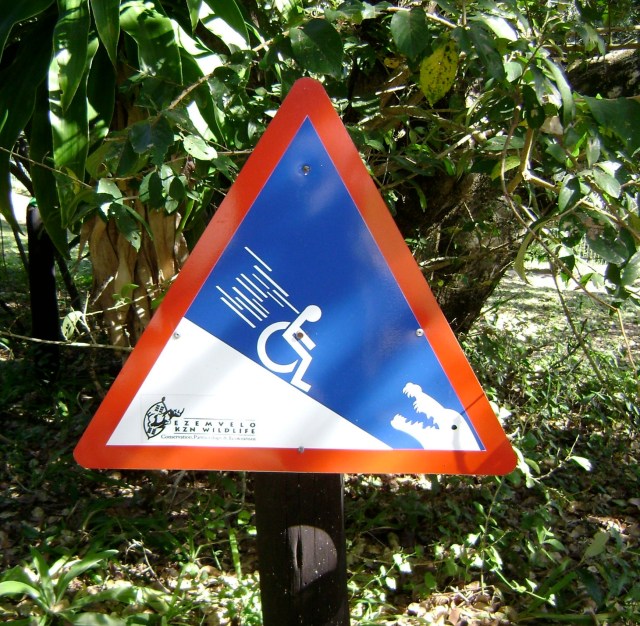
Yes, this is a warning sign that your wheelchair might roll into a pit of crocodiles.

Yes, this is a warning sign that your wheelchair might roll into a pit of crocodiles. Photo: Terry McGlynn

Summer is upon me, and the rest of us in the temperate Northern Hemisphere.  I’ll be a little busier, keeping the away from mostly metaphorical crocodiles.

With extended travel, fieldwork, conferences and 2.5 weeks of bona fide vacation (I hope), posting frequency will be a little more sporadic until the academic year ramps up.

This summer, I’ll be thinking and writing, about the upcoming job season, academic and personal travel, and how to supervise full-time undergrads and how to best savor in summertime. What about you? Add as many new categories as you need.

Thanksgiving; a state of the blog report

Standard

It’s now the 10-week mark since the launch of this site.

I wasn’t sure to what expect when I started, but I’m pleased at the early, and evolving, outcome.

I want to thank the scores of you that have helped out one way or another, as well as consistent readers, especially those of you who have chatted up the site with colleagues and more broadly shared posts of particular interest.

I’d like to specify thanks to a few who gave me a great push in my first moments. If I had to make a list of only three, in alphabetical order, it would undoubtedly be:

Chris Buddle of Arthropod Ecology, Jeremy Fox of Dynamic Ecology and Alex Wild of Myrmecos. Thanks, guys.

These three gents have distinct and engaging approaches to science that are useful and enlightening. If you haven’t clicked on over to their sites, please do (though odds are you’ve found this site because of them). And buy some spectacular prints from Alex, as he’s got a great sale going on at the moment.

The rest of this post is something like a state-of-the-blog address, in case you wanted to know more about the site and its trajectory. If you want a detailed look under the hood, read on.

Bloggers seem to keep their viewership numbers tight to their chest, maybe like how people don’t openly specify their weight or their salary. I don’t know if I’m violating a tacit code of honor, but here goes: To date the site has been viewed almost 20,000 times; on a run-of-the-mill day, as of this week, a few hundred people are visiting. I imagine that’s a blip compared to many other blogs, but I also expect that it’s uncommon for a blog that’s only 10 weeks old. I’m fortunate for what I think is early rapid growth. Each day, several people find this site by specifically seeking it out on search engines, which suggests some word of mouth. That’s encouraging. (There was one day when a post made the top of Reddit Skeptic. That was fun.) I’m in this for the long haul, and as long as I continue to invest, then I hope to continue growing.

In my first post, I tried to identify five characteristics of a successful blog. I think on all five marks, I’m doing well. First, I work to maintain a clear focus with a useful perspective. Second, I have maintained frequent entries, with one per day, and aiming for an absolute minimum of one substantial longer-form post per week. Third, I am steadily building a community of commenters, which is a diverse crowd with all kinds of academic backgrounds. Fourth, I think I have built up a much larger group of consistent lurking readers (I suspect), and lastly, I hope that I have maintained a high standard of writing quality. It feels that way, at least, because whenever I proof a piece I always catch screwups and typos. (I might write parenthetically too often, but that is better than David Foster Wallace’s copious use of footnotes, right?) Do I still think those five things are the properties of a successful blog? I’m not sure. My views on blogging, and this site, have evolved a lot in the last ten weeks.

I’ve evolved into some patterns that work well. Each weekday, there will be a single post, unless I feel hugely compelled to write something fresh that can’t wait (such as trying to make sense of why E.O. Wilson would tell young scientists to not worry about math). I aim to have at least one substantial and longer-form piece each week, and to make sure that every post introduces or revisit a concept that matters, even if not on a large scale. I’ll save Friday afternoons or weekends for additional posts that might be more relevant to dedicated followers to discuss things about the site (like this post). I’m planning for an ‘efficient teaching’ post weekly, and there are some other plans in the works. I’d love to hear from you via comments or email about what is working and what isn’t.

Summers will be quieter. Come late May, when I’m away doing fieldwork and on some extended travel, posting frequency will drop to 1-3 per week, but will pick back up in late August when the academic year starts back up again. I imagine that a lot of these posts will be about travel, fieldwork, student mentorship, conferences, and writing. Because that’s what I’ll be doing this summer.

If you want to be notified when a post comes out, you can subscribe to the blog with your email address, or sign onto tweet face. (In addition to the blog’s official page on facebook, you can connect with my personal facebook profile, too, using my email address. I don’t do much there and keep is mostly professional, but it’s been good for staying in touch with people.) Or you could just check in at some point in the day or week and get caught up. Or you could do a crossword puzzle instead.

Blogs are, perhaps by definition, a personal medium. I use the pronoun “I” frequently, but notwithstanding that fact I am intent on making this site about ideas, and not about myself. When I insert my own stuff into the picture, I’m doing it to serve the mission of the blog.

Broadly, my mission is to make sense of our jobs as scientists and teachers. Specifically, the mission is to represent, advocate for, support and provide a venue for researchers in teaching institutions. I’m not pleased to hold myself forth as a model, but I recognize that this is a necessary consequence of creating such a site.

Because we at teaching institutions inherently lack credibility with those at research institutions, I couldn’t have done this blog pseudonymously because part of the credibility is derived from the fact of my actual existence. Someone at a teaching school could claim that they’re a researcher, but people at R1 universities wouldn’t put much stock in it without looking at that person’s CV. It’s no accident that the CV on my lab website is being scrutinized a lot more closely now than it was 10 weeks ago. It’s not a strong CV by many R1 standards, but I hope it does show that I am a genuine researcher at a genuine teaching campus. I’ve yet to receive negative feedback for being uppity or self-centered, but the site is young. The challenge I have to face, then, is to live up to my own expectations for what a researcher at a teaching institution should look like. I won’t always live up to this, I realize.

I am aspiring to build something that is rare among academic blogs. There is clearly a niche for researchers in teaching institutions. More importantly, there is a niche for a substantial journalistic approach to writing about the relationships among research, teaching and academia. This is particularly true since Female Science Professor scaled back to a few posts per month.

I want this blog to be read by people who don’t typically read blogs. Most academics in many fields don’t read blogs, or at least don’t admit to it. I don’t know how to reach that audience. I imagine it just takes time and word of mouth. I’m reluctant to say something crazy or argue unnecessarily just to get temporary eyeballs. I realize that might slow my growth rate, but it will also help me to attract an audience that may otherwise be deterred by the general tenor found in most blogs.

I hope that this site can, at least by raising awareness, enhance the underappreciated role of teaching universities in research and academic life. If all kinds of researchers visit this site, they can examine their options and form a realistic view of what is possible (and yes, what isn’t possible) at teaching institutions. They also can adopt a more informed view of their colleagues.

The reason that I want to reach out to people who don’t typically read blogs is not (just) to gain a bigger audience. The hard-working and researchers and teachers in teaching institutions are overlooked, and this community that I want to represent doesn’t live in the internet. We work on campuses, publish in journals and make valuable academic contributions to our own fields. If I’m successful in this blog, then the conversation only starts on this site and makes a difference elsewhere, including campuses, professional societies, editorial boards, and funding agencies. Is that ambitious? Yes, it is. Is it overambitious? Time will tell. One measuring stick would be if we see an emergence of academic bloggers at teaching campuses, who choose to join the community of bloggers that now are mostly in research institutions. We’re all equivalently busy and overworked, in different ways. I want those of us at teaching schools to realize that we belong as much as everyone else.

I’m working towards that goal, of reaching out to many, by providing a broader value and respect for your time than I find in most blogs. I am working to do this by maintaining quality, focus, an absence of in-jokes, and emphasizing constructive engagement with whatever issue is at hand. I may have plenty to gripe about, but I don’t want to spend your time, nor mine, that way. I rarely have the answers, but I want to ask the right questions and get people to think about issues that might not have occurred to them before.

I suppose I should have photoshopped a picture of an ant standing at a podium with an American flag, flanked by Joe Biden and Boehner. But this is the best I could find.

Keeping tabs on pseudo journals [retracted]

Standard

Update 10 March 2014: Since I published this post, I’ve been made aware of an alternative agenda in Jeffrey Beall’s crusade against predatory publishers. His real crusade is, apparently, against Open Access publishing. This agenda is clearly indicated in his own words in an open access publication entitled, “The Open-Access Movement is Not Really about Open Access.” More information about Beall’s agenda can be found here. I am not removing this post from the site, but I am disavowing its contents as positive coverage of the work of Beall may undermine the long-term goal of allowing all scientists, and the public, to access peer-reviewed publications as easily and inexpensively as possible.

Earlier on, I lamented the annoying – and predatory – practices of pseudojournals. I wished that someone could do something to identify and contain these parasites.

I just learned someone is. Meet Jeffrey Beall. This guy is awesome. He’s an academic librarian at UC Denver. He’s taken on the herculean task of identifying, calling out, and investigating all of these non-journals that try hard to look like real academic outfits.

He calls these pseudoacademic entities “predatory journals” and “predatory publishers,” which is an apt label.

He runs the blog Scholarly Open Access, which I just discovered last week.

A column by him ran in Nature Magazine about this topic and his blog six months ago. I’m not a guy who regularly peruses Nature (unless EO Wilson goes all group-selectionist and my colleagues go all doctrinarian), so this slipped my attention.

It’s definitely worth a visit to Beall’s site. Not only does he keep an up-to-date list of publishers and journals that are “predatory” in nature, he also shares much of his investigation into particular circumstances, such as this one guy who is the “Editor in Chief” of several “journals.”

These journals have all kinds of fake information and corrupt financial arrangements, often done in a hilariously inept manner. It’s entertaining to spend some time on this blog. I’ll be regularly visiting, for entertainment of the drive-past-an-accident-scene-and-can’t-not-look-while-passing-by kind of variety.

Of course, it’s of practical use too, in the event your institution also has people who use these fake journals as a way to boost their CV, in case they need an external opinion to validate your own. Mr. Beall is doing some spectacular work and we should all express some appreciation for delving into this muck on behalf of the rest of academia.

By the way, right after I prepared this post, the New York Times came out with a profile of Beall’s efforts, focusing on not only pseudojournals but also the pseudoconferences that are hosted by the same or similar organizations.

About face

Standard

I’ve wholly changed the ‘about‘ for the site. You can learn more about me that way.

I’m still new to blogging. Just like playing an instrument or wrangling a bullet ant, being a dutiful observer doesn’t mean that you can do it well. I’m still learning. Even if the blog isn’t about me, it’s my blog and being forthright about that fact is part of doing it well.

I’m psyched about how the blog is coming along. I particularly want to thank Jeremy Fox and his blog, Dynamic Ecology, which has been particularly supportive. I don’t want to blog about blogging, so I’ll just shut up. Thanks for reading.

A rationale for existence

Standard

I’ve started this blog because I have so much free time on my hands.

Over the last couple years, a few blogs of scientists have become a part of my routine, even though I lurk on all of them. Reading blogs has been a way for me to learn from others.

Nevertheless, there is a huge disconnect between these scientists and my daily experience. Some of my biggest challenges and triumphs are endemic to my work at a teaching institution. We have a lot in common, but my experience is different in some fundamental ways. There are so many of us at teaching schools that do (or aspire to do) big-league research, even if it’s on a smaller scale. The strategies we use to build and maintain a research agenda are often different than our colleagues at research institution. I think we all prioritize our students and student training, but it’s really different when your students are all or mostly undergrads, and you teach a lot, and your school cares way more about your teaching than your research.

Many of my junior colleagues – whose work I greatly admire – are now taking jobs very similar to the one that I’m in. I am often asked about how I go about my job, get funded, manage my teaching load, maintain a research program. How I do what I do. This leads me to suspect that this blog will be useful.

I’ve read enough blogs to be able to identify, at least in my view, what makes a good one. That list includes:

  • a clear focus with a useful perspective that comes from experience
  • frequent entries, at least a couple times a week if not more often
  • a community of people who contribute their views
  • a greater number of lurkers who never contribute but regularly visit
  • high quality writing

If you’ve discovered this early on, input is particularly welcome. My plan is to do this for a little while before I attempt to let people know it exists. I’ve decided against anonymity. This is not common, but I’m tenured and don’t have dirty secrets to hide, and this will keep me from worrying about the attempt to hide details. (When I’m annoyed by something at my institution, which is more often then I could ever mention, I’d be glad if my administration read about it and know that it is from me). I will be able to showcase my research and field more openly, not to mention be openly proud of my students and institution. By being known, I just need to worry about being polite, which is a good habit to be in.