Reviewing manuscripts as an early career scientist

Standard

I find this weird, but apparently, some journals in some academic fields don’t allow grad students or postdocs to serve as peer reviewers. I do get the idea that professional experience and expertise should be required to conduct a peer review. They’re called “peer” reviews for a reason.

Then, the question is: are early career scientists our peers? Continue reading
Do R1s or PUIs have higher research expectations?

Standard

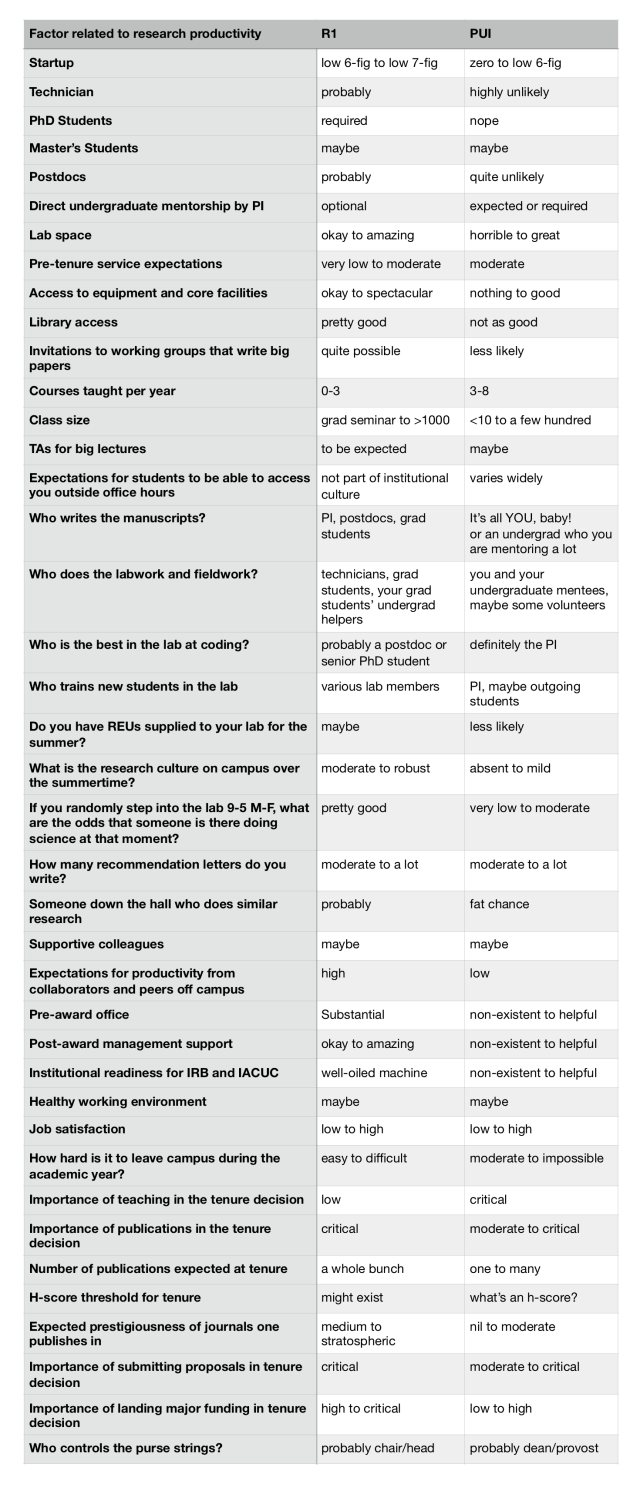
Well, of course, major research institutions (R1s) expect more research to come out of their labs than primarily undergraduate institutions (PUIs). But, after you take into account the circumstances of each kind of position, who experiences a higher relative demand for research productivity? At which kind of institution is it harder to meet the scholarship criteria for tenure?

Well, let’s compare various factors related to research productivity at these kinds of institutions*.

Continue reading

an old school wooden card catalog

Recommended reads #158

Standard

A very nice paper on efficient teaching, showing how small tweaks can result in big educational gains.

“Dr. Kathryn Milligan-Myhre works in the field of host-microbe interactions. In this mSphere of Influence article, she reflects on the people and scientific ideas that influenced her journey from a small town in Alaska to a faculty position at the University of Alaska Anchorage.”

If you are, like me, someone who studies things that are not humans and you’re interested in studying humans, you absolutely need to talk to people who do that for a living.” Continue reading

On unearned authorship by advisors of graduate students

Standard

Authorship is weird.  As an instrument to attribute of credit, it’s far too coarse whenever the number of authors is greater than one.

Authorship is a slippery concept, because you can’t really define what constitutes a substantial contribution, in a way that can apply generally. Continue reading