A recommended summer read: How People Learn

Standard

As a scientist, when I teach I want to know that what I’m doing in class is effective.

To know that something is effective, we ideally need data that demonstrate understand how people learn. Then we can then tailor our approaches to fit these data.

The problem is that there is a massive literature about human learning in educational settings, and I have enough trouble keeping up with the literature in my own field, much less the educational literature.

Wouldn’t it be great if there was just a comprehensive but easy to understand meta-analysis and interpretation of everything we know about human learning?

It turns out, there is. It’s called How People Learn. It’s so good, I’ve received two free copies on separate occasions, in science education professional development events.

This book was brought to you by the U.S. National Academies Press, back in 2000. It’s about as information-packed and useful as you might imagine. Follow this link and you can download the free pdf, read it online, or order a new bound copy if you’re inclined. You can get a used copy from resellers for less than ten bucks, including shipping.

Yeah, it’s more than ten years old. A lot of current movements in science education have been shaped by what’s in this book.

By the way, if you’re looking for an amazing non-science recreational read, then look no further than Mike Dash’s Batavia’s Graveyard (h/t @Rob Dunn who shared this book with me a long while ago). Be warned, it’ll be hard to put down once you get a few chapters in.

If you have any other recommended reading for the summer, fun and otherwise, feel free to add a comment.

Drifting towards deadwood, or not: learning to use R (updated)

Standard

Update 15 May 2013: If you’re a newbie to R and want to know where to start, the comments on this post are now replete with (what I surmise to be) wonderful suggestions. Of course learning in the presence of those who know R is best, but this is a great set of suggested resources regardless of your environment.

I’m not that old, but I already feel myself getting a little stale.

How did this happen? Well, I guess it’s because I’m a professor and this is just the default rate of entropy.

When I was an undergrad, one of our introductory bio professors was a kindly man who was the archetype of deadwood. He had a separate slide carousel for every lecture in his course. When it was his time to teach, all he did to prepare was to pull the carousel off of the shelf. He didn’t have any idea what he was going to say until he saw the slide appear on the screen. Then, he would say the same thing he’d been saying for that slide over the past 20 years. It was just so obvious. One day, the slide projector broke. What did he do? He cancelled class.

This kind of thing is even more common now than it was back then, because few people had so many carousels at their disposal. It’s just done with powerpoint.

I’ve worked hard to keep my teaching from becoming stale. And since I’m doing a lot of research, then I can’t get stale at doing research either, right? If only that were true.

I imagine that molecular biologists all had to learn the ropes at PCR as machines and reagents became commercially available, and then relatively cheap and efficient. Nobody’s out there doing allozymes for population genetics after all, I would hope. And the same is true for RNAi, and now with nextgen sequencing approaches to genomics. In my flavor of work, there isn’t as much required to stay current, but nonetheless I’m still getting behind. If only I could have the time to run to just to stay in place.

At least I’ve diagnosed this condition and can fight the entropy. Just I keep the dishes mostly clean in my house and I have the oil changed in my car on time, I’ve got to stay fresh as a practicing scientist too.  It isn’t easy.

This occurred to me, in part, when reading something that Joan Strassmann wrote (in the context of picking a good PhD advisor) that grad students are probably better at using R than their own advisor. I guess that’s the case in most labs, even if their advisors might have better statistical acumen.

If you’re a serious ecologist, nowadays, then R is an essential or near-essential tool. Here’s a confession: I’m useless with R. This is a problem. And it’s not a little problem, it’s a big problem.

I suspect that I’m not the only one in this boat, though I haven’t really heard anybody else admit to it. Every day that passes in which I still can’t use R, I’m not able to collaborate as effectively, the more reliant I am on others, and the less able I am to apply the most current tools to the experiments which I’m running. There is a single analysis that I should be able to do in R in an hour, that’s keeping me from submitting a manuscript that otherwise is pretty much done. That’s a problem.

Now, I’m not a statistical dunderhead. (I teach our graduate biostatistics class, but obviously teaching a class in something doesn’t mean you’re an expert). I design my experiments with specific tests in mind, and I choose ones that work, and I use model selection understanding the power and limitations of the approach. I understand frequentist vs. bayesian perspectives even though I don’t choose to say anything that would start a disagreement. (If you read my stuff, you can decide for yourself if I know what I’m talking about.) I guess you’ll probably just take me at my word that I’m not stupid when it comes to stats.

But there are a few analyses that I just can’t run easily, like NMDS or a GLMM. This is because I mostly use a powerful menu-driven version of SAS called JMP. It does nearly everything I want, and quite well. But there are a few analyses that I can’t run in JMP, which are becoming more and more relevant to the questions which I’m asking in my lab.

How did I get into this situation? Well, when do people learn R? In grad school. When I was in grad school, R was not the standard tool. Before then, I used SPSS on a mainframe (NO, not with punchcards) and a variety of easy-to-use programs on a Mac. (Statview was unparalleled for simple exploratory data analyses on Macs, and it was bought up by SAS and orphaned so that people would use JMP instead. The world has moved on without it.). By the time I was finishing up grad school in the late ’90s, R wasn’t in widespread use but it was ramping up. None of my fellow grad students were using it at the time, and I wasn’t behind the curve.

A few years later, while I was starting on the tenure track in the early 2000s, I put aside a little time to figure out R. That was a disaster and I couldn’t even get it to read my files. I had a few halfhearted attempts, but I couldn’t find the time. I looked into taking a short course, getting a book, but I didn’t have the time to make it happen. At this point, it wasn’t a critical failing, but I saw that more and more people were using R, and that I wasn’t one of them.

My lack of R mojo isn’t a teaching problem. Even if I was an R pro, I don’t think I’d use this in my course because the class is about understanding how statistics works and how to apply them, not how to use the software. I use JMP in the course because it is so easy to use, and I’m not going to waste instructional time on software tutorials. (We should have a separate class or seminar or experience that teaches students to use R, but it can’t fit in this class.) I’ve talked to people who teach with R in their courses, and they’ve reported that you either have to make it a course about learning stats, or learning R, but you can’t do both well with 45 hours of class time. Clearly, by using R you actually learn what you’re doing statistically, because that’s part of understanding coding. So I hear. But I’m not going to spend half of my time in class dealing with coding errors and stress when my students still don’t fundamentally understand probability, randomness and the actual nature of a null hypothesis.

While not a teaching problem, my lack of R mojo is a research problem. I am on it. I’ve been aware of this for a while, and I’ve found a way to deal with it.

For the last month, I’ve had sitting in my backpack wherever I go, what appears to be the exact resource I need: Beckerman and Petchey’s Getting Started with R: An Introduction for Biologists. From my quick browse, I feel mighty confident that using R like a pro is now only a matter of finding the time, and it doesn’t seem as insurmountable.

My hope is that, this summer, I find the time to actually remove the book from my bag and use it. This is the point in the narrative where I could explain everything I’ve done in the last month that would explain why I haven’t found the time to get to it, but you know the story. I won’t try to out-busy you.

This summer is already booked. Learning to use R to some degree of proficiency is going to take the amount of time that it would take to write a whole manuscript, or nearly write a whole grant. I have to decide which one of those things I’m not going to do to keep my skills sharp. Of course, I’ll be using R in the context of a manuscript. It’s just that this manuscript will take 2-3 times longer to write because of my R learning curve.

Maintenance isn’t optional. Learning R feels more like an engine replacement instead of an oil change, but I’ve got enough miles that I guess I’ve got to make the investment to avoid being sold for scrap.

Kodak stopped making the carousel projector less than ten years ago. I still have a carousel sitting around my lab, containing slides from the last talk I gave in this format. It wasn’t that long ago, really. (In the early 2000s, the Entomological Society of America hadn’t yet switched to accepting digital projection. That’s what still in the carousel.)

The world changes really quickly. As I’m doing my day-to-day faculty job, the world will be passing me by unless I actively work to keep pace. I always wondered how some people became deadwood. Now, I see how easy it is. It’s not about giving up, and it’s not about not caring. It’s about not strategically and systematically planning to keep up, which takes you away from immediate responsibilities. I’ve avoided this particular maintenance task for ten years, and just like when I go to get oil changed in the car, I’m not thrilled to spend my time that way. Of course, I’m glad that I can continue to drive a working car that will last a long while, and I’m glad that my soon-to-be-developed R mojo will keep me fresh for a good long while as well.

On attending graduation

Standard

Do you attend graduation?

On every campus, the formal expectation is that all faculty attend graduation. Nonetheless, not everyone goes. On some campuses, such as mine, only a small fraction of faculty go. We have so few faculty attend that it’s downright embarrassing to stand in such a small group of faculty among the massive throng of reveling graduates.

Who doesn’t attend graduation? For starters, those who aren’t available don’t go.

Who else doesn’t go? I guess it’s those faculty who wouldn’t enjoy it. There’s a lot to not enjoy. It could be really hot, it has some major tedium with all of those names, and it sucks up a good part of your weekend.

What is there to enjoy about graduation? It’s a celebration and you get to be adjacent to the center of it. The pomp can be fun. You get to meet the joyful families of your students, and you can express your pride in your students’ work and accomplishments. At my university, this is a huge deal, because in a goodly-sized fraction of these families the students are the first ones to graduate from college, and for many, graduation is an endpoint of perseverance through both economic and personal challenges on a scale with which I’m not familiar. The successes of these students is genuinely heroic to me. If I was dealt the cards that they were, I don’t know if I would have been as successful. So I attend with great pride.

I also go because it matters to my chair, and keeping him happy is important to keeping me happy. And he’s a great guy, and graduation is not a hardship by any means.

We spend a good piece of our careers working with our students, and while graduation better not be the end of their education it does mark a major milestone. If you look out at the students, it’s a condensed mixture of pleasure, pride, satisfaction and trepidation. This kind of drama is something to savor.

And, you never know, the commencement address might not be the same trite stuff. (I missed one graduation a few years ago which was an absolute train wreck for which apparently no explanation can do justice, and I’m sad I missed it.) I imagine the faculty who attended the ’05 Kenyon College ceremony are glad they went.

If you take pleasure in your students, then go on, go to graduation. You don’t have to go. But if you only did the things you had to, you wouldn’t be happy for doing your job well.

Summer is approaching: beware the pit of crocodiles

Standard
Yes, this is a warning sign that your wheelchair might roll into a pit of crocodiles.

Yes, this is a warning sign that your wheelchair might roll into a pit of crocodiles. Photo: Terry McGlynn

Summer is upon me, and the rest of us in the temperate Northern Hemisphere.  I’ll be a little busier, keeping the away from mostly metaphorical crocodiles.

With extended travel, fieldwork, conferences and 2.5 weeks of bona fide vacation (I hope), posting frequency will be a little more sporadic until the academic year ramps up.

This summer, I’ll be thinking and writing, about the upcoming job season, academic and personal travel, and how to supervise full-time undergrads and how to best savor in summertime. What about you? Add as many new categories as you need.

The relationships among fame, impact and research quality

Standard

I just read a particularly interesting post by Dr. Becca about life about halfway through the tenure track that got me thinking, particularly one section:

I feel like most of my job right now is to be famous… What I mean by this is that I’m pretty sure a lot of my future success is going to depend on whether people remember my name when they review my grant applications and manuscripts…

What determines your success? How famous you are.

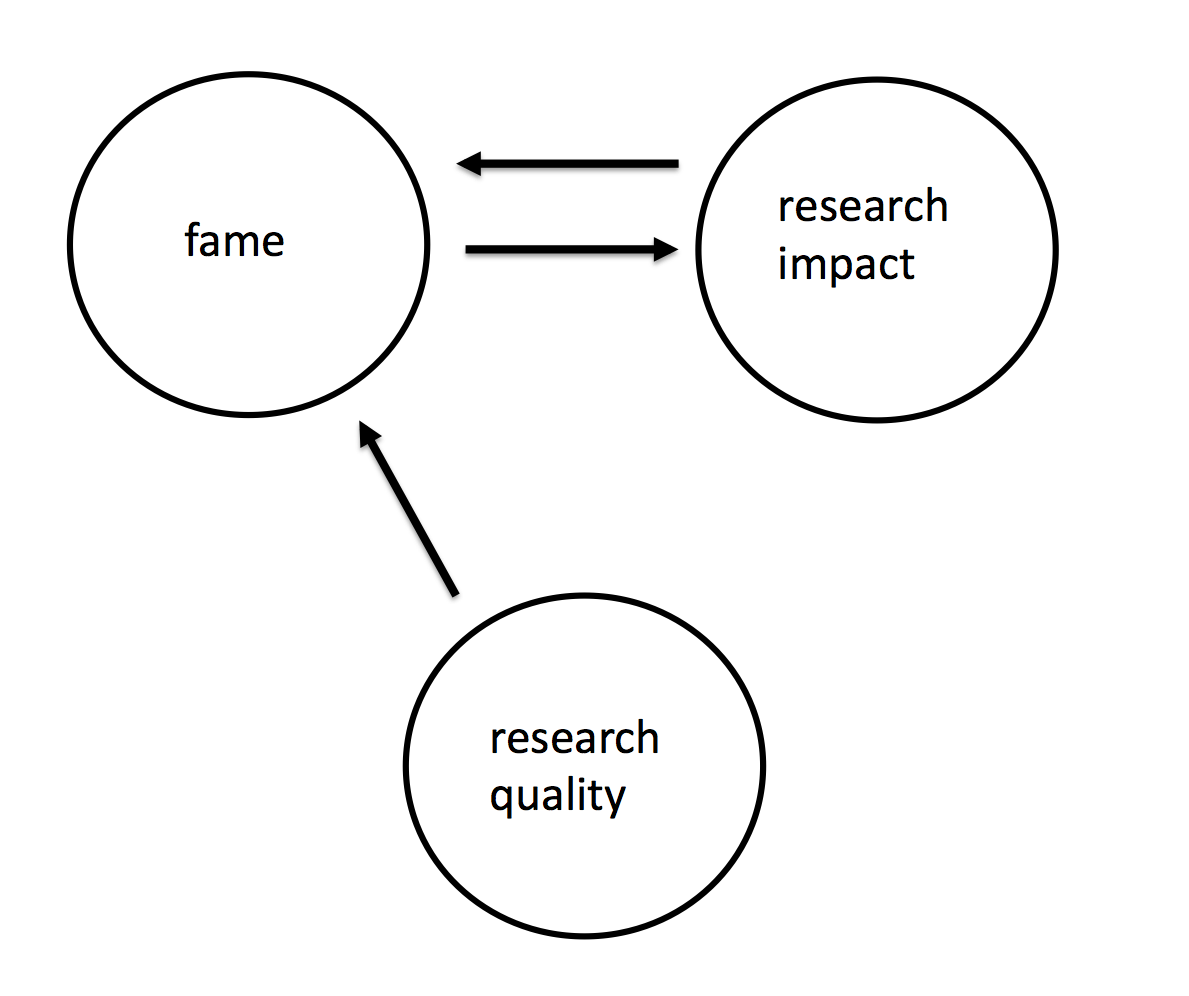
Most famous scientists have a history of excellent research with high impact. And most researchers with a history of excellent research with high impact are famous. (Fame, that is, among scientists.) However, the r2 on this relationship is well below 1. What explains the variance?

What are the factors that makes you more famous, or less famous, than would be merited by your research quality?

Is the impact of your research — how much it influences the work others — closely tied to your fame or are there people who have a high impact but not well recognized – or people who are quite famous but don’t have much impact?

Fame path diagram

A working hypothesis for the relationships among aspects of a scientist’s research program

I posit the figure above only as a suggestion, a working hypothesis that I’m not wholly wedded to. It’s a good template for discussion.

The ceiling of the impact of your research is dictated by how famous you are. Your impact could be (very) crudely measured using impact factor, or by an h-score or some other measure of citations. How much of a difference you make. You might get cited a few times if nobody has heard of you, but essentially you need to be known for your work to make a splash. You can only make a difference if people know who you are, which is exactly the point that Dr. Becca made. Your job, if it is to make scientific progress, is to become famous. Because you can only make a difference if you’re famous.

If asked to name two huge advances in biology from mid-1800s, most of us would pick the same things. One came from a person working in obscurity and another by one who was, among scientists of the day, mighty famous and was in regular communication with other famous scientists. Darwin’s scientific impact was immediate. Mendel’s finding required the fame of Hugo de Vries to create a scientific impact more than thirty years later.

There are many things that contribute to fame. One of these is research quality, but also the institution you came from, your academic pedigree, attractiveness, personality, and also your ethnicity and gender can have an effect.

What’s another thing plays a key role in facilitating, or limiting, your fame? The institution where you work. If you’re not based out of a research institution, there is a hard cap on how famous that you’re allowed to become as a research scientist. However, if you’re at a teaching institution, the school doesn’t really want you to be a research scientist of any fame, anyway. Fame isn’t part of the evaluation process for tenure, and you could be entirely unknown off campus and this shouldn’t (necessarily) negatively reflect your tenure bid. This would be fatal at a research institution, where you’re expected to establish a visible profile in the research community.

Our jobs at teaching campuses do not expect us to be famous and do not require it. This might be a defining contrast between a teaching campus and a research campus. However, there are lots of us in teaching institutions that not only are doing consequential research, but also want this research to have as much impact as it possibly can. However, based on the name of the institution found on our nametag when we present at conferences, this becomes very difficult.

There’s a positive feedback loop connecting one’s pedigree, social network, publication history, favorable reviews of grants and proposals, funding, talent of collaborators and fame. They’re all connected to one another. And if you’re at a teaching campus, you’re at a strategic disadvantage because those positive feedback loops don’t work as tightly.

Leveraging your pedigree, papers, and collaborations is harder to do, because of unacknowledged biases against teaching campuses in the research community. You can’t be famous above a certain level, because those at research institutions assume that you aren’t working at one because you can’t get a job at one. If you’re doing research from a teaching institution, that means that you haven’t had enough success to work at a teaching institution. So the thinking goes. Even in the incredibly tight job market, that line of thinking still prevails. You’re skeptical? Pull up a few journals and look at the mastheads, to find the institutions of the editorial board members and the subject editors.

So, unlike Dr. Becca and those at research institutions, my job isn’t to become famous. Even if I was famous, nobody on campus would even be aware of it anyway. However, if I have ambitions for my research to make a difference, then I need to become famous. This fame is required to activate the positive feedbacks among friendly reviews, funding, invitations, collaborations, and so on.

Efficient teaching: marking down for grammatical errors

Standard

I used to be appalled at the quality of my students’ writing on exams and other in-class assignments.

Now I’m slightly less appalled. Here’s what changed things:

About ten years ago, I got overly fed up with sloppy errors on exams and quizzes. Students would misspell the most basic words, and make standard homonym errors (such as there/they’re/their) and just sloppy phrasing. It was unbefitting of any college student, or actually of any student in general. These errors indicated an overall lack of pride in one’s work. Grading these could slowly eat one’s soul.

So then, here’s what I did: I told my students that any error in writing (grammar, diction, syntax, spelling) that would not be accepted by a middle school English teacher, wouldn’t be accepted in my class. I said that every single error would result in a loss of a tenth of a point. If you did the same error four times, then that would mean that you’d lose four tenths of a point. If you had a hundred errors, you’d lose ten points.

I put the policy in the syllabus, and I told students every time I handed out a quiz or exam.

When I started grading quizzes, I would mark down a “- 1/10” for every stupid little error. Even on short one-page quizzes which only contained short responses, there could have been up to a score of such errors for some students. Others had none, and many had just one or two.

So, instead of getting a full 10 on a quiz, an otherwise perfect quiz with two lame-o errors receives a 9.8. How would this affect a student’s grade? Negligibly.

Each semester, I would get predictable outrage from a few students (at the expensive private school), that I would try to teach something other than science. I asked if it was reasonable for a college professor to expect proper grammar and spelling of a college student regardless of the discipline. That usually quieted things down, though earning the respect of these students would be an uphill challenge. At my current job, it’s just accepted as par for the course.

What is the outcome of marking down points for sloppy writing? It’s actually amazing. Their writing improved dramatically. The writing more closely resembles the professional output they always should be generating.

This is what I find depressing about this whole affair. If students don’t think that they’re being graded on spelling and grammar, then they actually misspell words far more frequently, by about two orders of magnitude. They also are more likely to craft nonsensical sentences, use adjectives in place of adverbs, and use apostrophes with abandon except where needed.

My students actually can spell, and follow basic rules of grammar. They just don’t bother to do so unless it’s required of them.

If I make my students do it right in my classroom, that’s one small part of it becoming a routine. However, in one semester I can’t undo a decade of other instructors who weren’t maintaining similar standards.

Applying for faculty positions: the teaching philosophy

Standard

Job application season is not ramping up until the end of summer, but I’m bringing this topic up now because it might require some thought and introspection before applications get sent out.

Some ads ask you to make a teaching statement. Others ask you to also provide a teaching philosophy.

Those are the same thing, right? I don’t think so.

A teaching statement explains what you have taught, what you’re capable of teaching, how you have taught these courses and how you go about teaching on a day to day basis. It’s important for a teaching school to know these things when evaluating a candidate. But some departments want more information. They also want to know your philosophy.

Keep in mind that many members of search committees don’t give a damn about teaching philosophies at all. They’d be glad if you wrote a teaching statement, or if you needed to provide both, that you just got a little wordy in the philosophy. They won’t care. But for those that do care, an excellent teaching philosophy can really make you stand out, with at least some of the teaching faculty who are doing the hiring.

You might be asking yourself, “What the hell is a teaching philosophy? Do I have to have an actual philosophy about teaching?”

My answer would be, “Yes, you really should have one. Your teaching philosophy is your overall approach to teaching and a guiding principle behind all of the decisions that you make when teaching.”

Ideally, your teaching philosophy can be expressed in a sentence or two. And then it takes a few paragraphs to explain it. That’s how you write a 1-page teaching philosophy.

What is the secret to writing a kickass teaching philosophy statement to get you that job interview?

The secret is to actually, genuinely, have a kickass teaching philosophy. If you don’t have a few firm guiding principles that guide your teaching, this summer is a good time to develop them.

Instead of just telling you what a teaching philosophy is, let me give you some specific examples. I’m most familiar with teaching philosophies not from the university, but from K-12 science and math teachers. I’ve been involved in scores of interview panels for beginning and experienced teachers. One question that we always ask is: “What is your teaching philosophy?”

All but the most nervous and least prepared teachers have their answer down pat. Most of them say a slight variant of:

Every child deserves an opportunity to learn.

I love that one. I think it is broadly applicable to many circumstances – dealing with economic inequalities, differentiating instruction for students with higher-level work, working with those learning English, and those with behavioral challenges. Everybody, despite the challenges that they face and those that they even create themselves, deserves the opportunity to learn. And it’s the job of the teacher to create that opportunity. That’s a powerful philosophy.

That philosophy, however, doesn’t work for me in the university environment. Here’s my philosophy, that I’ve had for at least the last eight years:

You don’t truly learn something unless you discover it for yourself.

Someone can explain something to you, and you can understand it. But you haven’t learned it. It hasn’t been banked in memory or as something of substance unless you figure it out for yourself. Consequently, labs are important. Fieldwork is important. Discovery-based lessons in class are important. Interactivity during lectures helps. Making sure that students genuinely and deeply read helps. Creating an environment in which students feel an interest and need to discover matters. And so on. In my more recent job applications I spent a few paragraphs spelling out the corollaries and applications of this philosophy.

What are some other teaching philosophies that could work? Maybe:

University students learn best when they have both extrinsic and intrinsic motivators.

or maybe:

Learning is a social activity and interactions with others are a critical part of the college experience.

or how about:

Being able to communicate a clear understanding of a topic verbally and in writing is required for mastery.

or perhaps:

Learning is fun.

and lastly:

To be an effective teacher you must be a lifelong learner and create that spirit in your students.

or other stuff that you can just make up like I just did.

The best teaching statement is not one that you just made up, it’s one that you genuinely believe.

Realistically, most people emerging from grad school and postdocs looking for teaching jobs have something less lofty on their minds, such as “My philosophy is to do anything that results in good evaluations,” or “My philosophy is to not entirely destroy the entire semester by not knowing what I’m doing,” or “I just want to spend as little time on class as possible so that I can get everything else I need to get done finished so that I can actually keep my job.”

Those might be acceptable ideas. But it’s not a philosophy.

So, how do you find your philosophy? Experience with teaching helps, but I think even more important is to spend time interacting with others who care about teaching, and care about understanding what works and what doesn’t work.

You don’t have to be an expert in the education literature, but you should be able to hold a respectable conversation with someone who is. (You don’t need to know the acronyms but you should be able to understand the concepts.) You should be familiar with Bloom’s taxonomy, if nobody’s hit you over the head with it yet. Knowing about constructivism is a good idea. If you’re going to spend even a small part of your career teaching, then understanding the way professional educators approach teaching is a good idea.

Beware, though, when you write your teaching philosophy, you actually have to be careful to not bust out the technical education terms, because that would piss off the majority of the faculty who harbor a genuine suspicion of educational theory.

Any search committee is likely to have some people involved who think, “It’s just my job to teach and their job to learn.” I actually think that’s true, but the definition of good teaching and good learning is where I part way with those folks. The education folk like to make a distinction between the “sage on the stage” versus the “guide on the side.” I don’t follow the Johnnie Cochran school of espousing teaching philosophies, though I think effective teachers guide rather than preach.

You’d hope that these people are fossilized enough that they’re not reading blogs. Nonetheless, a dislike for anything other than bullet-point lecturing is common among many junior faculty who don’t want to be bothered with student learning and instead think their job is to spew information. As in all things related to job applications, you don’t want to express any view strongly enough that it would piss anybody off, even if that person is unreasonable.

The take-home message is that you are best off using your Statement of Teaching Philosophy to actually espouse a genuine philosophy of teaching. If you don’t have one, it’s not too early to develop your own!

If you have one you like, or would like feedback from folks on one, please share in the comments. You’ll probably get some good comments. And we won’t charge $100/hour.

How much space do faculty at teaching campuses take up in journals?

Standard

What’s the relative influence of teaching faculty on their fields as a whole? That’s hard to measure.

Here’s an easier, related, question to ask: What fraction of papers coming out have teaching faculty as authors?

A couple months ago, I perused the tables of contents of a variety of journals. Here’s what I found:

  • Ecology: 3 of 25 papers were partially or completely authored by researchers in teaching institutions
  • Journal of the Kansas Entomological Society: 1 of 10
  • Biotropica: 0 of 16
  • Annual Review of Ecology, Evolution and Systematics:  4 of 23.
  • Ecology Letters: 1 of 15
  • Proceedings of the Royal Society B: 0 of 20
  • Biology Letters: 2 of 32

By the way, in Physical Review Letters, it was 1 out of 32; Chemical Reviews was 0 of 12.

I can sniff out a teaching institution in the US based on its name. The primarily-teaching university doesn’t quite exist in the same manifestation internationally, but even so it was clear that most international authors were associated with research institutions of one kind or another.

Using this feeble back-of-the-envelope calculation using a very small sample size, maybe up to 10% of papers in my fields have teaching-school authors in the US. Is this more or less than you’d expect?

What’s it look like in your field, if you’re not a ecology/entomo/tropical type?

Getting and running a big site grant in a small institution: how collaborations fail

Standard

Here’s the message of the post in a single sentence:

You need open communication and collaboration to land and run a successful site grant, and petty concerns about sharing resources could mean that nobody gets anything.

Now here’s the rationale:

“Site grants” power research centers and student training programs. Research institutions are expected to have these big grants to make things run. These “site grants” support multiple faculty and students working together on a big project of some sort.

On a small teaching campus, having a site grant of any size has a proportionately large impact. For example, if a research university operates an NSF REU site (Research Experiences for Undergraduates), it would add a little substance and spice to business as normal. On a small teaching campus, though, an REU site could transform campus culture. It could fund a student or two in many labs and provide all kinds of ancillary support for participating faculty. It would be a big frickin’ deal.

My campus, at the moment, can’t run an REU site. We don’t have enough research active faculty to submit a credible proposal in any potential REU theme. This isn’t supposition, it’s an established fact, notwithstanding the unrealistically optimistic grant specialist that keeps suggesting it to us. (My first year on campus, I did put together a preliminary proposal for a similar program that no longer exists, the UMEB. The only reason we weren’t shot out of the water was because the grant didn’t stay afloat after it was assembled in drydock. Since that time, we’ve lost faculty who haven’t been replaced.)

Even though we can’t run an REU site, our campus actually runs a large number of other site grants. The majority of them are in education (including STEM education). There are also science site grants, including a couple NIH projects to support biomedical researchers in training, and grad school-bound students are supported by McNair and NSF-LSAMP programs. (I run a couple NSF-International Research Experiences for Students programs.) How do we we run these training programs if we don’t have the faculty? We farm the students out. For example, nearly all of the biomedical students are doing research in labs off campus in other institutions. We fund ’em and ship ’em off. This model does seem to work, to some extent, though the money from these grants then is not used to build our own laboratories or help our own scientists become successful. That is a drawback.

We could have a lot more big projects on campus, if it weren’t for one particular obstacle. That obstacle isn’t the limited number of faculty with biographical sketches that belong on a site grant. It’s the absolute absence of a collaborative attitude. It’s killed project after project, preventing them from getting to the submission stage.

I’ve seen so many grants get assembled without adequate involvement of the people who should be involved. And they’ve all either fallen apart, or are manifested in a suboptimal fashion. It’s maddening. I understand how it happens, and that’s exactly why it’s so maddening.

The people who control the money of these site grants have power that comes with allocating the budget. They can bring faculty on to the grant by giving them extra stipends, summer salary and reassigned time. They can fund your students, or choose to not fund your students. They can get access to space on campus that others can’t use. Also, the people with these grants have the ear of the administration, and since money begets money, this means that power begets even more influence.

Just like when people become rich they’re more likely to hate paying taxes, some faculty members in charge of grants start becoming stingy. Even worse, faculty members who are even thinking of being involved in grants get paranoid. They don’t want to talk about their plans for developing a grant. Any conversation even mentioning the grant should be “invitation only” (that is an actual quote, by the way). The thinking is, just like when you win the lottery and everybody becomes your best friend, then if you land a big grant then everyone’s going to nibble at you for a piece. That’s messed-up thinking.

Most people here writing grants do it behind closed doors, hush-hush, and if they decide to cut you in, it’s on a need-to-know basis.

I’ve seen this happen with four different projects in the last month. I was recently at a meeting to work on developing a proposal, and there was a side conversation referring to things to which I was not privy. When I asked, I was merely told, “it’s political.” Am I a collaborator or am I a little child?

Here’s another absurdity with which I was involved. A couple administrators and a few faculty members were discussing how to put together a particular proposal. The fact that we were all there to discuss the project was clearly a positive. It was clear that the person in charge had a clear vision for what the project was supposed to do, and her job was to bring us in line though she was open to hearing good ideas. After a while, a variety of specifics were discussed, a grantwriter was ready to go, and we were moving ahead. The next step: one of the administrators was to contact another person and inform him that he was going to be the PI.

Huh?!? That has to be an awkward conversation: “Hi there, Bob, so we met this afternoon to plan a big grant, we have a grantwriter doing it all, and we have the people to do the work on the project. It’s all set. And you’re PI. I know you don’t know anything about this, but that’s not a problem. Could you sign the paperwork?” This is what passes for collaboration ’round these parts.

Why are people doing these projects in the first place? Is it to get the job done the best way possible? If so, then shouldn’t the key personnel in the project be part of the conversation?

Here’s another illustrative anecdote: Last year, I was walking across campus and one of my administrators was showing around an off-campus colleague who was visiting for the day. I was walking alongside another faculty member. When she introduced the two of us, she didn’t say:

“This is Terry McGlynn, rainforest ant ecologist, and this is Horatio Wigglesworth, who works on apoptosis in naked mole rats.”

Instead, she said,

“Hi, this is Terry McGlynn, funded by NSF. This is Horatio Wigglesworth, funded by NIH.”

There was nary a mention of what we actually did. She communicated in a few words, what mattered to her: that we had grants. What we did with those grants was secondary. To her, the grant itself was what mattered, not the work that was empowered by the grant. This kind of thinking is not only petty, but it’s also wasteful because this mindset results in a focus on getting grants, rather than focusing on identifying funding for the projects that have the greatest need. The latter approach is the one that results in grants that are not only funded, but also successful.

Why do I choose to run the projects that I do? I have two big reasons. I love doing the research connected to them. And I’m committed to giving students the biggest and best opportunities I can create for them. That is clearly not a motivation for faculty cooking up these big projects and are being secretive. The reason they don’t want to talk about it isn’t because they fear the project will fail, but they fear that too many people will be part of its success. (Note that, even if you are successful in research and grantsmanship, that won’t help your baseline salary at all, as I’ve already addressed in a prior post.)

Here are some of the horrible reasons for getting grants that I see far too often:

  • Pay oneself extra stipends and summer salary (typically for not doing more work)
  • Be liberated from teaching
  • Enable one to spend less time on campus
  • Increase one’s power or prestige

These reasons are ones that can explain why there isn’t collaboration. If you’re running a project to keep things for yourself and your fiefdom, then to bring others in would just weaken your power while helping the students.

So, what’s the problem with ambition and wanting to be powerful and have influence? I’ll tell you the problem: it prevents reasonable people from actually doing their job to teach and help students grow. It prevents the projects from getting off the ground. If you’re in a lifeboat, you just can’t paddle in the direction you want to go. You need to communicate with the other people in the boat.

Territoriality around grants prevents conversations that bring in the best ideas, and also sometimes prevents the involvement of the most effective people who should be in on these projects.

Here’s another relevant anecdote from the grant silliness of the past month: A faculty member in education, who is operating one site grant at the moment, is now preparing for another one, involving science curricula and teacher preparation. On our campus, there’s one science faculty member that advises pre-service teachers on their science coursework, and is working with existing science education projects. It’s a no-brainer that this faculty member should be involved in developing this new science education grant. (It happens to be me.) Instead, of talking to me, the education faculty writing this grant hits up two of my department mates, who have absolutely no involvement in pre-service teacher advisement and curricula. She walks into their offices, and says, “I’ve written this grant, it’s all done. I’ll give you this amount of money if you give me a letter of support.”

Why did she want their letters of support, instead of talking to me, the guy who actually would be in a position to provide actual, genuine support instead of a mere letter? Because she didn’t want any of their help. She just wanted the letterhead. She wanted to buy them off to get the grant and have her own way without actually having them contribute to the project. Why didn’t she want any of us involved? Because our involvement would take time and money. It would involve synergies with other existing projects, but those aren’t under her control. It would actually improve the project, but that’s not what was important. Controlling the budget on her end, for her to spend it as she wishes, is what mattered.

I don’t know if she’ll get the grant or not. But what I do know is that the grant would be better if she talked to at least some of us before she wrote it. Why didn’t she want to talk to us while drafting it? Because we’d want a bigger piece than she was wiling to offer. Good for her, bad for the students.

Here’s a simple guiding principle: If you’re developing a project, you need to talk with all of the potential participants involved to not only gauge interest, but also to develop the best possible proposal.

If you do consult widely, then how do you keep it from growing out of control and having too many people demand a piece? That’s easy. It’s called leadership. That kind of leadership, though, just like that of Ernest Shackleton, means that you can’t elevate yourself on a pedestal, and you have to put the needs of those who you lead on the same par as your own needs, if not above your own needs. The PI with the most sway on our campus does exactly that, and it’s his collaborative attitude that puts students first is exactly the thing that’s made him so successful. It’s why I respect his work so much and why I always work with him when I have the opportunity. It’s what makes him so trustworthy and reliable, and also what makes his projects incredibly effective, or as they say, impactful.

Meanwhile, everyone else that can’t have a big enough piece of that particular pie is trying to build their own little walled fiefdom.

Perhaps because I study animals that live in social groups, I know that cooperation with others, even those with whom you have some conflict, leads to greater productivity for everybody. My fellow faculty members, for the most part, aren’t receptive to this lesson in animal behavior and game theory.

I hope that, on your campus, there’s a better spirit of collaboration.

Upon reading this post, the night before it came out, my spouse asked me, “Do you think that by writing about people not being team players, that you’re not being a team player?” That’s a really good point. I suppose that if the individuals in my anecdotes whom I do not name recognize themselves, then I won’t be on their team in any point in the near future. However, even if they never see this post, I still wouldn’t have been on their team regardless.

I wanted to write a post about how collaboration and cooperation can lead to better site grant proposals. Then, I realized that based on my recent experiences, that focusing on the negative makes my point quite well, because at a distance these stories are so absurd. They demonstrate how being secretive and exclusive about writing grants is absurd. For the record, the site grant of which I’m now a Co-PI was written in a highly collaborative manner, with all partners (including some who didn’t make the cut) in on the discussions from the very beginning. Building this project that way has helped us respond to unforeseen changes and challenges really well, and if we didn’t do the outreach at the beginning, it would have been not nearly as successful.

Getting past the comic stereotype of grad student life

Standard

I loved grad school. I have serious nostalgia for grad school. If I could be a grad student forever, that would rock.

In fact, my job as a faculty member is a lot like being a grad student. I do research, I teach, I write grants, I write manuscripts, I work with students less experienced than myself, and I build collaborations.

What about grad school was not awesome? You get to do research on exactly the topic or subsubfield that you chose to work in, you get to hang out with a diverse bunch of smart people with really similar interests, you presumably are traveling to conferences and sharing your work with others, and you have ample opportunity to shape your professional trajectory and identity in the direction you want. Sure, you don’t get paid much, but enough to get by. If you are in grad school later in life, it would cause some anxiety about saving up for retirement, I imagine. But in all, grad school rules.

Of course this might not be true for everyone. There are many kinds of graduate students, with many kinds of attitudes connected to many kinds of experiences. Labs are different, PIs are different, projects are different, and recreational pursuits vary. Some people have a horrible time in grad school. This I understand.

If you read the comics, grad students are pitiable creatures. They’re chronically poor and have no future. I’m not the only one tired of how the media consistently portrays grad school as financially insecure. In the context of the latest media sequester freakout, Joe Hanson agrees.

Humor often relies on stereotypes. In PhD Comics, the caricature of the miserable grad student is the basis of the humor. It’s often funny, and I’m a regular reader. I just hope people don’t buy into this stereotype as a mirror for their own lives, which is a recipe for misery.

The same for Matt Groening.

I realize that, as a fat cat tenured professor, this message might not be welcome to those who are unhappy. I’ll tell you at least this much: if you’re unhappy in grad school, then I don’t imagine you’d be happy as a tenured faculty member either.

How to run a summer undergraduate research lab

Standard

That title should indicate a question rather than a set of instructions.

How do you run a research lab in the summertime?

We’re approaching that time when campuses get really quiet, except for us scientists who are working year-round.

Many of us have undergrads funded (through a variety of internal and external funds) to work in our labs in the summer. What does it take to make sure that get work gets done on schedule, in high volume, and with the proper level of quality control? What can you do to make sure that the students have the best research experience? Are those two things wholly compatible?

What policies and procedures do you have, if any? Do you use a timecard with fidelity? How often do students report on their work formally, and how much time do you actually work alongside your students? How much is expected of the students in terms of hours per week, research product, or both? Do you have students write up much their work in the summer, save all it for the fall, or do they just hand over data to you and you write it up?

Please share your favorite practices, and ones you know that don’t work, in the comments. We’ve got lots to learn from one another.

I imagine that marital and reproductive status affect how you run the lab over the summer, too.

I tell my undergrads that I have three priorities for summer research:

  1. Everybody is safe
  2. Everybody has a fun time
  3. Everybody is collecting genuine data that is designed to be part of a publication

I explain that all three are mutually compatible. We are doing real science, not a make-work research “experience.”

That said, I have almost no experience with personally mentoring undergraduates in the lab throughout the summer.  Students working with me in the summer head to a large rainforest field station with me for a few weeks. And then I leave them behind to continue their projects, typically in the hands of capable peers or mentors. As my wife has described my field site, both the atmosphere and physical environment resembles the hybrid of a college campus and a summer camp. I’ll be sharing plenty more about this while I’m on site, just a few weeks away. (Gaaah! Not ready!)

If there’s a meltdown in my absence, or if a hole pops up in my schedule, then I might return back to the forest before the summer ends. But otherwise, much of my mentorship is conducted via skype and email. Which is no small task. I don’t supervise my students doing their field projects as closely as I could, but I have found that giving students with great judgment latitude to make decisions works out really well. I don’t allow students with less-than-great judgment to work independently in the rainforest. I’ve gotten pretty good at picking out the right students in advance, with the help of my colleagues, but I also intentionally occasionally take chances on students who I think might be deserving of a the opportunity. I’ve gotten burned occasionally, including last summer when I had to send a student home after just a few days.

I don’t think I could or would want to spend my summer in my lab. It’s glorious outside, and I want to travel, often in the guise of science, and I also want to spend lots of time with my family. So, when I’m not at my field station, I’m often working at home. There’s no shortage of writing projects that need my attention. If I were in the lab with students all summer, when would I be able to write?

What really is “excellence” in teaching ?

Standard

I’d like to extend a topic that I brought up recently – about the difficulty in evaluating excellence in teaching.

I danced around the central conundrum, by highlighting all the ways that we do, and don’t, evaluate teaching on our campuses. What I didn’t bring up is: what is it, exactly, that we are sizing up when we decide how good someone’s teaching is?

What I argued at the time is that most people use the template of their own teaching (or perhaps one’s aspirations for one’s own teaching) as a model for evaluating others. This operational definition of how excellence is measured doesn’t actually specify what characteristics define excellence.

Let’s set aside the evaluation problem, and ask: What is excellent teaching?

Nearly all of our evaluations focus on the process of teaching: what happens in class on a day to day basis.

What really matters is what happens in the end: what is the product of teaching?

If we focus on process, then we measure things like specific items in the curriculum, demeanor, what the assignments and exams look like, and classroom performance in the theatrical sense.

If we focus on product, then we look at outcomes: exam performance, student satisfaction, long-term professional growth, and — from the administration’s perspective — alumni giving.

You imagine that a quality process leads to a quality product, however a veneer of quality might not lead to a long-term high quality product. What educational practices that get high ranks in the evaluation system actually contribute to positive outcomes in the long term? How much of what we do in teaching doesn’t result in long-term learning but looks like quality teaching in the short term? For starters, the first thing that comes to mind is the use of overly detailed powerpoints that are shared with the class online for cramming studying for exams. Students love it, it raises satisfaction, the professor looks well prepared and: will students know any of it the next day, or how about five years later?

Just as we can design an individual class with backward planning, we can think of the whole college experience this way to inform what students really need to get what we want them to get out of the college experience. What constitutes an “excellent” college education? Whatever it is, then excellence in faculty is when they deliver on that goal.

In my view, when you graduate from college, the school has done its job if the product is:

  • articulate in thought, words and writing
  • able to differentiate between opinion and reason and has personal values informed by both
  • broadly interested in the world and all it has to offer
  • conversant in literature, art, history, geography, science, mathematics, philosophy, civics and more
  • able to separate style from substance
  • struggling to understand the faiths, or the lack thereof, of those in their midst
  • able to readily explain to any novice the basic tenets of their specialty
  • can perform admirably on a summative exam in the subject of one’s specialty (e.g., subject GRE)
  • reading the goddamn newspaper or its equivalent on a regular basis
  • able to whiff out pseudoacademic thinking (like Malcom Gladwell), pseudoscience and shabby reasoning
  • not taking oneself too seriously
  • treats other people as they would like to be treated

Those are my aspirations for what college should do for everyone. I wrote this on the fly but I imagine it would resemble to some degree what you think a “liberal arts education” is supposed to look like.

Just as it’s not the job of a K-12 teacher to merely teach the state standards, it’s not my job to cover the expected learning outcomes of my course. I’m working on providing one piece of a holistic college experience. Am I successful at this? No. But it’s a goal. Since I’m at a state comprehensive institution and all the talk is “career-training-this” and “job-preparation-that” we are really botching these fundamentals. My heart soared when our newish provost said, in his first address to the faculty, that he didn’t want to see any more business regarding what a college degree does for students, he wanted to hear more about what a college education does for students. In our environment, that idea is hard to deliver in deed, but I’m excited to see the emphasis nonetheless.

How do we measure teaching excellence? Foremost, students need to emerge from the class knowing the course material. In particular, they need to know it deeply: well beyond their graduation dates. Truly excellent teachers inspire lifelong learning, excitement tied to discovery in the discipline, and an academic ethos that pervades all aspects of life. There is a multiplicity of routes to this destination.

This is often why teaching is considered to be an art, because what works for one person might not work for another. The trickier part, though, is knowing what works. This might not be measurable at the end of a semester.

Don’t waste tenure

Standard

Tenure gives us academic freedom.

This doesn’t have to be an empty concept.

Before you get tenure, you need to live by the rules. After you get tenure, you have to follow the written rules but not live by them. You can choose to ignore as many unwritten rules as you think is wise. You have a lot of latitude.

I find it lamentable that, for most people, including myself, tenure changes very little.

It’s as if six years has been calculated as the amount of time that it takes for us to become a cog in the system.

Here’s another way to think about the time you spend in the system prior to tenure. Being a professor is like being a musician. Don’t they say that great musicians know all of the rules, and after developing technical expertise they know which rules to break, including how and when to do it, to to make extraordinary music? (I’m not talking about John Cage, but maybe the Beatles or the Pixies.)

Do you think the same is true for our academic careers, that we need to know which conventions have to be broken in order to excel?

In terms of research, I have always attempted projects with the notion that their success or failure wouldn’t alter my risk of unemployment. I have a variety of high-risk-but-potentially-really-cool projects happening, that I probably wouldn’t be inclined to take a chance on if I needed to focus on getting more papers and grants. (I’m able to take these research risks not because of tenure, though, but instead because my university isn’t in a position to expect much research productivity.)

Here’s one major change that I’ve made, that I wouldn’t have done pre-tenure: I rarely lecture. When I step into a classroom, I have a set of activities, discussion items and problems to be solved. I might occasionally bust into a 3-15 minute explanation of some topic if the circumstances require it. (As a caveat, I haven’t taught an introductory majors course in a number of years.) There are two reasons I wouldn’t have done this change pre-tenure. I wouldn’t risk a potential tank in my evaluation scores (which actually moved very little). And I wouldn’t have risked doing things so differently from my department mates who would be sizing up my tenure file. (My last department chair at my old job who observed me was actually put out when I stopped lecturing for a 2-minute think-pair-share activity, as I mentioned in the teaching/tenure post on Monday.) How do I find the time to do teach like this? I actually find that doing this takes less time than preparing a decent traditional lecture. I am actually concerned about being accused about not putting enough effort into my lessons, because the real work is being done by the students and not by myself. I just arrange the circumstances for them to learn. That is good teaching, in my view, but at most universities the lecture predominates and a departure from that practice might be viewed upon with suspicion, especially by scientists who aren’t trained in education. I haven’t had much formal education training, either, and by no means am I convinced that I’m doing it the best way. Which is why I call this change a risk that I can do with the benefit of tenure.

Here one risk that I’ve considered in my post-tenure era, but not had the guts to implement yet: In my Biostatistics class, I’d like to entirely do away with all quizzes and exams, and simply implement an oral performance-based final for 100% of the grade. By the end of the semester, the expected outcomes are so straightforward that a student should be able to demonstrate competency or mastery in the context of a short conversation and ten minutes with the software. (Last semester, gave my class the option to do this instead of doing a big take-home final, but everyone picked the time-intensive final.)

Here’s another risk I have yet to do: Instead of offering 0% participation points in a class (that’s a forthcoming post, at some point), switch to 100%. Grade students wholly on perceived effort. That’s the beauty of academic freedom. I can do this. I can’t be fired for it, I don’t think. Imagine if students were getting grades for trying, rather than for guessing right. Wouldn’t that be beautiful? Again, I’ve yet to try this.

This blog is a risk I took only because I have tenure. I’ve put effort into remaining civil and positive. However, a variety of things that I’ve written already could have been a huge liability before tenure, about my former dean, former president, how my campus is tragically underfunded, and how I interact with students. The only thing preventing me from telling it like it is, is my lack of confidence that I really understand how it is. That’s a nice perk of tenure. There are plenty of other pre-tenure bloggers, such as Dr. Becca among many others who I’ve linked to previously, but their identities are often hidden.

Once you are tenured, what risks would you want to take with your research and teaching? If you have tenure, what new risks have you taken or are you afraid to try?

Ant science: how avoiding modeling led to a cool discovery

Standard

Here’s a specific example, from my own work, of how the avoidance of mathematical modeling led to a fundamental discovery that eluded modelers and experimentalist for decades.

At least, that’s how I see it when I’m not feeling humble. It’s about resource allocation in ants, not the grand unified theory, after all.

For context, for those newer to the site, consider this post as a coda to an ongoing series (and discussion of sorts with Dynamic Ecology) about approaches to designing a research program. I have advocated that exploration by tinkering with unexplained curiosities within natural systems often leads to the best discoveries as well as the most consequential research programs. This post from a few weeks ago provides a good summary of that series. Another precursor to this post is a discussion about the relationship between mathematical modeling, hypothesis development, and how much math you need to become a scientist.  That is also a precursor to this post, though it is a “long read,” for those averse to verbiage.

The subject of this post — the scientific discovery — came out in a paper last year (go read it if you wish), which I wrote with Sarah Diamond and Rob Dunn. In short, we discovered a fundamental pattern that could have been obvious to everyone, if anybody just looked in that direction. This pattern explains many unanswered ideas, going back to theories that E.O Wilson developed in the 1970s, along with George Oster.

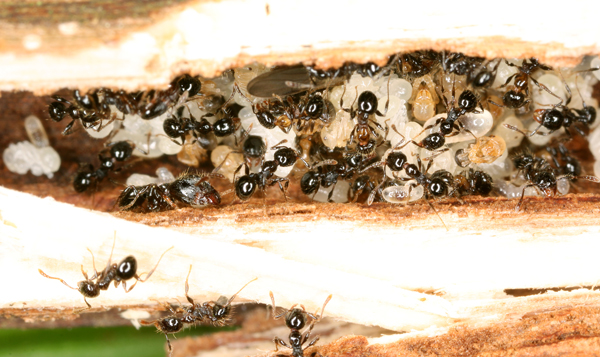
A twig nest of Pheidole sensitiva. Photo: Benoit Guénard

A twig nest of Pheidole sensitiva.
Photo: Benoit Guénard

Oster & Wilson set out to understand what regulates the varying levels of investment into the different members of ant colonies. Most inhabitants of ant colonies are functionally sterile, and in some species, there are multiple physical castes of sterile ants.

The genus Pheidole is the most species rich ant genus, and they’re found pretty much everywhere. All Pheidole (aside from a few exceptions) do something that isn’t found in many other lineages: they have two discrete sterile worker casts. They make big-headed soldiers and tinier minor workers, both of which do a variety of work for the colony. Some think that this dimorphic worker caste, and potentially the flexibility tied to its production, has enabled these ants to not only become ecologically successful but also to diversify.

Anyhow, Oster & Wilson made a number of predictions about the adapability of the ratio of soldiers to minor workers in Phediole colonies. One of their big testable predictions, or perhaps it could be seen as model to be falsified, is that the colonies actively adjust the ratio of soldiers to workers in response to environmental challenges.

It entirely makes sense. If a Pheidole colony is in an environment that requires more soliders, they would make more soldiers. Right? The problem is, despite a lot of looking carefully at Pheidole colonies, this wasn’t found. Finally in the mid ’90s it was found in the lab of Luc Passera, that P. pallidula colonies made more soldiers when they were exposed, without contact, to neighboring colonies. When I say it was found in the lab of Passera, I mean it happened physically in his lab. These were captive colonies.

A similar thing was found in the field in 2002, when I and Jeb Owen published a paper showing adaptive soldier production in another Pheidole species. (Also, my labmate Samantha Messier did the same thing before the Passera group, in a field experiment involving Nasutitermes termites and a machete.) Our studies were done in the field. In my experiment, when I put clumps of supplemental food in the field for months on end, the food was defended by soldiers, and in a short time colonies made more soldiers.

One thing I didn’t mention at the time, though, was that I didn’t find adaptive soldier production in a whole bunch of other species. However, I had less statistical power, and it was the most common species that showed this pattern. Maybe the less common ones did, but it was harder to detect.

If you were to ask around and dig into the literature, you’d see that it’s pretty clear that most species of Pheidole actually do not overtly shift their caste ratios when you mess around with their environment. Not every colony produces the same ratio, but a systemic environmental manipulation doesn’t cause an increase. Other than the two papers I just mentioned, I don’t think anybody else has found adaptive caste ratios in Pheidole. Others have looked, but it hasn’t emerged very clearly.

So, if most species just don’t ramp up and ramp down soldier production in response to the environment, what controls soldier production? For decades, there has been a consistent amount of work asking this question from behavioral, physiological and developmental angles. In the course of all of this excellent work (a lot of it being done by Diana Wheeler, Fred Nijhout, and their associates), we’ve made a lot of progress in understanding how colonies regulate their activity and how development is regulated through genetic, biochemical and physiological mechanisms.

One thing that I’ve always wondered about is, why do some species produce more soldiers than others? I’ve cracked open lots of twigs, and the numbers of soldiers are highly variable. And my experiments have shown that most species don’t obviously change their soldier production in response to environmental changes. There has been lots of great work to understand variation within a single species, but interspecific comparisons have been scant.

I can understand why there hasn’t been much comparative work. Measuring caste ratios of entire colonies can be hard. Find a Pheidole colony in the back yard and compare the number of soldiers and workers. See, not easy, huh? You’ve got to dig them up. Unless, of course, your backyard is a rainforest. In that case, you just pick up twigs. Over the years, I estimate that I and my students have picked up over 106 twigs over the years. Thousands of these have had Pheidole colonies inside. The rainforest is diverse, so I have data on many species. How do they compare?

Well, I learned that the caste ratios were different among species. Some species produced way more soldiers than others. Considering that we know so little about the natural history of these species, there wasn’t a great basis for comparing many of these species to one another. But one thing we could examine, quite easily, was body size. And, as it turned out, that was super-duper predictive of solider investment. Smaller species produced more soldiers than larger ones. When this pattern emerged on my laptop, it was one of those moments of elation that are very cool, but then you don’t have anybody with whom to share.

Then, I dug through the literature so see if the information that we had about caste ratios and body size shows the same pattern that I found in my rainforest. It turns out that the relationship is as identical as you can get. Our local scale pattern recapitulated Pheidole from around the world, and across the phylogeny.

Now, if you ask someone, what controls soldier production in Pheidole? You can say the answer is quite clearly body size. How and why does body size control this? There is some cool work that’s been done on this intraspecifically, that presumably is a mechanism that works more broadly.

How did my discovery of this generalized relationship come about from avoiding models? If you look at the work on soldier production, ever since Oster & Wilson published their monograph in the 1970s, there’s been a strong emphasis on modeling the mechanisms that trigger and regulate soldier production. Meanwhile, nobody before me bothered to step back to look at the big picture and ask, “how are species different and what is predictive of that?” If they did, then they would have found the caste ratio data in the literature as I had, and looked at the most obvious predictor: body size. Others were modeling solider production. I was merely trying to find a pattern.

I’m not claiming that the discovery of this pattern is earthshaking or that it explains mechanistically how colonies make more or fewer soldiers at the proximate level. The main take-home message from this paper is that many of the differences we find are driven by constraints rather than by adaptation, or that selection on body size is coupled with selection on soldier production. This leads to a lot of exciting thoughts about community structure, which we’re now working on.

This work by no means diminishes all of the careful experiments that others have done over the years on Pheidole. Though I’m not a developmental biologist nor as much of a behaviorist, I was able to find something that will be (or at least, I think should be) at the basis of future conversations about the evolution of caste ants.

This is why my choice is to keep asking “What is the pattern?” rather than attempting to model patterns.

What it takes to get tenure: ambiguity of the teaching criterion

Standard

Getting tenure at a teaching university might be harder than getting tenure at a research institution.

If you don’t like that concept, then try this similar concept on: what you need to do to get tenure at a teaching-centered institution is far more ambiguous than what you need to do at a research university. One could argue that it’s easier to get tenure if you know specifically what you need to do. At most teaching schools, exactly what you need to do to get tenure is vague at best.

In one, you need to convince the faculty and administration of a teaching university that you are excellent at teaching. In the other, you need to convince the faculty and administration of a research university that you are excellent at research.

At research institutions, when you interview for a job, it is typically spelled out exactly what you need to do to get tenure: grants, publications, and train doctoral students. At most places, you’re given a neighborhood of a dollar amount, or a certain set of grant agencies and number of grants you need, and a number of publications in journals with a certain tier, as first and senior author. There may be some subtleties, but when you’re coming up for tenure, it’s clear based on the numbers whether you’re approaching that threshold, and you should be well aware if you are shy of the mark or have well exceeded it. If you’re marginal, then you know that you’re marginal.

The notion that teaching counts in hiring and tenure decisions at research universities is a sham, as recently pointed out by Alex Bond at The Lab and Field. If you’re at a research institution, being a horrible teacher won’t hurt your chances at tenure and being a fantabulous teacher won’t help your bid for tenure. (If you are unliked or extremely popular, however, and your case is marginal, then teaching performance could be inserted as a surrogate variable to help swing the review one way or another.)

At teaching institutions, the story is entirely different.

At your on-site job interview, I wish you luck trying to get a wholly quantitative description about what it takes to get tenure. Typically, you need to be “excellent” at teaching, and “excellent” at either research or service, and mighty good at the third. I think that’s the answer I got at every single one of the 10 or so teaching campuses where I’ve interviewed over the years.

You know how teaching doesn’t matter at research schools? Well, the converse isn’t entirely true. Research does matter at teaching schools, though there may be a lot of flexibility about what counts as research. At lower-ranked institutions, “research” might not necessarily involve publications or external funding, if you really like someone’s teaching. It could just involve keeping students busy in your lab outside of the curriculum and having some of them get into grad school.

Some teaching campuses put specific numbers on publications, which in my experience has ranged between 0-6, with no real specification of impact factor. The expected publication rate before tenure is negatively associated with teaching load, but this relationship has only a moderate correlation. Most places expect you to submit a grant but aren’t horribly put out if you aren’t funded. The research criterion is pretty clear-cut at teaching campuses, and there is also fudge room because it’s not the primary criterion.

Then, what constitutes excellent teaching? Most campuses go with a Supreme Court Justice Potter Stewart kind of definition.

Knowing excellent teaching when you see it isn’t a good way to decide whether someone gets tenure, is it?

How do most people judge excellent teaching, when they are required to make such a judgment? A student of human nature would suggest that it is identified by how much it resembles the practices of the observer. I’ve never met a full professor who didn’t have a moderately high opinion of their own teaching. And we’ve all met plenty of full professors who couldn’t teach their way out of a bag. This does not bode well for effective tenure decisionmaking. (By the way, is the Bush neologism ‘decider’ now a replacement for ‘decision-maker’?)

In practice, there are many factors that are included in the quantitative and qualitative measures of teaching performance at a teaching campus.

The drawback to all of these quantitative and qualitative measures is that they all suck, or at least have poor resolution.

Let’s go over them one at a time. Keep in mind that no school uses all of these measures in concert.

Teaching evaluation forms There is a whole subfield in education research on this topic, and I’m not going to let this site devolve into a bitch session about teaching evaluations. Really horrible instructors get horrible eval scores, and amazingly perfect instructors get high scores. What happens for most of us, the professors in the middle — ranging between not-so-good and run-of-the-mill excellent — is really murky.

At my university the forms are called PTEs: Perceived Teaching Effectiveness evaluations. The key word here is “perceived.” Are students good at knowing whether their instructor is effective? Often, yes. However, there are a huge number of systematic biases that go along with these forms, suggesting that we need to avoid using the numbers in a comparative fashion. Upper division courses have higher scores than lower division courses, which have higher scores than non-majors courses. This might be independent of teaching effectiveness. There are age and gender biases that affect student perceptions of effectiveness, and associations between the grades received by the students and the perceived effectiveness of the instructor are not necessarily causative. How you dress in the first weeks of class can really matter, too. From discipline to discipline, mean evaluation scores are quite variable. If you want to measure improvement in the same course, with the same professor, with the same student demographic (including time of day the course is taught), then this might be a good measure, at a coarse resolution.

If your tenure case is being evaluated at the level of the college or the university, and your scores are being compared against colleagues in other disciplines, or who teach different kinds of courses, that isn’t fair. I don’t know of a campus that specifies a specific threshold score for evaluations (at least officially), and that is a good thing. However, unofficially some campuses or committees are expecting scores to be above a certain level. If that’s the case, then faculty need to learn the little tricks to make sure they don’t do things that cause students to lower their scores. (That’s a whole other set of posts.)

Written remarks by students The voluntary responses by students on evaluation forms are potentially telling. Students can offer specific and useful praise, and also tell damning stories that very clearly can explain instructor performance. Recurring similar comments by multiple students are particularly valuable. However, most student responses are idiosyncratic and it’s very difficult to distinguish between a student with a legitimate grievance and one who is bitter about their own performance.

Classroom observations Faculty members in the department may be requested or required to sit in on a certain number of hours or lessons before offering a recommendation. These observations are effective so long as the observer is capable of identifying effective instruction. This is heavily subjected to the biases of the observer, especially as scientists typically have no training in teaching methods. For example, when I was a junior faculty member, I made sure to implement the methods of active learning in science instruction that I learned as a graduate student in the College Teaching Certification program and as a Preparing Future Faculty fellow. So what happened when I was observed by my senior departmental colleagues sizing me up for tenure? I’ll always remember this, word for word: “You need to be less Socratic and lecture more. You should be using powerpoint and use more detailed information.” Never mind the fact that all of the current research on science education told me to do the opposite of what they said. After all, these professors were the ones evaluating my tenure file. So, when they were in my classroom, I had to lecture, even though I knew this was an ineffective approach.

How could classroom observations be effective? The people doing the observing could know what they hell they are doing and could be well trained in evaluating effective teaching. This happens in public schools. In the state of California, to be come a fully credentialed K-12 teacher you need to go through an evaluative induction process, the Beginning Teacher Support and Assessment (BTSA, pronounced “bitsa.”) To be a BTSA evaluator, you need to be trained to observe and score the performance of teachers, and this training process involves a calibration of standards and a long list of specific criteria. One BTSA evaluator observing one set of instruction comes up with a score very similar to any other BTSA evaluator; that’s the way the system is built.

What about teaching-centered universities, how do senior faculty do their observations? They show up, if they care to spare the time, and they then may fill out a cursory form if one exists, and then include whatever observations they choose to include or not in their letters. I can’t think of an evaluation that is more subjective nor disconnected from whatever objective measure that could exist. (I’m not saying that I’m any less guilty than anybody else, mind you. Of course, most faculty would be peeved at the notion that they need to be trained to recognize good teaching.) Regardless, in some teaching schools, classroom observations aren’t a required or even optional component of the tenure portfolio. Oftentimes, the only thing that tenure committees know specifically about what happens in the classroom is by hearsay from students.

I was impressed that once, my all-time favorite dean chose to sit in on my classroom for half an hour, and when he wrote the letter for my file he referenced specifics from what he saw in my classroom. He didn’t do this for lack of being busy, and I appreciate the time he spent in directly evaluating me.

Assessment data Perhaps we could look at student performance using assessment data, looking at student knowledge before and after individuals pass through your course. These kind of assessment data aren’t common, and anyway, most science faculty are in full rebellion against regional accreditation agencies that are requiring assessment in curriculum design, and using assessment data like this could actually annoy some faculty members who might think that you’ve gone over to the dark side of assessment. I suppose you could use these numbers but just not call it assessment and maybe get away with it.

Student letters I think few campuses do this, but it happens in my undergraduate institution. I was asked by my college to write letters of evaluation for faculty members in whose courses I was enrolled. The college requests letters from some students who are listed by the faculty member, and also randomly (or perhaps haphazardly) selects other students from rosters of recent courses. I imagine that these letters would be a lot more informative than whatever would be in student evaluations. They do this for both tenure and promotion to full professor.

Hearsay It is stunning how students are willing to discuss my colleagues in front of me, as long as I’m not involved in the conversation. Just the other day, I was in my lab sorting ants, and some of my research students were going on and on in great detail about an instructor in our department, who is a close colleague of mine. There was a mix of criticism and praise. They were talking like movie reviewers or restaurant critics. I wasn’t involved in the conversation, but I was sitting easily within ear’s reach where they were saying all kinds of things about my colleague that they would never say directly to this person. This kind of overheard conversation happens all the time, especially if you’re teaching lab sections. It’s unprofessional of the students to do this in front of other professors, but I guess they’re not professional. I arguably have more indirect information about my colleagues’ teaching from this route than any other. If I believe most of what I hear, by the way, then most people in my department are incredibly awesome. Regardless, this isn’t a valid source of information for evaluating teaching performance, though I imagine that in some environments this is probably the source of information with the greatest sway.

External evaluations Research universities require external letters from experts in the subfield of the tenure candidate to evaluate their tenure file. So, teaching universities must get outside experts to evaluate the teaching of candidates in their subfields of expertise, right? Ha! That’s a good one!

What it takes to be “excellent” at teaching is being able to convince the other faculty in department that you fit that label. Faculty use a variety of information sources, including not not limited to the information above. Ultimately, the assessment is a holistic gestalt-based system. Kind of like how honey bee colonies use guard bees size up the pheromonal composition of bees landing at the nest to decide if they belong, academic departments work the same way. If you don’t fit in, then the guard bee will pounce on you.

The biggest way to not fit in is to not teach well.

However, another way is to teach well, but teach differently.

It’s often said that tenure is about “fit.” Some people say that’s vague: how do you define fit? It’s nothing that needs any special definition. Either you fit in or you don’t. Either you have the same values and the same approaches with respect to education, or you don’t.

This is why it’s sometimes hard to get tenure in a contentious department (read: snakepit) in a teaching institution. Even if you’re careful to not take sides in any weird departmental politics, everyone involved in the tenure process will be called upon to assess your teaching. This is going to involve a meeting where your teaching is discussed. If the department has divisions about teaching philosophy or approaches, this will emerge in the criteria used for evaluations. If one side really likes what you do and explains why, then the other side might end up in disagreement. This is not good. You can ameliorate this by how you sell your teaching approach in your tenure file. You don’t want to make the mistake of arguing that you have worked hard to find the most effective approaches to teaching and that your assessments show that students learn effectively. What you want to do is communicate that your teaching fits in with your department, and that you have worked collaboratively with your colleagues so that you have learned how to teach well from them. You don’t want to say anything that is overtly contrasting existing practice, because, ultimately, the people in charge of deciding whether your teaching is excellent will compare your work with the template of their own work. Just like guard honeybees that use their own smell to decide whether to reject outsiders.

Even if you have a history of demonstrating teaching excellence at a teaching institution, a fresh pair of eyes with a different perspective, or a different agenda, could look at the same record and come up with a credible argument that the record fails to demonstrate excellence. Without anything changing, the environment can shift so that what is perceived as “excellent” in one year might not be acceptable the next year.

This is different than research institutions, I think. It’s harder to argue against grant dollars and a list of publications on a CV. You could argue that the journals aren’t of a high enough impact or that the grants are from the wrong agency, but the research bar at a research institution is far, far more tangible than the teaching bar at a teaching institution.

I would guess that if you are unambiguously above the bar that’s been set for you for research productivity and funding, and you haven’t entirely botched something else, you should be golden. Even if there are academic disagreements about your work, if you’ve got the grants and published in the right journals, then that is likely to be fine. This is particularly the case if you’re at a unionized institution, in which the tenure process is more transparent than at an institution with an opaque process with secret information, because the faculty lack the power to make sure that the process is fair.

Of course, at nearly all universities, tenure rates are quite high, except for a few Ivies that have a de facto policy of hiring Assistant Professor positions as glorified 7-year postdocs. When people don’t get tenure, it might be because performance is not up to snuff, but it can also happen because the department is toxic or incompetent. Other crazy stuff can happen, too. Regardless, the lack of specific quantitative criteria in the teaching criterion create an element of hap into the process that makes it less predictable, which makes it a source for anxiety if not a source of difficulty.

In short, the amount of work it takes to be an excellent teacher doesn’t necessarily correspond to the amount of work you have to do to get tenure at a teaching institution. To do that, you (most likely) have to be an excellent teacher and you also have to do the work to convince your colleagues that you are. In some places, this is harder to do than others. In some places, you don’t even have to be an excellent teacher, as long as you are able to create that perception. There’s the rub.

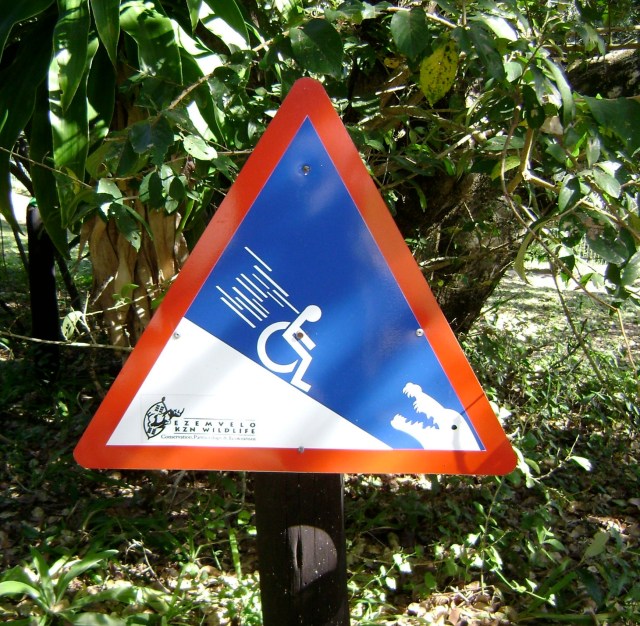
Not using the microphone at conference talks

Standard

In some humanities fields, when you present a paper, that’s exactly what you do. You stand at a microphone and read your paper, word for word. I’m glad that none of those conferences are in my plans.

Nevertheless, scientific conferences are more formal than our normal teaching milieu. People dress up a notch nicer than usual, and there are people being paid to do things on your behalf, like set up A/V equipment.

One of those slightly formal things about conferences is that every presentation space has a lectern and a microphone. The convention site that sets up the rooms for the conferences assumes that all speakers want to stand at a lectern and use a microphone for their speech. For all the organizers know, the presenters might be those people who go up with a manuscript and read.

But we’re not those people. We have no reason to stand at that lectern and speak into the mike. It’s as formal as we want it to be. Why don’t we ditch the formality?

Keep in mind that these rooms are not that much bigger than the larger lecture halls on your campus. It’s just a fancier affair at a conference, so you get a superfluous lectern and a superfluous microphone.

As I teach plenty, I have experience holding forth to a crowd. At a conference, why don’t I apply what I’ve learned from that part of my job? I do find it heartening that people sometimes mention after my talk, “I can tell that you must teach a lot.” They don’t mean that in a negative way, I think it’s a way of saying that I was engaging and at ease. I appreciate the compliment when it happens. I’d rather talk about the science, but it’s still friendly.

When speakers are introduced by the moderator, they see the lectern, and the microphone at the lectern. The default mode is to stand up there and speak into the microphone. The next speaker follows the example of the prior speaker. It befits the formality of the occasion in some way.

But, really, it’s absurd. Nobody is being done a favor by using a microphone in a space that doesn’t require it, and acting like what you’re doing is the most important thing in the world. It’s just a 15 minute presentation. Make it fun, explain why what you did is awesome, and talk about it casually. You want to be professional and show that your work is of high quality, but you also don’t want to be uptight. The entire genre of conference presentations is uptight. You don’t have to be a part of that.

Standing at the lectern with microphone is inherently awkward, because none of us are used to standing at microphones and talking for extended periods. You have to try hard to not be awkward in those circumstances. Why not give your talk in a way that doesn’t necessitate the avoidance of awkwardness?

I’m not the kind of guy that is typically invited to give a keynote or headline a large symposium, so I’m not speaking in cavernous spaces. I think I’ve only spoken twice in venue in which a microphone actually was needed for everyone to easily hear me. Granted, I’m not a quiet guy.

Other than that rare circumstance, I ignore the lectern, ignore the mike, and get up and talk just like I’m teaching a class. (The only difference is that when I’m teaching, I try to not talk, because when someone is talking to you, learning is less likely to happen. Which is probably why a few weeks after a conference, I couldn’t explain one of the talks with any detail.)

Get up, move around. Instead of a laser pointer, walk up to the screen and point with your finger. It’s more engaging. You don’t want to present your research, you want to teach the audience newly discovered information. Talk about it like you’re talking to your own class about the latest finding in the news. This starts with ditching the lectern.

Teaching efficiently: the muddiest point

Standard

I mentioned earlier that I sometimes start classes with short ungraded written quizzes.

Now, I’ll tell you how I sometimes end class: a ‘Muddiest Point Evaluation.’

If I have one minute at the end of class, I ask everyone to take out a piece or shred of paper. I ask everyone to write the ‘muddiest point’ in class – the single thing that happened in the class period that made the least amount of sense or had the biggest unanswered question. If any students say that they are 100% hunky-dory with the entire lesson, then I ask them to write that fact down and turn it in.

I try to do a muddiest post especially when we’re going over conceptually abstract material, or if the lesson is more densely packed than usual.

After browsing through the muddy points that I received, I spend some of the time in the next class clarifying things, doing a new activity to clear up something that I thought was done but wasn’t. Sometimes there are just very quick questions that I can answer in five seconds. Recurring trends in the muddy points among several students might indicate that part of the lesson was unsuccessful and needs a new approach.

This is important for me to do once in a while, because sometimes I find out at the end of class that some concepts that were obvious me went entirely over the heads of my students. It’s better to learn this right away, rather than find out while grading an exam. If it’s important enough to bring up in class once, it’s important to make sure that people actually learned it. (If it’s not, then perhaps you shouldn’t mention it and reduce the amount of pointless content in your class?)

This activity, including the name “muddiest point,” is taken straight up from the Angelo & Cross Classroom Assessment Techniques book. Some of the many techniques in there work for me, and some don’t, but it’s a great browse. Some techniques in the book are far more efficient than others, but they’re all good food for the mind.

Advice on whether to do an M.S. before the Ph.D.

Standard

If you have undergraduates who are thinking about doing a Ph.D., they may be seeking advice about how, or whether, to do an M.S. first.

I’m in a field in which the M.S. is entirely optional. Some people have ’em, and many don’t. (I don’t.) Many folks have strong-ish opinions about whether or not doing a Master’s is good. Some say it’s good because it helps you hone your experience, get into a better lab for the Ph.D., and results in a higher quality dissertation research. Others will say that an M.S. could be an unnecessary, financially and temporally expensive detour that might result in a subpar experience. In addition, sometimes students get trapped in M.S. programs for a long time, as many M.S. granting institutions like to treat their graduate students like the Ph.D. students that they can’t train.

Here’s my suggestion for those who are about to advice a promising undergraduate for or against the M.S.:

Throw your experiences and biases out the window.

There is no generalized reason why an M.S. degree is, or is not, a valuable precursor to a Ph.D.

The reasons that a Ph.D.-bound student should pursue or avoid an M.S. are entirely individualized, based on a given student’s experience, aspirations, and opportunities.

The things you need to take into account in this calculation are many, but they pertain to the student and not any generality that you might have to proffer. These include:

  • How difficult it is to get into a good lab for the PhD
  • Whether professional success in the subfield is associated with having an MS
  • Whether the student can afford the MS financially
  • Whether the experience of the MS would alter the decision to do the PhD
  • The specific program and lab that the student would go to for the M.S.
  • Whether the student has temporary geographic constraints
  • Whether the student has a realistic idea about what life is like in a PhD program
  • The presence, absence, or specifics of the student’s career plans
  • Whether the student’s probability for success in the PhD would be altered by having the experience of an MS
  • and I’m sure there are may more

You know your students well, or at least you should know them well. Dispense your advice on what they, in particular, need and what is in their best interest. Everybody is different, and the landscape is constantly evolving. What worked for us, just a few short years ago, can’t be used much to inform contemporary decisions.

“Student quality”

Standard

When you are sizing up the teaching part of your job, what is the role of student quality?

I often hear other scientists talking about how they enjoy the teaching part of their job when they have high quality students. They are successful teachers when they have high quality students.

I also hear professors sympathizing with other professors who report that they have poor quality students in their classes.

These conversations make me want to barf.

What the hell is a “quality student?”

I won’t say anything about a person behind their back that I wouldn’t be willing to say to their faces, admitting that at times it could be an uncomfortable conversation. Would anybody be willing to say to their own students that they are of low quality? Clearly, students can do low-quality work and have a low-quality investment. (Actually, I just said this last week to my class after slogging through some lackluster exams.) Are these students, themselves, poor quality?  I feel like I shouldn’t have to say so, but maybe I do: of course they aren’t.

When people are talking about student “quality,” they could mean a variety of things. They might be thinking about how smart the students are (whatever that is), how hard working they are, or how motivated they are to learn.

All of those variables change given the context. Some students will not work hard at all in some classes, but work hard in others. Some students will be disinterested in some classes but be fascinated by others. I suppose the “high quality” students are the ones that will work hard and be fascinated regardless of the context.

In other words, high quality students are the ones that would learn even if they had a poor quality instructor.

If you have traditionally “high quality” students, it doesn’t matter if you teach well. Do you really want that kind of job?

Clearly, if our classrooms are filled exclusively with bright, hard-working and inquisitive students who are always willing to learn, then our jobs would be really easy. In fact, the students wouldn’t need us other than to assign readings, play videos of lectures and have labs set up for them. We wouldn’t be required as teachers because they would be all ready to learn whatever is put up in front of them. I guess that’s a high quality student – one who is the least amount of work. The one who always understands and always does perfect work.

If that’s the case, then I don’t want these high quality students who are easy to teach. I want to be the person that made a difference in the life of another person. I want the students who come into my classroom to be the ones that don’t think that biostatistics matters, or not really caring much about the mechanisms of climate change. When I am successful at the end of the semester, which means that my students are successful at the end of the semester, I want it to be because of the quality of my work. I don’t want to preach to the converted, and I don’t want to spend an hour in class on a lesson that the students could have learned for themselves. I want the students who couldn’t just sit down in a MOOC and take it all in.

It means that all of the time and preparation that I put into my lessons actually matters.

Perhaps, some might think, that with classic “high quality” students, highly effective teachers can take things to extraordinarily high levels so that their students excel far beyond what any lesser “quality” student could ever imagine. If you are thinking that way, then please stay away from the classroom. You need to enter the room thinking that every person has unlimited potential. If you start out assuming that some students aren’t capable of extraordinary achievement, then you’re never to going to expect or get it from them. You need to expect the outstanding if you’re ever going to get it. And you need to expect it of everyone. Once in a while, I get outstanding from students that who have already been written off by everyone else. Now that is a quality student. And I have that opportunity every time I enter the classroom.

By the way, why is it that some of the most famous experts on science teaching come from universities that only admit students who earned top notch grades in high school, and mostly from private schools and public schools in wealthy school districts? Do their experiences with white middle- and upper-class students really reflect how education works for everyone else?

Almost none of the students in my university would be able to land admission to a highly selective institution, in part because of their social class but also because of their performance and preparation.

How I do I feel about teaching students who could be labeled as “poor quality?” I love it. There’s nothing better. I have unlimited opportunity to make a difference, and every day I am challenged to inspire and create a need for understanding. If you want to teach well, then how do you know you’re even capable of doing so if all of your students are pros at learning?

If you are teacher by profession, and all you want to do is teach “high quality” students, then you’ll never master your craft.

Overhead rates on grants, and prize money of the Royal Navy in the Napoleonic Wars

Standard
he Action and Capture of the Spanish Xebeque Frigate El Gamo, by Clarkson Frederick Stanfield

The Action and Capture of the Spanish Xebeque Frigate El Gamo, by Clarkson Frederick Stanfield

People who aren’t used to writing and running federal grants aren’t probably that familiar with how overhead works. For every dollar you bring in to do work with your grant, your institution gets an additional percentage from the federal agencies, which covers all of the indirect, or overhead, costs of running the grant. So, a project that directly costs $200,000 actually will bill the feds $320,000, if your overhead rate is 60%. There are additional complications, but that’s the gist of it.

At research institutions, overhead rates are typically > 50%, and sometimes much much higher. Teaching schools typically have lower indirect rates. My campus’ indirect rate is 42%. My previous university had an even lower one, which was only applied to salary. That’s a relative pittance compared to the 67% rate of Caltech, which also includes hefty salary fringe rates on top of overhead.

This money isn’t trivial. Most research institutions use it to stay afloat. Which is why universities value, or at least don’t eliminate, faculty members who bring in big grants.

In theory, overhead pays for lab space, equipment, maintenance contracts, electricity, computers, printer toner, photocopies, technicians and stuff like that. It’s entirely reasonable, at least in concept.

When funding gets tight, like it has been for a long time, some PIs gripe that high indirect rates make it harder for grants to be funded and result in smaller budgets. A good rebuttal comes from Prof-Like Substance. He points out that a lot of complaints about overhead are overblown, and no matter how you slice it, the money comes out of your grant one way or another.

Where does the overhead go, and who makes these decisions? Does it just enter some university general fund? No way. It gets divvied up among various fiefdoms. The president and the heads of financial stuff, who pull in unreasonably huge salaries, decide who gets various pieces of the pie, and the different sizes of those pieces. From the perspective of the scientist, how the pie is cut is entirely non-negotiable. You’ve got to wear a suit, drive a luxury car and work 9-5 to buy into that kind of conversation.

When comparing how the overhead pie is cut across different campuses, I’ve found that there are remarkable inconsistencies, and that some indirect allocation rules are very idiosyncratic.

Despite the differences among campuses, the entities that get a piece typically include:

  • The Campus office that runs awarded grants (post-award)
  • The Sponsored Research office that works on getting grants (pre-award)
  • The President
  • The Provost/Academic Affairs
  • The Dean/College
  • The Department
  • The PI who landed the grant

Everybody loves these indirect costs returned from grants because they have few or no restrictions. I’ve got a returned indirect account and I can spend it on pretty much any research-related need I have. That’s a good idea to get indirect back to the lab of the PI, because so much of the research that happens in the lab can’t be paid out of grants, which aren’t supposed to be spent on office supplies, for example. This isn’t a minor issue. There is no budget within my department that can be spent on toner for the printer in my research lab. And I’m not allowed to spend NSF money on stuff like this. It has to come from overhead, or some other creative source.

Under the salary of the university, our administrators send us out to compete for our share of federal funds to make our labs run. Getting the grants – the direct costs themselves – is merely part of our job and we are always expected to do the research, as that’s part of our job. However, the grants that we land also come with indirect, which funds the university to make it run.

Indirect is a kind of addictive gravy that comes poured over research grants that makes universities even more hungry for grants. I’ve never met a person in charge of stuff that didn’t love it when a grant comes in. Tell your administrator that you just two big-time publications and won a big non-monetary award. You’ll get a nice smile. Tell them you got a big grant. Then, they’ll be over the moon, and then ask for reassurance, “that comes with full overhead, right?” Administration can get bloated feeding on this gravy, if they don’t spend those calories where they need to be spent.

A similar phenomenon occurred within the British Navy during the Napoleonic wars a couple hundred years ago.

The allocation of indirect costs is surprisingly reminiscent of how the British Navy divvied up the spoils of war.

Whenever the Navy captured a vessel from another navy at war with England, the contents of the ship, and the ship itself, would be sailed back to England and sold. They also did this to any merchants allied with enemies, as well as privateers commissioned by enemies. In a short timeframe, the British Navy was at war with the Dutch, the French, the Spanish and the Americans. That’s potential for a lot of profit. Just like Halliburton makes a mint when the United States goes to war, so did the leadership of the British Navy in those days. War meant profit. For these men in the upper echelons of the Navy, news of peace was bad news.

Meanwhile, the captains of these ships-of-the-line were paid a modest living wage to do their job, and were provided the minimal provisions to get the job done. They were only given enough gunpowder to be used in case they were engaged in battle, and only the most spartan foodstuff were provided for the entire crew, including officers. Many captains, who often rose to that position through social connections, came from families with independent means and were able to purchase livestock and other comforts — and politically necessary entertaining — for their time at sea, and were able to purchase additional powder from their own funds that could be used to train their crews to become accurate and rapid with cannons and carronades. That accuracy and rapidity is what won battles at sea. Winning battles at sea is what brings money.

So, when a ship’s captain takes over an enemy’s ship, he sends over a portion of his crew to sail it back to England, where the ship and its contents are appraised and sold. Then, this prize money gets divvied up. Prize money was awarded even when the enemy’s ship was sunk. The Admiralty decided how this pie is divided. Who gets a piece?

  • The Admiralty
  • The Captain
  • The Senior Wardroom officers (lieutenants, master, and captain of the marines)
  • The Senior Warrant officers (carpenter, chaplain, gunner, purser, surgeon, several more men)
  • Junior Warrant Officers (a greater variety of men with various jobs)
  • The rest of the crew

How did the Admiralty divide this pie among all of the combatants? The Captain himself takes 1/4 of the prize money. Another 1/4 of the prize money is split among all of the regular crew on the vessel, with more senior members getting a bigger cut. The other categories listed above get 1/8 of the prize money.

That means that 7/8 of the prize money is going to the men that risked their lives in battle, and sailed at sea in often perilous conditions. And 1/8 of it goes to the admiral that issued the order. This money doesn’t go to run the Navy. That 1/8 of prize money from every ship captured or sunk goes into the pocket of the insanely wealthy admiral that sent that ship out to sea. (If there were no Admiral’s orders, by the way, then that eighth went to the Captain as well).

How is this system similar to, and how is it different from, how indirect costs are allocated in universities?

In this analogy, the PIs landing grants are the captains who capture ships. The officers and crew of the vessel are the students and staff of the PIs lab that make the project possible. The Admiralty is represented by the string of administrators that are above the PI in the administrative food chain.

I see a few key differences between the Royal Navy and the university. A Captain who does his job successfully becomes wealthy and actually climbs into new realms of social prominence associated with that wealth. PIs who land big grants don’t get paid more by the university, other than perhaps getting 2/9 summer salary. At my institution, if a PI of multiple federal grants were to approach the Admiralty administration for a raise in salary, this PI wouldn’t get yes for an answer. All the PI gets from landing a grant is the ability to keep one’s job, or the ability to fund the research that is expected of the PI. The PI also gets a little pat on the back. At least, that’s what happens at my university.

Here’s another difference. In the Royal Navy, 7/8 of the prize money goes directly to the individuals performing the task to enable the work to take place. In universities, even if you include direct costs into this measure, far less than 7/8 of the total award is controlled by the PI. A good chunk of the spoils of successful battle grantwriting aren’t reinvested back into getting more grants and supporting the projects that landed the grants.

In universities, the Admiral’s take is overwhelmingly greater than 1/8 of the prize money. It sure is at mine, at least.

Is that a fair comparison to make, considering that overhead really needs to be spent on things that the PI needs, to keep the lights on, equipment maintained and all that? I can’t speak for what happens at other universities in any detail, but in my university, the overhead doesn’t flow downhill. Almost none of the overhead gets back to the PI or the Department.

At my university, as rumor has it, all of Academic affairs is lucky to get 25% of the overhead. That’s just a rumor, mind you. The college gets a small bit of that fraction, and the department gets an even smaller piece, and the PI gets a pittance. (I don’t know the exact percentages. I’ve only overheard things at a meeting or two, and our last administration was entirely opaque about finances and the new administration this year is still busy cleaning up the mess left behind by the last one.) It’s not as if the overhead is being used at higher levels for startup packages for faculty, or support faculty research in some other way. I doesn’t even make it over to the academic side of the university budget.

You know that overhead account that I mentioned that I can do whatever I want with? It’s got a few hundred bucks in it. I’ve yet to spend any of it, and it’s less than 1% of the overhead than I’ve generated. (Up until a couple years ago, none — nada – – zilch — of the overhead came back to the PIs). I have to admit it’s hard on the administration to get overhead back to the college and below,  because some of the biggest grants that come into the university (mostly education grants) only allow about 10% overhead costs, which I hear is what it takes just to keep the post-award office running. Some of my grants from NSF fit that description, too, because they don’t allow overhead on “participant support costs” often which are the bulk of my awards.

That said, I haven’t observed anything to suggest that indirect costs over the past several years have been spent on any kind of infrastructure to support or facilitate research. Before our new president has started cleaning things up, it’s very clear that the Admiral’s Cut, which was something like 80% of overhead I could guess, was being spent on anything but academic affairs. It looks like this is changing with our new administration. I’ll feel better when I see the trickle that just came through isn’t just an intermittent springtime creek, but a genuine perennial creek. The cartridge in my lab is only going to last out a little while longer.

If you take a step back to look at the big picture, it is stunning.

When Admirals were greedy for even more wealth, they worked to perpetuate the wars so that more prize money would come their way. In the process, they made their successful Captains wealthy and powerful in the process, and allowed for a comfortable living for the crews of victorious vessels.

Administrators of universities that pressure faculty to bring in more and bigger grants have larger amounts of overhead that they can use to fulfill their plans, and they get a boost in salary when promoted to a higher administrative levels as a result of their success, which is built on the grant-garnering skills of their faculty. What do the faculty members get when they bring in these grants? They get to keep their jobs.

When you look at the funds raised from the exploits of Naval Captains and Scientific PIs, who would have thought that the Royal Navy, with only an eighth of the spoils going to the figureheads, would end up looking more equitable than one’s own university?

Hat tip to good friend and master artist Tony Millionaire, who once left on my doorstep a fresh copy of Patrick O’Brien’s Master and Commander.

Thanksgiving; a state of the blog report

Standard

It’s now the 10-week mark since the launch of this site.

I wasn’t sure to what expect when I started, but I’m pleased at the early, and evolving, outcome.

I want to thank the scores of you that have helped out one way or another, as well as consistent readers, especially those of you who have chatted up the site with colleagues and more broadly shared posts of particular interest.

I’d like to specify thanks to a few who gave me a great push in my first moments. If I had to make a list of only three, in alphabetical order, it would undoubtedly be:

Chris Buddle of Arthropod Ecology, Jeremy Fox of Dynamic Ecology and Alex Wild of Myrmecos. Thanks, guys.

These three gents have distinct and engaging approaches to science that are useful and enlightening. If you haven’t clicked on over to their sites, please do (though odds are you’ve found this site because of them). And buy some spectacular prints from Alex, as he’s got a great sale going on at the moment.

The rest of this post is something like a state-of-the-blog address, in case you wanted to know more about the site and its trajectory. If you want a detailed look under the hood, read on.

Bloggers seem to keep their viewership numbers tight to their chest, maybe like how people don’t openly specify their weight or their salary. I don’t know if I’m violating a tacit code of honor, but here goes: To date the site has been viewed almost 20,000 times; on a run-of-the-mill day, as of this week, a few hundred people are visiting. I imagine that’s a blip compared to many other blogs, but I also expect that it’s uncommon for a blog that’s only 10 weeks old. I’m fortunate for what I think is early rapid growth. Each day, several people find this site by specifically seeking it out on search engines, which suggests some word of mouth. That’s encouraging. (There was one day when a post made the top of Reddit Skeptic. That was fun.) I’m in this for the long haul, and as long as I continue to invest, then I hope to continue growing.

In my first post, I tried to identify five characteristics of a successful blog. I think on all five marks, I’m doing well. First, I work to maintain a clear focus with a useful perspective. Second, I have maintained frequent entries, with one per day, and aiming for an absolute minimum of one substantial longer-form post per week. Third, I am steadily building a community of commenters, which is a diverse crowd with all kinds of academic backgrounds. Fourth, I think I have built up a much larger group of consistent lurking readers (I suspect), and lastly, I hope that I have maintained a high standard of writing quality. It feels that way, at least, because whenever I proof a piece I always catch screwups and typos. (I might write parenthetically too often, but that is better than David Foster Wallace’s copious use of footnotes, right?) Do I still think those five things are the properties of a successful blog? I’m not sure. My views on blogging, and this site, have evolved a lot in the last ten weeks.

I’ve evolved into some patterns that work well. Each weekday, there will be a single post, unless I feel hugely compelled to write something fresh that can’t wait (such as trying to make sense of why E.O. Wilson would tell young scientists to not worry about math). I aim to have at least one substantial and longer-form piece each week, and to make sure that every post introduces or revisit a concept that matters, even if not on a large scale. I’ll save Friday afternoons or weekends for additional posts that might be more relevant to dedicated followers to discuss things about the site (like this post). I’m planning for an ‘efficient teaching’ post weekly, and there are some other plans in the works. I’d love to hear from you via comments or email about what is working and what isn’t.

Summers will be quieter. Come late May, when I’m away doing fieldwork and on some extended travel, posting frequency will drop to 1-3 per week, but will pick back up in late August when the academic year starts back up again. I imagine that a lot of these posts will be about travel, fieldwork, student mentorship, conferences, and writing. Because that’s what I’ll be doing this summer.

If you want to be notified when a post comes out, you can subscribe to the blog with your email address, or sign onto tweet face. (In addition to the blog’s official page on facebook, you can connect with my personal facebook profile, too, using my email address. I don’t do much there and keep is mostly professional, but it’s been good for staying in touch with people.) Or you could just check in at some point in the day or week and get caught up. Or you could do a crossword puzzle instead.

Blogs are, perhaps by definition, a personal medium. I use the pronoun “I” frequently, but notwithstanding that fact I am intent on making this site about ideas, and not about myself. When I insert my own stuff into the picture, I’m doing it to serve the mission of the blog.

Broadly, my mission is to make sense of our jobs as scientists and teachers. Specifically, the mission is to represent, advocate for, support and provide a venue for researchers in teaching institutions. I’m not pleased to hold myself forth as a model, but I recognize that this is a necessary consequence of creating such a site.

Because we at teaching institutions inherently lack credibility with those at research institutions, I couldn’t have done this blog pseudonymously because part of the credibility is derived from the fact of my actual existence. Someone at a teaching school could claim that they’re a researcher, but people at R1 universities wouldn’t put much stock in it without looking at that person’s CV. It’s no accident that the CV on my lab website is being scrutinized a lot more closely now than it was 10 weeks ago. It’s not a strong CV by many R1 standards, but I hope it does show that I am a genuine researcher at a genuine teaching campus. I’ve yet to receive negative feedback for being uppity or self-centered, but the site is young. The challenge I have to face, then, is to live up to my own expectations for what a researcher at a teaching institution should look like. I won’t always live up to this, I realize.

I am aspiring to build something that is rare among academic blogs. There is clearly a niche for researchers in teaching institutions. More importantly, there is a niche for a substantial journalistic approach to writing about the relationships among research, teaching and academia. This is particularly true since Female Science Professor scaled back to a few posts per month.

I want this blog to be read by people who don’t typically read blogs. Most academics in many fields don’t read blogs, or at least don’t admit to it. I don’t know how to reach that audience. I imagine it just takes time and word of mouth. I’m reluctant to say something crazy or argue unnecessarily just to get temporary eyeballs. I realize that might slow my growth rate, but it will also help me to attract an audience that may otherwise be deterred by the general tenor found in most blogs.

I hope that this site can, at least by raising awareness, enhance the underappreciated role of teaching universities in research and academic life. If all kinds of researchers visit this site, they can examine their options and form a realistic view of what is possible (and yes, what isn’t possible) at teaching institutions. They also can adopt a more informed view of their colleagues.

The reason that I want to reach out to people who don’t typically read blogs is not (just) to gain a bigger audience. The hard-working and researchers and teachers in teaching institutions are overlooked, and this community that I want to represent doesn’t live in the internet. We work on campuses, publish in journals and make valuable academic contributions to our own fields. If I’m successful in this blog, then the conversation only starts on this site and makes a difference elsewhere, including campuses, professional societies, editorial boards, and funding agencies. Is that ambitious? Yes, it is. Is it overambitious? Time will tell. One measuring stick would be if we see an emergence of academic bloggers at teaching campuses, who choose to join the community of bloggers that now are mostly in research institutions. We’re all equivalently busy and overworked, in different ways. I want those of us at teaching schools to realize that we belong as much as everyone else.

I’m working towards that goal, of reaching out to many, by providing a broader value and respect for your time than I find in most blogs. I am working to do this by maintaining quality, focus, an absence of in-jokes, and emphasizing constructive engagement with whatever issue is at hand. I may have plenty to gripe about, but I don’t want to spend your time, nor mine, that way. I rarely have the answers, but I want to ask the right questions and get people to think about issues that might not have occurred to them before.

I suppose I should have photoshopped a picture of an ant standing at a podium with an American flag, flanked by Joe Biden and Boehner. But this is the best I could find.

Research in community colleges?

Standard

The base teaching load at community colleges is typically five lecture courses per semester. They teach nearly as much as K-12 teachers (who have the most challenging and most important job ever).

Faculty in community colleges aren’t expected to do research.

That doesn’t stop some community college faculty members from doing some research. Heck, there’s a book about it that you can read online.

As a “best practice” in undergraduate education, engaging students in research in the context of the curriculum is thought to be a very effective teaching tool. It’s much better than assigning a term paper, or doing a cookbook lab, or having a classroom discussion. Having students engage in original investigations to learn something new about the world actually helps them learn more of the information that they’re supposed to learn in their courses.

Some community college faculty have moved into the job sideways even though they were pursuing job at a 4-year campus that includes research. I know a number of faculty members that, after a postdoc, and then years of adjuncting as freeway flyers from one teaching gig to another, took a full-time position at a community college. They did this for financial and personal stability, and (I surely hope) because they like teaching. But they didn’t give up research by choice. They just wanted a steady gig and were tired of the postdoc/adjunct turntable. So, it makes sense that they’d pick up a permanent teaching slot, so if they could, especially if it was beneficial for the students.

While some research-interested faculty end up at community college, most in this profession actively chose it as a passion. These folks, if they do research within the curriculum, have the primary purpose of enhancing student learning, I would think.

I’m thrilled about the idea, if only because we get so many transfers to my university from excellent community colleges. I’d love for students to be exposed to research before arriving to us, to help us identify the ones to work with more closely.

Here’s something else to chew on. The teaching load at community colleges is a 5/5. On my campus, it’s a 4/4. That’s not really that different from a community college. This makes you wonder how our university can reasonably expect substantial scholarship from its faculty if they’re teaching nearly as much as faculty who have no such expectations of them at schools just next door. (And those campuses have more technicians running things, with bigger budgets, too.) Are public comprehensives with a 4/4 load not that different from community colleges? Well, with respect to teaching loads, sure, that does seem to be the case. The philosophy, approach, facilities and acceptability of research might vary, and these differences might make or break research programs in the long run.

Efficient teaching: ungraded quizzes

Standard

One principle in teaching is that students need consistent feedback on their performance. They need to know how they’re doing, and use these data to adjust how, and how much, they are studying for a course.

The obvious drawback is that frequent assessments take plenty of your time as the instructor — whether in the form of quizzes, exams, homework, or even clicker questions.

How can you get the benefits of frequent assessments without the drawback of having to do it?

You have ungraded quizzes in class.  That is, quizzes graded in class not connected to points.

How does that work? You have a few quiz questions (multiple guess, fill-in-the-blank, short response, whatever). Write them on the board, project them, read them out loud. Make the students write down their responses on sheets of paper.

When the quiz is over (it should take no more than 3 minutes), ask the students to exchange their quizzes with their neighbors. (If they don’t want do, explain that it’s not necessary, just a good idea.) Then, just tell them the answers and have them grade it. Now, tell the students to read over their quizzes then recycle that piece of paper. Let them know that exam questions will look very similar to those questions, and some of them might even be identical.

What makes this different from a clicker question, is that by committing it to paper and having it graded by another person, the evaluation of their performance by someone else feels more formal and it takes the perception of their work outside their own brain.

The students are getting what you need them to get out of a quiz: that they don’t get it well enough. Being able to follow a storyline isn’t the same as being able to explain the story. These quizzes are an immediate reality check for students who might be overly confident before exams.

I also explain this to my students. I explain what metacognition is, and how we have to conscious to think about what we’re thinking about (sensu David Foster Wallace), and that this kind of external check for understanding will give them what they need to know to do well on the test.

I usually do this right at the start of class, because there’s something else that takes 2 minutes that I tend to do at the end of class. More on that another week.

A related factlet: this is a book that lives on my shelf about measuring student performance that I have consulted periodically over the last 12 years. It has lots of good ideas.

“Release time” vs. “Reassigned time”

Standard

Words matter, because words dictate how we think. Our brains think using words to organize ideas. Language and reasoning are coupled together. (Yes, I know some linguists that disagree.)

Here’s a example from our own realm that matters to me.

Faculty members can have their responsibilities partially shifted away from teaching to other obligations. For example, one might be the chair of the academic senate, or serve as departmental chair, run a campus center, or conduct externally-funded research. These responsibilities result in a reduction of the teaching load, to make time available to fulfill other service or research obligations.

I usually hear this shift of effort called “release time.”

That terminology bugs me. This phraseology implies that faculty are being released from a responsibility. That is not the case. The responsibility is being shifted partly away from teaching and partly towards service or research.

Nobody’s getting “released” from anything. Nobody’s getting away with anything.

In fact, in nearly all so-called “release time” assignments that I’m familiar with, the amount of time and effort required for the new task well exceed the teaching assignment from which the faculty member was “released.”

This is why I use the term “reassigned time,” because it more accurately reflects the arrangement at hand. If we give in to the term “release time,” then this gives a false impression to those who have the power to grant or deny this reassignment of your time. While we all rationally know that “release time” is still just as much — and typically more — work, the terminology works in insidious and subconscious ways.

So, when you’re negotiating for time to do an externally funded project, don’t call it release. Call it reassignment. It’s not only more accurate, but it might even increase the chance of a favorable decision.

Glamour publications: the view from a teaching campus

Standard

The academic publishing environment is being undermined by a bunch of extrinsic and intrinsic forces.

One such force is the genre of academic glamour magazines. They have massive impact factors that allow you to make a big splash when you land a spot inside one of them. Sometimes genuinely huge discoveries and advances end up in Science, Nature, Ecology Letters, or Cell. But most of what appears in these venues is a big sexy idea that doesn’t have any real lasting value. If science were nutrition, then this is junk food. It’s yummy, and it is dressed up with everything to make it exciting and yummy, but rarely is there substance.

For those running labs in research institutions, the perceived wisdom is that you should be publishing in a glamour magazine once in a while.

For those of us at teaching campuses, the perceived wisdom is that you should be publishing once in a while.

There are increased calls for principled stands against glamour mags. For those who stand too firm on principle and avoid any whiff of careerism when choosing a journal, Physioprof pointed out last year out that you’re probably in a position of privilege if you’re saying that. I like Drugmonkey’s attitude, to subvert the system by being entirely reasonable. Among these reasonable ideas: don’t cite glamour mags unnecessarily; don’t not publish a result because you can’t get it into one of them; as a reviewer, keep the standard crap out of them and support excellent work by your colleagues when you get it for review.

At teaching institutions, we approach this issue from an entirely different perspective. We rarely review for those venues, and typically don’t submit to them either. (I’ve submitted to Science/Nature a few times and reviewed a few times.) This suits institutional expectations. Landing a paper in a Science or Nature would be an immense coup. Few, if any, on campus would ever think of this as a gimmicky paper, though the rarity of it wouldn’t be fully appreciated. (The only person that I’ve ever worked with at a teaching campus who had one of these papers during my time actually has an overall below-par publishing record.)

These are glamour magazines because they are a flashy thing that impresses, because of the rarity itself. Gold and diamonds are valuable because there isn’t that much of them, or because they are difficult to access. Likewise, it’s hard to get into glamour mags, so that’s what makes them flashy. These papers themselves don’t communicate the value or prestige of a research program, they’re just the flashy pieces of ornamentation that are necessary.

What, then, is truly glamorous on a teaching campus? The answer is publications. Lots of ’em. The reason that this is glamorous is also because of its rarity. While many people publish on teaching campuses, status and glamour comes from doing it in high volume, because so few are able to do this. This is true even if the venues are not highly regarded, and even if the papers don’t end up being cited. If you want to show off your bling on a teaching campus, five papers in obscure regional or highly specialized journals actually seem more impressive than one paper in a top-notch journal. The people who are arbiters of your reputation on campus might not be able to assess publication quality, but they sure can assess publication frequency.

I make a point to publish in which I consider to be venues appropriate for my work. I avoid merely descriptive or confirmatory work without introducing substantial new ideas, so I try to avoid journals that mostly include this kind of work. I could change my focus and crank out many more papers than I do, in lower-impact journals, but that would harm my credibility in among my scientific peers even as it would increase my profile on campus. Some other scientists manage that tradeoff in different ways, of course. I’m not overly concerned as long as people work on their passion, and make sure that it gets shared with the world.

What is the distinction between publishing for glamour and publishing for genuine impact? It’s probably the same distinction between measured “impact factor” and and long-term citation rates.

Transparency in research: publish your reviews

Standard

When it comes to reform, and “reform,” it seems like most people think they know the fix, regardless of the problem that needs to be fixed.

For example, many people have strong opinions about how to solve the public education crisis in the U.S. What most of the people pushing for “reform” have in common is that they have little experience or success in public education. Solutions to a problem might involve fewer taxes, more taxes, more investment, less investment, more regulation, fewer regulations. It all blurs together.

It’s not too often that you hear someone in a position of ignorance say, “I’ll defer to the education experts.”

For some problems, there are self-evident partial fixes that don’t need any discussion, because the people who are wrong on the issue are straight-up ignoramuses. For example, if you want better schools, then you need to confer more respect, support and money to teachers. You can’t have good schools if the teachers don’t receive respect and support. That’s just obvious. If you want If you want children to stop dying at the hands of madmen, then you’ve got to restrict access to guns. You can’t get more sensible than that, and it’s a fact that other developed nations have figured out long ago.

The scientific publishing industry is a mess in several different ways, and this mess is stifling research progress. There are not many overt direct solutions. Perhaps scientists should be able to retain copyright of their own work, but this is a complex issue.

There is one component of the academic publishing mess that can be quickly and easily changed by us authors.

If you want more confidence and fairness in the integrity of the publication process, then you need more transparency.

There is one massive thing that we can do to increase the transparency of the publication process.  We can publish our reviews.

Here are some upsides to releasing your reviews:

  • There will be fewer doubts about the integrity of journals and the quality of peer review.
  • There will be more doubts about the integrity of journals that should be subject to doubts.
  • Reviewers, even though they are anonymous, may tend toward producing more civil and measured reviews, with fewer requests for citations to their own work, if the reviews end up being published.
  • Specific concerns about the scientific content of that paper which were addressed during the review process will be publicly available, increasing the ability of readers to critically evaluate the science of the publications.
  • Taxpayers who are paying for research will be more even more informed about the process and consequences of publicly-funded projects.
  • People will learn that the quantity and quality of peer review may be independent of the impact factor, prestige or ranking of a journal.
  • The academic glamour magazines will look a lot less glamorous if the reviews and editorial evaluations associated with those venues are seen in daylight.

How does this work?  Just put ’em on your website. I’ve been doing this since 2009. Go ahead and ‘read ’em! (and, feel free to cite them)

It takes a very short time to do this. I just take the reviews as they come in and copy-and-paste them into a word processing document, redacting the names of my correspondents. Then I make it into a pdf, and upload it right next to the paper itself on my website.

To my knowledge, I’m the only person who ever does this as a regular course of action.

I haven’t often mentioned it while chatting with colleagues, even though I know plenty of folks are downloading reprints from my site. Perhaps nobody mentions it because they think it’s a supremely risky or unwise thing to do. If you read through the files, you might notice that one or two good journals come out looking rather silly. It might have resulted in a grudge on their end, though, I don’t think that’s the case. Obviously it’s not wholly positive about me, to show evidence of rejection after rejection for some papers. I think the benefits of transparency outweigh publishing negative reviews that result in rejection.

How do the journals feel about this? Nobody’s ever said anything. It hasn’t come up.

I do look at this from the perspective of an editor, too. I have handled my share of manuscripts. I doubt that any of the authors whose manuscripts I handle are publishing their rejections and acceptances online (and rejections are far more common than acceptances). Nevertheless, I work for quality and fairness, which is clear enough so that if the documents were public, and my name were on them, that I would be proud of the work and not feel as if I would have to make any excuses. I do include the names of journals, but not the names of any particular individuals. You could infer editors-in-chief based on the dates in the correspondence, but it’s a different matter for handling editors.

I approach editing with the philosophy that I would want to be sure that I would be able to handle public scrutiny if it all was published on the front page of the newspaper. I also have the same policy for how I conduct myself in the classroom, and how I correspond over email. I honestly wouldn’t be bothered if my reviews of a manuscript and my remarks as an editor were publicly revealed with my name. I certainly wouldn’t mind if they were released without any name attached, which is what I do with the reviews I share with the world.

I don’t think people are too particular about the content of these reviews. They want to see the final paper, and few want to look into the sausage factory. It is probably of greatest interest to students who don’t know about how the process works.

One thing that you’ll see is the rigor of peer review associated with PLoS ONE. I’ve only published one paper in this venue so far, and when you compare the process there to the quality of editorial work in the other publications, and in the submissions of that paper to other venues first, you have to respect what happens under the hood at PLoS ONE.

Do you think this is a great idea to share your reviews? If everybody shared their reviews, would it destabilize the publication process, result in no change, or make things more fair? Would the level of hap involved in the process, and the importance of salesmanship, become more evident?

I’m not suggesting that this is a major fix, but from the way I’ve seen the angles so far, I see a lot of positives.

Science, math skills, and high school students

Standard

There was a diversity of visceral reactions to EO Wilson’s op-ed piece, which argued that you can be a great scientist without being good at math. The lowdown can be found at Dynamic Ecology (with 15 updates as of this writing!) I wrote my own take on it here.

Before we go any further, I’m curious about all of you, what’s your take on the op-ed piece? Compel yourself to make a choice. (If you have caveats, put them in the comments section of the post, but please pick one or the other).

One common reaction by scientists who teach and train students was, “Thanks, Ed, for making my job harder.” That was my first thought, as I regularly teach Biostatistics.

Another common reaction was, “That’s not the message to send students early on as they still are developing their skills in all aspects.”

With these ideas in mind, I brought the op-ed piece to a bunch of high school teachers. They read it and we discussed it for about half an hour.  How did the discussion go?

First, let me tell you more about the teachers. I regularly meet with this crowd as a part of an NSF-funded Noyce Master Teacher Fellow program that I run with education faculty. They all have their Master’s degree (most in education, some in science) and were competitively selected for this program as a result of their experience, excellence and continued commitment to teach in high-need urban schools in South Los Angeles. These teachers work in rough schools, with kids who have the deck stacked against them even before they enter the classroom. They were picked for this program because they are the ones staying at their schools even though most new teachers leave after a very short time.

These teachers are talented, dedicated, overworked, and mentors to new teachers. I tell them so often how much I respect and admire they work they’re probably sick of hearing it. (I have learned a lot from them about teaching over the past couple years, no surprise there.) One of the reasons I try to praise often is because they hear it so little elsewhere. The newspapers and the mayor and the school board and anybody who has a loud mouth will say that these teachers are the problem that need to be fixed. Let me tell you, that’s entirely backwards. These teachers are the solution to the problem. Free these teachers to do what they were professionally trained to do, with the resources to do it, and you’ll see the positive changes that have been so elusive. (Making this change, sadly, is politically complex).

These teachers know their stuff. Moreover, they teach exactly the population of students that NSF is trying to hard to recruit into the sciences: “underrepresented.”

The opinion of these teachers about the requisite math skills for becoming a scientist matters, more so than anybody else in the whole of the USA.

What did they say about Wilson’s piece? Immediately after we all read it, I did an informal survey: thumbs up or thumbs down, just like in this post. (Rest in peace, Roger Ebert.)

All I saw were thumbs up, or neutralish waves of whatever. I asked, why is that?

The general consensus was that being good at the process of science isn’t inherently mathematical. You don’t want to dissuade someone who is interested in science, after all. Of course, you need to use math, but that shouldn’t stop you from pursuing science and the math can come along for the ride. That was the initial response.

Then, one person (the only physics teacher in the bunch) disagreed, and a biology teacher joined in. They said that to be good at the practice of science, in real life, you have to be able to do math. You can’t really understand some fundamental principles in science unless you can grasp the math.  There were some disagreements, that this was endemic to physics, but then plenty of examples throughout the sciences were brought up. It was also raised that engineering is growing in importance and will be a key feature in new state educational standards soon to be adopted.

The discussion then turned to the fact that specific skill sets are required not just to be able to do science, but also to land positions, perform your job, and be able to adapt to evolving requirements of these jobs. Not all scientists can choose to work on whatever they want, even though E.O. Wilson has that option, and we need to train students to be prepared for the opportunities that rise before them and to be able to use their skills to create the opportunities that they want, or need.

If you’re E.O. Wilson, then you don’t need math, we decided. But if you’re not Wilson, with National Academy mathematicians available for collaboration, then sophisticated math is a very practical skill that will serve you well in the sciences more than almost any other resource. Especially if we are training students from disadvantaged backgrounds, we want to be able to confer upon our students every possible advantage, and being analytically and mathematically adept is key. It’s genuinely a key. It opens doors.

In the end, we agreed that Wilson was right on the fact: It’s possible to be a great scientist and not be great at math; this is a possibility.

We also agreed that this was a downright destructive choice to communicate such an idea.

Wilson’s article lamented that he had a hard time recruiting Harvard students to become scientists because of their math phobia. Nearly all of his students are archetypes of privilege, who also received strong preparation in high school before winding up at Harvard.

Meanwhile, the students in the classes of our master teachers who are lucky enough to graduate and then go to college, are likely to need remedial math. At my university, it’s been normal for a majority of entering students to require remedial math courses right off the bat because they don’t pass the stunningly basic placement exam. Do we want to tell them that math isn’t important to become a scientist? Should we tell them that this remedial math doesn’t matter, and that the calculus course required for our major is pointless?

Perhaps Wilson would like to visit us, and tell my students that they don’t need to worry too much about developing math talents to further their careers as scientists.

Far too often, my students have heard while growing up that they don’t need to work hard at something difficult. They have heard plenty enough that they should just slide into tasks suited to their inherent abilities, whatever they may be, rather than kick it up a notch and genuinely improve one’s talents. If you’re the first one in your family to go to college, expectations are paramount.

Maybe Wilson should limit his don’t-sweat-the-math message to his Harvard students. That way, our students will get jobs over their underprepared Ivy League competitors.

And then I woke up.

This is water: focusing on what matters

Standard
David_Foster_Wallace_headshot_2006

David Foster Wallace. photo by Claudia Sherman

It’s unsatisfying to be told that college students are learning “how to think.”

You don’t need to go to college for that. While the lack of teaching critical thinking in the curriculum is problematic, that’s not what the primary outcome of college should be.

You go to college not to learn to think, but instead to discover what to think about, said David Foster Wallace.

David Foster Wallace’s commencement speech at Kenyon College in 2005, including this 687-karat sized gem of wisdom, was reprinted in the Best Nonrequired Reading series. Since then, it’s been abridged and put into a cute book that you can give to a graduating student, if you don’t want to gift Dr. Seuss’s Oh the places you’ll go. I think it’s better to hear his talk than to read it. (He’s such a good writer, that you can tell that he wrote his address to be heard and not to be read.)

We need to think about the right things. For the past several years, when I get annoyed with minutia, I’ve told myself to focus on what matters. I don’t leave notes for myself, though that’s a great idea. I non-verbally tell myself, “This is water.” If you haven’t yet taken the 23 minutes out of your life to listen to this, I heartily recommend it.

When you’re done, if you’re still excited about the E.O. Wilson v, Math kerfuffle, then you could listen to David Foster Wallace with this perspective: how do you think about ecology? Are you thinking about their organisms and their interactions with the environment, or thinking about how math describes the interactions of organisms with the environment? Both are great. I lean towards the former, but to each their own.

My all-time favorite scientific paper

Standard

Current events (E.O. Wilson saying that scientists don’t need to be good at math) give me a great reason to introduce what might be my favorite scientific paper.

I have three reasons for choosing this paper to share with you. One minor reason is that, from one ant man for another more illustrious ant man, I’d like to be one of the few scientists to publicly say something nice about E.O. Wilson this week without any kind of caveat.

Second, the content of this paper, and the fact of its existence, frames Wilson’s message about science and math that dovetails with my recent writing on how to design a research program.

Last, since this paper was published it has been a source of inspiration to me as a scientist.

Without further ado, here’s the paper:

Wilson, E.O. 2005. Oribatid mite predation by small ants of the genus Pheidole. Insectes Sociaux 52: 263-265. There is a paywall – email me if you’d like a copy.

Here is the abstract of this three-pager in its entirety:

Using “cafeteria experiments” with forest soil and litter, I obtained evidence that at least some small Neotropical species of Pheidole prey on a wide array of slow-moving invertebrates, favoring those of approximately their own size. The most frequent prey were oribatid mites, a disproportion evidently due in part to the abundance of these organisms. The ants have no difficulty breaking through the calcified exoskeleton of the mites.

What is the deal with this, and why is it inspirational? Please humor me by reading on if I haven’t lost you already.

This paper was published in the year 2005. In 2003, after several decades of effort, Wilson had published a monumental revision of the most species-rich genus of ant, Pheidole. Any taxonomist can appreciate the sheer enormity of this effort that had Wilson’s attention over the years. Clearly, it’s a work of love. Most Pheidole are tiny in size. They’re charming little ants, if nondescript, and not really different from one another in obvious ways that could account for their richness.

Like most years, 2005 was a good year for Wilson. He wrote three PNAS papers, two with his long-time friend and colleague Bert Hölldobler. He also wrote a controversial paper in Social Research arguing that altruism doesn’t principally arise from kin selection, a precursor to Wilson’s now full-fledged group selection posture. He had a book chapter come out, oh, and also he published a big book introducing the concept of gene-culture coevolution. And then there was this little paper, one of my favorite papers ever, in Insectes Sociaux.

If you want to understand and measure the diversity of ants, the first place to start is to sample the leaf litter. A whole book has been written about how to do this, actually. That’s where the action is, in terms of functional and taxonomic diversity. Pretty much wherever you go on the entire planet, the most common thing that you’ll find in the litter is Pheidole. They’re cosmopolitan, if not sophisticated. If the importance of a taxon is measured by its diversity, abundance and distribution, then Pheidole are the most important ants. (I guess you could argue for carpenter ants, too. But why? They’re so boring.)

Wilson has argued time and time again that ants are really important, they rule the world, they have the same biomass as people, and all that stuff. So, since Pheidole are the ants that rule among the ants, then we’ve got to really have figured out these ants, right? After all, they’re easy to find, they show up at baits, they’re easy to work with.

So what can we, as the community of ant biologists, tell you about the natural history, life history and habits of these Pheidole that live in leaf litter? Here’s a quick list of features:

  • _
  • _
  • _

That’s only a slight underexaggeration.  Okay, so, I can at least tell you what they eat.

No, I can’t.

Actually, I can.  Why? Because E.O. goddamn Wilson, at 79 years of age, after reaching the pinnacle of his career twenty different times and receiving every honor you could invent, decided to do the little experiment to figure this out. He wrote it up as a sole authored paper in a specialized journal.

It turns out they love oribatid mites. Now you know.

(This is not insignificant, actually, for the field of chemical ecology. Two years after the Wilson paper, Ralph Saporito sorted out that mite alkaloids end up in ants, which end up in poison frogs as their chemical defenses. The frogs also eat the mites directly, too.)

Wilson had spent decades slowly churning on the revision of Pheidole. After spending all that time at the scope and in the museum sorting out the genus, he can’t be blamed for thinking, “what do we know about these ladies after all?” Instead of just wondering, he did the experiment. You gotta love that spirit.

It’s rare for a midcareer PI of a typical lab to do a little experiment of one’s own like this and take the time to write it up. And then there’s EO Wilson doing his own experiments, among a string of high-profile papers, books, gala appearances and being a reliable stand-up mentor to junior colleagues. This communicates an unabashed love for these ants, for discovery, for natural history, and for answering unanswered questions wherever they lead you. Wilson is the consummate tinkerer.

This paper is by no means an outlier. Studies like these pepper his CV, sandwiched with his major theories and findings. To me, these are the actual meat of the sandwich. (Or tofu or something. I don’t eat meat.) To those of us who study ants, that’s what makes Wilson a rockstar. He’d be super-awesome without any of the books and big theories formulated by collaborations with mathematicians. His productivity, keen sense of natural history, an eye for observation and an interest in discovering questions as well as answers has been a trademark of his ant-centered work. The man loves ants, and it shows.

When this paper had come out, I had been working on the ecology of litter-nesting ants in tropical rainforests for about ten years. There were many ideas that I was pursuing, and I’m proud of what I’ve done and excited about what lies ahead. This has been rewarding because so little is known about the biology of these animals, despite their abundance and diversity.

After ten years, if you had asked me, so what do they eat? I wouldn’t have been able to tell you. How many zoologists do you know who can’t tell you the diet of their study organism?

Isn’t that odd that I didn’t know what these ants eat? That nobody knew, at all? Hell yes, it’s odd. Wilson saw it was odd. And he did something about it. The publication of this paper was but a speck, if a speck at all, on the face of his career. For those of us who study litter ants, this was very important. Any one of us could have done it. But you know what? We didn’t, while Wilson did.

That’s what badass science looks like, in my book. And it doesn’t require partial differential equations.

Footnote: You might be wondering, by the way, how can you not know what they eat if you work with them all the time? The answer is, essentially, that these are really small ants. A massive colony fits in a microcentrifuge tube, and a smallish one can fit in a 2 cm piece of straw. You won’t see what’s between their mandibles in the wild, and can’t make out the refuse in nests, either.

Keeping tabs on pseudo journals [retracted]

Standard

Update 10 March 2014: Since I published this post, I’ve been made aware of an alternative agenda in Jeffrey Beall’s crusade against predatory publishers. His real crusade is, apparently, against Open Access publishing. This agenda is clearly indicated in his own words in an open access publication entitled, “The Open-Access Movement is Not Really about Open Access.” More information about Beall’s agenda can be found here. I am not removing this post from the site, but I am disavowing its contents as positive coverage of the work of Beall may undermine the long-term goal of allowing all scientists, and the public, to access peer-reviewed publications as easily and inexpensively as possible.

Earlier on, I lamented the annoying – and predatory – practices of pseudojournals. I wished that someone could do something to identify and contain these parasites.

I just learned someone is. Meet Jeffrey Beall. This guy is awesome. He’s an academic librarian at UC Denver. He’s taken on the herculean task of identifying, calling out, and investigating all of these non-journals that try hard to look like real academic outfits.

He calls these pseudoacademic entities “predatory journals” and “predatory publishers,” which is an apt label.

He runs the blog Scholarly Open Access, which I just discovered last week.

A column by him ran in Nature Magazine about this topic and his blog six months ago. I’m not a guy who regularly peruses Nature (unless EO Wilson goes all group-selectionist and my colleagues go all doctrinarian), so this slipped my attention.

It’s definitely worth a visit to Beall’s site. Not only does he keep an up-to-date list of publishers and journals that are “predatory” in nature, he also shares much of his investigation into particular circumstances, such as this one guy who is the “Editor in Chief” of several “journals.”

These journals have all kinds of fake information and corrupt financial arrangements, often done in a hilariously inept manner. It’s entertaining to spend some time on this blog. I’ll be regularly visiting, for entertainment of the drive-past-an-accident-scene-and-can’t-not-look-while-passing-by kind of variety.

Of course, it’s of practical use too, in the event your institution also has people who use these fake journals as a way to boost their CV, in case they need an external opinion to validate your own. Mr. Beall is doing some spectacular work and we should all express some appreciation for delving into this muck on behalf of the rest of academia.

By the way, right after I prepared this post, the New York Times came out with a profile of Beall’s efforts, focusing on not only pseudojournals but also the pseudoconferences that are hosted by the same or similar organizations.