First, let’s remove all the desks

Standard

Let’s say I were a provost or president, and had some hundred thousand dollars lying around that needed to be spent on an initiative to improve undergraduate education. (This isn’t an unlikely budgetary scenario.)

I’d spend all of it on furniture.

Starting with the smallest classrooms in the university and going up in size until I run out of money, I’d sell off all of the single-person desks as surplus, and replace them with smallish round tables that seat 4-6 students and chairs that go along. This wouldn’t diminish classroom capacity by much, if at all, as long as the chairs are well positioned. The fire marshal won’t be bothered by it, either.

If there were some money leftover I’d spend it on professional development. However, you can lead a faculty member to professional development but you can’t make them drink the kool-aid.

Most of us prefer teaching our lecture courses in a classroom full of desks pointing at us, rather than in a room with students seated at tables facing one another. Why is that? There are many reasons, I suspect, but at the root is the fact that we were taught this way in university, and it’s also the way we learned to teach. It’s familiar to us, and we might be disposed to thinking that it’s better.

There’s a lot of research to suggest that sitting around a table is much better for learning, especially when the course is designed to incorporate frequent student interactions. This is even true in a content-rich class like an introductory majors biology course.

Wouldn’t this move just be administration forcing on faculty top-down decisions without faculty input? Isn’t this too autocratic? You could see it that way, sure. Keep in mind that, right now, the status quo is being forced on faculty without their input too. I doubt faculty were consulted before all the current desks were purchased for all of the classrooms. (Don’t worry, I won’t become an administrator, so I won’t be one of those people who takes hare-brained ideas and scales them up without building consensus.)

Perhaps the way we teach is structured by the environment. Maybe, if we give faculty a room full of students positioned to interact with one another, then we’ll get lessons designed that take advantage of this interaction to improve learning. Maybe professors who are tired of lecturing will discover that they have more fun guiding learning rather than delivering content.

If you haven’t taught several semesters to a classroom full of tables, instead of students facing forward, then I recommend withholding judgment. Once your classes are designed for students to work together solving problems, instead of listening to the delivery of facts and ideas, then students may learn more from the course. I haven’t had this opportunity myself, either, but I am getting sick of having my students have to rearrange chairs at the start and finish of every time we meet.

I bet most professors wouldn’t like the change, at least at first. But, what happens in the classroom isn’t for us, it’s for our students. And there’s no real evidence out there indicating that this change would harm students, and at worst it would only slightly inconvenience faculty members who dislike the situation, but might empower others to make effective changes in how they teach. As new faculty come to campus, when they build their courses they’ll know about the tables and design their classes in mind.

Have you taught in a classroom like this? Do you teach lecture courses in a lab, that allows this kind of interaction, maybe? How mad would you be at your admins if your big lecture hall was converted to tables? Would you change your teaching, if you were paid a little stipend or given more time to work on your curriculum?

On not liking teaching

Standard

Some hubbub has emerged over an opinion piece published over in the Chronicle of Higher Education a few days ago, entitled: “I don’t like teaching. There, I said it.”

You should go over, give it a read, and please let me know what you thought, before I let you know about what I think about it.

I’m not writing this response so that I can contribute my own $0.02. I’ve written this response because I hope to move the conversation beyond the myopia of the entire discussion involving the article, which only tracks the myopia of the piece’s author.

On one side, you have a predictable argument: “If she doesn’t like teaching maybe she should have a different profession.” On the other side, you have a predictable response, “If she’s teaching well, she doesn’t have to like it because that’s her own business.” Another predictable counter to the initial criticism is that teaching is only one part of the job of a professor.

The preceding statements are all correct, and they are not contradictory. And they’re all mostly pointless. Instead, we might want to look at the nature of our profession, and why this particular pseudonymous author doesn’t like teaching even though she’s chosen this line of work.

For starters, I don’t know many people that received their Ph.D. because they were interested in teaching and who were primarily interested in teaching at the university level. If this is one’s primary motivation in completing a dissertation, what are the odds that the dissertation will be completed, and what are the odds that the person will do a good job?

I have to admit that, if I were in a position in which I had doctoral students, I would be reluctant to take such a student into my lab because that student would lack the ganas that is required for success in grad school. You just don’t do research on something for five+ years unless you’re passionately into it, and that isn’t going to come from a desire to teach at the university level. If students go into grad school with love of teaching above all else, will these students ever publish their theses?

Being a professor may or may not someone’s greatest passion and a personal calling as a career. Regardless, being a professor is a job. You do something and you bring in a paycheck. In my view, it’s a friggin’ awesome job. No matter how you dress it up, though, it’s a job, even if you love it.

Most people don’t like their jobs. You wouldn’t judge your supermarket cashier, your plumber or your associate director of human resources based on whether or not they like their jobs. You care if your plumber replaces your fixture promptly, professionally, and at a good value. Your interactions would be more pleasant if he enjoyed his job, but that’s not your concern. Your plumber might not like being a plumber. For a bunch of people, this is what life is like, to a good extent, and our default mode is to not enjoy our moment-to-moment existence. (To be clear, the last plumber I interacted with was talented, friendly, pleasant and seemed to be enjoying life.)

Maybe my plumber was doing the same thing that the pseudonymous author of the Chronicle piece does. Maybe he doesn’t like plumbing deep down but he has to convince his clients that he likes it because that’s the only way he gets referrals and keeps his job. Heck, I’d be glad to offer a referral, and if he seemed like a gloomy gus then that might not be the case. I’m not sure. Smiles do matter. I would wager a small bet that my plumber, deep down, is happier than the author of the Chronicle. I doubt he’d write an article for a plumbing trade journal about not liking plumbing.

Would my plumber be a better plumber if he enjoyed his job? Over the years, I would think so. It’s hard to have pride in one’s job over the years if one doesn’t enjoy it. Why stay current with the latest plumbing technology? Why focus on quality control, and why not get a job done in the minimum amount of time and effort required as long as you can get away with it with the client? Yes, I do want a plumber that enjoys his job. Other than my empathetic concern for all other people, I don’t care if my plumber enjoys his job. However, I’m willing to bet that the happy plumber will be the more effective plumber in the long run.

The author of the Chronicle piece writes that if one likes teaching for the wrong reason (“because one loves the spotlight”), then this person might be a worse teacher than a person who doesn’t care about teaching at all. That’s a Ray-Bolger-scale strawman argument that I’ll choose to ignore.

The author implies that she’s a perfectly fine teacher, just as she is perfectly fine at cutting the grass, changing diapers and doing the laundry: “You don’t have to enjoy something to do it, and you don’t have to enjoy something to be good at it.”

In short, the author dismisses the notion that happiness leads to doing a good job. If you know how to go through the steps to do laundry or make risotto, then you don’t have to enjoy it to do it well, right? Isn’t teaching the same way, if you do what it takes to be effective in the classroom you don’t have to enjoy it to do it well, do you?

Is teaching so special? Do you have to enjoy teaching to do it well even though that’s not true of many other tasks?

I think that might be the case. A good performer that could fake enjoyment might be just as effective, perhaps. What evidence do I have? Oh, I don’t have any. I’m not even particularly concerned about being right, that’s just a hunch.

This question itself – is teaching different because excellence requires a passion – is the center of the banal discussion of this article that I’d like us all to get past.

This whole discussion has been based on a linear thinking about teaching. You enjoy teaching or you don’t, and as a result you are good at it, or you’re not, or there’s no relationship between enjoyment and effectiveness.

Instead of asking whether enjoyment of teaching is required to be an effective teacher, how about we ask:

Does effective teaching lead one to be happy?

It seems this is not true for the author of the article. She argues that when she’s an effective teacher she doesn’t enjoy it. This means that effective teaching doesn’t make her happy.

Now, that’s her real problem.

And, I suspect, it’s her students’ problem too.

Ignoring the parts of teaching that none of us like (grading, grade grubbers), do I like doing most of the other stuff? Not really. Do I derive deep enjoyment from crafting a particularly good lesson? No. Do I really like developing a new laboratory exercise that involves inquiry for students to learn a central important concept in my discipline? Not much.

I don’t need to hide behind a goddamn pseudonym to say that. You know why I don’t need to hide? Because I deeply enjoy teaching. I love it.

How can I love teaching if I don’t enjoy doing all of the parts of it?

I don’t love the process; I love the outcome.

My brain is adequately wired, and has enough experience, that I can be driven by delayed gratification. Among the list of great feelings are having taught a great class and a having taught a great course. Even better is when you’ve spent the whole semester teaching an academic scientific concept, and at the end, students tell you that you’ve made a difference in their lives.

You’re damn right that’s enjoyable.

If that’s not enjoyable, then I don’t know what the hell is wrong with you. If students aren’t telling you that you’ve made a difference, then you might want to reconsider what constitutes effective teaching.

So how are mowing your lawn, making risotto and picking up trash different from teaching? You do the first three for yourself. When you teach, you are not doing it for yourself. You’re doing it for others. That’s the difference.

Let’s look at the author’s risotto example more carefully. According to her, if you know how to follow the steps, then you can make a great risotto. (By the way, if you are making risotto with all of that stirring instead of using a pressure cooker, you’re nuts. Seven minutes under high pressure and the risotto is perfect without any stirring. Get yourself a pressure cooker pronto if you don’t have one, and let me know if you need any tips.)

So, she claims that that she can make a good risotto without enjoying the process if she follows the steps. That’s true, but who is eating this risotto? It’s my bet that she is. If she’s making this risotto and not tasting it, then she’s probably not going to be focusing on doing a great job.

If she’s making risotto for others, and she’s not eating it herself, would she still make good risotto? You bet she would, if she actually cared about the people for whom she was cooking. If it was her spouse and kids, she’d make it super-tasty, take the time to mince the garlic just right, and all that. If it was just some schmo who she was feeding in a soup kitchen, maybe she wouldn’t make as good of a risotto. She might be able to, but does she go through the effort? I doubt it.

I love making a great risotto, though I don’t do it often. I’ll spend much more time in the kitchen making the risotto just right because that makes it so much more enjoyable. Do I inherently enjoy peeling and mincing garlic? No? Do I like peeling, seeding, and cubing a butternut squash? Not particularly. Do I like making a special trip to the store that has the particularly good parmesean? Of course not. But I do it, because I really like the risotto. I don’t find the cooking process objectionable, and I love being able to make a wonderful meal.

If you were to ask anybody who knows me very well, they’d say that I enjoy cooking.

So, now let’s look at the teaching of our pseudonymous non-liker of teaching, which can only be evaluated based on what she says and chooses to not say. She implies that she’s a perfectly fine teacher even though she doesn’t enjoy teaching. She’s only teaching because it’s her job.

Even though she’s teaching just fine, she still doesn’t enjoy it. Effective teaching, even when done efficiently, takes plenty of time.  If she’s not enjoying the product, then how does she go through the motions to teach so well?  Let’s take a look at what she thinks goes into effective teaching:

Effective teaching is, after all, a set of behaviors. What students need from us are clear presentations, careful selections of course material, engaging discussions—in short, the right behaviors.

If she thinks that this list above comprises the top requirements for highly effective teaching, then no wonder she doesn’t enjoy teaching.

I’m willing to wager that if she were to cook some risotto for me, I would find it passable but not delicious.

What do I think is highly effective teaching? Here’s a starting point.

If you’re going to enjoy teaching, then what brings you the most enjoyment is successful teaching. If you think that a rote set of behaviors, disconnected to your own emotions, makes you an effective teacher over the course of your career, then you’ve squandered your time failing to change the lives of your students.

We’re teaching the scientific method incorrectly

Standard

As a scientist, I am often doing science. It’s my job. I know science. By any measure, I’m as much a scientist as any other scientist.

SciMethodWhiteboard

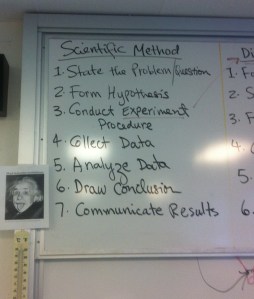
The scientific method as incorrectly taught to our children. Image from Washington Prep High School, Los Angeles Unified School District. photo: T. McGlynn

But if you look at what I do on a day to day basis, it looks absolutely nothing like what people think science should look like. Fixing misconceptions about science requires much more than correcting stereotypes of what scientists look like, though that’s a great start. (By the way, here’s my entry to This is what a scientist looks like.)

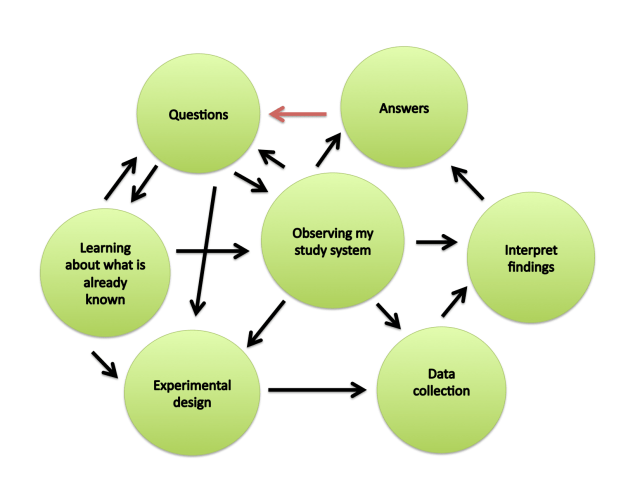
Science is taught in school as a linear process. In practice, it never is a linear process. It’s not even a linear process in the labs in which we teach the scientific method.

I was in a high school classroom last week, and on the whiteboard of this classroom was that odiously wrong conception that we see everywhere. I see this all the time, and if I was doing my job better I would openly contest it every time I see it.

In its stead, let me share with you what it looks like when I am doing science:

The Method of Science, as it happens in my lab

The Method of Science, as it happens in my lab

What science really looks like is a little more complex than how it is marketed by publishing companies to our children when they are in school. They’re not training kids to be scientists, they’re selling textbooks to teachers who are not scientists. Many of these teachers are reluctant to teach science because they are not adequately prepared, and because their bosses are making them overdose on math and English to maintain test scores.

Teaching science isn’t easy for those who aren’t used to doing science, so this cute linear process that kids see in school is what publishers have done to make teaching science as simple and boring as possible.

How do our kids really learn what science is? By actually doing science. By having teachers that understand science and do real science with them. What is often missing is the red arrow in the figure above. Even those who buy into the linear model of science need to realize that it is cyclical, that answers lead to questions. It’s not a plodding march of progress. It’s a messy tumble and jumble forward in which new information leads to even more confusion, but with broader horizons. Science expands the circumference of our ignorance.

How can teachers get our kids to do science if they don’t even know what real science looks like? We need to teach real science to the teachers. We can do this in college, but if you look at the science coursework that is required by future elementary- and middle-school teachers, you’d be either dismayed or outraged. This is the starting point in fixing the science education crisis in the US. We need elementary and middle-school teachers who understand, enjoy and prioritize science.

As scientists in science departments, we have the latitude to seize this curriculum and teach these classes the right way, and by the right people. And we can make sure that people don’t leave our classes without understanding and being excited about science. We can make sure that they’ve been involved in a genuine science experience. We can use genuine inquiry in our teaching.

We also can skip the middle man and do science with current teachers.

This summer I’m taking one of many small steps. I’m having an experienced master teacher at the middle school level joining my group in Costa Rica for a month. He should go home with a better idea what science looks like, I expect. If you want a teacher in your lab, and you’re one of those (declining few) with federal funding, just call up your program director and you probably could get hooked up mighty quickly once you find your teacher. To find a teacher, just ask around, and many will jump at the chance as long as they’re getting paid. Even if it’s just a lot of pipetting. Having a teacher in your lab can change science education for hundreds of kids in a short period of time.

To be clear, I’m not the only one who has this idea in mind. The more of us working to explode the notion that science is linear, the more opportunity kids have to get to do real science.

A recommended summer read: How People Learn

Standard

As a scientist, when I teach I want to know that what I’m doing in class is effective.

To know that something is effective, we ideally need data that demonstrate understand how people learn. Then we can then tailor our approaches to fit these data.

The problem is that there is a massive literature about human learning in educational settings, and I have enough trouble keeping up with the literature in my own field, much less the educational literature.

Wouldn’t it be great if there was just a comprehensive but easy to understand meta-analysis and interpretation of everything we know about human learning?

It turns out, there is. It’s called How People Learn. It’s so good, I’ve received two free copies on separate occasions, in science education professional development events.

This book was brought to you by the U.S. National Academies Press, back in 2000. It’s about as information-packed and useful as you might imagine. Follow this link and you can download the free pdf, read it online, or order a new bound copy if you’re inclined. You can get a used copy from resellers for less than ten bucks, including shipping.

Yeah, it’s more than ten years old. A lot of current movements in science education have been shaped by what’s in this book.

By the way, if you’re looking for an amazing non-science recreational read, then look no further than Mike Dash’s Batavia’s Graveyard (h/t @Rob Dunn who shared this book with me a long while ago). Be warned, it’ll be hard to put down once you get a few chapters in.

If you have any other recommended reading for the summer, fun and otherwise, feel free to add a comment.

Efficient teaching: marking down for grammatical errors

Standard

I used to be appalled at the quality of my students’ writing on exams and other in-class assignments.

Now I’m slightly less appalled. Here’s what changed things:

About ten years ago, I got overly fed up with sloppy errors on exams and quizzes. Students would misspell the most basic words, and make standard homonym errors (such as there/they’re/their) and just sloppy phrasing. It was unbefitting of any college student, or actually of any student in general. These errors indicated an overall lack of pride in one’s work. Grading these could slowly eat one’s soul.

So then, here’s what I did: I told my students that any error in writing (grammar, diction, syntax, spelling) that would not be accepted by a middle school English teacher, wouldn’t be accepted in my class. I said that every single error would result in a loss of a tenth of a point. If you did the same error four times, then that would mean that you’d lose four tenths of a point. If you had a hundred errors, you’d lose ten points.

I put the policy in the syllabus, and I told students every time I handed out a quiz or exam.

When I started grading quizzes, I would mark down a “- 1/10” for every stupid little error. Even on short one-page quizzes which only contained short responses, there could have been up to a score of such errors for some students. Others had none, and many had just one or two.

So, instead of getting a full 10 on a quiz, an otherwise perfect quiz with two lame-o errors receives a 9.8. How would this affect a student’s grade? Negligibly.

Each semester, I would get predictable outrage from a few students (at the expensive private school), that I would try to teach something other than science. I asked if it was reasonable for a college professor to expect proper grammar and spelling of a college student regardless of the discipline. That usually quieted things down, though earning the respect of these students would be an uphill challenge. At my current job, it’s just accepted as par for the course.

What is the outcome of marking down points for sloppy writing? It’s actually amazing. Their writing improved dramatically. The writing more closely resembles the professional output they always should be generating.

This is what I find depressing about this whole affair. If students don’t think that they’re being graded on spelling and grammar, then they actually misspell words far more frequently, by about two orders of magnitude. They also are more likely to craft nonsensical sentences, use adjectives in place of adverbs, and use apostrophes with abandon except where needed.

My students actually can spell, and follow basic rules of grammar. They just don’t bother to do so unless it’s required of them.

If I make my students do it right in my classroom, that’s one small part of it becoming a routine. However, in one semester I can’t undo a decade of other instructors who weren’t maintaining similar standards.

Applying for faculty positions: the teaching philosophy

Standard

Job application season is not ramping up until the end of summer, but I’m bringing this topic up now because it might require some thought and introspection before applications get sent out.

Some ads ask you to make a teaching statement. Others ask you to also provide a teaching philosophy.

Those are the same thing, right? I don’t think so.

A teaching statement explains what you have taught, what you’re capable of teaching, how you have taught these courses and how you go about teaching on a day to day basis. It’s important for a teaching school to know these things when evaluating a candidate. But some departments want more information. They also want to know your philosophy.

Keep in mind that many members of search committees don’t give a damn about teaching philosophies at all. They’d be glad if you wrote a teaching statement, or if you needed to provide both, that you just got a little wordy in the philosophy. They won’t care. But for those that do care, an excellent teaching philosophy can really make you stand out, with at least some of the teaching faculty who are doing the hiring.

You might be asking yourself, “What the hell is a teaching philosophy? Do I have to have an actual philosophy about teaching?”

My answer would be, “Yes, you really should have one. Your teaching philosophy is your overall approach to teaching and a guiding principle behind all of the decisions that you make when teaching.”

Ideally, your teaching philosophy can be expressed in a sentence or two. And then it takes a few paragraphs to explain it. That’s how you write a 1-page teaching philosophy.

What is the secret to writing a kickass teaching philosophy statement to get you that job interview?

The secret is to actually, genuinely, have a kickass teaching philosophy. If you don’t have a few firm guiding principles that guide your teaching, this summer is a good time to develop them.

Instead of just telling you what a teaching philosophy is, let me give you some specific examples. I’m most familiar with teaching philosophies not from the university, but from K-12 science and math teachers. I’ve been involved in scores of interview panels for beginning and experienced teachers. One question that we always ask is: “What is your teaching philosophy?”

All but the most nervous and least prepared teachers have their answer down pat. Most of them say a slight variant of:

Every child deserves an opportunity to learn.

I love that one. I think it is broadly applicable to many circumstances – dealing with economic inequalities, differentiating instruction for students with higher-level work, working with those learning English, and those with behavioral challenges. Everybody, despite the challenges that they face and those that they even create themselves, deserves the opportunity to learn. And it’s the job of the teacher to create that opportunity. That’s a powerful philosophy.

That philosophy, however, doesn’t work for me in the university environment. Here’s my philosophy, that I’ve had for at least the last eight years:

You don’t truly learn something unless you discover it for yourself.

Someone can explain something to you, and you can understand it. But you haven’t learned it. It hasn’t been banked in memory or as something of substance unless you figure it out for yourself. Consequently, labs are important. Fieldwork is important. Discovery-based lessons in class are important. Interactivity during lectures helps. Making sure that students genuinely and deeply read helps. Creating an environment in which students feel an interest and need to discover matters. And so on. In my more recent job applications I spent a few paragraphs spelling out the corollaries and applications of this philosophy.

What are some other teaching philosophies that could work? Maybe:

University students learn best when they have both extrinsic and intrinsic motivators.

or maybe:

Learning is a social activity and interactions with others are a critical part of the college experience.

or how about:

Being able to communicate a clear understanding of a topic verbally and in writing is required for mastery.

or perhaps:

Learning is fun.

and lastly:

To be an effective teacher you must be a lifelong learner and create that spirit in your students.

or other stuff that you can just make up like I just did.

The best teaching statement is not one that you just made up, it’s one that you genuinely believe.

Realistically, most people emerging from grad school and postdocs looking for teaching jobs have something less lofty on their minds, such as “My philosophy is to do anything that results in good evaluations,” or “My philosophy is to not entirely destroy the entire semester by not knowing what I’m doing,” or “I just want to spend as little time on class as possible so that I can get everything else I need to get done finished so that I can actually keep my job.”

Those might be acceptable ideas. But it’s not a philosophy.

So, how do you find your philosophy? Experience with teaching helps, but I think even more important is to spend time interacting with others who care about teaching, and care about understanding what works and what doesn’t work.

You don’t have to be an expert in the education literature, but you should be able to hold a respectable conversation with someone who is. (You don’t need to know the acronyms but you should be able to understand the concepts.) You should be familiar with Bloom’s taxonomy, if nobody’s hit you over the head with it yet. Knowing about constructivism is a good idea. If you’re going to spend even a small part of your career teaching, then understanding the way professional educators approach teaching is a good idea.

Beware, though, when you write your teaching philosophy, you actually have to be careful to not bust out the technical education terms, because that would piss off the majority of the faculty who harbor a genuine suspicion of educational theory.

Any search committee is likely to have some people involved who think, “It’s just my job to teach and their job to learn.” I actually think that’s true, but the definition of good teaching and good learning is where I part way with those folks. The education folk like to make a distinction between the “sage on the stage” versus the “guide on the side.” I don’t follow the Johnnie Cochran school of espousing teaching philosophies, though I think effective teachers guide rather than preach.

You’d hope that these people are fossilized enough that they’re not reading blogs. Nonetheless, a dislike for anything other than bullet-point lecturing is common among many junior faculty who don’t want to be bothered with student learning and instead think their job is to spew information. As in all things related to job applications, you don’t want to express any view strongly enough that it would piss anybody off, even if that person is unreasonable.

The take-home message is that you are best off using your Statement of Teaching Philosophy to actually espouse a genuine philosophy of teaching. If you don’t have one, it’s not too early to develop your own!

If you have one you like, or would like feedback from folks on one, please share in the comments. You’ll probably get some good comments. And we won’t charge $100/hour.

What really is “excellence” in teaching ?

Standard

I’d like to extend a topic that I brought up recently – about the difficulty in evaluating excellence in teaching.

I danced around the central conundrum, by highlighting all the ways that we do, and don’t, evaluate teaching on our campuses. What I didn’t bring up is: what is it, exactly, that we are sizing up when we decide how good someone’s teaching is?

What I argued at the time is that most people use the template of their own teaching (or perhaps one’s aspirations for one’s own teaching) as a model for evaluating others. This operational definition of how excellence is measured doesn’t actually specify what characteristics define excellence.

Let’s set aside the evaluation problem, and ask: What is excellent teaching?

Nearly all of our evaluations focus on the process of teaching: what happens in class on a day to day basis.

What really matters is what happens in the end: what is the product of teaching?

If we focus on process, then we measure things like specific items in the curriculum, demeanor, what the assignments and exams look like, and classroom performance in the theatrical sense.

If we focus on product, then we look at outcomes: exam performance, student satisfaction, long-term professional growth, and — from the administration’s perspective — alumni giving.

You imagine that a quality process leads to a quality product, however a veneer of quality might not lead to a long-term high quality product. What educational practices that get high ranks in the evaluation system actually contribute to positive outcomes in the long term? How much of what we do in teaching doesn’t result in long-term learning but looks like quality teaching in the short term? For starters, the first thing that comes to mind is the use of overly detailed powerpoints that are shared with the class online for cramming studying for exams. Students love it, it raises satisfaction, the professor looks well prepared and: will students know any of it the next day, or how about five years later?

Just as we can design an individual class with backward planning, we can think of the whole college experience this way to inform what students really need to get what we want them to get out of the college experience. What constitutes an “excellent” college education? Whatever it is, then excellence in faculty is when they deliver on that goal.

In my view, when you graduate from college, the school has done its job if the product is:

  • articulate in thought, words and writing
  • able to differentiate between opinion and reason and has personal values informed by both
  • broadly interested in the world and all it has to offer
  • conversant in literature, art, history, geography, science, mathematics, philosophy, civics and more
  • able to separate style from substance
  • struggling to understand the faiths, or the lack thereof, of those in their midst
  • able to readily explain to any novice the basic tenets of their specialty
  • can perform admirably on a summative exam in the subject of one’s specialty (e.g., subject GRE)
  • reading the goddamn newspaper or its equivalent on a regular basis
  • able to whiff out pseudoacademic thinking (like Malcom Gladwell), pseudoscience and shabby reasoning
  • not taking oneself too seriously
  • treats other people as they would like to be treated

Those are my aspirations for what college should do for everyone. I wrote this on the fly but I imagine it would resemble to some degree what you think a “liberal arts education” is supposed to look like.

Just as it’s not the job of a K-12 teacher to merely teach the state standards, it’s not my job to cover the expected learning outcomes of my course. I’m working on providing one piece of a holistic college experience. Am I successful at this? No. But it’s a goal. Since I’m at a state comprehensive institution and all the talk is “career-training-this” and “job-preparation-that” we are really botching these fundamentals. My heart soared when our newish provost said, in his first address to the faculty, that he didn’t want to see any more business regarding what a college degree does for students, he wanted to hear more about what a college education does for students. In our environment, that idea is hard to deliver in deed, but I’m excited to see the emphasis nonetheless.

How do we measure teaching excellence? Foremost, students need to emerge from the class knowing the course material. In particular, they need to know it deeply: well beyond their graduation dates. Truly excellent teachers inspire lifelong learning, excitement tied to discovery in the discipline, and an academic ethos that pervades all aspects of life. There is a multiplicity of routes to this destination.

This is often why teaching is considered to be an art, because what works for one person might not work for another. The trickier part, though, is knowing what works. This might not be measurable at the end of a semester.

Don’t waste tenure

Standard

Tenure gives us academic freedom.

This doesn’t have to be an empty concept.

Before you get tenure, you need to live by the rules. After you get tenure, you have to follow the written rules but not live by them. You can choose to ignore as many unwritten rules as you think is wise. You have a lot of latitude.

I find it lamentable that, for most people, including myself, tenure changes very little.

It’s as if six years has been calculated as the amount of time that it takes for us to become a cog in the system.

Here’s another way to think about the time you spend in the system prior to tenure. Being a professor is like being a musician. Don’t they say that great musicians know all of the rules, and after developing technical expertise they know which rules to break, including how and when to do it, to to make extraordinary music? (I’m not talking about John Cage, but maybe the Beatles or the Pixies.)

Do you think the same is true for our academic careers, that we need to know which conventions have to be broken in order to excel?

In terms of research, I have always attempted projects with the notion that their success or failure wouldn’t alter my risk of unemployment. I have a variety of high-risk-but-potentially-really-cool projects happening, that I probably wouldn’t be inclined to take a chance on if I needed to focus on getting more papers and grants. (I’m able to take these research risks not because of tenure, though, but instead because my university isn’t in a position to expect much research productivity.)

Here’s one major change that I’ve made, that I wouldn’t have done pre-tenure: I rarely lecture. When I step into a classroom, I have a set of activities, discussion items and problems to be solved. I might occasionally bust into a 3-15 minute explanation of some topic if the circumstances require it. (As a caveat, I haven’t taught an introductory majors course in a number of years.) There are two reasons I wouldn’t have done this change pre-tenure. I wouldn’t risk a potential tank in my evaluation scores (which actually moved very little). And I wouldn’t have risked doing things so differently from my department mates who would be sizing up my tenure file. (My last department chair at my old job who observed me was actually put out when I stopped lecturing for a 2-minute think-pair-share activity, as I mentioned in the teaching/tenure post on Monday.) How do I find the time to do teach like this? I actually find that doing this takes less time than preparing a decent traditional lecture. I am actually concerned about being accused about not putting enough effort into my lessons, because the real work is being done by the students and not by myself. I just arrange the circumstances for them to learn. That is good teaching, in my view, but at most universities the lecture predominates and a departure from that practice might be viewed upon with suspicion, especially by scientists who aren’t trained in education. I haven’t had much formal education training, either, and by no means am I convinced that I’m doing it the best way. Which is why I call this change a risk that I can do with the benefit of tenure.

Here one risk that I’ve considered in my post-tenure era, but not had the guts to implement yet: In my Biostatistics class, I’d like to entirely do away with all quizzes and exams, and simply implement an oral performance-based final for 100% of the grade. By the end of the semester, the expected outcomes are so straightforward that a student should be able to demonstrate competency or mastery in the context of a short conversation and ten minutes with the software. (Last semester, gave my class the option to do this instead of doing a big take-home final, but everyone picked the time-intensive final.)

Here’s another risk I have yet to do: Instead of offering 0% participation points in a class (that’s a forthcoming post, at some point), switch to 100%. Grade students wholly on perceived effort. That’s the beauty of academic freedom. I can do this. I can’t be fired for it, I don’t think. Imagine if students were getting grades for trying, rather than for guessing right. Wouldn’t that be beautiful? Again, I’ve yet to try this.

This blog is a risk I took only because I have tenure. I’ve put effort into remaining civil and positive. However, a variety of things that I’ve written already could have been a huge liability before tenure, about my former dean, former president, how my campus is tragically underfunded, and how I interact with students. The only thing preventing me from telling it like it is, is my lack of confidence that I really understand how it is. That’s a nice perk of tenure. There are plenty of other pre-tenure bloggers, such as Dr. Becca among many others who I’ve linked to previously, but their identities are often hidden.

Once you are tenured, what risks would you want to take with your research and teaching? If you have tenure, what new risks have you taken or are you afraid to try?

What it takes to get tenure: ambiguity of the teaching criterion

Standard

Getting tenure at a teaching university might be harder than getting tenure at a research institution.

If you don’t like that concept, then try this similar concept on: what you need to do to get tenure at a teaching-centered institution is far more ambiguous than what you need to do at a research university. One could argue that it’s easier to get tenure if you know specifically what you need to do. At most teaching schools, exactly what you need to do to get tenure is vague at best.

In one, you need to convince the faculty and administration of a teaching university that you are excellent at teaching. In the other, you need to convince the faculty and administration of a research university that you are excellent at research.

At research institutions, when you interview for a job, it is typically spelled out exactly what you need to do to get tenure: grants, publications, and train doctoral students. At most places, you’re given a neighborhood of a dollar amount, or a certain set of grant agencies and number of grants you need, and a number of publications in journals with a certain tier, as first and senior author. There may be some subtleties, but when you’re coming up for tenure, it’s clear based on the numbers whether you’re approaching that threshold, and you should be well aware if you are shy of the mark or have well exceeded it. If you’re marginal, then you know that you’re marginal.

The notion that teaching counts in hiring and tenure decisions at research universities is a sham, as recently pointed out by Alex Bond at The Lab and Field. If you’re at a research institution, being a horrible teacher won’t hurt your chances at tenure and being a fantabulous teacher won’t help your bid for tenure. (If you are unliked or extremely popular, however, and your case is marginal, then teaching performance could be inserted as a surrogate variable to help swing the review one way or another.)

At teaching institutions, the story is entirely different.

At your on-site job interview, I wish you luck trying to get a wholly quantitative description about what it takes to get tenure. Typically, you need to be “excellent” at teaching, and “excellent” at either research or service, and mighty good at the third. I think that’s the answer I got at every single one of the 10 or so teaching campuses where I’ve interviewed over the years.

You know how teaching doesn’t matter at research schools? Well, the converse isn’t entirely true. Research does matter at teaching schools, though there may be a lot of flexibility about what counts as research. At lower-ranked institutions, “research” might not necessarily involve publications or external funding, if you really like someone’s teaching. It could just involve keeping students busy in your lab outside of the curriculum and having some of them get into grad school.

Some teaching campuses put specific numbers on publications, which in my experience has ranged between 0-6, with no real specification of impact factor. The expected publication rate before tenure is negatively associated with teaching load, but this relationship has only a moderate correlation. Most places expect you to submit a grant but aren’t horribly put out if you aren’t funded. The research criterion is pretty clear-cut at teaching campuses, and there is also fudge room because it’s not the primary criterion.

Then, what constitutes excellent teaching? Most campuses go with a Supreme Court Justice Potter Stewart kind of definition.

Knowing excellent teaching when you see it isn’t a good way to decide whether someone gets tenure, is it?

How do most people judge excellent teaching, when they are required to make such a judgment? A student of human nature would suggest that it is identified by how much it resembles the practices of the observer. I’ve never met a full professor who didn’t have a moderately high opinion of their own teaching. And we’ve all met plenty of full professors who couldn’t teach their way out of a bag. This does not bode well for effective tenure decisionmaking. (By the way, is the Bush neologism ‘decider’ now a replacement for ‘decision-maker’?)

In practice, there are many factors that are included in the quantitative and qualitative measures of teaching performance at a teaching campus.

The drawback to all of these quantitative and qualitative measures is that they all suck, or at least have poor resolution.

Let’s go over them one at a time. Keep in mind that no school uses all of these measures in concert.

Teaching evaluation forms There is a whole subfield in education research on this topic, and I’m not going to let this site devolve into a bitch session about teaching evaluations. Really horrible instructors get horrible eval scores, and amazingly perfect instructors get high scores. What happens for most of us, the professors in the middle — ranging between not-so-good and run-of-the-mill excellent — is really murky.

At my university the forms are called PTEs: Perceived Teaching Effectiveness evaluations. The key word here is “perceived.” Are students good at knowing whether their instructor is effective? Often, yes. However, there are a huge number of systematic biases that go along with these forms, suggesting that we need to avoid using the numbers in a comparative fashion. Upper division courses have higher scores than lower division courses, which have higher scores than non-majors courses. This might be independent of teaching effectiveness. There are age and gender biases that affect student perceptions of effectiveness, and associations between the grades received by the students and the perceived effectiveness of the instructor are not necessarily causative. How you dress in the first weeks of class can really matter, too. From discipline to discipline, mean evaluation scores are quite variable. If you want to measure improvement in the same course, with the same professor, with the same student demographic (including time of day the course is taught), then this might be a good measure, at a coarse resolution.

If your tenure case is being evaluated at the level of the college or the university, and your scores are being compared against colleagues in other disciplines, or who teach different kinds of courses, that isn’t fair. I don’t know of a campus that specifies a specific threshold score for evaluations (at least officially), and that is a good thing. However, unofficially some campuses or committees are expecting scores to be above a certain level. If that’s the case, then faculty need to learn the little tricks to make sure they don’t do things that cause students to lower their scores. (That’s a whole other set of posts.)

Written remarks by students The voluntary responses by students on evaluation forms are potentially telling. Students can offer specific and useful praise, and also tell damning stories that very clearly can explain instructor performance. Recurring similar comments by multiple students are particularly valuable. However, most student responses are idiosyncratic and it’s very difficult to distinguish between a student with a legitimate grievance and one who is bitter about their own performance.

Classroom observations Faculty members in the department may be requested or required to sit in on a certain number of hours or lessons before offering a recommendation. These observations are effective so long as the observer is capable of identifying effective instruction. This is heavily subjected to the biases of the observer, especially as scientists typically have no training in teaching methods. For example, when I was a junior faculty member, I made sure to implement the methods of active learning in science instruction that I learned as a graduate student in the College Teaching Certification program and as a Preparing Future Faculty fellow. So what happened when I was observed by my senior departmental colleagues sizing me up for tenure? I’ll always remember this, word for word: “You need to be less Socratic and lecture more. You should be using powerpoint and use more detailed information.” Never mind the fact that all of the current research on science education told me to do the opposite of what they said. After all, these professors were the ones evaluating my tenure file. So, when they were in my classroom, I had to lecture, even though I knew this was an ineffective approach.

How could classroom observations be effective? The people doing the observing could know what they hell they are doing and could be well trained in evaluating effective teaching. This happens in public schools. In the state of California, to be come a fully credentialed K-12 teacher you need to go through an evaluative induction process, the Beginning Teacher Support and Assessment (BTSA, pronounced “bitsa.”) To be a BTSA evaluator, you need to be trained to observe and score the performance of teachers, and this training process involves a calibration of standards and a long list of specific criteria. One BTSA evaluator observing one set of instruction comes up with a score very similar to any other BTSA evaluator; that’s the way the system is built.

What about teaching-centered universities, how do senior faculty do their observations? They show up, if they care to spare the time, and they then may fill out a cursory form if one exists, and then include whatever observations they choose to include or not in their letters. I can’t think of an evaluation that is more subjective nor disconnected from whatever objective measure that could exist. (I’m not saying that I’m any less guilty than anybody else, mind you. Of course, most faculty would be peeved at the notion that they need to be trained to recognize good teaching.) Regardless, in some teaching schools, classroom observations aren’t a required or even optional component of the tenure portfolio. Oftentimes, the only thing that tenure committees know specifically about what happens in the classroom is by hearsay from students.

I was impressed that once, my all-time favorite dean chose to sit in on my classroom for half an hour, and when he wrote the letter for my file he referenced specifics from what he saw in my classroom. He didn’t do this for lack of being busy, and I appreciate the time he spent in directly evaluating me.

Assessment data Perhaps we could look at student performance using assessment data, looking at student knowledge before and after individuals pass through your course. These kind of assessment data aren’t common, and anyway, most science faculty are in full rebellion against regional accreditation agencies that are requiring assessment in curriculum design, and using assessment data like this could actually annoy some faculty members who might think that you’ve gone over to the dark side of assessment. I suppose you could use these numbers but just not call it assessment and maybe get away with it.

Student letters I think few campuses do this, but it happens in my undergraduate institution. I was asked by my college to write letters of evaluation for faculty members in whose courses I was enrolled. The college requests letters from some students who are listed by the faculty member, and also randomly (or perhaps haphazardly) selects other students from rosters of recent courses. I imagine that these letters would be a lot more informative than whatever would be in student evaluations. They do this for both tenure and promotion to full professor.

Hearsay It is stunning how students are willing to discuss my colleagues in front of me, as long as I’m not involved in the conversation. Just the other day, I was in my lab sorting ants, and some of my research students were going on and on in great detail about an instructor in our department, who is a close colleague of mine. There was a mix of criticism and praise. They were talking like movie reviewers or restaurant critics. I wasn’t involved in the conversation, but I was sitting easily within ear’s reach where they were saying all kinds of things about my colleague that they would never say directly to this person. This kind of overheard conversation happens all the time, especially if you’re teaching lab sections. It’s unprofessional of the students to do this in front of other professors, but I guess they’re not professional. I arguably have more indirect information about my colleagues’ teaching from this route than any other. If I believe most of what I hear, by the way, then most people in my department are incredibly awesome. Regardless, this isn’t a valid source of information for evaluating teaching performance, though I imagine that in some environments this is probably the source of information with the greatest sway.

External evaluations Research universities require external letters from experts in the subfield of the tenure candidate to evaluate their tenure file. So, teaching universities must get outside experts to evaluate the teaching of candidates in their subfields of expertise, right? Ha! That’s a good one!

What it takes to be “excellent” at teaching is being able to convince the other faculty in department that you fit that label. Faculty use a variety of information sources, including not not limited to the information above. Ultimately, the assessment is a holistic gestalt-based system. Kind of like how honey bee colonies use guard bees size up the pheromonal composition of bees landing at the nest to decide if they belong, academic departments work the same way. If you don’t fit in, then the guard bee will pounce on you.

The biggest way to not fit in is to not teach well.

However, another way is to teach well, but teach differently.

It’s often said that tenure is about “fit.” Some people say that’s vague: how do you define fit? It’s nothing that needs any special definition. Either you fit in or you don’t. Either you have the same values and the same approaches with respect to education, or you don’t.

This is why it’s sometimes hard to get tenure in a contentious department (read: snakepit) in a teaching institution. Even if you’re careful to not take sides in any weird departmental politics, everyone involved in the tenure process will be called upon to assess your teaching. This is going to involve a meeting where your teaching is discussed. If the department has divisions about teaching philosophy or approaches, this will emerge in the criteria used for evaluations. If one side really likes what you do and explains why, then the other side might end up in disagreement. This is not good. You can ameliorate this by how you sell your teaching approach in your tenure file. You don’t want to make the mistake of arguing that you have worked hard to find the most effective approaches to teaching and that your assessments show that students learn effectively. What you want to do is communicate that your teaching fits in with your department, and that you have worked collaboratively with your colleagues so that you have learned how to teach well from them. You don’t want to say anything that is overtly contrasting existing practice, because, ultimately, the people in charge of deciding whether your teaching is excellent will compare your work with the template of their own work. Just like guard honeybees that use their own smell to decide whether to reject outsiders.

Even if you have a history of demonstrating teaching excellence at a teaching institution, a fresh pair of eyes with a different perspective, or a different agenda, could look at the same record and come up with a credible argument that the record fails to demonstrate excellence. Without anything changing, the environment can shift so that what is perceived as “excellent” in one year might not be acceptable the next year.

This is different than research institutions, I think. It’s harder to argue against grant dollars and a list of publications on a CV. You could argue that the journals aren’t of a high enough impact or that the grants are from the wrong agency, but the research bar at a research institution is far, far more tangible than the teaching bar at a teaching institution.

I would guess that if you are unambiguously above the bar that’s been set for you for research productivity and funding, and you haven’t entirely botched something else, you should be golden. Even if there are academic disagreements about your work, if you’ve got the grants and published in the right journals, then that is likely to be fine. This is particularly the case if you’re at a unionized institution, in which the tenure process is more transparent than at an institution with an opaque process with secret information, because the faculty lack the power to make sure that the process is fair.

Of course, at nearly all universities, tenure rates are quite high, except for a few Ivies that have a de facto policy of hiring Assistant Professor positions as glorified 7-year postdocs. When people don’t get tenure, it might be because performance is not up to snuff, but it can also happen because the department is toxic or incompetent. Other crazy stuff can happen, too. Regardless, the lack of specific quantitative criteria in the teaching criterion create an element of hap into the process that makes it less predictable, which makes it a source for anxiety if not a source of difficulty.

In short, the amount of work it takes to be an excellent teacher doesn’t necessarily correspond to the amount of work you have to do to get tenure at a teaching institution. To do that, you (most likely) have to be an excellent teacher and you also have to do the work to convince your colleagues that you are. In some places, this is harder to do than others. In some places, you don’t even have to be an excellent teacher, as long as you are able to create that perception. There’s the rub.

“Student quality”

Standard

When you are sizing up the teaching part of your job, what is the role of student quality?

I often hear other scientists talking about how they enjoy the teaching part of their job when they have high quality students. They are successful teachers when they have high quality students.

I also hear professors sympathizing with other professors who report that they have poor quality students in their classes.

These conversations make me want to barf.

What the hell is a “quality student?”

I won’t say anything about a person behind their back that I wouldn’t be willing to say to their faces, admitting that at times it could be an uncomfortable conversation. Would anybody be willing to say to their own students that they are of low quality? Clearly, students can do low-quality work and have a low-quality investment. (Actually, I just said this last week to my class after slogging through some lackluster exams.) Are these students, themselves, poor quality?  I feel like I shouldn’t have to say so, but maybe I do: of course they aren’t.

When people are talking about student “quality,” they could mean a variety of things. They might be thinking about how smart the students are (whatever that is), how hard working they are, or how motivated they are to learn.

All of those variables change given the context. Some students will not work hard at all in some classes, but work hard in others. Some students will be disinterested in some classes but be fascinated by others. I suppose the “high quality” students are the ones that will work hard and be fascinated regardless of the context.

In other words, high quality students are the ones that would learn even if they had a poor quality instructor.

If you have traditionally “high quality” students, it doesn’t matter if you teach well. Do you really want that kind of job?

Clearly, if our classrooms are filled exclusively with bright, hard-working and inquisitive students who are always willing to learn, then our jobs would be really easy. In fact, the students wouldn’t need us other than to assign readings, play videos of lectures and have labs set up for them. We wouldn’t be required as teachers because they would be all ready to learn whatever is put up in front of them. I guess that’s a high quality student – one who is the least amount of work. The one who always understands and always does perfect work.

If that’s the case, then I don’t want these high quality students who are easy to teach. I want to be the person that made a difference in the life of another person. I want the students who come into my classroom to be the ones that don’t think that biostatistics matters, or not really caring much about the mechanisms of climate change. When I am successful at the end of the semester, which means that my students are successful at the end of the semester, I want it to be because of the quality of my work. I don’t want to preach to the converted, and I don’t want to spend an hour in class on a lesson that the students could have learned for themselves. I want the students who couldn’t just sit down in a MOOC and take it all in.

It means that all of the time and preparation that I put into my lessons actually matters.

Perhaps, some might think, that with classic “high quality” students, highly effective teachers can take things to extraordinarily high levels so that their students excel far beyond what any lesser “quality” student could ever imagine. If you are thinking that way, then please stay away from the classroom. You need to enter the room thinking that every person has unlimited potential. If you start out assuming that some students aren’t capable of extraordinary achievement, then you’re never to going to expect or get it from them. You need to expect the outstanding if you’re ever going to get it. And you need to expect it of everyone. Once in a while, I get outstanding from students that who have already been written off by everyone else. Now that is a quality student. And I have that opportunity every time I enter the classroom.

By the way, why is it that some of the most famous experts on science teaching come from universities that only admit students who earned top notch grades in high school, and mostly from private schools and public schools in wealthy school districts? Do their experiences with white middle- and upper-class students really reflect how education works for everyone else?

Almost none of the students in my university would be able to land admission to a highly selective institution, in part because of their social class but also because of their performance and preparation.

How I do I feel about teaching students who could be labeled as “poor quality?” I love it. There’s nothing better. I have unlimited opportunity to make a difference, and every day I am challenged to inspire and create a need for understanding. If you want to teach well, then how do you know you’re even capable of doing so if all of your students are pros at learning?

If you are teacher by profession, and all you want to do is teach “high quality” students, then you’ll never master your craft.

“Release time” vs. “Reassigned time”

Standard

Words matter, because words dictate how we think. Our brains think using words to organize ideas. Language and reasoning are coupled together. (Yes, I know some linguists that disagree.)

Here’s a example from our own realm that matters to me.

Faculty members can have their responsibilities partially shifted away from teaching to other obligations. For example, one might be the chair of the academic senate, or serve as departmental chair, run a campus center, or conduct externally-funded research. These responsibilities result in a reduction of the teaching load, to make time available to fulfill other service or research obligations.

I usually hear this shift of effort called “release time.”

That terminology bugs me. This phraseology implies that faculty are being released from a responsibility. That is not the case. The responsibility is being shifted partly away from teaching and partly towards service or research.

Nobody’s getting “released” from anything. Nobody’s getting away with anything.

In fact, in nearly all so-called “release time” assignments that I’m familiar with, the amount of time and effort required for the new task well exceed the teaching assignment from which the faculty member was “released.”

This is why I use the term “reassigned time,” because it more accurately reflects the arrangement at hand. If we give in to the term “release time,” then this gives a false impression to those who have the power to grant or deny this reassignment of your time. While we all rationally know that “release time” is still just as much — and typically more — work, the terminology works in insidious and subconscious ways.

So, when you’re negotiating for time to do an externally funded project, don’t call it release. Call it reassignment. It’s not only more accurate, but it might even increase the chance of a favorable decision.

Science, math skills, and high school students

Standard

There was a diversity of visceral reactions to EO Wilson’s op-ed piece, which argued that you can be a great scientist without being good at math. The lowdown can be found at Dynamic Ecology (with 15 updates as of this writing!) I wrote my own take on it here.

Before we go any further, I’m curious about all of you, what’s your take on the op-ed piece? Compel yourself to make a choice. (If you have caveats, put them in the comments section of the post, but please pick one or the other).

One common reaction by scientists who teach and train students was, “Thanks, Ed, for making my job harder.” That was my first thought, as I regularly teach Biostatistics.

Another common reaction was, “That’s not the message to send students early on as they still are developing their skills in all aspects.”

With these ideas in mind, I brought the op-ed piece to a bunch of high school teachers. They read it and we discussed it for about half an hour.  How did the discussion go?

First, let me tell you more about the teachers. I regularly meet with this crowd as a part of an NSF-funded Noyce Master Teacher Fellow program that I run with education faculty. They all have their Master’s degree (most in education, some in science) and were competitively selected for this program as a result of their experience, excellence and continued commitment to teach in high-need urban schools in South Los Angeles. These teachers work in rough schools, with kids who have the deck stacked against them even before they enter the classroom. They were picked for this program because they are the ones staying at their schools even though most new teachers leave after a very short time.

These teachers are talented, dedicated, overworked, and mentors to new teachers. I tell them so often how much I respect and admire they work they’re probably sick of hearing it. (I have learned a lot from them about teaching over the past couple years, no surprise there.) One of the reasons I try to praise often is because they hear it so little elsewhere. The newspapers and the mayor and the school board and anybody who has a loud mouth will say that these teachers are the problem that need to be fixed. Let me tell you, that’s entirely backwards. These teachers are the solution to the problem. Free these teachers to do what they were professionally trained to do, with the resources to do it, and you’ll see the positive changes that have been so elusive. (Making this change, sadly, is politically complex).

These teachers know their stuff. Moreover, they teach exactly the population of students that NSF is trying to hard to recruit into the sciences: “underrepresented.”

The opinion of these teachers about the requisite math skills for becoming a scientist matters, more so than anybody else in the whole of the USA.

What did they say about Wilson’s piece? Immediately after we all read it, I did an informal survey: thumbs up or thumbs down, just like in this post. (Rest in peace, Roger Ebert.)

All I saw were thumbs up, or neutralish waves of whatever. I asked, why is that?

The general consensus was that being good at the process of science isn’t inherently mathematical. You don’t want to dissuade someone who is interested in science, after all. Of course, you need to use math, but that shouldn’t stop you from pursuing science and the math can come along for the ride. That was the initial response.

Then, one person (the only physics teacher in the bunch) disagreed, and a biology teacher joined in. They said that to be good at the practice of science, in real life, you have to be able to do math. You can’t really understand some fundamental principles in science unless you can grasp the math.  There were some disagreements, that this was endemic to physics, but then plenty of examples throughout the sciences were brought up. It was also raised that engineering is growing in importance and will be a key feature in new state educational standards soon to be adopted.

The discussion then turned to the fact that specific skill sets are required not just to be able to do science, but also to land positions, perform your job, and be able to adapt to evolving requirements of these jobs. Not all scientists can choose to work on whatever they want, even though E.O. Wilson has that option, and we need to train students to be prepared for the opportunities that rise before them and to be able to use their skills to create the opportunities that they want, or need.

If you’re E.O. Wilson, then you don’t need math, we decided. But if you’re not Wilson, with National Academy mathematicians available for collaboration, then sophisticated math is a very practical skill that will serve you well in the sciences more than almost any other resource. Especially if we are training students from disadvantaged backgrounds, we want to be able to confer upon our students every possible advantage, and being analytically and mathematically adept is key. It’s genuinely a key. It opens doors.

In the end, we agreed that Wilson was right on the fact: It’s possible to be a great scientist and not be great at math; this is a possibility.

We also agreed that this was a downright destructive choice to communicate such an idea.

Wilson’s article lamented that he had a hard time recruiting Harvard students to become scientists because of their math phobia. Nearly all of his students are archetypes of privilege, who also received strong preparation in high school before winding up at Harvard.

Meanwhile, the students in the classes of our master teachers who are lucky enough to graduate and then go to college, are likely to need remedial math. At my university, it’s been normal for a majority of entering students to require remedial math courses right off the bat because they don’t pass the stunningly basic placement exam. Do we want to tell them that math isn’t important to become a scientist? Should we tell them that this remedial math doesn’t matter, and that the calculus course required for our major is pointless?

Perhaps Wilson would like to visit us, and tell my students that they don’t need to worry too much about developing math talents to further their careers as scientists.

Far too often, my students have heard while growing up that they don’t need to work hard at something difficult. They have heard plenty enough that they should just slide into tasks suited to their inherent abilities, whatever they may be, rather than kick it up a notch and genuinely improve one’s talents. If you’re the first one in your family to go to college, expectations are paramount.

Maybe Wilson should limit his don’t-sweat-the-math message to his Harvard students. That way, our students will get jobs over their underprepared Ivy League competitors.

And then I woke up.

Online learning is the ghetto of higher education

Standard

People need to rethink the concept of the digital divide.

In our society, the digital divide doesn’t separate those who have access to computers and those who don’t.

It separates those who are required to use digital devices for learning and those who have the privledge of learning directly from genuine experts.

Soon enough, if my legislature has its way, the wealthy will get to go to real colleges and take classes with real professors. Everybody else is sitting at home on a computer.

Those who are pushing MOOCs and online learning as an alternative to higher education are trying to take my students away from me. The big push is coming from those who stand to gain financially, or from those trying to balance the budget books, so I won’t trust them much on the matter of best educational practices.

Perhaps I’m narcissistic in overvaluing my role in higher education. I think the most important part of my students’ experience is me. I’m involved in their lives in a way that can’t be done online.

The student population on my campus is mostly low-income, working part-time or full-time, first-generation college students, nearly all from groups underrepresented in the sciences. These are, by definition, disadvantaged students. This isn’t an insult, just a fact – the deck is stacked against them based on their background. They have a competitive disadvantage against those with more resources and against those with a pedigree that creates access to fancier opportunities.

This year, a few undergraduates who have worked with me are heading off to great graduate programs. What all of them have in common is that they started working with faculty at my university in the classroom and in the lab, in person. They’ve all told me and my colleagues that there’s no way they would have been able to do what they’ve done without us as a resource and as an influence. I take them at their word.

All the research shows that personal interventions into the lives of disadvantaged students is what leads to their success.

The students that need personal interactions with their professors are the ones that are the most economically disadvantaged.

This is the same group of students who will be the first pushed into online education instead of going to college for real. Why aren’t people more worried about this?

Some are – there is a bunch of concern at Computing Education, such as this post. Overall, though, as usual, the underrepresented students remain, well, underrepresented.

Pointing this fact out doesn’t come without some personal risk at annoying my higherups. My university is deep in the push for online education, and has a mess of wholly online degrees, such as a B.S. in “Applied Studies,” whatever that is.

My university is also known as a place of refuge for the disenfranchised and disadvantaged. This is a painful irony that we are at the forefront of the push for online learning. Pushing students out of our labs and onto their laptops.

As a mentor to undergraduates, and an advocate for undergraduate research as a great way to learn, I wonder how this online education trend will affect the ability for students to truly move ahead. I wonder, but I will never want to find out, because I don’t want it to happen.

I just want these students physically in my lab, where I can chat with them personally and help them in ways that I can’t over a computer screen. Please don’t take them away from the university. Please give me the chance to speak with them, listen to them, and show them how to become scientists. Please don’t take away their best chance at success. Don’t make them settle for anything less than what wealthy students are getting at more heavily endowed campuses. Give them what they need to get from college – personal, actual connections with their professors.

You can let the students of privilege take their classes online, if you think online education is just as good. Those students don’t need the face time like the disadvantaged students do. If you don’t like that idea, it’s only because you acknowledge the fact that one truly is lesser than the other.

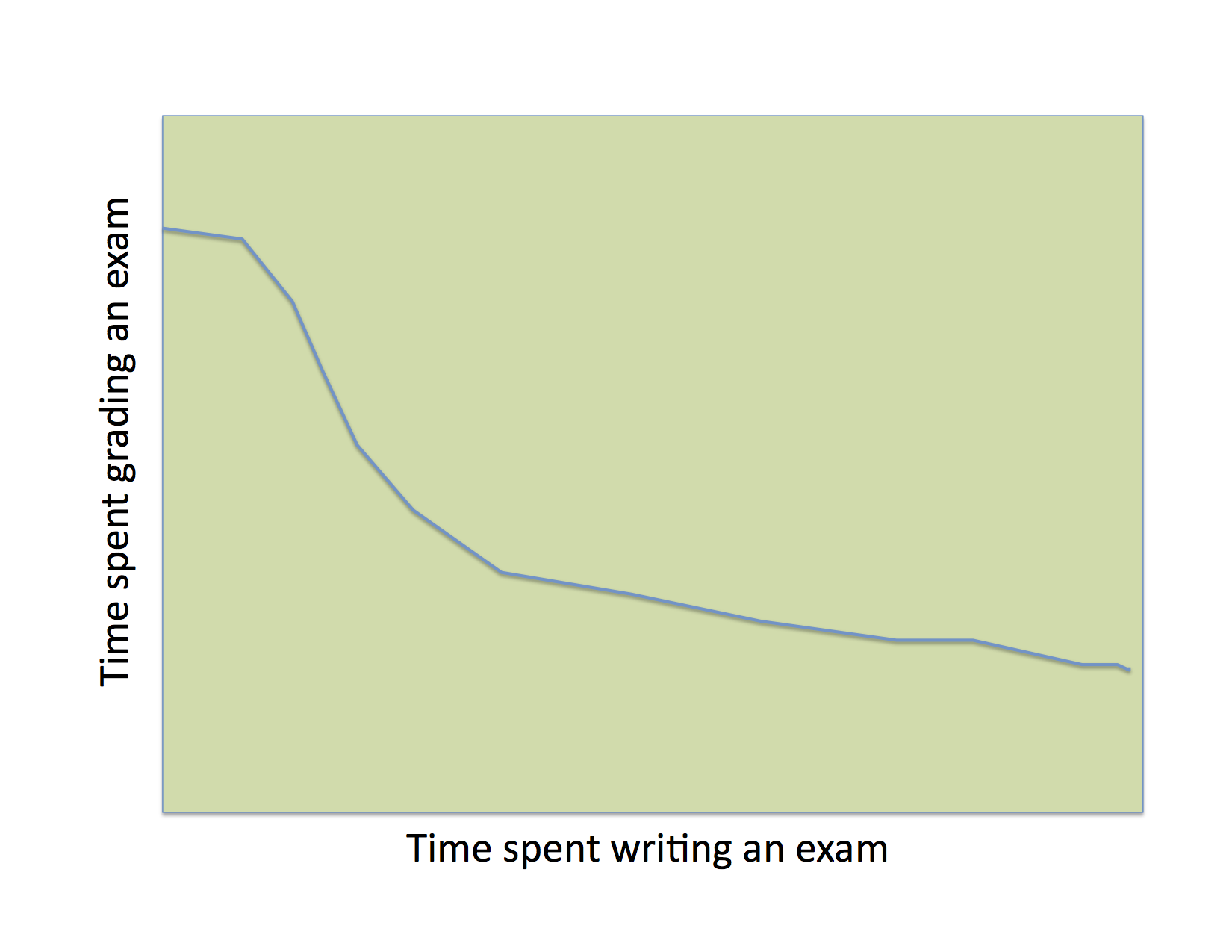
Efficient teaching: exam writing vs. exam grading

Standard

Grading sucks. I hate grading. I guess even the best job in the world has its downside.

I hate grading because it makes me think about all of the less un-fun things that I could be doing at that moment. And I often do those things (like laundry, or dishes) instead of grading. Which only makes grading worse.

I’ve never actually given a scantron exam in a class that I’ve had the freedom to teach how I wanted. I haven’t had a massive class that’s required this approach (or a small army of student graders). I’m not inherently opposed to multiple choice exams, but I’ve mostly been in places where they were not appreciated, at least not in the kinds of classes I have been assigned.

One of the reasons I haven’t liked multiple choice exams is that writing a good one takes a lot of time. (And, even when I’ve used some of these questions on a paper exam, I find that they can contain a lot of hidden cultural biases that only come out when talking with students afterwards.)

If your exams aren’t multiple choice, then how can you do spare yourself grading hell?

You can’t. But you can lessen it.

Which is more annoying, writing an exam or grading?

Which is more annoying, writing an exam or grading?

This is just a working hypothesis. It’d be interesting to really know. But not interesting enough to delve into the education literature.

On one extreme, you could write an exam in ten seconds. It would ask:

Explain in detail the five most important ideas that you learned while studying for this class in the past month.

Very easy to write, very hard to grade.

When underthinking exam questions, then we could be in for a world of hurt when we have to grade the responses. You can’t necessarily create a perfect rubric up front, because you might get correct but unanticipated answers.

Students can put all kinds of crazy stuff down when you ask questions on exams. Sometimes, this crazy stuff is actually factually correct and directly answers your question. Even if the answer is not addressing the content that you were expecting the question evaluate?

Badly Worded Question: When the earth had more oxygen in the atmosphere, would the sky appear orange or not? Explain your answer with a sentence.

Correct answer: Yes. The sky would either be orange, or it would not be orange.

I have a really hard time marking points off a question which is fully answered correctly, even if the correct answer isn’t what I anticipated. (In fact, I promise I won’t do this to my students, as a part of a policy of transparency and fairness.) The onus is on me to write questions that directly get at what I need to know to assess their content knowledge and the ability to process it (Blooms taxonomy, yadda yadda)

So, if you make sure your exam is airtight going in, then grading it should be easier.

But writing exams is no fun either. So we don’t write the best exams in the first place. Maybe the memories of painful grading are enough of a stick to make us write tighter exams.

hat tip to Prof-Like Substance for venting about grading.

Class duration and time for research

Standard

If you had total control, how would you block your teaching time?

Would you want classes to meet frequently for short periods of time, or infrequently but for a long stretch each time? What is good for your research? What is good for the students? Are the two mutually compatible?

One end of the continuum (the block system aside) is having classes meet 3-5 days per week, plus a lab. When I was in college, my intro science classes met in the mornings, 5 days per week, for an hour, over 10 weeks.

At the other end of the continuum is where I am teaching now. Most daytime classes are either MW or TTh, so they meet for 1.5 hours twice per week. There are almost no MWF classes. Since most faculty teach four courses per semester, this presents enough flexibility so that scheduling is not impossible, though I feel deep sympathy for the chairs that have to schedule.

We also have a many classes that meet in the evenings, as I teach on a commuter campus. Plenty of them meet once per week, for three hours. My teaching load has included these for the last few years.

Tonight, after my kid already gets home from school, I’m teaching for three hours. I only see these students once per week. This semester I do this on two nights per week. I miss evening activities with my kid, but it does lead to having more time with him at other moments, including my being able to pick him up from school those other days. I’ve arranged my schedule so that I’m available for parenting the evenings I’m not teaching, and my spouse sometimes has weekend commitments. I think it evens out during the semester, in terms of parental effort.

How do feel about it, in terms of my research opportunity? I’m liking it a lot. On most days, I have massive blocks of time that I can protect to allocate to time-consuming tasks. It’s great. I also don’t have to rush into campus those days, and I can take care of business at home. It also leads to an expectation that I might not be on campus in the day, if I am there in the evening.

How does it work out pedagogically? At first I was reluctant and concerned that it wouldn’t work out. After doing the same class several times, I’ve been converted to this schedule. First of all, preparing for a class is three times as much work, though that also is less frequent. That’s something to take into account. But assuming that you’re prepared, how does it affect learning? I think it’s a net gain. Actually, putting my own schedule aside, I’d structure all of my classes to meet in a 3-hour stretches on a weekly basis instead of more frequent lectures.

Why do I think this time format is better? Because active learning requires focus and depth. I was reluctant to teach these long infrequent classes because, let’s face it, after three hours of lecture your mind is pulp. You’re exhausted and parched, and the students are on overload. All lecture audiences slow down after 20 minutes.

Once I learned how to stop lecturing, and to teach using other approaches, we have time to learn much more deeply when we’re together. And I have enough experience running a classroom to keep students accountable in the intervening week, so that their brains don’t shut off during that time span. I realize that it’s nearly impossible, at least in the short term, to shift class schedules around for many political and practical reasons. This is, though, a good thought exercise to think about what’s best when you do have the choice.

Grad students in the sciences who teach for a living learn to balance their time while teaching long class sessions. Usually, grad students are teaching the lab sections. I taught three 3-hour sections per week to get my TA wage (for a wage around the poverty line) in grad school. So, that’s not that different from what I’m doing now as faculty. If grad students with TAships have time for a dissertation, then if faculty plan well they should have plenty of time for research.

If you’re lecturing, I think short classes are best, or least bad, for the students, because the human brain doesn’t have the capacity to absorb lectures for long stretches, even when they are engaging. But if you’ve abandoned the lecture, then long classes will give you the time to let students consider topics in depth and learn a lot more. And, on the plus side, having classes in big blocks will let you schedule research in big blocks, too.

The Science Research – Education Research Divide

Standard

I’ve always been puzzled, and frustrated, at the fact that most scientists either ignore or outright dismiss the latest in science education research.

I just came on a great post on Sci-Ed about the divide from last month. It starts:

Science education researchers and science teachers have much to offer each other. In an ideal world, knowledge would flow freely between researchers and educators. Unfortunately, research and practice tend to exist in parallel universes. As long as this divide persists, classrooms will rarely benefit from research findings, and research studies will rarely be rooted in the realities of the classroom. If we care about science education, we have to face the research-practice divide.

It’s worth a read. The irony is that scientists, more than anybody else you would think, should be the ones to use evidence-based methods in their practices. Why would you do something if you don’t know it to be effective? Research shows that professors often think that a number of methods they use are effective when, upon investigation, they clearly aren’t. (This is often true about lecturing in general.)

If you found out that your experimental methods were inaccurate or giving false results, you’d change your methods lickety split.

But if a scientist is told by a professional science education researcher that what they’re doing doesn’t work, what happens? All too often, nothing does.

I really have no idea how to open this up; there are inherited prejudices. The science education literature is rife with jargon and acronyms, and most scientists who give a look don’t see the methods as particularly robust.  Communication is a start, but I don’t know what’s to be said.

Making time by teaching efficiently

Standard

Science faculty need to be highly effective teachers.

Researchers need to be highly efficient teachers.

How are teaching effectiveness and teaching efficiency related to one another? What can we do to change this relationship to best serve our students and get research done? As a working hypothesis, I suggest the following:

FigureTeachingEfficiency

Many variables affect the effectiveness of teaching. Among these variables is instructor effort. The more work you you put into a course, the more students learn. After a certain amount of work, there are diminishing returns. The shape of this relationship can vary, of course, and the function that I’ve invented for the figure isn’t authoritative by any means.

What constitutes efficient and inefficient teaching? How can we increase the slope of the function? Why work for a bigger slope?

If you can teach more efficiently, then your students can learn more and you can have more time for research.

Some highly effective practices are inherently inefficient. These include frequent graded evaluations in class, multiple revisions of written work, and guiding groups of students on independent projects. Other highly effective practices are more efficient. These include guided discovery lessons, frequent checks on understanding during class, “think-pair-share” techniques, and snap ungraded quizzes at the start of every class. Research shows that they are effective teaching approaches but they don’t have to take more time to prepare.

Some technology-intensive approaches can be effective and not necessarily take much time (clickers, moderated question boards, and perhaps “flipping”) while others may take more time to set up than the payoff is worth (quizzes in the course management system, creating online videos to supplement in-class instruction). In my experience, CMS software (e.g., Blackboard, WebCT) is a massive time sink (i.e., inefficient) if you use it to do anything other than disseminate materials. They don’t help students learn as far as I can tell, and are just part of the Techo-Education complex (unless of course it’s an online course, which is a different beast altogether).

Because we all have different experiences and aptitudes, what is efficient for one person may not be for another. For example, some people report that classroom approaches that do not involve traditional lectures take a lot of time and are still worthwhile. I find it’s actually easier to not build a big fat dense lecture, but I did get some genuine training to learn how to do it. Experience with certain techniques can make them more efficient, but others (making and grading quizzes, for example) always takes plenty of time, even if you do them with clickers or some other higher-tech approach.

What are effective and efficient techniques? What inefficient techniques are we obligated to use because they are irreplaceable?