Overhead rates on grants, and prize money of the Royal Navy in the Napoleonic Wars

Standard
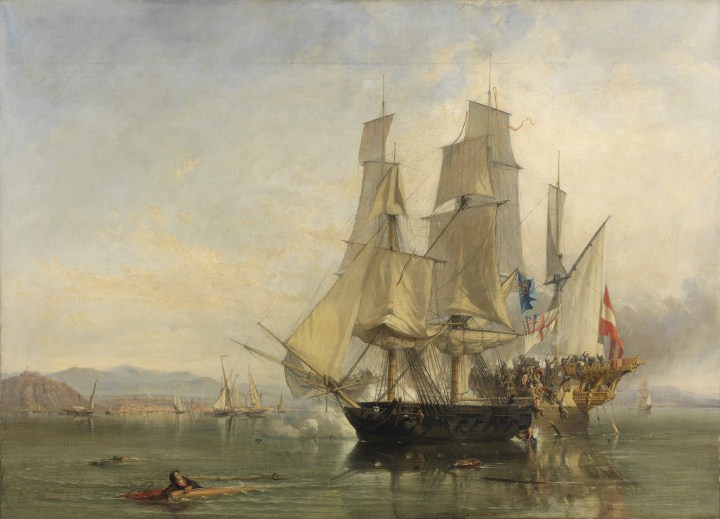
he Action and Capture of the Spanish Xebeque Frigate El Gamo, by Clarkson Frederick Stanfield

The Action and Capture of the Spanish Xebeque Frigate El Gamo, by Clarkson Frederick Stanfield

People who aren’t used to writing and running federal grants aren’t probably that familiar with how overhead works. For every dollar you bring in to do work with your grant, your institution gets an additional percentage from the federal agencies, which covers all of the indirect, or overhead, costs of running the grant. So, a project that directly costs $200,000 actually will bill the feds $320,000, if your overhead rate is 60%. There are additional complications, but that’s the gist of it.

At research institutions, overhead rates are typically > 50%, and sometimes much much higher. Teaching schools typically have lower indirect rates. My campus’ indirect rate is 42%. My previous university had an even lower one, which was only applied to salary. That’s a relative pittance compared to the 67% rate of Caltech, which also includes hefty salary fringe rates on top of overhead.

This money isn’t trivial. Most research institutions use it to stay afloat. Which is why universities value, or at least don’t eliminate, faculty members who bring in big grants.

In theory, overhead pays for lab space, equipment, maintenance contracts, electricity, computers, printer toner, photocopies, technicians and stuff like that. It’s entirely reasonable, at least in concept.

When funding gets tight, like it has been for a long time, some PIs gripe that high indirect rates make it harder for grants to be funded and result in smaller budgets. A good rebuttal comes from Prof-Like Substance. He points out that a lot of complaints about overhead are overblown, and no matter how you slice it, the money comes out of your grant one way or another.

Where does the overhead go, and who makes these decisions? Does it just enter some university general fund? No way. It gets divvied up among various fiefdoms. The president and the heads of financial stuff, who pull in unreasonably huge salaries, decide who gets various pieces of the pie, and the different sizes of those pieces. From the perspective of the scientist, how the pie is cut is entirely non-negotiable. You’ve got to wear a suit, drive a luxury car and work 9-5 to buy into that kind of conversation.

When comparing how the overhead pie is cut across different campuses, I’ve found that there are remarkable inconsistencies, and that some indirect allocation rules are very idiosyncratic.

Despite the differences among campuses, the entities that get a piece typically include:

  • The Campus office that runs awarded grants (post-award)
  • The Sponsored Research office that works on getting grants (pre-award)
  • The President
  • The Provost/Academic Affairs
  • The Dean/College
  • The Department
  • The PI who landed the grant

Everybody loves these indirect costs returned from grants because they have few or no restrictions. I’ve got a returned indirect account and I can spend it on pretty much any research-related need I have. That’s a good idea to get indirect back to the lab of the PI, because so much of the research that happens in the lab can’t be paid out of grants, which aren’t supposed to be spent on office supplies, for example. This isn’t a minor issue. There is no budget within my department that can be spent on toner for the printer in my research lab. And I’m not allowed to spend NSF money on stuff like this. It has to come from overhead, or some other creative source.

Under the salary of the university, our administrators send us out to compete for our share of federal funds to make our labs run. Getting the grants – the direct costs themselves – is merely part of our job and we are always expected to do the research, as that’s part of our job. However, the grants that we land also come with indirect, which funds the university to make it run.

Indirect is a kind of addictive gravy that comes poured over research grants that makes universities even more hungry for grants. I’ve never met a person in charge of stuff that didn’t love it when a grant comes in. Tell your administrator that you just two big-time publications and won a big non-monetary award. You’ll get a nice smile. Tell them you got a big grant. Then, they’ll be over the moon, and then ask for reassurance, “that comes with full overhead, right?” Administration can get bloated feeding on this gravy, if they don’t spend those calories where they need to be spent.

A similar phenomenon occurred within the British Navy during the Napoleonic wars a couple hundred years ago.

The allocation of indirect costs is surprisingly reminiscent of how the British Navy divvied up the spoils of war.

Whenever the Navy captured a vessel from another navy at war with England, the contents of the ship, and the ship itself, would be sailed back to England and sold. They also did this to any merchants allied with enemies, as well as privateers commissioned by enemies. In a short timeframe, the British Navy was at war with the Dutch, the French, the Spanish and the Americans. That’s potential for a lot of profit. Just like Halliburton makes a mint when the United States goes to war, so did the leadership of the British Navy in those days. War meant profit. For these men in the upper echelons of the Navy, news of peace was bad news.

Meanwhile, the captains of these ships-of-the-line were paid a modest living wage to do their job, and were provided the minimal provisions to get the job done. They were only given enough gunpowder to be used in case they were engaged in battle, and only the most spartan foodstuff were provided for the entire crew, including officers. Many captains, who often rose to that position through social connections, came from families with independent means and were able to purchase livestock and other comforts — and politically necessary entertaining — for their time at sea, and were able to purchase additional powder from their own funds that could be used to train their crews to become accurate and rapid with cannons and carronades. That accuracy and rapidity is what won battles at sea. Winning battles at sea is what brings money.

So, when a ship’s captain takes over an enemy’s ship, he sends over a portion of his crew to sail it back to England, where the ship and its contents are appraised and sold. Then, this prize money gets divvied up. Prize money was awarded even when the enemy’s ship was sunk. The Admiralty decided how this pie is divided. Who gets a piece?

  • The Admiralty
  • The Captain
  • The Senior Wardroom officers (lieutenants, master, and captain of the marines)
  • The Senior Warrant officers (carpenter, chaplain, gunner, purser, surgeon, several more men)
  • Junior Warrant Officers (a greater variety of men with various jobs)
  • The rest of the crew

How did the Admiralty divide this pie among all of the combatants? The Captain himself takes 1/4 of the prize money. Another 1/4 of the prize money is split among all of the regular crew on the vessel, with more senior members getting a bigger cut. The other categories listed above get 1/8 of the prize money.

That means that 7/8 of the prize money is going to the men that risked their lives in battle, and sailed at sea in often perilous conditions. And 1/8 of it goes to the admiral that issued the order. This money doesn’t go to run the Navy. That 1/8 of prize money from every ship captured or sunk goes into the pocket of the insanely wealthy admiral that sent that ship out to sea. (If there were no Admiral’s orders, by the way, then that eighth went to the Captain as well).

How is this system similar to, and how is it different from, how indirect costs are allocated in universities?

In this analogy, the PIs landing grants are the captains who capture ships. The officers and crew of the vessel are the students and staff of the PIs lab that make the project possible. The Admiralty is represented by the string of administrators that are above the PI in the administrative food chain.

I see a few key differences between the Royal Navy and the university. A Captain who does his job successfully becomes wealthy and actually climbs into new realms of social prominence associated with that wealth. PIs who land big grants don’t get paid more by the university, other than perhaps getting 2/9 summer salary. At my institution, if a PI of multiple federal grants were to approach the Admiralty administration for a raise in salary, this PI wouldn’t get yes for an answer. All the PI gets from landing a grant is the ability to keep one’s job, or the ability to fund the research that is expected of the PI. The PI also gets a little pat on the back. At least, that’s what happens at my university.

Here’s another difference. In the Royal Navy, 7/8 of the prize money goes directly to the individuals performing the task to enable the work to take place. In universities, even if you include direct costs into this measure, far less than 7/8 of the total award is controlled by the PI. A good chunk of the spoils of successful battle grantwriting aren’t reinvested back into getting more grants and supporting the projects that landed the grants.

In universities, the Admiral’s take is overwhelmingly greater than 1/8 of the prize money. It sure is at mine, at least.

Is that a fair comparison to make, considering that overhead really needs to be spent on things that the PI needs, to keep the lights on, equipment maintained and all that? I can’t speak for what happens at other universities in any detail, but in my university, the overhead doesn’t flow downhill. Almost none of the overhead gets back to the PI or the Department.

At my university, as rumor has it, all of Academic affairs is lucky to get 25% of the overhead. That’s just a rumor, mind you. The college gets a small bit of that fraction, and the department gets an even smaller piece, and the PI gets a pittance. (I don’t know the exact percentages. I’ve only overheard things at a meeting or two, and our last administration was entirely opaque about finances and the new administration this year is still busy cleaning up the mess left behind by the last one.) It’s not as if the overhead is being used at higher levels for startup packages for faculty, or support faculty research in some other way. I doesn’t even make it over to the academic side of the university budget.

You know that overhead account that I mentioned that I can do whatever I want with? It’s got a few hundred bucks in it. I’ve yet to spend any of it, and it’s less than 1% of the overhead than I’ve generated. (Up until a couple years ago, none — nada – – zilch — of the overhead came back to the PIs). I have to admit it’s hard on the administration to get overhead back to the college and below,  because some of the biggest grants that come into the university (mostly education grants) only allow about 10% overhead costs, which I hear is what it takes just to keep the post-award office running. Some of my grants from NSF fit that description, too, because they don’t allow overhead on “participant support costs” often which are the bulk of my awards.

That said, I haven’t observed anything to suggest that indirect costs over the past several years have been spent on any kind of infrastructure to support or facilitate research. Before our new president has started cleaning things up, it’s very clear that the Admiral’s Cut, which was something like 80% of overhead I could guess, was being spent on anything but academic affairs. It looks like this is changing with our new administration. I’ll feel better when I see the trickle that just came through isn’t just an intermittent springtime creek, but a genuine perennial creek. The cartridge in my lab is only going to last out a little while longer.

If you take a step back to look at the big picture, it is stunning.

When Admirals were greedy for even more wealth, they worked to perpetuate the wars so that more prize money would come their way. In the process, they made their successful Captains wealthy and powerful in the process, and allowed for a comfortable living for the crews of victorious vessels.

Administrators of universities that pressure faculty to bring in more and bigger grants have larger amounts of overhead that they can use to fulfill their plans, and they get a boost in salary when promoted to a higher administrative levels as a result of their success, which is built on the grant-garnering skills of their faculty. What do the faculty members get when they bring in these grants? They get to keep their jobs.

When you look at the funds raised from the exploits of Naval Captains and Scientific PIs, who would have thought that the Royal Navy, with only an eighth of the spoils going to the figureheads, would end up looking more equitable than one’s own university?

Hat tip to good friend and master artist Tony Millionaire, who once left on my doorstep a fresh copy of Patrick O’Brien’s Master and Commander.
Thanksgiving; a state of the blog report

Standard

It’s now the 10-week mark since the launch of this site.

I wasn’t sure to what expect when I started, but I’m pleased at the early, and evolving, outcome.

I want to thank the scores of you that have helped out one way or another, as well as consistent readers, especially those of you who have chatted up the site with colleagues and more broadly shared posts of particular interest.

I’d like to specify thanks to a few who gave me a great push in my first moments. If I had to make a list of only three, in alphabetical order, it would undoubtedly be:

Chris Buddle of Arthropod Ecology, Jeremy Fox of Dynamic Ecology and Alex Wild of Myrmecos. Thanks, guys.

These three gents have distinct and engaging approaches to science that are useful and enlightening. If you haven’t clicked on over to their sites, please do (though odds are you’ve found this site because of them). And buy some spectacular prints from Alex, as he’s got a great sale going on at the moment.

The rest of this post is something like a state-of-the-blog address, in case you wanted to know more about the site and its trajectory. If you want a detailed look under the hood, read on.

Bloggers seem to keep their viewership numbers tight to their chest, maybe like how people don’t openly specify their weight or their salary. I don’t know if I’m violating a tacit code of honor, but here goes: To date the site has been viewed almost 20,000 times; on a run-of-the-mill day, as of this week, a few hundred people are visiting. I imagine that’s a blip compared to many other blogs, but I also expect that it’s uncommon for a blog that’s only 10 weeks old. I’m fortunate for what I think is early rapid growth. Each day, several people find this site by specifically seeking it out on search engines, which suggests some word of mouth. That’s encouraging. (There was one day when a post made the top of Reddit Skeptic. That was fun.) I’m in this for the long haul, and as long as I continue to invest, then I hope to continue growing.

In my first post, I tried to identify five characteristics of a successful blog. I think on all five marks, I’m doing well. First, I work to maintain a clear focus with a useful perspective. Second, I have maintained frequent entries, with one per day, and aiming for an absolute minimum of one substantial longer-form post per week. Third, I am steadily building a community of commenters, which is a diverse crowd with all kinds of academic backgrounds. Fourth, I think I have built up a much larger group of consistent lurking readers (I suspect), and lastly, I hope that I have maintained a high standard of writing quality. It feels that way, at least, because whenever I proof a piece I always catch screwups and typos. (I might write parenthetically too often, but that is better than David Foster Wallace’s copious use of footnotes, right?) Do I still think those five things are the properties of a successful blog? I’m not sure. My views on blogging, and this site, have evolved a lot in the last ten weeks.

I’ve evolved into some patterns that work well. Each weekday, there will be a single post, unless I feel hugely compelled to write something fresh that can’t wait (such as trying to make sense of why E.O. Wilson would tell young scientists to not worry about math). I aim to have at least one substantial and longer-form piece each week, and to make sure that every post introduces or revisit a concept that matters, even if not on a large scale. I’ll save Friday afternoons or weekends for additional posts that might be more relevant to dedicated followers to discuss things about the site (like this post). I’m planning for an ‘efficient teaching’ post weekly, and there are some other plans in the works. I’d love to hear from you via comments or email about what is working and what isn’t.

Summers will be quieter. Come late May, when I’m away doing fieldwork and on some extended travel, posting frequency will drop to 1-3 per week, but will pick back up in late August when the academic year starts back up again. I imagine that a lot of these posts will be about travel, fieldwork, student mentorship, conferences, and writing. Because that’s what I’ll be doing this summer.

If you want to be notified when a post comes out, you can subscribe to the blog with your email address, or sign onto tweet face. (In addition to the blog’s official page on facebook, you can connect with my personal facebook profile, too, using my email address. I don’t do much there and keep is mostly professional, but it’s been good for staying in touch with people.) Or you could just check in at some point in the day or week and get caught up. Or you could do a crossword puzzle instead.

Blogs are, perhaps by definition, a personal medium. I use the pronoun “I” frequently, but notwithstanding that fact I am intent on making this site about ideas, and not about myself. When I insert my own stuff into the picture, I’m doing it to serve the mission of the blog.

Broadly, my mission is to make sense of our jobs as scientists and teachers. Specifically, the mission is to represent, advocate for, support and provide a venue for researchers in teaching institutions. I’m not pleased to hold myself forth as a model, but I recognize that this is a necessary consequence of creating such a site.

Because we at teaching institutions inherently lack credibility with those at research institutions, I couldn’t have done this blog pseudonymously because part of the credibility is derived from the fact of my actual existence. Someone at a teaching school could claim that they’re a researcher, but people at R1 universities wouldn’t put much stock in it without looking at that person’s CV. It’s no accident that the CV on my lab website is being scrutinized a lot more closely now than it was 10 weeks ago. It’s not a strong CV by many R1 standards, but I hope it does show that I am a genuine researcher at a genuine teaching campus. I’ve yet to receive negative feedback for being uppity or self-centered, but the site is young. The challenge I have to face, then, is to live up to my own expectations for what a researcher at a teaching institution should look like. I won’t always live up to this, I realize.

I am aspiring to build something that is rare among academic blogs. There is clearly a niche for researchers in teaching institutions. More importantly, there is a niche for a substantial journalistic approach to writing about the relationships among research, teaching and academia. This is particularly true since Female Science Professor scaled back to a few posts per month.

I want this blog to be read by people who don’t typically read blogs. Most academics in many fields don’t read blogs, or at least don’t admit to it. I don’t know how to reach that audience. I imagine it just takes time and word of mouth. I’m reluctant to say something crazy or argue unnecessarily just to get temporary eyeballs. I realize that might slow my growth rate, but it will also help me to attract an audience that may otherwise be deterred by the general tenor found in most blogs.

I hope that this site can, at least by raising awareness, enhance the underappreciated role of teaching universities in research and academic life. If all kinds of researchers visit this site, they can examine their options and form a realistic view of what is possible (and yes, what isn’t possible) at teaching institutions. They also can adopt a more informed view of their colleagues.

The reason that I want to reach out to people who don’t typically read blogs is not (just) to gain a bigger audience. The hard-working and researchers and teachers in teaching institutions are overlooked, and this community that I want to represent doesn’t live in the internet. We work on campuses, publish in journals and make valuable academic contributions to our own fields. If I’m successful in this blog, then the conversation only starts on this site and makes a difference elsewhere, including campuses, professional societies, editorial boards, and funding agencies. Is that ambitious? Yes, it is. Is it overambitious? Time will tell. One measuring stick would be if we see an emergence of academic bloggers at teaching campuses, who choose to join the community of bloggers that now are mostly in research institutions. We’re all equivalently busy and overworked, in different ways. I want those of us at teaching schools to realize that we belong as much as everyone else.

I’m working towards that goal, of reaching out to many, by providing a broader value and respect for your time than I find in most blogs. I am working to do this by maintaining quality, focus, an absence of in-jokes, and emphasizing constructive engagement with whatever issue is at hand. I may have plenty to gripe about, but I don’t want to spend your time, nor mine, that way. I rarely have the answers, but I want to ask the right questions and get people to think about issues that might not have occurred to them before.

I suppose I should have photoshopped a picture of an ant standing at a podium with an American flag, flanked by Joe Biden and Boehner. But this is the best I could find.

Research in community colleges?

Standard

The base teaching load at community colleges is typically five lecture courses per semester. They teach nearly as much as K-12 teachers (who have the most challenging and most important job ever).

Faculty in community colleges aren’t expected to do research.

That doesn’t stop some community college faculty members from doing some research. Heck, there’s a book about it that you can read online.

As a “best practice” in undergraduate education, engaging students in research in the context of the curriculum is thought to be a very effective teaching tool. It’s much better than assigning a term paper, or doing a cookbook lab, or having a classroom discussion. Having students engage in original investigations to learn something new about the world actually helps them learn more of the information that they’re supposed to learn in their courses.

Some community college faculty have moved into the job sideways even though they were pursuing job at a 4-year campus that includes research. I know a number of faculty members that, after a postdoc, and then years of adjuncting as freeway flyers from one teaching gig to another, took a full-time position at a community college. They did this for financial and personal stability, and (I surely hope) because they like teaching. But they didn’t give up research by choice. They just wanted a steady gig and were tired of the postdoc/adjunct turntable. So, it makes sense that they’d pick up a permanent teaching slot, so if they could, especially if it was beneficial for the students.

While some research-interested faculty end up at community college, most in this profession actively chose it as a passion. These folks, if they do research within the curriculum, have the primary purpose of enhancing student learning, I would think.

I’m thrilled about the idea, if only because we get so many transfers to my university from excellent community colleges. I’d love for students to be exposed to research before arriving to us, to help us identify the ones to work with more closely.

Here’s something else to chew on. The teaching load at community colleges is a 5/5. On my campus, it’s a 4/4. That’s not really that different from a community college. This makes you wonder how our university can reasonably expect substantial scholarship from its faculty if they’re teaching nearly as much as faculty who have no such expectations of them at schools just next door. (And those campuses have more technicians running things, with bigger budgets, too.) Are public comprehensives with a 4/4 load not that different from community colleges? Well, with respect to teaching loads, sure, that does seem to be the case. The philosophy, approach, facilities and acceptability of research might vary, and these differences might make or break research programs in the long run.

Efficient teaching: ungraded quizzes

Standard

One principle in teaching is that students need consistent feedback on their performance. They need to know how they’re doing, and use these data to adjust how, and how much, they are studying for a course.

The obvious drawback is that frequent assessments take plenty of your time as the instructor — whether in the form of quizzes, exams, homework, or even clicker questions.

How can you get the benefits of frequent assessments without the drawback of having to do it?

You have ungraded quizzes in class.  That is, quizzes graded in class not connected to points.

How does that work? You have a few quiz questions (multiple guess, fill-in-the-blank, short response, whatever). Write them on the board, project them, read them out loud. Make the students write down their responses on sheets of paper.

When the quiz is over (it should take no more than 3 minutes), ask the students to exchange their quizzes with their neighbors. (If they don’t want do, explain that it’s not necessary, just a good idea.) Then, just tell them the answers and have them grade it. Now, tell the students to read over their quizzes then recycle that piece of paper. Let them know that exam questions will look very similar to those questions, and some of them might even be identical.

What makes this different from a clicker question, is that by committing it to paper and having it graded by another person, the evaluation of their performance by someone else feels more formal and it takes the perception of their work outside their own brain.

The students are getting what you need them to get out of a quiz: that they don’t get it well enough. Being able to follow a storyline isn’t the same as being able to explain the story. These quizzes are an immediate reality check for students who might be overly confident before exams.

I also explain this to my students. I explain what metacognition is, and how we have to conscious to think about what we’re thinking about (sensu David Foster Wallace), and that this kind of external check for understanding will give them what they need to know to do well on the test.

I usually do this right at the start of class, because there’s something else that takes 2 minutes that I tend to do at the end of class. More on that another week.

A related factlet: this is a book that lives on my shelf about measuring student performance that I have consulted periodically over the last 12 years. It has lots of good ideas.

“Release time” vs. “Reassigned time”

Standard

Words matter, because words dictate how we think. Our brains think using words to organize ideas. Language and reasoning are coupled together. (Yes, I know some linguists that disagree.)

Here’s a example from our own realm that matters to me.

Faculty members can have their responsibilities partially shifted away from teaching to other obligations. For example, one might be the chair of the academic senate, or serve as departmental chair, run a campus center, or conduct externally-funded research. These responsibilities result in a reduction of the teaching load, to make time available to fulfill other service or research obligations.

I usually hear this shift of effort called “release time.”

That terminology bugs me. This phraseology implies that faculty are being released from a responsibility. That is not the case. The responsibility is being shifted partly away from teaching and partly towards service or research.

Nobody’s getting “released” from anything. Nobody’s getting away with anything.

In fact, in nearly all so-called “release time” assignments that I’m familiar with, the amount of time and effort required for the new task well exceed the teaching assignment from which the faculty member was “released.”

This is why I use the term “reassigned time,” because it more accurately reflects the arrangement at hand. If we give in to the term “release time,” then this gives a false impression to those who have the power to grant or deny this reassignment of your time. While we all rationally know that “release time” is still just as much — and typically more — work, the terminology works in insidious and subconscious ways.

So, when you’re negotiating for time to do an externally funded project, don’t call it release. Call it reassignment. It’s not only more accurate, but it might even increase the chance of a favorable decision.

Glamour publications: the view from a teaching campus

Standard

The academic publishing environment is being undermined by a bunch of extrinsic and intrinsic forces.

One such force is the genre of academic glamour magazines. They have massive impact factors that allow you to make a big splash when you land a spot inside one of them. Sometimes genuinely huge discoveries and advances end up in Science, Nature, Ecology Letters, or Cell. But most of what appears in these venues is a big sexy idea that doesn’t have any real lasting value. If science were nutrition, then this is junk food. It’s yummy, and it is dressed up with everything to make it exciting and yummy, but rarely is there substance.

For those running labs in research institutions, the perceived wisdom is that you should be publishing in a glamour magazine once in a while.

For those of us at teaching campuses, the perceived wisdom is that you should be publishing once in a while.

There are increased calls for principled stands against glamour mags. For those who stand too firm on principle and avoid any whiff of careerism when choosing a journal, Physioprof pointed out last year out that you’re probably in a position of privilege if you’re saying that. I like Drugmonkey’s attitude, to subvert the system by being entirely reasonable. Among these reasonable ideas: don’t cite glamour mags unnecessarily; don’t not publish a result because you can’t get it into one of them; as a reviewer, keep the standard crap out of them and support excellent work by your colleagues when you get it for review.

At teaching institutions, we approach this issue from an entirely different perspective. We rarely review for those venues, and typically don’t submit to them either. (I’ve submitted to Science/Nature a few times and reviewed a few times.) This suits institutional expectations. Landing a paper in a Science or Nature would be an immense coup. Few, if any, on campus would ever think of this as a gimmicky paper, though the rarity of it wouldn’t be fully appreciated. (The only person that I’ve ever worked with at a teaching campus who had one of these papers during my time actually has an overall below-par publishing record.)

These are glamour magazines because they are a flashy thing that impresses, because of the rarity itself. Gold and diamonds are valuable because there isn’t that much of them, or because they are difficult to access. Likewise, it’s hard to get into glamour mags, so that’s what makes them flashy. These papers themselves don’t communicate the value or prestige of a research program, they’re just the flashy pieces of ornamentation that are necessary.

What, then, is truly glamorous on a teaching campus? The answer is publications. Lots of ’em. The reason that this is glamorous is also because of its rarity. While many people publish on teaching campuses, status and glamour comes from doing it in high volume, because so few are able to do this. This is true even if the venues are not highly regarded, and even if the papers don’t end up being cited. If you want to show off your bling on a teaching campus, five papers in obscure regional or highly specialized journals actually seem more impressive than one paper in a top-notch journal. The people who are arbiters of your reputation on campus might not be able to assess publication quality, but they sure can assess publication frequency.

I make a point to publish in which I consider to be venues appropriate for my work. I avoid merely descriptive or confirmatory work without introducing substantial new ideas, so I try to avoid journals that mostly include this kind of work. I could change my focus and crank out many more papers than I do, in lower-impact journals, but that would harm my credibility in among my scientific peers even as it would increase my profile on campus. Some other scientists manage that tradeoff in different ways, of course. I’m not overly concerned as long as people work on their passion, and make sure that it gets shared with the world.

What is the distinction between publishing for glamour and publishing for genuine impact? It’s probably the same distinction between measured “impact factor” and and long-term citation rates.

Transparency in research: publish your reviews

Standard

When it comes to reform, and “reform,” it seems like most people think they know the fix, regardless of the problem that needs to be fixed.

For example, many people have strong opinions about how to solve the public education crisis in the U.S. What most of the people pushing for “reform” have in common is that they have little experience or success in public education. Solutions to a problem might involve fewer taxes, more taxes, more investment, less investment, more regulation, fewer regulations. It all blurs together.

It’s not too often that you hear someone in a position of ignorance say, “I’ll defer to the education experts.”

For some problems, there are self-evident partial fixes that don’t need any discussion, because the people who are wrong on the issue are straight-up ignoramuses. For example, if you want better schools, then you need to confer more respect, support and money to teachers. You can’t have good schools if the teachers don’t receive respect and support. That’s just obvious. If you want If you want children to stop dying at the hands of madmen, then you’ve got to restrict access to guns. You can’t get more sensible than that, and it’s a fact that other developed nations have figured out long ago.

The scientific publishing industry is a mess in several different ways, and this mess is stifling research progress. There are not many overt direct solutions. Perhaps scientists should be able to retain copyright of their own work, but this is a complex issue.

There is one component of the academic publishing mess that can be quickly and easily changed by us authors.

If you want more confidence and fairness in the integrity of the publication process, then you need more transparency.

There is one massive thing that we can do to increase the transparency of the publication process.  We can publish our reviews.

Here are some upsides to releasing your reviews:

  • There will be fewer doubts about the integrity of journals and the quality of peer review.
  • There will be more doubts about the integrity of journals that should be subject to doubts.
  • Reviewers, even though they are anonymous, may tend toward producing more civil and measured reviews, with fewer requests for citations to their own work, if the reviews end up being published.
  • Specific concerns about the scientific content of that paper which were addressed during the review process will be publicly available, increasing the ability of readers to critically evaluate the science of the publications.
  • Taxpayers who are paying for research will be more even more informed about the process and consequences of publicly-funded projects.
  • People will learn that the quantity and quality of peer review may be independent of the impact factor, prestige or ranking of a journal.
  • The academic glamour magazines will look a lot less glamorous if the reviews and editorial evaluations associated with those venues are seen in daylight.

How does this work?  Just put ’em on your website. I’ve been doing this since 2009. Go ahead and ‘read ’em! (and, feel free to cite them)

It takes a very short time to do this. I just take the reviews as they come in and copy-and-paste them into a word processing document, redacting the names of my correspondents. Then I make it into a pdf, and upload it right next to the paper itself on my website.

To my knowledge, I’m the only person who ever does this as a regular course of action.

I haven’t often mentioned it while chatting with colleagues, even though I know plenty of folks are downloading reprints from my site. Perhaps nobody mentions it because they think it’s a supremely risky or unwise thing to do. If you read through the files, you might notice that one or two good journals come out looking rather silly. It might have resulted in a grudge on their end, though, I don’t think that’s the case. Obviously it’s not wholly positive about me, to show evidence of rejection after rejection for some papers. I think the benefits of transparency outweigh publishing negative reviews that result in rejection.

How do the journals feel about this? Nobody’s ever said anything. It hasn’t come up.

I do look at this from the perspective of an editor, too. I have handled my share of manuscripts. I doubt that any of the authors whose manuscripts I handle are publishing their rejections and acceptances online (and rejections are far more common than acceptances). Nevertheless, I work for quality and fairness, which is clear enough so that if the documents were public, and my name were on them, that I would be proud of the work and not feel as if I would have to make any excuses. I do include the names of journals, but not the names of any particular individuals. You could infer editors-in-chief based on the dates in the correspondence, but it’s a different matter for handling editors.

I approach editing with the philosophy that I would want to be sure that I would be able to handle public scrutiny if it all was published on the front page of the newspaper. I also have the same policy for how I conduct myself in the classroom, and how I correspond over email. I honestly wouldn’t be bothered if my reviews of a manuscript and my remarks as an editor were publicly revealed with my name. I certainly wouldn’t mind if they were released without any name attached, which is what I do with the reviews I share with the world.

I don’t think people are too particular about the content of these reviews. They want to see the final paper, and few want to look into the sausage factory. It is probably of greatest interest to students who don’t know about how the process works.

One thing that you’ll see is the rigor of peer review associated with PLoS ONE. I’ve only published one paper in this venue so far, and when you compare the process there to the quality of editorial work in the other publications, and in the submissions of that paper to other venues first, you have to respect what happens under the hood at PLoS ONE.

Do you think this is a great idea to share your reviews? If everybody shared their reviews, would it destabilize the publication process, result in no change, or make things more fair? Would the level of hap involved in the process, and the importance of salesmanship, become more evident?

I’m not suggesting that this is a major fix, but from the way I’ve seen the angles so far, I see a lot of positives.

Science, math skills, and high school students

Standard

There was a diversity of visceral reactions to EO Wilson’s op-ed piece, which argued that you can be a great scientist without being good at math. The lowdown can be found at Dynamic Ecology (with 15 updates as of this writing!) I wrote my own take on it here.

Before we go any further, I’m curious about all of you, what’s your take on the op-ed piece? Compel yourself to make a choice. (If you have caveats, put them in the comments section of the post, but please pick one or the other).

One common reaction by scientists who teach and train students was, “Thanks, Ed, for making my job harder.” That was my first thought, as I regularly teach Biostatistics.

Another common reaction was, “That’s not the message to send students early on as they still are developing their skills in all aspects.”

With these ideas in mind, I brought the op-ed piece to a bunch of high school teachers. They read it and we discussed it for about half an hour.  How did the discussion go?

First, let me tell you more about the teachers. I regularly meet with this crowd as a part of an NSF-funded Noyce Master Teacher Fellow program that I run with education faculty. They all have their Master’s degree (most in education, some in science) and were competitively selected for this program as a result of their experience, excellence and continued commitment to teach in high-need urban schools in South Los Angeles. These teachers work in rough schools, with kids who have the deck stacked against them even before they enter the classroom. They were picked for this program because they are the ones staying at their schools even though most new teachers leave after a very short time.

These teachers are talented, dedicated, overworked, and mentors to new teachers. I tell them so often how much I respect and admire they work they’re probably sick of hearing it. (I have learned a lot from them about teaching over the past couple years, no surprise there.) One of the reasons I try to praise often is because they hear it so little elsewhere. The newspapers and the mayor and the school board and anybody who has a loud mouth will say that these teachers are the problem that need to be fixed. Let me tell you, that’s entirely backwards. These teachers are the solution to the problem. Free these teachers to do what they were professionally trained to do, with the resources to do it, and you’ll see the positive changes that have been so elusive. (Making this change, sadly, is politically complex).

These teachers know their stuff. Moreover, they teach exactly the population of students that NSF is trying to hard to recruit into the sciences: “underrepresented.”

The opinion of these teachers about the requisite math skills for becoming a scientist matters, more so than anybody else in the whole of the USA.

What did they say about Wilson’s piece? Immediately after we all read it, I did an informal survey: thumbs up or thumbs down, just like in this post. (Rest in peace, Roger Ebert.)

All I saw were thumbs up, or neutralish waves of whatever. I asked, why is that?

The general consensus was that being good at the process of science isn’t inherently mathematical. You don’t want to dissuade someone who is interested in science, after all. Of course, you need to use math, but that shouldn’t stop you from pursuing science and the math can come along for the ride. That was the initial response.

Then, one person (the only physics teacher in the bunch) disagreed, and a biology teacher joined in. They said that to be good at the practice of science, in real life, you have to be able to do math. You can’t really understand some fundamental principles in science unless you can grasp the math.  There were some disagreements, that this was endemic to physics, but then plenty of examples throughout the sciences were brought up. It was also raised that engineering is growing in importance and will be a key feature in new state educational standards soon to be adopted.

The discussion then turned to the fact that specific skill sets are required not just to be able to do science, but also to land positions, perform your job, and be able to adapt to evolving requirements of these jobs. Not all scientists can choose to work on whatever they want, even though E.O. Wilson has that option, and we need to train students to be prepared for the opportunities that rise before them and to be able to use their skills to create the opportunities that they want, or need.

If you’re E.O. Wilson, then you don’t need math, we decided. But if you’re not Wilson, with National Academy mathematicians available for collaboration, then sophisticated math is a very practical skill that will serve you well in the sciences more than almost any other resource. Especially if we are training students from disadvantaged backgrounds, we want to be able to confer upon our students every possible advantage, and being analytically and mathematically adept is key. It’s genuinely a key. It opens doors.

In the end, we agreed that Wilson was right on the fact: It’s possible to be a great scientist and not be great at math; this is a possibility.

We also agreed that this was a downright destructive choice to communicate such an idea.

Wilson’s article lamented that he had a hard time recruiting Harvard students to become scientists because of their math phobia. Nearly all of his students are archetypes of privilege, who also received strong preparation in high school before winding up at Harvard.

Meanwhile, the students in the classes of our master teachers who are lucky enough to graduate and then go to college, are likely to need remedial math. At my university, it’s been normal for a majority of entering students to require remedial math courses right off the bat because they don’t pass the stunningly basic placement exam. Do we want to tell them that math isn’t important to become a scientist? Should we tell them that this remedial math doesn’t matter, and that the calculus course required for our major is pointless?

Perhaps Wilson would like to visit us, and tell my students that they don’t need to worry too much about developing math talents to further their careers as scientists.

Far too often, my students have heard while growing up that they don’t need to work hard at something difficult. They have heard plenty enough that they should just slide into tasks suited to their inherent abilities, whatever they may be, rather than kick it up a notch and genuinely improve one’s talents. If you’re the first one in your family to go to college, expectations are paramount.

Maybe Wilson should limit his don’t-sweat-the-math message to his Harvard students. That way, our students will get jobs over their underprepared Ivy League competitors.

And then I woke up.

This is water: focusing on what matters

Standard
David_Foster_Wallace_headshot_2006

David Foster Wallace. photo by Claudia Sherman

It’s unsatisfying to be told that college students are learning “how to think.”

You don’t need to go to college for that. While the lack of teaching critical thinking in the curriculum is problematic, that’s not what the primary outcome of college should be.

You go to college not to learn to think, but instead to discover what to think about, said David Foster Wallace.

David Foster Wallace’s commencement speech at Kenyon College in 2005, including this 687-karat sized gem of wisdom, was reprinted in the Best Nonrequired Reading series. Since then, it’s been abridged and put into a cute book that you can give to a graduating student, if you don’t want to gift Dr. Seuss’s Oh the places you’ll go. I think it’s better to hear his talk than to read it. (He’s such a good writer, that you can tell that he wrote his address to be heard and not to be read.)

We need to think about the right things. For the past several years, when I get annoyed with minutia, I’ve told myself to focus on what matters. I don’t leave notes for myself, though that’s a great idea. I non-verbally tell myself, “This is water.” If you haven’t yet taken the 23 minutes out of your life to listen to this, I heartily recommend it.

When you’re done, if you’re still excited about the E.O. Wilson v, Math kerfuffle, then you could listen to David Foster Wallace with this perspective: how do you think about ecology? Are you thinking about their organisms and their interactions with the environment, or thinking about how math describes the interactions of organisms with the environment? Both are great. I lean towards the former, but to each their own.

My all-time favorite scientific paper

Standard

Current events (E.O. Wilson saying that scientists don’t need to be good at math) give me a great reason to introduce what might be my favorite scientific paper.

I have three reasons for choosing this paper to share with you. One minor reason is that, from one ant man for another more illustrious ant man, I’d like to be one of the few scientists to publicly say something nice about E.O. Wilson this week without any kind of caveat.

Second, the content of this paper, and the fact of its existence, frames Wilson’s message about science and math that dovetails with my recent writing on how to design a research program.

Last, since this paper was published it has been a source of inspiration to me as a scientist.

Without further ado, here’s the paper:

Wilson, E.O. 2005. Oribatid mite predation by small ants of the genus Pheidole. Insectes Sociaux 52: 263-265. There is a paywall – email me if you’d like a copy.

Here is the abstract of this three-pager in its entirety:

Using “cafeteria experiments” with forest soil and litter, I obtained evidence that at least some small Neotropical species of Pheidole prey on a wide array of slow-moving invertebrates, favoring those of approximately their own size. The most frequent prey were oribatid mites, a disproportion evidently due in part to the abundance of these organisms. The ants have no difficulty breaking through the calcified exoskeleton of the mites.

What is the deal with this, and why is it inspirational? Please humor me by reading on if I haven’t lost you already.

This paper was published in the year 2005. In 2003, after several decades of effort, Wilson had published a monumental revision of the most species-rich genus of ant, Pheidole. Any taxonomist can appreciate the sheer enormity of this effort that had Wilson’s attention over the years. Clearly, it’s a work of love. Most Pheidole are tiny in size. They’re charming little ants, if nondescript, and not really different from one another in obvious ways that could account for their richness.

Like most years, 2005 was a good year for Wilson. He wrote three PNAS papers, two with his long-time friend and colleague Bert Hölldobler. He also wrote a controversial paper in Social Research arguing that altruism doesn’t principally arise from kin selection, a precursor to Wilson’s now full-fledged group selection posture. He had a book chapter come out, oh, and also he published a big book introducing the concept of gene-culture coevolution. And then there was this little paper, one of my favorite papers ever, in Insectes Sociaux.

If you want to understand and measure the diversity of ants, the first place to start is to sample the leaf litter. A whole book has been written about how to do this, actually. That’s where the action is, in terms of functional and taxonomic diversity. Pretty much wherever you go on the entire planet, the most common thing that you’ll find in the litter is Pheidole. They’re cosmopolitan, if not sophisticated. If the importance of a taxon is measured by its diversity, abundance and distribution, then Pheidole are the most important ants. (I guess you could argue for carpenter ants, too. But why? They’re so boring.)

Wilson has argued time and time again that ants are really important, they rule the world, they have the same biomass as people, and all that stuff. So, since Pheidole are the ants that rule among the ants, then we’ve got to really have figured out these ants, right? After all, they’re easy to find, they show up at baits, they’re easy to work with.

So what can we, as the community of ant biologists, tell you about the natural history, life history and habits of these Pheidole that live in leaf litter? Here’s a quick list of features:

  • _
  • _
  • _

That’s only a slight underexaggeration.  Okay, so, I can at least tell you what they eat.

No, I can’t.

Actually, I can.  Why? Because E.O. goddamn Wilson, at 79 years of age, after reaching the pinnacle of his career twenty different times and receiving every honor you could invent, decided to do the little experiment to figure this out. He wrote it up as a sole authored paper in a specialized journal.

It turns out they love oribatid mites. Now you know.

(This is not insignificant, actually, for the field of chemical ecology. Two years after the Wilson paper, Ralph Saporito sorted out that mite alkaloids end up in ants, which end up in poison frogs as their chemical defenses. The frogs also eat the mites directly, too.)

Wilson had spent decades slowly churning on the revision of Pheidole. After spending all that time at the scope and in the museum sorting out the genus, he can’t be blamed for thinking, “what do we know about these ladies after all?” Instead of just wondering, he did the experiment. You gotta love that spirit.

It’s rare for a midcareer PI of a typical lab to do a little experiment of one’s own like this and take the time to write it up. And then there’s EO Wilson doing his own experiments, among a string of high-profile papers, books, gala appearances and being a reliable stand-up mentor to junior colleagues. This communicates an unabashed love for these ants, for discovery, for natural history, and for answering unanswered questions wherever they lead you. Wilson is the consummate tinkerer.

This paper is by no means an outlier. Studies like these pepper his CV, sandwiched with his major theories and findings. To me, these are the actual meat of the sandwich. (Or tofu or something. I don’t eat meat.) To those of us who study ants, that’s what makes Wilson a rockstar. He’d be super-awesome without any of the books and big theories formulated by collaborations with mathematicians. His productivity, keen sense of natural history, an eye for observation and an interest in discovering questions as well as answers has been a trademark of his ant-centered work. The man loves ants, and it shows.

When this paper had come out, I had been working on the ecology of litter-nesting ants in tropical rainforests for about ten years. There were many ideas that I was pursuing, and I’m proud of what I’ve done and excited about what lies ahead. This has been rewarding because so little is known about the biology of these animals, despite their abundance and diversity.

After ten years, if you had asked me, so what do they eat? I wouldn’t have been able to tell you. How many zoologists do you know who can’t tell you the diet of their study organism?

Isn’t that odd that I didn’t know what these ants eat? That nobody knew, at all? Hell yes, it’s odd. Wilson saw it was odd. And he did something about it. The publication of this paper was but a speck, if a speck at all, on the face of his career. For those of us who study litter ants, this was very important. Any one of us could have done it. But you know what? We didn’t, while Wilson did.

That’s what badass science looks like, in my book. And it doesn’t require partial differential equations.

Footnote: You might be wondering, by the way, how can you not know what they eat if you work with them all the time? The answer is, essentially, that these are really small ants. A massive colony fits in a microcentrifuge tube, and a smallish one can fit in a 2 cm piece of straw. You won’t see what’s between their mandibles in the wild, and can’t make out the refuse in nests, either.

Keeping tabs on pseudo journals [retracted]

Standard

Update 10 March 2014: Since I published this post, I’ve been made aware of an alternative agenda in Jeffrey Beall’s crusade against predatory publishers. His real crusade is, apparently, against Open Access publishing. This agenda is clearly indicated in his own words in an open access publication entitled, “The Open-Access Movement is Not Really about Open Access.” More information about Beall’s agenda can be found here. I am not removing this post from the site, but I am disavowing its contents as positive coverage of the work of Beall may undermine the long-term goal of allowing all scientists, and the public, to access peer-reviewed publications as easily and inexpensively as possible.

Earlier on, I lamented the annoying – and predatory – practices of pseudojournals. I wished that someone could do something to identify and contain these parasites.

I just learned someone is. Meet Jeffrey Beall. This guy is awesome. He’s an academic librarian at UC Denver. He’s taken on the herculean task of identifying, calling out, and investigating all of these non-journals that try hard to look like real academic outfits.

He calls these pseudoacademic entities “predatory journals” and “predatory publishers,” which is an apt label.

He runs the blog Scholarly Open Access, which I just discovered last week.

A column by him ran in Nature Magazine about this topic and his blog six months ago. I’m not a guy who regularly peruses Nature (unless EO Wilson goes all group-selectionist and my colleagues go all doctrinarian), so this slipped my attention.

It’s definitely worth a visit to Beall’s site. Not only does he keep an up-to-date list of publishers and journals that are “predatory” in nature, he also shares much of his investigation into particular circumstances, such as this one guy who is the “Editor in Chief” of several “journals.”

These journals have all kinds of fake information and corrupt financial arrangements, often done in a hilariously inept manner. It’s entertaining to spend some time on this blog. I’ll be regularly visiting, for entertainment of the drive-past-an-accident-scene-and-can’t-not-look-while-passing-by kind of variety.

Of course, it’s of practical use too, in the event your institution also has people who use these fake journals as a way to boost their CV, in case they need an external opinion to validate your own. Mr. Beall is doing some spectacular work and we should all express some appreciation for delving into this muck on behalf of the rest of academia.

By the way, right after I prepared this post, the New York Times came out with a profile of Beall’s efforts, focusing on not only pseudojournals but also the pseudoconferences that are hosted by the same or similar organizations.

Tribalism in the sciences: empiricists vs. theoreticians

Standard

In complex societies, tribes inevitably emerge when individuals with similarities band together, to promote and defend their own interests. I’m not going to go all Jared Diamond on you and pretend to be an anthropology scholar. But I can go so far as to claim that like individuals gravitate to like, and then things have the potential to get ugly.

Scientific tribes are based on ideas. These often track one’s scientific lineage, but ultimately your own ideas — and the people with whom you associate — become your tribe.

Like in any social group, membership in a tribe offers a blend of benefits and costs. Tribes can expand your influence and power, though mostly only as far as the reach of your tribe. The leaders of tribes might be propelled into a greater role beyond the tribe, but the rank-and-file members of the tribe are stuck in that group.

In science, you can join a tribe, but you don’t have to. If you’re research active and collaborate, it takes some work to avoid drifting into one.

The problem with these tribes is that most people haven’t learned how to play nice. What’s worse, is that people have trouble separating out criticism of ideas from personal attacks. Some people conflate the two together. Others use personal attacks when they aren’t necessary or warranted.

On an unsettled topic, I occasionally do enjoy me a good argument, if I think it’s going somewhere and I have the capacity to learn or make a difference.

That’s a rare opportunity, because it seems that most interlocutors are not entering into discussion to genuinely convince another person, or with a mind that is adequately open to change. Instead, people enter an argument to win. I’m open to being convinced, but instead of getting a convincing argument, I usually get an attack on my ideas rather than a sales job on more attractive ideas.

That’s no good. That kind of discussion isn’t worth my time. I’d rather be exposed to something that has the capacity for a positive change, either on myself or others.

Those polemics used to be something I used to like, I think, though it was a while ago. I went to one of those liberal arts colleges where it’s not uncommon to find yourself staying awake into the wee hours of the morning discussing politics, history, religion, science, sociology and the nature of existence, and where all of these ideas intersect. I loved it. At the time, the school was as diverse as a privileged expensive school could possibly be, so there was always someone to disagree with you. It was an intellectually challenging environment, and I loved it. I learned a lot about how to disagree with people but still maintain respect for, and from, others. I wasn’t always successful, but I learned that this respect this is a priority. One model for this kind of collegiality is the late Paul Wellstone.

It turns out that most people haven’t developed that skill, even scientists with PhDs. Perhaps they have the skill but not the patience to exercise it. Or, maybe, they have the skill but have decided that winning an argument is more important to establish social dominance within a tribe. Social dominance within a tribe is important, because in a tribal environment you can only get ahead unless you’re leading the tribe.

This is why scientists often engage in pointless arguments in which nobody changes their minds.

One example is the recent kerfuffle when E.O. Wilson was the author of a Nature magazine article with a complex population demography model that purportedly supported group selection over kin selection in the evolution of eusociality. (I have to admit that, despite a few careful reads, I mostly but not entirely understood the technical merits of the paper.) The massive backlash from the kin selectionist tribe was not based on the actual science in the article, but instead at the inflammatory (and factually incorrect) statements within the article directed at the other tribe. Wilson designed the paper to start a hissyfit, and it did. There were several letters published in response to the article, which essentially were designed to punish Wilson for offending the tribe which he used to lead.

Both sides wanted to win the argument. Meanwhile, in all honesty, I can’t think of a single person who was an author to any of the articles or rebuttals that has deliberately and publicly sought to reconcile the ample contradictory evidence that exists. I think most of the people involved really wish to understand the science of how eusociality has evolved so many times, and under what selective forces. But nearly everything published is tribal in nature. Why is that?

I suspect that the benefits of the tribe outweigh the costs and limitations. it’s easier to lead a tribe than forge your own way. It’s not only easier intellectually, it can be better for one’s career. Ecology is filled with a history of feuds among tribes, and I’m sure other disciplines are the same way. The leaders of these tribes now have named professorships, big salaries, and are revered as great elders within their subsubfields. That’s what you get for leading a tribe.

To ascend to leadership of a tribe, you have to have certain attributes. One prerequisite is that you need to have an academic position at well-known research institution. Since I work in a small pond, that rules me out of tribal leadership. Unless I pick up and move to a place where I have PhD students, a big lab, and larger grants, I’ll never get past the status of beta male.

Since I can’t ascend to tribal leadership, why would I want to join a tribe? There are benefits to being a member of the tribe, but there are also costs and limitations. The benefits are small enough for me that I don’t want to incur those costs. A few years ago, I stuck my neck out to publicly support a well-established member of a tribe who was attacked by a rogue journalist, and at the first opportunity he disavowed my support, by lying to me, in a major public diss. It seems I’m not able to join that tribe, after all. (I don’t mind bringing it up here because, after all, I was already totally dissed as insignificant by this guy.) You won’t see me doing that again.

As the proprietor of this blog, I have to be particularly conscious about how tribalism works, as heavily expressing an opinion here or there could easily shift me towards a tribal affiliation, even though I wouldn’t get much benefits from the tribe. I can’t think of many scientific issues on which I feel the need to choose one side or the other. (Of course, I’m not counting non-controversies that make it into the media as controversies.) On the other hand, I am inclined to call out the ridiculousness of arguments when both sides aren’t listening to one another well enough.

I’m a member of a few clearly defined social groups, reflecting who I spend my time with in the sciences. These mostly include social insect researchers and also those who work in tropical rainforests, mostly at one particular field station. That group numbers easily in the hundreds to a few thousand. It’s a good crowd. But I stay out of arguments, like the silly one about Wilson that I mentioned above. I’m not an ant tribalist, or a La Selva tribalist. But those are the people with whom I run.

Which brings me to the current events that prompted me to write this post.

The latest tribalist kerfuffle started this weekend, yet again with E.O. Wilson, the gentleman rabble-rouser. He wrote an op-ed piece run by Rupert Murdoch’s Wall Street Journal, in which he argued that you didn’t have to be good at math to become a great scientist.

I agree with his idea, with some caveats. His supporting arguments weren’t that robust, mostly trumpeting his own success and ability to collaborate with top-notch modelers.

This didn’t stop some people from taking huge exception, yet again, like clockwork. There’s a good discussion over at Dynamic Ecology about Wilson’s notion that math isn’t important for generating new ideas.

It’s no coincidence that Wilson’s position on math comes not too long after he used some very sophisticated math to make an argument that got aroused tribal anger. The incongruity of the position that “math doesn’t matter but complex math is the main support of my controversial stance” is sending some people into fits.

Of course, this had to have been entirely calculated by Wilson, who wanted to start this argument. I think it’s a good discussion for us to have, broadly speaking, about the attributes that we need to develop to make creative scientists. That’s where this discussion is going, I suspect he hopes, once the outrage passes.

What are the tribes engaged in this argument that was prompted by Wilson? It’s one as old as the field: the empiricists vs. the theoreticians.

Yawn.

The theoreticians essentially have ruled the roost for the last fifty years in ecology. There’s always been a place for work that is driven by empirical investigation, which in fact occupies far more pages in journals that the more math-intensive theoretical work. Despite being outnumbered, the theoretically-focused researchers are the ones who tend to fill up the editorial boards, publish in the highest-impact journals, and attract the biggest crowds at conferences. There clearly is a celebrity culture in the field, and the top theoreticians mostly rank higher than the top empiricists.

Keep in mind that this is an artificial dividing line. Few are wholly theoretical or empirical. However, for those that have clearly identified affiliations, the theoreticians are in charge. They’ll probably tell you that their status has emerged because their work is more valuable. When David Tilman received an award from the Ecological Society, the main point of his address was that you should do theoretical work just like he does because other work is less valuable. That’s gutsy.

If theoreticians are so in charge of affairs, then why are they so upset when someone says that mathematically-driven theories are a footnote to science rather than the heart of it? That op-ed piece, after all, isn’t going to change what the theoreticians allow to be published in the top journals in the field. Why get so upset?

They’re upset because it came from Wilson. This man built his fame, in part, using theoretical models using somewhat to very fancy math, with collaborators who were good at math. He essentially wrote that he was the ideas man and that the math collaborators are easy to come by. If he mentioned Robert MacArthur by name as one of the easy-to-come-by-theoretical-collaborators, then all hell would have broken loose, considering MacArthur’s status as a tribe leader before his untimely death.

For an empiricist who built his reputation with the help from more analytically minded coauthors who often did the rhetorical heavy-lifiting, it’s pretty brutal for Wilson to overtly suggest in the Wall Street Journal that his contributions were the important ones. He was the man with the vision and those other guys with the math could have been anybody.

Now that’s gotta hurt.

If I was a theoretician, you’re damn right I’d be pissed off.

I’d be pissed off because I ‘d have difficulty separating the logic of Wilson’s argument from the personal nature of his message. What’s Wilson’s argument? That you can have great ideas, and make those ideas come into reality and make scientific progress happen, without being particularly good at math. You need to be okay at the math, but you don’t have to obsess on it.

Is that true? Well, partially. But it’s not true if you’re going to become a theoretician.

So why are theoreticians so offended, if Wilson says that there’s another valid route to become a scientist that isn’t driven by math-heavy theories? I think it’s because many of the them think that the central ideas in the sciences nowadays are mostly mathematical.

Are there major progresses to be made without a lot of math? My initial thought is: hell yes there are. We’re still in the wild west of scientific discovery, with huge frontiers yet to be explored. Not everybody agrees with that, though.

That is an interesting debate, in my view.

As I’m not in the theoretical tribe, I can look at this with some distance. I can do that because my contributions weren’t directly insulted, and I am in a position to separate the concept of his argument from the people in the argument.

Wilson, in a rhetorically inelegant fashion, just reignited the ol’ empirical vs. theoretical fight. I think if he were rhetorically elegant, it would have passed unread. It would have been too intellectual for Fox News The Wall Street Journal. And it’s such an old saw that typical venues wouldn’t be interested in hearing it. I wonder if the WSJ was his first choice.

Here, is the essence of the disagreement:

Are the central concepts in science based on equations and mathematical relationships, or are they built on broader principles that do not have to be described by mathematical models?

Here is how I reconcile the disagreement: All relationships can be described with math. To fully understand any phenomenon, math is the language of nature and the language of science. Math is key to understanding patterns and relationships, as math essentially the only way they can be expressed in a specific form, other than using logic. However, in order to be able to write the equations that describe the patterns, we must first be able to know what the variables are, and how they might be able to relate to one another. Wilson’s point, though written inelegantly, was that many of the potential relationships that might exist haven’t even yet come to our attention. You can’t build the model without knowing which variables to put into the model.

The fundamental divide between empiricists and theoreticians is a disagreement about whether we know what the most important variables are. Empiricists are in search of the variables, and theoreticians are seeking to develop the specific patterns among variables. When empiricists do experimental and observational research, they’re testing whether specific things matter, and if so, how.

A few times in my career as an empiricist, I think I’ve come upon new variables, or shown in a very clear way that the relationships between a few variables matters in a way that wouldn’t compel theoreticians without theoretical evidence. I am not as personally interested in working out the specific relationships between key variables as I am sorting out which variables matter.

I think the same could be said about Wilson. He thought that the size of an island, and its shape and distance from the mainland (and so on) would be very predictive of the species richness on an island. Then, he buddied up with MacArthur who worked with him on the details. I think they both were important – perhaps essential – in the development of the Theory of Island Biogoegraphy. I don’t know the history enough to know whether this is something that MacArthur would have, or could have, done without Wilson. Wilson didn’t invoke this example in his piece. Instead he invoked George Oster, who worked on social insect caste theory with Wilson. In this case, Wilson was clearly the social insect ideas man and Oster was the modeling man. I do think that Wilson is correct in this case – that Oster couldn’t have done it without Wilson in particular, but that Wilson could have found many modelers to work with him on this monograph. It was inelegant for Wilson to point out this fact. I hope I’m more gracious when I hit that stage of my life.

To slightly rephrase, here’s where the divide lies: does the world still need people who are envisioning these variables in the broad sense, or do we all need to learn how to do the complex math to model relationships?

I think we all should learn the math, we all should learn how to model, and this would inform our world view. However, there are only so many hours in the day. It so happens that some of the most visionary people are the ones that have focused on things other than modeling. It also so happens that some of our visionaries are excellent modelers.

As David Foster Wallace has pointed out (stay tuned for a post later this week): what we learn in our studies is not how to think, but what to think about. Should we think about models, or should we think about what belongs in the models? These are somewhat mutually exclusive, I think. We do need people who think about the latter more than the former.

In my experience, when I spend to much time trying to model relationships, I lose sight of the forest – both in metaphorical and in actual terms. If my projects lead to developing and testing models, I’m all over it. But right now, I’m still trying to identify which relationships matter, because there is so much that remains unknown. (In the coming month, I’ll take the time to write another long post about how avoiding modeling led to a discovery, oddly enough in one of Wilson’s pet genera.)

So yes, I think Wilson is right. You can be a visionary without being a modeler.

Modelers themselves are also visionaries. That’s where Wilson is wrong.

It’s horrible to be able to do research in your own lab

Standard

I can get a little jealous of people who have research systems in their labs, or do fieldwork nearby. You can just run experiments year-round if you want. A manuscript needs a more data for the revision? Go ahead and knock that experiment out. If you want flexibility when you get to do research, then having research right at home works quite well.

Then, why is it that some of the most successful researchers that I know have research systems that are geographically far away from the university? And the people — at teaching institutions — with the most tractable, easy-to-use systems can have trouble getting stuff done? (I think there’s a whole other set of problems with model systems on small campuses, but that’s a whole other diatribe post.)

Being far away from your research system can be a recipe for success. Among people I’ve known, a marine ecologist might have to drive eight hours to the rocky coast. Some physicists have collaborative projects at big national or international labs on the far coast of the US, Europe, and Japan. Anthropologists have sites in Southeast Asia and Central and South America. Humanities researchers rely on archives that are in libraries in distant cities. Others might study ephemeral events that occur locally, with no control over the timing of the events.

There are also successful people who work locally, too. Regardless, it is very clear that having your research system on the other side of the world doesn’t preclude success, even if you’re based in a small pond. That strikes me as counterintuitive.

In my own circumstance, I think having all of my fieldwork based out of Costa Rica has been a great boon for my productivity. If I was able to do research in the local mountains or desert, I don’t think I’d really get anything done. I’d never compartmentalize the time that it takes to fully focus on the work.

I’ll consider this with a social insect analogy.

Some of the most “advanced” social insect societies (as some call them) have workers that demonstrate temporal polyethism. That is: workers are born as nurses, then are promoted to guard duty or nest maintenance, and then they spend the last phase of their lives doing the most risky task, foraging. It’s well described in a variety of species.

This temporal division of labor makes for higher productivity, as a result of higher efficiency and organization of labor. (This is at least true in large colonies with a lot going on. The jury is still out on species with small colonies.) A big ant colony would be in disarray if all individuals tried to do everything at the same time. And so would I.

If I tried to run a field research program while doing every other part of my job, I doubt I’d be able to get high quality fieldwork done. I’ve figured out, in a clearly suboptimal fashion, how to juggle writing, teaching, analysis, mentoring during the year, service, and all that stuff. I can’t imagine adding “data collection” to that list of things to juggle during the academic year.

(And, of course, my greatest responsibility and source of joy is being a parent. But this isn’t a Daddy blog, even though I wish such a genre existed. Even though I spend my time writing here about research, don’t be mistaken. I’ve already established that parenting and spousal duties are more important than everything else.)

When I finish a field experiment, it’s over. One project might build upon the other, but I work with discrete ending points, and that’s when I pull the flags from our field sites and pack things to go home. I’ve hired people to do things in my absence for bigger projects, but for most work, I don’t have the option of just returning to do more. If an editor or reviewer asks for another sample, you know what? They’re out of luck, and I’m out of luck. They can buy their own plane ticket to Costa Rica to get that additional data point, if they don’t want to publish the paper without it.

from skinnylawyer@wikimedia

My field site.

This finality of data collection helps me to get stuff done. I have no doubt when I need to start analyzing and writing the manuscript. It’s as soon as I leave the country.

I never think to myself, “Here is a little something which is missing from this project to make it complete.” Instead, I tell myself, “I have to package this as a complete project, and accept the fact that there are some missing holes.”

There’s another reason that working far away lets me get more work done. When I go to my field station, I’m in 100% data-collection mode. We’re running experiments full time, and I’m usually working my butt off. And I’m working my students’ butts off.  There’s no way I could give so much focus to work like that while I’m at home, because I’d have to get home and cook dinner, and I’d choose to hang out with my kid at times. When I’m in the field, my responsibility to home is an evening video chat date, which is sometimes missed on one side or the other.

There’s also no way that I would be able to get so much dedication and effort from the students in my lab, without taking them to a kind-of-remote rainforest. When you plop people down in a place where there is nothing to do but fieldwork and labwork, and that’s mostly what you get. (If you bring the right people. I’m getting better at that over the years, but there are always flukes. Flukes, you know, are a kind of parasite.)

I’d guess that work happens by students on site about 12 hours per day, in one form or another. You don’t get that kind of consistent work at that level for an extended period at home. (I lament that the internet has gotten faster on station, because those with an internet addiction have a hard time fully dedicating themselves to their work.) So, at the end of a field season, we have a relative ton of data, much more than I’d have than if I tried to work locally or in the lab.

Some lab work does happen during the academic year, mostly dealing with samples that we collected during the summertime. However, we reserve the academic year for writing manuscripts and preparing for the next field season. Data only gets collected in intermittent bursts, and that has been more than enough for my lab. The fact that I can’t collect data except when I fly to Costa Rica forces me to spend my time writing up the results. That gives me a lot of time to write without any other research-related distraction.

If I block away time during the academic year, it’s usually not to do lab work, it’s only to analyze and to write. When I do research while abroad, it’s only to collect data, and not to write. This temporal polyethism is what allows me to get stuff done.

A field course about ants this summer (some self-promotion)

Standard

Last year, a new field course on ants launched at the Southwestern Research Station, in Portal, AZ, USA called Ants of the Southwest. It got rave reviews, and it’s happening again.  Are you interested in going?

Here’s how to sign up!

The course is designed to provide a generalized hands-on approach to the pragmatics about research with ants. How do you observe and manipulate behavior in the field and in the lab? What kinds of ecological experiments are possible, and how do you do them? How do you collect, identify and maintain a collection of ants? How do you keep colonies in the lab?antsofsw2

There is a diverse set of experienced and talented instructors (in addition, I’ll be there for much of the time).

antsofsw1Don’t mistake this course with the long-running and superb Ant Course run by Brian Fisher from the California Academy of Sciences, which focuses on identification, taxonomy, systematics and building a collection. The Ants of the SW course is a complement to the Ant Course as a different introduction to ant biology, emphasizing ecology and behavior. It’s targeted towards graduate students, but is accessible to folks with other levels of experience.

If you are thinking about using ants as a model system but don’t have years of experience with them, this course would be a great place to figure how to do things, what works and what doesn’t, and will give you the chance to spend time in a community of myrmecologists in a hotbed of ant diversity.

If you have any questions about the course, you can contact me or leave a comments, and of course you can follow the link to the course page and contact the station. I hope to see some of y’all in July!

Science is real

Standard

I wish Richard Dawkins stuck to writing science books.

if you’re concerned that religion too often interferes with rationality (as I do), then being a petulant booby about it won’t do much good. Frans de Waal is more my kind of speed.

And, They Might Be Giants are too. This one song is probably going to make more change than the collected writings of Dawkins, Coyne and Myers.  Just because you’re correct about the absence of a god doesn’t mean you should be annoying about it. You can’t win hearts and minds that way, you got to be a little more lighthearted about it. Start with the kids.

(song starts at 0:20)

Consequences for those who assault our students

Standard

I gained an education about the politics of rape on college campuses while I was still an undergraduate, coincidentally during the Clarence Thomas nomination disaster. (If you were unaware, he is not only a wholly demented Associate Justice of the US Supreme Court, but also a big-time sexual harasser. The Senate knew this, and confirmed him anyway, in 1991.)

I was one of fifteen or so people who signed up to be trained as a “Sexual Harassment Advocate.” There was one other man. I received several hours of training over multiple sessions, and then my contact information was provided to anybody who had questions or concerns about campus sexual harassment policies and incidents. Though not by design, victims of sexual assault also might have contacted sexual harassment advocates.

Within a short period of time, the program was renamed “Advocates Working Against Sexual Harassment.” There were plenty of jokes that preceded the switch.

As you might expect, as a man, I didn’t get contacted often. I think it was twice, and once was by someone who was concerned about a report against him. During the same time, there were plenty of harassment incidents as well as sexual assault cases, that were not widely known on campus but definitely occurred. I graduated a year later, and I suspect the program didn’t last much longer after that time.

I didn’t realize, until much later, that this entire program on campus was essentially designed to circumvent legal channels of action. The campus was complying with the law, and genuinely concerned about its denizens, but also didn’t want people to contact external authorities.

More than 20 years later, it seems that things haven’t changed much.

What I find stunningly shameful is that some people think that students shouldn’t have the option to handle rape as a criminal matter to be handled by the justice system. What I find even more appalling is that plenty of college administrators actively discourage students to seek legal action against sex offenders. I have seen this too often, and I find it sickening.

When I was still learning the ropes as a faculty member, a student in one of my intro classes stopped attending, and she then took a leave of absence for the rest of the semester. As this was happening, I learned that another student who was also in the same class had (allegedly) sexually assaulted her. The campus was taking action to keep her from having to interact with him, but then stopped doing anything on her behalf as soon as she pressed charges. The campus wanted to punish this rapist on their own terms, by holding a little campus hearing and having some kind of little disciplinary action that would have no real consequence for him.

Meanwhile, if the accusation against him is correct, he deserved serious time in prison. Anything else would have been a miscarriage of justice. Yet administrators at my private, tuition-driven university actively sought to keep the case out of the criminal justice system and out of the public eye. As far as they were concerned, the less attention towards rape on campus, the better off the university is. That would only be true if the university were not the vehicle that allowed rapes to occur by letting the perpetrators get away with it.

In this particular case, this student transferred away from the university and never returned, and I heard indirectly that there was a criminal trial, though I never heard about the outcome.

This incident was an outlier. Most rapes that take place are never reported. Those that are reported to campus safety may or may not result in criminal charges. What affects how this happens?

Some campuses have real cops, and others have campus safety. On private campuses, the campus safety officers may be well trained, professional, and effective at their jobs, but they lack the authority of sworn police officers. They can’t issue traffic and parking tickets that are enforceable off campus, and they can’t arrest people when they do things wrong. They have to call the cops for that.

On public campuses, campus safety officers are typically real cops. Unpaid parking tickets can result in a genuine warrant off campus, and they can give you real traffic tickets that have the same legal effect as if you were pulled over by the cops off campus. They also can arrest you. They also are empowered to conduct real investigations when sexual assaults occur and are prepared to cooperate with the justice system when victims seek prosecution of their attackers.

My current campus has real cops, empowered by the State of California. We have a very safe campus, according to the statistics, and when a violent crime does happen on or near campus, we are notified about it very promptly. As far as I am aware, victims are fully empowered to go after their attackers with the full extent of the law. There’s no administrator trying to keep students from seeking the full consequences of the law off campus.

That doesn’t happen at some public universities, and I’m not aware of any private university where that happens. Private schools typically want to sweep it under the rug. It’s always been that way, and even when big incidents happen that make campuses demand more transparency and justice, I get the feeling that gains are ephemeral. Image management is paramount at private schools.

The astute administrator will realize that people concerned about sexual assaults on campus are aware that this kind of thing is far too common, everywhere. The public evidence of consequences for rapists is a good thing, because that shows the campus cares about its community. If you don’t see any talk at all about rape and its consequences, that means it’s being swept under the rug. No college is entirely safe, but there are some colleges where the criminals can actually get in trouble. It’s safer where you hear about these rapists, because that means that they are getting in trouble and aren’t shielded by the campus image police.

Until the people on all sides of the issue realize that public shaming and prosecution of rapists is a good thing, there will always be malfeasance in the guise of protecting the campus mirage of a safe environment.

Negotiating for reassigned time when writing a grant

Standard

Here’s a guiding principle: Don’t write a grant to do a project, if you don’t have the time to do the project that you proposed.

There are a substantial number of corollaries to this principle, especially at a teaching institution. The corollary I’m focusing on now is:

Be sure to get time assigned to the project by your administrators before you submit a grant.

Funding agencies spend most of their money at research institutions. Even if they claim to understand the role of research at teaching institutions, they do not back this understanding up with dollars. It’s tacitly understood that, if you land a grant, that you’ll have the time to work on the project. Even if the program provides for some salary for the PI, that salary isn’t enough to fully fund your effort on the project.

If your teaching load is two courses per semester, then you’re probably already expected to spend some serious time on research. However, if your load is much more than this, then most of your time is spent teaching, and the teaching would be substantially harmed if you’re trying to do a major project on a timeline at the same time.

If you are currently spending most of your time teaching, then you need to make sure that when you land a grant that you’ll be able to get the project done. The time to do this is before you submit a grant. After that, you won’t have much leverage in asking for time.

A number of my colleagues ultimately got fed up with, and left, their jobs because their administration wouldn’t give them the time to work on their externally funded projects. There has been some good discussion about this in the comments in an earlier post. These situations emerged because these scientists found themselves in a position in which they weren’t given the opportunity to do research that was expected of them by a federal agency. You don’t want to be in that position.

To avoid that situation, you need do talk to your chair, dean and provost up front about preparing and submitting a grant. Explain that you want to write a grant for X dollars to be submitted to Y agency that would accomplish Z. This project would bring in aX dollars of overhead and hire M students, and send some of them to grad school. However, you can only include bX dollars of salary for yourself, and to do the project would require more time if you’re going to do it right. Ask them what kind of support they could provide to make this project happen.

Negotiation is based on finding mutual interests. They administration wants a positive student experience, productive faculty, and external recognition of excellence. Grants can provide this for them, and they should be putting some money behind this. If they don’t want to reassign any of your time away from your teaching to work on the grant, then, frankly, you don’t want to waste your time writing that grant. You would be between a federal agency and a hard place if the grant came in and you couldn’t free yourself to get the project done right.

If your university can’t fund your time once your grants are funded, then your time spent writing grants might be better spent writing job applications. If your ambition is to do research, and your institution can’t support it, then you might well have some irreconcilable differences.

Teaching institutions have lower overhead cost recovery rates. Your provost and dean might not get enough overhead back to fully cover your reassigned time. If they do, then the decision for them should be a no-brainer. If they don’t, then they’ll have to find the money in other parts of their budgets to subsidize your research. If they value the research, and the opportunities it affords students, they’ll find the money. Remind them that you’re only asking for their support if the grant comes in, and that most grants are not funded.

On your end, you need to deliver product for the investment. If I’m ever asked to explain what I’ll deliver, I will promise to deliver a peer-reviewed paper in a well-recognized journal for every reassigned course (though not necessarily a first-authored paper). I’ve never been asked about this, though. My institution hasn’t ever funded reassigned time for more than 25% of my teaching load, so this hasn’t been a difficult benchmark to meet.

Most teaching campuses have their grant funding incentives bassakwards. There are plenty of grant incentive programs that help faculty get the time to write grants. I get that it’s cheaper to pay for time to write grants than it is to pay for faculty to work on funded grants.

Far less common is systemic support for faculty who are externally funded. This is what would really get grants rolling.

The last thing you want to do is pay an unfunded faculty member to write a grant. They’ll take the money, and might submit a grant, but if they do, is there any reason you should expect it to be competitive?

If faculty members are getting paid for their time to write a grant, but they won’t get any additional time when the grant comes in, then why would they want the grant to be funded?

When a faculty member really wants to do research, then a single reassigned course to write a grant isn’t goint to make a project happen. Those that want to do the research without reassigned time probably are already doing it.

For example, about a score of us on our campus just got funded a single reassigned course , plus some extra funds, to submit a grant within the next two years. I’m grateful for this time, and the additional funds to hire students to collect preliminary data, which’ll help me get a proposal out next January.

I was probably going to submit the grant in January regardless of whether the university gave me the time for it. I think most researchers who are earnestly wanting to get a grant funded would write the proposal without the time. Don’t get me wrong, the time helps, but it’s not making me write a proposal that I wouldn’t have otherwise written.

I am glad that I don’t have to squeeze it in so tightly, and it probably will be a better proposal because I’ll be less stressed in getting it together. I greatly appreciate the institutional investment. I really want the grant that I’m submitting to get funded. However, is that true for all of the other faculty who received these funds? It would not be rational for these faculty members to want to get the grant, because that just means more work without any time to make it happen. We’re already maxed out just teaching, so how are we going to add in more research?

Our university is paying for our time up front to submit a grant. And, once the grant comes in, do we have any time to do the project? The majority of the people who got funded are working in fields that won’t allow you to use much, or any, of your grant funds to buy your time to work on the project. (NIH is liberal about this, but there’s not much help for those in non-NIH fields. If you did buy enough time with the NIH grant, though, nothing would be left for the project.)

One thing to keep in mind is that writing a grant by no means indicates that you’ll get funded. Even R1 researchers are used to writing a ton of grants in order keep funding rolling, as most submissions aren’t funded. Check out the comments in Dr. Becca’s post showing how many grants folks submit to stay funded.

I don’t want to be put into the position of telling a federal agency that I will deliver on a project if I can’t create the opportunity to get the project done. If I got a standard NSF grant to do a research project, there’s no way I could get a project done to the level of NSF expectations without having the time in my schedule assigned to the project. I expect to get several publications out of a single external grant. That’s pretty standard for an NSF award, I think. How would I get the work done, much less write it all up, unless my institution gave me the time? NSF would let me buy out a course or two per year, or some summer salary, using the grant, but that might not be enough to meet NSF expectations.

So, now I’m in an awkward position. My institution is giving me time to write a grant, but as things stand, there’s no current policy in place about what will happen if it gets funded. So, before then, I’ll need to sit down with my new dean (my fourth in six years), and my provost (my fourth in six years), and have to ask, “I know you are helping me write this grant, but could I have some more?” Their answer will definitely reflect how I excited I am about the proposal that I’m writing over the next six months.

I’ll probably have to max out my salary in the budget of the grant, to the extent that I can’t fund students, and then it’ll get trashed in review for being topheavy. On the other hand, if I ask for only modest salary along with a time commitment from my institution, along the lines that you find from proposals originating from R1 campuses, then my proposal will look far more competitive. So, whether the administration realizes it or not, there are mechanisms that will prevent me from doing a project if I don’t have the time for it.

Making the telephone less annoying

Standard

The phone has no respect for your time. Other means of communication happen on your own terms, but this only happens with the phone if you ignore it.

Email is only reliable when the reply is important to the recipient. If it’s not important to the recipient, then it goes on the backburner, and may slowly carbonize.

You can email about some convoluted topics, but the email can be used for the sole purpose of scheduling a two-minute phone conversation. A scheduled phone conversation can make the phone less annoying.

Here are a couple scenarios in which the phone can easily trump email or texting.

A: Last month, I got a phone call from a colleague in another department, who I have not yet met, about some university service. We chatted for about five minutes. If we even came close to having the same conversation over email, it would have taken 30 minutes of back-and-forth typing and I wouldn’t have even come close to establishing the working rapport that happened in the conversation.

B: You can harness the dislike of the phone to work in your favor. Use the phone to avoid unnecessary interactions. Students will make all kinds of imprudent requests by email, that they’d never dare do so in person or over the phone. When this happens, email back one sentence: if you’d like to discuss this give me a phone call during my office hours. They probably won’t call or drop by. But if they do, it’s easier than the email. If you need to respond to this request with substance promptly, then you can call the student. Their phone number is on record. They probably won’t pick up because they don’t know the number, and then you leave a voice mail and you’re done. That’s faster than crafting an email that has the balance of politeness, concern, and firmness that you need to portray when responding to a peevish request in writing.

Caveat: do not leave a voice mail for me, unless I already contacted you and asked for something specific that requires a voice mail.

It’s not easier, just different

Standard

When I was applying for faculty positions, I had a number of reasons for focusing on small liberal arts colleges and other teaching institutions.

Among those reasons was that I didn’t want to have to worry about grant pressure at a research institution. I didn’t want to have to constantly think about keeping the money train rolling, as a constant source of anxiety. I think I was prepared to write a lot of manuscripts, but I wasn’t too confident that I’d be able to the land the grants that would be required to convert a tenure-track position to a tenured position. And, even if I did get those grants, I didn’t want to be in a position of “running a lab” instead of “doing research.” I wanted to be a small-town grocer instead of Wal-Mart.

At my field station, I saw that PIs swing through, give orders to grad students, get a token couple days in the field, and then move on. I didn’t want that. I wanted to be out there taking part in all of the stages of science.

With the grant thing and the not-being-a-manager-but-being-a-scientist thing, a teaching school seemed the way to go. And, oh, yeah, I really liked teaching.

I was naïve.

Here’s a related story that puts it in perspective. A couple weeks ago, I went to an evening coffee at the house of someone I didn’t know, to talk about a middle school in my local school district. Within the next year, my family will have to decide among middle schools for my kid. So, I’m starting to do my homework. A great-hearted nonprofit in my town is built to educate parents about school options, and sets up evening coffee discussions among prospective parents and current parents.

The coffee would have tolerated a boost of scotch, but alas it was a dry event. Sending your kid to middle school is freaky and scary for a number of reasons. Parents of elementary school kids have all kinds of concerns and worries about what their middle school is like, and they ask all kinds of questions to address their concerns. There was a lot of talk about certain worries regarding safety and supervision.

One parent made an excellent point, far too late in the discussion, that helped put people on track. She has been involved in a study addressing the concerns, strengths and weaknesses of the middle school experience in the area. One recurring theme, she reported, was that both elementary parents and middle school parents had big concerns about the middle schools. However, the concerns of the current middle-school parents had little to do with the concerns of the prospective middle-school parents. Once their kids actually started school, all those early concerns faded away and were replaced with entirely different issues on the ground.

Picking your middle school on the basis of your concerns as prospective parents won’t do too much to result in a good choice. Your concerns as a prospective middle school parent, that affected your choice of school, seem to fizzle once you get there and you’re dealing with the actuality of being in middle school. You realized that the factors you used in picking a school were mostly superfluous, and you should have looked at the process differently.

I don’t think I need to explain how this story can be modified to produce more generalized advice for scientists choosing among career options.

I’ll never forget the observation from one of my undergraduate professors that has been a model and mentor for me. Just as I was telling her about my concerns and grant pressure and all that stuff, she told me:

It’s not easier. It’s just different.

I asked her to amplify on this, and she did. She explained how the regular day-in and day-out demands of a faculty position at a teaching institution are not any easier than the demands of a high-profile position running a big lab at an R1 institution. She explained the various responsibilities pulling her in different directions, and claimed that her job was just as much work. In addition, it was not only an equivalent amount of work but it also was just as stressful, and the demands of getting grants and keeping a lab up weren’t substantially easier than everything that she was juggling.

It was just stressful in a different way, but not in an easier way.

I was skeptical. After all, one of my reasons to work at a teaching campus was to avoid the grant pressure. So, I wasn’t glad to hear that I was just trading one stress for another.

It took several years of experience for me to really understand what she meant. She’s entirely correct.

Your PhD advisor might disagree, and other faculty at research institutions might also be skeptical of this notion. Skepticism is fine, but belief without knowledge isn’t.

In my community, white middle class families have harbored a fear of public schools ever since forced desegregation in 1970. That was before I was born, so many things have changed. Our neighborhood school isn’t okay, it’s amazingly great. It is a shameful display of ignorance when 1/3 of all of the families in my city insist on sending their kids to private school, mostly out of fear of the demographics of the population in public ones. (Whereas I’m afraid of the private schools because of the demographics of the population in those schools. That, and the underpaid and undertrained teachers. I have lots of experience with these schools, so this fear isn’t based on ignorance.)

There’s plenty of old money that can only be spent on fanciest prep schools, but there are a lot of middle-class families going broke to send their kids to those same prep schools, mostly out of fear.

Among the public school advocates in my town, there’s a truism: don’t talk smack about the public school until you’ve visited one.

I’ve talked to so many people who say, oh, the public schools in our city have so many problems, I couldn’t send my own child there?! Then I ask, in feigned naivete, really, what have you heard? When you visited the schools what did you see that was wrong? That usually switches the conversation to a topic that involves less ignorance on the part of the public school vilifier.

By corollary, if you want to know what the daily life of a science professor at a teaching institution is like, you aren’t going to learn about it from a professor at a research university. Your concerns about the job before you head in are going to be inevitably very different from those when you are in the position.

All of the reasons that I had for picking a teaching school over a research school weren’t really that good. It is true that I am glad that I don’t have to worry about funding a lab of employees by bringing in grant after grant. However, the machinery that I do keep running, in various aspects, also requires constant fuel and lubrication. I’d be just as happy trading in those stresses for the need to get a big grant once every few years, or more often. It’s more complex than that, of course.

Should I have listened more to my mentor when I was choosing a job? I don’t think so, because at the time I did listen to her and valued her perspective. I didn’t think she was wrong at the time, I just didn’t adequately understand her. That’s because understanding required experience.

I accept the fact that when we make decisions – about schools for our kids, about our own careers, and most other things – the bases for these decisions don’t pair up with the functional positives and negatives once we’ve committed. You should still try to assess carefully when making decisions, but the assessment will be more effective if it emphasizes the actual experiences of others over your best guesstimate about what your priorities might be in the future.

Being naïve means that you don’t have experience. There’s nothing wrong with that, but you just need to know that when you do make decisions, you have no choice but to be naïve to the consequences, because after all, they haven’t happened yet.

A confession about service obligations

Standard

A standard piece of advice for faculty members is to learn how to say “no.”

No, there is no makeup assignment.
No, there is no space in my lab for you.
No, I don’t think it would be wise for you to ask me to write your recommendation letter.

No, I’m sorry, I’m not available to serve on that time sink of a committee.

My confession is that I’ve only said no to a service obligation once. (That one was a stinker, a game of chicken which I won only because I would have preferred the flaming wreckage over that particular task.)

I’m not often asked to run things. However, I do usually turn things in on time, show up when expected and try to keep my mouth shut. So, I’ve been on my fair share of service assignments, most of which I consider to have been worthwhile. When I say that I’ve done my fair share, I mean that. I haven’t done more than my share.

I don’t mean that I don’t say “no” in a literal sense. In most cultures, there is an exquisite art to saying no without using that ugly N-word. That’s a skill lacking in the US. I truly mean that I’ve not done the verbal no-dance nor said no directly. I say yes.

So, how am I not doing service 24/7?

When I say yes, I say “Yes, but is it important?” Usually, it’s not.

When I say yes, I say, “Yes. But if others come forward, please let me know because I’m busy with X and Y.” I am specific with X and Y, and they involve hard work and productivity and great things for students, and they are usually cool things that make my eyes light up. My suitors see me so happy about those ideas, and they can’t bring themselves to bring me down to earth. This often does the trick.

The result is that a couple times a year, on average, I get a visit or an email telling me, “That committee that you said you’re be on? I’ve got good news: we’ve found someone else.”

Doing your service time is valuable. It helps you get to know people on campus who you otherwise wouldn’t know, and building those connections will be important for you. I’m not the only one who thinks that junior faculty can benefit from doing their share of service.

I’m glad to be a team player. On every team, individuals have their roles. In all, I’ll leave the service-beast role to others.

Startup needs for researchers in teaching schools

Standard

When I started my current job, most of those who dropped by my office to say “Greetings,” first stopped short with a question: How did you get that monitor? (I have a big monitor. They no longer make them that big. I think it’s really helped me work more efficiently.)

I answered, “I asked for it.” It really was that easy. I gave up my printer for a big monitor. No biggie, I just brought my own printer.

When you start a new faculty position, you have to use the opportunity wisely. You’re over the moon that you actually landed the job, but don’t act too hastily. When you get the phone call, say that you look forward to discussing the offer very soon, don’t say yes. Once you sign on the line (it’s probably not dotted), you’ve lost all of your leverage for anything you want in the future.

Some schools leave things more open to negotiation than others. They’ll tell you straight out if something is fixed and can’t be changed. Often, things are flexible. You need to enter the conversation with the fact of negotiation. See what you’re getting as a starting point for discussion.

Salary is really, really important, because all of your future raises will be based on your starting salary. If you’re at a public institution, then salaries are probably public record. If you can’t find it online, then talk to a librarian at the university. These data matter.

You need to know what kind of ballpark startup you can expect. You should get this from the search committee rather than the Dean. You should find out what recent hires have got, and you should get at least that (depending on your specialty, maybe a lot more). Some schools will have a low five-digit offer and on the higher end some will have low six digit offer – and very wealthy campuses could shave something more. (This range sounds insanely low to faculty at R1 universities. Yup, I agree. Some places actually have startup that comes in four digits.) Sometimes people don’t like to talk with specific numbers. This isn’t the time to be shy. You don’t want to lowball your startup, and you also don’t want to get laughed out of the room for asking for an order of magnitude too high. Hopefully during your interview process you’ve built up enough rapport with your search committee, and your potential new chair should ideally be some help (if not your partner) on this as you go through the Dean.

What are the other things that you should or shouldn’t negotiate for? Here’s a quick review of the biggies, other than salary. Keep in mind that there is no grand wisdom in here, just a set of observations that plenty of others have made.

-Reassigned time from teaching. If it’s a teaching school, they hired you to teach. However, it will take a while for you to get on your feet and start up your lab. The longer you can prolong the reassigned time for you to focus on getting started and submitting grants, the better off you are. You don’t want to be a prima donna and ask for much much more than what others have gotten in the past, of course. You’ll note that I’m using “reassigned time” instead of release time. This is an important distinction in my book. “Release time” sounds like you’re getting out of a responsibility. “Reassigned” correctly indicates that you’re working just as hard on a different kind of assignment. Another thing that you should establish up front is under what circumstances, if any, funds are used for reassigned time in the future. If you bring in grants, can you negotiate for reassigned time even if it isn’t in the budget? Or, if you have to buy it with a grant, what is the rate? Especially at private institutions, the rate at which individual PIs are charged for reassigned time can be bartered. I’ve seen some people get outrageously great deals, only because they asked for them.

-Equipment and supplies. If your research requires a special piece of equipment that’s lacking, like a certain kind of mass spec, microscope, or whatnot, then this is your chance for the school to buy it for you. Keep in mind, though, that having equipment could be a curse rather than a boon. I have to admit that I can’t think of a fancy machine that would let me to things that I’m not already doing. You don’t want to admit this too readily, though, if that’s the main form of your startup. Often, once you get startup, you can spend it how you want. You can ask for cash for a big piece of equipment, but if you get it on the cheap or your needs change, you might be able to spend it in another way.

-Moving expenses. Sure, this is nice. But if you can convince them to shave money off of moving expenses to increase your salary, or reassigned time or something else, that is probably of more use to you.

-Space. If you want a better office or lab, now is the only time it’s going to happen, until someone retires or leaves. Nobody will get kicked out for you (usually), but if there is a variety of possible space then you should make your needs known.

-Staff. Will they guarantee that you have funds to hire a research assistant or tech? Small schools might be able to get you a paid part-time undergrad to work in your lab.

-Travel. To you, money for staff, travel, equipment and supplies all looks the same. But to the resource managers at the university who have to cobble together the funds for you, they aren’t. They need to get your startup from different pools of money with different rules. If you want to get money to travel to conferences, that might need to be specified up front. It also might not be possible, or might allow you to get a larger total amount.

-Duration of startup. Have you seen the Richard Pryor movie Brewster’s Millions? (This shows I am not young.) Pryor’s character has to spend a ton of money – all of it – in a short period of time. Most people who get startup are given a deadline to spend all of their money, and it typically arrives too soon. You’re so busy getting settled into your classes your first year, you can’t set up your lab on time. It’s likely that they’ll be pleased if you want your startup to be distributed over multiple years. That’s flexibility that you’ll appreciate. (I didn’t get the bulk of my startup until after I was tenured, but that’s a whole ‘nother story.)

There are a lot more details, and nuances about what kind of resources are better than others, but most of this depends on the specific circumstances of your particular needs and those of your institution.

Before your start your negotiation, there is a classic book about negotiation that I strongly recommend reading: Getting to Yes. This book will help you take away the adversarial approach to arguing over resources and instead help you find common ground. It should never be an argument, it should be a collaboration. Read this book before you get an offer.

How tinkering can work as a research program

Standard

This is the fourth and final post in a series, wherein I attempt to make the case that tinkering is a viable, and perhaps optimal, approach to conducting a research program, particularly for those at teaching-centered institutions. Here are the first, second, and third posts preceding the present post.

I’m a tinkerer. That means that I don’t typically design my research to fit the framework of a big theory, but instead I set out to answer a small little question that has occurred to me. I do experimental research, combined with observational research, to find the answers to open questions. I’m just not going after the big fish that other labs do. After all, I work in a small pond.

This is a personal narrative about how tinkering has worked for me. It’s hard to write about the concept in the abstract, so I’m going into the specifics about one line of tinkering I’ve done over the years. If I am going to make the case that tinkering works well for me, it’s easiest for me to to use specific projects to illustrate how tinkering has worked for me. So if you read on, you’ll be reading about ants. Consider yourself forewarned.

When I started as full-time faculty at a teaching institution, I found myself with the position of having a field season in front of me. What did I want to do?

I quickly decided that I wouldn’t continue along the lines of my dissertation, which was on the biology of invasive ants. There were so many questions about biological invasions that were interesting to me, but they all seemed too, well, big. For all of the specific big questions about invasiveness that I wanted to tackle, there were other labs that were going at it at the same time, full time with multiple collaborators, without teaching. (In the end, their work was — and still is — awesome in its creativity and quality, going well beyond my initial interests. In my position, I don’t think I ever could have run most of the experiments they have, at least not on the scale that they did. I admire their work a lot.)

My dissertation was one part of getting the invasive ant bandwagon rolling, but after taking a job at a teaching institution, I needed to find a better ride. I had a few papers that made a difference, by looking at the issue from a broader-than-usual perspective, and it was time to move on.

I knew that I wanted to get back to my field station in Costa Rica. It was a place that I knew well from my dissertation, and it had become kind of a second home to me, and I hadn’t been down there for 18 months. I had a few weeks on site, along with several undergraduate field assistants.

I wanted to pick a project that fit three criteria:

  • The project could be completed in a few weeks
  • The project lead to a modest publication, regardless of what the results were
  • It would be fun

Here was my thought process: This rainforest is chock-full of ants, everywhere. People study them all of the time. But they only study the cool and bizarre ones, like leafcutters, bullet ants, ant-plant mutualists, and army ants. There are hundreds of ants that make the forest run that are overlooked. I wanted to study one of those. So, I picked what I thought what was one of the most common, but unknown, species, and designed a cute little project around it. (By the way, free versions of all the papers in this post are found on my website.)

My main goal was to ask, “What is up with this extremely common species that we know nothing about?” I built it around a question about unpredictable resource heterogeneity, competition, and whatnot, but it was mostly a vehicle to play around, because I knew nothing about this species. And I wasn’t going to go down for a few weeks and not get a paper out of it.

Even though I designed that cute little project to be fail-proof (negative results would still be publishable), I barely eeked that paper out. That was because my sample size was dropping precipitously throughout the short experiment. We started out by marking a bunch of colonies in the field. As days progressed, the colonies flat out disappeared. Their nests were just empty holes. By the end of our experiment, we sorted out that they just moved nextdoor. Over the course of a few weeks, we’d lost well more than half of our colonies, but I didn’t have data on them after they moved.

The next field season — one year later, after my first year on the tenure track — I had a few more weeks with a team of undergrads. I wanted to understand the non-optimality of home range size. I was ready for nest movements, and built it into the experimental design. The answer was kind of interesting: foragers spent more time looking for food before giving up when the home range is of poor quality.

At this point, for two years on the tenure-track teaching a full courseload of new courses, I’ve gotten two okay papers out from two short field projects, while spending time on other projects as well. At the rate of a paper a year, I would’ve been well exceeding scholarly expectations at my university, as a decent first-authored paper per year is pretty good at a teaching institution with a heavy teaching load. I was okay with my publication rate, but I felt like I wasn’t taking this anywhere interesting.

I felt that I knew this critter pretty well. The most curious thing was nest movement behavior. Delving into the literature on nest movements in ants, I found that nest movements have been documented aplenty. But in each species, it was studied only once. It looked like everyone experienced what I did – they stumbled on the phenomenon which botched an experiment, and then they wrote up how the experiment was botched by nest movements. Then, they moved onto more tractable systems, using animals that don’t disappear when you’re not looking. Nobody had gotten far beyond the nest-movements-botched-my-study study.

I decided to directly tackle nest movements in my next field season, which was, again, with several undergrads for about a month. All I wanted to know was, “why do they move their nests all the time?” You can’t ask “why” questions with science, though, so I asked “how” and “with what consequences, correlates and a potential cause.” These results were really interesting to me. It turns out that they move, on average, about once per week, and it has nothing to do with food or competition.

After working on a variety of other things, I wanted to take some time to get back to these mysterious nest-moving ants. My earlier work suggested – only vaguely – that odors might play a role in how they move their nests. I wanted to see if this was the case. So, I ran an experiment by experimentally manipulating nest odors. It turns out that nest odors can keep them from occupying or staying in nests, but the manipulation had enough artifacts I can’t really trust that this experiment explained what was really happening.

While working on other stuff, this nest odor problem kept nagging at me. Eventually, while I had students doing a variety of other things, I cooked up a field manipulation for myself to run, by reducing odors within the nest. That made them like their nests more than they would otherwise. But then, again, what does this really show? If their endogenous odors make them dislike their nests, what’s the selective pressure behind nest movement? That’s a really hard question to address.

That was a few years ago. I’ve just returned to it last year. With one student student, I have (meaning, she has) rerun the earlier odor manipulation, but with narrow chemical fractions to identify which compounds are playing a role. We also have additional observational work happening to test some newer hypotheses. These projects are involving a chemical ecologist who I brought into this project, as I lack any of that mojo, as well as the equipment. (Sometimes not having the equipment is a good thing, I’ve already argued.)

All of these studies essentially have been a set of little side projects, that in all have amounted to a substantial line of investigation over the years. We know more about the ecology of nest relocation in this species, than any other. By the way, their name is Aphaenogaster araneoides. I eventually worked up a new official common name, “gypsy ant.” (That was Anna Himler’s idea.)

How were those experiments tinkering? Well, one thing you may or may not have noticed is that the only reason I did these experiments was to figure out what’s going on with these ants. I was curious about what they were doing, and so I tried to sort it out. I didn’t come in to working with this system with a big question about optimal foraging, neighborhood competition, or social organization in mind. I just wanted to know exactly what this one species was doing, because it was a mystery to me.

Because I was open to this species to telling me what it wanted to, I let it take me in the direction where I was led. You’re moving your nests all the time? Sure, I’ll try to figure that out. I wasn’t setting out to use nest relocation to evaluate any grand theory about social insect behavior or movement theory in ecology. I just wanted to know about what was causing them to move their nests.

In the process, I documented in some detail how they maintain multiple unoccupied nests, but only use one at a time. This was seen in a few other species, but it was a distinct and heretofore undescribed pattern of nesting. I thought to give it a new name — “serial monodomy” — which might stick. What else do you do when you find something that happens that doesn’t have a name?

This project has gotten me to think more about nest relocation in ants. It’s permeated a lot of my thinking about the biology of this community of ants, and has seeped over into my community-level work. I realized that nest relocation is biologically significant, and is not taken into account in so many studies. And we pick our study systems by focusing on the tractable species: those that don’t move. Looking at what is known, I found that most species are apparently mobile, and those are the ones that we don’t study for this reason. Our whole understanding about ants is very biased. I decided to write a review about that idea.

Ultimately, I think my work on nest movements on ants has had some influence on how our research community thinks about ant ecology. At least there’s been some movement (yes, that’s a pun) in that direction. Not too long ago, the prevailing notion was that typical ant colonies are like plants, that just don’t move. There are some oddballs, like invasive species and army ants, that move around, but everyone else is anchored down.

I’m pointing out to others that this notion is false. I’ve only done work addressing nest relocation with this one species, but in the process I’ve called attention to all of those other species that have been found to do similar things but are overlooked.

Of course, anybody who really knows ants easily realizes that nest relocation happens in a bunch of species. But this fact hasn’t been broadly appreciated, nor had it been documented. By working on this phenomenon, in detail, within one species, I was given the perspective that allowed me to make this concept more tangible across the phylogeny.

If you asked me after I finished my dissertation, what are you going to work on? I never would have said, “nest relocation.” I wouldn’t have identified any major concept or theory. I mostly was focused on teaching, after all. I wanted to do some cool projects when I had the chance. This brought me to working with a very common ant, which compelled me to figure out its nest movements because that’s a basic part of its biology. I was just tinkering around with it to figure it out, that’s all. But following that direction, once in a while over the years, I’ve built together a set of substantial ideas, that I imagine will continue to matter for some time to come.

This work on nest relocation on ants isn’t earth-shattering. But it is changing, just a little bit, how we think about ants, including changing some long-held and mistaken assumptions. This is just the result of five trips to the rainforest for 2.5-5 weeks each, over the last 13 years. That’s not too bad.

I think if I went down to the rainforest trying to test a big theory, I would have come back empty handed, or with a few papers that mostly would be collecting dust by now. But simply by wandering off without a specific vision of big theories, I think I’ve done something that results in tangible, if not big, progress.

So, that’s my case for why tinkering is a good way to do science. You might stumble on something amazing, or you might come upon something just mildly curious, but no matter what happens, you’ll learn something genuinely new.

Just imagine what else we’d be learning if other scientists doing basic research, in all kinds of disciplines, started doing research in obscure directions on things that were mysterious to them but didn’t seem of much obvious consequence. I think we’d be learning a lot more about the world and probably develop many new ideas more quickly than we are now.

Accessing the articles you need (or not)

Standard

We’re on the dawn of a new age with open publishing in science, yadda yadda, hubledydoo.

In the meantime, I just need that damn reprint.

If people at large research universities are having trouble getting their articles from certain journals, then how do you think it feels at Southern Northeastern Podunk State?

I got used to not having Web of Science when that was a necessary tool. Every year, it was on my wishlist for the library. We regularly argued for it. Two leap years passed. Then, they got Web of Science. The year I was leaving.

My current campus doesn’t get Web of Science, nor Nature or Science. I’m not concerned about that, as long as Google Scholar still exists and is free (and who knows how long that will last. I imagine once ISI loses its customer base, then Google will close up shop on Scholar or start charging big bucks. It’s funny that Google’s initial corporate sales pitch was “Don’t be evil.” Once they conquered RSS they killed Reader because the entire medium wasn’t profitable enough. Once they conquer scientific publishing databases, will they do the same?)

There are massive sweeps and suites of journals that we’re missing. We don’t get much from Elsevier, I think, but we do okay with Blackwell. (Or is it the other way around?). We get about 50% of the journals I want to access. That’s mighty horrible. I’d feel more horrible, though, if we squandered our limited resources by paying extortion to the publishers.

How to get everything we don’t get through the university? The majority of the papers get from the site of one of the authors, which is usually discovered promptly by Google Scholar. Sometimes it’s there but not indexed in Google Scholar. If it’s a new paper, I email the corresponding author, and I usually get the pdf within hours. I try to not do that, though I don’t mind the requests when I receive them.

That does leave holes. There theoretically is an interlibrary loan that could be used, but I don’t use it.

I have an research associate/adjunct appointment another university in my area, connected to my collaborations and I work there on occasion. Their library has decent access, but with lots of holes as well. By magical coincidence, the holes of the two institutions I use are entirely complementary, and I can access almost everything. This pretty much rocks, and I realize that I’m the lucky beneficiary of this arrangement.

I recognize that few people have this kind of opportunity, as most institutions have their library access locked down really tightly, so that various institutional hangers-on can’t get article access without physically being in the library.

This is a dilemma to which I don’t have an easy solution. Usually interlibrary loan requests are cumbersome, but if your institution allows it, that’s better than nothing. (That still beats what I did in grad school – pull if off the shelves of Norlin Library and photocopy it. Uphill. Both ways.) If you can’t do that, then I guess you’ll just have to contact the authors. I just feel bad being a part of the weight of another person’s email. Among the the administrative weight of email tasks, sending out reprints isn’t the worst thing, though. If your correspondent doesn’t want to deal with digital reprint requests, they should post them until they get a DMCA takedown notice from their publisher.

One of the best pieces of advice about literature research I got from my ‘intro to grad school and academic life’ class was, “Don’t mistake having a copy of an article for having read and understood it.”

You could do what most people probably do when they can’t get an article. Read the abstract and pretend that you read the entire paper.

If you have any tricks of the trade to get articles of which I’m unaware, please leave a comment.

One thing I’ve thought about doing is opening a dropbox file to colleagues with similar research interests, and we can all share there. I do with students in my lab, but I could open it up more broadly.

The “future” will solve these article access problems one way or another, I suspect, based on the hard work of academics pushing to change the industry. In the meantime, I’m tired of workarounds.

Efficient teaching: after academic dishonesty happens

Standard

One of the most unsavory parts of the job is dealing with violations of academic integrity policies.

This is an “efficient teaching” post because dealing with academic dishonesty is a part of teaching, and there are many ways to handle it, some of which are more efficient than others.

Just sweeping it under the rug is not efficient, because efficiency is a ratio of teaching effectiveness and teaching effort. Doing nothing about academic dishonesty is ineffective teaching, because if that’s what you do, then you’re not doing your job.

I used to be bothered by the poor judgment of the students. If students are driven to cheat, how can I be an effective instructor? What did I do wrong?

I’ve gotten over that worry. It was cured with data. If you’re familiar with the literature on academic dishonesty (the wikipedia page is particularly good), then you are aware that cheating on exams and assignments is rampant in all sectors of higher education wherever you go.  That’s just a straight-up fact. Every class you’re teaching, there’s someone cheating in it. Don’t even try to deny it.

(To get the obvious stuff out of the way: Buckets of ink have been spent on how to deter cheating and plagiarism. Often it’s real ink, in the form of useless handouts at professional development sessions. I work hard to design my courses to reduce the incentive for cheating and plagiarism as well as making it harder to get away with it. Every student of mine is fully, wholly, aware about what constitutes academic dishonesty, so when they do it, there’s no doubt that they’ve made an active choice in the matter. You should only pursue consequences for academic misconduct when it is entirely obvious to you, without any doubt whatsoever, that the misconduct occurred. Moving on to the meat of the issue:)

Events of academic dishonestly don’t make me even think about my teaching quality anymore, or fuss about the welfare of the perpetrators. Nowadays, the only reason that academic dishonesty pisses me off is that it’s a massive time sink.

Students who cheat are selfish because they’re wasting my time while I make sure the proper consequences are administered. I deal with this almost every semester at least once. It’s maddening.

When a student decides to foul up in one of my classes, in a stupidly obvious way that I can detect it, it has the potential to screw me up just as it does for them. It can suck away many good hours that would be better spent on students who aren’t cheating, and on manuscripts that are waiting for me.

The first time I intercepted academic dishonesty (while not as TA) was when five students were all plagiarizing together on a lab research project. It was overt, badly done, and they clearly knew it was the wrong thing to do. One student even brought in someone’s draft from the year earlier (with edits on it from the instructor of the prior year!) to pass off as their own and ask me for input. I spent days – literally  – doing all the legwork, paperwork, documentation, interviews, and other crap associated with making sure that these students got their fair dose of justice. My department was very supportive of it, but it mushroomed, because the students escalated the issue. And then one of the plagiarists claimed I was racist. Hearings were held. This is what you do not want to happen when you’re in your first or second year on campus.

This turned into an inquisition because I set the stage to let the students make this happen. In this instance, I was initially dealt a bad hand, as the assignment was designed for plagiarism by the professor who designed (or rather, didn’t design) the lab curriculum. Regardless, I lost control of the situation before I even started. I took the well-meaning but misdirected advice of senior faculty, who mostly did nothing about the plagiarism in their midst, who in fact encouraged it by usually ignoring it or giving extremely light penalties. Most faculty handle academic dishonesty in a way that is designed to make themselves miserable in the process, either by guilt or by effort.

There is a completely fair way of handling the situation without wasting all of your time.

It’s alluring to let students off light, because if you don’t, they can make a big stink which involves lots of paperwork, conversations with administrators, and hearings. However, letting students off easy (aside from being an injustice) also invites more cheating. Once you get a reputation for busting people — and the reputation does get out there — you have deterring effect.

So, how do you appropriately nail cheaters and plagiarists without making it your life’s work?

Here are some handy dandy observations that you should be aware of before heading into this morass:

  • When a students are personally accused of misconduct, they will deny it. It’s a gut instinct to defend one’s self against external threats. They’ll even deny it when the evidence is incontrovertible. You could have a photograph of their arms with smuggled formulas, a cheat sheet in your possession, or the original version of an online essay from two years that perfectly resembles their own. You could have a misdirected email between two students explaining to one another exactly how they cheated on the last test. You could invite God into your office and have him testify that he saw the student cheating. All but the most incredibly forthright students will still absurdly insist they did nothing wrong.
  • The reason that students deny in the face of total proof is, in part, because this strategy often works. It’s amazing how consistent denial in the face of clear evidence can persuade administrators to dismiss or lessen a university-level penalty. (Many student affairs offices are filled with Poppy Harlows that have trouble watching students experience the consequences for their poor decisions, regardless of whether the events were horrific or banal.)
  • Once a student claims innocence, even in the face of incontrovertible evidence, there’s nothing you can do to get the student to recant. They won’t recant because then they’d be guilty about lying about dishonesty, which is just as bad as the original dishonest act. They don’t want to get busted for that either, and they won’t trust you after they lie to you.
  • When students feel that they are cornered, they might lash out. This could result in pages-long diatribes copied to every administrator whose email address is on the university website. If the student has a wealthy parent who donates to the school, or is a member of a traditionally disenfranchised minority on campus, or has a disability, or stands out in some other way, then their claims of persecution might have traction. Some students might lawyer up. A couple years ago a student said I was biased against him because he wasn’t from an ethnic minority. Seriously. These irrational attacks by students may or may not help out the students in the long run, but one thing is for sure: it’ll take a lot of your time.
  • Everybody handles academic dishonestly differently, and in your department, there are faculty members who have policies and practices that don’t meet your standard. It’s not useful to try to get someone to change their policies, because they have made up their mind and if you show that you think differently, you’re just losing common ground with your own colleagues.
  • It’s a fine practice to think of your syllabus as a legal contract. It’s not, but if a policy is clearly stated in the syllabus at the start of the semester, the university thinks that it is the students’ responsibility to be aware of that policy.

In light of these observations, how I have I decided to handle academic dishonesty when it happens? I handle the matter in a way that maximizes the probability that it will work out smoothly and not result in a big waste of my time, while making sure that the necessary outcome happens. Keep in mind that I follow this course of action only when it is 100% clear that there was an intentional violation. (If it’s plagiarism, then I am sure of intent; see #1 and #2 below.)

  1. I put unambiguous and detailed policies in my syllabi. I discuss (meaning, talk at my students) in detail on the first day of class, informing them that I don’t expect anybody to be academically dishonest, but it’s something that I have seen often and I need to take care of it when it does. This policy results in an assigned grade of F in the course for any academic dishonesty.  (I make this an “administrative F” by writing a memo to the Student Affairs office, so that the student can’t repeat-and-cancel, by retaking the course to eradicate the F from the GPA. Your institution might now allow that to happen easily, though.)
  2. We go through a short lesson (5-10 minutes) on what constitutes plagiarism, to ensure that they know what it is. I’ve also assigned a short web tutorial with a quiz at the end.
  3. When dishonesty happens, do not immediately engage with the student. If it’s a plagiarized assignment, don’t contact the student. If you intercept a student cheating, then you should document as much as possible at the moment, and don’t start a conversation. Make a note of who is sitting next to the student, and write notes for yourself.
  4. Mention to your chair that you have an academic misconduct incident and that you’re handling it. That will be an inoculation against a possible toxic student outbreak, which is what you’re trying to avoid.
  5. Within the next day, you need to spend about an hour writing a memo. This memo will be addressed to the student, and cc’d to your chair and the other authorities to whom you are supposed to report academic integrity violations. In this memo, you state that you establish the fact that the student violated the academic integrity policy. You spend several sentences going into some detail about exactly how you know this is a violation. Don’t overexplain, and don’t nitpick into detail, but report that it the misconduct was unambiguous and overt (as it needs to be if this is your course of action). If you used turnitin or a similar service, do not specifically reference the originality report, but instead indicate that sections are plagiarized from other preexisting sources in a fashion that it is logically impossible for the student to not have committed plagiarism, and that the similarity transcends coincidence. Be clear that this letter is to inform the student that you have determined the fact of the dishonesty, and that this is not a matter of further discussion, and if the student disagrees with this finding of fact this may be rectified with a formal appeal. This memo will then tell the student the specific consequence – that they will be receiving an F in the course and also that you’re reporting this to the appropriate university body. Write that the student is entirely welcome to continue attending class for the remainder of the semester, but that that any further involvement will not effect the grade at the end of the semester. Write to the student that, if he or she chooses, a meeting can be scheduled. To protect the student’s interests, any future conversation should be conducted in the presence of another faculty member, and should be scheduled through the departmental office. Indicate that you don’t require such a meeting, as the outcome is already determined and is not subject to change based on any further information. Remind the student that you are required to follow this policy and that you are working to represent their interests as best as possible, and as long as there are is no further academic misconduct, you are not going to request that the university pursue further sanctions such as probation, suspension or expulsion. The memo should also indicate that you do not want to discuss the matter over email or the telephone, as these matters are best handled in person and with the involvement of other parties, if necessary. Ask that the student wait at least 24 hours to respond, and if the student wants to file a formal response, you’ll accept it in writing and send it in to the university along with your report. A written statement should precede any formal meeting about the matter.
  6. Send this memo to the student’s home address by postal mail, and also send a copy of it to the student as a pdf attachment to an email.

Your goal here is to handle the matter while letting the student know that you’re on their side, and are only following the policy. Give them 24 hours to cool down. If they find you at the office and lie to you before the cooling off period is over, tell them that you can’t talk, and they should put down in writing their response. Their lies look stupider to them on paper than they do coming out of their mouths, and they recognize this fact. So, make sure their first rebuttal (if any) is in written form. Since plagiarists are repulsed by actual writing, this can dissuade many of them right at the start.

There are a few possible outcomes from the memo. The best one, for all parties, is that the student disappears and you never talk about it again, and you just give the F when turning in your grades. This has happens for me the majority of the time. The student might email me with an excuse, and I just email back saying that the letter is unambiguous about the policy. Then it’s done.

The second best outcome is that the student wants to meet with you to proffer an explanation. In this meeting, you’ll get excuses or mitigating factors. You listen and then firmly tell them that your policy stands, and that all misconduct has this outcome. If they persist, then you remind them that further misconduct, which includes being untruthful about misconduct, would result in a request for more serious sanctions. The student typically then will face facts and accept the F.

This whole approach, keep in mind, is designed to get the student to recognize the obvious fact of the misconduct and come to terms with it before they choose to deny it. Because once they deny it, they won’t take it back, and if they won’t take it back, then they’ll fight you on it. You want them to accept it easily. You have to be your own bad cop and good cop. I do honestly believe I’m representing my students’ interests, and I don’t want them to be unnecessarily harmed. However, I have to administer the consequences that I set forth at the start of class if I’m going to be fair to everyone.

It might be possible that the student will fight the F by filing a grade grievance, talking to the Dean of Students or your Dean or whatnot. At this point, there isn’t that much for you to do. You let the student continue to attend class like normal. You’ve already written your memo that explains what happened. You might have to write a more detailed statement explaining exactly how it is a violation, but this shouldn’t be too much work. And if there’s a hearing, you go. You’ve done everything you’ve could to give the student an opportunity to do the right thing after misconduct, and if they choose against it and continue to fight, then you just have the facts on your side and it’ll speak for itself. Getting deeply engaged in thinking about it can’t help you. You’re just doing your job. If the student lawyers up, then let the lawyer deal with your administration, after all, that’s why they get paid the big bucks. But hopefully, it won’t come down to that, and by handling it this way, I think you’re minimizing the chance that it’ll happen.

Life is not fair, but I can work hard to make my classroom as fair as possible. If a student is caught cheating in your class, or knowingly plagiarizes an assignment, and you don’t flunk them, I don’t even want to hear about it. It’ll just ruin my day. This is where others of like mind might post a picture of a cat wearing sunglasses, captioned, “I CAN HAZ CHEETING?”

I got me the travelin’ blues

Standard

I imagine that when other scientists need to travel for research-related business, they file some paperwork, and then hop on a plane.

I only dream that I could do the same.

The official rule at my university is that faculty need permission one month before any work-related international travel. Period. Even if the funding is external. And even if it’s okay with your chair and doesn’t interfere with teaching.

This rule, in itself, is a massive handicap that puts my research program at a disadvantage.

During moments like these, it can feel like my own administration is the enemy of my research program. I know that they everyone is, in fact, quite supportive, at least in spirit. Nonetheless, I’ve had to grow accustomed to an administrative obstacle course.

Each year, I schedule round-trip travel for about ten people to go to Costa Rica. I’ve been doing this since I arrived at this university, and every year, weird stumbling blocks are put in front of me.  Because of this rule, I’ve kept home people home who would otherwise could have joined our research trip, and I’ve spent several extra thousands of (taxpayer) dollars on airfare because of administrative dillydallying. (I’m sure my administrators see it differently, of course.)

To get travel authorization, I need signatures from a long series of administrators. Before signing, they have a series of questions about budget, insurance, and logistics that require detailed answers before a signature arrives. Sometimes this process has taken a few weeks, and that’s with our departmental admin person chasing the process diligently the whole time (for which I am eternally grateful).

ugh.

ugh.

There are a few reasons why these questions posed to me are unnecessary, overly silly, and frustrating. First, all of the questions they ask could be easily answered by looking at the text of the grant itself, which was already approved by administration. Second, these administrators are aware that I essentially am doing the same thing every year with the funds, and so nothing changes. If I was approved the year before, what’s wrong with this year? Third, all of these funds are administered by the fiscally independent university Foundation, which operates outside contracts and grants, and technically my administration has no control over these funds and only need to approve my time away from campus. Also, this travel happens off the clock of the academic year, so really the only branch concerned with my time and the funds should be the Foundation.

This year, I should note, the process has gone smoother than ever before. It might be because I have the same Provost for two years in a row, which is a new record for me in the past six years. (So far, he’s been a keeper.) Moreover, the Provost’s lead administrative person is the most awesome ever, who used to work in my Dean’s office. Having her there is soothing.  (Apparently, she spent an hour on the phone with my equally excellent departmental admin person sorting out technicalities that she was required to attend to.) I just got the signatures last night, and bought the tickets. This time it only took a couple weeks to get permission!

I can only take so much solace in the fact that an unnecessary process is less painful than it has been in the past.

How hard is it to travel with your university? Are the international travel rules overly onerous? How much of your time have you spent dealing with paperwork that you could have spent on teaching or research?

Lab meetings: the publication process

Standard

My lab meeting last week got totally derailed. In a good way.

One of my students mentioned the manuscript that she’s working on, and from all erupted a series of questions and questions about the publication process. Everyone wanted to know so much about that, we mostly ditched our original plans (to discuss the design of an experiment for the summer).

The social subtleties of how a paper gets published are entirely foreign to undergrads. Moreover, the basic mechanics of the process are also nothing of which they’re aware.

The meeting turned into a long clinic/tutorial about how the process goes. If I knew better, I would have been prepared with examples of cover letters, reviews, rejections, responses, and revisions.

Actually, I liked the way we went about it as an ad hoc conversation. I just answered their questions as they came in, rather than having prepared a little lesson about it. How do you pick a journal? How does an editor find reviewers? You mean they can just reject you without getting reviews? How often have you gotten rejected? How much do you get paid? You have to *pay* to publish? How much do you review? What happens when you say no? How long does it take for a paper to be published once you submit it? Can you submit to more than one at a time? What do you do when the reviewers don’t agree with one another? What does the university say when you publish a paper?

It’s important for my undergrads to be familiar with the how-we-do-things-on-a-daily-basis part of academia. They’ll be a lot more savvy as they gain more exposure and will be able to understand doctoral students, when they hang out and as they’re applying to grad school.

I’ve had this kind of conversation, informally, with students more times than I can remember. Little things get explained here and there, now and then. Lab meetings would be a good time to make this more formalized. There was a good discussion in an earlier post about what exactly we do and don’t do in lab meetings. So, here’s one thing you can dedicate a whole lab meeting to – the forensic analysis of the publication cycle of a couple manuscripts, explaining all the choices along the way.

My students are still surprised over the concept that it sometimes takes more work to publish a paper than it takes to collect the data, and even more surprised (or dismayed, perhaps) that it can take far longer to do so as well.

That’s a lesson that we need to reinforce, that much of science is about writing.

Tinkering around is the best way to do research

Standard

On my desktop sits a file, as a reminder. It’s the log of a Skype text chat dated 24 October 2007.

My desktop isn’t usually tidy, but this file always sits there in a corner. I haven’t read it in years, but its existence is, in itself, a reminder.

This article is third in a series of four. A couple weeks ago I wrote about whether or not we should try to develop new theories or to test existing ones by hopping on theoretical bandwagons.

Last week I wrote why theoretical bandwagons are good for, or at least well suited to, big labs and that small labs should avoid them. (You might want to read those over, if you haven’t yet, before reading the present post. Or not. Your call.)

This week, I’m explaining the kind of research that I choose to do in my own small lab.

This chat took place with a deep friend of mine as we both were undergoing career transitions, both of us starting out in new (and radically different) faculty positions. (It’s great when your friends are your role models, and when your role models are your friends, even if you only see one another in a long while. It’s not too often that you connect with others whose values and priorities are well calibrated to match your own, and it’s a pleasant confluence.)

Darwin was a tinkerer. (Richmond's portrait of Darwin is from 1840)

Darwin was a tinkerer. (Richmond’s portrait of Darwin is from 1840)

I had just moved to a new position, back to my hometown. This change involved a massive shift in pretty much everything. I was wondering what kind of questions I should be pursuing, and how I should go about it. My friend was settling into a tenure-track position at a research institution and his lab was growing exponentially.

We were wondering what I was going to work on next. At this point, I wasn’t sure. I had a number of big questions that I wanted to tackle, each of which would involve a major direction for my lab. Up until this point, I had been doing a series of one-off projects (which essentially is what my dissertation was as well).

So, I threw out a bunch of ideas. I want to work on X, I want to work on Y, and Z looks interesting too. I said I didn’t want my work to get lost as ephemera, addressing theories-of-the moment.

Then, at the same moment, we independently stumbled on the term that describes the work that I enjoy most, and also has had the greatest impact.

Tinkering.

My best work has happened whenever I’ve found some little natural history curiosity that has piqued my interest, and then I designed an experiment (observational or manipulative) to tinker around with the system to figure out what’s going on. It was my doctoral advisor who first introduced me to “experimental natural history.” (Sorry about the paywall, damn JSTOR)

This leads to both the stuff that is most cool, interesting, and in the long term useful to other people. I think that good science happened because my approach was most likely to lead to discovery, even if discovery was not the goal.

Research is supposed to result in new knowledge.

What are the odds that you’re going to make a big discovery or formulate a grand theory as long as you’re working on the same ideas that other people are? How much are you pushing the frontiers of science when there are other people out there doing the same thing? If you’re working for a specific applied aim – an HIV vaccine, cancer prevention, et cetera, then I can understand that a massive push in one direction, like against a two-ton piece of stone, is what can make the stone move.

I’m not in the business of inventing vaccines for rapidly evolving viruses or building pyramids. I’m doing basic research. I’m just trying to understand how the world works. There is so little that is known, that I want to mine into directions that that are entirely mysterious. The world is still fundamentally mysterious.

I posit that there are two distinct philosophies that scientists have about the nature of our knowledge, with little middle ground. On one side are people who think that we have learned a lot in the fields that we have studied, and that research is filling in the gaps and discovering new fields that we have yet to understand. On the other side are people who think that we are still vastly ignorant about the world, and even the things that we have studied really heavily remain mysterious and what we think we know may in fact be wrong.

Is this a fair dichotomy? Does one of these describe you or do you fit in the middle somewhere?

I’m in the latter group (or at one end of the spectrum if it’s not a dichotomy). I suspect that a number of ecologists might fall into that group as well. For all the work that we’ve done, we’ve only scratched the surface, and that surface is probably deceiving. Some classic major concepts, such as “competitive exclusion,” are so simplistic that they don’t even begin to describe nature.

The one thing that students seem to learn in school about evolution is that Lamarck was wrong, and this lesson comes with a certain example involving a giraffe. It’s taken us a couple centuries to figure out that, to a certain extent, Lamarck was quite right about the inheritance of acquired characteristics after all. He just didn’t know the mechanism was epigenetic, just as Darwin wasn’t aware of the particulate inheritance mechanisms described by Mendel. Jerry Coyne addressed this a score of moons ago.

In short, some things we think we fundamentally understand, we really don’t. This is particularly the case for complex phenomena that are explained by theories requiring mechanisms that can’t be readily measured in nature. Natural selection is very straightforward and observable, and we have that one locked down. But many more intricate concepts in ecology? I wouldn’t buy stock in them.

If your research program is oriented towards testing theories, then you’re less likely to stumble on a new perspective.

When I design experiments, I “tinker” with natural systems by tweaking them in small ways to see what happens. I do this because I find something that’s curious to me, and I want to understand what’s happening in that system. I don’t pretend that what I find will answer a grand theory or unify different branches of our disciplines. I just want to get a little answer about a little thing that’s curious. My suspicion, that might approach something resembling belief, is that this kind of work will help us learn more about the world than most theoretically-driven research. I think that most of our major advances came from this kind of approach as well.

You’lll find some mildly unflattering things said about this approach, over at Dynamic Ecology. This is a healthful disagreement of opinion. (Heck, there might even be a claim that it wasn’t unflattering!) I recognize that what I’m writing goes against current dogma, that if your work isn’t driven by theory, then it’s not of much value. I can respectfully disagree, but then again, there’s no major concept or principle with my name on it, either, so I can’t push my point too firmly.

If you take a walk through a rainforest, a few hundred curiosities, with no known answers, should slap you in the face very quickly. This happens during a walk during the desert, as well, though with lower frequency as there’s less biomass.

When I walk through the rainforest, I see something new every time I step out. Among the things that visibly move under their own power, ants are clearly the dominant feature of rainforests. If I want to be able to ask a whole bunch of questions, and had to pick a taxon, ants are a good way to go. (A well known and true event is that Bert Hölldobler and Ed Wilson spent two weeks together at what is now my field site; it resulted in three very cool publications based on what they found.) One major unexplored frontier is the leaf litter of tropical rainforests. Nearly all of the the primary production of the forest ends up on this thin layer between the sky and the earth, as Jack Longino once said, and we know so little about it and its denizens. It’s a big linkage in food webs that is a huge black box with respect to most fields of ecology (aside from ecosystem ecology, though this is still not as well known as it could be in this respect).

Now you can see why I have trouble assembling an elevator talk.

I propose a taxonomy of research goals, with three domains:

  • Discovery. Finding or creating something brand new – a species, a theory, a mechanism.
  • Improving ideas. This is the theoretical bandwagon – amassing evidence to flesh out, support, refute or modify existing theories.
  • Tinkering. There’s a little something that doesn’t make sense and you want to figure it out. Your goal is not to create a new theory or to test specific hypotheses.

Obviously the third category wouldn’t sit well with funding agencies. That’s not keeping me from adopting this approach as my primary orientation. From reading my papers, you wouldn’t necessarily be able to tell which primary goal led to a particular manuscript, though it’s almost always the result of tinkering. You can’t sell tinkering to well-read journals in the current environment. They want you start your story as if your experiment was always designed to test one very specific hypothesis, even if everybody knows that isn’t true.

When I’m wondering what project I want to do next, I do a few things. I weigh a bunch of factors – what’s fundable, what’s do-able, and what’s publishable.

Then I notice the file on my desktop, and I toss all of that crap aside.

I do that little thing that’s always been nagging: “Answer me!” Then, I go off and do that project. My only problem is that the list of nagging questions is far too long for me to answer in one lifetime.

You might be asking, “How’s that working out for ya?” I’ll get to that next week with some specific examples.

It’s taxonomist appreciation day!

Standard

Have you reminded that special person in your life exactly what they mean to you?

Research engines come up empty for the phrases “systematist appreciation day” and “taxonomist appreciation day.”

I want to declare a new holiday!

If you’re a biologist, no matter what kind of work you do, there are people in your lives that have made your work possible.

Even if you’re working on a single-species system, or are a theoretician, the discoveries and methods of systematists are the basis of your work. Long before mass sequencing or the emergence of proteomics, and other stuff like that, the foundations of bioinformatics were laid by systematists.

We need active work on taxonomy and systematics if our work is going to progress, and if we are to apply our findings. Without taxonomists, entire fields wouldn’t exist. We’d be working in darkness.

I can lay it on thicker, but you know how important systematists are. Arguing for their importance would just minimize the obviousness of their significance.

Taxonomists and systematists often work in obscurity, and some of the most painstaking projects come to fruition after long years with only a small dose of the recognition that is required.

One particular systematist has made almost everything I do possible. He chose one small piece of the planet, and decided to make it his goal to find every single ant in the place. He came mighty darn close, with well  >400 species documented.  Check this out: He didn’t just document them, but for pretty much every genus, he came up with user-friendly and easy-to-use taxonomic keys for the region. In some messy genera, in which keys are difficult, he came up with even more user-friendly ways to distinguish species among one another. Each species has its own page, with detailed notes about natural history, including where, when and how it has been collected, with lots of useful but not over-reaching speculation based on his supreme natural history mojo. This all happened in one of the most species-rich spots on the planet (if only because he documented all of the richness better than anybody else anywhere).

You wouldn’t think that one of the easiest places in the world to identify an ant to species would be a tropical rainforest, but thanks to his work, it is. For years now, he’s moved on to the rest of the tropical Americas. I’m excited for what’s next.

Jack Longino, you are the wind beneath my wings.

Get out there and #loveyourtaxonomist, even if Linneaus was a pompous jerk.

How to figure out if you want to work at a teaching university

Standard

Do you want to know what it’s like to be a professor at a teaching campus?  The single best thing you can do to figure this out is to visit.

All through grad school, I was pretty sure I wanted to work at a PUI (primarily undergraduate institution), if only because I went to one and liked it so much.

At the time, I didn’t really know what the job was like. My time as an undergrad didn’t give me any idea about what it would be like to be a professor at one.  I knew what life as a PI at an R1 university was like from being in the lab, seeing what what faculty were doing all the time, particularly my own advisor.

A teaching campus is really, really, really different from where you went to grad school and did your postdoc. It’s hard to learn what it is like unless you spend some real time at one, and not as an undergrad. Interviews don’t count at all, either. That’s a magical time when money flows easily, everybody has time for you, anything you choose to ask for can be agreed to as a possibility, and they are trying to convince you to take the job. It’s different once you’re there.

The best way to do this is to take a job as a visiting Assistant Professor, on a sabbatical replacement spot. But that choice would lead you near-permanently off the road towards a tenure-track position at a research university. If you aren’t sure about your calling, this is an extreme step. Those jobs aren’t easy to get, anyway. Adjuncting at a teaching campus doesn’t count either. If you’re an adjunct, then your experience will be fundamentally different than the tenure-track experience.

The best thing to is to visit. Call some colleagues up — if you don’t know anybody, ask around — and ask if you can spend a day or two on campus. Ask if it’d be possible to give a talk. Visit a fancy expensive small liberal arts school, and a 4-year regional teaching campus (North Southern Western State), and whatever else that isn’t too much of a drive. If you went to one for college, go back and visit. Your old professors would get a kick out of seeing you, and they can give you an honest take on their job.

This is how I cure premeds. I ask them if they’ve volunteered in a hospital, or if they’ve shadowed a doctor. Most premeds don’t know what it’s like to be a doctor on a day in, day out kind of basis. If they’re spending time with a doctor, then they’ll see it’s a pretty boring job, and with a lot of monotony, and with little freedom. You shouldn’t be a premed unless you’ve spent lots of time in a hospital. This is prerequisite for an informed decision.

Likewise, you shouldn’t be applying to PUIs unless you know what it’s like to be a professor at one. I’m writing about the various challenges we have, and the wonderful things that happen too, but the understanding is primarily experiential. What is it like to teach that much, and how does it affect what else I do? How do you relate to students, what do they expect, what kinds of resources are available in labs, and how do your collaborations work?

These things all very greatly from campus to campus. But unless you know exactly what the experience might be like on a daily basis, you won’t know what to look for when you’re interviewing. Putting in the time up front will help. And, when you go to conferences, hanging out with the faculty from those kinds of schools will give you a good idea, too.

So, give some of us a call. We’d love to hang out with you for a day or two. It won’t be the most exciting thing, but you’ll see what we do, what we can do, what we can’t, and how we balance things. Better yet, you can look up someone with whom you want to collaborate, and it can be a working visit. (If you’ve got some serious community assembly mojo, you’re particuarly welcome at this moment. I’ve got something with 2% left that’s driving me nuts.)

Online learning is the ghetto of higher education

Standard

People need to rethink the concept of the digital divide.

In our society, the digital divide doesn’t separate those who have access to computers and those who don’t.

It separates those who are required to use digital devices for learning and those who have the privledge of learning directly from genuine experts.

Soon enough, if my legislature has its way, the wealthy will get to go to real colleges and take classes with real professors. Everybody else is sitting at home on a computer.

Those who are pushing MOOCs and online learning as an alternative to higher education are trying to take my students away from me. The big push is coming from those who stand to gain financially, or from those trying to balance the budget books, so I won’t trust them much on the matter of best educational practices.

Perhaps I’m narcissistic in overvaluing my role in higher education. I think the most important part of my students’ experience is me. I’m involved in their lives in a way that can’t be done online.

The student population on my campus is mostly low-income, working part-time or full-time, first-generation college students, nearly all from groups underrepresented in the sciences. These are, by definition, disadvantaged students. This isn’t an insult, just a fact – the deck is stacked against them based on their background. They have a competitive disadvantage against those with more resources and against those with a pedigree that creates access to fancier opportunities.

This year, a few undergraduates who have worked with me are heading off to great graduate programs. What all of them have in common is that they started working with faculty at my university in the classroom and in the lab, in person. They’ve all told me and my colleagues that there’s no way they would have been able to do what they’ve done without us as a resource and as an influence. I take them at their word.

All the research shows that personal interventions into the lives of disadvantaged students is what leads to their success.

The students that need personal interactions with their professors are the ones that are the most economically disadvantaged.

This is the same group of students who will be the first pushed into online education instead of going to college for real. Why aren’t people more worried about this?

Some are – there is a bunch of concern at Computing Education, such as this post. Overall, though, as usual, the underrepresented students remain, well, underrepresented.

Pointing this fact out doesn’t come without some personal risk at annoying my higherups. My university is deep in the push for online education, and has a mess of wholly online degrees, such as a B.S. in “Applied Studies,” whatever that is.

My university is also known as a place of refuge for the disenfranchised and disadvantaged. This is a painful irony that we are at the forefront of the push for online learning. Pushing students out of our labs and onto their laptops.

As a mentor to undergraduates, and an advocate for undergraduate research as a great way to learn, I wonder how this online education trend will affect the ability for students to truly move ahead. I wonder, but I will never want to find out, because I don’t want it to happen.

I just want these students physically in my lab, where I can chat with them personally and help them in ways that I can’t over a computer screen. Please don’t take them away from the university. Please give me the chance to speak with them, listen to them, and show them how to become scientists. Please don’t take away their best chance at success. Don’t make them settle for anything less than what wealthy students are getting at more heavily endowed campuses. Give them what they need to get from college – personal, actual connections with their professors.

You can let the students of privilege take their classes online, if you think online education is just as good. Those students don’t need the face time like the disadvantaged students do. If you don’t like that idea, it’s only because you acknowledge the fact that one truly is lesser than the other.