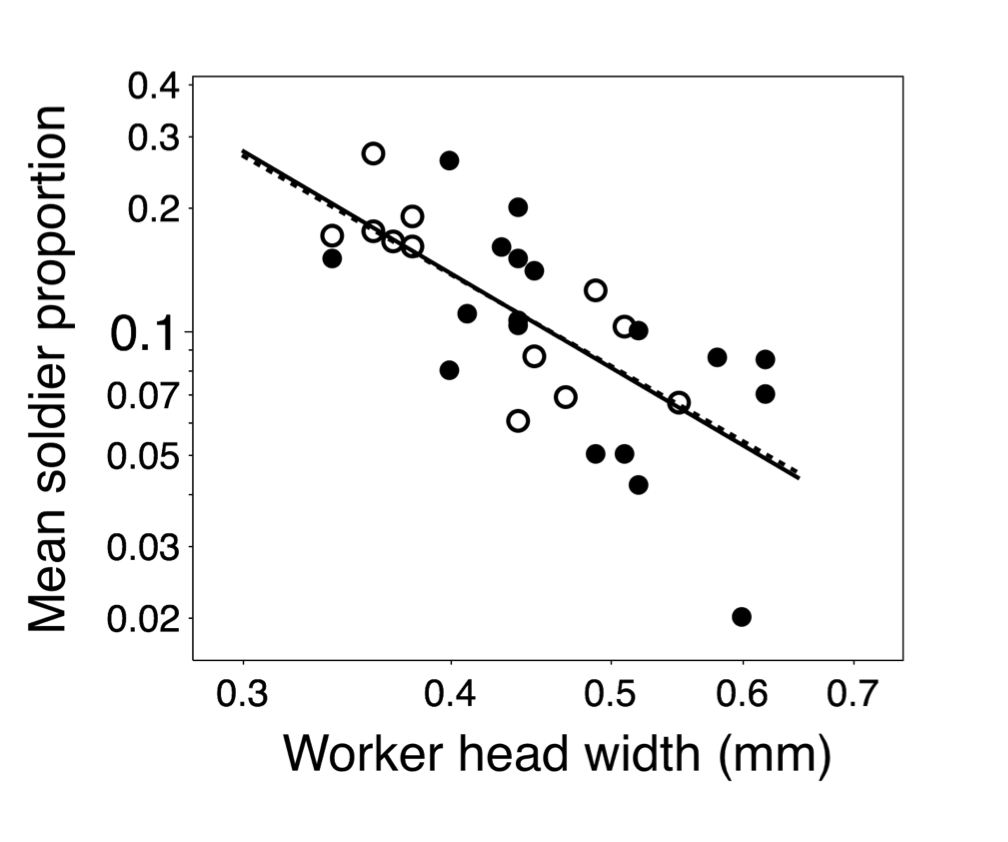
Ant science: Thievery persists in a world of plenty

Standard

I can forgive people for overlooking the fascinating behaviors of the thieving ant Ectatomma ruidum. There are so many ants with peculiar and amazing features (like agricultural ants, and those with rampaging armies). Some just fly under the radar.

Here’s the latest from my lab.

A few decades ago, Mike Breed and his students were studying behavior, and one part of the work involved using baits to feed ants. He noticed that sometimes, when a colony brought a good piece of bait underground, a different ant took it out of the colony, and carried it in a straight line to a neighboring colony. With a set of careful observations, excavations, labeling workers and some nestmate recognition chemistry, he described a unique phenomenon.

The sneaky thief

The sneaky thief

Colonies of E. ruidum steal from one another, all the time. They have a caste of specialized thieves that spend their time hiding out in a particular neighboring colony. When some good food comes along, they bring it back to their own colony. The best food items move around from one colony to another like uneaten Christmas fruitcake, only everybody wants it instead of passing it off.  The behavior of the thieving has been worked out well by the Breed lab, in a great set of papers. (And, I’m biased, because Mike Breed was my own PhD advisor, the best one I could have had.)

I wanted to understand how this thieving can persist, with everybody stealing from everyone else. This phenomenon makes a jumble of most game theoretical models, because everyone seems to be cheating, all of the time. What makes thieving happen? If they have plenty of food, do they stop thieving?

We ran an experiment in which we gave the colonies as much food as they ever could have wanted. It turns out that the rate of thieving did slow down.

The surprising result was that they kept continuing to steal from their neighbors, even when they had everything they could ever want.

This raises many more questions about the function, evolution and maintenance of thievery. We’re actively working on that, with some work finished and more in the works, and I’ll share more as it comes out.

How this project happened in my teaching institution

I’ve long wanted to work on the ecology of thieving, ever since I helped out on a project with these ants. However, I never had the time to set aside.

In 2008, a friend of mine had a PhD student who was working on poneromorph ants, who was interested in getting some time in the tropics. I was down in Costa Rica with a group of undergrads at the field station, and Benoit Guénard joined us a few weeks. He was a tremendous influence on my students with his enthusiasm, natural history talent, and the most robust work ethic I’ve ever seen. Seriously. We knocked out this project together, with Benoit taking the lead.

So, it took 4 years to get this paper out. In that time, Benoit completed his dissertation on the invasion of the Giant Needle Ant and also has done some top notch work on the macroecology of ant diversity patterns. Once his dissertation was out of the way, he focused on writing up this thieving experiment that we started early on in his dissertation. (I also have a few other collaborations with grad students, and former grad students, that are also awaiting a writeup. We’ll get to them, eventually. There are worse things than a backlog of papers that need to be written.)

Theoretical bandwagons are for big labs

Standard

Small labs should avoid theoretical bandwagons. It’ll make it hard to get money, publish and do good work effectively.

In an earlier post, I described two categories of research: the development of new ideas, and the testing, shaping and fine-tuning of these ideas.

I said I didn’t like either of the categories. I’ll explain that next week, but to get to that point I need to explain how big labs are designed for bandwagons, and how labs at teaching institutions should avoid designing their work to address bandwagon theories.

A bandwagon — as I use it here — is any theory, topic, or issue that lots of people are working on simultaneously. What do I think are some bandwagons at the moment? It’s easy, just pop open a journal and look at the table of contents! In ecology and social insects, my two main fields, here are a few that are at some point in the bandwagon boom-and-bust cycle: functional traits to understand community structure and assembly; genomic approaches to understanding the social regulation of development; models of geographic range shifts in response to climate change; physiological and genomic mechanisms of task allocation. (You could also throw in arguing about group selection, but that’s more about yelling than data.)

I’m not saying that the scientific community doesn’t need this work to happen. All of these topics are very interesting, and people have chosen them because they’re ripe for discovery and progress. It’s not a bad thing that these topics are bandwagons. When great ideas come along, we need people to work on them, including both disagreements and points of consensus. This is the standard practice of science.

It’s so much the standard practice of science, that labs at research institutions are engineered to thrive while working on bandwagons. Race cars are built for speed, thermoses are designed to keep your drinks hot, and many big research labs are designed to produce bandwagon research. (Not all big labs do, but they can be easily engineered to do so if this is the goal of the PI.)

If you’re running your own small lab at a teaching institution, there are a number of major strategic disadvantages from working on the same questions as big labs. These are disadvantages because they make it harder for the lab to get grants, publish papers, have a visible research profile, develop collaborations and provide the best opportunities for students.

No matter what you do, you won’t be perceived as the primary expert on the bandwagon topic. There will always be someone who is considered to be the authority, who is more productive on the topic. This person will have a whole lab working alongside them on the same topic. Moreover, this person’s name tag at conferences will have the name of big of a research university next to their own. Does this perception as an expert matter? Sure it does. This kind of perception enables you to do better science and gives better resources for your students.

Big labs can mobilize to jump on bandwagons quickly. They can turn on a dime by having a new dissertation start on the project, or assigning a postdoc to it. (You’re thinking, dissertations don’t start overnight?! Compared to the timescale of when I start and finish projects, they do. Tomorrow is a story about a quick project done in 2008 but was published this year. That’s par on my course. The manuscript I’m editing today has has had all of the data assembled on my hard drive for seven years. And I’ve been thrilled about it the whole time, too. And – get this – it’s still not stale. It’s actually ripened.)

You don’t want to work on a specific aspect of a project when other bigger labs will get to them quickly. Moreover, big labs will work so quickly that they will exhaust it before you get finished. In ecology, for example, thank goodness I didn’t work on the mid-domain effect myself or I would have entirely missed that wave before I even submitted my first paper. I would like to work on functional traits in ants, as the ideas seem interesting, but the same thing will happen to me if I do that. My paper would be passé by the time I tried to publish it.

Big labs need big funding. Theoretical bandwagons are the things that attract dollars. They can be sold as “transformational” research that NSF is seeking to support. Most of these potentially transformative projects will end up in the dustbin of history, and a small fraction will result in big change. If you’re a big lab and you need to pay for people, then you better hop on board! If you don’t, you’ll have trouble keeping staffed. If you’re top notch, you an create your own bandwagon. But if you catch it in the first couple years, then you can still get in there for one grant cycle, or maybe even two.  Following the same principle, bandwagons are horrible for small labs because they can never compete with these big labs that are putting in proposals on the same question. They’d never survive a side-by-side comparison once you put the biosketches up against one another. Of course they’ll fund the lab that they think will get 10-20 papers out of a project when they think you’ll only get a few out of it. So stay away unless you have the record to show that you can beat the top labs riding the same bandwagon.

To be clear: I am not suggesting that scientists at teaching schools specialize on an obscure topic that nobody is interested in, that can be mined for a series of novel but inconsequential publications.

I not suggesting that you stay fully clear of theoretical bandwagons under all circumstances, but only that if you hop on it should be with a big lab that is ready to roll. You also could take an existing project of yours and sell it this way, if you wish, though that will shorten its shelf life.

Next week, I’ll share a taxonomy of research goals, which will explain how I think you can do novel and truly meaningful research without chasing theories-of-the moment.

Mentorship = Training?

Standard

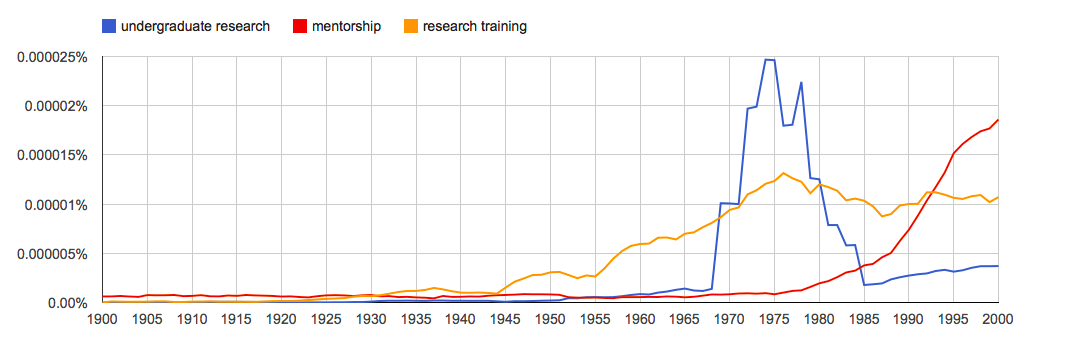
When I was an undergraduate in the early ’90s, I didn’t do much research. But when the students in my midst were doing research, they weren’t being “mentored.” They were getting “research training” or doing “undergraduate research.”

Nowadays, we “mentor.”

Is there any difference in what we are doing now compared to what people used to do, or is it just an evolution of nomenclature?

Here’s exhibit A. On Dynamic Ecology and elsewhere, they were having fun comparing historical trends with Google’s n-grams. I couldn’t resist cooking my own up:

Google n-gram of the use of the terms "undergraduate research," "research training" and "mentorship" in books

Google n-gram of the use of the terms “undergraduate research,” “research training” and “mentorship” in books over time

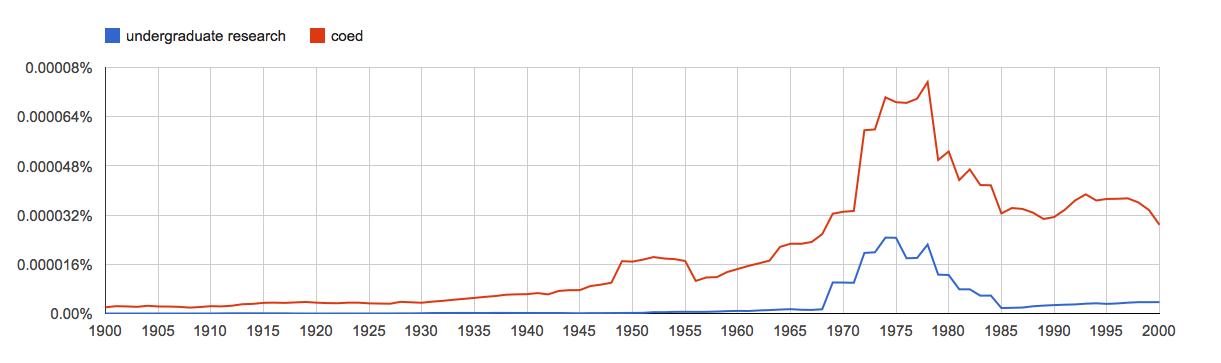
Oddly enough, the rise and fall of “undergraduate research” corresponds well with the use of that dated term to refer to female college students, “coed”:

ugrescoed

The way I read this, there was a steady climb in “research training” after World War II. On the other hand, the popularity of the term “undergraduate research” tracks disco on the airwaves, or the push for the Equal Rights Amendment. “Mentorship,” though, has steadily climbed since the 1980s, following the wake of “undergraduate research.” I won’t tell the people at CUR if you don’t tell them.

I think what we are doing, on a day to day basis in our labs with our students, hasn’t substantially changed ever since the term “undergraduate research” was popularized.

The term “mentorship” is broadly applied to many circumstances. It’s not just used for undergraduate research. (In 30 Rock, Jack Donaghy was Liz Lemon’s “mentor.”). However, the rise of the term in general does seem to have displaced “undergraduate research” off the radar.

I have to admit that I’m partial to the notion that “mentorship” is different in philosophy than “training.” In the context of training Master K-12 science teachers to help new teachers being inducted into the profession, I’ve gotten some exposure to training in a formalized program that shows people how to mentor, called “Cognitive Coaching.” I bet the Cognitive Coaching people will disagree with me, but this is mostly about learning how to mentor, by learning how to truly listen well and coach someone through a learning process or challenge. I was skeptical of the whole concept at first, but let me tell you that every person I know who has gone through the training is very positive about it and says it was helpful, and these are people who don’t like to have their time wasted.

I can train someone. Mentorship is more difficult, because it takes more patience. Mentorship requires that you help someone figure it out for themselves when they can. Training is just showing someone how to do it and make sure they copy well.

I aspire to the practice of mentorship. I’m not a patient person, but I try. Let’s hope the change in language reflects a change in practice. However, I wouldn’t recommend that the Council for Undergraduate Research change its name to feature the role of Undergraduate Mentorship more prominently.

On gender, parenting and academic careers

Standard

It used to happen all the time. I’d be out in public, with my son, at the grocery store, zoo or bagel shop. A friendly person would ask,

Babysitting today?

And I want to punch someone. Or punch something else. Or cry.

Instead, I grit my teeth, and reply with masked fury, in a moderately loud and determined voice:

I am not babysitting. I am parenting. This is my own son. We do this all the time.

Then, I mutter under my breath:

Idiot.

I don’t get this remark anymore, now that my kid is approaching ten years of age. Instead, I can see that when I’m hanging out with my kid on a Saturday morning, folks could be jumping to a couple other conclusions. One might be that I have partial custody and am getting in “quality time,” or that I’m letting mom sleep in because she’s worked so hard parenting during the week. They might not jump to these conclusions. But one that is less likely is the truth, is that I’m parenting while my spouse is working.

I regularly get asked about my field research. I go to one place in the rainforest for weeks at a time, during which I am supervising students, working in the field and lab, and am generally really busy.

Do you take your wife down with you?

What is odd, is that people rarely ask if she joins me. They ask if I’m taking her. I do take students down. But if my wife were to go, I wouldn’t be “taking” her. She’d be making the time to come along. I think, “She’s not a possession for me to bring along as I please wherever I go. We both have things to do you know.” Instead, I reply:

No, she’s busy working. I don’t think she can blow so much time to go to watch me work or to volunteer as my field tech. Also, someone has to take our kid to school and feed him, so I’m rather grateful to her to cover for me while I’m gone. She has come down a few times, for some vacation before or after my work, though we’d rather vacation somewhere new when we have the chance. Actually, this summer my kid’s coming along for a couple weeks and I’m looking forward to that.

I’m more inclined to give people a free pass, because most people — even other scientists — can’t really imagine what it’s like down at the field station where I work, nor what I do from moment to moment. Nevertheless, it does seem absurd that someone would think my wife could just drop everything and join me as an accessory.

The bottom line is that If I was a woman, nobody would be asking me if I “take my husband” to the rainforest while I was working. Nobody would ask me if I was “babysitting” my own child if they saw me with him in a jogging stroller at the zoo.

These remarks don’t make me a victim of bias, other than the fact that I find them annoying. These remarks actually have the false presumption that I am the beneficiary of bias.

The unfortunate truth is that these mistaken assumptions have a real basis. Why do I really want to punch someone when they ask if I’m babysitting? Because most of the other guys at the grocery store with their kids probably are babysitting their own children.

Many families that I know well have one parent employed full-time, with the other part-time or not at all. In those cases, the division of parenting and household labor makes sense. In dual-career couples, though, it’s far too often that the guy ends up not holding up his end of the marital bargain.

I don’t know if my wife would tolerate it if I didn’t do my fair share of parenting. She presumably would be annoyed, but if I just abdicated my responsibility, then she would have no choice to pick up the slack. It would be the same the other way around, if she didn’t do her share of the parenting then I would have to.
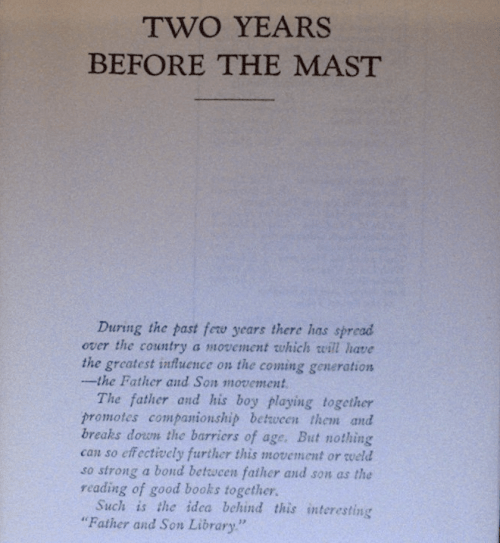
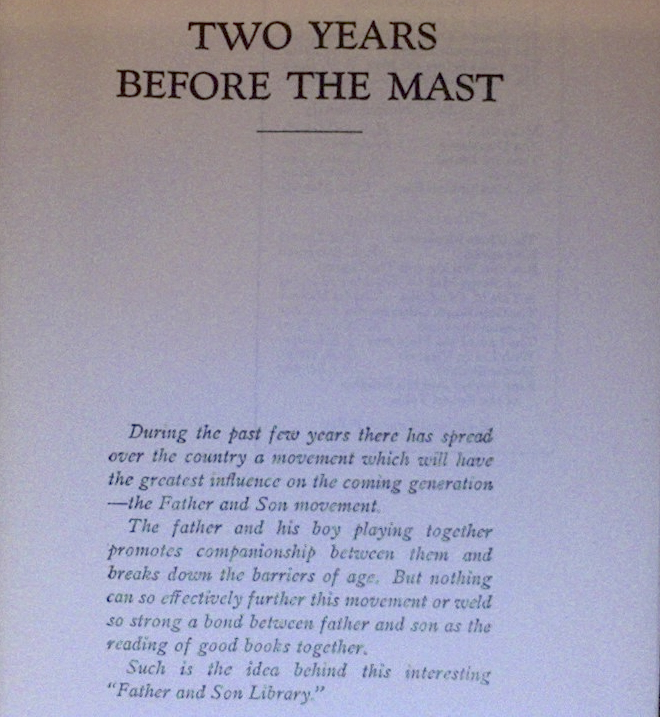
This is the book I'm reading with my kid now, from a 1927 edition. The token role of fathers in their children's lives has always been important to their development

This is title page of the book that I’m reading with my kid now, from a 1927 printing. Even back then, the token role of fathers in their children’s lives was promoted, perhaps even more robustly than in today’s parenting culture that still emphasizes the role of mothers over fathers.

In our culture, in dual-career couples, many fathers feel perfectly free to let the mothers do more than their fair share. This rarely happens the other way around.

I don’t look at the arc of history and see the need for systemic progress. It would be great if our jobs made more accommodations for working families and the entire NSF work-life balance agenda is great. But this is not the root of the problem, and you can’t fix it by simply giving women more slack or more time or more money. Those fixes just make it less worse.

I see individual people making bad decisions. I see men who choose work over family voluntarily, and I also see some women who step in and parent without giving their spouses the opportunity to carry the load.  The problem starts once a dual-career family lets one spouse assume more responsibility than the other one.

In my family, we’re not equal, but I think we are equivalent. I have to admit that I rarely do our laundry. On the other hand, I spend an equivalent amount of time cooking. I would hope that if a behaviorist were scoring my house with an ethogram, that we’d come out relatively even with respect to domestic duties. The number of nights that I’m out for social affairs or volunteering match hers. (I do teach nights a couple times per week, though that often means that I get other mornings and evenings. It evens out.)

More importantly, we come out equivalent on parenting. I hold this as a point of pride, but it really should not be a point of pride. It should be the status quo, at least when both parents are working as much as the other.

The fact is that women are doing more parenting than their spouses, in most dual-career couples. This is not caused by biology or by the system. It’s caused by individual men screwing up.

I am tired of the trope that biological differences between genders makes women expend more time parenting than men. For most academic work (aside from dealing with reagents, and some fieldwork, and medical complications), women are capable of working for nearly the entire time they are pregnant. A few weeks after giving birth, in some cases, women are as physiologically capable of working as men. The one factor that continues is milk production. However, pumping can often work well and formula isn’t exactly evil. (For what it’s worth, my wife went back to work full time after six weeks and we never spent a dime on formula.)

The only biological difference that causes women to parent more is that men might be more likely to be born as jerks that let their wives’ careers suffer because they are inadequate parents.

Just because women are the producers of milk, shouldn’t that mean that men can just as easily step up to the plate and contribute in other ways?

Especially in academia, men have plenty of latitude to do their fair share of parenting compared to other careers because it’s so flexible. Women partnered with someone working a typical non-academic inflexible job also can get lots of spousal support, from a partner that is available to cover mornings, evenings and weekends.

I essentially took six months off to parent full-time, aside from Tuesdays when Grandma stepped in for us. Did this hurt my career? Actually, it did. I was at a Catholic university at the time, and my male Dean expressed concern about my request for paid parental leave (as clearly specified in faculty handbook), because that was intended only for mothers and not fathers. He told me that he understood my dilemma because he had five children of his own and he never missed a day of work. That conversation was not good for my career.

My point is that there is no inherent biological reason that mothers, more than fathers, may have more negative repercussions at their work because of parenting, because both are equally capable of doing so. There may be sexist reasons that transcend scheduling and effort, like I experienced, but that’s not going to stop me from doing my job as a parent.

(As a side note, have you ever looked inside Parenting magazine? It should be renamed Mothering magazine. There is always a column about fathers, but it is always, without exception, about how women can convince their husbands to do something like change a diaper once in a blue moon or do bedtime reading.)

The only biological difference that makes women parent more is that some men are assholes. These men don’t fulfill their duties to their spouses or they demonstrably care less about raising their families on a day to day basis.

If you tell me that women have more problems at work because of they have more parenting obligations than their spouses, then I tell you: their spouses are doing it wrong. And the women are doing it wrong because they’re accepting less than 50% from their spouses.

As you can tell, I get mad when gender is conflated with work-life balance issues. This is probably a chip on my shoulder from being a dad and spouse that did his fair share, in an environment where this is a rarity.

If you want to fix the dual-career couple inequity issue with respect to parenting, the first step is to tell women to not marry men who don’t parent enough. Women should not be spending more time parenting than their partners if they’re both living in the same house and both working full time. How many times and ways do I have to write this? Apparently, it is a lot, because it doesn’t seem like anybody else is saying it.

Of course, in our country there is so little systemic support, from the government, our own workplaces and our extended families, that we have a greater stress placed on working parents overall. This is not a gender issue, it’s a parenting issue.

If a married woman says that she has a greater challenge at her job because of the time demands of parenting, then she needs to hear that the problem is not the system, it’s her spouse. The problem might be her spouse’s boss, but I’m not convinced that this is a rampant problem. Perhaps this should be the main problem, but right now it isn’t.

I avoid these conversations because I it never has ended well when I’ve told a guy that he needed to spend more time parenting. And I don’t have the temerity to tell a woman that she picked a crappy husband who isn’t willing to accept 50% of the parenting load. (Now, I can just tell people to read my blog post about it and be done with it.) I’m not sure how to implement change when the necessary change requires individual responsibility on the part of others. We can raise sensitive males that understand their roles as partners. Hopefully, I’m doing that by example.

For me, it’s not a problem, because hanging out with my kid is the best thing in the world. I can’t conceive how a man would think otherwise about his own kids. I was lucky that my academic career gave me the flexibility to shut down my research program for a spell, so that I could be at home with my baby. (This I could do because I was at a teaching institution. With a big lab, and pressure for grants and pubs, it wouldn’t have happened that way, and daycare would have started earlier or we would have relied on extended family, both of which also would be fine options.) If I didn’t have that flexibility, I wouldn’t demand it of my wife. We’d solve it together, and it wouldn’t involve sacrificing her career.

There are substantial issues involving sexism in the sciences and academia, independent of parenting. That’s a separate issue, and one that I’m not addressing here. Perhaps I’m addressing it by claiming overtly that it is a separate issue — that parenting should not be a gender issue, and it’s only an issue in dual-career families in which the man is a wretched bum.

Every time I see a story or hear a person remark, “it’s great and inspiring that this woman can be a scientist and a parent” I get mad. You know what? That statement can apply to me, too, aside from the fact that I’m a man. I do just as much parenting as my spouse. My “success” or the lack thereof, that is tied to my status as a parent and a researcher, should represented in equal measure as it is for female scientists. (This would be different, of course, for single parents or those who have demonstrably jerky husbands.)

If you think that notion isn’t broadly applicable to all men, that’s because you think that many male scientists with kids are deadbeats. I might agree with you on that. The father-scientists I’m working with now seem to be dedicated and supportive of both their kids and their spouses, but that’s not the norm. My non-academic father friends are also doing their 50%, or their share depending on the family employment situation, but then again, I feel like I can’t relate to most guys, in part because of a fundamental difference in values. I can accept that some guys would be nuts for basketball, or have a specific religious belief, or drive a fuel-inefficient vehicle. But not parent 50%? That’s a dealbreaker.

If a man says that his full-time job doesn’t allow him the time or flexibility to do what needs to be done as a parent, and that’s why his wife is doing more parenting, I call bullshit. A woman would never say that she is incapable of doing what is necessary to be a good parent. A man should never be able to get away with saying something like that.

That just means that you don’t have the courage to tell your work that you prioritize your family over the job, and it means that you’re letting your wife do that and take the damage to her career as a result. That’s cowardice.

If there’s going to be a change, then men have to stop being cowards and start parenting. Men can address this problem by accepting the same career risks of parenting that are being endured by their partners. Until that happens, any progress is a mirage.

What happens off campus stays off campus

Standard

I suspect that one’s research profile on campus has no relationship to what happens off campus in the research community. (Keep in mind that this pertains to teaching campuses.)

These kinds of perceptions might matter, to some extent, if they govern how resources are allocated.

A person might be considered to be mighty fine on campus in their small pond (get it?!), but among their research peers could be unknown. Likewise, I’ve known a couple people who have been tremendous scholars in their own fields but this fact was either unknown, unappreciated, or willfully ignored on their own campus.

There might even be a negative relationship between the two parameters. Some people who have scant standing in their scholarly communities can easily puff up every little thing and can readily deceive professors outside their disciplines. In some fields, conferences are more prestigious than journal articles, and in others, only books count for much. In one’s own department, the sham might be transparent, but throughout campus the big scholarly charades can be successful. Promoting yourself on campus takes time, and that’s time that could be spent getting real work done.

Serious and productive scholars may have no time or incentive for promoting or discussing their research on campus. In departments or colleges where major research is more cause for suspicion than praise (which I’ve seen multiple times), wise researchers should keep their heads down.

(As a corollary, most administrators are smart people and can see through the bunk pretty easily, and they also have access to information that others don’t have. So, a widespread perception among faculty on campus doesn’t mean that the the Dean and the Provost don’t know the time of day. This is, as far as I’m concerned, the only place where perceptions matter, because this is where resources get allocated. I don’t really know how to influence this, though, other than by keeping my head down and working. If I use my words sparingly, each one will have more weight. So, I avoid interacting with administrators as much as possible, so that if I really do need something, there’s a greater chance they’ll be there for me. That’s the most sophisticated I’ve gotten at image management, which I think is rudimentary.)

In short, my anecdotal observations suggest that, the more someone talks about research on a teaching campus, the less it happens. I’m not sure how universal this observation might apply, though.

Efficient teaching: exam writing vs. exam grading

Standard

Grading sucks. I hate grading. I guess even the best job in the world has its downside.

I hate grading because it makes me think about all of the less un-fun things that I could be doing at that moment. And I often do those things (like laundry, or dishes) instead of grading. Which only makes grading worse.

I’ve never actually given a scantron exam in a class that I’ve had the freedom to teach how I wanted. I haven’t had a massive class that’s required this approach (or a small army of student graders). I’m not inherently opposed to multiple choice exams, but I’ve mostly been in places where they were not appreciated, at least not in the kinds of classes I have been assigned.

One of the reasons I haven’t liked multiple choice exams is that writing a good one takes a lot of time. (And, even when I’ve used some of these questions on a paper exam, I find that they can contain a lot of hidden cultural biases that only come out when talking with students afterwards.)

If your exams aren’t multiple choice, then how can you do spare yourself grading hell?

You can’t. But you can lessen it.

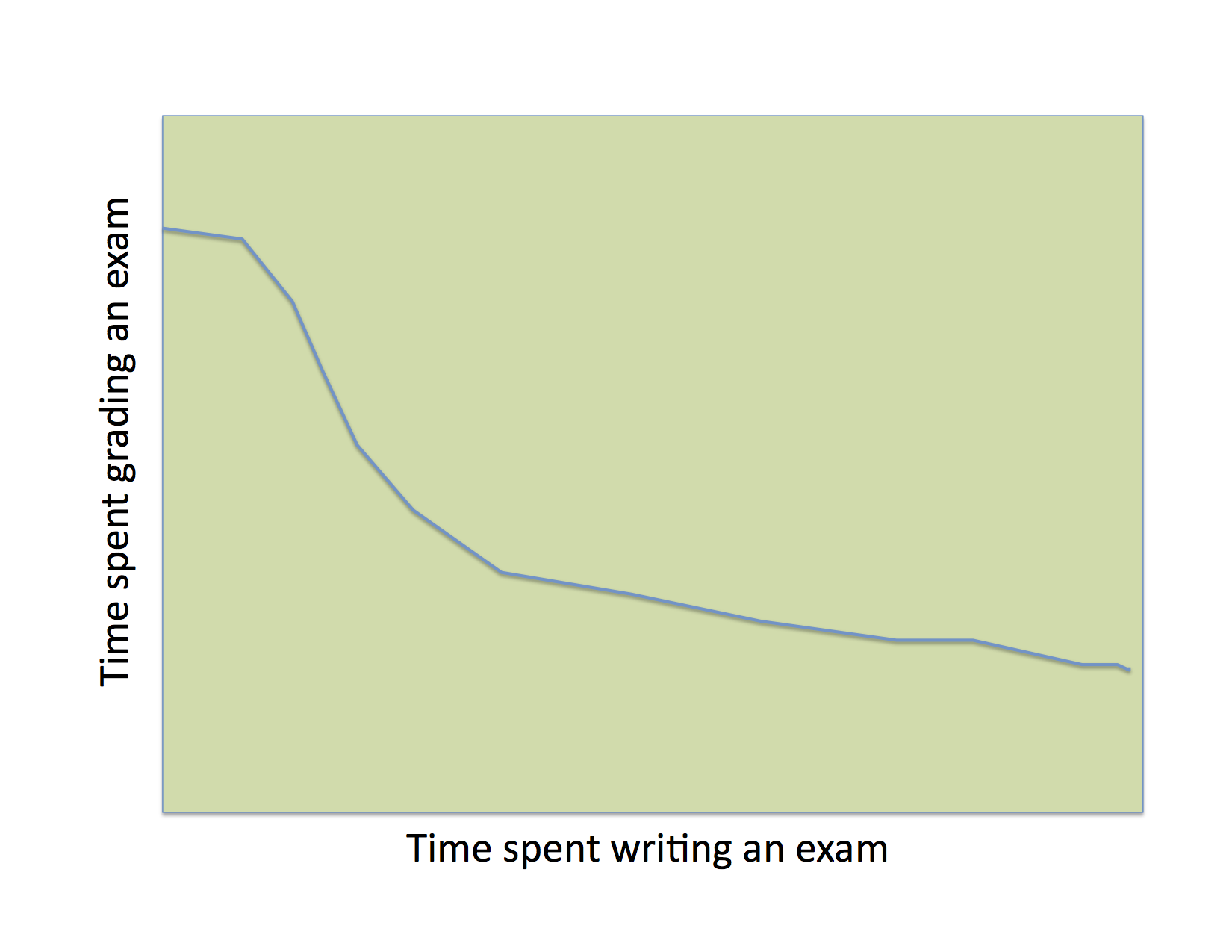
Which is more annoying, writing an exam or grading?

Which is more annoying, writing an exam or grading?

This is just a working hypothesis. It’d be interesting to really know. But not interesting enough to delve into the education literature.

On one extreme, you could write an exam in ten seconds. It would ask:

Explain in detail the five most important ideas that you learned while studying for this class in the past month.

Very easy to write, very hard to grade.

When underthinking exam questions, then we could be in for a world of hurt when we have to grade the responses. You can’t necessarily create a perfect rubric up front, because you might get correct but unanticipated answers.

Students can put all kinds of crazy stuff down when you ask questions on exams. Sometimes, this crazy stuff is actually factually correct and directly answers your question. Even if the answer is not addressing the content that you were expecting the question evaluate?

Badly Worded Question: When the earth had more oxygen in the atmosphere, would the sky appear orange or not? Explain your answer with a sentence.

Correct answer: Yes. The sky would either be orange, or it would not be orange.

I have a really hard time marking points off a question which is fully answered correctly, even if the correct answer isn’t what I anticipated. (In fact, I promise I won’t do this to my students, as a part of a policy of transparency and fairness.) The onus is on me to write questions that directly get at what I need to know to assess their content knowledge and the ability to process it (Blooms taxonomy, yadda yadda)

So, if you make sure your exam is airtight going in, then grading it should be easier.

But writing exams is no fun either. So we don’t write the best exams in the first place. Maybe the memories of painful grading are enough of a stick to make us write tighter exams.

hat tip to Prof-Like Substance for venting about grading.

About face

Standard

I’ve wholly changed the ‘about‘ for the site. You can learn more about me that way.

I’m still new to blogging. Just like playing an instrument or wrangling a bullet ant, being a dutiful observer doesn’t mean that you can do it well. I’m still learning. Even if the blog isn’t about me, it’s my blog and being forthright about that fact is part of doing it well.

I’m psyched about how the blog is coming along. I particularly want to thank Jeremy Fox and his blog, Dynamic Ecology, which has been particularly supportive. I don’t want to blog about blogging, so I’ll just shut up. Thanks for reading.

Making ideas or evaluating them? Climbing aboard theoretical bandwagons

Standard

It’s no mere coincidence that both Darwin and Wallace figured out natural selection at roughly the same time. The basic facts at the foundation of the mechanism of natural selection seem to have been established for a couple millennia. They didn’t converge until the Victorian era of natural philosophers. Before that time, some false assumptions about the nature of existence stood in the way.

In a similar vein, both Newton and Leibniz independently developed calculus at the same time as one another.

Likewise, Verhulst created the logistic equation. Then, it took almost 100 years for someone to come upon this again, by Pearl and by Lotka who did this independently of one another.

At the start of the 1900s, people were attempting to build a heavier-than-air machine capable of controlled flight. There was a convergence of technology and ideas that allowed these things to develop on three continents, at just about the same moment in human history. That’s no mere coincidence. History was ripe for that to happen, though it took a special vision, and plenty of hard work applied in just the right way, to put things together. The Wright Brothers were were perpetual tinkerers. They were also driven by data, experimentation and critical analysis of their findings, allowing them to figure out the actually fatal errors of their predecessors. (It’s worth a visit to Dayton, I had the chance to visit a couple months ago. Their bicycle shop looks and feels a lot like a lab you’d find at a small teaching school. It’s mighty inspiring.)

For every Darwin and Newton, whose ideas had contemporary shadows, there are many more innovators that go it alone. If their ideas were not developed, then we have to wonder if they ever would have happened. Some people say that about the smartphone. It’s hard to say how often this is true. Regardless, there is a reward to the first to figure out an important idea, when these ideas spur progress. (I have to admit that the copy of Kuhn’s Structure of Scientific Revolutions on my shelf is dusty and not fully read. I think more people have made it through Ulysses.)

I got to take a vacation to Iceland a couple years ago. It was enlightening. And there was a Penis Museum in Húsavík, too. For a millennium, Iceland’s subsistence living, and whatever mediocre export economy that could be mustered, depended heavily on sheep. While farmers in Europe were using the spinning wheel for centuries, Icelandic farmers were still spinning wool with feeble handspools. Moreover, back in the day they made shoes out of hide, but never figured out how to make leather. A long journey would require several pairs of shoes for long journeys because they would wear out so quickly. Some contemporary roads are named after the number of pairs of shoes it used to take to make the journey along the road. I don’t mean to pick on the Viking ancestors of contemporary Icelanders, as they withstood the little ice age far better than I ever could have. I don’t know if, while spinning wool on a handspool, I would have been the one to independently invent a spinning wheel separate from outside influence. I’d like to think I could have been that resourceful, though I might have been too busy to take the days off to work on it.

As contemporary Icelanders can tell you, the development of new ideas matters.

Orville and Wilbur Wright invented the plane. Now, without consulting Wikipedia, can you tell me who else was critical in the development of early airplanes?

Many people did great and important work on early flight. Their contributions were critical, even if we can’t recall many of their names. Heck, I’ve been surrounded by aviation history for more than a decade (on account of my spouse’s job and the location of my campus) and I can’t name more than a handful of the pioneers of early flight.

from wikimedia commons

from Wikimedia Commons

Here’s why we can’t remember those other guys (and, it seems they indeed were all men) who turned early planes into something workable for society: their jobs were interchangeable.

I posit that anybody with the training in engineering, math and workmanship skills could have followed through on the first principles developed by the Wright Brothers to grow the field of aviation. Much of it was done by the Wrights themselves, but they had many colleagues and competitors. Flight wouldn’t have taken off (heh heh) unless there was the labor and brain juice expended by many people at the time.

When a new idea comes out, which is more important, the development of the idea or the fleshing out of the idea? Clearly, more glory comes with the former. Both are important. I think it’s silly to say that one is more important than the other because both are essential components. When a great idea comes around, someone’s got to put meat on those bones. It take a whole community of researchers to do that.

For example, some have said that E.O. Wilson is one of the most important scientists of the past century. Why do people say that? Because he created the kernels of many ideas. He put them out into the world, and then many people pursued them. These include the taxon cycle, island biogeography, the social regulation of caste in social insects, sociobiology. He fleshed out the ideas enough to get others to test them out in great detail. He never really lingered on these ideas once he put them out there.

The community of scientists is principally composed of people who are testing theories and fleshing them out. After someone figured out the spinning wheel, then there were many people who worked on the design to make it better. That task of filling-in-the-details is the currently bulk of work in science.

Humor me while I bring out a couple more examples.

In the field of ecology, Hubbell’s formulation of neutral theory was a major progress as a null model that was entirely lacking in community ecology. In the field of behavior, Hamilton’s conception of inclusive fitness revolutionized how we think about the evolution of social groups. After these ideas were formalized, small armies of researchers have pursued these questions to hammer out details, question theoretical foundations, and understand how things can be generalized and how things might not occur. Regardless of how significant kin selection is 100 years from now (I am not invested into it either way), the formulation of the idea by Hamilton was successful in spurring a scientific revolution, which is still spinning to this day (and Wilson even stepped into the fray as a gadfly).

Many of my friends and colleagues have done great work, with much of their careers invested, on the details of kin selection and many of its subtheories and corollaries. So, I hope I don’t hurt any feelings when I suggest the idea that a lot of this work could have been done by interchangeable scientists. (I’m open to being convinced otherwise.) The work required brilliance, perseverance and specialized training. However, if any one person didn’t make some of the contributions, then the gaps would have filled in by the others. As a group, the entire endeavor was significant and as a community, researchers of social animals learned a ton. I greatly value their contributions, and some of them are a model for how I run my own lab in a number of ways.

Who should be a part of that workforce ? Does it matter? Who is best suited to it?

Who is suited to making big new concepts, and who is suited to that kind of fleshing-out-of-ideas science, to test existing theories, and build upon these to make new subtheories? Moreover, what kinds of research labs are suited to each kind of option? My little undergraduate lab probably shouldn’t follow the same path of a lab with multiple doctoral students and postdocs.

So, I don’t choose that path.  I mean: I don’t like either option. I choose option C.

What’s option C? That requires a taxonomy of research goals. That’s a set of posts within the next month.

Undergraduate research offices: what makes one work well?

Standard

Many universities – of all conformations and sizes – have a special center or office dedicated to undergraduate research. It’s a nice idea.

On some campuses, they are tremendously helpful. On others, I’ve seen or heard that they’re more of a hindrance than a help. Some campuses don’t have one. That’s a good thing if the office would be unhelpful, or a bad thing if the nonexistent office would be successful.

The scopes of these undergraduate offices vary, depending on how well they’re funded, and what level of buy-in they have from the administration and faculty. I actually haven’t had the benefit of having the services of any one of these offices yet, though I’ve worked with colleagues at many universities who have talked to me about their experiences. (I also have mentored students from schools with these offices.)

On the whole, I’ve heard more complaints than praise, but considering that our species is wont to complain, I imagine that by the existence of praise, a lot of these offices are doing fine. A colleague of mine once got a great bottle of wine for just submitting a grant that included undergraduate research. She didn’t complain.

Here is a partial list of things that the office can do:

  • Track data and progress on undergraduate research projects
  • Provide support for undergraduates, with respect to writing, test preparation, workshops
  • Coordinate lecture series
  • Promote and facilitate grant-writing to support undergraduate research.
  • Facilitate and advertise selection of students applying for undergraduate research programs (REU, MBRS, IRES, RISE, McNair)
  • Provide support to PIs of grants involving undergraduate research
  • Support (financially and otherwise) faculty mentoring undergraduates
  • Coordinate an undergraduate research-related events (like a poster session)
  • Direct an program that funds undergraduate research projects with internal funds
  • Provide space for research students to gather
  • Provide administrative support for project coordination

Sometimes these offices are run out of, or in coordination with, the offices of sponsored programs on campus. sometimes they’re separate entities that are run with distinct budget lines. I think the latter might allow for more latitude for the center to focus on its mission. What is that mission, though?

Often, what these offices do is murky and there is disagreement about the best use of the resources of the offices. I think that these conflicts arise from fundamental differences in the purpose of undergraduate research on campuses. Sometimes, there is a disagreement about what constitutes research itself.

It is mostly established that undergraduate research enhances the educational enterprise, and coursework that includes genuine and novel inquiry results in better learning. Some administrators and faculty have this as a primary goal, as a way of increasing retention, decreasing time to graduation, and promoting “best practices.” Some, on the other hand, see undergraduate research as an enterprise to prepare students for graduate school, and as having inherent value regardless of its effect on other aspects of academic life on campus. Others see undergraduate research as a mechanism for conducting a research program, and if a the campus is full of undergraduates, then “undergraduate research” just means “research.” On some research campuses, the office might even protect undergraduates from being the serfs of their labs.

I don’t think we all can agree on a definition of undergraduate research, though such definitions do exist. I say that research means that original scholarship is being conducted. If students are involved in research projects that are not intended to make new discoveries, then these in fact are not research projects. They’re merely learning exercises.

Moreover, scholarship itself is only useful if shared with the academic community. If a student develops new knowledge but that knowledge isn’t disseminated to the community of researchers in that field, then the research project was not a success. In my view — and I recognize that this is a minority view on teaching campuses — if a student research project doesn’t eventually make it to press, then it is not clear if it was genuine research.  It was clearly research training. Keep in mind that pilots can go through stages of flight training without ever leaving the ground, and we go through earthquake safety training without having an earthquake.

So, are undergraduate research centers supposed to promote undergraduate research training, or undergraduate research itself? This is not idle discussion because it affects the decisions about how resources get allocated.

This distinction is tied to the heart of the notion of what happens on a teaching-centered institution. Is faculty research just there to keep the teaching instrument sharp, or are faculty expected to be active scholars? If it is the latter, then faculty are doing students a disservice if they’re not fully engaging them in opportunities for genuine research that are already taking place.

So how do you know if undergraduate research centers are successful? Many institutions use vague accounting, listing the number of students reported to participate in projects. More concretely, other metrics include the number of publications with undergraduate authors, the number of students employed to do research in the summer full-time and part-time during the academic year, or the long-term professional outcomes of the students. Others will count the number of dollars spent on student research; some administrators will be counting indirect cost recovery. The best metrics depend on the mission.

So, perhaps when building such an undergraduate research center, focusing on the mission is a critical starting point. You can’t get everyone to agree, but you need to clarify what the center is doing, and also why it is doing it. Consensus is always good, when possible.

If you have an undergraduate research center, could you remark on what you think works and doesn’t work? If you were in charge (or, if you are) what would you do if you could, and what would you not do?

We exist.

Standard
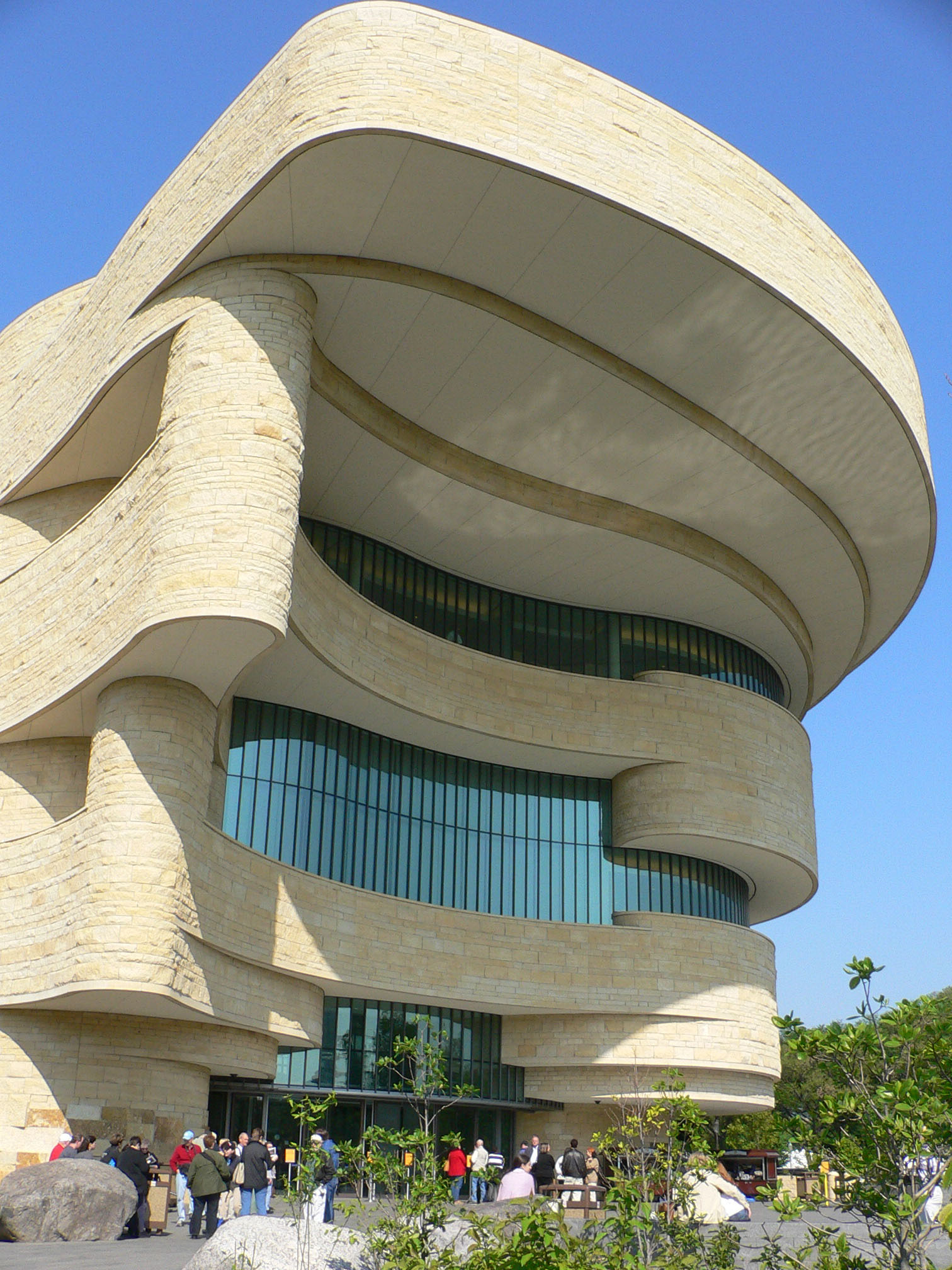
The NMAI

The National Museum of the American Indian, Washington, DC, USA

This is a manifesto about science research.

The National Museum of the American Indian opened on the national mall in Washington, DC in 2004, as a branch of the Smithsonian Institution. The building is a work of art, the exhibits are mostly engaging and informative, though the most remarkable thing about the place is the food court as its own lesson in biodiversity and cultural plurality. It’s worth a visit, along with scores of other great museums in DC.

The mission statement of the museum reads like boilerplate, about advancing knowledge about the diversity of Native American cultures in the Western Hemisphere. The museum itself accomplishes this task as well as it can, considering the massive diversity of peoples that could be represented within one building.

The NMAI was born after a long gestation, more than a decade. The creators of the museum had a tremendous challenge in presenting a unified structure that communicates the experiences of so many different kinds of peoples, ranging from those in the arctic to Patagonia and every place in between. They developed many mini-exhibits featuring a representative but small subset of the peoples of the Americas, featuring citizen curators who worked with the museum professionals in an attempt to use a small amount of space in an attempt to represent a culture. It was ambitious, and the success of these efforts varies. The result is a visual melange, and a cognitive jumble. This medium appears to be, in part, the message of the curators.

When the museum was being developed, it is my understanding that the creators had a more challenging mission, which isn’t explicitly stated on their website. They realized that most US citizens have a mistaken view of the role of Native Americans in our past and present.

This primary task for the museum is very straightforward: Tell the people that Native Americans still exist. Tell the people that Native Americans are one of us.

I suspect that museum staff hopes that visitors to the museum leave thinking, “I had no idea! This was a total surprise.” I would guess that the typical visitor walking through the doors for the first time might expect a series of maps, valuable old artifacts, and a history lesson. Instead, the exhibits are about the lives of people who are alive today, where they live, how they make their living, and the great diversity of their spiritual, linguistic and social practices.

American Indians are not (just) a part of history. They are a large set of vibrant and active cultures living within and among all of those who live in the Americas. If you learn about American Indians in school in the US, the story you learn is that the European settlers steadily and systematically exterminated Native Americans. That story is a falsity. Native Americans persist. They are both distinct and a part of us.

What does this have to do with being a scientist?

The mission statements of this site, of sorts (the “about” tab and “rationale for existence“) said that I wanted to represent the experience of doing research in a teaching institution. There are many kinds of teaching schools, and they all have different kinds of opportunities and challenges. I thought that those of us doing research in these environments should have a bigger voice.

I have received unanticipated (and uniformly wonderful) feedback from readers, especially senior graduate students, postdocs and junior faculty. Based on what they’ve told me, I now realize that I had jumped the gun with my mission statement. I started by getting into the nitty-gritty of what it’s like doing research on a teaching campus. That wasn’t a mistake, but I didn’t adopt the broader perspective. I needed to follow the example of the creators of the National Museum of the American Indian. I neglected to frame this endeavor with an elemental message:

We exist.

We are doing research in these teaching campuses. To take this kind of job doesn’t mean that our research career is over. We do research in your field, and we train those who become your graduate students. We create new knowledge and we are scholars just like you.

We are one of you.

We are rarely on disciplinary grant review panels or the mastheads of journals. We aren’t able to hire your grad students as postdocs. We are rarely invited to give seminars at your big research universities, because schmoozing us won’t yield as many tangible benefits as schmoozing someone else.

This doesn’t invalidate the fact that many of us have good research labs. We read and publish in the same journals as you. We get funding from the same agencies, and we have specific talents and resources that allow us to get stuff done and to be valuable collaborators. Our undergraduates do not handicap our research programs. These students are our greatest asset. They are both the means and the ends.

The grad student who opens a research lab in a teaching campus is not a failure. Be proud. Do not expect us to disappear from science. If you keep us as members of your research community, we will be able to participate in the community.

Don’t see this as settling for less.

It’s not less, unless you perpetuate this perspective.

On teaching campuses, faculty aren’t required to do much research, if at all. This doesn’t prevent some us from running serious and productive research labs. We have to do some things differently. We also have the opportunity to do things differently.

And, let’s face facts. There is a steady decline of tenure-track positions as the 20th century notion of the professoriate is relegated to the history books. Nowadays, lots of researchers are taking teaching positions. Research institutions, and their faculty lines, will not disappear, but it’s been a long time since research has broken out of traditional research institutions in the United States.

Researchers have a variety of motives for taking jobs at teaching schools. Some are dedicated to teaching and are seeking to do both teaching and research actively. Others are more excited about teaching, and others might prefer a research institution but have personal reasons for choosing a particular job. While there is more competition for tenure-track jobs at top research universities, none of these jobs are inherently easier, less stressful or more rewarding, if you’re doing them right.

It’s not easy to do research at any university. You’re working to keep funded from grant cycle to grant cycle, and juggle competing demands of student training, teaching, service, writing, and outreach. At teaching campuses, we do things differently than at research institutions. That’s what this site is about – how research gets done at teaching schools.

It sounds like I’ve struck a resonant chord so far. I’m hopeful that what I choose to write here continues to be helpful to those developing their career paths, at all levels. So far, I’ve heard that the most helpful aspect has been the formerly tacit message, that we exist.

It should seem perfectly natural for labs at research universities to train people to run research labs on teaching campuses. After all, that is the actual status quo. My job here is, in part, to make this obvious fact more visible, and a shift in this perception will continue to produce more great research labs on teaching campuses. If this site is capable of shifting perceptions, then it is my hope to write this blog out of existence.

And now, back to our normal programming.

A formal model for undergraduate authorship

Standard

The standard guidelines for authorship rarely address undergraduate-specific issues. Earlier, there was some interesting discussion about what it takes to make an undergraduate a first author, and the costs and benefits of working to make this happen. Since then, I’ve been made aware of a detailed and thoughtful article specifically addressing this topic, by Burks and Chumchal at Southwestern University and Texas Christian University.

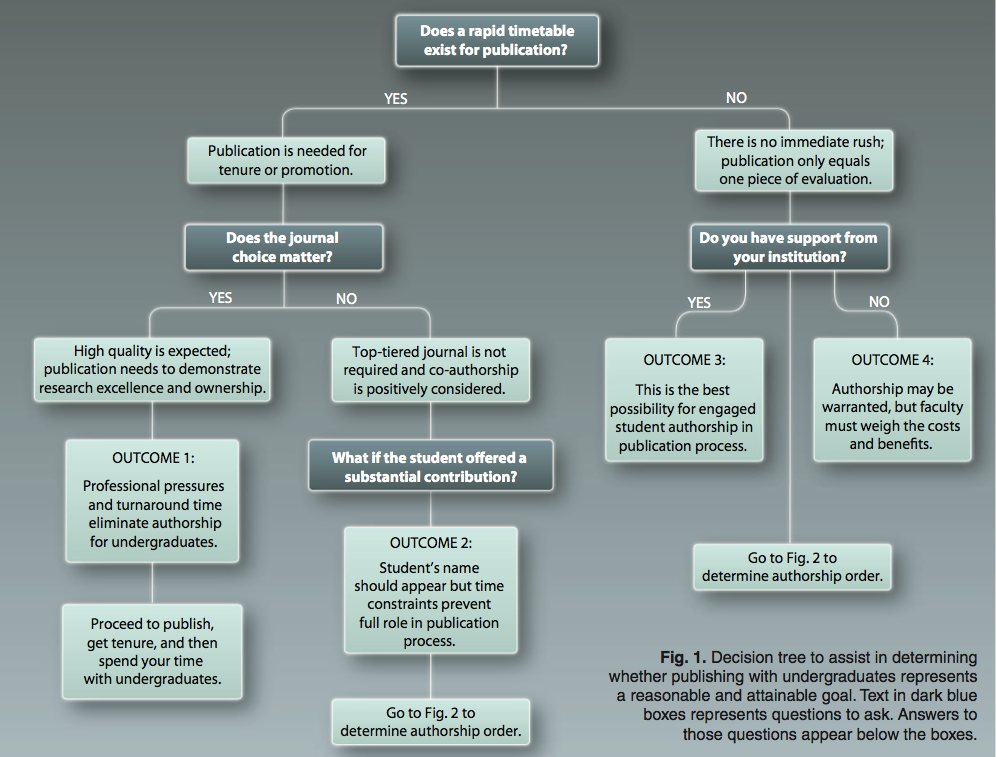
If you’re thinking about investing the time into mentoring an undergrad through the long slog of the writing process, this fuel for thought is worth your own time to read. There is a great list of recommended strategies, which we only touched on in the comments before. Here’s a copy. The paper includes this decision tree:

a decision tree to figure out how an undergrad is an author

From: Burks, R.L. and M.M. Chumchal. 2009. To Co-Author or not to co-Author: How to write, publish, and negotiate issues of authorship with undergraduate research students. Science Signaling 2: tr3.

This article was sent to me by a reader who didn’t want himself to be identified. Thanks, anonymous correspondent!

This paper is spot on and provides a very useful way to structure a project even before you start. There are a few tacit assumptions in here, though, of which I’m not wholly convinced.

  • Publication with undergraduates makes it harder to get into a higher tier journal (potentially because of time constraints)
  • Lack of institutional support may alter the costs and benefits of involving students in research
  • The motivation for supporting student authorship will vary with tenure/promotion status

The paper also addresses whether or not students earn any authorship at all, and if so, what position. This part made me feel better, because it looks like my current practice mostly follows the recommendations. However, the authors suggest that if a project couldn’t have been completed without a student, then that students merits authorship, at least somewhere in the paper. Almost nothing in my lab gets done without students. What is the role of an undergraduate student who performs the role of a thoughtful technician? This student didn’t conceive the project, but they spent 200 person-hours working on it. They aren’t in a position to analyze or write (or, at least, I’m not in a position to mentor them on it). They collected nearly all the data but didn’t do much else. Are they coauthors? This is murky. The student has a good deal of ownership and the project would not exist without the student, but you did everything but collect data. I prefer to involve students more deeply, but sometimes this doesn’t happen.

This is still a dilemma for me. One of the pragmatic aspects that enter the equation is the professional trajectory of the student. Would the paper matter for them? This shouldn’t be a part of authorship criteria, but it’s hard to ignore.

Ant Science: litter ants follow sunflecks

Standard

When something fresh does come out of my lab, I’ll share it. I also will share the process by which the paper got published, in the context of working in a teaching institution.

Here’s the latest.

Plants living on the forest floor are starving for light.

I was wondering if the same is true for ants, as light brings heat, which regulates ant activity.

In the 1970s, ecologists sorted out some big ideas about how communities assemble (even if they didn’t use the word “assembly” often). It turns out that access to light is a key variable, for plants. This is especially true for plants that live at the bottom of the forest, chained to the ground and not yet reaching the sky. They live and die by the tiny little flecks of sunlight that poke through the forest canopy to provide energy.

Myrmecologists were late to this story, because they were sidetracked by an obsession with interference competition. When you drop some tuna or a cookie on the ground, it turns out that ants go nuts. Now that many of us have accepted the fact, in real life, they don’t get regular tuna and pecan sandies from the sky, we are focusing on what really makes ant communities tick on a day to day basis. Particle physicists might have to smash their subjects in order to understand them, but as ecologists we can be more subtle.

One fundamental way that ant colonies are different from the plants is that they move around on the forest floor. The ants in rainforest litter move their colonies every few weeks from twig to twig. Maybe their nest movements reflect changes in the light coming through the canopy. Some ants might want to avoid the bits of sunlight and stay in shaded areas.

So, I ran an experiment by giving ants free nests, and putting them in a variety of light environments, including experimental shade treatments.

There were some taxonomic differences in who arrived at the supplemental nests, regardless of light environment. That’s not much of a surprise. What was more interesting was that the shade treatment radically affected the size of the colonies that occupied the nests. Generalist foragers like Pheidole and Solenopsis had much smaller colonies in the shade. In fact, the shade treatments had multiple Solenopsis foundress queens, who apparently prefer a shade microhabitat to start out their nests. On the other hand, the slow-moving specialized predators of litter microfauna, the dacetines (mostly Pyramica and Strumigenys) had larger nests in the total shade and much smaller ones in when there was some canopy light. Across the board, among all ants, colonies were smaller as the canopy became more closed. Just a few percentage points of change in the canopy radically affected the ants on the forest floor.

So, light – and its consequent effects on the temperature microclimate – affects how these ants move around their nests in the litter.

In short, sunflecks matter for ants as much as they do for plants, it seems. There is still a lot to learn about this, and we’re working more on it this upcoming field season. With fancier equipment than photosensitive paper to measure light, like we did in this one.

How this paper happened, from start to finish, in my teaching institution:

I went down to my field station in Costa Rica in January 2009, for two and a half weeks, with a group of five students. Travel was mostly funded by our campus AMP program (and some from an NSF grant to bring students to Costa Rica). I left for Costa Rica as soon as my son in first grade went back to school, and stayed down as long as I could before I had to return for classes in late January. My spouse was helpful in parenting 100% while I was gone, counting on ‘the village‘ once in a while.

All but one of us worked together on this single project, which is the foundation for this paper. (One student was prepping part time for the next field season for her MS thesis). The undergraduate in charge of data management was Melinda Weaver (third author). We found that the time span wasn’t enough to get enough of a sample size – it was very cold at the start of that dry season so the ants were not moving their nests much. So, we set up the experiment to cook over the whole season. In the summer of 2009, I took on an REU student from the field station’s REU program, Aura Alonso-Rodríguez (second author), from the University of Puerto Rico. At the end of the summer, a few people pitched in with Aura to finish data sampling (especially those who Aura had already helped out earlier in the summer). That summer, I was on station for a few weeks at the start of the summer, and then returned for a week and a half as the field season was winding down. That was a lot of time to be away from home, but I also had to return to handle a personnel issue, to prevent a different experiment from exploding or melting. This is a rarity.

We worked on the draft of the manuscript, on and off, for a year, and first submitted it in August 2010. (On my website, along with reprints, I provide the reviews of my papers throughout the review sequence). It got rejected after review, and then in the summer of 2011 I got around to submitting it out again, with some big changes to the analyses but mostly ignoring the biggest criticisms in the first rejection. This came back as a reject/resubmit, and I got it back just a couple days before my three month window for revisions expired. The reviews were far more useful than normal, as they caught a couple egregious errors in the analysis. It came back for minor revisions which I knocked out within a month.

Aura is now in grad school at the University of Puerto Rico, with her fieldwork based in Costa Rica. Melinda is now in a PhD program studying animal behavior at Arizona State.

I’m now developing a grant to examine the thermal biology of the community in more detail, in the context of community assembly and biodiversity, as the lowland rainforests get hotter than they already are. Even if the grant doesn’t come in, we’ll still find a way to work on this project for the next couple years.

Class duration and time for research

Standard

If you had total control, how would you block your teaching time?

Would you want classes to meet frequently for short periods of time, or infrequently but for a long stretch each time? What is good for your research? What is good for the students? Are the two mutually compatible?

One end of the continuum (the block system aside) is having classes meet 3-5 days per week, plus a lab. When I was in college, my intro science classes met in the mornings, 5 days per week, for an hour, over 10 weeks.

At the other end of the continuum is where I am teaching now. Most daytime classes are either MW or TTh, so they meet for 1.5 hours twice per week. There are almost no MWF classes. Since most faculty teach four courses per semester, this presents enough flexibility so that scheduling is not impossible, though I feel deep sympathy for the chairs that have to schedule.

We also have a many classes that meet in the evenings, as I teach on a commuter campus. Plenty of them meet once per week, for three hours. My teaching load has included these for the last few years.

Tonight, after my kid already gets home from school, I’m teaching for three hours. I only see these students once per week. This semester I do this on two nights per week. I miss evening activities with my kid, but it does lead to having more time with him at other moments, including my being able to pick him up from school those other days. I’ve arranged my schedule so that I’m available for parenting the evenings I’m not teaching, and my spouse sometimes has weekend commitments. I think it evens out during the semester, in terms of parental effort.

How do feel about it, in terms of my research opportunity? I’m liking it a lot. On most days, I have massive blocks of time that I can protect to allocate to time-consuming tasks. It’s great. I also don’t have to rush into campus those days, and I can take care of business at home. It also leads to an expectation that I might not be on campus in the day, if I am there in the evening.

How does it work out pedagogically? At first I was reluctant and concerned that it wouldn’t work out. After doing the same class several times, I’ve been converted to this schedule. First of all, preparing for a class is three times as much work, though that also is less frequent. That’s something to take into account. But assuming that you’re prepared, how does it affect learning? I think it’s a net gain. Actually, putting my own schedule aside, I’d structure all of my classes to meet in a 3-hour stretches on a weekly basis instead of more frequent lectures.

Why do I think this time format is better? Because active learning requires focus and depth. I was reluctant to teach these long infrequent classes because, let’s face it, after three hours of lecture your mind is pulp. You’re exhausted and parched, and the students are on overload. All lecture audiences slow down after 20 minutes.

Once I learned how to stop lecturing, and to teach using other approaches, we have time to learn much more deeply when we’re together. And I have enough experience running a classroom to keep students accountable in the intervening week, so that their brains don’t shut off during that time span. I realize that it’s nearly impossible, at least in the short term, to shift class schedules around for many political and practical reasons. This is, though, a good thought exercise to think about what’s best when you do have the choice.

Grad students in the sciences who teach for a living learn to balance their time while teaching long class sessions. Usually, grad students are teaching the lab sections. I taught three 3-hour sections per week to get my TA wage (for a wage around the poverty line) in grad school. So, that’s not that different from what I’m doing now as faculty. If grad students with TAships have time for a dissertation, then if faculty plan well they should have plenty of time for research.

If you’re lecturing, I think short classes are best, or least bad, for the students, because the human brain doesn’t have the capacity to absorb lectures for long stretches, even when they are engaging. But if you’ve abandoned the lecture, then long classes will give you the time to let students consider topics in depth and learn a lot more. And, on the plus side, having classes in big blocks will let you schedule research in big blocks, too.

Why you should get to know grad students

Standard

My favorite thing about conferences, aside from seeing old friends and colleagues, is getting to know grad students.

There are so many great reasons to get to know grad students, and even more if your lab doesn’t have them.

First of all, I’d like to remind everyone that grad students are both professional scientists and individual human beings. Grad students are not interchangeable pieces. They don’t have as much experience as senior researchers, but most of them have dedicated their careers to this fun endeavor of science. Moreover, grad students do the same job as faculty – teaching, research, and even service (seminar series, running journal clubs, and stuff in the lab that is expected of them). My lens is adjusted so that I see that grad students are just like me. I’m just older than most grad students and, now, more grey. From there, the differences are minor unless it’s my position to mentor a student.

If I’m not a mentoring a grad student, then I am this person’s colleague and I will treat them with the appropriate level of attention and respect. Even though some early grad students might not see this in themselves.

I have made number of good friends – or perhaps close colleagues – because I’ve made the time to build these relationships. Though I’m not in grad school, this shouldn’t keep me from continuing to make friends with grad students.

Grad students are great because they are excited about their projects and love to talk about them. By hearing about what they’re working on, you not only get an introduction to their own work, but also all of the recent ideas and discoveries that have contributed to their ideas. Hearing the 10-minute intro to a dissertation is drinking a thick rich idea smoothie, from the person who has probably read more about that combination of ideas than anybody else.

Grad students are great because they are often eager to hear about what you’re working on. There are two big benefits to this. First of all, they comprise a potential audience open to new ideas and your work could be influential. More importantly, if they hear about your project in some detail, it’s likely that they’ll offer a separate perspective, new insights, and relevance from their own line of work. They might suggest a fancy new kind of analysis, a new set of things to measure, or other people who might be interested in your datasets of whom you’re not aware. They might know of datasets that would shed light on your own and they could put you in touch.

Grad students are great to hang out with if your lab is made up of undergraduates, as a resource for your students. It’s not likely that your undergrads are going to pal around with your PI friends at conferences that much, but they are more likely to get to know the grad students as see their successes as a possible model for their own next steps. They also can advise about the whole grad school application/selection process, as they’ve done it recently.

There is another practical benefit from getting to know grad students well. You become a deeper part of the field when you get to know its future leaders before they are breaking new ground. When you befriend a the current generation of grad students, that means that you’ll be friends with the next set of junior faculty. Even mentioning it sounds mighty careerist, but it nevertheless is a long-term positive.

I enjoy people for who they are, and when grad students are doing good work I go out of my way to compliment them. It costs you nothing to mention the truth but it makes a big difference to someone who is just starting out. I’ve tried to be outgoing in this way ever since grad school, and I’ve made a point to not change this as I’ve gotten older.

When I do see old friends at conferences, I met most of them during grad school days (either mine, theirs, or both of ours). While most other professors at an obscure school like mine would be unknown to a new generation of scientists, I’m at least not wholly anonymous, because I’ve continued to make the effort to know people. Being friendly and supportive of your colleagues is itself its own reward, and is one that compounds itself over time. That’s a nice side benefit of being friendly.

What do you do in lab meetings?

Standard

When your research lab is comprised of undergraduates, what do you do in lab meetings?

I remember what lab meetings were like in grad school and as a postdoc. Everybody would give a quick progress report. Then the agenda would include a talk in preparation for a seminar or meeting, or everyone would chime in edits and comments on a manuscript in development. A new idea might get fleshed out, or there might be a discussion of a particularly important or relevant paper that had just come out. In addition to witty banter, there’d be a sophisticated exchange of ideas, a fair number of well-placed skeptical challenges, and sense of movement.

When the lab is composed of undergraduates, I don’t think lab meetings don’t happen this way. (Though, in my lab, when we meet we might have witty banter).

At least in my experience, convening together a bunch of undergraduates will not fulfill many of the possible functions of a research lab meeting. The meeting can be used to cement the bonds of the group, disseminate information to the lab, and (somewhat) as a journal club.

Lots of things won’t work in an undergrad lab meeting. The group can edit manuscripts for a variety of things, but it’s not the most productive venue for this task. If a student in the lab is prepping a talk for a meeting, they can present it to the group once it’s perfected, however I would be skeptical that fellow students would offer the best advice, because they’re not adequately familiar with the genre. They could communicate updates on their work, but the amount of progress that an undergrad makes from week to week is scant during the academic year, as they are taking classes and such, and if they have substantial questions about their research then they are best being advised in a personal conversation with you.

When we do journal club articles, no matter how I try, it devolves into a question-and-answer session with me. They ask me about the statistics, or how a certain method works, or why the question was picked, and if a conclusion is warranted. Usually these are the kind of things would get discussed as a group. When I get questions I punt them back to the group, and it all gets bounced back to me. I could, and fairly so, see this as a validation that I haven’t encouraged (or required) enough independence or confidence on their part. On the other hand, there isn’t any reasonable starting place for their specific questions other than to just answer them. The articles that I pick out are very close to what we do in the lab, for the most part, but they’re still not accessible enough. I could try to pick out more for-the-public kind of papers, but they wouldn’t be as germane.

You could use lab meetings as a method to develop your students’ insight and experience as a member of a lab and as a scientist. This meeting, though, won’t serve the otherwise primary function of normal lab meetings: to advance the work of the lab.

These lab meetings won’t get papers written more quickly, or result in insights for the next grant, or help students work out methodological or analytical problems. Those are things that you have to do on your own. The contributions of other students would probably slow things down rather than speed them up.

For these reasons, I don’t often hold lab meetings. Most semesters, I don’t have a critical mass of motivated and productive students to get a workable meeting together. Heck, every semester, scheduling a regular meeting can be hard because students are often in class at different times, or have other things in the way. The greatest benefit of the meeting is that I enjoy the company of my students as people, because overall they’re sophisticated and charming and with some, I look forward to the day that a power relationship is gone so that we can be friends.

I have had meetings for the last year, because I have a particularly top-notch set of students at the moment who all get along together well and who all work hard and effectively. I imagine that, as turnover happens in the next year, these meetings will fall apart, as they have in the past.

The best use of the meetings, I’ve found, is to keep the students accountable for getting a job done. If they need to present to the group a summary of their findings, then they’ll feel more pressure to have results on time. If they have an introduction or methods section that needs to be edited by the whole group, it’ll show up in better shape than if they just wrote it for me.

But, in all, I like to focus working with my students individually on their projects, because discussing them with a group is just awkward. The situation is different when we are in the field. As a field ecologist, nearly all of our data comes in while working far away. We are very close to one another by spending time in the field, lab, meals and often sharing housing. When we’re doing an experiment, we have to intentionally sit and meet on a daily basis to ensure data quality, adequate progress, and to adjust for the inevitable and numerous unanticipated difficulties. But in the lab, during the academic year, such little happens on a week-to-week basis that a meeting seems silly.

I suspect that the usefulness of a meeting will vary with the nature of the work that happens in the lab, and the cycle of activity. If students are getting paid to work in the lab during the year (I don’t have that kind of funding), then maybe the situation would be different. If we had fancy equipment in the lab that we needed to maintain or colonies of animals to keep tabs on, that would be different too. Do the benefits of the meetings overcome the costs of taking the time out each week to plan a meeting and make it happen?

The Science Research – Education Research Divide

Standard

I’ve always been puzzled, and frustrated, at the fact that most scientists either ignore or outright dismiss the latest in science education research.

I just came on a great post on Sci-Ed about the divide from last month. It starts:

Science education researchers and science teachers have much to offer each other. In an ideal world, knowledge would flow freely between researchers and educators. Unfortunately, research and practice tend to exist in parallel universes. As long as this divide persists, classrooms will rarely benefit from research findings, and research studies will rarely be rooted in the realities of the classroom. If we care about science education, we have to face the research-practice divide.

It’s worth a read. The irony is that scientists, more than anybody else you would think, should be the ones to use evidence-based methods in their practices. Why would you do something if you don’t know it to be effective? Research shows that professors often think that a number of methods they use are effective when, upon investigation, they clearly aren’t. (This is often true about lecturing in general.)

If you found out that your experimental methods were inaccurate or giving false results, you’d change your methods lickety split.

But if a scientist is told by a professional science education researcher that what they’re doing doesn’t work, what happens? All too often, nothing does.

I really have no idea how to open this up; there are inherited prejudices. The science education literature is rife with jargon and acronyms, and most scientists who give a look don’t see the methods as particularly robust.  Communication is a start, but I don’t know what’s to be said.

People not understanding your job

Standard

It’s pretty obvious that non-academics, even those that are well familiar with the college experience, don’t have an idea what our jobs are about or what our responsibilities are. At social occasions outside academia, I’ve found it’s best to not mention that I’m a professor, because it triggers a set of false assumptions that misdirect the conversation.

These misunderstandings about your job are only the tip of the iceberg, if you work for a teaching institution. Misconceptions about the professoriate abound, without adding into the mix that typical preconceptions might, to some extent, fit a number of your colleagues. My campus actually has a huge fraction of professors that are only there two days per week, and are not working when they’re not there. This is not the case for the scientists, though.

Even people at your own work misunderstand your job. It’s reasonable that administrative staff and students might not get it, but most other faculty – including some science faculty – don’t understand that that scientific research is part of the job.

Last year, I had just returned from an extended trip conducting field research with ten students. It was a challenging and rewarding excursion. Upon my return, my dean at the time — once a science researcher herself — asked me without any hint of irony, “How was vacation?”

On my campus, almost no classes are taught on Fridays. (This evolved in the budget crisis before last.) Every non-scientist that I bump into on campus asks, “what are you doing here? It’s Friday!?” Even worse, every other science faculty member in other departments asks the same question, begrudging that they have to be on campus for some service commitment. It is mostly inconceivable that I am on campus because this is where my lab is located, and that I’m doing work.

I live halfway between Caltech and the nearby NASA-Jet Propulsion Laboratory. There are misconceptions tied to living near a NASA facility. Folks around here hear “scientist” and they think “rocket scientist.”  Wait, you’re not at Caltech, you teach at a state university?  Oh, I thought you were a research scientist. Nobody says this, of course. I don’t perceive an insult. This behavior is curious, though, and can lead to misunderstandings.

At my kid’s elementary school, we are blessed with a corps of volunteers that work with the kids on a variety of science, math and engineering projects. Admittedly, I don’t do this regularly or as often as I should (and I feel guilty about it, even if the time isn’t to be found on my calendar). There is a weird distinction among the community volunteers. The rocket scientists are “Dr. Smith” and “Dr. Jones” and the non-rocket scientists are “Mr. Cooper” and “Mr. White.” The only reason this does bug me is that the kids are getting a misconception that being an astronomer or rocket scientist gives you a fancy title, but geologists and ecologists don’t. The parents who are Dr. X and Dr. Z don’t ask to be called Dr., just as I don’t ask to be. They just have naturally attracted the label.  More often than not, kids beckon me as the dad of my kid, rather than by my own name. I like that best, actually.

I don’t know if this has happened because they don’t see the field of ecology as Dr.-worthy, or if it’s because I’m not at a high-powered research institution, or my attire and bearing doesn’t gel with the preconception of a scientific researcher. (I am a field biologist, after all. Cargo pants are sometimes involved.) It’s obvious that everyone’s more impressed by the rocket scientists and think they have more to offer. This is exactly why I feel guilty about not volunteering enough, because I’m tacitly allowing science to be seen as a narrowly focused enterprise.

When I lived near Ft. Detrick, where the U.S. army developed its biological weapons, people would assume that as a scientist was doing research for classified military purposes. That was an entirely different sort of misconception.

As long as the people who misunderstand you don’t have an effect on your job, I don’t think it matters. I’m sure I have no understanding about what an investment banker does all day, and if I tried to guess, I’d probably end up being annoying. It is a major problem if my own Dean doesn’t know that when I travel somewhere on university business, it is actually work, and not vacation. That’s a difficult one to fix, and usually I think the only way to do it is to let the work speak for itself. So, we’ll just keep our heads down and do our jobs.

The elevator pitch: more harm than good?

Standard

There’s lots of advice out there that scientists need an elevator pitch.

What are the properties of a good elevator pitch, other than its brevity? It shows:

  • focus without appearing myopic
  • prospects for cool discoveries
  • specific and broadly applicable relevance beyond your study system

So, do all scientists really need one? Do I really have to have one? Several years ago I lost it. I haven’t been able to find it. I’ve unsuccessfully tried to come up with a good one.

The best I’ve got is: Ants are really cool. Even if you’re crazy and you don’t think they’re cool, then by looking carefully at ants in one incredibly diverse patch of forest, I am figuring out a whole bunch of new stuff about ecology. And behavior.

Clearly, that’s a sucky elevator pitch.

It’s especially sucky because then my listener will ask, “what new stuff?” I have several different answers, each of which is a pitch unto itself. If I narrow it down, though, then it doesn’t represent what I do. Does this mean that I’m a failure because I’m unfocused? Or because I can’t communicate it effectively in a couple sentences? If my lab isn’t a failure, then am I failing at marketing? One or more of those statements are probably true.

Let’s put this in context.

You might first think of a certain person when asked to name an accomplished ant biologist. In case you didn’t know, the myrmecologists’ myrmecologist is Bert Hölldobler. I haven’t asked him what his elevator talk would be. (When I’ve crossed paths with him at meetings, I have been reluctant to disturb him. Even when he’s two chairs down from me having a beer. I had a similar feeling when I walked past John C. Reilly when I was out to lunch last month. I wouldn’t want to disturb his pleasant lunch by getting all excited that I saw him, though it’s moderately exciting, like finding a bird far outside its range or or stumbling on a Leptogenys colony in your field site. I might have friends who collaborate with him or work in his lab, but still, he’s frickin’ Bert Hölldobler. I’m pleased to retain some awe in his presence.)

By all accounts, Bert is great. I bet he has a cracking elevator speech, but if he does, could it encompass all of his main questions and goals? If so, that’s got to be an amazing speech. I would think it’d be hard to get beyond “cool stuff about ants” if I were in his shoes. Then again, nobody can fill Bert’s shoes. Still, take at look at what he’s done and try to construct a good elevator speech that fits the characteristics of a model elevator pitch. Can you do better than, [assuming Bert’s German accent] “I am discovering everything cool about ants that is known to humanity.” I think cell/molecular types would have the same trouble with Sydney Brenner, though that’s far from my realm.

Of course, in scientific contexts Bert Hölldobler doesn’t need an elevator speech, because he’s Bert Hölldobler. He just has to bust it out when visiting the National Academies, hobnobbing with folks in very different disciplines. Perhaps he could use it backstage with Ringo Starr, dancing with Michelle Obama, or at a baccarat table with a Jonathan Goldsmith.

Perhaps anybody who doesn’t attain Hölldobler-like status needs to have an elevator pitch. If you don’t aggregate a crowd of politely fawning admirers when you walk around a conference, then it’s your duty.

Clearly, grad students, postdocs and junior faculty members need to have an elevator talk. I apparently do have one too, because I’m called on task to produce it on a regular basis. Its characteristics do not fit the model elevator speech. On the spot, I do one of two things: I mention the one very specific thing I’m doing right now, which is exciting to me at the moment. Or, I say I work on all kinds of ecological questions involving litter-dwelling ants in this one rainforest in Costa Rica. These are both horrible, but it’s what I do.

And you know what: I embrace the lack of an elevator pitch. The broadness of the pitch itself defines my approach to science, in both its positives and negatives.

If you work on too many things, then people will say that you can’t get stuff done for lack of focus, that if you’re a jack of all trades then you can be a master of none. Go ahead and say that about Charles Darwin, Dan Janzen, or Bert Hölldobler. Did Leonardo DaVinci have an elevator speech?  Would it be wrong to model one’s approach to science after these folks?

These scientists had the goal of solving the problems that were in their paths, which resulted in sinuous journeys far from their starting points. Some problems were more persistent, and more fertile, than others. They probably were working on a variety of questions at the same time.

Are we training new scientists to use the elevator speech to define their research trajectories? Or are we just using it as a marketing tool? I hope it’s the latter. Use your elevator pitch with caution, because if you repeat something long enough, it becomes a part of you.

While playing around with ants, I’ve seen plenty weird stuff. Many things don’t make any sense to me at all, and defy any overt explanation. Such things usually are distant from what I am working on at the time, and all of them are out of sight from my dissertation elevator pitch. But, if I am equipped to tackle it, I’m all over it. If I’m not equipped, I might try anyway.

As a scientist at a teaching institution, I’ve had the freedom to work on whatever I want. Any worries about quantity or quality of research, or funding, are those that I impose on myself. So, I have the latitude to figure out weird stuff. Once I got over the notion that I didn’t have to run a unified research “program,” but could just do any ol’ research that I felt like doing, things got fun, and I’ve been doing better science. While working on weird stuff, I stumble on another weird thing and I get to work on that.

Weird stuff about ants isn’t an elevator pitch, but it is what propels my research program.

If I can encapsulate all of the major questions that I have in my brain at a moment, what does that say about my vision of the world and what I am trying to learn? We have enough scientists who spend their careers mining small corners of existence to increase the pool of knowledge. If you’re trying to describe and cure a disease, that’s probably a good idea.

If you’re doing basic research to explain how the world works, doing research that fits the model elevator pitch can be a trap. I suggest that the biggest discoveries happen when scientists go out of the prescribed lines of their elevator pitch and do something different. I do suppose if you’re funding a big lab, this approach makes it harder to keep the money train rolling.

Especially when communication becomes limited to 140 characters, or a few sentences, I often see junior scientists confusing their specific aims with a statement of research goals or a statement of purpose.

By all means, have an elevator pitch. But, please, let it describe what you’re doing right now, not your professional identity. You are more than a brand.

Build your elevator pitch, but don’t be limited by your own hype.

Training vs. productivity. What’s your currency?

Standard

In a big lab, research gets done through the training of grad students and postdocs. The lab simultaneously fulfills its research mission and meets the “broader effect” agenda of developing the scientific workforce. Training and productivity are mutually compatible.

Granted, some PIs – often those that have the most effective training programs – do lots of independent work and their research happens separate from their students. Regardless, the training of students and the production of research aren’t in conflict.

Theoretically, this statement applies to labs in teaching schools. However, it’s not necessarily the case in practice.

I suspect science faculty – at least senior faculty at teaching schools – can be sorted into three pools:

  • Those who think that their main research responsibility is to mentor student researchers and provide them with high quality experiences to further their careers. The publication of research is an important and useful product of the research experience.
  • Those who think that their main research responsibility is to conduct and publish research and be a part of the scientific community. The mentorship of students and their future success as scientists is an important and useful product of the research experience.
  • Those who think that research distracts from quality teaching. If you can find the time for it, that’s okay as long as it doesn’t harm the students.

Is this an overgeneralization? It might be.

In an attempt to pin a theory on this (overgeneralized) concept, perhaps these perspectives form the axes of a triangular continuum (in ecology, like CSR theory or Holdrige life zones), “productivity,” “training” and “emphasis on the classroom.”

When new faculty start their jobs, maybe they start near the middle of the continuum space, or wherever the departmental culture requires for tenure. As they gain experience and a string of successes and failures of various kinds, they may gravitate to one of the corners. (I should add that an emphasis on training, research, or the classroom doesn’t necessarily mean that someone is better at that particular thing. For example, someone who says that student training is paramount might not necessarily serve their students well.)

Another theoretical framework could be taken from optimal foraging theory. Faculty members can have different currencies for their decisions. For example, when a bird is foraging, is it trying to collect the highest energy food, or trying to collect the most nutrients? Or is it trying to maximize net energy gain (and thus balance food collection with calories spent foraging)? Or is it trying to minimize predation risk? These are all different possible currencies that an  individual could select when making decisions.

Faculty members have different currencies when pursuing their research agenda. Some will seek to maximize grant money or publications, others will seek to increase the quality of student training, or the number of students heading to graduate school. Some will be seeking to maximize scientific discovery, and others are trying to have the most fun possible. Some might be trying to maximize their free time to go play with their pets.

With respect to how research happens in the lab, I think there are two common currencies that undergraduate faculty mentors choose: One is Research Productivity (a composite of publication quantity and quality) and the other is Student Training (a composite of the number of trained students and their entry into top labs in grad school).

The choice of this currency isn’t made because people love productivity or student outcomes per se. Instead, they may love the exhilaration of research and all that it entails (in my case, ants in the rainforest and all their amazing little quirks), and they may love working with their students on a day to day basis and watching them grow and succeed (which cam be spectacular in a way that words fail to describe).

To put it a different way: do you want to do research for the sake of doing the research and all that it entails, or are you doing it as an avenue for training students to be an effective educator and improve student outcomes? These two priorities, of course, are mutually compatible. However, when making decisions on a day to day basis, what is your currency?

Both perspectives, in my view, are valid and useful for the missions of most schools. I posit that a department might work best when it has faculty with diversity of currencies, with mutual respect of each others’ differing choices. A successful department might not require maximal diversity, but needs at least adequate representation of the major functional roles. When you don’t have that functional diversity in a department, things don’t work as well.

To illustrate this principle, here’s a story, slightly modified to protect the innocent: At a field station, I once shared a bottle of rum with a colleague. (This has happened plenty, but only once did it lead to this particular story from at least 10 years ago.) He was mostly a research-for-research’s sake kind of guy, and he was working in a small college in which others focused on research as a vehicle for student training. He would have to have been a top-notch scholar on his campus, I imagine. He told me how he had trouble getting promoted to full professor, because his department didn’t approve of how he conducted his research program. He eventually received promotion, accompanied with a reprimand. Apparently, he needed to involve more students in his research. The odd thing is that he actually did include students in his research, quite a bit.

This probably seems like an odd story if you haven’t taught in a teaching institution. Similar toxic situations can evolve when newly hired research-active faculty may raise the bar on unproductive faculty, or in a department focused heavily on productivity, and some scientists take care to mentor a small number of students with lots of attention, at the cost of productivity. (And, of course, at research institutions, departments focused on productivity don’t appreciate faculty who want to focus more heavily on classroom teaching.)

Behavioral ecologists have found that animals may switch currencies, depending on the environmental context.

In a low research environment such as my campus, resources cannot be acquired without a moderate to high level of productivity. Frankly, since my campus doesn’t provide me with the resources (time, space, funds) to do any student research training whatsoever, it would be very difficult to accomplish this task unless it’s built on a backbone of productivity. Moreover, successes in student training are not specifically valued or rewarded by the institution (even if it is an explicitly stated priority), whereas bringing in grants is given high priority. So, I don’t have the option to focus primarily on student training, because if I did that too much, I would not have resources to support my students. Though I’m at an undergraduate institution, I need to run my lab like at a big university if I am to get anything done, because we don’t have any other way to support our students.

My own currency, then, is productivity, though this does seem to maximize student training, at least in my current low-resource environment. In an environment where faculty are provided resources to mentor student researchers (time for mentorship, modest supply funds, and a stipend or salary for student research), then a currency switch might make sense. This might explain why small liberal arts schools are known for placing so many students into top graduate programs, not just in relative frequency but in absolute numbers. There, an emphasis on a high quality research experience might serve the students best.

Perhaps the best environment for a budding undergraduate researcher is to be mentored by a graduate student in a big research lab. You will have access to fancy resources and that important pedigree, plus quality time with someone more experienced than you, and lots of feedback and an opportunity to learn. (So far, two of my former undergraduate mentees have moved on to faculty positions at universities, both of whom coauthored a piece of my dissertation. That’s a stronger record than with I’ve had since becoming a professor whose job it has been to mentor undergraduates.)

Perhaps NSF and NIH should include salary for an undergraduate mentee for every graduate student on a project? That might be the best, and a very cheap, way to make more scientists.

Calling in The Wolf

Standard

Part of being a scientist is being so excited that you bite off more than you can chew. You’re busy working on a current project, but there’s another that needs one more analysis, or the grant just needs some polish – or the right preliminary data. Maybe you’ve got a great find but you can’t find the hook to sell it. Sometimes, a project is 98% done. And that 2% is a huge stumbling block, especially when it’s something not yet in your expertise.

If you don’t have a postdoc at hand, you’ve got two choices. A: Let it linger, until you find the spare time, momentum or resources to get that done at some undefined point in the future. B: Call in The Wolf.

Faculty at teaching schools are isolated. You can’t drop by a neighboring department, or look down the hallway, to see if someone might want to join you on an endeavor. There just isn’t anybody there who can help you. If you’re not finishing it after, say, several months of lingering, then call in the finisher who’ll get the job done. Somewhere, out there, exists a person who can deliver what you need, and would benefit from delivering it for you. You need to call in The Wolf.

A finished project is better than any unfinished project. If I’ve done a project, I want it to be done. The “done” part of the prior sentence takes precedence over the “I” part. My guideline is: if bringing someone in will get it done, wonderful! The more the merrier!  While projects overweighted with personnel are hard to manage, it’s a mistake to let a project grow stale for lack of attention.

There are people out there that would give up a couple days of their time, to become coauthor on a paper or a collaborator on a (very promising) grant. Even if you just contact them out of the blue. (As long as your website/CV vouches that you’re bona fide.)

So, this is all well and good, but you make it sound so easy! But how do you get The Wolf’s number? People are so busy, who has the talent and wants to take on more work? There are a few avenues. They all rely on your professional network.

There are a few subspecies of Wolf:

  • Canis lupus parvus: Someone at a teaching institution with the appropriate skill set. You bring them in because the final 2% is easier for them than it is for you. (Because we are isolated at teaching institutions, we may rely on collaborations, as long as they fit our strengths.) Be careful to not mistake this subspecies for a similar one, C. lupus tarduswhich is tied up with teaching and will not be able to meet deadlines.
  • Canis lupus taucetiensis: A grad student or postdoc, who is hungry to get on an additional paper. Hungry like the Wolf.
  • Canis lupus canescens: The PI who is the world expert on the thing you need. If you look up this PI, whether you know her or not, she can presumably knock out the task in no time. Even if you’re small potatoes, you might get referred to someone from the lab.

If I’ve needed a little something to get a project done, I’ve found that reaching out to new people has always been helpful. If the person I’m contacting isn’t available, interested or prepared to do it, then they inevitably refer me to the right person. Just be sure to explain up front what you propose, and clearly specify, timeframe, authorship, funding, and so on.


The Evolution of Pseudojournals

Standard

Does your institution accept pseudojournals? Mine does.

Today, I got an invitation to publish in the new journal, “Expert Opinion in Environmental Biology.” Then it provided a list of the “High Profile Editorial Board” members. I usually don’t discuss spam at breakfast (nor eat it), but this morning my family had fun inventing names of prestigious journals. I could go through my spambox and find a couple dozen more.

These journals exist because there are people out there whose jobs require some sort of external validation of their scholarship. Long ago, the Who’s Who series profited from people who needed to show their names in a bound volume. They’re still making a mint, I think. Now they are joined by a small army of “peer-reviewed” journals. Any website claiming to have a peer review process can magically add fresh meat to your publications list on your CV.

Who would be involved with such an outfit? After all, if my 9-year-old kid can see through the name of a silly pseudojournal, shouldn’t professors in the field? Wouldn’t they actually make you look worse? The answer is, apparently, no.

Universities require that faculty coming up for tenure and promotion are demonstrably scholars within their field. At teaching schools, in which most people do little research, how is scholarship evaluated? Within a department where new faculty coming up for tenure, the evaluators may have by been tenured long ago, unfamiliar with the current norms in the field.

Standards might be locked in time from when faculty were active scholars in grad school. For example, a former colleague of mine was convinced that a having paper in Ecological Entomology would be a much bigger accomplishment one in Ecology Letters. That’s because he hadn’t heard of Ecology Letters, even if it had recently become the ISI top-ranked journal in the field.

Some scholars realize that things change, which maybe is why pseudojournals may be so easily accepted. Some might see through the sham of the pseudojournal, but decide to not care about the deceit because scholarly prominence may not be a priority.

At my university, I attended a session about tenure file evaluations. There was a discussion about the perrenial problem: how can faculty evaluate people in different subfields, especially in diverse disciplines?

It was a disappointing conversation. The outcomes affirmed the following policies: Committees are not allowed to request external evaluation of an academic record or CV. They are allowed to subjectively evaluate journal quality, but are specifically forbidden from referencing specific metrics such as impact factor, h-scores or ISI indexing. They are not encouraged to search for information regarding the validity of a journal, and any specific facts or evidence that a journal is of poor quality, or has sham peer review, should not be included in an evaluation.It is okay to report that you have not heard of a journal, but you can’t report whether your investigation has shows it to be a good journal. So, the only other ecologist at my old job would say, “I’ve never heard of Ecology Letters before” but he wouldn’t be allowed to say that ISI ranks it is the top journal in my field. Ecology Letters would be on par with Expert Opinion in Environmental Biology.

These policies allow the continued persistence of pseudojournals. This lets the institution check off the scholarship box on the tenure file without caring about the reality or quality of the scholarship. That said, people have been denied tenure for inadequate scholarship. However, it appears that this can only happen to the scholars who have too much pride to publish in pseudojournals. Heck, they could join the editorial boards of several of them, if they so chose.

I suspect, or at least hope, that many teaching schools actually do ferret out pseudojournals. However, the proliferation of these venues – and the willingness of faculty to lend their names to editorial boards – suggests that they indeed have an audience. Otherwise, who would go to the trouble and how could you make a profit without a customer base? Who really does see these things and think they’re real? I am honestly confused.

As academic publishing is moving towards more transparency, open access and data sharing, it will be interesting to see how the perception or measurement of scholarly activity shifts. The acceptance rate at PLoS ONE, for example, is over 2/3. Anybody can publish in this journal, and even more importantly, anybody can read this journal. I imagine that this trend will continue, and I’m excited for the notion that citation, and all that comes with it, will be more of a meritocracy, not managed by for-profit publishers keeping findings away from the public.

Undergraduate first authorship?

Standard

When undergraduates are conducting their own research projects in your lab, should first authorship be one of the main goals of mentorship?

This isn’t common, but it happens. (I’ve met several such undergrads at conferences.) If you work in a research institution, the event would be fun thing to lightly celebrate.

At teaching schools, this would be ultimate evidence of a top-notch operation. It probably would look better for your undergrad to be first author than to be sole author yourself, or better than having several undergrads as coauthors. It could potentially seal the deal on the scholarship expectations for tenure or promotion, especially in an institution that only expects one or a few papers before tenure. Off campus it wouldn’t look like much, but on campus it would be a big frickin’ deal.

Here is the rub: It takes much more of the mentor’s time for the student to be first author than if the mentor just wrote the paper on one’s own. It requires frequent individual meetings, revision of draft after draft, lots of advising about literature review, reading and placing the work in context. Even if the mentor does the final analyses and results and makes the figures (which wouldn’t preclude first authorship in my view), the rest of it is probably a long slog, even if the student is talented and motivated. Some manuscripts are long slogs even without undergrads doing the writing. It could be a joyful process, but simultaneously time-intensive.

I’ve never known an undergraduate to expect first authorship unless the mentor is the one who generates, and reiterates, the expectation. I regularly express this expectation among my students who clearly own their projects. I create a specific set of tiered expectations, first with lots of reading, then generating a set of specific questions for the manuscript and an introduction leading towards it.  Then, well, then… umm…. I’ve never gotten any further than that.

I admittedly set the initial bar high. It takes persistence for anybody to write their first manuscript, especially as an undergrad. I don’t want to have the process drag on for months and years only for a student to drop the ball. So, if the student is up to the first task with gusto, then we proceed. This limits an unnecessary investment.

I would love it if one of my students wrote their own paper and became first author. I’d be over the moon. (I think it might actually be happening this semester for the first time, though I’ve said this before.) Some students are too busy and consistently fail to meet deadlines, and various deadline extensions. Others change their priorities. Others have moved on to grad school and their PIs think they should leave the manuscript behind. Some students might decide that it’s ready, even though it’s not, then get frustrated and give up.

Most of my students don’t even get past the first filter. They stall at the first stack of reprints and come unprepared to discuss them. Clearly, if student authorship is my main goal, I could provide even more care and feeding to students, with more and smaller tiers of expectations. I could be doing the job better.

My first priority when supervising research is to make sure that the work gets finished and published. Because my lab relies on students to generate most of the data, we can’t afford to have students spinning their wheels on projects that result in half-completed projects or data that can’t be used. I’m the only one in the operation who is equipped to ship a manuscript out the door on schedule. I’m also equipped to mentor students through the process of doing it themselves, but this would take more resources and limit productivity.

I want my students to benefit the most they possibly can from being in my lab. In my view, that benefit isn’t the the opportunity to write their own paper. It’s being an actual co-author on an actual paper that comes to press. I could carefully mentor, cajole, coddle and push, and get students to write papers once in a long while. Or I could write a bunch more myself. Without much conscious thought into the process, I’ve fallen into the latter approach.

Perhaps it’s crass to say that I favor creating a productive lab over careful individual mentorship of students leading their own projects to publication. At some liberal arts schools, that’s heresy. However, what I really want to offer students is the opportunity of being in a successful lab, and the fact that I’m writing most of the manuscripts lets this happen. If I didn’t write up student projects, then productivity would take a bit hit. Nobody has suggested that this approach is exploitative of students, and given standard criteria that people apply to authorship, I’m relatively generous with students.

Ultimately, I think my approach offers a much greater benefit to students, and to a greater number of students as well. If my success is measured by the professional trajectories of my students, then I’ve been doing just fine.

Research labs, even in teaching institutions, need outside validation. Outside the microcosm of my campus, nobody gives a hoot about student outcomes. Even NSF cares much more about pubs than the quality of student training (but that’s another post of its own).

Have you had an undergrad write their own paper? Have you been tempted to slap their name as first author even if they haven’t? How do you measure your success as a mentor? Does tenure change the approach? How does departmental climate matter?

Making time by teaching efficiently

Standard

Science faculty need to be highly effective teachers.

Researchers need to be highly efficient teachers.

How are teaching effectiveness and teaching efficiency related to one another? What can we do to change this relationship to best serve our students and get research done? As a working hypothesis, I suggest the following:

FigureTeachingEfficiency

Many variables affect the effectiveness of teaching. Among these variables is instructor effort. The more work you you put into a course, the more students learn. After a certain amount of work, there are diminishing returns. The shape of this relationship can vary, of course, and the function that I’ve invented for the figure isn’t authoritative by any means.

What constitutes efficient and inefficient teaching? How can we increase the slope of the function? Why work for a bigger slope?

If you can teach more efficiently, then your students can learn more and you can have more time for research.

Some highly effective practices are inherently inefficient. These include frequent graded evaluations in class, multiple revisions of written work, and guiding groups of students on independent projects. Other highly effective practices are more efficient. These include guided discovery lessons, frequent checks on understanding during class, “think-pair-share” techniques, and snap ungraded quizzes at the start of every class. Research shows that they are effective teaching approaches but they don’t have to take more time to prepare.

Some technology-intensive approaches can be effective and not necessarily take much time (clickers, moderated question boards, and perhaps “flipping”) while others may take more time to set up than the payoff is worth (quizzes in the course management system, creating online videos to supplement in-class instruction). In my experience, CMS software (e.g., Blackboard, WebCT) is a massive time sink (i.e., inefficient) if you use it to do anything other than disseminate materials. They don’t help students learn as far as I can tell, and are just part of the Techo-Education complex (unless of course it’s an online course, which is a different beast altogether).

Because we all have different experiences and aptitudes, what is efficient for one person may not be for another. For example, some people report that classroom approaches that do not involve traditional lectures take a lot of time and are still worthwhile. I find it’s actually easier to not build a big fat dense lecture, but I did get some genuine training to learn how to do it. Experience with certain techniques can make them more efficient, but others (making and grading quizzes, for example) always takes plenty of time, even if you do them with clickers or some other higher-tech approach.

What are effective and efficient techniques? What inefficient techniques are we obligated to use because they are irreplaceable?

Nobody with whom to share cool discoveries

Standard

Research institutions build core strengths in particular research areas. However, teaching schools hire faculty to teach their specialty, so that as many subdisciplines as possible can be represented. This means that there is typically one person in each field. There are exceptions, such as a department that houses multiple herpetologists who study different aspects of herps.

The hardest part about being the only expert in social insects at my job, is how lonely it gets when something exciting happens. Without a doubt, most exciting, heart-pounding this-is-awesome experiences happen in front of the computer when I’m analyzing data. (Aside from stumbling on caecilians and big cats in the field.) When I find out something entirely new that changes, just a little bit, how we think the world works. Sometimes it’s a steady realization, but sometimes – BAM – the pattern emerges immediately. Like the one in the figure. This is a genuinely new find, which has a generalized application, and right away I was thrilled. But there was nobody there to revel with me.

interestingfind

A cool pattern.

My undergrad lab members don’t quite get how cool these moments are. My excellent department mates would be happy but it’s not their field. My spouse is as smart as a person gets, but she’s not a biologist and explaining it in a couple minutes takes away the fun. There are tens of thousands of people in the world who would understand exactly how this is cool, but none of them are next door.

There’s one big upside to being isolated when making cool discoveries. The desire to share it can burn for a while, to get me through writing, revision, submission, resubmission, resubmission, revision and publication. If I remember how cool it was to first learn about it, I hang on to that through the more tedious stages.

This is what I miss about grad school and postdoc-ing: a space full of labmates for sharing these moments. Perhaps this is why I particularly enjoy conferences, being invited for talks, and overlapping with others at my field site, because this is when I’m with my kindred.

The importance of lacking necessary equipment

Standard

It’s frustrating to to be hampered by inadequate facilities.

My university is severely underequipped. We have a Bioinstrumentation course featuring mostly broken and outdated equipment. Our EM has cobwebs. I can’t weigh to milligram accuracy. Until last year, only one person could use our autoclave because he knew the special trick (how to not kill yourself). The GC-MS has a useless detector, and HPLC is out of the question. The DI lines are not to be trusted, and a recent triumph was to convince physical plant to not shut down the vacuum lines over the evenings and weekends. (My rainforest field site is better equipped and staffed by an order of magnitude.)

My last university, which I left six years ago, had everything I could want, and plenty more – bomb calorimetry, confocals, automontage, and the machine that goes bing.

So why did my research productivity quadruple (or so) since I arrived at broken-down-equipmentville? It’s a causal relationship.

When I was in Equipment Heaven, I designed experiments that fit my most pressing questions. They involved cuticular hydrocarbons, image analysis, microsats, isotopes, nutrients, volatile odor bioassays and headspace analysis. And none of them worked. Either I didn’t have enough experience to make it work on my own, or my relationship with the expert connected to the machine didn’t work. The chemists at Equipment Heaven were great, but didn’t give a hoot about my biological question, and they had their own students, classes and projects on the front burner. What good is the fanciest GC-MS in the world if you can’t get a chemist to troubleshoot with you? I spent a lot of time at the fancy university spinning my wheels but getting nowhere.

After I moved to a place without working equipment, I needed access. But instead of finding machines, I sought out people. I’d find the best person to fit the project. “Hi, you don’t know me, but here is a cool project. It’s about ants that live in outer space and eat moondust. Doesn’t that sound cool? Want to work with me on this?” I was surprised how easy it was to find collaborators. People want to say yes to something fun. If the machine is next door, it seems easy enough to do it yourself. But it’s better to pack it in a box, and send that box to someone who’ll do it for you and then write part of the manuscript. Some of my best collaborators have been grad students and postdocs. Their PIs are generally happy to see them get extra papers and have them build their own networks.

I’m getting more done without any equipment now, because I have no limits. If I want to do a project, I just need to find the right people. My students are getting a more genuine taste about how science happens, too.

Taking a chance on the pre-med

Standard

What criteria do you have for bringing in premeds to do research in your lab?

There are so many reasons to keep away from premeds. For starters, premeds are more prone to:

  1. want research “experience” but don’t want to do actual research
  2. drop lab duties at the drop of a hat whenever an A- might happen
  3. walk away as soon as they think their stellar recommendation letter is a lock

Of course it’s unfair to apply these stereotypes to actual human beings. Even if they are premeds.

It’s difficult to filter unmotivated students, because many premeds are quick to feign interest. But you can’t do research for long if you don’t love it. The bottom line is that if I’m going to invest into a student, I want them to stick around. When you take on a premed, you’re taking a bigger chance that the investment won’t pay off in terms of data productivity. There are enough non-premeds in my midst that I can wholly avoid premeds, when properly identified. But I still accept them on occasion.

I can think of only one good reason to take on a premed. But it’s a really good reason. You can convert them. It’s tempting. Most premeds don’t go to med school, and their premed experience is a big mistake. You can rescue these students early on. You can show that a becoming a scientist is a real option. It gives you the opportunity to make a genuine difference in someone’s life.

Early on, I got burned plenty of times. But I had some successes, and now I have a better spidey sense when a premed is looking for a route off the path that they (or their families) have created. My main motivation is karmic. In retrospect, I still have no idea why I was a premed environmental biology major. The professor who took the chance on me is still an excellent mentor to me, and I like to think that it’s my duty to pass the favor along to her academic grandkids.

A little pool of cash

Standard

It’s a little absurd, but this year our college gave us $300 each in “professional development” funds. There are a few restrictions – no travel, no salary or stipends or wages for anybody. No food, either.

This isn’t even really enough to buy basic supplies or reagents, and I’m covered in that department at the moment anyway. I could buy half of an iPad for the lab (which has been handy for online identifications). It would have been nice to take the lab out to a nice dinner.

I’ve got two thoughts so far. The first is to not spend it out of spite – it could be turned over to someone who needs $600. The second is just to buy a bunch of books that I’ve been wanting to read, some new and some old.  Suggestions? What would you do with $300 bucks burning in your pocket?

Work on the grant or the manuscript?

Standard

You need papers to get a grant, but how do you get the data for manuscripts without grant funding?

I don’t have this dilemma anymore, as I have enough interesting data to stun a subadult moose. But I still have to decide how to allocate my time between grants and manuscripts. I’m referring to the nuggets of time when I’m not teaching and advising.

Based on what I have in progress, I think I can get two, maybe three, papers out before the summer field season, if I suspend grantwriting ambitions until the fall (when I have a brand new set of exciting data from the summer). I have one grant pending, and I’m co-PI on another going out in a month or so. So I do have an iron in the fire, though I don’t know if the fire is hot enough to press my shirts when I remove it (that is what you do with the irons in the fire, right?).

I would much rather submit a paper than submit a grant, but I would much rather a grant gets funded than a paper get accepted. On a related note, a couple years ago I went to a Nick Hornby book signing. He was asked about the differences between novels and screenplays for movies. He said he was done with writing screenplays, because of the frustration tied to wasted effort. He estimated that a contracted screenplay makes it to production about 10% of the time. He mentioned that he finished a screenplay for A Heartbreaking Work of Staggering Genius  [loud gasps of delight fill the spacious room], and that he was convinced it would never make it to production [widespread groans of despair]. I imagine it would have been a gorgeous movie.

I feel about grantwriting like Nick Hornby feels about screenwriting. However, Nick Hornby will continue to ply his trade as novelist without writing screenplays. Without grants, my trade as a tropical field biologist will promptly wither. I’m not paying postdocs or grad students, but I do have to get myself down there along with some students. My hard drive has a number of finished grants which will never get funded. But the list of finished but never-to-be-published manuscripts is incredibly short.

So I’ll be working on the manuscript because I’m just more excited about the fact that it will come to completion and find its audience. All scientists go through cycles of grant writing, manuscript writing and data collection. I just don’t know what the optimal periodicity of each of those cycles should be to maximize productivity.

A rationale for existence

Standard

I’ve started this blog because I have so much free time on my hands.

Over the last couple years, a few blogs of scientists have become a part of my routine, even though I lurk on all of them. Reading blogs has been a way for me to learn from others.

Nevertheless, there is a huge disconnect between these scientists and my daily experience. Some of my biggest challenges and triumphs are endemic to my work at a teaching institution. We have a lot in common, but my experience is different in some fundamental ways. There are so many of us at teaching schools that do (or aspire to do) big-league research, even if it’s on a smaller scale. The strategies we use to build and maintain a research agenda are often different than our colleagues at research institution. I think we all prioritize our students and student training, but it’s really different when your students are all or mostly undergrads, and you teach a lot, and your school cares way more about your teaching than your research.

Many of my junior colleagues – whose work I greatly admire – are now taking jobs very similar to the one that I’m in. I am often asked about how I go about my job, get funded, manage my teaching load, maintain a research program. How I do what I do. This leads me to suspect that this blog will be useful.

I’ve read enough blogs to be able to identify, at least in my view, what makes a good one. That list includes:

  • a clear focus with a useful perspective that comes from experience
  • frequent entries, at least a couple times a week if not more often
  • a community of people who contribute their views
  • a greater number of lurkers who never contribute but regularly visit
  • high quality writing

If you’ve discovered this early on, input is particularly welcome. My plan is to do this for a little while before I attempt to let people know it exists. I’ve decided against anonymity. This is not common, but I’m tenured and don’t have dirty secrets to hide, and this will keep me from worrying about the attempt to hide details. (When I’m annoyed by something at my institution, which is more often then I could ever mention, I’d be glad if my administration read about it and know that it is from me). I will be able to showcase my research and field more openly, not to mention be openly proud of my students and institution. By being known, I just need to worry about being polite, which is a good habit to be in.