NSF just announced their Graduate Fellowship (GRFP) awardees. Continue reading
Month: March 2016
My path to science
StandardTwo years ago, Meg Duffy told the the story of her path to ecology. It’s a good story, why not go over and read it? I think it might be useful for more folks to tell their own stories. Here’s mine, about how I became an ecologist, with specialities in tropical biology and social insects.
As a kid, I didn’t collect bugs and I wasn’t a nature geek. Continue reading
Recommended Reads #73
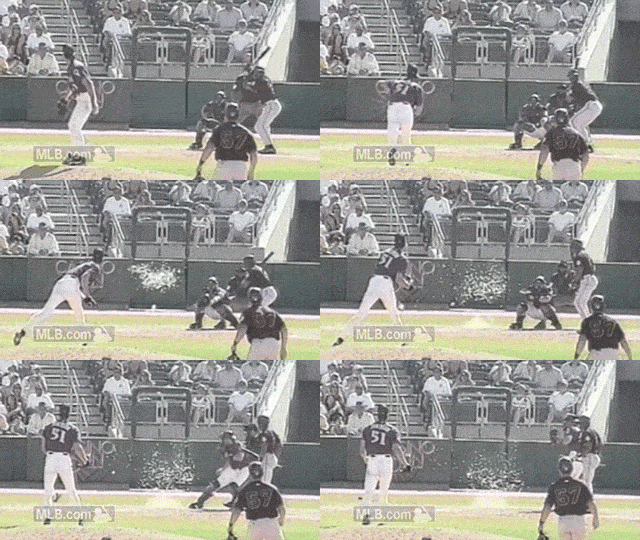
StandardCan you believe it’s been fifteen years since Randy Johnson vaporized a mourning dove with a 100 mph fastball? Here are some ornithologists looking back on this unfortunate chance encounter.
What are office hours for?
StandardWhat do you think office hours are for?
Office hours are drop-in* hours for students to see their professors. How should you spend this time?
If you don’t have students in your office, then you should probably be writing. Because we always should probably be writing, right? Or analyzing. Or doing a weekly browse of tables of contents. Or something else productive. If you’re me, you should be cleaning your office.
But let’s say students appear** for office hours, how are they supposed to be used? Here are some reasons students visit: Continue reading
“Open Science” is not one thing
Standard“Open Science” is an aggregation of many things. As a concept, it’s a single movement. The policy changes necessary for more Open Science, however, are a conglomerate of unrelated parts.
I appreciate, and support, the prevailing philosophy of Open Science: “the movement to make scientific research, data and dissemination accessible to all levels of an inquiring society.” Transparency is often, though not always, good. Continue reading
Recommended reads #72
StandardThis student adds a woman in science to Wikipedia every time she’s harassed online. This keeps her busy.
Time management is the key to happiness: “Organization saves time mostly because it averts crises.” I think this is not an overstatement.
A grading rubric for job talks at small liberal arts colleges. This meshes with my experience pretty well. Continue reading
NSF makes its graduate fellowships more accessible
StandardThe US National Science Foundation has changed a rule for their Graduate Fellowships. As of next year, grad students can only make one attempt at landing a graduate fellowship, which is intended to increase the proportion of awards going to undergraduates. Continue reading
The case for open book exams
StandardIn the sciences, most exams are a closed-book affair. Is this a good thing?
 On some tests, I’ve allowed students a 3×5 card, or a one page “cheat sheet.” This is usually met with relief, or joy, or gratitude. When I tell students that they can bring in their textbook for the exam, they get even more relieved.
I might say, “Don’t be so happy, because this just raises the bar for what I’m asking on the exam.” But then, my students say that they feel like it’s not useful for them to have to memorize stuff. And they would prefer solving problems and applying information in novel ways. Even if memorizing stuff is important, it causes a lot of anxiety. Continue reading
 Small Pond Science