The semester is about to start. When your class meets for the first time, do you just go over syllabus, schedule, policies, and such? If you have some extra time, do you let your students go early or do you teach?
I teach, for a few reasons.

The semester is about to start. When your class meets for the first time, do you just go over syllabus, schedule, policies, and such? If you have some extra time, do you let your students go early or do you teach?
I teach, for a few reasons.
Editorial boards of ecological journals are far less likely to have people who principally work with insects, compared to other taxa. Simon Leather runs down the numbers for us.
Here is a great site for students about the Anatomy of a Scientific Article. Looks like great reading for students in lower-division and starting upper-division coursework. Continue reading
Distractions in the classroom are a problem.
Digital devices are often a huge distraction.
Therefore, to manage distractions in the classroom, we need to manage devices.
People go to conferences for a variety of reasons. Conferences are used to align future research priorities, and students and postdocs can “network.” Meetings also provide an opportunity to travel to cool places and take a vacation.
When conferences are in fancy places, they might attract more people, but only those who can afford to go. We need to have students and postdocs at conferences, for their own sakes and for the future of the field. At least in my fields, international conferences often are designed to make it very hard for students and postdocs to attend. Continue reading
We need to ditch the “academic pipeline” metaphor. Why?
The professional destinations of people who enter academic science are necessarily varied.
We do not intend or plan for everybody training in science to become academic researchers.
The pipeline metaphor dehumanizes people. Continue reading
The National Academy of Sciences just came out with a report on the status and future of field stations. If you’re a field scientist, this is an important read.
Dads typically do less parental care than the mom, at least in the US. This is a problem, especially for the mom’s career.
Many men, and I suspect particularly academics, are genuinely focused on parenting. They want to do right by their partners, and make sure that they don’t create an inequitable parental burden. Parenting is a joy, but time demands of the required tasks involved are often burdensome. In some some families, if you fast-forward from zygote to toddler, you’ll find that some, if not many, of these guys are not doing their share. Continue reading
Whoa. A “peer review ring” was caught and sixty papers were retracted. I’ve joked about such a thing before, but never truly thought that something like that would actually exist, especially on such a large scale. Considering the difficulty in detecting such a thing, it really makes you wonder how common this actually might be. This clearly can’t be the only one.
“Randomized data showed similar patterns.” You know those rhythmic courtship songs of Drosophila? Don’t bother, they don’t exist. They were merely an artifact of a sound analysis methods.
For a few years, I’ve harbored a very cool (at least to me) natural history idea. But it’s a big technical challenge. The required fieldwork is never going to happen by me. So, I should write a blog post about it, right?
Bullet ants (Paraponera clavata) are one of the most charismatic creatures in Neotropical rainforests. My lab has done some work with them recently. These often-seen and well-known animals are still very mysterious. Continue reading
You’re probably familiar with this scene from academic conferences:
Person A and and Person B have been chatting for a few minutes. Person C strolls by and makes eye contact with Person A. Person C gives a big smile to Person A, which is reciprocated, perhaps with a hug. Both A and C enthusiastically ask one another about their lab mates, families, and life in general.
At this moment, Person B is feeling awkward.
How exactly did you prepare for a conference presentation before the powerpoint era? What the heck do you put into a slide carousel? Check out the comments on the post about conferences from last week.
There was a piece published on the Science Magazine website, by Eli Kintisch, that smelled fishy to me. The article was an overview of a range of efforts to make the sharing of raw scientific data easier and more common. Continue reading
At the moment, I have the great pleasure of working with a bunch of students at my field site in Costa Rica. Which means that I’m really busy — especially during the World Cup too! — but I’m squirreling away a bit of time before lunch to write about this perennial fact that permeates each field season.
We are used to stuff working. When you try to start your car, it turns on. When we set alarms to wake us up, they typically wake us up. You take a class, work hard and study, and earn a decent grade. Usually these things things happen. And when they don’t happen, it’s a malfunction and a sign of something wrong. Continue reading
Last week I went to the Goldschmidt conference, which is a convergence of geochemists. I’m not a geochemist. I’m not even an ecosystem ecologist (though I’ve pretended to be one a few times). I was there to speak about how insects respond to the legacy of geologic history in a rainforest, and to share a bit about how animals may affect long-term nutrient cycles. In short, to remind them that animals might, just maybe, actually matter.
I learned a heck of a lot. Here are a bunch of stray observations and ideas that occurred to me throughout the meeting. Continue reading
“How to search your hotel room for bed bugs,” written by an entomologist who knows how to break it down for non-entomologists. For starters, put your luggage in the bathtub at the outset. Continue reading
I distinctly recall a little non-event at a conference: I was scooting to catch a friend’s talk on time. I found him sitting in the hallway outside the room, slide carousel* in his lap. Grabbing a bunch of slides and putting them into his carousel. He was picking out slides, on the fly at literally the last minute. Figuring out both his content and his sequence Continue reading
Last year, I had the dubious honor of chairing a search committee for two positions in my department. The speciality was open. I learned about my department and my university by seeing it through the eyes of applicants and would-be applicants. There’s a lot I’d like to say about the process that I can’t, or shouldn’t, say. But I do have some observations to share. Continue reading
Nine months ago, I asked LEGO to make more female scientists. As a start, I cobbled together a few from spare parts at home: arachnologist, chiropterist, herpetologist, ichthyologist and ornithologist. Click through to check them out. I made them with my 10-year old son.
I never thought they’d make a chiropterist. But, now, they indeed they are making an astronomer, a chemist, and a paleontologist! Continue reading
Scientific B-Sides brings to you the Four Stages of a Project infographic. With pithy observations and useful advice. Continue reading
I’ve developed a mechanism to make sure that I stay productive: when I submit abstracts for meetings, I promise data that I haven’t finished collecting. Of course when I give a talk, I can say almost whatever I want. Nobody’s going to cut me off if my talk doesn’t match the program.
I just realized that I always have been in the habit of submitting abstracts for projects that are so fresh, I haven’t even gotten all the numbers, much less run analyses. In grad school, that was the only option, because at one point I didn’t have anything else to say. Now, even when I have other newish finds that I’ve yet to present, I submit abstracts for projects that still lack a rudimentary answer. I do this at least once a year, writing a check for results that aren’t yet in the bank. Continue reading
I’m an Associate Professor at a regional state university. How did I get here? What choices did I make that led me in this direction? This month, a bunch of folks are telling their post-PhD stories, led by Jacquelyn Gill. (This group effort constitutes a “blog carnival.”) Here’s my contribution.
I went to grad school because I loved to do research in ecology, evolution and behavior. I knew when I started that I’d be better off having been (meagerly) employed for five years to get a PhD.
The default career mode, at least at the time, was that grad students get a postdoc and then become a professor. It was understood that not everybody would want to, or be able to, follow this path. But is still the starting place in any discussion of post-PhD employment. As time progressed in grad school, I came to the conclusion that I didn’t want to run a lab at a research university, and that I wanted an academic position that combined research, teaching and some outreach.
I liked the idea of working at an R1 institution, but there were three dealbreakers. First, I didn’t want the grant pressure to keep my people employed and to maintain my own security of employment. Second, I wanted to keep it real and run a small lab so that I could be involved in all parts of the science. I didn’t want to be like all of the other PIs that only spent a few days in the field and otherwise were computer jockeys managing people and paper. Third, I was taught in grad school that the life of an R1 PI is less family-friendly than a faculty position at a non-R1 institution. In hindsight, now that I have worked at a few non-R1 institutions, I can tell you that these reasons are total bunk. I was naïve. My reasons for avoiding R1 institutions were not valid and not rooted in reality. Even though I now realize my reasons at the time were screwed up, I was primarily looking for faculty jobs at liberal arts colleges and other teaching-centered institutions.
We muddled through a two-body problem. My spouse wasn’t an academic, but needed a large city to work. She was early enough in her career that she was prepared to move for me while I did the postdoc job hop. I wouldn’t have wanted her to uproot from a good situation. In hindsight, our moves ended up being beneficial for both of us.
As I was approaching the finish to grad school, I was getting nervous about a job. My five years of guaranteed TA support were ending. I recall being very anxious. I landed a postdoc, though the only drawback was starting four months before defending my thesis. I moved from Colorado to Texas for my postdoc, and spent the day on the postdoc and the evenings finishing up my dissertation. As a museum educator, my spouse quickly found a job in the education department at the Houston Museum of Nature and Science.
While I was applying for postdocs, I also applied for faculty positions, even though I was still ABD. And surprisingly enough, I got a couple interviews. (I think I had 2-3 pubs at the time, one of which was in a fancy journal.) I got offered a 2-year sabbatical replacement faculty position at Gettysburg College, an excellent SLAC in south central Pennsylvania. At the same time, my spouse was deciding to go to grad school for more advanced training in museum education. By far, the best choice for her was to study at The George Washington University (don’t forget the ‘The’) in Washington, D.C. This seemed like a relatively magical convergence. With uncertainty for long-term funding in my postdoc (and also no shortage of problems with the project itself), we bailed on Texas and headed back east.
We lived in Frederick, Maryland. Which at the time was the only real city between Washington DC and Gettysburg. (Since then, I’ve heard it’s been converted into an exurb of DC.) I drove past the gorgeous Catoctin mountains every day to go to work, and she took car/metro into DC to work and started grad school. We scheduled her grad school so that she’d finish up when my two-year stint at Gettysburg would be over. I taught a full courseload for the first time, and noticed that I really liked the teaching/research gig at a small college. Grad school was great for my spouse. Life was good. In my first year as a Visiting Assistant Professor, I got four tenure-track job interviews.
Through a magical stroke of fortune, I got a tenure-track job offer in my wife’s hometown, in San Diego, just 2 to 5 hours away from my family in LA (depending on traffic). The only catch was that I’d have to leave my position at Gettyburg one year early, and my wife had one year left in grad school. But, I really needed to focus on starting out my tenure-track position, and she really had to focus on grad school. She could move to DC instead of splitting the commute with me, and I could figure out San Diego without her for a year. If kids were involved, this scenario would have been a lot more complicated. If my spouse’s career was at a more advanced stage, the move from grad school to postdoc to temporary faculty to tenure-track faculty would have a lot messier and would have required more compromises. But somehow we made it work and it felt something resembling normal.
Then, after working in San Diego for seven years, we moved up to Los Angeles. I already have told that story. Which, if you haven’t read it, is a nail-biter.
As I tell the story to non-academics, they find our peregrinations rather surprising. From LA, to Boulder, to Houston, to Maryland, to San Diego, and eventually back to LA, at least for the last seven years. (In the meanwhile, I’ve been going back and forth from my field site Costa Rica on a regular basis). This frequency of moving is entirely normal in academia, even if we look like vagabonds among our friends.
What do I offer as the take-home interpretations of my post-PhD job route?
First: The geography of my tenure-track job offers was lucky. To some extent, I’ve made this luck through persistence, but having landed a job in my wife’s hometown was pretty damn incredible. And after botching the first one entirely, getting one in my hometown was amazing. Now that my spouse is at the senior staff level, openings in her specialized field of museum education are about as rare and prized as in my own field. However, we now live in a big city with many universities and many world-class museums, so we can (theoretically) move jobs without moving our home. We now are juggling a three-body problem.
Second: My early choices constrained later options. Even though I no longer am wary of an R1 faculty position, after spending several years at teaching-focused universities that is a long shot for me. (I do several people who made that move, but it’s still a rarity.) I’m confident that I can operate a helluva research program at a highly-ranked R1, but I’m too senior for an entry-level tenure-track position, and not a rockstar who will be recruited for a senior-level hire. For example, I am confident that I would totally kick butt at UCLA just up the road, but I doubt a search committee there will reach the same conclusion. I am just as pleased to be at a non-prestigious regional university, and when I do move, it’ll be because I’ll be looking for better compensation and working conditions. I’m looking at working at all kinds of universities, and I think my job satisfaction will be more tied to local factors on an individual campus rather than the type of institution.
Third: I applied for jobs that many PhD students and postdocs think are unsuitable for themselves. I spent a lot of time creating applications for universities that I’ve never heard of. I was hired as an “ecosystem ecologist” at CSU Dominguez Hills in Los Angeles. Even though I grew up in Los Angeles, the first time I ever heard of CSU Dominguez Hills is when I saw the job ad. And I’m not an ecosystem ecologist either. That didn’t keep me from spending several hours tailoring my application for this particular job. But I wouldn’t have gotten this job unless I applied, and most postdocs are not applying for jobs like the one I have now. I know this from chairing a search committee for two positions last year. That’s a whole ‘nother story.
Fourth: Is being a professor my most favorite job ever? Actually, no. My employment paradise would be a natural history museum, with a mix of research, outreach and occasional teaching. I’m not a systematist or an evolutionary biologist, so getting hired into this kind of job is not likely. However, I have had a couple interviews for curatorial-esque positions over the last ten years and was exceptionally bummed that I didn’t get them. On the balance, even large museums go through phases of financial instability. It would be hard to give up tenure for a job that might bounce me to the street because of the financial misdeeds of board members and museum leadership. I’ve seen too many talented good museum people lose positions due to cutbacks or toxic administrators. I don’t know what could get me to take off the golden handcuffs of tenure. There are some university museums that hire faculty. That would be wonderful. Maybe someday that could happen. But I am pleased with what I’m doing, and I still am amazed that there are people paying me to do what I love.
Fifth: I ruled out a number of possibilities for family reasons. There are a variety of locations where I would be able to find work but would be unworkable for my spouse. Even in the depth of a job crisis, I opted against a number of options that would’ve given me strong and steady employment.
Sixth: I am not employed as a professor because I deserve it more than others. There are others equally, and more, deserving that are underemployed compared to my position in the academic caste system. The CV I had when I got my first academic position probably wouldn’t be able to do so now, 15 years later.
Now is the time of year when we work with students on designing summer research projects. How do you decide exactly what their project is, and how the experimental design is structured? This is something I struggle with.
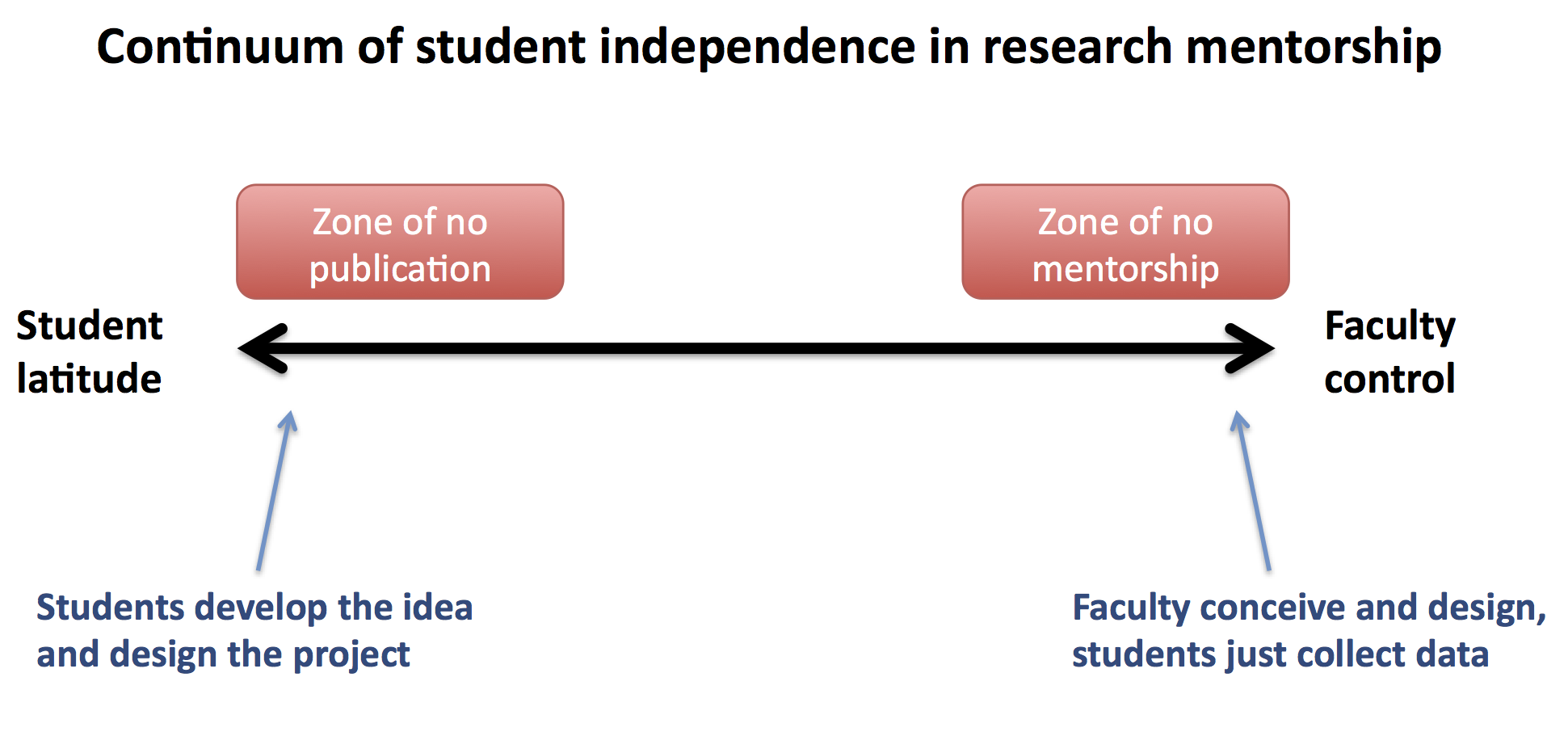
Image by T.McGlynn
In theory, quality mentorship (involving time, patience and skill) can lead a student towards working very independently and still have a successful project. Oftentimes, though, the time constraints involved in a summer project don’t allow for a comprehensive mentoring scheme that facilitates a high level of student independence. Should the goal of a student research project be training of an independently-thinking scientist or the production of publishable research? I think you can have both, but when push comes to shove, which way do you have to lean? I’ve written about this already. (Shorter: without the pubs, my lab would run out of dough and then no students would have any experiences. As is said, your mileage may vary.)
A well-designed project will require a familiarity with prior literature, experimental design, relevant statistical approaches and the ability to anticipate the objections that reviewers will have once the final product goes out for review. Undergraduates are typically lacking in most, if not all, of these traits. Sometimes you just gotta tell the student what will work and what will not, and what is important to the scientific community and what is not. And sometimes you can’t send the student home to read fifteen papers before reconsidering a certain technique or hypothesis.
When students in the lab are particularly excited about a project beyond my mentorable expertise, or beyond the realm of publishability, I don’t hesitate to advise a new course. I let them know what I hope students get out a summer research experience:
experience designing and running an experiment
a pub
All three of those things take different kinds of effort, but all three are within reach, and I make decisions with an effort to maximize these three things for the students. Which means that, what happens in my lab inhabits the right side of the continuum, sometimes on the edge of the ‘zone of no mentorship’ if I take on too many students.
You might notice one thing is missing from my list: conceive an experiment and develop the hypotheses being tested.
Students can do that in grad school if they want. Or in the lab of a different PI. I would rather have a students design experiments on hypotheses connected to my lab that I am confident can be converted into papers, rather than work on an experiments of the students’ own personal interest. (Most of my students become enamored of their experimental subnets pretty quickly, though.)
This approach is in the interest of myself to maintain a productive lab, but I also think that being handed a menu of hypotheses instead of a blank slate is also in the long-term interest of most students. I’m not keen on mentoring a gaggle of students who design their own projects when these projects are only for their edification, and not for sharing with the scientific community. That kind of thing is wonderful for the curriculum, but not for my research lab.
Other people have other approaches, and that is a Good Thing. We need many kinds of PIs, including those that give students so much latitude that they will have an opportunity to learn from failure. And also those that take on 1-2 students at a time and work with them very carefully. I like the idea of thinking about my approach to avoid falling into a default mode of mentorship. Does this scheme make sense, and if it does, where do you fit in and how have you made your choices? I would imagine the nature of your institution and the nature of your subfield — and how much funding is available — structures these choices.
An exceptionally well-told story, of a too-uncommon interaction, by Valéria M. Souza, “Can you get me into college?” You really will have appreciated having read this story. Seriously.
If you liked stories as good as the one in the link above, try picking up a copy of one of the back issues of The Best Nonrequired Reading series. For several years, it was edited by Dave Eggers with a bunch of high school students in San Francisco who found amazing pieces of writing and compiled a volume. (The most recent, and final, volume apparently had Michael Chabon’s kid in the group.) But I don’t think all of the participants came from such a background, given the mission of the 826 Valencia writing center where the work was done.
Have you wondered exactly how corrupt football coaches always get away with funneling money under the table to their players without getting caught by the NCAA? This long-form article explains the intricate scheme in great detail, and is fascinating.
Students totally love it when we distribute lecture powerpoint files to help them study. Here is a particularly cogent argument by Chris Buddle about why this is inadvisable.
Measured thoughts on how we share links. David Perry suggests if you choose to share links with others via social media (facebook, twitter, pinterest, and all the others), it is more thoughtful to share original content from the little guys, instead of that one link that everybody sees over and over again. For example, in the last two days, I would wager that you’ve probably already seen at least one link to that cat who saved the toddler who was being attacked by the dog. Which is why I’m not linking to it here. Even though it was interesting. I’d rather do everything I can to get you to read that story by Dr. Souza that I linked to up above.
There was what I thought was a great post in Dynamic Ecology this week by Angela Moles and Jeff Ollerton, about the oft-assumed but unsupported notion that the tropics have stronger and more specialized interactions than in the temperate zone. The discussion in the comments is worthwhile, too. One of the commenters who works on this topic, Carina Baskett, took exception to not just calling this topic a Zombie Idea, but also to any claims that there are Zombie Ideas. She wrote a rebuttal on another site. Baskett presents a very different vision about what scientific debate should look like on the internet. She wrote that Moles and Ollerton were “irresponsible and polarizing” and used “inflammatory language.” Whereas, I just didn’t see that in a case of Rashomon. Baskett saw that Moles and Ollerton were trying to quash debate and suppress ideas from people such as herself, whereas I saw the whole point of their post was to generate ongoing discussion in the scientific community. Of course if authors are taking a stand on one side of a scientific issue, they argue for that point with the best arguments they can muster. Baskett doesn’t think she was outargued on the science, but rather that the authority of the blog has the ability to unfairly prejudice the scientific populace against her work. Without using the phrase, she essentially argued that academic blogs are bully pulpits, and implied that the authors held a claim to “the final authority on how to define, test, and interpret an area of science.” In other words, science bloggers should refrain from certain forms of argumentation because they are unproductive. I never would have anticipated that Moles and Ollerton post would drive a researcher on the topic to “cry foul,” as Baskett wrote. So, it seems I have a blind spot about certain ways in which people can get touchy about academic discussions in blogs, even when written in a collegial and professional manner. Which makes me wonder how often others think I’m being adversarial — or even working to squash discussion — on the occasions when I’m actually trying to engender discussion and be inclusive. I’ve written a lot of opinions about how I think science should be done, how I teach, what approaches to teaching are more efficient or more effective, and on scads of other things. I clearly come from a certain point of view, but on any academic or pedagogical topic, I mean to convince others with argument rather than shut down the arguments of others. And I readily see that what works for me can’t work for everybody. Looking at Baskett’s response to Moles and Ollerton, which I never would have anticipated, makes me wonder if there is anybody out there who thinks that I use this site as a bully pulpit, when it is intended as a town square. If I need to shape up and be more aggressive in inclusive language, I’d appreciate the input. Also, please share any other interesting links you wish, just in case you feel compelled to share that cat-saving-the-toddler-from-the-dog video.
For links, thanks to HK Choi and Cedar Reiner.
Teaching has some perennial questions: How do you engage students? How do you make a classroom run smoothly? How does mutual respect make a better working environment? How does curiosity lead to learning? How do you get groups of students to work together effectively? How do you design a lesson that flows conceptually and addresses key ideas?
To figure out some of these answers, in all sincerity, I suggest hanging out in the classroom of a high quality kindergarten teacher at work. My kid has had some remarkable teachers. Just interacting with them over the years on an infrequent basis, I think I’ve picked up as many tips and ideas as I have from my university-level colleagues.
Now that my sole heir is heading off to middle school, I haven’t visited kindergartens too often of late. Last week, though, was our last Open House at his elementary school, and we always make a point to cruise by our kid’s former teachers, see what’s going on in their classrooms, and to say Hi and Thanks.
Every time I have a short chat with his former Kindergarten teacher, I get a pick-me-up and often pick up ideas. She has couple decades more experience then myself — and unimaginably more contact hours. On our last visit, she was explaining the changes that she’s making as the state is shifting to new standards.
She explained to me that the students are now reading more nonfiction in her class. She is doing some of the assignments that she used from previous years, but in addition she is requiring the students to do non-fiction reading and assignments prior to their fictional projects. For example, before writing a fictional story about a particular animal, they would read non-fiction about that animal and do a report on what they learned. Then they’d do a fictional story about these animals.
She told me that she’s always learning something new. In this case, she learned that the quality of the fictional projects was improved by the prior experience with the nonfictional projects. More knowledge led to more creativity. That’s pretty cool.
What I liked about this little story even more is that it comes from the most-experienced amazingly perfect-as-far-as-I-can-tell teacher, who tells me new things that she’s learning about teaching.
I imagine that the reason she is such a a good teacher, is because she always has been working to improve, and no matter how good she is, she still is both open to and working at learning new ways to do things better. At the end of what has felt like a long semester, that’s inspirational.
I’m at a different place on the improvement curve, as I’m well aware of far too many things that I need to improve in my teaching. But I’ve been thinking, well, maybe I have the routine down solid enough for now. Watching great teachers at work puts me on notice: I should be wary whenever I feel that equilibrium can emerge from stasis. This is another sign I should take that overdue sabbatical.
We’re number 33!
According to the latest rankings by Time Magazine, my current university — California State University Dominguez Hills — is ranked #33 in the nation. Among more than 2,500 colleges and universities.
As people on campus have been quick to point out, Harvard is several spots below us. (If you’re curious, UC Riverside comes out as #1. California public universities are featured quite well on this list.).
How the heck could this be? This survey used new variables that the current US federal government is using to classify universities on how well they serve their students. It takes into account cost, graduation rate, and rates of student aid. If you remove graduation rate from the equation, we come in at #4. Here’s the take on it from the CSUDH campus.
What does this mean, and what does this change?
I think the only thing it means is something we’ve already known: College rankings reflect the values that you put into the equations. Colleges with massive endowments and extraordinarily high rates of alumni giving have done well in the rankings that have been the common currency, used by the US News and World Report. If you measure affordability and accessibility, then you get entirely different results, reflecting entirely different values.
If you look at the differences that we make in the lives of our students, we deliver. Moreover in many cases, the differences that we make would not have been made unless we made them. As we prepare for graduation this upcoming weekend, this is something that’ll be on the forefront of my mind.
What does this change? As far as I know (and this is not too extensive in this regard) this could be one of the first national quantitative rankings that doesn’t place our campus in the bottom quarter. Some — though not that many — of my colleagues on campus have a severe inferiority complex about our place of work. It is true that we are under-resourced, which manifests in many limitations. We have always said, “We serve our students well!” and now it’s nice to have this form of external validation.
This also is more than just window dressing, because to some extent these rankings can drive federal policies. I think they were just invented so that the predatory for-profit “universities” can’t use public money for private profit. But at least on our campus, this is a win, and we’ll take it.
Did you hear about this ranking? How did your campus fare? What do you think these Time rankings mean and don’t mean?
The fitness of organisms is measured by their reproduction. Successful scientists make more scientists. Successful professors make more professors, so the story goes.
With some folks, honoring a successful academic pedigree is almost a fetish. And it’s not just something that happens at research institutions, For those of us at teaching-focused institutions, sending students on to PhD programs is a source of pride, and often seen as a sign of successful mentorship.
On a day to day basis working with students, there are two huge facts that overshadow my mentoring relationships:
The first fact is that faculty positions are hard to get. Even if you’re very good, there is a huge amount of luck involved in grabbing the brass ring. Many PhD students and postdocs recommend that undergraduate professors not encourage their students to go to graduate school, because of the state of the academic job market. (Of course, there is no PhD problem, there is just an attitude problem.)
The second fact is that, in the United States, blacks and Latinos are scarce in ecology, and in science as a whole. We really do need to increase the representation of these groups in science. That means we need to send more of these students to grad school. This isn’t just an equity problem, it’s also a crisis for the future of scientific enterprise in the country.
My university student body is 90% minority, according to our newly invested president, if such a thing is mathematically possible. If anybody is in a position to “change the face of biology” as one friend of mine put it, then I’m in that place.
This could be seen as a dilemma: If I am trying to help out the field of ecology by diversifying it, I need to send as many of my talented students as possible to grad school. However, because job prospects in academia are so dim, then I’d be sabotaging the success of my students if I send them to grad school!

Cross-section of a not-double-edged sword.
I don’t buy into that dilemma. I think what is good collectively for diversity in science also is good for the students of mine who do go on to earn their PhDs. This sword only has one edge, which I realize is not necessarily a common sword. (A katana, I just learned, has only a single edge, as you can see.
I take money from the federal government with the promise that I’ll be a part of the pipeline to grad school. Consequently, I provide cool research opportunities to students and if they want to go to grad school, I think that’s great. But I don’t steer them in that direction, even though I provide a rental car for free.
I’ve been told that I’m doing a bad thing to my students by sending them off to grad school. I’m just tuning those voices out. Because those voices don’t know me, they don’t know my students, and they don’t know what the alternatives are for my students. For every one of my students who has passed through my lab and gone to grad school, I have a high degree of confidence that they are, or will be, better off for having received a PhD. I can understand how in the humanities, going into debt to get a PhD is a silly or stupid proposition. But some of my former students earning their PhDs are making more money from their relatively small graduate stipend than many members of their families are earning by working full-time back home. They aren’t taking out student loans, and they are getting experience with research, teaching, writing and problem-solving that will be useful in a great variety of possible jobs.
Most important for their career prospects, my students are building a social network that will help them find employment after receiving their PhDs. They will have developed practice hobnobbing with people from wealthier social classes. Even if they didn’t have a friggin’ PhD, they still have spent years in a professional milieu which otherwise would have been inaccessible. Of course they have to know that the odds of getting a tenure-track position are small, and they need to have an open mind with respect to their careers.
Our students should also know that they have more and better options with a PhD than without one, considering the social capital at their disposal when starting out on the job market. They shouldn’t be told they won’t get a job, when most people do.
Let’s put the employment options post-PhD into context with data. Nearly all PhD recipients in biology are gainfully employed, and the number of tenure-track faculty, industry and government researchers, and those with other non-research/teaching jobs greatly outnumber those that end up in non-tenure track academic positions. There are too many contingent faculty, and this is a problem for universities, but the existence of adjuncthood as a possible career option doesn’t mean that opting for a PhD is a bad choice. There is a far greater fraction of unemployed lawyers than unemployed Biology PhDs.
Unemployment rates for those that don’t go to grad school are worse for those who do. And the situation is even worse for first generation college students, who lack the social capital to get their first opportunities. So, no, I won’t be telling my students they can’t get a job if they earn a Ph.D. I’ll just tell them that they’ll be lucky if they land a tenure-track position and that they shouldn’t plan on that from the outset.
Do you love it when students waste office hours with questions that don’t help them learn? Do you want to cultivate anxious emails from students sent at 3 in the morning? Do you want your students to wager their grades by guessing what you think is the most important material?
Then don’t tell your students what is going to be on the exam.
It is entirely legitimate for a student to be told the basis of their evaluation. Students take a course, and earn a grade. They should be made aware, as specifically as possible, the foundation for this grade before they do what it takes to earn it. The less they know about the basis of their evaluation, the less fair we are to our students.
The more specific you are about what is on the exam, the happier the students will be. Moreover, specificity gives you control over the material that they will study. I have often heard colleagues frustrated that students aren’t focusing on studying the right material, or asking the right questions while studying. I seriously don’t get these questions from students, and I think that both they and myself are better off for it.
If students ask you what will be on the exam, please don’t reply, “Whatever I think is important.” That just will help the students who are better mind readers. (Which are probably those with a social and cultural background most similar to yourself.)
If students ask you what will be on the exam, please don’t reply, “Everything in the lectures and everything in the chapters.” This vague set of expectations will prevent students from focusing on facts and concepts which are most important, and may lead to some students wasting their time on minutia.
The more vague you are about what will be on the exam, the less control you have over what they study. The worry about the mysterious contents of the exam detracts from learning. Our value in the classroom isn’t our content knowledge itself, but our expertise that allows us to parse the useful, meaningful and relevant. Asking the students to master too much information will result in no mastery at all.
Several years ago, I decided that the exam guesswork was a bad thing. Now, I administer three types of exams, all of which are designed to remove guesswork on the part of students:
I give students a comprehensive exam preparation sheet, one or two weeks before the exam. I give them a solemn promise that everything on the exam will be covered by one or more items on the review sheet. Sometimes these items are very narrow but other times they could be rather open-ended. But they are never intended to be vague. I tell the students that if any question on the exam isn’t based on one of these review items, then I’ll drop it from the exam. I am also tempted to hand these out at the beginning of the semester, but I call too many audibles to make this a wise choice. Here is an example of one, from the first exam in a biostatistics course. You’ll note that there’s a lot of material on there. I can’t ask questions to cover every one of those items. But I can make sure that students study them all, but also make the scope narrow enough that it is do-able.
I can give a take-home exam. I only do this if I’m blessed with a small class. Because are a variety of problems associated with take-home exams, I typically only do this with a small graduate course.
One of the more annoying questions that a student can ask is, “What’s going to be on the exam?” I just have to answer that with a single piece of paper.
Sometimes some students will email me, “What’s the answer to number 8 on the exam prep sheet,” or they’ll write me an answer and ask me how it meets my expectations. I make a point to not evaluate their responses or give them any information, unless I do so for the entire class. I might clarify a question or an item, if a student doesn’t understand the words. Under all circumstances, I assiduously avoid evaluating providing privileged information for the students who feel more comfortable with approaching me for private studying advice, because that would be unfair to the students who don’t email me. I might send a reply to a question to the entire course.
I always schedule time during a class session prior to the exam so that students can ask me questions about any of the review items. Sometimes this lasts just a few minutes, and sometimes the bulk of the class period. (I do not hold separate reviews outside regular class hours, as I’ve mentioned before.) Usually when students email me a question, I ask them to save it for class, so that everyone can benefit from their question. But most of the review session is me saying, “I’m not going to reteach that entire lesson, but this is the nutshell version.”
The better I construct the exam prep information, the less time we spend in review during class, and the more time students spend studying with each other, which is where the real learning takes place.
Here is a summary of a study that tracked time budgets of faculty members. I find it to be shockingly spot on, though I have made an effort to not work for more than a couple hours on weekends.
On NPR, Frank Deford had an insightful, if crotchety, three-minute piece on changes in the perception of sports and its reporting. You can read or listen to it here.
The urban legend was true, about Atari throwing unpurchased copies of their famously horrible E.T. game cartridges into the landfill.
Last week, nearly a score of Sherpa mountaineers died in a single event, while establishing a climbing route for their clients paying for a route up to the top of Mt. Everest. This tragedy has fueled the long overdue conversation about the ethics of paying people to put their lives on the line for the glory of reaching the top of the world. The climbing season has ended as the Sherpas have taken time to reflect and mourn their losses. Of course, you can always climb if you’re willing to risk your own life while carrying your own gear up the mountain. The Sherpas now have published a rather moderate list of demands to make the situation a little less exploitative.
Dynamic Ecology ran four posts this week, all by Meg Duffy, about stereotype threat and what we can do to promote the development of all scientists. She provided many simple, concrete, useful and easy recommendations about what we can do about the problem. The first post is an introduction to the stereotype threat. The second one says what we can do to counter stereotype thread. The third explains how some people avoid engaging in these issues for fear of being criticized, and the fourth is a transcript of a Neil deGrasse Tyson remark about the path of greatest resistance as black science student, from a panel discussion that went viral last week. Every post is not only interesting, but also important. The talk:action ratio on this topic by individual PIs is outrageously low, and by reading these posts, we can learn how to do better, regardless of where we work.
You presumably heard last week that the US Supreme Court decided that affirmative action is, or at least can be, illegal, in a 6-2 decision. The dissent by Justice Sonia Sotomayor is, in the literal sense of the word, epic. It’s definitely worth your while to read the original document. The bunk by Scalia, Roberts and Breyer precede her statement, which starts about halfway through the document.
In case you’ve somehow missed it, you might want to ask: Has The Whale Exploded Yet?. But it looks like it’s deflating non-explosively. I’m sorry to disappoint you.
Tomorrow (the first Saturday in May) is Free Comic Book Day! Head to your local comic store! The more people you bring, the more free comics you get. There will be a line, and it probably will be worthwhile, if only to savor the company of the characters in line.
Along the same line, I just read the 14-year old book Reinventing Comics by Scott McCloud. (This a followup to the classic required-reading book, Understanding Comics). It’s ostensibly about the business of publishing comics, the conflicting interests in comic publishing, the emergence of online comics, and is full of ideas about the causes and consequences of an oligarchy of for-profit publishers. While this might not be fully relevant to the comics industry anymore, oh my GOSH the parallels with current state of affairs scientific publishing are remarkable. I think anybody wishing to get a fresh outside perspective on the relationships among authors, funding agencies, publishers, open access journals and the executives running for-profit publishers really would benefit from reading this. I might write a post about it in the future, but that shouldn’t stop you from buying this book. (I got mine used at Goodwill for two bucks, but you can get a copy for 6 bucks online.)
Are you Just starting out on your dissertation? Why not write it up in comic book form, like Nick Sousanis?
I added The Wall of The Dead, hosted by Richard Conniff, to the blogroll. It is a memorial listing naturalists who have fallen in the line of work. I regrettably report the addition of Subramanian Bupathy to the list, as Madhu Katti reported this week on twitter. Dr. Bupathy was the Head of Conservation Biology at the Sálim Ali Centre for Ornithology and Natural History.
Several times a year, students contact me to tell me that I was the worst professor ever.
To be precise, former biostatistics students contact me with the simplest, and often ignorant, statistics questions. These questions are so basic that it is clear that I have failed in my job as a stats professor.
With a basic dataset, a student might ask, “what test should I use?” Last month I had a student drop by my office with a result of p = 0.0071 to ask me to tell him whether or not his result is significant. Without a hint of irony.
If you taught comparative vertebrate anatomy, how would you feel if a recent student of yours came into your office and pointed at his biceps, and then asked, “What muscle is this?” This is how I feel when students come to me for statistical consulting.
My one-semester graduate biostatistics class doesn’t go into much depth and covers the standard, mostly univariate, frequentist statistical approaches that you find in similar courses. We spend a decent chunk of the course on probability, experimental design and why people do statistical tests and what the results mean. We spend a lot of time – and by a lot I mean a lot – on what p-values are, and the relationships among probability, null hypotheses, variance, distributions, and errors. (And when I say we spend time on it, I don’t mean that I lecture a lot about it. I mean students actively figure this stuff out. And their exams show that, at least at the time, they really understand it.) I am convinced that, at the end of the semester, that these students really understand the main concepts.
But then they don’t understand it after the course is over.
If a student came to me and said, “I realize that we didn’t learn how to do a GLM in class but from my reading I think that might be the best choice here, and I was wondering if you had the time to talk about it,” I’d ask her to pull up a chair. But when a student says, “I know I was in your class a couple years ago, but I’m looking at this dataset that I already collected and I don’t know where to start,” I’m not going to lift the paperwork that is probably occupying all three chairs in my office.
The hypothetical students-who-forgot-the-name-of-the-biceps-muscle are professional frustrations, and evidence of educational failure, for three reasons:
On the bright side, there is one positive aspect of the fact that students come in to ask me dumb stats questions. They think positively enough about my course that they think that I’m useful for statistical advice. That’s not much of an upside, but hey, it’s all I’ve got as far as I can see.
I’m long past taking this personally. I don’t get insulted when students come to me asking me to reteach a very basic concept of probability that we studied for a whole semester. I see that this is their problem, and not mine. I don’t take it home with me. There’s a 0% probability that this issue will keep me from sleeping. However, if I’m trying to be more effective at my job, then I need to confront the issue raised by these interactions. It’s a form of teaching assessment, in which I’m doing poorly. (Some students do thank me quite generously for what they learned in the course, and I’m not forgetting that input either.)
How do I handle these outrageous questions? It varies, because I haven’t (yet) developed an a priori approach to the situation. In some cases, I might simply chimp grin a bit and say something like “you really don’t recall how to test a null hypothesis?” or “So you’re telling me that you haven’t been able to find anything about what to do when your independent variables are categorical and your response is continuous?”
The bulk of the class is biomedically-oriented Master’s students who have some need for statistics with their thesis but don’t think that they’ll need to practice stats for everyday use. So, each semester, I make a point of saying at the outset, “When you design your thesis experiments, you’re welcome to consult with me about the process. But if you don’t discuss your stats with me before collecting your data, then there won’t be much I can do to help you.” I’ve had to remind a couple students of this fact, one of whom had a horribly pseudoreplicated design. And another who failed to run a necessary control.
While I’m not the most amazing professor, I don’t genuinely think I’m the worst, either. I just think that some students think it’s acceptable to offload course material from their brain as soon as the course is over, and do not feel obligated to go back to the hardware store if they lost the tools that they picked up during the course. And among students who are stats-phobic and math-phobic, which is a sizable fraction of the population in the course, they’re just glad they survived. It’s particularly frustrating because my guiding principle in this course is to teach a small number of fundamental concepts in a way that they are supposed to stick with the students for a long time. At least in this class, I know it isn’t happening, with at least some of them. I honestly don’t know what I can do, if anything, to make sure that students really remember what a null hypothesis looks like and what a p-value means. But it is clear that some of them genuinely forget it, presumably because they think it’s not important.
So, when I teach this class again in the fall, I have to find a way to make biostats personally important, with students who don’t see the usefulness of stats in their professional future. Wish me luck.
Most senior scientists aren’t from ethnic backgrounds underrepresented in the sciences, and don’t train many scientists from these backgrounds either. The day-to-day issues facing black and Latino students in the US might be on the minds of people in charge, but the people in charge don’t face the same day-to-day challenges.
I haven’t experienced those problems myself (as a tenured white dude), though I do I work in a minority-serving and Hispanic-serving institution. So, it’s my job to understand and to do what I can to provide the best opportunities for my students.
Nonetheless, mentoring students from underrepresented groups doesn’t validate one’s ideas about equity and diversity in science. To illustrate this point, let’s look at the recent comments of Michael Rich, the PhD advisor of Neil deGrasse Tyson (who is arguably the most famous living scientist, and definitely the most famous living black scientist):
I think my colleagues would agree that no overt barriers based on race, gender, etc. remain. (In fact, incoming graduate classes tend to be 50-50 in terms of gender and there are many special programs to help under represented minorities.)
Now, before we decry Dr. Rich for being horribly wrong, let’s give him the benefit of the doubt. After all, he might have been on crack, or stoned, or taking psychotropic mediation when he wrote that. It’s also possible that he was jet lagged from space-time travel from an alternate universe and he hadn’t gotten his bearings settled back to our own dimension.
But if he wasn’t on drugs or returning from another reality, then he’s bearing a massive anchor of delusion and seclusion. I guess he hasn’t asked any black men, any women or Latinos about how they feel about overt barriers. I guess he hasn’t chatted much with his famous former PhD student.
Dr. Rich observes a 50:50 ratio of men to women in graduate classes, but he’s not bothering to look at the proportion of women in permanent academic positions. Or how many women are selected to win awards.
Dr. Rich sees special programs for minorities, but he is ignoring the conditions that necessitate these programs. Black Americans comprise more than 12% of our population. So, I’m guessing that the proportion of black students in his program is at least ten percent, right? Are 10% of senior scientists black?
Oh, there’s a helluva lot of work to do. We are nowhere near equity. This is so damn obvious that I feel stupid even writing it.
But I have to write it, because Michael Rich, and those who share his views, aren’t just failing to fix the problem. They are part of the problem we need to fix. Those of us who are pushing up from the grassroots for equity and access need those senior faculty to validate the need for change. Those of us who are training students at the K-12 and undergraduate levels need people in graduate programs to not only recognize, but take concrete steps, to support and recruit minority students starting their science careers.
A lot of senior scientists feel just like Dr. Rich. I’ve heard it far too often. We need to inoculate the current generation of scientists in training against these toxic views of Dr. Rich. It’s probably too late to change Dr. Rich’s mind, as there’s nothing we can say that his famous former graduate student hasn’t already said or embodied. But we can keep pushing to move this mountain shovel by shovel. And we can advocate for heavy equipment that can really move the mountain.
In my undergrad years, my college president was a unicorn. Or, something almost as unique as a unicorn: A black electrical engineer. From Kansas. The story of John Slaughter is mighty amazing. When he recounted his path, from childhood, to grad school, to professor, to university president, I was both inspired and amazed by his tenacity in an environment that was unrelentingly opposed towards his progress in the direction of his choice.
Dr. Slaughter has long been retired. In the emerging generation of STEM leaders, Dr. Neil deGrasse Tyson is yet another unicorn.
If one of my black students ends up being a global ambassador for her discipline, will she be a unicorn?
According to Dr. Rich, those problems have already been fixed. Of course, he’s flat out wrong, though I wish he wasn’t.
 Small Pond Science
