
Do you think giving students “participation” points is a good idea? I don’t. Continue reading
Uncategorized
Recommended reads #65
StandardTeaching grownups how to eat. How to acquire an actual taste for healthful food after you become an adult.
The AAUW reports that 91% of campuses reported zero incidents of rape in 2014. That’s a problem. Because that number is obviously wrong, so underreporting needs to be addressed. Continue reading
A lot of scientists are kind, careful and caring
StandardI just returned from a tremendous meeting of the Entomological Society of America. I experienced a lot of moving moments.
I attended my first EntSoc meeting twenty years ago, as an early grad student. I’ve skipped the last few years (because family). This return brought a flush of friends and close colleagues that I don’t see on a regular basis. I got to meet PhD students who are being advised by my own former undergrad students. When I was in grad school, my advisor had two small kids. At this meeting, I got to see his older daughter, now in a MD/PhD program.
There are so many scientists who made a difference in my life — professionally and personally — and having so many of them gathered under one large roof was overwhelming. Continue reading
Costs and benefits of attending conferences as a student
StandardRecently I attended the annual meeting of the Entomological Society of Canada, which this year was held jointly with the Société d’entomologie du Québec, in Montréal. While chatting with a (professor) friend at the conference it came up that we both don’t really like attending conferences for a lot of reasons, but attend anyway because we think it is important to do so. At the time I remarked that I thought there were few tangible benefits of attending conferences as a student. Since then I’ve been thinking a bit about the costs and benefits of attending academic conferences as a student, and here I will summarize my thoughts.
The obvious costs of attending conferences are time, money, and energy. Continue reading
The sabbatical isn’t what it used to be
StandardBefore I was a professor, I had heard of sabbaticals. That’s when a professor spends a year away from the university and visits a distant land to gain new skills, build new projects, and make new connections.
Then I became a professor and learned that (most) universities don’t pay for a full year of sabbatical, they only pay for one semester. They’ll let you take a year, but at half of the pay. So finding a half-year of salary from grants is needed for a full sabbatical.
Then I became eligible for a couple sabbaticals, and experienced how the travel-to-far-lands part isn’t necessarily what happens either. Continue reading
Recommended reads #64
StandardIf you haven’t been watching the news lately, you might not have noticed that the United States is in the midst of a national moment in which university students are speaking and acting out in response to the perennial marginalization of minorities. I imagine more things will emerge, but here is the rundown from a few campuses:
At Mizzou, years of administrative disregard for an environment that minimizes and threatens black students came to a boil with a particularly hateful action that was met with the same do-nothing attitude by the President and the Chancellor. The football team went on strike, and then, in a jiffy, the President and Chancellor stepped down. Since then, protests have grown. Here’s a clear take on the strike at Mizzou this from Dave Zirin, who writes about the intersection of sports and politics. (also, HK and I talk about the Mizzou situation at length in the Not Just Scientists episode coming out this weekend) Continue reading
Prescriptive reviews are a scourge
StandardHow do you spot an academic? Listen for gripes about manuscript reviews.
We all get bad reviews. I’m not talking about critical reviews — we all get those too. I mean: We all get reviews of bad quality. Continue reading
Why I avoid lecturing
StandardAcademic freedom is glorious. Despite pronouncements to the contrary, university faculty — including most contingent faculty — enjoy tremendous freedom in what we teach and how we teach it. Most professors teach however the hell they choose to teach.
Academic freedom enables change, but resists rapid change. Faculty have the liberty to stand aside as change happens. We can stand by and snark as fads wash by. We also can fossilize as the landscape truly changes. I think it’s hard, in the moment, to distinguish between a fad and a change in the landscape. Continue reading
Choosing between “head of lab” and “independent scholar” models
StandardWhen people ask how I run my lab group, I don’t know how to respond. It boggles me because these perfectly normal questions often have assumptions baked into them, about my university, my students, and the kind of work that happens in my lab.
It’s only natural that folks might compare my “undergraduate research lab” to the template of major research institution lab, most of which also feature undergrads in substantial roles.
The way I run my research program, and the students involved, is probably different than you might imagine unless you’ve spent a bunch of time at an underfunded regional state university like mine. Continue reading
Recommended reads #63
StandardThe New York Times published a stunning piece about what is happening to the Greenland ice sheet. It’s an extraordinary piece of journalism and a really important read. Especially if you live somewhere that’s not too far above sea level.
How to Not Drop Out of Grad School. Like everything else I’ve read in Mary Anning’s Revenge, this is great. It’s about how to take care of yourself, and be a happy and balanced person. Working long hours consistently doesn’t make you more productive.
The Odds That a Panel Would ‘Randomly’ Be All Men Are Astronomical
The Frontiers series of journals is now on Beall’s list as a possible predatory series of journals. Here’s a long take on the how/why/what of this move. Beall’s List of predatory publishers — created and run by a rogue librarian — is a useful service for academia, but I am reluctant to even mention, much less endorse, the List because it’s clear that Beall really doesn’t understand the distinction between predatory publishing and open access publishing. Or, if he does understand the distinction, he is deliberately conflating the two because of his social and political views on the value of the for-profit scientific publishing industry. It’s a hot mess and I hope that someone — Retraction Watch maybe? — can step in to keep tabs on predatory publishers instead of leaving these judgments to a source as specious as Beall.
Tools for Change in STEM identifies the two biggest things that need fixing to increase the representation of women.
Daylight Savings is a dumb idea, I say. Why do we still have it? One reason is that Big Candy sells more candy at Halloween.
The new head of the University of North Carolina system is bad, bad news for higher education: “For those of us who think that universities exist for academic purposes — to teach academic knowledge and skills, to pass on academic virtues, and to sustain academic research — the stakes could not be higher.”
Empirically Testing a Three-Step Intervention to Increase Faculty Gender Diversity in STEM. If your department is hiring and you don’t have the gender ratio you should have, then this looks like a very useful guide to make the change we need. Seriously. If you’re on a search committee, print this out and give it to everybody else. Why? “Searches in the intervention were 6.3 times more likely to make an offer to a woman candidate, and women who were made an offer were 5.8 times more likely to accept the offer from an intervention search.”
A nice explainer why we need diversity in science published in The Hill. So some congressional staffers are now more enlightened. (By the way, why it is that they are “staffers” and not “staff?”) Also, the ideas in here are good for boilerplate for your broader effects section. But if you’re like 89% of people, then your broader impacts aren’t targeting underrepresented groups.
The so-called Freshman 15 might be because of bad sleep patterns.
“Many reviewers reject papers for pseudoreplication, and this occurs more often if they haven’t experienced the issue themselves. The concept of pseudoreplication is being applied too dogmatically and often leads to rejection during review.” Really? I’m not inclined to buy this idea. (First of all, reviewers don’t reject papers, editors do! It might sound like a mere semantic difference but does show a lack of appreciation for how the editorial process works, which is the focus of the article.) How often do papers get seriously dinged because the experimental system isn’t amenable to highly replicated units? In my experience — as reviewer, editor, and author — reviewers are understanding of the notion that some kinds of systems can’t be perfectly replicated, because they are taking place in someone else’s plantations or in streams, or habitat fragments that are scarce or difficult to access. Really, this is keeping good science from getting published? Hmmm.
“’You can’t infer process from pattern’ is just one of those things people like to say because they think it makes them sound rigorous and clever. It’s a slogan. Politicians like to bandy these about, and sometimes, we scientists do too. Real rigour and cleverness don’t lie in slogans; they lie in careful thought that recognizes the complexity of nature.”
Six myths about a teaching persona. This is a really good list if you’re wondering what kind of persona that you should be adopting with your students.
Do you know anybody who complains that the approach to math in common core is dumb? Here’s a straightforward explainer why the “new math” in Common Core is way better, and how Americans have been learning math as kids makes no sense and deprives the chance to develop number sense. (If you’re not familiar with Common Core, it’s a new set of standards for K-12 education in the United States, that emphasizes problem-solving and integrative thinking, and definitely an improvement over what we’ve been doing. It’s not a panacea but it does provide teachers more latitude to teach effectively as these are less prescriptive standards and emphasize critical thinking and problem-solving. You might hear trash talk about Common Core standards, but rarely from those who are in charge of teaching it. Implementation varies, of course.)
George Saunders on his development as a writer. (And if you haven’t read anything else by Saunders, it’s amazing stuff, put it on your list. I’d say start with The Braindead Megaphone. And Saunders’s commencement speech is up there with David Foster Wallace’s commencement speech.)
Monkeys compensate for small gonads by being more loud and annoying. (Here is the press release.)
How Back To The Future‘s vision of the future was off. We don’t have that middle class that Marty and his kids were living in. The neighborhood-of-the-non-horrible-future was filmed pretty close to where I live, and this article in the LA Times really resonated with me.
The New York Times published a hideous op-ed that criticized a strawman version of active learning in higher education. It had a fair amount of the get-off-my-lawn-kids-need-to-sit-down-and-listen BS. She only addressed the educational needs of marginalized students in one line, and then in the subsequent line dismissed those concerns as inconsequential. Josh Eyler was up to the task of debunking the false claims in this op-ed. What to think about whether or not to lecture or do active learning? I think we should listen to The Little Professor on this matter.
Why white parents don’t choose black schools.
Dinosaurs teach kids certain things about the monsters they will encounter: that scary things look scary, that scary things are dead, and also that scary things are exciting and anthropomorphic. Dinosaur fights suggest a singular, definitive battle, like a dragon, something you see coming from a mile away, ready yourself for, slay, and move on from. When, of course, real problems are the opposite: boring, small, creeping, not singular but sprawling. And: extant. A grown-up problem is nothing if not alive.
Why is academic writing hideous? “Academics play an elitist game with their words: They want to exclude interlopers.”
Have a great Halloween weekend, y’all.
Respecting the time and needs of adjuncts
StandardAlmost every university in the US has succumbed to financial pressures and employs a relatively high proportion of adjunct instructors. Typically, adjuncts are highly trained professionals with a graduate degree, but don’t get the compensation or professional courtesy that they deserve.
Universities have given up on the notion that all faculty should have job security. Instead, now institutions are measuring “tenure density” as a measure of how many faculty are fully paid and fully respected. Continue reading
The dangers of twitter
StandardWhen I first joined twitter, I was nervous I might mess up somehow. I wanted to use my professional identity but because no one around me* was using twitter, I didn’t know how it would be perceived. Also, we’ve all heard about disastrous mistakes on social media that have lead to personal and professional fallout. Although I didn’t think I would do anything that extreme I was worried about job applications and such. So in short, I was cautious and worried about the dangers of putting myself out there on twitter. Now over two years and some 6000+ tweets later, I am less so**. Continue reading
Ant science: Thieving ants know how to be sneaky
Standard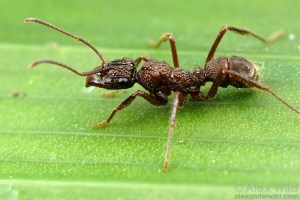
Ectatomma ruidum. Image by Alex Wild
The most recent paper from my lab is a fun one. We show that thieving ants have a suite of sneaky behaviors, to help them avoid being caught in the possession of stolen goods. These differences are dramatic enough to classify thieves as a distinct and new caste of ant.
Recommended reads #62
StandardPoster session drinking game for the Society for Vertebrate Paleontology meeting.
Machines get broken. Human social systems don’t “break.” Academics should get back to discussing our systems and conventions in a more sophisticated manner.
The hardest part of academia? Moving.
Wow, Lou Reed was horrible.
Whereas Tom Petty wasn’t horrible, (and picked up a heroin addiction when he was 50, which he kicked.) This is an interesting interview. Almost as interesting as Chrissie Hynde’s interview on NPR, which needs to be listened to rather than read.
California signed into law a ban on the use of the R-word for school mascots. There were four schools still using it, and they are (sadly) clueless about why it’s racist. It’s stunning how they just don’t get it. Anyway, this article about the how these schools are taking the loss of their mascot is informative and a bit tragic, but worth reading if only because the last two paragraphs are just so painfully ironic, in a “I can’t believe this isn’t The Onion” kind of way.
A protocol for data exploration to avoid common statistical problems‘.
What it’s like to earn a living as a professional subject in clinical trials. This is not a good thing for medical research.
Did you see that story going around, about how an evil scientist saw a rare bird for the first time and then killed it? It took off without any context, and it was implied that this was a rare or endangered species, which is not the fact at all. It’s locally common, just in a really remote corner of the Pacific, and it just hadn’t made its way into a collection, which is really important. Here is an explanation from the person who did the fieldwork, which is a remarkably even-keeled, genuine, and nonjudgmental response to the trashy story you might have had to see on facebook.
Gotta love having an intellectual President. Barack Obama interviews Marilynne Robinson for the New York Review of Books. Just because he can.
Still anonymous, from the exceptional Women in Astronomy blog.
On serial sexual harassment: The Long Con
(By the way, if you’re inclined to hear more from me and HK Choi about the Geoff Marcy situation and his long history of harassment at UC Berkeley, it’s the bulk of the next Not Just Scientists episode that will that launch on Monday.)
A museum from the hometown of William Carlos Williams hosts a reception for all of the people that he delivered throughout his career as a pediatrician. You know, in his spare time when he wasn’t writing poetry. Love this.
Huh. The director of NSF has a blog that gets updated quite frequently.
It looks like there was at least one major omission in the Nobel Prize for DNA repair.
Speaking of which, The Folly of Big Science Awards.
Here is a story about a scientist serving as an observer on a fishing vessel who disappeared under suspicious circumstances.
These are hands-down the best lab manual/exercises for invertebrate zoology. At least, that I’m aware of.
The need for more professors of color: No matter what an institution does or how committed it is, the goal of developing an inclusive and equitable environment for students requires a diverse faculty.
While we’re on the topic: Being marked for speaking truth to power.
From the files of “No shit, Sherlock”: Publish or perish may discourage innovate research, a study suggests.
Is Snoopy a narcissist that destroyed Peanuts halfway into its 50-year run?
Should we do blind analysis, to reduce bias?
Dan Janzen is interviewed in La Nacion, the paper of record in Costa Rica, about the waning passion for conservation in Costa Rica. These stories you hear about enlightened conservation ethic in Costa Rica? Those might be relictual. (Note, the article is in Spanish.)
How to recommend reviewers when you submit a paper? This is more insightful than you might think, about the set of people you might suggest: “Give a list of people who aren’t the obvious “usual suspects” in the broad field. In terms of seniority, focus on mid-career (e.g. Associate Prof. level in the U.S. rank scale is often ideal); junior faculty or even postdocs can also be great if they’ve done interesting and insightful work in your area. Often younger researchers do the best reviews, and the ideal is someone who’s had enough experience to develop vision and perspective, but who still has the time in their life to commit to doing a thoughtful review. The perfect name is one to which my response will be ‘Ah ha, of course! I hadn’t thought of her, but she’d be great.’ Give me three of those, and I will be grateful and impressed. Never a bad way for the editor to feel when he’s beginning the process of determining your paper’s fate.”
Seeds that act like dung to get moved around by dung beetles.
This is an outrage: when women are hired into biomedical research positions, they get just a small fraction of the startup costs that men get. What the hell.
And probably not a surprise to those in the know: Harvard has trouble keeping women on the faculty: (who they call “female faculty.” Like the Ferengi. “The report details a trend in the departure of female faculty members before they stand for full-time tenure review. Last academic year, only 66 percent of women up for the final tenure review—which determines whether or not junior faculty members will be promoted to full-time, tenured professors—actually stayed at Harvard through that review, compared to 78 percent of men, a difference the report calls ‘troubling. In interviews with tenure-track women who were leaving Harvard, administrators found a “striking” reason that they left was an uncomfortable culture in their respective departments, according to the report.” (emphasis mine)
If you saw this story, you could totally predict I would be linking to it: Prison inmates beat a Harvard debate team. Yes, in a debate.
I’m not posting those two previous ones in a row to pick on Harvard at all. I just thought I’d put my two Harvard links next to one another. For reals.
The NSF Division of Environmental Biology blog dispels some myths. One biggie, they say, is that the only difference between the PI and the Co-PI, in their eyes, is who does the paperwork. Huh. Do panelists and reviewers know this?
Why schools should exclusively use free software. (This has a little too much ethical absolutism, and clearly doesn’t choose to look through the eyeglasses of others, but anyway, here you go.)
Some sexist tropes in The Martian (book). I heard the book is amazing, and heard the book is horrible. Clearly a bimodal distribution of responses. I haven’t heard anybody claim it’s fine literature, though. A ripping science yarn, sure.
Why ancient Rome matters to the modern world.
Insect taxonomists have some bunched up undergarments over the description of a species without a voucher. This is not unprecedented, but nonetheless isn’t a good precedent to repeat.
Why I avoid the p-word
StandardI write because I want to change minds. I don’t need everybody to agree with me, but I write because I want people to be aware of the stuff that I’m writing about.
People are often irrational, often to the extent that important advice is ignored. Using facts and ideas to open people up to different ideas is an uphill task. But I’ve heard on occasion that this site has sometimes changed minds — or at least exposed people to new ideas. Stories like that are encouraging, and prevent me from stopping.
If you’re trying to reach people who disagree with you, then minds need to stay open. Bombast, indignation and overgeneralization generate readership but they also tend to close minds.
When dealing ideas that are weighed with cultural baggage, then it’s really easy to do or say something that makes people stop listening.
Which is why I avoid using the p-word. Continue reading
Useful science communication resources
StandardInspired by my own endeavours in science communication and an informal talk I gave to my department, I started to think about offering a course. There isn’t anything like that for PhD students so I went through a few easy hoops and got approval to give a short course on science communication. We finished up the meetings last week and I thought it might be useful to collect and share all the information in one place. Keep on reading if you’re interested in running your own version of such a course or if you are looking for information on topics in science communication. Continue reading
There are lots of opportunities for grad students to learn how to teach
StandardIn my last post I complained that grad students don’t generally get taught how to teach in grad school, despite the fact that they are (arguably) there to be trained for a career that requires them to teach. Thanks very much to everyone who commented! As a result of both the comments and getting more information about TA training at my current university, I’ll now write about how there are in fact a lot of opportunities for grad students to learn how to teach. You just have to put a bit of effort into going out and finding them. Continue reading
Recommended reads #61
StandardDo you know who discovered that VW was cheating on its emissions? Researchers at West Virginia University, who were working on a $50K grant. In addition to the previous link from the Atlantic, here’s the shorter NPR story.
‘This Goes All the Way to the Queen‘: The Puzzle Book that Drove England to Madness
Does your field station have a guide for responding to sexual harassment and sexual violence? Here’s one from Kathleen Treseder that will be in use with UC Irvine facilities. And UC Irvine has an Equity in Fieldwork initiative.
Now we have video footage of the squirrel that officially (?) has the world’s fluffiest tail. And rumor has it that it is a predator of deer. In all seriousness.
Ta-Nehisi Coates was picked for an extraordinarily well-deserved MacArthur Fellowship. Here is a hilarious interview with him about how he is a certified “genius.”
Lower test scores for students who use computers often in school, 31-country study finds.
Gangolf Jobb wrote Treefinder, software that you use to build evolutionary trees using data from genetic sequencing. Americans are forbidden from using his software because of imperalism. And most western and northern European nations are forbidden because of their immigration policies. In addition to the software manual, the Treefinder site has some primo xenophobic ranting that can’t found on any other phylogenetic software website, at least not that I’m aware of. Yikes.
Jerry Coyne, evolutionary biologist, atheist activist, and blogger, officially announced his promotion to Professor Emeritus. He reflects at length on his career, the state of science today, and his plans for retirement. One tidbit in there that raised my eyebrows is that he was able to renew his grant from the NIH for thirty years of consecutive funding. Another other thing that piqued my interest is that over the course of those thirty years of funding, he had four graduate students. His two big pieces of advice for junior scientists? Work hard, and don’t engage in “gratuitous co-authorship” on the papers produced by members of your lab. I guess with his extensive record of mentoring so many students over the length of his career, he’s earned the right to give that advice.
On an entirely unrelated note, check out this very brief youtube that shows the change in the age structure of NIH grantees between 1980 and 2010:
Nine Ways to Improve Class Discussions
It sounds insane that the US and China might go to war. But in the history of civiliations, a shift of power as big as this one has almost always been associated with war. Are conditions any different now or are we destined to fall into “Thucydides’s Trap?” This is a really interesting read.
The grass may look greener: a post by David Baltrus about being a microbiologist in a research institution that doesn’t have a microbiology program to house the many microbiologists at the university. He’s dealing with intellectual isolation issues that those of us in teaching-focused institutions deal with, and it has good insights. (My university just hired a microbiologist. So now, we have one microbiologist in the whole university. I bet she can relate to this.) My experience has been that if a colleague is in a different building, or a different floor of the same building, they might as well be across town or on a different continent.
What one college discovered when it stopped accepting SAT/ACT scores
Four behaviors I had to overcome to move forward in my career. Robert Talbert explains that his teaching went through a progression of phases, each improving his teaching. The post in which he explains these professional transitions is pure gold. I think a lot of the ideas in there crystallize the central message about respect for students that underpins the ideas about teaching on this site:
- Moving from unprofessionalism to being a professional.
- Moving from the reflex of assigning blame to the process of solving problems.
- Moving from having it be about me and my personality, to having it be about students’ lives.
- Moving from thinking of students as objects to students as human beings.
Math with Bad Drawings: What does probability mean in your profession?
The “doomsday” seed vault in Svalbard has been opened for use, because of the crisis in Syria.
Amid budget fight, Illinois State Museum prepares to close. This is tragically shortsighted.
The shockingly racist campus salute for USC’s student body president
“Don’t tell me what’s best for my students,” finally a take about trigger warnings with adequate nuance that seems to pretty much reflect what I think, for what it’s worth.
I was chatting with some people the other day who hadn’t heard of the term “microaggressions.” If you have been inclined to dismiss this term, or the ideas associated with it, this explainer might just change your mind, I hope.
“Remembering the Vela Incident” – did you know about the nuclear test in the south Indian ocean, from a joint Israel-South Africa venture — or was it something else? An interesting mystery that persists.
Three universal New Yorker cartoon captions that work with every New Yorker cartoon.
Philip Morris knew that smoking caused cancer and COPD back in the 1950s. And Exxon precisely knew how their product was causing climate change long, long before Al Gore started to write Earth in the Balance and before anybody else was talking about climate change.
If you can handle the p-word, this is a really informative interpretation of the extreme wealth that pervades the administration of elite universities and what that means for us and our students.
“Why I don’t recommend the Pomodoro technique” Endorsed.
How to Dress in Academia and Not Feel Like You’re Dead Inside.
How can p = 0.05 lead to wrong conclusions 30% of the time with a 5% Type 1 error rate? – this is a rebuttal to a paper that I linked to in recent months. Good stuff.
This Trump situation is depressing. Or is it? “Donald Trump Is Saving Our Democracy”
Choosing the Best Approach for Small Group Work
If I had to identify the best blog about academia, I wouldn’t pause before saying it is Tenure, She Wrote. The recent story about Title IX, which I would classify as a must-read if I thought it’s my business to actually tell you what to read, is just one of the many amazing things that come from the folks who run that shop.
If you’re an ecologist who hasn’t been pointed to the blog of Manu Sanders, I’m rectifying that situation. Here’s a recent post about art history, in a series about the importance of humanities in science.
The Heartbreak of Watching Richard Dawkins Implode
Putting kids into college: Here’s a story about a family that hired a college admissions advisor.
Making time for exercise on a regular basis
StandardThere are a couple facts that make regular exercise an obvious choice:
- Exercise makes you healthy and happy.
- Exercise helps you focus and get more work done, even after you subtract the time spent on exercise.
Those two things are definitely true for me.
Nonetheless, historically I’ve done a crappy job of getting regular exercise. Continue reading
Educating the ignorant masses, Eli Broad style
Standard
The exterior of The Broad.
Los Angeles has a brand new huge art museum, The Broad. I had a chance to visit it a week after it opened.
Unlike most contemporary art museums, The Broad is designed to house and display one person’s collection. Eli Broad (rhymes with toad or goad) is a fantastically wealthy person who is a major collector of contemporary art. After supporting some other museums in town, he decided to go it alone and build his own building for his own stuff. It’s right across the street from Museum of Contemporary Art, right next to the rippled Gehry structure that houses the LA Phil. In LA, at the moment, it’a a big frickin’ deal.
The Broad is, above all else, a jewelry box designed to hold items of great financial value. What else is The Broad? Continue reading
Why aren’t grad students taught how to teach?
StandardThe biology departments at the university I attended for my MSc and the one I just started at for my PhD both have courses for new grad students that are meant to be an introduction to the skills they will need to be successful in grad school and beyond. One is called “Basic skills for a career in science,” which is pretty self-explanatory. The other is called Professional Skills Development “Philosophy and methods” and is “intended to be a forum for students to enhance their current skills and understanding of how to do ‘good’ science and to discuss some issues that they will encounter as scientists.” One used to be optional and is now mandatory; the other used to be mandatory but is now optional. (updated)
The course I took included writing grants and abstracts, making scientific posters and presentations, effective data presentation, time management and advisor-advisee relations, the publication process, and ethics. The one I haven’t taken appears to cover somewhat similar topics. Neither mentions teaching, which I’m pretty sure is an essential skill for a career in science. Continue reading
How often should tenure-track faculty be reviewed?
StandardHow often should pre-tenure faculty files have to submit files for review? Too often can be annoying and stressful, too much work for all. If reviews are too infrequent, then pre-tenure faculty might have more anxiety and uncertainty, and final decisions may be inadequately informed.
How often does your university review pre-tenure faculty? How often do you think it should be? Continue reading
Recommended reads #60
StandardFirst things first: I’d like to share that I just launched a new podcast series, Not Just Scientists. It’s not associated with this site at all, though we might occasionally discuss a topic I link to here. I’m doing this with HK Choi, a buddy in my department. I’m pretty excited about it. It’s a conversation between HK and myself about things happening in science, and in not-science, and we have plans to interview guests who are doing interesting stuff. New episodes will launch every two weeks – the first one is up. It involves the discovery of Homo naledi, the biology and biogeography of lice, what you say at parties when people ask what you do for a living, and more. It’s not a high-production affair (like, say, Radiolab), but we’re in this for the long haul and we will be getting even better as we continue. Feel free to join us at the start, and if you like it, please spread word.
Bringing back a forest. How we are bringing the American Chestnut back after Chestnut Blight did them in. This is beautifully written and goes into great detail. Here’s hoping that we’ll see recoveries of the American Elm and the American Ash. Or maybe we should stop giving trees the common name “American [tree].” and that won’t tempt invasive pathogens into taking them away from us.
Teaching is not exactly brain surgery, is it?
A professor at Memorial University of Newfoundland is refusing to wear a transmitter to help one of her hearing-impaired students. Her reason? Religion. She apparently made a deal with the university twenty years earlier so that she could be exempted from using these devices.
Just a heads up, if you report academic misconduct of your collaborators on federally funded research, you may not qualify for federal protection as a whistleblower, and retaliation at work can come swift and hard without recompense.
Fathers who serve as the “primary parent.”
The five second rule is bunk. In microbiological terms, it’s much better to eat food off of a carpet than a wood floor or tile.
“Audubon painted a bunch of birds that no one has seen since. We explore the most likely options behind the mystery birds.”
“The HMS Erebus and a sister ship left England in 1845 to find the Northwest Passage. They were never seen again — until a team of Canadian searchers discovered the wreckage in the Arctic last year. What followed was a dispute over the facts of, and credit for, the historic find.”
Did I mention that Not Just Scientists is free on the iTunes store?
Is teaching an art or science? For that matter, what about the practice of medicine nowadays?
HK Choi, my podcast pal, writes in his blog about the History of Molecular Biology:
Few would argue the position that The Double Helix holds in the history of [molecular biology]. Its influence cannot be overstated. Every biologist, chemist and physicist I have ever met – and many others besides – has read the it (it doesn’t hurt that it is a short, breezy read). Entire books have been written to defend those it besmirches. Scientific lives and careers have been colored by its often unfair and grotesque characterizations. The history of molecular biology – or should I say more accurately, the manner in which molecular biologists view the history of their own field, has been framed by its narrative – the thesis that the elucidation of the physical structure of DNA formed the culminating, climactic moment of a nascent science – Griffith, Avery, Chargaff mere preamble; Hershey and Chase, Meselson and Stahl the supporting evidence; recombinant DNA, the Human Genome Project, biomedicine in general and the history of humankind the consequence. Watson’s book is testament to the power of narrative. The relentlessness of story gobbles everything in its path; and protestations and contrary evidence and mitigating circumstances become mere handwaving, as ineffectual as it is pathetic. Some have argued that the book is as great an accomplishment as the discovery itself.
Just in case you want to learn about the Campaign Against Sex Robots. Really.
This is just brilliance from McSweeney’s: An Interactive Guide to Ambiguous Grammar.
Did you hear, I started a podcast! A PODCAST! Not Just Scientists.
A drum that’s worth beating continuously: There is no excuse for how universities treat adjuncts.
From Talking Heads to Talking Students: Driving the paradigm shift in science education. If you can overlook the use of the phrase “paradigm shift” then this can be useful.
How to be a URM grad student. It’s written for physics/astro, but works far more broadly, and goes far beyond the boilerplate stuff that you tend to see on the topic. It’s written by
Chanda Prescod-Weinstein, who is also worth a follow on twitter.
Rethinking the University Classroom: Ban the podium-style lecture, not the laptop.
My long journey to student-centered learning.
Time versus debt: why these students chose community college.
From R1 to CC: 3 Things I Wish I Had Known About Community College Careers
Exploring the advantages of rubrics. Why is it that some people just reflexively hear ‘rubric’ and think that they’re bad or dumb or not constructive or a waste of time? All of the arguments that I hear against them are never student-centered. Okay, fine, let’s say a rubric doesn’t help you grade better or more fairly. (I find that hard to be believe, and the research says it’s not true, but okay, fine, I’l accede that point.) What a rubric does more than anything else is help students write better. It gives students a very clear indication of the things that matter to you. Do you want your students to write more clearly, makes sure that they use topic sentences, don’t have typos, follow length guidelines, make clear logical arguments, have enough background research, cite material appropriately? Do you want students to think originally? Is there something else you want from your students? If so, then put it in the rubric and then they’ll do it because their grade depends on it. (For context, what I wrote about rubrics earlier.)
“Let’s be more frank with colleagues and students: Being head of undergraduate studies was an eye-opener for Stephen Curry”
Here’s a non-paywalled article from the Chronicle: When it comes to startup for biomedical researchers, women get totally screwed over. If you ever wondered how negotiations can be gendered, here you go. Wow.
“The problem in American education is not dumb teachers. The problem is dumb teacher training.”
This is an entertaining light read, “How I used science to fight back and [defeat] my insurance company.”
On the moral qualities of teaching and pedagogical content knowledge. What’s the difference between the knowledge in your discipline, and “pedagogical content knowledge”? This is one piece of of edu-jargon that in my opinion is connected to a useful idea, and this is a good place to start. Pedagogical content knowledge is, in short and probably badly put, the information about teaching about a topic. Someone can be brilliant in (say) immunology, and be highly versed in teaching, but still know bupkis about how to teach immunology.
“A teacher gets inside the mind of a serial cheater—and is dismayed by what she learns.” I’ve said this before, I’ll keep saying it, and people keep denying it even thought the science is very clear. Cheating is rampant, even in our own classes. Cheating is the norm. That’s a fact we have to own.
From the desk of an intolerant nincompoop: “All scientists should be militant atheists.” Actually, despite the odious title, the contents of the piece aren’t so bad, basically arguing that scientists need to argue for the use of evidence with respect to everything. I guess this guy can’t accept the fact that people aren’t inherently rational.
“Economic diversity is within the power of any top university. The question is whether the university’s leaders decide it’s a priority.” This is in the context of what reads like PR piece for the University of California system in the New York Times. These campuses half the fraction of first-generation college students at the California State University, and they cost more than twice as much. But they rate higher in ‘college access’ rankings because their graduation rates are a lot higher. Most of the students in the CSUs don’t even have UCs on their radar because they didn’t have access to a high school that would prepare them to get in, or they can’t come close to affording it – the CSU is still too expensive for most of our students. The UCs definitely are an engine lifting up incomes, but it’s not so much serving the people in poverty as the people in families struggling above the edge of poverty, in a state that is expensive to live in. For context, I almost went to a UC myself 26 years ago, but it was too expensive for my (lower middle class) family and the need-based financial aid from a private small liberal arts college was cheaper and required us to borrow less money. Let’s be clear — the UCs are not for California’s low income students — but they still do play a role in class mobility.
More numbers about which colleges enroll first-generation students. Who looks good in this? Me! Well, my university, which is second-highest among public universities in the nation. The top five in that category are all Cal State universities.
Is it time to tax the endowments of extraordinarily rich universities? This article starts with the quip that Harvard is a Hedge Fund with a university as a tax shelter. By the time you’re done reading this, you might well agree.
The Atlantic has always been a solid outfit, I mean always because they’ve been around for so long. And now they’re doing science right. Read this and tell me you’re not inspired to love the vision.
Creativity, play, and science.
…and even more from Stephen Heard, about why he’d rather teach non-majors.
The lab decalogue. (If you’re unfamiliar with western religion, that’s the ten commandments. But there actually are eleven here.)
Walter White apparently made the ugly Pontiac Aztek cool again. I mean for the first time.
How do you handle sharing and educating about environmental change when conditions are often so devastating?
This is hilarious. An Australian rugby player covers an American football game.
This is the most epic humblebrag about being 4.0 student.
The cost of private colleges isn’t skyrocketing. It’s just that the sticker price is getting inflated, and then you get a discount from the dealer. I suppose this is one way that income inequality is playing out in a less-than-horrible way, that obscenely wealthy people are subsidizing people who need discounts. But come talk to me in five years as my kid is preparing to go to college. (I can’t even begin to get my head around that idea about that idea now.)
Elizabeth Kolbert explains what it will look like if we burn all of the world’s fossil fuels.
Does the Anthropocene have to be a fatal vision?
“We aim to counterbalance current dystopic visions of the future that may be inhibiting our ability to move towards a positive future for the Earth and humanity. We will do this by soliciting, exploring, and developing a suite of alternative, plausible “Good Anthropocenes” – positive visions of futures that are socially and ecologically desirable, just, and sustainable. We expect that any “Good Anthropocene” that emerges will be radically different from the world as people know it today. Yet we also know that these futures will be composed of many elements already in existence, which we call “seeds’, which could combine in unique and surprising ways to create an almost unimaginable future.
More than two centuries ago, Humboldt surveyed the vegetation on Chimborazo, a huge volcano is what is now called Ecuador. These folks went back and redid Humboldt’s survey and wrote about it in PNAS. And surprise, things are shifting upslope. It’s a very cool study.
Speaking of Humboldt, I just picked up a copy of Andrea Wulf’s brand new book, “The Invention of Nature: Alexander von Humboldt’s New World.” If you’re not familiar with Humboldt, he was a naturalist who travelled the world, back when it wasn’t so easy to do that kind of thing, and his work is at the foundation of so much that happened since his time. Foundational to what people often think of as the foundations for the study of nature. I can’t quite recommend the book yet, as I haven’t read it, but I’m excited to get to it. But I’m mentioning it now because I have a feeling I won’t get to it until the holidays roll around.
There are fewer black men heading to med school in the US now than there were 40 years ago. Not just a smaller percentage, a smaller absolute number.
Noam Ross just successfully defended his PhD thesis at UC Davis. And his exit talk had a gorgeous flyer:
http://twitter.com/noamross/status/641655871907368960
“Donald Trump is the new face of white supremacy,” says hate crime expert. “Before you think this article is ‘just one liberal’s opinion,’ let me briefly say I have dedicated my life to studying racism.” It’s a more worthwhile read than you normally would think. I almost didn’t click through when I saw this and I’m glad I did. It’s really educational. Considering I’m white and all, I realize I didn’t know much about how the white supremacy movement works in the US.
There was an interesting article in the Chronicle of Higher Education about how the University of Georgia is throwing down millions of dollars to hire adjuncts in order to dramatically lower class sizes. But I’m not linking to it because it has a paywall. Yeah, I’ll link to some paywalled things, but not from the Chronicle. So there.
“It’s often said, for example, that contingent faculty are less valued because they are teachers rather than researchers and the academy privileges research. This is not true. The academy values neither teaching nor research when it is produced by the lower caste, and both (though to varying degrees) when it is produced by the higher caste. The teaching of all contingent faculty is often judged to be inferior simply because contingent faculty are contingent.”
The Hipster Bar Menu Generator. Actually it says Brooklyn bar but you get the idea.
Here’s an interesting “citizen science” project using people and their cell phones to measure air pollution. By the way, I put “citizen science” in quotes because I just think it’s not a good phrase. First, whether or not you’re a citizen shouldn’t be a barrier to joining this kind of project, if you have a green card or are on a visa or undocumented, you’re still wanted. In communities where “citizen science” projects are most needed is where this term is most likely to be marginalizing. What to use instead? I have no idea. The field of “informal education” has a similar problem. People just don’t know what it is. But what’s a better phrase to use? “Out of school time education?” Ugh, that’s worse.
I think the Smart Girls movement/organization by Amy Poehler is spectacular, especially celebrating that girls can be awesome by being themselves. But then there’s this video series that they’re sponsoring which is just, in one word, wrong. Katie McKissick, the artist behind Beatrice the Biologist, does a great job with the delicate matter of expressing reservations about this series. It’s interesting that some legitimate and otherwise not-subject-to-poor-judgement science educators have been involved. But I suppose work like this pays the bills. I’m not in a position in which I’ve been offered money to appear in a video series that glorifies drinking to preteen girls in the context of a science infotainment video, so I can’t say I’d do differently.
This visualization is worth five and half minutes:
If 12-year-olds Anissa Weier and Morgan Geyser knew that the internet character they worshipped was a fantasy, why did they want to kill their friend for him? Save this for the weekend, brew a hot beverage and curl up with this one.
How did Ashley Madison hide the fact that they were scamming would-be-cheating men with female robots? Actually, they were horrible at hiding it. And some guys sought legal remedies. But of course most would just pay and slink away.
Have a great weekend.
And, oh, if I haven’t mentioned it yet, I started a podcast.
Science topics that you feel compelled to discuss in polite conversation
StandardAs a scientist, I am sometimes shy to talk about what I do in social groups. I’m not a constant science communicator, although I do try to be a better one. Yes, I love my job. Yes, I am happy to talk about it. But I don’t always. Some of this is that I can have shy tendencies and can be shy to talk about myself in general. That shyness sometimes extends to talking about what I do and being a scientist is more than a job. Being a scientist is who I am and is fundamental to how I look at the world, so it can sometimes feel pretty personal. I’m not one to call attention to myself, I’m happier chatting with few people than speaking up in a big social circle. However, if the conversation steers to certain topics, I can’t help myself from putting in a few words no matter what the size of the group or how well I know them. Continue reading
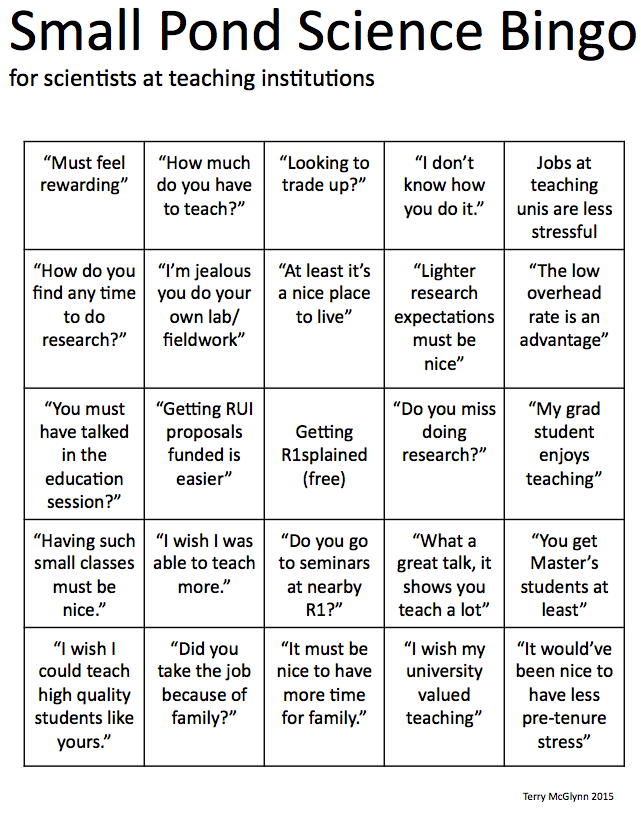
The Small Pond Science Bingo Card
StandardAre you interacting with colleagues from research institutions that have misconceptions about your job? Heading to a conference? Here’s a bingo card:
Academic job security and productivity (or the plant ecologist weighs in on potted plant metaphors)
StandardI had been planning this post for a while because the topic has been on my mind but now it seems like a perfect fit. Following up on Terry’s theme about nourishing research at teaching schools, I’m going to extend the plant metaphor to career transition stages. Continue reading
Faculty research is like a potted plant
StandardThe Ecological Society of America has wonderful program called SEEDS, which is designed to support and mentor underrepresented undergraduates who are pursuing careers in academic ecology*.
Let’s extend the metaphor of undergrads-as-seeds further. Continue reading
Recommended reads #59
StandardThe time I became a father in the same week my tenure portfolio was due, from Liberal Arts Ecologists.
You’re an insect curator. Cool! So what is it you do?!
Saving species experts from extinction
How should a professor be? 22 suggestions, including many great ones.
The NSF Division of Environmental Biology is typically in top blogging form. Lately, they’ve told us how how to write and what they want to see in annual and final reports. Since the reporting system recently shifted over from Fastlane to Research.gov, this is a good time to consider the what, how and why about what goes in there. (And I’ll be making some offering to the Lab Goddess in the hopes that this will still be a problem of mine a few years from now.)
Weeks ago, NSF announced that they have scaled back the scope of NEON, the ambitious National Ecological Observatory Network. They didn’t cut the funding allocation to NEON, but just discovered that there were bigger financial and logistical constraints than initially anticipated. What to think of this? Well, in short, I think budgets gonna budget. A more informative view about changes in NEON comes from 16 presidents of the Ecological Society of America, which was published yesterday.
Our obsession with metrics is corrupting science
Research metrics have made rivalry part of higher education’s DNA
I Am Biased and So Are You: thoughts on funding and influence in science
Sexism in science leads to willful blindness
Oh my gosh the first paragraph of this review of Franzen’s latest novel pins him down in a way I have primordially conceived but couldn’t really express:
Probably no one alive is a better novelist than Jonathan Franzen, and this is frustrating because his novels are awful, excellent but awful, books you read quickly and remember ponderously, books of exhaustive craft and yet a weird, spiraling cluelessness about the data they exhaustively collate. They analyze the wave frequency but don’t hear the sound. They are full of people who talk and act exactly as you imagine such people would talk and act in real life…
(And for the record, as a human being, Franzen is a verified putz.)
Here is an incredibly helpful post in Dynamic Ecology for new parents and parents-to be, about pumping at work. (Dads, this is for you too, as presumably you’re on bottle cleaning and management, and probably involved with Picov Andropov.)
If you’ve ever had the misfortune of going to or from Los Angeles through LAX, you probably noticed this historic airport was designed around the car, but not for contemporary quantities of cars. The design is particularly non-amenable to modernization. But here’s a big design that can help make LAX work more like a regular international airport.
Oliver Sacks has died. The New York Times obituary is a good one. One thing I learned, that surprised me a bit, is that he was a super-duper workaholic. Spent all his time thinking about work.
If you have any black students, or any students who are women, or any learning disabled students. Or anybody who isn’t a white male. Please do them, and yourself, a favor and read this explainer of stereotype threat if you don’t think you’re an expert on stereotype threat. It’s amazing how massively student performance can be affected merely by how assessments are perceived.
‘Love Becomes a Funeral Pyre’ review: The rise and fall of the Doors. Huh. I had no idea Jim Morrison was just a horrible person.
Using Active Learning to Teach Concepts and Methods in Quantitative Biology: “We describe some of the recent initiatives to develop hands-on activities in quantitative biology at both the graduate and the undergraduate levels. Throughout the article we provide resources for educators who wish to integrate active learning and technology into their classrooms.”
Teaching a class all about On the origin of species
The Case for Teaching Ignorance
10 Things This Instructor Loves
Taking My Parents to School — this is a wonderful read about the experience of first generation college students, and food for thought because odds are you’re teaching at least a few.
Is the tech sector in a bubble again? Hell yes, we are in a bubble.
On turning down the startup job:
The startup world, or at least the ones making the majority of the noise, have their heads up their own ass and don’t realize it stinks. They’re solving problems for the top 5% of the population. How can I get poor people to do my chores? How can I get people to drive me around without having to pay them health insurance? How can a drone deliver my toilet paper within 15 minutes while the person who fulfilled my order sits at her desk crying because she’s working a 15-hour day and can’t take time off to get that lump in her chest looked at. This is known as the service economy. Where entitled white boys figure out how to replicate their private school dorm experience for life.
“I Had a Baby and Cancer When I Worked at Amazon”
Next time someone asks me what it’s like being an Associate Editor, I’ll point to this post, which has the lowdown.
“An organic chemist I know tells her doctors that she is a professor of Southern literature whenever she is in the hospital.” Herein lies some interesting thoughts about the education of doctors.
This is not a surprise at all, the but data themselves are fascinating: That Ashley Madison site had no real women using the site. And they invented a bunch of women for men who paid more than a little money to fantasize that they could actually use this website to cheat on their spouses.
How understanding the prisoner’s dilemma can help bridge liberal and conservative differences. You know about that class that had an extra credit problem, in which students had to choose to Hawk or Dove for extra credit points? This is an interesting rationale.
Why is the US number one in mass shootings? The American Dream.
Japan is serious about getting rid of the humanities and social sciences.
How Common Core Can Help in the Battle of Skills vs. Knowledge
This 50-Cent Paper Microscope Could ‘Democratize Science’ – if you ignore the hyperbole, this is a mighty fascinating and inexpensive tool.
Here’s a consequential convergence of gay rights, sports, and intercultural understanding (or the lack thereof): It was only in 2013 that the US saw the first openly gay athlete playing in a major league team sport. The pioneer was Robbie Rogers, who starts at left back for the LA Galaxy (whose stadium happens to be on my university campus, which has its perks). That was a big signing for the team, but a more recent big signing has inadvertently introduced an ethnically charged anti-gay element into the fan base of the Galaxy. In perhaps the biggest leap ever in Major League Soccer, the Galaxy just brought on board the Mexican international star Giovani Dos Santos. Who seems to be a perfectly nice guy. This is a huge coup for the league, and also for the Galaxy which has caught the eye of many Mexican soccer fans in LA who up until now looked to the south and to Europe to follow the game. And they’re coming to the stadium to cheer on Gio and the Galaxy. But, there’s this thing that Mexican fans do when they’re at a soccer game. When the opposing keeper takes a goal kick, the crowd shouts “puto.” Which, no matter how you slice it, is an anti-gay slur. (I haven’t been to a game since Gio was signed, and now, well, I’m not so thrilled about the idea.) I’m sure a lot of the people who do this, don’t think consider it to be the horrible anti-gay insult that it is. The Galaxy doesn’t want to alienate the Mexican fans they just paid several million dollars to attract, but they also don’t want the league to take a step back after having made some substantial progress towards equity and inclusion — the work environment for gay and ethnic minority athletes in the US is much, much better than in Europe. It’s critical for the Galaxy and the league to shut the lid on this practice of hurling an anti-gay slur at the opposing team. How do you get fans to stop doing something they’ve been doing for so long, that some think is a part of their culture? In Europe, teams and their supporters have been punished for racial abuse by being forced to play future home games to an empty stadium. I hope Major League Soccer heads in this direction if a kinder, gentler educational approach doesn’t work.
Do you list job talks on your CV as invited talks? I used to, then pulled them, but it seems at least in biology that people tend to? Here’s the start of a discussion on the topic, click through to see the extended and interesting conversation that follows:
Last, a set of spectacular artwork featuring butterflies and moths gets published, after being hidden away more than a century.
Have a nice weekend, which is a 3-day weekend in the US. (So I’m not planning on posting on Monday.)
A collective blind spot in measuring natural systems?
StandardA few months ago I got a Fitbit, which for those of you who haven’t heard of it is basically a step counter. I’d been thinking about getting one for a while to help me motivate my exercise and keep my work-life balance somewhat on track. Perhaps symptomatic of not managing the balance, it took me awhile to get around to deciding what to get and actually buying it. Luckily for me, in the mean time, my husband bought one as a present and now I get to obsess about how many steps I take in a day. Continue reading
We have now reached critical mass
StandardThis academic year started auspiciously.
The hallway bustles with the activity of new faculty. It’s funny that I’ve only been in the department for eight years, but am one of the most senior, on account of retirements, other departures, and new growth. Continue reading
 Small Pond Science