Efficient teaching: Doing active learning an easy way

Standard

Here are a few difficult facts about education in college classrooms:

  1. Lectures don’t work well. People just don’t really learn much from hour-long lectures.
  2. People learn when they discover ideas on their own.
  3. People learn best when working with peers.
  4. It’s a hell of a lot easier to just explain something to someone than to set up a situation in which this person can figure it out for themselves
  5. It takes a lot longer for a person to figure something out than it takes for you to just explain it to them.

I suppose you can take issue with some of these facts and argue that they’re not true facts. But just as climate scientists are mighty darn sure about anthropogenic warming trends, education researchers seem to be just as sure about this these facts. I let them take my word for it about ecology and evolution, and I’ll take their word for it about education.

And this is a problem, because it means that what a lot of us have been doing appears to not just suboptimal but downright inadvisable. Continue reading

Academic self care

Standard

The semester has begun and everyone is returning back to campus. It means my commuter bus is full and I rarely get a preferred seat. Bike parking in Uppsala is a lot harder too. For me this means that I’m returning to my office and there are people walking around in the corridors. I spent my summer doing a mix of work travel, fieldwork, housework, vacation and lots of mad writing at home. It was a nice break from the routine and a hopefully productive summer. Mostly it has meant that I’ve only dropped by the lab every once in a while to run samples but otherwise I haven’t spent much time there.

So when I started coming back into the office, I’ve been catching up on all those things I’d ignored during the summer. There is juggling the samples I’ve accumulated, meeting with students, catching up with my PhD student about her work this summer, chatting with colleagues, digging out my desk, and trying to finish up writing on a deadline.*

When I get into a rhythm of working at home/in the field, I often find that I don’t transition well to being back in my office. I’m not sure why really but I tend to get distracted by all the things that need doing. I don’t drink enough water. I eat my lunch late and I generally push myself in ways that are unhealthy. It only takes heading home with a headache to reset my mindset and remind myself that I don’t need to do all the things. And if I ignore my body it comes with a cost.

In the ‘back to school’ season it is good to remind myself to take care of myself and remember to listen to my body. I think that academia can be quite bad at creating healthy work environments. Although there is the issue of taking care of your mental health, and I know they are connected, but in this post I’m going to focus on physical constraints of a job in academia. I think the job can lend itself to all kinds of bad for you behaviours. I’m definitely guilty of a few.

In my experience, one of the problems of research can be that you never do any particular task (accept maybe computer work) for long enough periods of time to ensure they are ergonomic and not damaging. Now before you start thinking about those long days in the field or lab doing some horribly repetitive task for hours on end and disagree, I’m not talking about hours, days or even weeks here. I’ve done some tasks in physically awkward ways (or witnessed them) simply because it isn’t such a long term thing. You just need to get through these 100, 1000, etc samples/computer files/whatever. If it were your job to do that thing and only that, you’d never be able to sustain it if you didn’t have a good work station. But we often only work on short-term assembly line tasks so they are often not set up in the most ergonomic way. Of course some situations are beyond your control. It is difficult to measure flowers on a plant at an awkward height but you can’t change how the plant grows. You can however, varying your position, use a camping stool, sit on the ground and otherwise make accommodations so you don’t strain your body. The same is true in the lab or at the computer. I know many examples of grad students who developed some kind of repetitive stress injury while doing their research. It a real and can be debilitating thing.

Most of us spend a lot of time at our computers so it is a good idea to create a good desk situation. Separate keyboards from your laptop, raised screens, a good chair… all these things can help long hours at the computer. Meg Duffy has also talked about her treadmill desk and its benefits and limitations. I have an adjustable desk for standing, which I try to do much of the day, but haven’t ventured to a treadmill. But it isn’t just posture at your desk that can cause problems, typing and mouse work can lead to repetitive stress injury so setting up your work station can be crucial to successful computing (some ideas for avoiding bad computer setups and injury here).

Similar principles apply to your lab and fieldwork. The more conscious you are about the way you have to do the activity and think about it before hand, the more healthy you can be. I also find that those few moments of thinking about how to do a job in a healthy way also improves efficiency. It is hard to be efficient at a task if it is physically awkward in someway. So whether you are processing 10, 100, 1000 or 10000 samples, making it easy on your body is worth a few moments of contemplation.

I try to be mindful of the tasks I do and set things up in a way that are ergonomic, even if I’m not going to be doing that activity for extended periods. But it is easy to forget about your body, get caught up in a task. For me it is always the rush to the finish line that gets me; it is precisely because I see the end of the task that I tend to push myself too hard.

I’m definitely not writing from some moral high ground. I am currently battling frozen shoulder, which was probably made a lot worse by spending too many hours painting windows this summer. I’m sure the inactivity of desk work doesn’t help me either. But the experience has got me more conscious of what I’m doing with my body and I hope after some physiotherapy I might be able to lift my arm above shoulder level again some day soon. Now I just need to also remember to take breaks, drink water, don’t over-caffeinate and generally take care of myself at the office.**


*Who in their right mind accepts to co-author a review due at the end of the summer? So glad I said yes, and more so now that it is submitted, but it definitely made for a crazy summer.

**Thanks to @CMBuddle and @Julie_B92 who got me thinking more about the topic.

Recommended reads #34

Standard

It’s nice to have administrators you can trust

Standard

Last week, our campus had its back-to-school events. Our administrators talked about their big plans.

There was one Thing that the President talked about for a few minutes.

The Provost talked about the same Thing for a half hour.

My Dean talked about It for about twenty minutes.

When I had lunch next to my Associate Dean, the conversation was about this Thing for about fifteen minutes.

Then when my department met, the Thing was discussed for about another half hour.

So what is this Thing?  Continue reading

History will not repeat itself (i.e. lessons learned as a first-year faculty member)

Standard

By Sarah Bisbing

I survived my first year as a faculty member. In fact, I think I even did pretty well if I consider my student evals and the number of end-of-year hugs received. I’m going to pat myself on the back. Why? Because being a first-year faculty member (or really an any-year faculty member, as far as I can tell) makes you feel like you are in a constant state of fight or flight. I did know what I was getting myself into by starting down the path to tenure, but I also really didn’t have any idea what it would actually feel like. I was exhausted from living in a constant state of undone to-dos and never-ending lists, and I felt a bit like I was drowning. This reality hit me hard about half way through my first year, and I decided that I needed to come up with a better strategy for survival. I thought hard about my experiences to-date as a new professor and came up with my own rules of the game. And, you know what, I think I made some significant strides in managing my time and surviving the uphill battle toward tenure. Continue reading

A vacationing scientist.

Standard
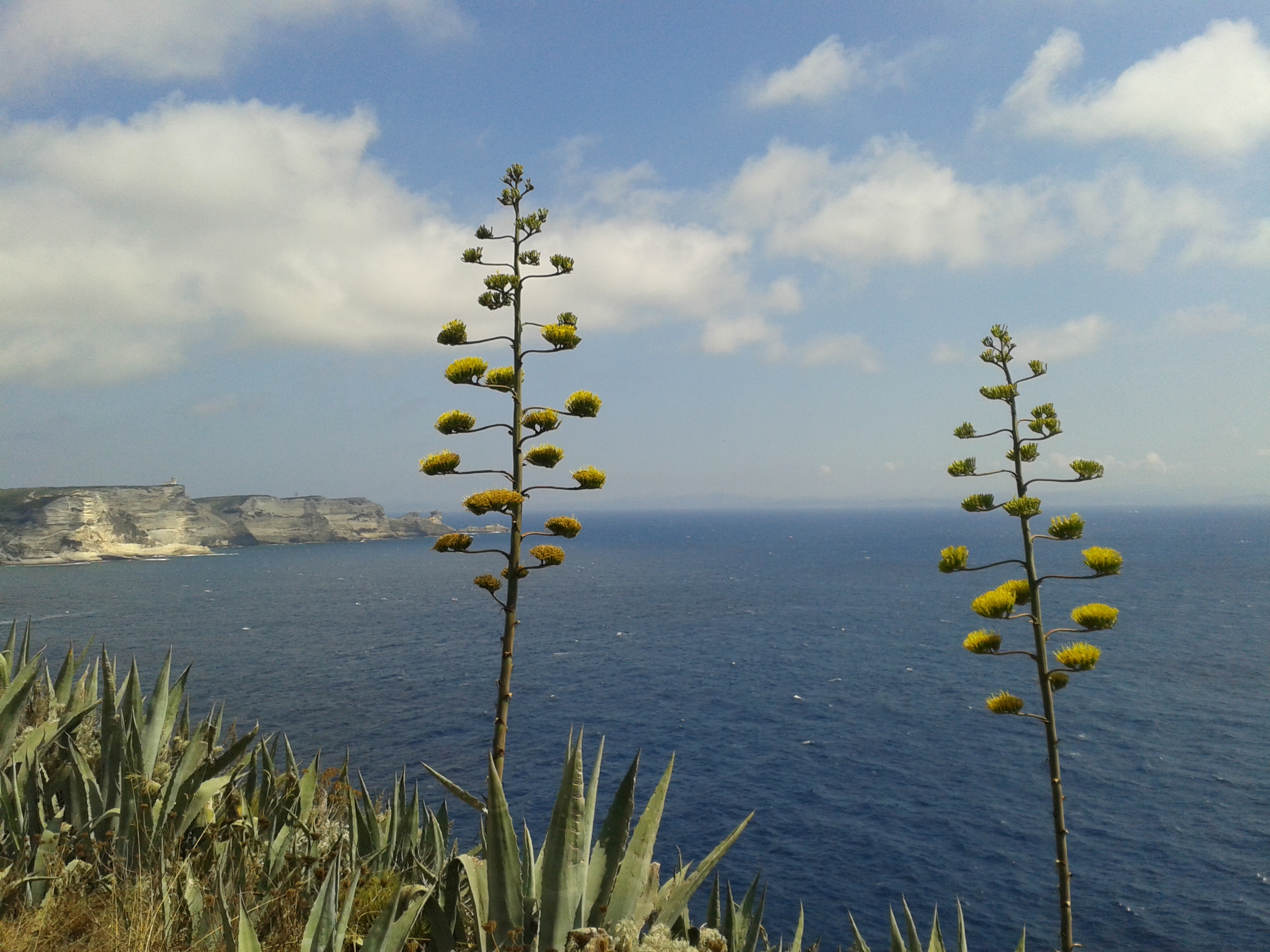
“I wish those flowers were closer and then we could pick them and you could do the work.” –my daughter to me while on vacation

“I wish those flowers were closer and then we could pick them and you could do the work.” –my daughter to me while on vacation

Last month we traveled as a family to Corsica for a real honest to goodness vacation. We spent days on the beach and exploring medieval towns. It was mostly sunny and warm and relaxing.

But…I did bring my computer. I had minor heart palpitations when I realised that the cottage we were staying in did not come with internet but it helped me actually have a vacation. I was reduced down to a few hurried email sessions at cafes or restaurants where I answered the most critical emails and sent off a few promised items. I worked a little on a paper I’m currently facing down a deadline for but not nearly enough to make this week back to work a breeze. So I vacationed but I didn’t truly drop everything. I rarely do. Some might find this a horrid part of the job—flexible enough to always follow you around but for others that is some of the joy of academic life. Continue reading

Introducing high school students to research

Standard

Like a number of other institutions, my institution offers outreach-y type programs over the summer, aimed at high school students. In the case of my institution, we offer a number of 3-week programs in different disciplines that generally follow the same format: class in the morning, and what we call “guided research” in the afternoon. The purpose is to introduce students to various fields through early research experiences, to give them a taste of college life, and, of course, to convince them to apply to my institution. Continue reading

Conferences need students: make them affordable

Standard

People go to conferences for a variety of reasons. Conferences are used to align future research priorities, and students and postdocs can “network.” Meetings also provide an opportunity to travel to cool places and take a vacation.

When conferences are in fancy places, they might attract more people, but only those who can afford to go. We need to have students and postdocs at conferences, for their own sakes and for the future of the field. At least in my fields, international conferences often are designed to make it very hard for students and postdocs to attend. Continue reading

Remetaphoring the “academic pipeline”

Standard

We need to ditch the “academic pipeline” metaphor. Why?

The professional destinations of people who enter academic science are necessarily varied.

We do not intend or plan for everybody training in science to become academic researchers.

The pipeline metaphor dehumanizes people. Continue reading

Recommended reads #32

Standard

Continue reading

Charging a cover for lab participation

Standard

I am considering implementing a new policy this fall in the lab portion of my primary course. The short version is: students would need to read/watch certain things before coming to lab that would prepare them for the day’s activity. Before entering the lab classroom, they would be handed a (relatively easy) quiz on those materials. These practices are pretty standard in lab courses, in my experience. Here’s the twist: if a student didn’t get at least a 75% on the quiz, s/he would not be allowed to participate in the lab, and would forfeit all points associated with it.

If you’re like me, your first reaction to that is, “Wo. That’s pretty harsh.” Continue reading

Teaching Challenges: group projects

Standard

Science is a collaborative effort and in essence, more and more of our scientific effort is done in groups. We come up with projects together, divide the labour, and co-write the papers that come out of it. So the idea of the lone scientist, working away in a solitary lab is really something for the movies rather than reality.

In teaching, group projects not only mimic the reality of what happens ‘for real’* but also provide a valuable learning experience for students. If you’re interested in reading more about the benefits of group work here is a start and here and here offer some tips on how to implement group assignments. Continue reading

Parental care and scientific careers: a fish metaphor

Standard

Dads typically do less parental care than the mom, at least in the US. This is a problem, especially for the mom’s career.

Many men, and I suspect particularly academics, are genuinely focused on parenting. They want to do right by their partners, and make sure that they don’t create an inequitable parental burden. Parenting is a joy, but time demands of the required tasks involved are often burdensome. In some some families, if you fast-forward from zygote to toddler, you’ll find that some, if not many, of these guys are not doing their share. Continue reading

Recommended reads #31

Standard

Continue reading

What happens in the canopy stays in the canopy.

Standard

For a few years, I’ve harbored a very cool (at least to me) natural history idea. But it’s a big technical challenge. The required fieldwork is never going to happen by me. So, I should write a blog post about it, right?

Bullet ants (Paraponera clavata) are one of the most charismatic creatures in Neotropical rainforests. My lab has done some work with them recently. These often-seen and well-known animals are still very mysterious. Continue reading

Respectful conversation at academic conferences

Standard

You’re probably familiar with this scene from academic conferences:

Person A and and Person B have been chatting for a few minutes. Person C strolls by and makes eye contact with Person A. Person C gives a big smile to Person A, which is reciprocated, perhaps with a hug. Both A and C enthusiastically ask one another about their lab mates, families, and life in general.

At this moment, Person B is feeling awkward.

Continue reading

Field courses: a blessing and a curse

Standard

Since I began my position at Uppsala, my summers begin frantically. Although my teaching load is relatively light, the majority of it comes in the spring just when I am getting ready for my own and my PhD’s fieldwork.

I teach in a course on Ecological Methods. Students learn mainly about sampling and survey techniques for a broad range of organisms but the focus is on birds, insects and plants (for which I’m responsible). The course starts in March and runs until the first week of June (therein lies some of my problems but more on that later). Continue reading

Between a rock and a hard concept: teaching multilevel selection

Standard

This post is by Leslie Curren.

I recently came across Amy’s post from last October about the ecological concepts people find the most difficult to teach, and knew my own answer immediately: multilevel selection. I was surprised no one else had mentioned it, although perhaps that’s because it is more evolution than ecology. But given the tight links between ecology and evolution, I still expected someone to bring it up—multilevel selection always finds its way into every course I teach, and that includes General Ecology (as well as Animal Behavior, Behavioral Ecology, Intro Bio, and others). Continue reading

Constructing a summer

Standard

For those of us on trimester or quarter systems, the summer is just beginning. (Graduation at my institution was this past Saturday, for instance.) My two undergrad research students started work officially on Monday, although both have been working with me for months now. I’m finally easing out of academic year mode and into summer mode, where my focus turns mainly to research, research, research. Continue reading

Huge problems during research are totally normal

Standard

At the moment, I have the great pleasure of working with a bunch of students at my field site in Costa Rica. Which means that I’m really busy — especially during the World Cup too! — but I’m squirreling away a bit of time before lunch to write about this perennial fact that permeates each field season.

We are used to stuff working. When you try to start your car, it turns on. When we set alarms to wake us up, they typically wake us up. You take a class, work hard and study, and earn a decent grade. Usually these things things happen. And when they don’t happen, it’s a malfunction and a sign of something wrong. Continue reading

Conference report from a non-expert: Geochemistry

Standard

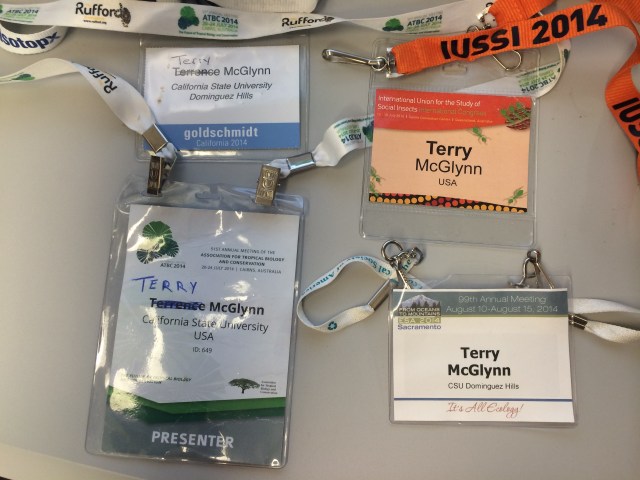
Last week I went to the Goldschmidt conference, which is a convergence of geochemists. I’m not a geochemist. I’m not even an ecosystem ecologist (though I’ve pretended to be one a few times). I was there to speak about how insects respond to the legacy of geologic history in a rainforest, and to share a bit about how animals may affect long-term nutrient cycles. In short, to remind them that animals might, just maybe, actually matter.

I learned a heck of a lot. Here are a bunch of stray observations and ideas that occurred to me throughout the meeting. Continue reading

Preparing a talk for a conference

Standard

I distinctly recall a little non-event at a conference: I was scooting to catch a friend’s talk on time. I found him sitting in the hallway outside the room, slide carousel* in his lap. Grabbing a bunch of slides and putting them into his carousel. He was picking out slides, on the fly at literally the last minute. Figuring out both his content and his sequence Continue reading

Chairing a search committee, in hindsight

Standard

Last year, I had the dubious honor of chairing a search committee for two positions in my department. The speciality was open. I learned about my department and my university by seeing it through the eyes of applicants and would-be applicants. There’s a lot I’d like to say about the process that I can’t, or shouldn’t, say. But I do have some observations to share. Continue reading