By my counting, we have three kinds of science education crises in the USA. Continue reading
Author: Terry McGlynn
The more things change, the more they change
Standard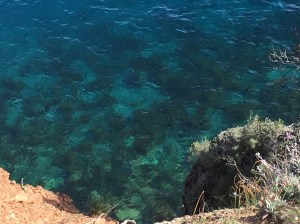
Monet Kelp Forest. photo by Bruce McGlynn
I just had the pleasure of spending a couple days hiking around the interior of Catalina Island. The last time I did this was about 23 years ago, when I was a student on an undergraduate field trip for a course in Conservation Biology.
I learned a lot from that course, and a lot of specific things from that field trip stuck with me. The biggest thing that I remember from that trip was: Goats. The second biggest thing that I remember from that trip was: Pigs. Continue reading
Taxonomist Appreciation Day is Thursday!
StandardTaxonomist Appreciation Day is March 19th – this Thursday!
Among all the sciences, one of the least heralded and most critical roles is the taxonomist.
We need more funding and more jobs for taxonomy. That’s not in my power, but the very least we can do is to explicitly value taxonomists and work they do with our recognition and appreciation. Continue reading
Recommended reads #48
StandardAllen Orr wrote a masterful review of DS Wilson’s latest book on the evolution of altruism.
Jeremiah Ory has some spectacular advice non-advice for managing dual careers.
Quiz: Did a computer or a human write this?

How Eric Grollman came out of the liberal arts closet.
My 11-year old son Bruce just told me about the Hawkeye Initiative, in which the absurd sexualization of women in comics is highlighted by substituting particularly egregious images of women with sarcastic dude Hawkeye. (Who is Bruce’s favorite comic character, by the way.) Here is a two-year old article about the Hawkeye Initiative. (If you’re like, “which one is Hawkeye?” then he’s the one who was played by Jeremy Renner.)
“I think we instead start to see in ecology what have already seen in other disciplines – rather than leave science, people will just leave. The US. I fear an ecological brain drain may be around the corner for the USA.” This is a really informative, link-filled, and important post by Emilio Bruna.
The chilling effect of mandatory reporting of sexual assault. An important read, especially if you are in a position to influence policy on your campus. (Actually, everybody is in a position to influence policy, but some have more individual power than others.)
Fundamental ecology is fundamental.
Why do we send so many of our best stories to journals whose editors are not accomplished, experienced, practicing scientists? Why do we give professional editors of journals that are not directly responsible to our community the authority to set the standards of our fields by deciding what gets published in top-tier journals? Most importantly, why do so many people serving on faculty hiring-and-promotion committees and grant review panels give these editors so much influence over who gets hired, promoted, and funded? Wouldn’t we, and science, be better served if we entrusted our best stories to journals with peer-editors whose authority is well founded, who have earned the respect of their peers, who are qualified to set the standards of the field? [and then this editorial goes off the rails and argues that journals should then be ranked based on the h-scores of the editorial board.]
5 Lessons Education Research Taught Us In 2014.
How misguided science fandom hurts actual scientists. This is pretty awesome.
Call-out culture refers to the tendency among progressives, radicals, activists, and community organizers to publicly name instances or patterns of oppressive behaviour and language use by others. People can be called out for statements and actions that are sexist, racist, ableist, and the list goes on. Because call-outs tend to be public, they can enable a particularly armchair and academic brand of activism: one in which the act of calling out is seen as an end in itself.
For more and different weekend reads, Jeff Ollerton has started posting, “Something for the weekend”!
Here’s a nice piece with “career advice to young scientists” who are not planning to stay in academia. I’m not big on advice which is overtly labeled and construed as such, but this is a good list.
You might have heard that Sweet Briar College is closing up shop. This is a long-established, not-badly endowed institution that just couldn’t make ends meet. This does seem to be a cautionary tale, especially for small, private, rural institutions.
Did you hear the one about how humans have evolved tolerance to arsenic-rich water?
At every university, to the best of my limited knowledge, academic misconduct sanctions are handled on a case-by-case basis, and often subject to the preferences (or even whims) of faculty and administrators involved in the process. But not so at the University of Arkansas. They have a very detailed point system that standardizes how academic misconduct is handled throughout the university, ranking some kinds of misconduct as worse than others. I have no idea how often faculty go rogue and don’t use this system, but the fact of its existence is pretty striking, and maybe a broader model. Do other places have a system like this, or is Arkansas unique?
I picked up some of these links from the social media of Arvid Ågren,Meg Duffy, Auriel Fournier, Neil Losin, and Marianne Peso. Anything else of interest, please add to the comments! (People do follow links in the comments quite a bit.)
How does blog readership grow, and (how) does this matter?
StandardHow useful are science blogs, and what is the future of science blogging? Probably the worst place to get a useful answer would be from a blog. But on the other hand, it’s the blogs that have relevant data, and it’s bloggers that think about this stuff. Here are my opinions and some digits, and my inferences. Continue reading
Efficient teaching: improving student writing ability
StandardLast week’s post was about university writing requirements that fall ludicrously short of their goal, like how this ferret falls short of his goal:
Let’s assume two facts:
- We should expect good writing of our students.
-
Good writing comes from lots of experience with writing.
Which results in the following inference:
It is incumbent on us to require lots of writing from students in our classes. Continue reading
University writing requirements are a joke
StandardWhen your undergraduates leave campus with a Bachelor’s degree, can they write well?
I wish I could say that about our student body as a whole, but I’d be lying. Continue reading
Academic Moneyball
StandardOver the past week, I’ve been reading Moneyball, by Michael Lewis.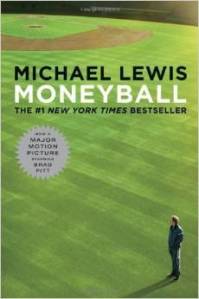
I’m not a baseball person (though I do keep tabs on football soccer). I found Moneyball to be interesting in its own right, but particularly when considering how its lessons may be applied to academic culture.
Lewis tells the story of Billy Beane, the manager of a small-budget major league baseball team, who assembled a crew that was better than most big-budget competitors. How did Beane pull this off?
According to Moneyball, Beane saw through the intellectually inbred and reality-challenged worldview that permeated the baseball community at the time. Scouts were picking players — and offering them humongous salaries — on the basis of athletic traits that didn’t help teams win games. Continue reading
Recommended Reads #47
StandardGain a rare look into the brain trust at Nature to understand how they pick manuscripts for review.
Quiz: North Korean Slogan or TED Talk Sound Bite?
One journal bans null hypothesis significance testing. That’s right, they’ve banned the P value.
A look back on the time when a columnist for Parade magazine (the celebrity rag that comes with the Sunday paper) understood and explained math and probability better than university professors, who were proud to trumpet their own ignorance: “Maybe women look at math problems differently than men.”
We don’t need more STEM majors. We need more STEM majors with liberal arts training.
There are probably a number of reasons that have contributed to the decline in field biology. These include the rise of molecular biology, the loss of staff competent and comfortable in the field, and the general decline in children getting outdoor experience. However, a key factor has to be that the skills involved have been distinctly unappreciated. In fact, we would argue that, in educational circles, this lack of appreciation goes much deeper. Educationalists have been guilty of formalising a gross undervaluing of the complexities involved in field biology. This has occurred through a naive adherence to an incredibly damaging dogma that has influenced so much of modern educational practice. Ironically, the dogma that has been so detrimental to field taxonomy is known as Bloom’s taxonomy.
This piece of writing has really made the rounds, but for good reason, so if you haven’t read this, now is the time to click through. Oliver Sacks discovered that he has terminal cancer, and this is his reflection on this discovery.
Shut Up & Write Tuesdays, a virtual writing workshop for academic folk.
Who is to blame for poor science communication?
How do you recruit new students into your lab?
Yet another gorgeous animation from the folks who brought you the stunning one about Alfred Russell Wallace. This is one is about Alfred Wegener.
Across disciplines, we find that faculty hiring follows a common and steeply hierarchical structure that reflects profound social inequality. Furthermore, doctoral prestige alone better predicts ultimate placement than a U.S. News & World Report rank, women generally place worse than men, and increased institutional prestige leads to increased faculty production, better faculty placement, and a more influential position within the discipline.
“The first rule for teaching ecology: “Get them outside; early and often”.
Current university courses on ecology often fail to persuade students that ecological science provides important tools for environmental problem solving. We propose problem-based learning to improve the understanding of ecological science and its usefulness for real-world environmental issues that professionals in careers as diverse as engineering, public health, architecture, social sciences, or management will address.
A Century After Being Cast into the River Thames, a Celebrated Typeface Reemerges.
For links, thanks to Allison Chapman, Lee Dyer, Karen Kapheim, and Steven Whitfield.
On being wary of bringing straight-A students into the lab
StandardI had a conversation a couple months ago about the fact that I’m a bit wary of taking Straight-A students into my lab as research students. Here’s an explanation. Continue reading
Poll: What is your risk/reward preference in science funding?
StandardRecommended reads #46
StandardWhat happens when you get paid 18 grand from NASA to stay in bed for two and a half months?
Ever wonder what it’s like to remove your own appendix?
How should we be selecting our grad students? This study indicates that we shouldn’t be looking at stuff like general GRE scores, GPA, and the fanciness of the undergraduate institution. Well, duh. But it’s nice to have numbers to point to your graduate committee when you go to bat for a great student that they don’t want to pick.
Undergraduate tokenism at its finest, from the good people of Nature.
From Black Geoscientists (tagline: Geology isn’t just for crazy white people!), “What’s with all the blackity-black blackness all the time?!”
Building insect manipulators for working with museum collections, made of LEGOs.
A guide to Bayesian model selection for ecologists. “Our aim with this guide is to condense the large body of literature on Bayesian approaches to model selection and multimodel inference and present it specifically for quantitative ecologists as neutrally as possible.” Another interesting this about this paper is that it has just two authors, but six institutional affiliations. Huh?
Here is a very short and very forcefully on-point argument about why academics need to spend time engaging the public to shape policy.
This obituary for Colleen McCullough, neurophysiologist and author, tells a fascinating life story.
Here is a blog about people in R1 universities who are teaching at teaching-centered institutions to learn how to teach better. It’s been around for six months, but I just caught wind of it. It’s really mighty awesome stuff. Here’s hoping for more of the same for good long while, and lots of great work coming from that end.
Here is a short article in Scientific American that explains the details of the absolutely horrific, and totally avoidable, disaster of the Nicaraguan Canal that is in progress. The article doesn’t mention how this is a Chinese canal, and how this is one piece of a big overall strategy of the Chinese government to become the primary economic force in Central America. I’m not saying the Monroe Doctrine is a good thing, but it’s interesting that people don’t seem to be noticing that it’s no longer in operation.
Can a tenured professor lose his job because of what he says on his blog? Apparently, yes. I’m not shedding any tears for him, though I am concerned about the effects of his actions on others. Something that hasn’t cropped up in this conversation, as far as I am aware, is the fact that he was tenured at a private religious institution, in which there is little to no transparency about retention and tenure policies. If he was unionized, I wonder if he’d be able to keep his job despite his horrible behavior. The mechanism that allowed the university to strip his tenure could also allow the university to do the same thing to a professor who did precisely the right thing but pissed off the wrong person. That he lost his job? Not a bad thing. The specific policy that allowed it? Hmmm.
this is what p-hacking looks like. (Beware: Don’t click through unless you are equipped to travel paragraph after paragraph through a desert bereft of capitalization.)
In defense of the p-value. This comes to you from Scientist Sees Squirrel, Stephen Heard’s new blog which has lots of good insights on perennial topics, brings up new important ones, and is really interesting and entertaining and deserves a big start.
In the last 15 years, ecologists have shifted from simple ANOVA models with a couple independent variables to models with 5-8 terms. Is this messed up, is it helping us discover new things? What should you be doing? A very interesting read, and, as always at Dynamic Ecology, don’t forget overlook the comments.
Swirl. “swirl teaches you R programming and data science interactively, at your own pace, and right in the R console!” I haven’t used it, it just looks interesting and user-friendly. Just passing word along. And like everything related to R, it’s free and open, of course.
If you’re interviewing for jobs, have you ever wondered or worried whether the order of interviews reflects initial rankings or final outcomes? Well, it probably doesn’t.
Last month, the groundbreaking Leopold Leadership Foundation picked 20 researchers as 2015 Leopold Leadership Fellows. Congratulations to them! I have no doubt that all of the Fellows are deserving of the honor and opportunity. I mentioned in November that they had a history of failing to include scientists from teaching-centered institutions. This year, the pattern remains, as just one new Fellow comes from a teaching-centered institution. (I didn’t apply, so I don’t have sour grapes about this.) I don’t know if they are failing to recruit applications from excellent environmental researchers at teaching-centered institutions, or if they are actively choosing against them. I do hope they make an effort next time around. It’s hard to lead from a position of exclusivity.
Important and Valid Point: Vilifying Parents Who Don’t Vaccinate Their Kids Is Counterproductive
Counterpoint: The Anti-Vaccine Movement Should Be Ridiculed, Because Shame Works, with a dissection of the difference between guilt and shame.
A grimly hilarious illustration: I’m an Anti-Braker
A study in Harvard used GoPros to track actual lecture attendance in nine different courses, and finds that students skip class a lot. Here’s a presentation with the data.
Scientists need more non-scientist friends. This, so much.
Claussen pickles are crazy good. I attempted this facsimile, which comes close enough for me. Who would have thought they have fennel, cinnamon and allspice among everything else in there?
for links, thanks to Darren Boehning, Amelia Chapman, David Clark, Meg Duffy, Tugrul Giray, Karen Lips, Loreall Pooler, Neil Tsutsui.
What are our academic blind spots?
StandardHere’s a notion: When we discover a big new thing, this often requires an abandonment — or at least serious doubt — of a commonly accepted notion. Continue reading
Two years of Small Pond Science
StandardSmall Pond is exactly two years old. Here’s a reflection on how this site has affected me. Some might call this navel-gazing. I look into that navel infrequently, so after two years I might as well remove this lint.
It takes a few moments to set up a blog. I’m more sheepish about divulging how much time I’ve spent on Small Pond Science over the last two years. I try to give as much attention to this site as I would to a class that I’m teaching, no less and no more. Continue reading
Browsing the tables of contents
StandardThis is going to make me sound not young, but here it goes.
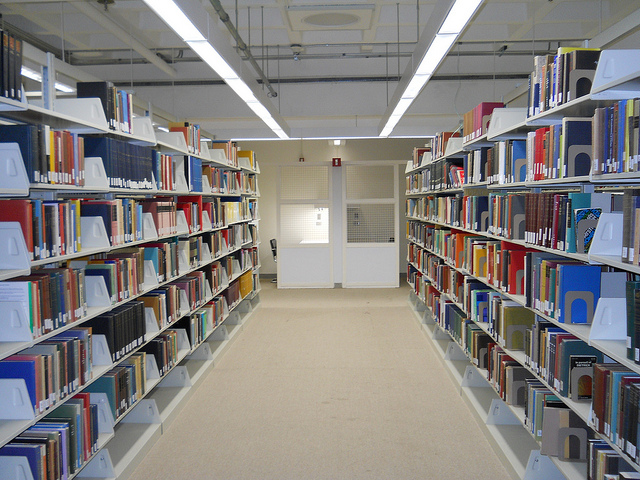
Library Stacks from Purchase College Library
When I was in grad school, if you wanted an article, you had to go over to photocopy it at the library. (Uphill, both ways, in the snow.)
Every time I went to the stacks to get the article I needed, I’d walk by the current periodicals section. That’s where the new issues accumulated before they were sent off to be bound for the stacks. There were typically several months’ worth of issues for every journal.
I usually paused to look through the new issues of some of my favorite journals, including American Naturalist, Behavioral Ecology and Sociobiology, Biotropica, Ecology, Insectes Sociaux, Oecologia, Oikos, and a upstart journal called Ecography. And many others. (The journal landscape has really evolved over the past couple decades, of course.) Continue reading
A conversation that can help protect your students
StandardA student recently dropped by to tell me about an exciting opportunity. She was going to spend a few weeks doing research in a gorgeous location, camping with a field crew led by the professor who taught her Intro course last semester.
I asked her how much the job paid, and she said it was a volunteer gig, but the opportunity of this short trip would would be worth it on its own. And she would be getting academic credit.
I had more questions. Continue reading
Recommended reads #45
StandardThis video clip showing aggressive mimicry by the Persian Horned Viper is amazing.
University Signs Slavic Languages Professor to Five Year, $52 Million Contract
Here’s a tremendously useful Guide for Scientists on Giving Comments to Journalists.
The machine-gunners’ dreams of point blank fire into serried masses of Emus were soon dissipated. The Emu command had evidently ordered guerrilla tactics, and its unwieldy army soon split up into innumerable small units that made use of the military equipment uneconomic. A crestfallen field force therefore withdrew from the combat area after about a month…. If we had a military division with the bullet-carrying capacity of these birds it would face any army in the world…They can face machine guns with the invulnerability of tanks. They are like Zulus whom even dum-dum bullets could not stop.
It’s a problem when people don’t understand (or choose to not bother to understand) mathematical models of evolution.
Do brilliant things occur to you while you’re washing the dishes? If so, here’s the job for you: Associate Dean of Eureka Moments.
Three kinda famous-ish people (who I’ve barely heard of, who are known from making youtube videos), interviewed the President of the United States. One of them wrote about the experience, and it puts “legacy media” vs. emerging media in perspective.
Following that thread, Adrian Smith just had a paper come out about fertility signaling in ants. When the paper came out, he released a 4-minute youtube video that explains the paper for a broader audience. It’s quite good. You might know Adrian from such podcasts as The Age of Discovery, previously mentioned in these pages.
Also on the same theme: A science communication course. In the rainforest. I have worked with the people doing this course from various encounters over the years, and I can only imagine this will be a great learning experience. This is no surprise as OTS courses have a reputation for excellence. If you have the time this upcoming summer and you’re interested in “science communication,” check it out.
“I owe it all to Chabot College,” says Tom Hanks. (He’s a well-known movie actor, if you’re more of a Hank Green kind of person.) If you ever look down your nose at the community college in your neighborhood, please read this piece and then, please reconsider. By the way, the movie inspired by his time at Chabot College (Larry Crowne) was filmed on my campus. Yes, people were very excited that Tom Hanks was on campus at the time. Even if he does live just 30 minutes up the road. LA is weird that way.
The citation revolution will not be televised: the end of papers and the rise of data. This is more of a wish than a description of the future. But it does show a model of how, if people make it happen, that people can get credit for data. The end of papers? Umm.
A reading seminar where every student reads, writes and contributes to the discussion in class. Unlike the preceding link, this isn’t about a utopia, and is a lot more pragmatic.
Does the myth of the solo genius scientist contribute to imposter syndrome?
Holy moly, rice has a lot of arsenic in it. As people eating predatory marine fish should be worrying about Hg, it looks like maybe those of us eating rice might want to think about As. Brown rice has more dietary fiber, yes, but also a lot more As. Tradeoffs are everywhere, aren’t they?
What’s a “publication power-of-attorney,” and why should you have one?
A bunch of Australian journal editors got together and wrote a document explaining how there needs to be some kind of credit, someway somehow, for doing peer review.
Did you know that when Behavioral Ecology switched to double-blind review, it increased the proportion of female first authors? This makes me want to think more consciously every time I write a review, and every time I consider reviews as an editor. What are the specific forms of the anti-female bias in the reviewing process? Is this because the reviews are targeting the credentials of the author rather than the quality of the work, or because the perceived quality of the work is lower because of the gender of the first author? I am also curious if American Naturalist will have the same results years from now.
Why journals sometimes are slow processing papers: look in the mirror.
Do you know about Software Carpentry bootcamps? Here’s a reflection from an instructor. I don’t really know the people who do this personally, but they look like they’re doing amazing and effective work with the pure intention of empowering people with useful tools. If I had a critical mass of participants, I’d be all over this.
Darwin’s hypothesis about inbreeding depression is tested within Darwin’s own pedigree.
For links, thanks to Lee Dugatkin, Russell Graham, Nate Sanders, and a comment from the previous recreads post.
Is it harder, or easier, to publish in your field?
StandardIt takes time and effort to publish a paper. After all, if it were really easy, then publications wouldn’t be a workable (albeit flawed) currency in for success in the sciences.
I often have heard about how some labs experience a bigger or smaller MPU (minimum publishable unit) than others, as I’ve worked in biology departments with a lot of academic diversity.
For example, I once knew an immunologist in an undergraduate institution who spent five years of consistently applied effort, to generate a single paper on a smallish-scale project. This wasn’t a problem in the department, as everyone accepted the notion that the amount of work that it took to generate a paper on this topic was greater than what it would take for (say) physiology, vertebrate paleontology, or ecology. Continue reading
Why I’m a little sour on crowdfunding
StandardHere’s an idea for a new way to fund science: We can just create websites about our projects, and then ask taxpayers to vote for competing research proposals, based on which ones they see on social media.
I didn’t say it was a good idea. This is, essentially, what crowdfunding is. Continue reading
Recommended reads #44
StandardIf you haven’t read it yet, Terry Wheeler’s post, “20 Years in the Professor Game: things I did right and things I did wrong.” is just so great. (I’ve been playing the game for just fifteen, but found that this really spoke to me and reflected the same things I’ve screwed up and the same things I’ve done right.) This post got a lot of attention after it came out, and rightfully so.
Piotr Naskrecki made a top-notch super-duper high quality video about the biology of human bot flies, filming the critters that he was reared out. This is the link to share with someone when you need to explain bot flies. (Of course, just because you tell students what to do with a bot fly when they get one, doesn’t mean that the’ll follow your advice.)
In public colleges, student tuition now contributes more than state funding.
Who are scientists? When we try to differentiate ourselves from those who aren’t scientists, we need to be honest and inclusive about all the different places, organizations and people that are doing good science. This is a great piece by Alex Bond.
The Royal Society drafted up a document to tell universities and PIs about how PhD students need to hear about career options while they are in grad school.
Here is a delicious and spot-on rant by Auriel Fournier: “‘At least they don’t seal the fire exits,’ Or why unpaid internships are BS.”
There was a nice article in Nature about the history of how R has evolved to become a standard statistical platform in some fields. It’s really an interesting story.
First day of class activities that promote a climate of learning.
American Naturalist has just gone double-blind! Now reviewers have to pretend that they don’t know which lab group produced the article that they’re reviewing.
Speaking while female. It’s important that men read this piece. Especially those who don’t typically care about these issues. If it helps, one of the two authors is named Adam.
California condors that have been introduced into the wild don’t get much privacy from the researchers constantly keeping tabs on them. Except, apparently, for this pair of birds that had a baby and raised it for nine months without any notice.
The Royal British Columbia Museum might not be hiring a new curator for their mighty nice and important entomology collection. Let’s hope they maintain this position, and give them some encouragement.
Buy some nice, and quite reasonably priced, paintings that were made by ants. And this is how they were made.
Are Black Colleges Boosting Minority Representation in the Sciences? This article in The Atlantic explains how under-resourced and under appreciated campuses are pulling the heavy weight in training the next generation of scientists. And they’re doing it by being collaborative.
This article in The Economist explains how World War II changed the field of statistics, and how statistics changed the war. Fascinating.
Here is a blog post that claims to have a list of the best research articles about the science of teaching and learning. I’m not in a position to decide whether that’s true.
A fun post by Meg Duffy about teaching ecology with Pablo Escobar’s hippos. And a nice illustration about how our lessons are taste the best when seasoned with current events.
Andrew Hendry wrote a great How To Do Statistics post. It’s full of all of the good opinions, at least in my book.
Maya Lin — who is famous for designing the breathstopping memorial to the Vietnam War in Washington, DC — has designed a memorial for all of the organisms that we have lost. What is missing.
Here’s an informative and example-laden post about how Undergraduate Journals Are a Good Thing. I’m not sure I agree, but this is still interesting reading. (I have a long list of posts that I haven’t yet written, and one of those is about how I think undergraduate journals might not be doing much good at all, or that the not-good outweighs the good.)
You know bar charts. You know box plots. Do you know violin plots?
What are the new frontiers in Animal Behavior? Here’s what an NSF-supported workshop thinks.
What it’s like to be an adult college student with ADHD.
Buzzfeed Science goes entomophobic. Having serious journalists at the masthead clearly doesn’t keep them from publishing muck.
Take a stand against abusive advising.
Academia has too many frickin’ mixers.
What’s the new low price of gasoline in the US? About 25 fatalities per day.
Posting a preprint before a paper is in press puts you at risk for being scooped.
PLOS apparently is asking authors to provide personal bank statements in order to get consideration for a fee waiver. Since this blog post came out, PLOS said on twitter that they don’t ask for personal bank statements. But here’s the thing: they did. So who are we to believe, PLOS’s twitter account or the quotes in the blog post? I’ll take the latter. They didn’t seem to offer any subsequent explanation or apology. The lesson is: don’t submit to PLOS if you can’t afford the pricey page charges, unless you don’t mind sharing your bank statements with them.
Siobhan O’Dwyer explains how our academic work is treated like a mass-produced trinket, but it’s really a hand-crafted artisanal product.
Academic assholes and the circle of niceness.
Jeff Ollerton asks and answers, “What do academics do once the research is published?” He points out that a third of all biology papers are never cited, and explains what we should be doing to fix that.
The American Museum of Natural History has started a video series called Shelf Life that takes us into their collections. It looks promising.
For some links, thanks to Marielle Anzelone, Kate Clancy, and Matt MacManes.
Authorship when the first author is the senior author
StandardAuthorship conventions are based around assumptions that research was done under the umbrella of a research institution.
It’s often just fine to assume that the first author did the most work, and the last author is the senior author who is the PI of the lab that enabled the project.
That’s a fair assumption, so long as the senior author and the first author are different people. In my circumstance, when a paper comes out of my lab, I’m typically the first author and the senior author. Continue reading
Experiments can sell your science, even if they’re not going to work
StandardWe typically need manipulative experiments to truly know how a biological system works.
Nevertheless, on most days, I feel that the subculture of ecology suffers from a fetish for manipulative experiments. In some cases, people design experiments that don’t entirely make sense because they know that the reviewers and the community will value that experiment more than observational research. Even if the experiment isn’t really that informative. Continue reading
Standards-based grading
StandardAs we start up the new semester, this is an apt time to evaluate, and update or change, our grading schemes.
I don’t like giving grades. I wouldn’t assign grades if I didn’t have to, because grades typically are not a good measure of actual learning.
Over the least year, I’ve heard more about a new approach to assigning grades, that has a lot of appeal: “standards based grading,” in which students get grades based on how well they meet a detailed set of very clearly defined expectations. This is apparently a thing in K-12 education and now some university instructors are following suit. Continue reading
Recommended reads #43
StandardIn an intentional experiment in peer review, the organizers in a computer science conference discover that half of the papers accepted to the conference would have been rejected if the review process were rerun. (Note: in computer science, conference presentations are the meaningful currency of academic productivity, not journal pubs.)
Two weeks ago, very few people clicked through on the really good Veritasium link to a short video about effective teaching. Maybe if I explain how great it is, more people will click through?
The two cultures of mathematics and biology. If you read this piece all the way through, then you’ll learn a lot about the deep and unfortunate division between biology and math as academic fields, and how much we are missing out on as a result of this divide.
Are black colleges boosting minority representation in the sciences?
9 major takeaways from a MOOC called “An introduction to evidence-based undergraduate STEM teaching.”
How does segregation happen and what are two possible routes to promoting integration? The Parable of the Polygons is an interactive simulation that answers this question, which I wager will be interesting informative, even for those who feel like they have a conceptual handle on these issues.
Here’s a strong-emotioned take on the pitfalls and inequity in the pass/fail system. It raises some important points about how pass/fail courses give an additional disadvantage to students who are already disadvantaged.
This study of hype in press releases will change journalism.
In the New York Times, a story about how “colleges reinvent classes to keep more students in science.” It’s nice that news about not lecturing during lesson time in class is getting more press. (By the way, if you’ve exceeded your free reads in the NYT, you can just circumvent that by going into your browser’s private mode.)
Just as a reminder for prepping your syllabus and lessons for the upcoming semester, Meg Duffy maintains an annotated list of videos that are great for teaching, which just got a number of new additions. (And no, this is not a “curated” list, not that she called it one.)
Best wishes for a wonderful 2015. For links, thanks to Chemjobber, Richard Lenski, and Corrie Moreau.
Dead grandmothers no more: the equal accommodation classroom
StandardLet me tell two anecdotes to put the Dead Grandmother Syndrome in perspective.
I remember when I was a student in Evolutionary Biology in my junior year of college. Right before the midterm, I got really sick with the flu. I felt like hell and doing normal things seemed like a physical impossibility. If I took the miderm, I would have gotten a horrible score, only because I was so darn sick. Continue reading
Recommended reads #42
StandardI’ve mentioned this before, but it bears re-mentioning. NSF’s Division of Environmental Biology has a superb and informative blog, DEBrief. The latest post is called: How to win over panels and influence program officers: advice for effective written reviews. If you’ve ever wondered what NSF wants to know when you’re writing a review and the best way to write one, this is what to read.
There is a useful and detailed “mentoring” section on the lab page of Anna Dornhaus, of the University of Arizona. These pages include a lot of links to other resources, separated for undergrads, grad students, and postdocs.
An open letter to parents of college students, from Hope Jahren.
Preparing students for class: How to get 80% of students reading the textbook before class. This is a peer-reviewed paper in a physics journal. But the abstract says it works just as well for biology courses. So there.
From Veritasium, so frickin’ good, a 7-minute video: This Will Revolutionize Education. It explains the history of dumb technological fads in education. The best line, of many, in this video: “The fundamental role of a teachers is to guide the social process of learning.” Totally worth your while, and worth even more the time of your administrators. If you can dupe your adminfolk to watch this, even better.
The invasive hippos of Colombia are getting fixed. Fixed, as in, “take Rover to the vet to get fixed.” This is not a small task. You knew about the invasive hippos, right? It turns out that druglord Pablo Escobar had two hippos in his private zoo. A boy and a girl. And then in the aftermath of the Escobar empire, they just sort of made their way beyond the Escobar estate. So far, these hippos have only suffocated one cow, to our knowledge.
Jeremy Fox had a post at Dynamic Ecology reviewing the various tools that we can use to detect plagiarism, in addition to the widely used Turnitin service. The comments on the post are also useful. (On my campus we use Turnitin, which is integrated with our online course management system. And it gets lots of exercise in our department.)
Scientists are not that smart. Science is about effort and creativity.
This is hilarious. A pair of annoying pundits were doing their annoying punditry on C-SPAN, and their mom called into the show. To scold them for being so annoying. The first thirty seconds are hilarious, just to see the looks on their faces.
How far do you go with collaborative coding? Simon Goring makes the point that when you’re the collaborator dude on a project, it matters that other people in the project can understand what you’re doing. On the other hand, the reason people collaborate with coders is because they provide specialized skills, but working to avoid being needlessly inaccessible is still important.
I apparently missed this great piece in TREE two years ago by Fischer, Ritchie & Hanspach: about the important of Quality of science over Quantity of science in publishing. Box 1 in the paper has a very specific “roadmap” to get academia beyond quantity. The road looks as navigable as the road to Mordor or the route in the Phantom Tollbooth, but that doesn’t mean it’s not worth the trip. Euan Ritchie puts this paper in perspective on his site.
What do obscenely inexpensive oil prices mean for the future of oil exploitation? To keep this place from becoming a furnace, massive amounts of oil reserves must stay in the ground, resulting in lost profit for people making money off of greenhouse gas emissions. It’s a dilemma that as we become more fuel efficient and ramp up use of alternative energy sources, the demand for oil will drop relative to supply, resulting in cheap oil prices. Which’ll in turn make people want to use oil. Here’s a piece where we hear what Al Gore has to say about it.
There’s a new tree for birds, with a lot of interesting finds.The Avian Phylogenomics Project site, which manages to be both slick and useful. Among the key results are that what we’ve called raptors are, for sure, not a monophyletic group. And a lot, lot more.
This new field station built by the University of Chicago is a gorgeous structure. So purty that it was written up with a bunch of photos in the New York Times Home and Garden section.
One year ago (back when people would leave comments with additional recommended reads, boy that was great, hint hint), Wendy recommended the book The Evolution of Calpurnia Tate. Well, I finally read it. It was really good. If there’s an aspiring naturalist in your life, especially though not necessarily a tweenish girl, this could be a nice present. And I just saw while preparing this link that next year a followup is due! That will be a nice read, I bet.
I recently put in my preorder for Rob Dunn’s next book, The Man Who Touched His Own Heart. I imagine it’ll be at least as half good as his last two, which makes it a must-read.
Please list comments with other great reads over the last couple weeks! For links, thanks to Kelle Cruz and Emilio Bruna. Note that posts will more sporadic over the holidays and beyond, in part because I’m away on fieldwork for half of January.
Students say the darndest things!
StandardOftentimes, professors make sport of sharing humorously incorrect exam answers. I’ve seen a bunch of these during this end-of-semester grading season.
When students don’t know the answer, they sometimes entertain us with witty, technically correct answers that don’t answer the intended question. (There’s a well-selling book about this. And at least one website, too). But that’s not what I’m talking about. Continue reading
What I said about my blog in my promotion file
StandardI’m periodically asked about the role of social media and blogs in my career and campus interactions. Here’s some information. Continue reading
Efficient teaching: 5-second wait time
StandardI’m not a fan of asking questions in the middle of a lesson that are designed to elicit raised hands. But once in a while, it makes sense. Continue reading
Recommended reads #41
Standard45 things I’ve learned about science since I was a student, by Rob Dunn. Knowing these things matters. Staying conscious of these things when it matters is even more important. Pretty much the best set of advice for science and life as a scientist I can recall ever reading.
American universities are experiencing a brain drain, especially the University of Texas.
Next year I’ll be able to wear this awesome women-in-STEM shirt designed by Elly Zupko. You can still order your own! The kickstarter was fully funded within a day, and there’s still almost a month left. Get in on it, and share this widely! I’m loving this constructive response to the sexist incident that interfered with the successes of the comet robot mission. It’s lot better than dudes using shrill insults.
Here is a particularly cogent argument against traditional grading systems. It’s in Robert Talbert’s blog on the Chronicle of Higher Ed site. The whole blog itself looks pretty good, actually.
A paper just came out in PNAS explaining that triclosan, the widespread antimicrobial compound that people like to put in soap and a whole other bunch of stuff, promotes liver tumors.
So, the story about how the Secretary Bird got its name might be apocryphal? The latest from Frontiers in Ecology and the Environment.
The British Ecological Society just published the handiest, informative, and most useful Guide to Data Management in Ecology and Evolution. This goes looks like to be a good partner to another BES document, a so-excellent-it-might-be-perfect guide to peer review. Kudos and thanks to the good folks of the BES.
One down, hundreds to go. The University of Alabama at Birmingham is shutting down its football program. But it’s not a principled stand about the exploitation of student labor, the corruption in the NCAA or the fact that American Football directly causes severe brain injury and dementia. It’s just about saving money.
You might be wondering how a 25 g mouse can take down a 9 kg albatross chick, but I can assure you that a) it does happen, and b) it’s a big problem.
That and a lot more from bird guy Alex Bond, who has been chronicling extended fieldwork in Tristan de Cunha, the most remote group of islands inhabited by humans anywhere in the universe. This is a seriously underbiologized location. He’s been writing about his work there on his site, The Lab and Field, with a series of posts. Prologue; Part 1; Part 2; Part 3; Part 4; Part 5. The only reason to not read this is that you’ll get jealous at the adventure cool natural history.
Do you want the Charles Darwin Research Station in the Galapagos Islands to shut down? Me neither! You can help prevent this from happening – which might be imminent – by contributing. And if you click through there’s a great image of Darwin-as-Santa. Is individual philanthropy of non-wealthy academics a reliable funding model for an important research station? Of course not. But as a stopgap measure to allow them to find their feet, it’s not a reasonable thing to request at the moment.
My great-great-aunt discovered Francium. And it killed her.
A nice obituary for Chespirito, the comic genius.
BioMed Central discovered at least 50 papers with fake peer review in several of their journals, in which authors recommended reviewers with email addresses that point back at themselves.
Bring back the dead with old ecology photos. While long-term ecological data are valuable, old photos can often provide things that you won’t get in a spreadsheet.
An organization that advocates vegetarianism did a big survey about who, how and why some Americans are vegetarian. The results are really interesting. As one of the 2% of veg people in this country, I’ve always been curious about the numbers of people who adopt – and typically drop – the veg habit, and their motivations and challenges.
Meg Duffy flipped her intro Bio classroom. And it worked out well. Find out why she’s reluctant to recommend it to others. (How’s that for clickbait?)
NSF has a three-month pilot forum to discuss graduate education. Want NSF to know about priorities and challenges that might shape future funding guidelines? It would be a good idea to participate!
My Vassar College faculty ID makes everything ok.
The Chronicle of Higher Edcuation has “created a booklet full of tips, trends, and ideas collected from news articles and first-person accounts” about How to Be a Dean.
The community of Imperial College London suffered a tragic loss with the death of Stefan Grimm. Why would an academic kill himself over the prospect of a looming performance review? I recommend we listen, very carefully, to Kate Bowles.
This is what happens if you buy a scam dissertation. It’s a long read that I heard was funny.
Conferencing with a kid, on Tenure, She Wrote. A great prescription in this post: “Treat graduate students like the adults they are.”
The campus alcohol problem that nobody (except Rebecca Schuman) talks about.
The site Biodiverse Perspectives publishes Flump every Friday. That’s not so much an insult, but just a fact. If you’re looking for even more links on Friday, try Flump. And, of course, Dynamic Ecology’s friday links.
 Small Pond Science