Novels, science, and novel science

Standard

I was chatting with a friend in a monthly book group. A rare event happened this month: everybody in the group really liked the book. It turns out that that most of the books they read are not well-liked by the group. How does that happen? Well, this is a discriminating group, and there are lot of books on the market; many books aren’t that good.

We speculated about why so many non-good books are sold by publishers. The answer is embedded within the question: those books sell.

Let me overgeneralize and claim that there are two kinds of novels: First, there are those that were brought into the world because the author had a creative vision and really wanted to write the book. Second, there are novels that are written with the purpose of selling and making money. Of course, some visionary works of art also sell well, but many bestselling books aren’t great works of art. (No venn diagram should be required.) Some amazingly great novels don’t sell well, and weren’t created to be sold easily in the marketplace.

Most novels were never intended for greatness. The authors and the publishers know this, but have designed them to be enjoyed and to have the potential to sell well. When someone is shopping for a certain kind of book, then they’ll be able to buy that kind of book. Need a zombie farce? A spy thriller? A late-20s light-hearted romance? I have no problem with people writing and selling books that aren’t great. Books can be a commodity to be manufactured and sold, just like sandwiches or clothing. A book that is designed to sell fits easily fits into a predetermined category, and then does its best to conform to the expectations the category, to deliver to the consumer what was expected.

I think a similar phenomenon happens when we do experiments and write scientific papers.

First, some research happens because the investigators are passionately interested in the science and have a deeply pressing creative urge to solve problems and learn new things.

On the other hand, some research is designed to be sold on the scientific marketplace.

To advance in our careers, we need to sell our science well. The best way to do this, arguably, is to not aspire to do great science. We can sell science by taking the well trod path on theoretical bandwagon, instead of blazing our own paths.

If you want a guarantee that your science will sell well, you need to build your research around questions and theories that are hot at a given moment. If you do a good set of experiments on trendy topic, then you should be able to position your paper well in a well-regarded journal. If you do this a dozen times, then your scientific career is well on its way.

On the other hand, you could choose a topic that you are passionately interested in. You might think that this is an important set of questions that has the potential to be groundbreaking, but you don’t know if other people will feel the same way. You might be choosing to produce research that doesn’t test a theory-of-the-moment, but you think will be of long-term use to researchers in the field for many years to come. However, these kinds of papers might not sell well to high-profile journals.

Just like a novelist attempting to write a great novel instead of one that will sell well, if you are truly attempting to do great science, there is no guarantee that your science will sell. Just like there are all kinds of would-be-great novelists, there are some would-be-great scientists who are not pursuing established theories but are going off in more unexplored directions.

Of course, some science created for the marketplace is also great science, too. But the secrets to creating science that sells, are very different than the secrets to doing great science.

After all, most papers in Science and Nature are easily forgettable, just like the paperbacks for sale at your local chain bookstore.

Update: For the record, y’all, I’m not claiming that I am above doing science to be sold. That’s mostly what I do. I’m just owning that fact. There’s more on this in the comments.

Friday Recommended Reads #16

Standard

Wouldn’t you like to see the cutest darn photos of collembolans? I thought you might.

Students have abandoned professional correspondence when writing their professors. That is old news. The new news is that now you have a clear explanation to give your students to save yourself the trouble: Here are the reasons that students need to write professionally to their professors.

Two of the best programs on radio are This American Life and Radiolab. They have their distinct aesthetics, and the Radiolab guys came on the scene well after Ira Glass created This American Life and reinvigorated how we tell, and listen to, stories. I’ve wondered how they feel about one another: as colleagues, competitors or both? Here’s the answer: Ira Glass wrote a gorgeous paean to Radiolab, explaining in minute detail exactly how good these guys are and how their show works.

What are the characteristics and behaviors of someone who can be successful in the sciences? This post at Dynamic Ecology makes a really good case for the ability to get stuff done at every stage in the research & publication process.

When we talk about women leaving science because of gender inequity, we tend to focus on students and early-career scientists. But the unjust crap women have to deal with doesn’t stop as they advance in their careers. We can hear about it from this heartfelt and detailed story from a high-achieving senior scientist, Jenny Martin, who had slightly more senior idiots in her path. There are a few comments that are also well worth reading.

What it’s like to be the first person in your family to go to college. A good account in the pages of The Atlantic.

NIH has a well-documented problem with racial biases in funding rates. Here is an intriguing idea: maybe the lower level of diversity in those who are funded by NIH might reflect a lower diversity in the topics of proposals. Maybe scientists from the underfunded groups are interested in different stuff that the NIH panels don’t want to fund?

Weeks ago, there was a joint post organized by Hope Jahren from some of us who blog with our real-life identity. (To clarify, the names on our blogs are the same names that we use at work, on our CVs and papers, and with people in our lives. Call the name on my birth certificate a pseudonym if you wish.) I mentioned this in my own post about it, but I really want to point to it again because I really liked it: the post by tressiemc on using one’s own name in blogging. One memorable line: “The penalty for raising hell is not the same for everyone.”

Feel free to add more links in the comments.

For leads, thanks to Karen James and Jane Zelikova.

Faith, knowledge, respect and science education

Standard

People sometimes make decisions and solve problems without using reason. It’s part of our nature. People seek understanding through a variety of modalities. It’s normal.

I don’t use reason and science to deal with everything I encounter in the world, but I rely heavily on evidence. Faith remains perplexing to me, and not for the lack of education about a variety of religious traditions. Faith is the choice to believe that something is true without evidence. I won’t choose to use faith about anything of real consequence. I am not a religious person, and I choose against faith.

I am aware that my approach to understanding remains a minority view. Remembering this fact is an important part of my job, if I am to be an effective science educator.

Last year, the blog Sci-Ed (I’m a fan of the site) ran a piece by Adam Blankenbicker arguing that we should not “believe” in science because the belief requires faith, whereas knowledge is gained though evidence and investigation. With respect to the facts and the concepts, I agree with Mr. Blankenbicker, wholeheartedly.

However, I never would attempt to sell his concept, as written, in a blog devoted to science education. Science is about evidence, but just because science educators put an emphasis on evidence that does not mean that we need to go out of the way to insult belief.

The first concern about this post was expressed by Holly Dunsworth, who wrote that an interview with her for that piece was taken out of context.

In contemporary culture, the prevailing view is that faith is a virtue rather than a vice. On the other hand, many scientists have gone to the great trouble to point out that faith more often leads to bad behavior. But, as a science educator, that’s never an argument I want to actively seek out. That conversation will not be resolved anytime soon, and if you bring that conversation to the forefront of science education, the conversation will promptly stall.

One cannot win the argument that faith is a vice, if the definition of winning includes earning respect from people of all backgrounds. In my book, science education wins when everybody learns and loves evidence-based science, and that includes people of faith.

Some science educators, such as Mr. Blankenbicker, attempt to convince others that the use of faith is a vice. I may agree with him, but delivering that argument would hobble my own efforts as a science educator. Once a person who has strong religious faith sees the “faith = bad” idea coming from science educator, the analytical part of the brain turns off.

Too much science education involves preaching to the converted, in which people who are already interested in science learn even more about science. A different approach is required when informal education efforts target an audience that arrives with both scientific ignorance and suspicion of the motives of the science educator. With some topics that are (allegedly) connected to religious doctrine, such as the origin of life on Earth and the diversification of biodiversity, lessons involving facts, knowledge, and evidence won’t be accepted if the same lessons simultaneously attack faith.

To bring new people over to science, we can’t start by insulting them. No matter how many fan emails published by Dawkins, this basic fact remains: Whenever a science educator argues that religious faith is a delusion, the receptivity of the target audience shrivels.

To put it more simply, when someone feels that an educator just insulted their beliefs, they’re not going to consider the content of that educator’s science lesson. Ever since Sci-Ed published a piece insulting the use of faith, I imagine that religious readers of the site, if any remain, will be less receptive to the science content within. I find it dismaying that some science educators have written off the majority of the US population because they are religious. That religious population is the one that informal science educators need to reach the most, if we are to reverse the nation’s decline in science education.

When people don’t trust science educators for information, they’re not necessarily leaning heavily on Descartes either. Lots of people simply make decisions without any useful evidence. Most people who reject facts generated by science don’t necessarily see their views as a product of “faith” or “belief.” Some people use faith about empirical matters in which it is often useless, when knowledge would be more useful is more useful. But most people who use faith for spiritual matters don’t have the theological or philosophical training to understand which kinds of decisions are better solved with knowledge instead of faith.

Here is a small story, to illustrate how people use faith when knowledge and reason is required. When my son was in kindergarten, he was having a friend over, and they were playing with some toys. The friend was struggling mightily to join together two pieces in a puzzle, even though these pieces weren’t designed to connect to one another. Literally, one piece had a square peg and the other had a round hole. When the friend was told that the pieces would not fit together, the child replied, “They will fit. I have faith that they’ll fit.” Then he continued to twist and push, but the pieces never joined.

If you know typical 5-year-olds, that conversation is perfectly normal except for the fact that the child specifically explained that he made his decision based on faith. This child learned, at home, to use faith to solve an everyday problem to which knowledge was suited. It so happens that one of his parents was being trained as an evangelical minister. I have no idea if the parents would have been proud of the child’s faith in this circumstance. I don’t know how the parents would have handled the situation if they were present. I’m sure that he eventually figured out that spatial problems using puzzles are solved using reason, and not with faith.

When it comes to more complicated problems that take a little more than round holes and square pegs, I don’t know if he’ll learn to drop faith and pick up knowledge. Will he use the same reasoning as biologists to measure natural selection and reconstruct evolutionary histories? Will he use the same logic and evidence that geologists and physicists use when seeking to understand the age of the Earth? Many adult Americans inappropriately apply faith instead of reason to these topics. Or, they use poor quality reasoning from lines of inquiry that originate from faith-based assumptions.

To get to the factually correct answers, faith must be set aside. Effective science education doesn’t require that the entire audience reject the use of faith for everything. It just requires that the audience uses reason when it comes to matters of science. Emphasizing that knowledge is useful and appropriate is a positive, but emphasizing that faith is useless and inappropriate is a negative. People rarely learn, or adopt constructive approaches, by focusing on the negative.

As far as I’m concerned, as a science educator, it’s beyond my job description to judge other people if they use faith about matters that are not informed by science. Moreover, if I do judge other people because they use faith, then I’ve just made my job impossible because I have cut myself off from my target audience. Some science educators don’t worry so much about teaching science content, but instead primarily argue that it’s stupid to be religious. This approach is not going to solve the science education crisis in the United States.

I want everybody to use the knowledge gained from science to make factual decisions about the natural world. If I can demonstrate that knowledge provides answers, then others will be able to conclude that faith is not suited to scientific matters. There are a small number of people who insist on using faith to directly controvert factual evidence. These people have no interest in knowledge, and these people are lost to science education efforts.

If science educators focus heavily on the small minority of the uber-faithful and anti-factual, we alienate the nearly everybody else: the people who who use faith at some times in their life but are open to knowledge. Effective outreach begins with respecting the notion that some people use faith and religion in some aspects of their life. Any science educator who can’t respect the fact some of the audience is religious and uses faith at times is in the wrong line of business.

Science and religion may or may not be compatible. But much of the country is religious, and it’s in all of our interests for this majority to use reason to understand and accept facts that have been established through science. It’s the job of the science educator to convince the faithful that science requires reason and knowledge. You can’t do it successfully if you start by insulting the faithful for their faith.

How all ecology grad students can benefit from an OTS course

Standard

If you’ve only just started grad school, or if you’re getting ready to finish, there are a ton of great reasons to take the OTS course this summer. The Organization for Tropical Studies courses aren’t just for tropical biologists, and the experience is useful for all ecology grad students.

  • Breadth of research methods — Gain experience in running experiments in a great variety of biomes, fields, and taxa. No matter your speciality, it can be useful and important to know how to mark insects, do biogeochemistry and microbial ecology, dissect flowers and do pollination experiments, mist net birds and bats, make and analyze sound recordings, and much, much more.
  • Making connections — You will work very closely with a large number of faculty from universities all over the United States and elsewhere. More important, you’re in the course with a bunch of other grad students who are typically fun-loving and academically talented. The course is work hard-play hard environment and you’ll go back home with new friends and colleagues, some of whom you’ll stay in touch with for the remainder of your career. You want to emerge from grad school with a network that goes well beyond your own institution. This is a great way to make that happen.
  • Experimental design — This course will have you designing and conducting experiments at many different sites in small groups. This really helps you learn how to develop the right questions, design the most appropriate experiments and that you’ve had the best analysis in mind the whole time.
  • Data analysis — Because you are involved in so many experiments, you gain experience with may kinds of analysis. The course has expert faculty including well-recognized statistical gurus who communicate in common English. You’ll get training in R to give you the tools that you need.
  • Science communication skills — Learn how to produce media that communicate your science with the public, by working with PhD scientists/filmmakers. Here are the tremendous results from a brief science communication project on the OTS course, from a post on the National Geographic Explorers Journal. The course runs its own blog and you have an opportunity to create podcasts and posts.
  • Experience with conservation in action — You’ll have the chance to interact with land managers and conservation professionals on the sites of ongoing projects. If you’re thinking about getting into the this aspect of the ecology business, you’ll have experiences and opportunities with making connections.
  • Tropical nature — If you haven’t ever spent time in the tropics, the biological diversity is stunning compared to the meager biota of the temperate zone. You get to see these biomes in the company of researchers who are experts in this environment and conduct a number of experiments. If you want to learn natural history and biodiversity, this is a chance to be in the field with the experts who can show you what you what to learn.
  • Units — You get six credit hours from the University of Costa Rica that (typically) count towards the coursework requirements of your program. So, there’s that, too.

Speaking just from my own experience, the course gave me so many skills — and ideas — that have been useful in many unpredictable ways. I’ve yet to meet anybody who has taken the course who has said it is anything short of incredibly useful, and I think everybody has rated it as a spectacular experience. In the course of your graduate career, it definitely is worth your time.

Here’s a pdf flyer with more info.

Here is the link to the course for summer 2014, with its list of great faculty and remarkable sites the course visits, and instructions on how to apply. The deadline for applications is just over a week away, but then there are rolling admissions afterwards.

Natural history is important, but not perceived as an academic job skill

Standard

This post is a reflection on a thoughtful post by Jeremy Fox, over on Dynamic Ecology. It encouraged me (and a lot of others, as you see in the comments) to think critically about the laments about the supposed decline of natural history.

I aim to contextualize the core notion of that post. This isn’t a quote, but here in my own words is the gestalt lesson that I took away:

We don’t need to fuss about the decline of natural history, because maybe it’s not even on the decline. Maybe it’s not actually undervalued. Maybe it really is a big part of contemporary ecology after all.

Boy howdy, do I agree with that. And also disagree with that. It depends on what we mean by “value” and “big part.” I think the conversation gets a lot simpler once we agree about the fundamental relationship between natural history and ecology. As the operational definition of the relationship used in the Dynamic Ecology post isn’t workable, I’ll posit a different one.

As a disclaimer, let me explain that I’m not an expert natural historian. Anybody who has been in the field with me is woefully aware of this fact. I know my own critters, but I’m merely okay when it comes to flora and fauna overall. I have been called an entomologist, but if you show me a beetle, there’s a nonzero probability that I won’t be able to tell you its family. There are plenty of birds in my own backyard that I can’t name. Now, with that out of the way:

Let’s make no mistake: natural history is, truly, on the decline. The general public knows less, and cares less, about nature than a few decades ago. Kids are spending more time indoors and are less prone to watch, collect, handle, and learn about plants and creatures. Literacy about nature and biodiversity has declined in concert with a broader decline in scientific literacy in the United States. This is a complex phenomenon, but it’s clear that the youth of today’s America are less engaged in natural history than yesterday’s America.

On the other hand, people love and appreciate natural history as much as they always have. Kids go nuts for any kind of live insect put in front of them, especially when it was just found in their own play area. Adults devour crappy nature documentaries, too. There’s no doubt that people are interested in natural history. They’re just not engaged in it. Just because people like it doesn’t mean that they are doing it or are well informed. That’s enough about natural history and public engagement, now let’s focus on ecologists.

I honestly don’t know if interest in natural history has waned among ecologists. I don’t have enough information to speculate. But this point is moot, because the personal interests of ecologists don’t necessarily have a great bearing on what they publish, and how students are trained.

Natural history is the foundation of ecology. Natural history is the set of facts upon which ecology builds. Ecology is the search to find mechanisms driving the patterns that we observe with natural history. Without natural history, there is no such thing as ecology, just as there is no such thing as a spoken language without words. In the same vein, I once made the following analogy: natural history : ecology :: taxonomy : evolution. The study of evolution depends on a reliable understanding of what our species are on the planet, and how they are related to one another. You really can’t study the evolution of any real-world organism in earnest without having reliable alpha taxonomy. Natural history is important to ecologists in the same way that alpha taxonomy is for evolutionary biologists.

Just as research on evolution in real organisms requires a real understanding of their taxonomy and phylogeny, research in real-world ecology requires a real-world understanding of natural history. (Some taxonomists are often as dejected as advocates for natural history: Taxonomy is on the decline. There is so much unclassified and misclassified biodiversity, but there’s no little funding and even fewer jobs to do the required work. If we are going to make progress in the field of evolutionary biology, then we need to have detailed reconstructions of evolutionary history as a foundation.)

Of course natural history isn’t dead, because if it were, then ecology would not exist. We’d have no facts upon which to base any theories. Natural history isn’t in conflict with ecology, because natural history is the fundamental operational unit of ecology. Natural history comprises the individual bricks of LEGO pieces that ecologists use to build LEGO models.

The germane question is not to ask if natural history is alive or dead. The question is: Is natural history being used to its full potential? Is it valued not just as a product, but as an inherent part of the process of doing ecological research?

LEGO Master Builders know every single individual building element that the company makes. When they are charged with designing a new model, they understand the natural history of LEGO so well that their model is the best model it can be. Likewise, ecologists that know the most about nature are the ones that can build models that best describe how nature works. An ecologist that doesn’t know the pieces that make up nature will have a model that doesn’t look like what it is supposed to represent.

Yes, the best ecological model is the one that is the most parsimonious: an overly complex model is not generalizable. You don’t need to know the natural history of every organism to identify underlying patterns and mechanisms in nature. However, a familiarity with nature to know what can be generalized, and what cannot be generalized, is central to doing good ecology. And that ability is directly tied to knowing nature itself. You can’t think about how generalizable a model is without having an understanding of the organisms and system to which the model could potentially apply.

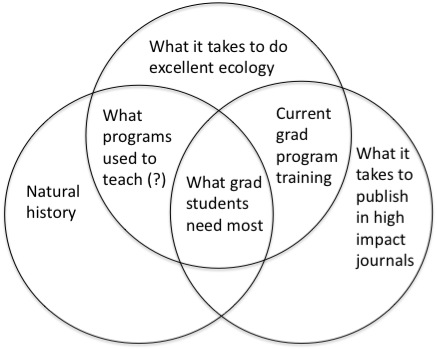
I made an observation a few months back, that graduate school is no longer designed to train excellent scientists, but instead is built to train students how to publish papers. That was a little simplistic, of course. Let me refine that a bit with this Venn diagram: 
nathistvenndiagram

What’s driving the push to train grad students how to publish? It doesn’t take rocket science to look at the evolutionary arms race for the limited number of academic positions. A record of multiple fancy publications is typically required to get what most graduate advisors regard to be a “good” academic job. If you don’t have those pubs, and you want an academic job, it’s for naught. So graduate programs succeed when students emerge with as their own miniature publication factory.

In terms of career success, it doesn’t really matter what’s in the papers. What matters is the selectivity of the journal that publishes those papers, and how many of them exist. It’s telling that many job search committees ask for a CV, but not for reprints. What matters isn’t what you’ve published, but how much you have and where you’ve published.

So it only makes sense that natural history gets pushed to the side in graduate school. Developing natural history talent is time-intensive, involving long hours in the field, lots of reading in a broad variety of subjects. Foremost, becoming a talented natural historian requires a deliberate focus on information outside your study system. A natural historian knows a lot of stuff about a lot of things. I can tell you a lot about the natural history of litter-nesting ants in the rainforest, but that doesn’t qualify me as a natural historian. Becoming a natural historian requires a deliberate focus on learning about things that are, at first appearance, merely incidental to the topic of one’s dissertation.

Ecology graduate students have many skills to learn, and lots to get done very quickly, if they feel that they’ll be prepared to fend for themselves upon graduation. Who has time for natural history? It’s obvious that ecology grad students love natural history. It’s often the main motivator for going to grad school in the first place. And it’s also just as obvious that many grad students feel a deep need to finish their dissertations with ripe and juicy CVs, and feel that they can’t pause to learn natural history. This is only natural given the structure of the job environment.

Last month I had a bunch of interactions that helped me consider the role of natural history in the profession of ecology. These happened while I was fortunate enough to serve as guest faculty on a graduate field course in tropical biology. This “Fundamentals Course,” run by the Organization for Tropical Studies throughout many sites in in Costa Rica, has been considered to be a historic breeding ground for pioneering ecologists. Graduate students apply for slots in the course, which is a traveling road show throughout many biomes.

I was a grad student on the course, um, almost 20 years ago. I spent a lot of my time playing around with ants, but I also learned about all kinds of plant families, birds, herps, bats, non-ant insects, and a full mess of field methods. And soils, too. I was introduced to many classic coevolved systems, I learned how orchid bees respond to baits, how to mistnet, and I saw firsthand just how idiosyncratic leafcutter ants are in food selection. I came upon a sloth in the middle of its regular, but infrequent, pooping session at the base of a tree. I saw massive flocks of scarlet macaws, and how frog distress calls can bring in the predators of their predators. I also learned a ton about experimental design by running so many experiments with a bunch of brilliant colleagues and mentors, and a lot about communicating by presenting and writing. And I was introduced to new approaches to statistics. And that’s just the start of it the stuff I learned.

I essentially spent a whole summer of grad school on this course. Clearly, it was a transformative experience for me, because now I’m a tropical biologist and nearly all of my work happens at one of the sites that we visited on the course. Not everybody on the course became a tropical biologist, but it’s impossible to avoid learning a ton about nature if you take the course.

The course isn’t that different nowadays. One of the more noticeable things, however, is that fewer grad students are interested, or available, to take the course. I talked to a number of PhD students who wanted to take the course but their advisors steered them away from it because it would take valuable time away from the dissertation. I also talked to an equivalent number of PhD students who really wanted a broad introduction to tropical ecology but were too self-motivated to work on their thesis to make sure that they had a at least few papers out before graduating.

In the past, students would be encouraged to take the course as a part of their training to become an excellent ecologist. Now, students are being dissuaded because it would get in the way of their training to become a successful ecologist.

There was one clear change in the curriculum this year: natural history is no longer included. This wasn’t a surprise, because even though students love natural history, this is no longer an effective draw for the course. When I asked the coordinator why natural history was dropped from the Fundamentals Course, the answer I got had even less varnish than I expected: “Because natural history doesn’t help students get jobs.” And if it doesn’t help them get a job, then they can’t spend too much time doing it in grad school.

Of course we need to prepare grad students for the broad variety of paths they may choose. However, does this mean that something should be pulled from the curriculum because it doesn’t provide a specific transferable job skill? Is the entire purpose of earning a Ph.D. to arm our students for the job market. Is there any room for doing things that make better scientists that are not necessarily valued on the job market?

Are we creating doctors of philosophy, or are we creating highly specialized publication machines?

There are some of grad students (and graduate advisors) who are bucking the trend, and are not shying away from the kind of long-term field experiences that used to be the staple of ecological dissertations. One such person is Kelsey Reider, who among other things is working on frogs that develop in melting Andean glaciers. By no means is she tanking her career by spending years in the field doing research and learning about the natural history of her system. She will emerge from the experience as an even more talented natural historian who, I believe, will have better context and understanding for applying ecological theory to the natural world. Ecology is about patterns, processes and mechanisms in the natural world, right?

Considering that “natural history” is only used as an epithet during the manuscript review process, is natural history valued by the scientific community at all?  Most definitely it is! But keep in mind that this value doesn’t matter when it comes to academic employment, funding, high impact journals, career advancement, or graduate training.

People really like and appreciate experts in natural history. Unfortunately, that value isn’t in the currency that is important to the career of an ecologist. And it’d be silly to focus away from your career while you’re in grad school.

But, as Jeremy pointed out in his piece, many of the brilliant ecologists who he knows are also superb natural historians. I suggest that this is not mere coincidence. Perhaps graduate advisors can best serve their students by making sure that their graduate careers include the opportunity for serious training in natural history. It is unwise to focus exclusively on the production of a mountain of pubs that can be sold to high-impact journals.

We should focus on producing the most brilliant, innovative, and broad-minded ecologists, who also publish well. I humbly suggest that this entails a high degree of competency in natural history.
Assigning literature in a science class

Standard

I don’t know more than a few science undergraduates who regularly read literature.

If I’m training excellent scientists, that means I’m training excellent thinkers and problem-solvers. I’m training people who see things beyond their own perspective. One huge route for that is literature. But my students don’t read literature. So, am I training truly excellent scientists?

There’s a conversation I often have, during lab, or waiting for class to start. I broadly ask, What good books have you read lately? Then I ask, When was the last time you’ve read a non-required book? Through the silence you can hear the sound of crickets (and raccoons fighting over the food put out for feral cats).

When I ask students why they don’t read novels, I always hear that they don’t have time. If I have a good rapport, then I call BS on that claim. I suggest the idea that, maybe, they have the time, but haven’t prioritized reading. I then get some pushback, about how busy they are. This, I cannot deny. Nearly everybody works long hours and has major family obligations on top of coursework.

But, they really still have time for reading.

I’ve asked how much TV they watch, and they say “not much.” Then I ask which shows they are currently following, and how many games per week they watch on TV, and for nearly all students, it’s a long list. We do the math together, and it seems that they’re watching 10 or more hours per week at a minimum. My eyebrows indicate that the lack of literature in their life is a choice.

I’m not a TV-is-bad-for-adults sourpuss, but I am a no-reading-is-bad sourpuss.

One of the great things about academic freedom is that we have broad latitude over what happens in our classrooms. Even if the course needs to conform to a tight curriculum, you have broad interpretive latitude about how you go about things.

There are tons of great novels that feature protagonists who are scientists, or are in settings that are relevant to the course at hand. I don’t think I’d throw students into challenging literary fiction if they aren’t used to it. But I could assign things like The Poisonwood Bible, Angels and Insects, The Monkeywrench Gang, House of Leaves, Dirt Music, Never Let Me Go. These books have people at the heart, not science, but they are infused with ideas tied to science or nature.

I haven’t yet assigned an unabashedly not-a-science-book novel in a class; I’ve assigned non-fiction books like Beak of the Finch in the past. But I’m open to the idea. At least at my university, students don’t get too many novels to read in the route to getting a B.S. in a STEM field. Academic freedom allows me the latitude to decide that reading literature is an important of learning how to do science. Of course, by requiring it, I have to make students accountable for having done it, and make it a large enough part of the grade to make sure they read it. And I wouldn’t scale back any other part of the course, and I’d make sure that all other course objectives are met as always.

Do you know anybody in a STEM field who has done this? If you did this, how much guff would you get from your department mates? What are some other books that you think would be good?

Why I write with my own name

Standard

This post was written in concert with four others on the same topic, which can be found at this link on Hope Jahren’s site.

When you click on “about,” you see my unveiled face and my real name. Some of my credibility – and the lack thereof – comes from who I am and what I have done. It’s self-evident that the identity of the messenger affects how the message is received.

It is my hope that my identity gives more credence to my words. If I talk the talk, then I’d like to show that I walk the walk. If I write about research productivity, then I need to show that I actually, you know, publish. If I write about mentorship, then a cranky person can track down my students. Of course, any writer should be judged by one’s words and not by one’s credentials. So, the credence that I might get from my identity would only be temporarily bought, from the population that is unfamiliar with the mores of the pseudonymous science “blogosphere.” That turns out to be most people.

Before I started blogging, I did a little bit of amateur sociological fieldwork. I learned that most people don’t read blogs on a regular basis. I learned that a visit to a blog can be like arriving at an intimate party where you don’t know anybody. In contrast, I want my blog to be approachable to everybody. I want to be the guy who walks over to the front door, says “Hi, I’m Terry. Come on in. Can I get you something to drink? Let me introduce you to these folks.” I want every single blog post to be able to stand on its own, and to not make any references to other people or other blogs that aren’t fully understandable to a novice.

And I want people to know who is addressing them. It’s more approachable to guests who just put their foot through the front door. I’ve written more here about my approach to running my site so that it is transparent, professional, and inclusive. I’m not claiming that my approach is better than others, but I try to be different in a way that, I hope, broadens the audience.

Compared to most other bloggers, it’s easy for me to be public: I represent the trifecta of privilege as a tenured white man. And I’m straight. I don’t have to worry about the job market anymore, and I won’t be attacked because of my gender or ethnicity, like some of my colleagues.

It’s my duty to use this relative comfort to agitate for change. It’s the best and most important part of my job.

I am the great grandchild of wops and micks who immigrated into a low-income ethnic enclave of New York City. I fight a similar battle as my great grandparents, not for myself but on behalf of my students. My lab is mostly composed of students from traditionally underrepresented groups, from low-income backgrounds, who are often the first in their families to attend college. Every day, I work to ameliorate the mountain of prejudice and disadvantage facing my students.

I can stick my neck out on occasion. I can press for student rights, call out bias, and encourage practices that make sure that the future generation of scientists looks like the American populace. My privilege doesn’t come without minor challenges. I need to be clear about my awareness of power differentials and where privilege lies. While I have been working very hard to declare myself as an ally and advocate, I’ve heard far too often that I’m not the right person to advocate for my students. But I won’t shut up, and it’s a challenge that I’m up to, because these things matter.

It’s rare that people accuse me of being out of touch because of my tenured-white-dudeness, but it happens. The last time I touched on the topic of my pseudonymity, I got burned. A formerly-pseudonymous colleague posted my name and picture, right next to a picture of herself with a black eye from a vicious assault, suggesting that attitudes like mine were partly to blame. One commenter remarked that I am a danger to children. My crime was ignorance of the fact that some people have good reasons to use pseudonyms. Like I didn’t know that or something. I was also guilty of not doing a literature search on the history of writing about pseudonymity in the “blogosphere.” You know you’re been shamed when the author has to write a caveat that you’re not actually being shamed.

I’m okay with the occasional potshot because risks are necessary to make change. The real risk is that I am a highly flawed model for the change I wish to see. I write about being an effective professor, but I was denied tenure. I push for more and better mentorship of minority students and women, but I’m a white guy. I write a regular set of posts on efficient teaching but I’m not winning any teaching awards. I write about time management and how to do research with a heavy teaching load, but lately I’ve been in the classroom much less than my departmentmates.

I’d like to help change the environment so that more people find it possible and worthwhile to write with their own names. For some, that environment already, tenuously, exists. This post by tressiemc about her choice to use her own identity is powerful and inspirational. I applaud her courage, and I believe we all stand to gain from it.

Based on the volume of what I’ve written, there is no shortage of people who consider me to be a rube, buffoon, blowhard, or a narcissist. That’s a chance I’ve taken. But these challenges and worries are infinitesimal compared to the truckloads of bunk that my students, and many of my junior colleagues, have to face every day. Because I am capable of using my own name while writing on their behalf, I am.

More sincere answers to stupid questions

Standard

Some people find this site by using google as an oracle. Others just ask stupid questions. I had fun the last time I answered these questions with some sincerity, so here’s a new round. The questions are directly copied from what visitors entered into google:

do ants like fake sugar

No. They don’t like margarine, either.

what do you call someone whos an adjunct professor

Professor.

what to do if we don’t know anything about the subject in exam

You study.

david correia fuck jared diamond

If you have photos, you might consider blackmailing both of them for some serious cash.

are professors at top slac good researchers? –confidential

Some of them are.

should i call him doctor or professor

Assuming that he’s your professor with a doctorate, either will do fine.

is a professor higher than a mr

Probably not me. I’m just 5’3” or so.

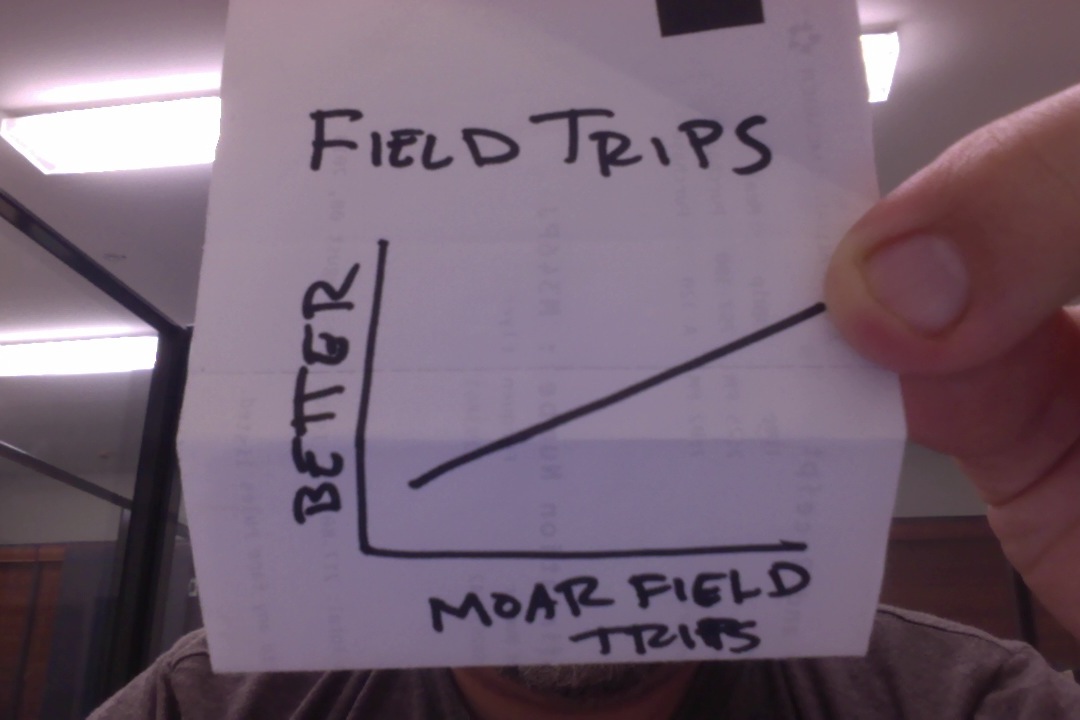
effectiveness of field trips graph

Photo on 1-23-14 at 5.11 PM

will i ever get a tenure track job?

Maybe.

life at an r1 vs pui is it better

You can have fulfilling career in both research and teaching at either one. What way do you want to be held accountable? If you want to be held accountable for research productivity and grant acquisition, the R1 is better. If you want to be held accountable by having created the perception of quality teaching, then a PUI is better.

Is being denied tenure the same as being fired?

Technically, no, it’s a non-renewal of contract. But for all functional purposes, yes. It sure feels like getting fired.

chances of getting a faculty position at good institution

Ranging from excellent to poor, depending on your definition of “good.”

can i get tenure track without nature paper

Yes.

does agreeing to a job verbally commit you to anything?

No.

how can you answer if being asked what is your philosophy in teaching

You say what your teaching philosophy is.

why is mcglynn collecting dead insects and leaf litter from the rainforest floor

For what it’s worth, they’re alive when they’re collected.

how to call an old men sir mister

The same way you call younger people sir mister. People are people, you know.

should i take the first r1 job

The question is, do you feel lucky?

antscience name

Myrmecology. Or, if you’re feeling cheeky like my podiatrist, “ant-omology.”

characteristics of a bad elevator speech

body odor, spittle, and a broken elevator.

in my school how is my science laboratory

You might want to start with a reference librarian.

why shouldn’t women be science

Because you’re a sexist pigdog who needs to rot for eternity in his own insecure misogynist hell. No offense intended to pigdogs.

Flexibility is wonderful, and horrible.

Standard

Academics have a wonderfully flexible job.

If my kid is sick, or has a performance at school in the afternoon, I can change my schedule. I can work from home if I’m not teaching. I can focus on a crisis, or a grant, or revisions and drop everything else if necessary. I can get new tires for my car on a weekday morning instead of the weekend.

This flexibility shouldn’t worry those who think that we somehow have it easy. It turns out that we university scientists work far, far more than the 40 hours that is contractually required of us.

The downside to our flexibility in scheduling is that we grow to depend on that flexibility. And we have the capability to schedule ourselves into traps.

Because we are accustomed to flexibility, we have the latitude to schedule things that other, more reasonable, people might not schedule. We have the capability to create untenable and inflexible schedules.

Take, for example, my schedule at the moment. I’m now somewhere remarkably far away from home for two weeks. Before this trip, I was away from home for a week and a half. So, I’m gone for almost the entire month of January.

I’m traveling for two good reasons. I’m now setting up some students with exceptional research opportunities And I also found it too tempting to turn down an opportunity to join a field course, which was fun but also an important obligation in my view.

I also have two, more important, reasons to be home. My spouse and my kid.

This is a very long time away from home, especially considering that I spend weeks away in the summer on fieldwork. At the moment, I am a delinquent parent and a delinquent spouse. While I’m away, I’m missing important events (both good ones and bad ones). I’ve put an undue and undeserved burden on my spouse, who I clearly owe big time when I get back home. I don’t want to be the oafish not-adequately-involved dad who prioritizes science and career over family. This trip, I’ve pushed that margin too far.

We agreed to all of these scheduled things in advance, but that doesn’t make the situation any better. It looks different on the calendar than when you’re actually away.

What’s the fix to the inflexibility of our own flexible schedules? How do we make sure that we don’t overcommit ourselves, just because we can? The answer is simply to say “no” once in a while. But of course it’s not that easy. If it were, I wouldn’t be in this mess, having a remarkably fun time, but far away from my family with whom I want to, and should, be with.

Why students don’t raise hands in my classroom

Standard

People learn when they are engaged. So, then, what is engagement? Don’t hold me to this definition, but I think it’s when students are actively thinking about a topic. Engagement is not just paying attention. It happens when concepts are evaluated, synthesized, compared, and all that. Engagement is when the mind is actively churning on the topic at hand.

Effective teaching happens when we do things that promote engagement, and ineffective teaching is when we do things that allow students to disengage.

Whenever I’ve had any kind of professional development about engagement, one of the first topics that gets mentioned is raising hands in class.  And the message is always the same:

No raise hands good. Raise hands bad.

And I agree with this.

It’s what K-12 teachers are taught when they’re being trained as teachers, and the concept is just as relevant for university faculty as well.

When we ask a question to a class, we shouldn’t do it in a way that requires only a small number of students to volunteer. This allows the entire class an opportunity to put their brains into cruise control. Some students, regardless of engagement, will never raise their hands. Over time, they’ll know that they aren’t required to engage, and they might not.

Good teaching keeps everybody on their toes and requires everyone to think. Calling out questions and asking people to raise their hands with the answer is the opposite of requiring everybody to think.

I want my students to emerge from the classroom thinking that they’ve had an exhausting mental workout. A gym for the brain. Zumba instructors don’t call on certain members of class participate. Likewise, in my classroom, everybody has to dance.

There is a variety of ways to ask questions and make sure that everybody is engaged. One great way is a think-pair-share. I know some people who use set of index cards and draw student names randomly for every question. If I don’t want to make a big deal about a question, sometimes I just call on a student arbitrarily. Sometimes I make a point of calling on a student who doesn’t appear to be engaged, though if this happens too often then some students might (correctly) think that they’re being singled out unfairly.

And, of course, the entire rationale behind clickers is that they prevent the disengagement that happens when only asking a small number of students raise their hands. But you can engage students just as well without clickers, but you don’t get the data in a digital format. In a very large lecture, using clickers could be an effective strategy if classroom management of group work is difficult to manage.

Another reason to not ask students to raise hands is that there is a clear gender bias at work. Men are far more likely to raise hands, and with many instructors, men are more likely to be called. So, by asking students to raise hands, men are more likely to be engaged by the instructor than women. This, obviously, is no good.

Do you have other ways of asking questions to the class that keep everyone engaged?

Interview: David De Haan

Standard

This is the first in an irregular series of interviews with scientists who research in teaching-centered institutions.

Meet David De Haan, Professor of Chemistry at the University of San Diego.

What are you finding out in your research lab?

I’ve been looking at how chemicals present in clouds can cause haze even after the clouds burn off.  It turns out that a bunch of reactions are accelerated by the evaporation of water, producing large molecules that can’t evaporate, so they and up as haze.  This haze is an air pollution issue, and also connects to climate change.

How did you wind up where you are?

My first four years as an assistant professor were spent at a very small and interesting college in Arkansas (Lyon College).  My spouse was doing some adjunct teaching in the math department, but decided she wanted to get back into research.  I was looking for more flexibility in how I divided my time between teaching and research.  Our oldest daughter was beginning to speak with a Southern drawl.  For all these reasons we decided to go back on the job market, and moving to the University of San Diego (a PUI) solved all three problems.

How was your former job different from your current one? 

Students in San Diego address me as “Sir” much less frequently.  And the instrumentation available for teaching and research at USD is far in excess of what we had in Arkansas.  Other than that, my experience has been amazingly similar – students at both schools turned out to be similar in academic preparation, and both schools have very friendly, student-centered chemistry departments.

How do you go about recruiting research students?

Since instituting a research requirement for all students in our department five years ago, finding research students has no longer been an issue.  But we hold a “Sci-Mix” poster session in the science building lobby every semester, where students can come and find out about the ongoing research projects that are happening, and meet current student researchers.  I find that my current researchers are my best recruiters.

What advice do you think grad students should be getting about academic careers that they’re not getting enough?

I think too many grad students don’t know about the full range of teaching and research “mixtures” that are available at different institutions.  Many students think that you have to choose mostly one or the other, but there actually is a continuum of choices about how much research and teaching you get to do, and even some wiggle room within each institution.  I think it’s important to do some teaching as a postdoc, along with research, to find out how much you like each activity.

What are your most and least favorite parts of your job?

The best part of my job is teaching undergraduates how to do research by working with them in the lab.  They often can tap into the “excitement of discovery,” and pick up on the “zen of motorcycle maintenance” (trouble-shooting).  In research, undergraduates are free to fail in a way that no one else can be, so they can take scientific risks.  Even if their experiments fail, they still graduate on time.

The least favorite part of my job is grading. It’s thankless, and I’m always a little bit disappointed in what I haven’t yet been able to get my students to learn.

If you had to choose between working in a federal research lab or a community college (for equal salary), which would it be?

Having just said that this is a false dichotomy, if I had to choose between teaching and research I would probably give research my first shot.  I’m pretty sure I could do the community college teaching, so working at a federal research lab would be a larger challenge for me, and maybe more fun.  I do dream periodically of working at NCAR in Boulder.

Tenure denial, seven years later

Standard

Last month, l linked to a series of posts about my job search after tenure denial, and how I settled into my current job.  Here is the promised follow-up to put my tenure denial ordeal, now more than seven years ago, in some deeper context.

As I was getting denied tenure, nobody suggested that tenure denial was actually a blessing. Nevertheless, if anybody would have had the temerity to make such a suggestion, they’d have been right.

I don’t feel a need to get revenge on the people who orchestrated the tenure denial. But if the best revenge is living well, then I’m doing just fine in that department. I’m starting my fourth year as an Associate Professor of Biology in my hometown. Without asking, I was given the green light to go up for promotion to full Professor two years early. In the last few years, I received a university-wide research award and I was elected to a position of honor in my professional society. I feel that all aspects of my work are valued by those who matter, especially the students in my lab. I’ve managed to keep my lab adequately funded, which is no small matter nowadays. Less than a year ago, I started this blog. That’s been working out well.

The rest of my family is also faring well, professionally and personally. We are integrated into the life of our town. We have real friendships, and life is busy, fun and rewarding.

I’m high enough on life that I don’t often reflect on the events surrounding my tenure denial. There’s nothing to be gained by dedicating any synapses to the task. Three years ago, I wrote that hindsight didn’t help me understand why I was denied tenure. One might think that a few more years wouldn’t add additional hindsight. But a recent surprise event put things in perspective.

As part of work for some committees, I’ve been reading a ton of recommendation letters. One of these letters was written for someone who I know quite well, and the letter was written by my former colleague, “Bob.” (I don’t want to out the person for whom the letter was written, so I have to keep things vague.) This letter was both a revelation and a punch to the gut.

Bob was a mentor to me. He was an old hand who knew where the bodies were buried and was an experienced teacher. I knew Bob well, and I thought I understood him. When came upon Bob’s recommendation letter for this other person I know, I was stunned.

Bob primarily wrote in detail about a single and irreparable criticism, and then garnished the letter with faint praise. The two-page letter was written with care. Based on how well I know Bob, or how well I thought I knew him, I am mighty sure that it was not written with any intention of a negative recommendation. (I also happen to know the person about whom the letter was written better than Bob, and it’s also clear that the letter was off the mark.)

Being familiar with Bob’s style, if not his recommendation-writing acumen, I clearly see that he thought he was writing a strong positive letter, short of glowing, and that he was doing a good deed for the person for whom he wrote the letter. He didn’t realize in any way that he was throwing this person under the bus.

How could Bob’s judgment be so clouded? I am pretty sure he merely thought that he was providing an honest assessment to enhance the letter’s credibility. In hindsight, I see that Bob often supported others with ample constructive criticism. (For example, he once gave me a friendly piece of advice, without a dram of sarcasm, that I was making a “huge mistake” by choosing to have only one child.)

It didn’t take long for me to connect some dots.

I remembered something that my former Dean mentioned about his recommendation to the independent college committee (which oddly enough, also included the Dean as a member): the letters from my department were “not positive enough.” (I never had access to any of these letters.) Because my department, and Bob in particular, claimed to support me well, I found this puzzling.

At the time, I suspected that the Dean’s remarks reflected the lack of specific remarks and observations, as most of my colleagues skipped the required task of observing me in the classroom, despite my regular requests. Presumably nobody bothered to visit my classroom because they thought I was meeting their standards.

Then I recalled that one of the few colleagues who actually visited my classroom on a regular basis was Bob. Did his letter for me look like the one that I just read? Did he write that my teaching had some positive attributes, but I that my performance fell short of his standards for a variety of reasons?

Did Bob try to offer some carefully nuanced observations to lend credibility but, instead, inadvertently wrote a hit piece? That seems likely.

Considering the doozy of a letter that he wrote for this other person who I know well, it’s hard to imagine that he even knows how to write a supportive recommendation letter. Since he was my closest mentor and the only other person in my subfield, I’m chilled to think of what he wrote for my secret tenure file.

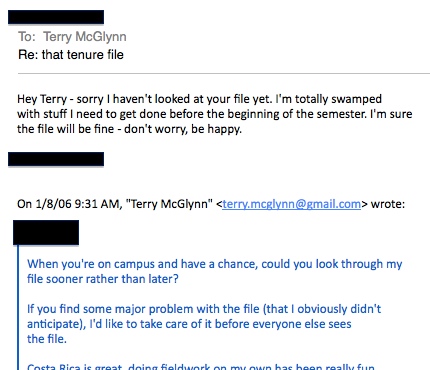
Meanwhile, it’s likely that my other official mentor wrote a brief, weak, letter, because he couldn’t even spare the time to review the narrative for my tenure file before I submitted it to the department. Thanks to the everlasting memory of gmail, check out what I just dug out of my mailbox:

BeHappySnippet

So, why was I denied tenure? It’s not Bob’s fault for writing a bad letter. The most parsimonious conclusion is that I just didn’t fit in.

I saw my job differently. At the time, I would have disagreed with that assessment. But now, I see how I didn’t fit. The fact that I didn’t even realize that Bob would be writing bad recommendation letters shows how badly my lens was maladjusted. If I fit in better, I would have been able to anticipate and prepare for that eventuality. I trusted the wrong people and was myopic in a number of ways, including how others saw me. I probably still am too myopic in that regard.

How was I different? I emphasized research more, but I also worked with students in a different manner. Since I’ve left, my trajectory has continued even further away from the emphasis of my old department. I’m teaching less as my research and administrative obligations grow, and my lab’s productivity is greater than could have been tolerated in my old department. My lab is full of extraordinary students that would have been sorely out of place in my old university.

I work in a public university with students whom my former colleagues would call “poor quality.” I am changing more individual lives than I ever could have before, by giving students with few options opportunities that they otherwise could not access.

It is fitting that my current position, at a university that gives second chances to underprepared students from disadvantaged backgrounds, is also a second chance for myself.

I might not have gotten tenure in my last job, but I had lots of opportunities to work with students. These interactions transcended employment; they were mutualistic and some have evolved into friendships. I look on my time there with great fondness, despite the damage that my former colleagues inflicted on me. I am gratified that I made the most in an environment where I didn’t belong.

I hope that it is obvious to those who know me and how I do my job, that my tenure denial does not make me look bad, but makes my former institution look bad. If I were to draw that conclusion at the time it happened, it would seem like, and would have been, sour grapes. Now that more time has passed, I’m inclined to believe the more generous interpretation that others have proffered.

I resisted that interpretation for a long time, because others would correctly point out that I would be the worst person to make such an assessment. I still have that bias, but I also have more information and the perspective of seven years. Is it possible that my post-hoc assessment paints a skewed picture of what happened? Of course; I can’t be objective about what happened. If I have any emotion about that time, it’s primarily relief: not just that I found another job, but that I found one where people make me feel like I belong.

I don’t stay in touch with anybody in my old department, as I snuck away as quietly as possible. Tenure denial is a rough experience, and I didn’t have it in me to maintain a connection with my department mates, even those who claimed to be supportive. We had little in common, other than a love for biology and a love for teaching, but both of those passions manifested quite differently.

I don’t have any special wisdom to offer other professors that have the misfortune of going through tenure denial. Tenure denial was the biggest favor I’ve ever received in my professional life, but I wouldn’t recommend it for anyone else. If it were not for tremendously good luck, I probably would have been writing far grimmer report.

Update: After a couple conversations I realize I should clarify how evaluation letters worked where I was denied. In the system at that time, every professor in the department is required to write an evaluation letter that goes straight into the file. These are all secret evaluations and it’s expected that the candidate is not aware of what is in the letters. If I had the option of asking people to write letters, I don’t think I ever would have asked Bob to write a letter for me, because I had several colleagues who I knew would write me great ones. The surprise about Bob was had the capacity to write such a miserably horrible letter and not even realize it. He is even worse at nuance than I expected.

Friday Recommended Reads #15

Standard

If you hear a song and want to know what it is, you can whip out your phone and an app called Shazam will identify it for you. It’s been around for years. Isn’t it about time that we should be able to do stuff like that with birds and trees? Natural history guides on phones are not taking advantage of the possibilities: “We stuck dumb apps on smart phones.”

Someone set up a site just to list kind things that academics have done for one another, typically with more senior people being unselfish with junior scientists. I find it discouraging that common human decency needs to be highlighted, as if it is an exception.

What might be the coolest subfamily of ants is no longer extant. The fossils of these creatures are stunningly weird. Maybe you could suggest how those crazy mandibles might be useful. It’s a puzzle to me.

You can visit behind the scenes of the Smithsonian Insect Collection. Virtually, that is. Here’s a great post about what entomology collections looks like and how they work, with great photos.

In a variety of groups of animals, there have been some clownish people publishing taxonomic revisions that range from absurd to nonsensical. According to current rules, the crazy stuff is supposed to be honored. Are you interested in contributing your point of view towards changing the rules of the ICZN?

This wasn’t a long list; after a couple weeks of vacation I didn’t read much online. But one of the books I read was an amazing non-fiction page-turner. I’m now helping out with the Organization for Tropical Studies field course in Costa Rica. The traveling course has a mighty substantial blog, and the very short daily podcasts provide a great taste of the course as it is experienced by the students.

Have a great weekend and please feel free to add any additional interesting reading in the comments.

Keeping seven people out of your head

Standard

I recently declined to seek an opportunity to become a 50% time administrator. Why did I turn it down? I want to keep seven people out my brain. My dean is wonderful, and the interim provost is a nice guy, and the chairs of other departments are very congenial. But I don’t want them in my head. Let me explain.

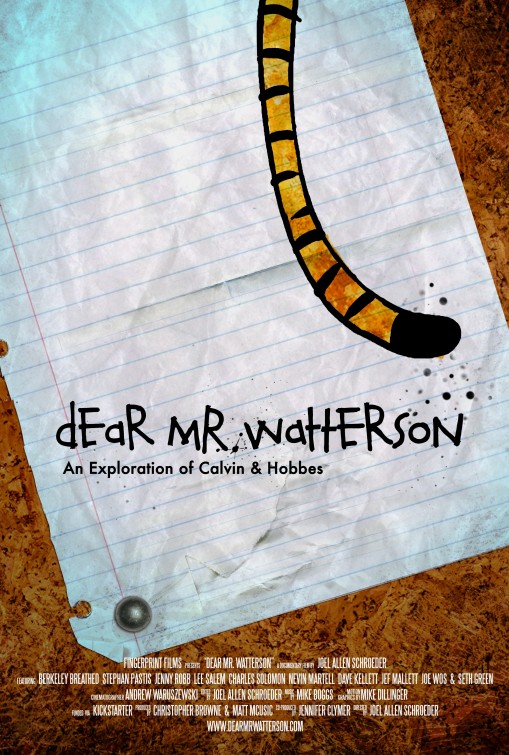
dear_mr_wattersonSeveral weeks ago, my family and I went to see Dear Mr. Watterson in the theater. This movie is a Kickstarter-funded fan-film homage to perhaps the greatest comic strip of the latter half of the past century, Calvin and Hobbes. (If you haven’t yet read some Calvin and Hobbes, get thee over to a used bookstore pronto, where you should be able to pick up a tattered collection on the cheap. Trust me, it’ll bring you joy.)

The creator of Calvin and Hobbes famously refused to license the production of paraphernalia. Every sticker of Calvin peeing on something is bootlegged. You can’t buy a stuffed Hobbes, and Calvin isn’t shilling insurance like Snoopy. Hobbes isn’t selling candy bars like Bart Simpson does. Because of this decision, Bill Watterson walked away from tens of millions of dollars, and perhaps a lot more.

Depending on the audience, Watterson’s decision provoked admiration, consternation or puzzlement. The fascinating parts of Dear Mr. Watterson are interviews with syndicated comic artists who are big fans of Calvin and Hobbes.

The most enlightening interviewee was Stephan Pastis, the creator of Pearls Before Swine, one of my favorite strips in current syndication. Pastis was discussing his own experiences with syndication, and his experience authorizing the production of Pearls Before Swine merchandise. He remarked on what Bill Watterson got by saying no to merchandising.

Pastis explained that merchandising brings profit, but also takes your attention. When new products get developed, a bunch of them are going to stink, or otherwise misrepresent the strip. Even if they don’t suck, they need your input. The syndicate will have questions, the graphic artists will have sketches, and the manufacturers will have samples and suggestions.

As Pastis explains, once you agree to sell merchandise, then you’ve just invited seven new people into your life.

Even if you’re not on the phone or meeting with them that often, these seven people are on your brain. You think about what these people want and how to respond to them. They generate a whole set of questions and issues for you to consider and take care of. You become a business person, managing a money-making operation.

Pastis explained what Watterson got from not merchandising: control. He got the freedom of his time – and his brain – to create Calvin and Hobbes. This comic strip is a sublime creation and its gorgeousness and excellence was enabled by Bill Watterson’s unfettered ability to focus on art. Perhaps Watterson wanted to keep his art untainted by the machinations of salesmen, but in addition he also kept his own mind free of the clutter of a supply chain.

If I ended up taking on a half-time administrative job at my university, there’s no way the job would end up being a half-time gig. Even if I somehow only spent twenty hours per week working at it (and fat chance at that), far more hours would be sucked away by the seven administrative sausage-makers taking up space in my head. I’d be worrying about preventing one person from trying to gain access to another person’s budget. I’d try to sort out who I could cajole to join a committee. My calendar would have deadlines for reports popping up. Even when not in meetings with people who wear suits, I wouldn’t be able to eliminate the conversations with suits from my consciousness.

I want to think about manuscript revisions, my next lesson, the next grant and keeping tabs on the projects students are doing over the year. This last semester had more admin work than I’m used to, and regardless of the time I spent on it, the administrative stuff handicapped everything else. I could be a part-time administrator by the clock, but not by the brain.

I’m sure people with lots of admin experience know how offload admin duties from the brain when not on the clock. But I’m inclined to agree with Stephan Pastis, that if you can keep those seven people out of your head, you’re a lot more able to focus your mind on things that are of true interest to you. I’m not ready to put ecology, ants and rainforests – and my research students – on the back burner. Maybe someday, though at this moment hard to imagine such a day.

Cheating is the norm. Plan your course with this in mind.

Standard

If you make it through the upcoming semester without having busted any students for cheating, then the odds are that you failed to detect the academic misconduct that happened in your class.

Cheating is pedestrian and commonplace. The bulk of tests and assignments are probably done honestly, but cheating, plagiarism and other forms of academic misconduct are super-duper common. Academic dishonesty happens far, far more often than we detect. Most students arrive into college from a “culture of cheating.”

There’s no shortage of peer-reviewed literature indicating that most college students cheat, and that cheating happens all of the time, and that situations when nobody cheats are the outliers.

I always start my courses telling my students that I have no expectation that any individual will violate the academic integrity policy. But I also let them know that nearly every semester, one or more students have received an F course that I teach because they were found to intentionally violate the academic integrity policy. And I spend time with my class on the topic so that it is wholly clear what constitutes cheating and plagiarism. There can be no valid cries of ignorance once academic misconduct is detected.

Most important: I show students how to do their work honestly. I don’t know how much of this lesson takes, because at the start, most of my students have no idea how to do non-plagiarized written assignments. This is a sad truth.

Aside from plagiarism, lots of students just flat-out cheat on exams and quizzes. Using old-school cheat sheets, notes on their bodies, looking over at their neighbors, peeking into their notes, and looking stuff up on their phones. This is not an oddity. This is the norm. I realize that I miss most instances, but I also detect it once in a while. I set up the situation in my classroom to minimize these incidents, but it still happens. And I recognize that more students get away with it than get caught.

When designing my syllabus, I aim to minimize the benefit of cheating as well as the opportunity to do so. I also make it so that when it happens, it’s more readily detected. And I make sure that people know what happens whenever I discover academic dishonesty.

There’s no shortage of information to find out about how to design a course to dissuade cheating and plagiarism. Some of these measures are more onerous than others. Everybody needs to chart their own path, but the journey should start with understanding the fact that cheating is pervasive.

By the way, how should you handle the situation when students do cheat? Here’s a previous post of mine about what I do after detecting academic misconduct. Your mileage may vary.

Are you taking a real holiday? A poll.

Standard


On any given day, we don’t have to work as much as we usually do. A lot needs to be done, but a lot of this is set to a schedule that we prescribe for ourselves. For example, in a few weeks I have a grant deadline. But I don’t have to work on it today. I didn’t need to work on it yesterday, and I don’t need to work on it tomorrow. Because I’m taking vacation.

I am checking email a few times per day in case some huge problem emerges. And I’m sending a couple last-minute rec letters out.  And I’m not neglecting editorial duties for those who managed to get their manuscripts and revisions out before they went on their own holidays. But otherwise, I’m on vacation.

I’m writing this post, well, because this site isn’t my job.

How are you at not working over the break? Are we collectively responsible at taking a refresher at once in a while, or are we all workaholics?

NSF mostly overlooked teaching institutions for Presidential Early Career Awards

Standard

The PECASE awards from NSF were announced as a Christmas present for 19 scientists.

These Presidential Early Career Awardees are picked from the cream of the crop of the CAREER awards. The CAREER award emphasizes an integrated research and teaching career development plan. Hearty congratulations to all recipients! This should make the holiday even nicer.

This year’s recipients of NSF PECASE awards work at the following institutions. Undergraduate institutions are in bold.

Alabama

Arizona

Berkeley (x2)

BYU

Bowdoin

Caltech

Cornell

Georgia Tech

Louisville

Maryland

Minnesota

Princeton

Santa Barbara

Stanford

Univ. Puerto Rico at Cayey (classification here)

Texas

Virginia Tech

Wisconsin

According to NSF:

Selection for this award is based on two important criteria:  1) innovative research at the frontiers of science and technology that is relevant to the mission of the sponsoring organization or agency, and 2) community service demonstrated through scientific leadership, education or community outreach.

This year, if you round up, then 11% of these PECASE awards from via NSF went to scientists at primarily undergraduate institutions. If you browse the institutions with CAREER awardees, it’s clear that this nonrandom subset has a bias against the awardees from teaching institutions. There are far more than 11% CAREER awardees from teaching institutions.

Is this bias based on merit? That’s an interesting question. How is merit quantified by NSF when picking PECASE awards from among the CAREER awards? I have no idea how to answer that question.

I don’t find any of this surprising, but thought that I should put this fact out there. Those of you are applying for CAREERs from teaching institutions have a good shot at getting one, but, well, don’t make the mistake of thinking you have a fair shot at the PECASE. For the two of you who cracked that very hard nut this year, congratulations!

Friday Recommended Reads #14

Standard

Would you like to volunteer in a natural history museum collection but can’t find the time or opportunity? If you have a computer and 15 minutes, you have a chance to make a great contribution to the entomological collections of California. The web interface is really slick and you can make a real difference.

We have such a love/hate relationship with the freeway system in LA that we name our interchanges. I recently drove through the “Marilyn Jorgenson Reese Memorial Interchange” (It’s the 10-405 interchange for you Angelenos out there.) Who was she? Reese was the first female civil engineer in California, and she designed the interchange, which opened in 1964. While reading through her 2004 obituary in the LA Times, this snippet stood out:

In a 1963 story on “lady engineers” in a California Highways and Public Works publication, Reece said she felt that women had an advantage in the field of engineering and “if there’s any prejudice toward women, I’ve not encountered it. Men have always been very helpful; and being a woman has never hampered me in my career.”

This makes me wonder what has changed since 1963: working conditions for women, or the freedom to discuss working conditions?

It’s refreshing when rich and famous athletes give back to their communities by supporting the arts. Widely recognized as one of the three best football soccer players in the world*, Cristiano Ronaldo has fully funded a new museum…. about himself.

At this moment in the arc of the annual academic job search, those with two-body problems who are blessed with possibilities also are cursed with dilemmas. I enjoyed reading this bit of advice about handling this kind of situation.

I’ve never bought the notion that grades in the Ivy League are inflated because the students who are admitted are already so damn smart. But I haven’t taught in the Ivy League yet. Here’s a personal account of how grades get inflated in the Ivy League. Spoiler: it’s not because the students are smart.

Most weeks, I put together a list of links I like to share, like what you’re reading right now. Whenever I go through the wonder full reading items put forth by Dezene Huber, I realize I’m still something between a neophyte and an amateur. His latest set is here. It’s a collection of items that allow you to reflect, think, and appreciate.

Do you hate long-form journalism? I do — the label, that is.

Thought of the month on academic publishing, and how perverse incentives for academic publicity are akin to ratfarming, brought to you by Kate Bowles:

The idea of publication as a means of making funded research genuinely useful has been substituted by the work of counting and factoring up research outputs. The classic story told about perverse incentives is ratfarming under colonial rule in Hanoi: in an economy where peasants are paid per rat kill, the sensible response is to farm rats to kill and turn in for reward. In other words, the rational decision that the system triggers is the exact opposite of the system’s goal. The hyphenation of citation to rankings means that higher education is very close to perfecting in its workers its own ratfarming calculation, and we all know it.

Quality eggnog is about pH balance? Using science to perfect your ‘nog.

A little while ago I wrote a little introduction to Jeffrey Beall, the guy who runs the website keeping track of predatory publishers. Apparently, this anti-pseudojournal warrior doesn’t really have a beef with predatory publishing, but with the open access model in general. He just went full Repub (link is pdf).

If I were an agouti parent, I’d make sure that my kids keep to curfew.

Have a wonderful holiday, y’all.

*Number two would be Ibrahimović.

Thanks to Holly Dunsworth and John Coupland for links.

Through the holidays, things will be slowing down on the site. In early-mid January, things will be ramping up again.

The rejection that wasn’t

Standard

I remember when I got the reviews back from the first big paper that I submitted. I was mad to have to deal with a rejection after such petty reviews.

Then I showed the editor’s letter to my advisor. He said, “Congratulations!” It turns out it was not a rejection, but a minor revision. Who would have thought that a request for a minor revision would have had the word “reject” in the decision letter?

I think editors are more clear about their decisions nowadays. That incident was a while ago. That was an actual letter. Which arrived via postal air mail from another continent.

More recently, in 2007, I got another rejection I found annoying. I inadvertently unburied the decision letter last week, when I was forced to clean up my lab before the holidays (because work crews need all surfaces clear for work being done in the building). Here’s what the letter said:

Enclosed is your manuscript entitled “Moderately obscure stuff about ants” and the reviews. Based upon these reviews, in its present form the manuscript is not accepted for publication in the Journal of Moderately Obscure Stuff.

Significant work/re-write will be needed before the manuscript can be resubmitted.

The reviews were not bunk, but were simply prescriptive and didn’t require massive changes. I realize now, years later, here is another rejection that wasn’t a rejection! I was fooled again! This was a pretty straightforward “major revision.” This paper still is sitting on my hard drive, unpublished, and down low in the queue. I just forgot about it because I was occupied with stuff that was more interesting at the time. The coauthor on the paper, who was a postdoc at the time, now has tenure. So there’s no rush to get this paper out to enhance his career.

The moral of the for authors is: If you’re not an old hand at reading decisions from editors, be sure to have senior colleagues read them and interpret them. When in doubt about what you need to do for a revision, it’s okay to ask the editor.

The moral of the story for editors is: We need to be careful to construct decisions so that there is no doubt that less experienced authors will be able to understand if a revision is welcome, and if so, what needs to be done to make the revision acceptable.

Coming out of the closet, tenure denial edition

Standard

With a bit of CV forensics, you can infer a lot about the career of an academic.

One potential indicator of tenure denial is employment as an Assistant Professor for seven years, not immediately followed by an Associate Professorship. An astute person mulling over my CV would notice this.

I don’t hide this fact, but I don’t advertise it either. It’s no secret, by any means.

Volunteering this fact comes with some serious baggage. It’s not like I was denied at Harvard, where denial is the default expectation. In my last job, tenure denial was a rarity. You had to really botch it to get denied. While I had some high-performing colleagues, I also had one colleague who was tenured despite not publishing anything after getting hired. Others moved successfully through the system even though they were notably ineffective in the classroom. Even though the bar was low, I didn’t make it over.

The standard of line of thought must be that I really sucked at my job, or I must have been a major jerk. It’s difficult to argue against that reasoning.

Tenure denial is a failure. Tenure denial can be caused by poor professional performance, poor navigation of politics, or by personal faults. I would bet that, if any of you called up my former colleagues who were involved in the process, that their explanation might be evenly split among the three possible causes, and maybe a trifecta of all three.

The experience of tenure denial is extraordinarily difficult. It’s painful and lonely. There is a mixture of grief and loss, often heavily salted with injustice. Take the angst involved in the path towards a tenure-track position, and mix in six more years of effort. Then, top that with your spouse’s career and bake in your personal finances. It’s hard to describe, and I wouldn’t wish it on anybody.

How, exactly, did this happen? I actually have already explained it elsewhere. Throughout my terminal year, I shared the story over a series of four installments in The Chronicle of Higher Education. I wrote a follow-up column a few years later, as I was waiting to hear the tenure decision at my current institution. Here are the links:

Part 1, October 2006: No warning signs

Part 2: November 2006: A way out of this mess

Part 3: February 2007: Reviving my career

Part 4: May 2007: A fresh start

Part 5, February 2010: Life after tenure denial

[update, Part 6: January 2014: Tenure denial, seven years later]

I also have another installment in the works, which I’ll probably publish later on this site. I have learned some new lessons, and new facts, since the 2010 installment. [update: here is that installment]

These articles were published pseudonymously. Obviously, at the time it would have been unwise to discuss my job search process in real time under my real name, especially in my delicate position. (The only fact that I altered in the columns was that I switched the gender of a couple individuals.) Because I didn’t use my own name, the reach of those articles might have been limited. If I want to make a bigger difference by having written these articles, then connecting my real name to them might create a better understanding because I don’t have to obscure any details about myself.

There are pluses and minuses about coming out. I’ll have detractors who claim that I deserved what I got. Others might think that I fabricated or exaggerated details. Others might think that I’m oblivious to my ample flaws. Still others might think that this fact explains more than it does. I’ll have to deal with those things, because the benefits of coming out are great. There are plenty of people who are looking for a new tenure-track job after tenure denial, but there’s little information to be found from those who have gone through the process. I think those going through this process might benefit from some of the details about the things that worked and didn’t work out for me. (They also might see some hope in my happy ending, which at the outset I never could have foreseen.)

I am, admittedly, more fond of my current job than my last one. I don’t think this difference is caused by my nasty experience, but could reflect that I am genuinely a better fit for my current job. The sources of great pleasure in my current job were scarce in my old job, and the things that I dislike about my current job were in far greater supply at my old job.

So, have at it. If you wish to leave comments about this story, I do recommend that you read the five columns to which I have linked.

Friday Recommended Reads #13

Standard

How many scientific arguments are philosophical disagreements rather than disputes over scientific theory? Jeremy Fox makes a great, and detailed, case for why scientists also need to be philosophers, over at Dynamic Ecology. I’ve heard some folks wonder why there are not more, and more active, blogs among ecologists. Maybe it’s because Dynamic Ecology has set the bar so high for everyone else. The quality and utility of comments on the site are spectacular, too.

How is it that new religions emerge, especially those that are not derived from established faith traditions? Scientology sprung out of the head of L. Ron Hubbard, and much of what happens in the church is held under tight secrecy. Is it a weakness to be curious about the secrets of Scientology? If you’re as weak as me, here’s a site that tells you quite a bit.

Before Thomas the Tank Engine was teaching the proletariat their role in a capitalist society, there was Richard Scarry’s Busytown, a multiracial multispecies community of people animals doing all kinds of work together. It seems rather progressive and egalitarian, but different kinds of animals have different kinds of jobs. What is to be learned about culture from Richard Scarry?  Martin, J.L. 2000. What do animals do all day?: The division of labor, class bodies and totemic thinking in the popular imagination. Poetics 27: 195-231. (pdf)  Keywords: Animals; Totemism; Class body; Busytown; Symbolic domination; Division of labor.

Myrmecologist extraordinaire Adrian Smith recently started an engaging podcast series entitled The Age of Discovery, featuring “interviews with biologists about being a biologists.” I’ve heard a few of them so far, and Adrian is an engaging interlocutor who asks great questions and is an even better listener. The great news is his latest interview is with Bert Hölldobler, perhaps my greatest academic hero. Each episode is about an hour, good for a little spell of labwork.

White House official photographer Pete Souza is mighty spectacular. This set of his behind-the-scene photos from the trip to the memorial service for Nelson Mandela is pretty interesting.

Did the Lobotomy Committee of the US Veteran’s Administration decide that your family member needed a lobotomy to address postwar behavioral problems? If so, here’s the handy six-page guide provided by the VA, to help you take care of your loved one after the lobotomy.

This superhero movie doesn’t take itself too seriously. Antboy.

Thanks to John Chapman for a link.

Disadvantaged students come from disadvantaged universities

Standard

The future of research in the USA requires that we recruit the best possible scientists. As the country gets less and less white, we can’t afford to have fewer and fewer people seeing science as a valid career path. This should be self-evident.

When NSF and NIH throw money at the problem, the money mostly winds up in institutions that don’t have many underrepresented minority (URM) students. It’s no surprise, then, that we haven’t seen a substantial increase in the URM population of career scientists. At least, the increase is meager given the big emphasis over the years.

Most URM students who are brought into active research programs are the token few, who are already interested in research and are prepared to do it. Research institutions can advertise and recruit, and they’ll get research-focused students. So, a small number of prepared and focused URM students become a highly prized commodity among funded researchers. As the stakes get higher for URM students, then the small number of them who already want to do research become even more valuable.

To recruit new URM students into science, you have to recruit URM students into doing science. To increase the actual number of URM students who want to do science, you need to identify those who aren’t interested or ready to do science and make it happen for them. This happens some places, but it’s not the standard approach. Most programs take the easier route, to scrounge for the already-science-focused URM students instead of recruiting new students. It’s easier.

URM students disproportionately come from disadvantaged backgrounds. And disadvantaged students go to disadvantaged universities. Disadvantaged students aren’t to be found in the locations where world-class scientists are trained.  Let me emphasize this point again, because it’s huge:

Disadvantaged students enroll in disadvantaged universities. The URM students that we need to recruit are found in universities that are disconnected from big research training programs.

If you’re serious about recruiting new URM students into science, who otherwise wouldn’t be in science, then you need to build provide opportunities to students at disadvantaged universities. This is not as easy as it sounds.

Genuine recruitment requires serious relationships with students, in which they trust their professors. Students don’t need just an awesome science experience; they need to see science as a viable career path. Once my URM students want to become scientists, their biggest roadblocks are likely to be their own families. Rich experiences, personal relationships and friendships are what makes a difference.

I can tell my students that they have access to certain opportunities far more easily than non-URM students, because they’re a rare and valued commodity. I tell them they could spend a summer doing research in Svalbard, maybe go to Antarctica, or the rainforest, or live in Australia for several months doing climate change research. Or they can spend the summer working in a local NASA facility. And they’re not jumping on board or applying in droves. This is not the thing for which they went to college. What looks like amazing opportunities to me looks like a distraction, and a huge inconvenience, to many URM students. Moreover, many of them literally can’t afford to take a summer research experience with a full stipend, because they’d lose gainful employment in the process.

They’re underrepresented in the sciences for a reason. It’s not that they’re not capable of doing science, it’s that they’re not oriented towards doing it.

To make more URM scientists, you need to make more URM scientists. You’ve got to create them from non-scientists, from people who never saw themselves as scientists. These students aren’t at your research institution. They’re at the technical college. They’re at the regional state university. They’re at the community college. If you’re at a research institution, the exact students that you need to diversify the discipline are not to be found at your institution.

To truly reach out to and recruit new URM students from disadvantaged institutions, you need to directly deal with faculty members who work these students on a daily basis. Their disadvantaged institutions can’t be seen as a mere source of students, but need to be seen as partners in mentorship.

The faculty members at disadvantaged institutions don’t have the capacity for mentoring students like you find at research institutions. They spend more time in the classroom, they don’t have big labs, and they don’t have postdocs and grad students. Research institutions that want URM students from disadvantaged institutions need to be able to help create that capacity. They need to give resources to enable the faculty at URM-serving institutions provide the mentorship that is necessary to create scientists.

There are a variety of “bridges” programs that have been devised to connect up such disadvantaged institutions with research institutions with greater resources. This kind of program, in theory, is exactly what is needed to grow more URM scientists. However, in my limited experience I have found that these bridges have been constructed of poor quality and the foremen don’t pay attention to potholes on the disadvantaged sides of the bridges. When these partnerships are genuine, they work. The disadvantaged institution needs to get plenty of resources to make sure that the required mentorship can happen. This means time, supplies, and travel. And all three cost money. But the lead institution — the advantaged side of the bridge — is inclined to only fund the partner as much as absolutely necessary to keep the bridge from collapsing. And URMs students are not inclined to cross such a rickety bridge.

I hear far too often from people who are running research training programs, who have trouble getting their URM numbers high enough for themselves or their funding agencies. Either recruitment falls short, or retention, or long-term outcomes are inadequate.

For them, my prescription is simple: go to disadvantaged universities which are replete with capable science majors who may have an open disposition to research. Don’t just ask these universities to ship students to you, but build genuine relationships with the faculty and students at these universities to provide mentorship opportunities. This takes time, it takes effort, and it takes money. The good and important things, though, shouldn’t come easily.

Grabbing the brass ring

Standard

Many moons ago, I wrote some friends and colleagues to let them know I was starting a tenure-track position. One of them wrote back to congratulate me on “grabbing the brass ring.”

Grabbing the brass ring involves far more luck than skill. I know this from experience.

Have you ever grabbed the brass ring? I mean, actually, a real brass ring. Do you know the origin of the phrase?

There’s a gorgeous carousel in San Diego’s Balboa Park, more than a hundred years old, with most of the original parts intact. I’ve rode this carousel on occasion. This is one of relatively few places that still runs the classic ‘brass ring game’ that used to be a common feature of carousels.

If you ride on the outside row of the carousel, then you have the opportunity to reach out and grab at an apparatus that delivers metal rings. Most of these rings are made of iron or steel. If you grab a one of those rings , then you can just toss it at a target. But if you grab the brass ring, you get a free ride. At least, that’s the prize in Balboa Park. It takes a little bit of effort and dexterity to grab the ring. You’re going by pretty quickly, and you’ve got to hook your finger in just the right spot. But it’s mostly about being at the right place at the right time. There are lots of riders who grab rings on the carousel. It’s not that difficult if you’re trying to do so and you ride several times. So, when you get the brass ring, it’s mostly luck that you happened to be there when it came down.

I used to think that “grabbing the brass ring” was a phrase that referred to some kind of prize or some kind of achievement. And it is, but for anybody attempting to grab it, whether or not you get it is mostly luck. If you keep riding the carousel, then odds are you’ll grab a ring.

This is a germane analogy for the academic job market. Of course, some people are far more likely to get offers than others, based on their application materials. But once the short list gets drafted, well, everybody’s on a horse in that carousel, and someone’s going to grab the brass ring. There are lots of things that can affect the timing of when that brass ring is dropped, but it’s not under the control of the person riding the carousel horse.

Friday Recommended Reads #12

Standard

Did you know that the funding rates of NSF Graduate Fellowships are about 50%!? That’s true as long as your letter-writers get all their letters in on time. For the 2/3 of all applicants who have a recommendation letter arrive late, the funding rate is 0%.

It’s not often that students from low-income backgrounds attend wealthy universities. But it happens sometimes. Here’s an interesting little article about what it’s like to be poor student surrounded by rich students.

photo-mainI had to spend way too much time in a car this week, alone with NPR. And let me tell you, this gave me the chance to catch the Planet Money five-part series about the garment industry, which is spectacular journalism and storytelling. They tell this story by following the production of t-shirts they ordered, featuring this squirrel, a pun on a classic Keynes phrase about the forces governing the capitalist market economy.

The current pope of the Catholic church is sounding a lot more like Jesus of Nazareth than his predecessors. (Don’t get too thrilled: being gay is still a sin, and women are still second-class members our species.) Check out chapter two the latest document released by his administration. There some serious words in there:

Some people continue to defend trickle-down theories which assume that economic growth, encouraged by a free market, will inevitably succeed in bringing about greater justice and inclusiveness in the world. This opinion, which has never been confirmed by the facts, expresses a crude and naïve trust in the goodness of those wielding economic power and in the sacralized workings of the prevailing economic system. Meanwhile, the excluded are still waiting.

Did you ever wonder how long it took for faculty members to land their jobs, and how much time and effort they had to put into the job market? So did Alex Bond, so he set out to collect data, and he presented the results in this great post on his site, The Lab and Field.

Impact factors are dumb, but it doesn’t stop people from using them. There are many citation-based approaches to sizing up journals other than the classic “impact factor.” Daniel Hocking wrote a paper to compare these measures of journals in ecology and evolution. Here’s his blog post about the paper, with a link to his paper.

Below is a 1907 image of Churchill, up in Manitoba, Canada. This place is well known as a hangout for polar bears. (Image by Geraldine Moodie)File:Royal North West Mounted Police barracks and Churchill River, Churchill, 1907 (HS85-10-18547).jpg

Can you believe that this place has 198 species of spiders? Maybe it’s just me, but I’m willing to bet that they’re boring spiders. And I don’t mean that they dig holes into wood.

On the death of Nelson Mandela: “Mandela lived a life without sanctimony. You try it; it’s not easy. His lack of piety helped him turn former foes into friends.” This and a little more from Bono.

If you accidentally steal a shipment of 60Co, don’t open up the sealed container.

Here is a novel approach to cutting back on the rejection-review cycle in scientific publishing: pay a bit of cash to a group that will procure reviews and then attempt to get your paper into journals on your behalf. Or something like that. Ask Jeremy Fox, who is involved with the project.

For links, thanks to Cedar Reiner and Chris Buddle’s Expiscor.

Income inequality predicts science test scores, but not the way you might imagine

Standard

More than half of all children attending public schools in the United States are living in poverty. As the unequal distribution of wealth has become new norm, science education has stagnated. Perhaps these two might be connected to one another, reflecting a global pattern among developed nations?

Think again:

GiniPisa

This relationship is the opposite of what I expected to find among developed nations.

This is fascinating, and troubling.

After looking at a few other variables, I’ve realized that I can’t even come close to understanding it, yet. Yes, higher Gini index values means greater income inequality: a greater gap between rich and poor.

Sources: http://en.wikipedia.org/wiki/List_of_countries_by_income_equality; http://www.businessinsider.com/pisa-rankings-2013-12

Conflicting interests of faculty and administrators

Standard

Motives of faculty and administrators can be highly variable. But even though many administrators were once faculty themselves, I can only imagine that things inevitably change when you put on that suit.

What are the ranges of possible interests of faculty members and administrators?

Administrators aren’t monolithic. Here are some various priorities that you might identify in an administrator, all of which might be mutually compatible. Of course I’m leaving plenty out, and of course many of these might not apply to any given administrator.

  • An administrator wanting to climb the ladder will need to keep a balanced budget, carry out the vision of higher-ups, and be well-liked.
  • An administrator who wants to make the university successful will also want to balance the budget, work to promote the visibility of the institution, and try to get the most work out of everyone as possible.
  • An administrator working to promote student success will support faculty efforts to teach and support students, will allocate resources to individuals who best enhance the education of students and is not overly focused on carrying out the nonsensical orders of higher-up administrators.
  • An administrator who just wants to collect the salary of the position until retirement will want to do as little as possible and delegate tasks without much thought. This administrator won’t allocate resources in a way that will require additional management or accountability.
  • An administrator who want to directly support the faculty interests experiences conflicts with higher levels of administration that have distinct expectations of administration.

What do faculty want? This group is more heterogenous than the administrators. Only a small, non-random, subset of faculty move into administration, after all.

  • Some faculty will do anything to teach effectively and want resources allocated towards classroom resources, student experiences, professional development of faculty and staffing to support student needs.
  • Some faculty are focused heavily on research, and want resources allocated towards the equipment and time required for research to get done, as well as support for campus-wide emphasis on research, including support for students conducting research
  • Some faculty are focused on things away from the university (a.k.a. retired on the job), and want resources allocated to minimize their efforts towards the job, so that they can ride horses and play with their dogs. They’ll want more staff, lower and easier teaching loads and no service commitments. They might want teaching technology that lets them be on campus less frequently.
  • Some faculty want to be accorded with respect and perceived to have prestige. These faculty members will want resources allocated to their pet interests and in ways that they may be able to exert direct control over these resources, often in a way that maximizes their visibility.
  • Some faculty want to have a faculty job at a different university because they are not fulfilled do not feel that they are being treated fairly. They are looking for resources that are allocated in a way that will help them to reinforce their CV to make them the most competitive on the job market.
  • Some faculty want to become administrators. They’ll spent lots of time doing service on campus and aren’t picky about how resources are allocated, so long as they’ll have the ability to do the allocating in the future. These faculty don’t have much overt conflict with administrators, though the administrators might be annoyed that they these faculty are pretending to run things instead of focusing on their actual job, to teach and do research.

Note that when faculty goals come in direct conflict with the goals of administrators, or of other faculty members, that’s when junior faculty members demonstrate the mythically poor “fit” that sinks tenure bids.

It’s no wonder that faculty and administrators can get into intense, and frequently petty, disagreements. Both the faculty and administration are diverse groups that can’t even agree on their own interests and priorities. As a result, productive cooperation with administrators is unlikely to emerge because there is a complex mélange of conflicts that define the structure of the relationship. The only thing that everyone has (or, you would hope, should have) in common is the interest in bettering the lives of our students.

I am consistently surprised at how many faculty members don’t perceive that their interests fail to match those of other faculty and administrators. As a result, some individuals consistently rail about one pet priority of theirs, which results in deaf ears all around. Some people are widely known for their pet issues. Pet-issue people aren’t ever in a position to convince others to make change happen.

Here is an attempt at a grand summary about conflict-cooperation between faculty and administration:

Admins and faculty have different priorities. Even within faculty, there are often be conflicts that prevent cooperation. Everybody is better off if the non-essential conflicts are overlooked, and the benefits of shared cooperation are emphasized. Conflict results in a waste of resources and results in lower productivity for all individuals.

I’m not advising faculty to roll over when administrators tell them what to do, but it might be wise to simply ignore the things that administrators tell you to do that are not mutually beneficial. Instead, we should focus on things that deliver for both the administration and faculty. There are only so many hours in the day, and if any of that time is spent arguing about something that isn’t in one’s mutual interest, it better be important enough to outweigh the lost benefits that could emerge from cooperation.

By the way, this happens to be the last installment of a 5-part series on conflict and cooperation between faculty and administration. Here are parts one, two, three and four.

On creating your own path through life

Standard

This weekend, I took my kid to a Mythbusters live show. When I left, I was inspired.

The source of inspiration wasn’t the world’s most impressive paintball gun, modified from an anti-aircraft machine gun. Though that was pretty cool.

I was inspired by learning about the wandering path taken by Jamie Hyneman. He’s the quieter Mythbuster that always wears a beret and has walrus-y facial hair. A one-page bio of Hyneman was in the big glossy program connected to the show.

As long as it’s all true, it seems that Jamie Hyneman has led one hell of a life. I’ll try to capture his trajectory, based on what I learned from his bio as well as his Q&A session during the show. The timing of all these things is rather vague to me, but here are highlights:

  • He grew up in a small Midwestern town. When he was 14, at his request, his parents sent him to a hardcore wilderness survival training school in Wyoming.
  • When he graduated from high school he bought a pet shop, and then sold it after a few years.
  • He went to college and got a degree in Russian. At one point along the line, he worked as a librarian for the United Nations in Geneva.
  • He worked as crew on sailing vessels in the Caribbean. He eventually bought his own ship, and got all the certifications to be a captain, and sailed around for a living.
  • He was interested in the various creative challenges with movie effects, so he left for New York City, where he started working in entry-level jobs in movie production, working to gain new skills.
  • He moved to San Francisco to access more exciting movie production work, and when his company folded he bought up the shop and went into business for himself. One of the guys he hired along the line was Adam Savage. At some point he asked Adam to join him in a pilot for Mythbusters, and you can figure out the trajectory for the following ten years up to the present.

I hear far too often, “What can I do with a degree in X?” This question comes with a false assumption: what you do after college must directly follow from the undergraduate degree. When a premed asks me what’s a good major, I say: “What do you find interesting? Since you’re going to be a doctor for your whole life, then what do you want to do before you get trained as a doctor? Art? Philosophy? Economics? Cell Biology? Music?”

Jamie Hyneman became a Mythbuster, with a degree in Russian. One of my siblings became a financial manager with a degree in Art. Another became a middle school special education teacher with a degree in Theater. A friend of mine became an FBI agent with a degree in Biology.

We chart our own paths in life. Far too often, we let our past decisions dictate our future directions far more than necessary.

The way that academics discuss their jobs in the university, they make it sound like we are captive to our disciplines. Tenure has been called the golden handcuffs. That’s pretty much the silliest notion ever. You can study — and do — whatever you want with tenure.

Linus Pauling, a tenured protein chemist, won a goddamn Nobel Peace Prize because of his social activism. This didn’t happen because he was handcuffed to the laboratory. Then again, nobody ever used the term “golden handcuffs” in the day of Linus Pauling. Nobody told him he couldn’t be both a scientist and social activist.

Jamie Hyneman could have made a go at his Indiana pet shop until retirement, or he could have stayed on as a Russian librarian, or he could have been running a sailing business in the Caribbean for his career. Or he could have kept to movie effects and never made a TV pilot. Mythbusters isn’t the culmination of his life. It’s just one chapter, albeit a very public one. He’s chosen an exciting and rewarding route.

All of our lives are short, and from the looks of it, Jamie Hyneman is making the most of his.

My trajectory is as linear as Hyneman’s has been circuitous. I went to high school, then college. Then I farted around for a year before grad school. Then I did a postdoc, visiting faculty, assistant professor, associate professor. I’ve lived in different places but I have been a scientist since the age of 20, and I enjoy science so much, that I’ll just keep doing it.

I have a very rare gift – tenure – and I don’t want to waste it. I have the opportunity to attempt the extraordinary, and am able to keep my stable job and pension in my back pocket the whole time. I’d like to think that what I am doing, on a day-to-day basis, is a part of this attempt. This blog is part of the attempt, and the continued effort to provide opportunities to my students is part of that attempt. This attempt at the extraordinary means that I will continue to pursue high-risk experiments that might not work but could turn out to be exciting. I’d like to think that with less personal security, I’d be just as inclined to take chances. I don’t know how true that would be.

The most extraordinary endeavors can also appear, on the outside, to be the most mundane. Being a parent, and spouse, is a special responsibility and joy. Sometimes the most extraordinary thing is making waffles for my family on a weekend morning. That might seem like an odd take-home message from a night out with the Mythbusters. But if Jamie can give up his gig as a Russian librarian to become a movie special effects wiz, then I can be, and do, far more than the stereotyped professor, husband and father.

This purposefulness about living an intentional life did not emerge in isolation. Overwhelming anything related to Mythbusters, this weekend my family experienced a loss that was was simultaneously sudden and gradual. I’ve been freshly reminded of the brevity and preciousness of life.

Perhaps the best way to honor those that have given us life is to make utility of this life as much as possible. It can be entirely workable that inspiration for our own utility can come from unconventional sources.

Friday Recommended Reads #11

Standard

Alfred Russel Wallace gets his first statue, unveiled by David Attenborough.

About ten years before AR Wallace got his due, Antarctic Explorer Mrs. Chippy was memorialized with a statue, in honor of Harry McNish, the carpenter who was instrumental in the survival of the the entire Shackleton expedition.

It’s very rewarding to work with first generation college students. This site is designed to help more students be able to say, “I’m first!” There are a huge number challenges connected with the leap of going to college, but life without having gone to college is a lot more difficult. That notion might be obvious to those with an academic background, but could be a rare and unsupported concept for students without family members who have graduated from college. This site can help make these concepts more tangible and looks like it has the potential to be a powerful outreach tool.

It is crazy how many museum administrators and board members have no grasp of basic museum ethical guidelines regarding curatorial practices. Here’s a story about how the San Diego Natural History Museum (which recently adopted the unfortunate moniker “The NAT”) narrowly stopped a sale of valuable fossils in their collection.

This one made big rounds in social media but I want to share it anyway: A collection of lists of things that people were surprised about when they came to the United States.

There was a great story on the BBC about an engineer who learned he had Marfan syndrome, a lack of elasticity in his aorta. So he invented a new fix for it and convinced his doctors to implement it.

Here is a non-link reading item: There is a growing trend for public shaming of tourists doing big-game “hunting” in Africa by broadly distributing the photos that the perpetrators share on social media. Anybody who is both willing to shoot a lion or elephant as a trophy and stupid enough to circulate a picture of themselves celebrating their actions really deserves these photos to be widely distributed.

If you’re looking for a longish vacation, in a home rather than a hotel or rental unit, then home exchanges are awesome. This article about a California family’s exchange with a Parisian family is so much like my own family’s experience it’s summer, it’s like we could have written it ourselves. Including the part about not easily figuring out how to find reverse on the gearshift of our host family’s car. (I’ve done two home exchanges so far, and I’ll probably doing it a bunch more.)

Have you noticed the deflating uniformity shared by rehabilitated and upper-class locations? Is it the case that true local character is destroyed by wealth? Here’s a thought-provoking article about that idea, which is also about Paris.

I’ve always been pleased to tout Chris Buddle’s great roundup of things in the world of science called Expiscor, with a tilt towards charismatic spiders. He’s sold out moved up to a new home hosted by SciLogs, tied to nature.com. (And hey, I’d link to Expiscor even if the First Segment didn’t feature my ant-y stuff.)

Thanks to Andrew Farke (@AndyFarke) for a link.

Oh, and this’ll be the last time I mention Jared Diamond, I promise: As recompense for the creatively titled monomaniacal review I linked to earlier, here’s a review in the pages of the London Review of Books that is far more measured, and as a result, is even more damning: The final sentence reads, “We have virtually no credible evidence about the world until yesterday and, until we do, the only defensible intellectual position is to shut up.”

Have a great weekend, and as always, feel free to add your own recommended reading in the comments.

The three most important members of your department

Standard

Everybody matters. But on a day-to-day basis at work, there are three people who have a lot of power. They can make things very pleasant, or the converse.

Here’s a slightly premature Thanksgiving. Unless you’re Canadian, which would make this a late Thanksgiving.

First, our departmental administrative assistant is five steps above spectacular. When I say that I don’t know how she does all that she does, it is not hyperbole. I truly can’t imagine how she handles all that she does, and she does it so well. She schedules, she allocates, she does politics, she is a central information center, she shares, she supervises, she tolerates, and she handles. She won the university-wide staff award this year. If we put in a bid for her every year, there’s a very good argument to be made that she should win every year.

Second, our techs who set up labs are not only models of effectiveness, but they are masters at making do with few resources. Not only do they fix problems when they come up, but they are even better at anticipating and avert them before they happen. They’re excellent teachers on top of all of this, too, and our students benefit so much from working with them. Our senior tech in the department won the university-wide staff award, the year they invented the award, two years ago.

Third, my chair. He protects us from unnecessary bureaucracy as much as possible, and he arranges our teaching schedules, taking us into account as human beings, and to maximize our efficiency in teaching. He has to deal with all the crap that we don’t want to, and he doesn’t like it any more than we do ,but he does it as a service to his faculty to help the department serve its students well. He works hard to make opportunities for our students and he sees how being in charge of stuff, done right, really can make a difference. My chair is spectacular. Somebody needs to give this man an award.

I have an exceptionally collegial department, and it’s a privilege and a pleasure to work with everybody. I’m grateful, and a little humbled, because the folks I listed above do their job to facilitate what faculty do in classrooms, labs, and our research programs. This work is inadequately appreciated, and when it’s done well, it’s not even obvious. Labs are set up with things I didn’t even knew I needed. Paperwork glitches get resolved without me being aware they happened. Phone calls get made on my behalf without me even putting in a request. These kinds of things are priceless, and I’m ever so thankful.

Journal prestige and publishing from a teaching institution

Standard

Finally. There are journals publishing quality peer-reviewed research, but leave it to the reader to decide whether a paper is sexy or important. Shouldn’t this be better than letting a few editors and reviewers reject work based on whether they personally think that a paper is important or significant?

This newish type of journal uses editors and reviewers to assure quality and accuracy. The biggie is PLoS ONE. A newer one on the block is PeerJ. Another one asked me to shill for them on this site.

The last few years have seen a relatively quick shift in scientific publishing models, and there has been a great upheaval in journals in which some new ones have become relatively prestigious (e.g., Ecology Letters) and some well-established journals have experienced a decline in relative rank (e.g., American Journal of Botany). These hierarchies have a great effect on researchers publishing from small ponds.

Publishing in selective journals is required to establish legitimacy. This is true for everybody. Because researchers in small teaching institutions are inherently legitimacy-challenged, then this is the population that most heavily relies on this mechanism of legitimacy.

Researchers in teaching institutions don’t have a mountain of time for research. Just think about all of the time that could be spent on genuine research, instead of time wasted in the mill of salesmanship that is required to publish in selective journals. (I also find that pitching research as a theory-of-the-moment to be one of the most annoying parts of the business.)

With new journals that verify quality but not the sexiness, we can hop off the salesmanship game and just get stuff published. Sounds great, right?

After all, the research that takes place at teaching institutions can be of high quality and significant within our fields. But, on average, we just don’t publish as much. That makes sense because our employers expect us to focus on teaching above all else.

Since we’re less productive, then every paper counts. We want to get our research out there, but we also need to make sure that every paper represents us well. What we lack for in quantity, we need to make up for in (perceived) quality.

How do people assess research quality? The standard measure is the selectivity of the journal that publishes the paper. It’s natural to think that a paper in American Naturalist (impact factor 4.7) is going to be higher quality than American Midland Naturalist (impact factor 0.6).

People make these judgments all the time. It might not be fair, but it’s normal.

And no matter how dumb people say it might be, no matter how many examples are brought up, assessments of ‘journal quality’ aren’t going away. No matter how much altmetrics picks up as another highly flawed measure of research quality, the name of the journal that publishes a paper really matters. That isn’t changing anytime soon.

The effect of paper on the research community is tied to the prestige of the venue, as well as the prestige of the authors. Fame matters. If any researcher – including those of us at teaching institutions – wants to build an influential research program, we’ve got to build up a personal reputation for high quality research.

Building a reputation for high quality research is not easy at all, but it’s even harder while based at a teaching institution. Just like having a paper in a prestigious journal is supposed to be an indicator of quality research, a faculty position at a well-known research institution is supposed to be an indicator of a quality researcher. Since our institutional affiliations aren’t contributing to our research prestige, we need to make the most of the circumstances to establish the credibility and status of the work that comes out of our labs.

If journal hierarchies didn’t exist, it would be really hard for researchers in lesser-known institutions, who may not publish frequently, to readily convince others that their work is of high quality. Good work doesn’t get cited just because it’s good. It needs to be read first. And work in non-prestigious journals may simply go unread if the author isn’t already well known.

If journal hierarchies somehow faded, it’s not as if the perception of research quality would evolve into some perfect meritocracy. There are lots of conscious and unconscious biases, aside from quality, that affect whether or not work gets into a fancy-pants journal, but it is true that people without a fancy-pants background still can publish in elite venues based on the quality of their work. This means that people without an elite background can gain a high profile based on merit, though they do need to persevere though the biases working against them.

If journals themselves merely published work but without any prestige associated with them, then it would be even more difficult for people without well-connected networks to have their work read and cited. It wouldn’t democratize access to science; it would inherently favor the scientists with great connections. At least now, the decisions of a small number of editors and reviewers can put science from an obscure venue into a position where a large audience will see it. On the other hand, publishing in a journal without any prestige, like PLoS ONE, will allow work to be available to a global audience, but actually read by very few.

If I want my work to be read by ecologists, then publishing it in a perfectly good journal like Oikos will garner me more readers than if I publish it in PLoS ONE. Moreover, people will look at the Oikos paper and realize that at some point in its life, there was a set of reviewers and an editor who agreed that the paper was not only of high quality but also interesting or sexy enough to be accepted. It wasn’t just done well, but it’s also useful or important to the field. That can’t necessarily be said of all PLoS ONE papers.

Not that long ago, I thought that these journals lacking the exclusivity factor were a great thing because it allowed everybody equal access to research. What changed my mind? The paper that I chose to place in PLoS ONEI chose to put a paper that I was really excited about in this journal. It was a really neat discovery, and should lead to a whole new line of inquiry. (Also, the editorial experience was great, the reviewers were very exacting but even-handed, and the handling editor was top notch.)

Since that paper has come out just over a year ago, there have been a number of new papers on this or a closely related topic. But my paper has not been cited yet, even though it really should have been cited. Meanwhile they’re citing my older, far less interesting and useful, paper on the same topic from 2002.

Why has nobody cited the more recent paper? Either people think that it’s not relevant, not high enough quality, or they never found it. (Heck, the blog post about it has been seen more times than the paper itself.) Maybe people found it and then didn’t read it because of the journal. It’s really a goddamn great paper. And it’s getting ignored because I put in PLoS ONE. I have very little doubt that if I chose to put it in a specialized venue like Insectes Sociaux or Myrmecological News, both good journals that are read by social insect biologists, that it would be read more heavily and have been cited at least a few times. This paper could have been in an even higher profile journal, because it’s so frickin’ awesome, but I chose to put it in PLoS ONE. Oh well, I’ve learned my lesson. There are some papers in that venue that get very highly cited, but I think most things in there just get lost.

I would love for people to judge a paper based on the quality of its content rather than the name of the journal. But most people don’t do this. And I’m not going to choose to publish in a venue that may lead people to think that the work isn’t interesting or groundbreaking even before they have chosen to (not) read it. I’ll admit to not placing myself on the front of reform in scientific publishing, even if I make all of my papers immediately and universally available. I have to admit that I’m apt to select a moderately selective venue when possible, because I am concerned that people see my research as not only legitimate but also worthwhile. I’m not worried that my stuff isn’t quite good, but I want to make sure it’s not done in vain. Science is a social enterprise, and as a working scientist I need to put my work into the conversation.