Towards better titles for academic papers: a hermeneutic approach from a blogging perspective

Standard

I think a lot of academic article titles are pretty bad. What do I mean by bad? The title doesn’t really tell you what the paper is actually is about. It could be buried in jargon, or overselling an idea, or focuses on details that most of the intended audience won’t care about.

Does the title of a paper affect how it gets read and cited? Probably. In what way? That’s not so simple, based on my short browse of some scientometric findings. Continue reading
A student-centered academic conference

Standard

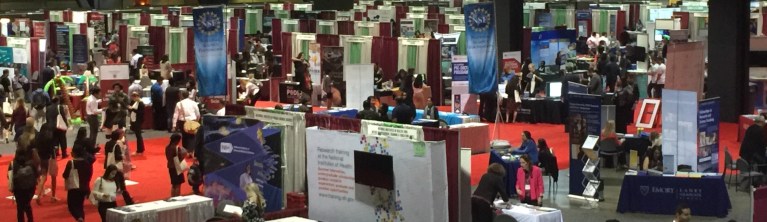
The national SACNAS conference came through LA again. SACNAS is an organization that fosters diversity in higher education and runs a huge national conference each year. The organization does other things, but the national conference is clearly a focal point.

SACNAS has been described as a “mentoring conference.” From what I’ve seen, that’s a good description. Continue reading

Bias in graduate admissions

Standard

Yesterday, I received an epic comment on a recent post of mine about minority recruitment. I want to share it:

This fits my experience so so well. I am first gen American, started at community college, transferred to a good public university and struggled but ultimately graduated with a 3.2 GPA and did OK on GREs. Had zero “social capital” (and had no idea what that was). I was lucky to have a TA (PhD student) who took me under her wing and had me volunteer in her lab a few hours a week and an excellent professor in my last quarter who informed me about internships and helped me secure one specifically targeting minority students (and it was paid!). Anyhow, after gaining a lot of experience though field jobs , I applied and was rejected from many PhD programs and ended up going to a small CSU, racking up student loans and working full time while getting my Master’s. I then applied to one of the better ecology programs with excellent letters of reference and was flatly denied. Again, luckily I had a greater supervisor at a govt agency who was very supportive and together we published a couple of manuscripts. I re-applied to that same ecology programs and was offered a multi-year fellowship (no TAing, no RAing). The only difference in my application was the publications. Now that I am in the program, I look around at a sea of white faces and most of them I have come to find out are straight out of undergrad, no pubs, very little experience, just great grades and test scores and a lot of social capital and opportunity (paid internships, semester at a field station, paid field methods courses, etc) . What a load of crap.

Continue reading

Recommended reads #88

Standard

Without tenure, professors become terrified sheep.

The terrorist inside my husband’s brain. This piece by Robin Williams’s widow, written for practicing neurologists, is an important read for all of us.

Why people wince at talk of “flipping classrooms.” This phrase has pretty much lost any specific meaning or utility, and that’s why I haven’t really used it. I’m a fan of active learning approaches but not a fan of flipping sensu stricto. Continue reading

How should the shape of your grade distribution change the way you teach?

Standard

I’ve received a number of comments about one of the recommended reads from last Friday. It was about the New York Times op-ed piece, about why people shouldn’t grade on a curve. And then, I asked, who does that anymore? The answer is: a lot of people. In addition to the comments on the post, I’ve gotten some emails and chatted with a few people (here while I’m at the International Congress of Entomology in Orlando, Florida).

One friend is in a department in which all faculty are rigorously required to conform their grades to a particular distribution, and they can’t submit their grades unless they follow this practice. Continue reading

Please nominate colleagues to be selected as ESA fellows

Standard

This one is for the ecologists.

There are a lot of people who have made outstanding contributions to the field of ecology — in education, research, outreach, and policy.

Do you think that any of these outstanding contributions came from ecologists in teaching-focused institutions? Continue reading

Networking from scratch

Standard

I’ve been writing regularly for Vitae, the careers section of The Chronicle of Higher Education. This piece was published there a couple weeks ago. I’m reprinting it here:

Conferences are a wonderful time to see old friends and colleagues. That is, if you’re an old-timer.

If you’re not, the experience can be isolating and intimidating. And even if you do have friends at a meeting, the prospect of expanding your network can be daunting. Continue reading

Recruiting underrepresented minority students

Standard

The last couple weeks have posed a challenge, as several people have contacted me (mostly out of the blue), asking me for ideas about specific steps they can take to improve the recruitment of minority students. This isn’t my field, but, I realize I’ve put myself in this position, because it’s a critical issue and I discuss it frequently. I’m just one of many who work in minority-serving institutions.

I realize that most of the suggestions I’ve given to people (but not advice) are generalized. If several folks are writing to me, I imagine there are many more of y’all out there who might be thinking the same thing but not writing. Hence this post. Just with my suggestions. Continue reading

Conference travel awards that you can’t apply for until after the travel is done are bad

Standard

I’m about to make some statements that I think should be obvious. In fact, everything I say in this post about travel awards will probably be obvious, but I feel moved to write about it since these obviously bad travel awards exist.

Grad students are typically on very tight budgets.

Grad students are expected to attend and present their work at conferences (usually at least one per year).

Departments or schools often have funds available (as conference travel grants or similar) to students to help cover the costs of attending conferences, which is good.

Some of these grants require students to wait until after the conference is over and include all receipts for their expenses before they can apply, which is bad. Continue reading

On absurd tenure requirements at small institutions

Standard

As this site continues to grow, the more I hear about issues that people face in teaching-focused institutions. There is one issue that I consistently hear about, but I have yet to mention: nonsensical tenure requirements for scholarship, especially in small liberal arts colleges. The most common one is: When an entire college or university uses the same publication expectations for all faculty. In. Every. Field. Continue reading

Let’s nominate folks for NSF’s Waterman award, including women

Standard

Every year, the National Science Foundation gives an award to the most bestest early-career scientist in the US. It’s up to the scientific community — that’s me and you — to make sure the pool really has the best. Which means it has to have a lot of women in it.

Months ago, we had a small spike in traffic here at Small Pond because we joined the chorus wondering how NSF can manage to go thirteen years without giving the Waterman Award to a woman. Continue reading

Accessibility isn’t the key to mentorship

Standard

When I start a new batch of students in my lab, my spiel includes:

Two problems can prevent success. The first is poor communication, and the second is poor data management.

At the moment, I think this is true. As poor data management is a by-product of poor communication, it really just boils down to communication.

Earlier on in my career, I was too quick to attribute communication failures to my lack of approachability, or poor decision-making by my students. I don’t see it this way anymore. Continue reading

Recommended reads #84

Standard

Are you familiar with the work of the Holotypic Occlupanid Research Group? I applaud their dedication and excellence in chronicling the diversity and natural history of this unappreciated yet widespread taxon. This is where the line between science and art is invisible.

Women are woven deeply into the history of science, stretching back to ancient Egypt, over 4,000 years ago. But because their contributions often go unacknowledged, they fade into obscurity—and the threads of their influence today aren’t as apparent as they ought to be.” I’d like to call this one early: We’ll be looking back at Dr. Emily Temple-Wood as the person who rewrote the history of scientific discovery.

Racism in the research lab. This post, from two scientists from prestigious institutions, is important. Continue reading

We need to stop putting diversity in a box at conferences

Standard

At the moment, I’m having an absolutely great time at the Ecological Society of America meeting. I’m learning new science, meeting old friends and a variety of folks who read this site, and formulating plans for my sabbatical that recently started.

This wonderful time has been punctuated with moments of my own frustration and annoyance. Why? Because this is a typical academic conference. And the status quo is often maddening. Continue reading

Serious academics take the media seriously

Standard

The Guardian chose to publish a piece from a “serious academic” who made an argument that we shouldn’t share our work on social media.

So who is this “serious academic?” Well, we have no idea. They are an anonymous “young” PhD student. Does this mean they’re some kind of whistleblower, warning the world about the rampant public sharing of academic information?

Anyway, what does the phrase “I’m a serious academic” mean? Continue reading

Advice for department chairs

Standard

I recently finished up a three-year stint as chair of my department. (At my institution, the role of department chair rotates among the senior members of the department — basically, anyone with tenure — based on seniority. Three years ago, it was my turn to take the mantle, as the next most senior person in line.) It was an interesting experience and I certainly learned a TON from it, but I am also relieved that it’s now someone else’s turn.

Since relinquishing my post, I’ve been reflecting a lot on the experience of being chair. Continue reading

Recommended reads #83

Standard

New Zealand is developing detailed plans to eradicate every exotic predator, including feral cats, rats, and weasels.

How women are harassed out of science. Let’s be clear about this: It’s not just that scientific institutions and individual scientists are implicitly biased against women. That is true, but on top of all that, direct harassment itself drives women out of science. Not convinced this is true? Then please please please read this story. Continue reading