To ban or not to ban laptops?

Standard

Some folks want to ban laptops from their classrooms, and others are okay with laptops.

This is a perennially annoying discussion in higher ed today.  But I think it’s an important issue because it has the potential to really affect learning.

What do I do? Here’s the language in my syllabus for this semester: Continue reading

EEB Mentor Match to help underrepresented students get graduate fellowships

Standard

I’ve griped about how undergraduates from wealthy private institutions and public research universities get the lion’s share of graduate fellowships. This happens for some obvious reasons of course, and I’m pleased to introduce a scheme that — with your help — can contribute to fixing this situation.

To get right to it: I’m teaming up with Meghan Duffy to pair up mentors with students from Minority-Serving Institutions (MSIs) to give them guidance and support as they put together their fellowship applications. (Meg has been the leader on this.)

To participate, see this post from Dynamic Ecology where she describes the project. Continue reading

Deadline awareness for everybody

Standard

I and my family are now up in Oregon to experience the total solar eclipse. Which will be amazing.

This trip wasn’t hard to plan, but only because we were ready many moons ahead of time. I asked for my buddy’s spare bedroom about a year ago. Also, it’s the first official day of classes on my campus. My spouse’s work has a big exodus for the eclipse, no big deal there, but for our son, that’s the day that the big assignments from summer reading are due. So we all had to sort things out ahead of time.

This is the kind of planning that we need to build for students who we are advising and mentoring. Because applying for opportunities is far, far more than just filling out a form, and students who are not savvy to the mechanics of higher education may not appreciate this reality. Continue reading

Recommended reads #110

Standard

This, I think, is ingenious and next-level stuff: Designing malware to hack bioinformatics software by coding it into the DNA of organisms that get sequenced! Which, in the future, maybe could be a real problem?

This is old news, but not to me. In Holland there is (was?) a place that used a misting spray of synthetic DNA that could be used to identify folks who committed robberies.

Now that it’s start-of-semester-get-your-syllabus-ready season, let me remind you of this useful course workload estimator, to make sure that your expectations are well calibrated relative to the number of units associated with a course. Continue reading

What are best ways to learn R?

Standard

Screen Shot 2017-08-06 at 3.35.38 PMOver my year of sabbatical, I planned to become comfortably proficient with data manipulation and analysis with R. I’m getting there. (I was doing a lot more over sabbatical of course, but this was one of my main objectives.) I figure it’ll take at least a few more manuscripts to get comfortable. As I really should be cranking out a dissertation’s worth of stuff in the next year, I have plenty of opportunity to get better, and the rate limiting step for me is sorting out the code. Continue reading
What’s up with preprints?

Standard

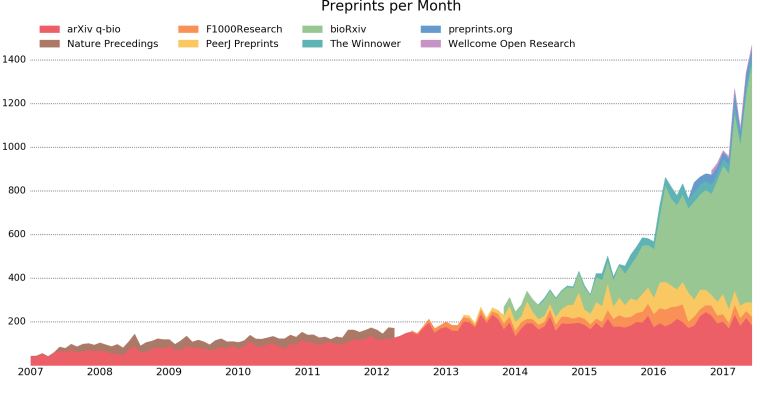
image from prepubmed

Preprints are not a standard practice in biology. Nowadays, most papers that get published in peer-reviewed journals were not uploaded to a public preprint server.

Maybe this is changing? It looks like preprints are starting to take off. It’s not clear if this is a wave that will sweep the culture of the field, or just a growing practice among a small subset. Continue reading

Recommended reads #108

Standard

Wow. This opinion piece written by a scientist, who is a whistleblower working in the Department of Interior, is both important and landmine. They essentially reassigned him — and many other senior scientists — to work in the mailroom. Far away from home. We knew in advance that our new federal government was going to be anti-science, and in places like this, it’s as clear as ever. If you haven’t seen this yet, it’s a short op-ed and a key piece of information if you’re trying to stay even the slightest informed about science policy in the US kleptocracy.

This one-minute clip of a US congress member asking a NASA scientist whether it is possible that a civilization was on Mars thousands of years ago is also a must-see. Continue reading

Thinking critically about the ways we help our students

Standard

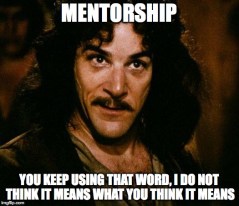
wskqpFolks can throw around the word “mentoring” rather sloppily. Which can lead students to being told that they’re being mentored, when they’re not.



I’ve seen a bit more of this while reviewing a variety of formal “mentorship plans” (in the context of panel service). A lot of people get what mentorship is about. But a good fraction of the plans weren’t so much about mentorship as they were about supervision — they said what the “mentee” would be doing for the “mentor,” but not specific about how the “mentor” would be supporting the specific needs of the “mentee.”

So what is mentorship and what isn’t? I volunteer an example for your consideration: Continue reading

We need to stop calling professional development a “pipeline”

Standard

When we talk about increasing the representation of women and ethnic minorities in STEM, the path towards a professional career is often characterized as a “pipeline.”

The pipeline metaphor is so entrenched, it affects how people think about our deep-rooted problems. This metaphor has become counterproductive, because it fails to capture the nature of the problem that we are trying to solve. Even if we were to magically repair all of the so-called “pipeline,” we still would have what some would call “pipeline issues.”

What are the problems with the pipeline metaphor? Continue reading

How bad is the loss of NSF dissertation improvement grants?

Standard

Last week, NSF announced they have stopped awarding DDIGs – the Doctoral Dissertation Improvement Grants in the divisions of Environmental Biology and Integrative Organismal Systems.

How bad is this decision? In the words of Jane Lubchenco:

Continue reading

Recommended reads #104

Standard

It’s been two weeks already!? Here’s some reads for what remains of the long holiday weekend, for those of us in the US.

In mentorship, a sense of belonging may be most important

Getting past Bloom’s taxonomy in a way that focuses on the minds of the students

This online comic as struck a big chord with a a lot of women I know. It explains how many men don’t share the burden of parenting and running a household by simply thinking that doing stuff when asked is enough. The cognitive load of keeping track of domestic affairs is not a trivial matter. Continue reading

Making scientific conferences more engaging

Standard

In scientific conferences, the talks are often the least constructive part of the meeting. That’s my experience and opinion, at least. This is ironic, because at least in theory, the talks are the raison d’être of a conference.

When people fly in from great distances to be together, should we really be spending most of the day in dark rooms listening to canned talks from our colleagues? Should we be spending our time on things that we could just as easily do in a webinar? Continue reading

The deficit model of STEM recruitment

Standard

As we train the next generation of STEM professionals, we use a filter that selects against marginalized folks, on account of their ethnicity, income, gender, and other aspects of identity. This, I hope you realize, is an ethical and pragmatic problem, and constrains a national imperative to maintain competitiveness in STEM.

When we are working for equity, this usually involves working to remediate perceived deficiencies relative to the template of a well-prepared student — filling in gaps that naturally co-occur with the well-established inequalities that are not going away anytime soon. These efforts at mitigation are bound to come up short, as long as they’re based on our current Deficit Model of STEM Recruitment. Continue reading

An introduction to writing a peer review

Standard

I recently had an exchange with a colleague, who had just written a review at my request. They hadn’t written many reviews before, and asked me something like, “Was this a good review?” I said it was a great review, and explained what was great about it.  Then they suggested, “You should write a post about how to write a good review.”

So, ta da. Continue reading

I am complicit

Standard

My academic societies support the March for Science. So do I.

I’m familiar with the arguments for and against the March, from major newspapers and social media. If you’re not familiar, don’t worry, I won’t rehash them for you.

I think it’s possible for some people to have an ethical position to oppose something, and for others to have an ethical position to support the same thing. Nobody’s got a monopoly on being right. Continue reading