Ant foraging diversity: a simple and elegant explanation

Standard

Science can be creative and elegant.

To illustrate this fact, I want to bring to your attention a groundbreaking review paper that was recently published in Myrmecological News, written by Michele Lanan of the University of Arizona.

Usually the terms “groundbreaking” and “review paper” aren’t paired with one another. Review papers usually codify existing ideas, propose some new ones that may fall flat. And, if you chat with an editor, you’ll learn that good reviews really improve a journal’s impact factor.

Then there’s this amazing review I loved so much I had to write this post about it. Even if you don’t know a thing about ants, I’m betting you’ll love how the paper draws a clear and simple explanation from complex interacting phenomena.

Ant people are asked about foraging behavior quite often. How and why do ants make trails? Why do some species make trails and others don’t? Until now, our answers were vaguely correct but relied heavily on generalizations. Now, after Michele Lanan scoured pretty much every paper that’s ever collected data on foraging behavior and ecology, we have a quantitative and robust explanation that is powerfully simple and elegant.

We’ve known that foraging behaviors are structured by that ways in which food is available. Among all ants, there’s a huge variety of foraging patterns. Some are opportunistic hunter-gatherers, others are nomadic raiders, and some use trunk trails, as in the figure below. These patterns reflect differences in food availability.

Figure by M. Lanan

Figure from M. Lanan 2014, Myrm News 20:50-73.

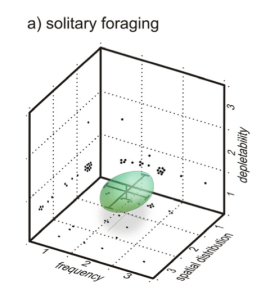
How, exactly, is it that the properties of food availability can predict how ants forage? In an analytically robust and predictable manner, that works for all ants throughout the phylogeny? It doesn’t require an n-dimensional hyperspace to understand foraging patterns of ants. It only needs a 4-dimensional space.

figafromms

Figure from M. Lanan 2014, Myrm News 20:50-73.

Lanan took into account four properties of food items: size, spatial distribution, frequency of occurrence, and depletability. She arranged these variables along four axes (as on the right), and showed how this this 4-dimenstional space foraging patterns in the figure above.

How do these foraging patterns distribute across the major ant subfamilies? Are some lineages more variable than others, and what might account for these differences? What other beautiful figures and photographs are in the review that illustrate the relationship between spatiovariability of food and foraging biology? As they say on Reading Rainbow, you’ll have to read the review to find out!

Reference: Lanan, M. 2014. Spatiotemporal resource distribution and foraging strategies of ants (Hymenoptera: Formicidae). Myrmecological News 20: 50-73.

As a disclaimer, I should mention that the author of this paper is a collaborator and friend of mine. And she is leading The Ants of the Southwest short course this summer which I’m also teaching — and spaces are still available!

But that’s not why I’m featuring this paper. I am enthusiastic about this paper because it so obviously resulted from a labor of love for the ants, and is a culmination of years of reflection. This is just a downright gorgeous piece of science, and the more people that see it — and the more recognition that the author gets — the better.

After one year as a Visiting Assistant Professor

Standard

This is a guest post by Carrie Woods, a Visiting Assistant Professor at Colgate University. This is a follow up to her post from last year, about starting out in a VAP position.

I just completed my last lecture of my first year as a Visiting Assistant Professor at a liberal arts University. Each semester I got to design my own course and teach three lab sections of a general biology course called Ecology, Evolution, and Diversity. Having graduated in August 2013, this was my first experience in designing and teaching my own course and it was absolutely amazing.

I did stumble a bit at the beginning though. In the fall I taught Plant Physiology, a junior level course of my own design, and had a bumpy start trying to figure out how to teach. Given that all of my post-secondary education has been at research I universities, I assumed the most familiar teaching format I knew – standing in front of students, powerpoint up, throwing information and numbers at them. That was my first lecture. I blew through what I thought would take me three lectures in one hour.

Then I did what anyone in my position would have done: sought advice from fellow faculty. This is a top-notch liberal arts university after all, and I am surrounded by teaching gurus. Within a couple of hours and several meetings with different faculty post-first lecture, I completely changed how I thought about teaching. As per the advice of the faculty, I abandoned my powerpoints (except for complicated images and figures) and returned to the most basic method of teaching: the chalkboard.

My second lecture, I asked what they had learned from my first lecture and, after many mumbles and looks of confusion, I decided to start from scratch and re-teach the first lecture. I was honest and open about it and told them that if I was doing something that confused them, I wanted them to let me know. I used a socratic method and got them engaged and involved by asking questions constantly. I used the chalkboard to write and explain key concepts. The classroom transformed into an open and engaged learning environment. I was happier, my students were happier, and my teaching was way better. The learning curve wasn’t just steep, it was 180°!

Through my Masters and Ph.D., I had so many opportunities to TA courses as a graduate student that I realized my teaching skills were developed for running labs. So the lab sections of the biology course that I ran were much smoother than my Plant Phys course. I shadowed the faculty member who was the coordinator for the course, by which I mean I went to every MWF lecture and to her Monday lab so that my Tuesday, Thursday, and Friday afternoon labs went smoothly. Although it took quite a large time commitment, I learned a lot by doing this and incorporated the same questioning and engaging teaching methods from my classroom into the labs.

With new skills in hand and great feedback from my students in the fall, I designed a CORE science course on agriculture called Food for Thought this spring. By far, this has been my most rewarding teaching experience. The class is for freshmen and sophomores in any discipline. I only have three students from biology the rest being from varying departments – political science, economics, philosophy, English, and sociology. Students discovered biology through the history of agriculture and current farming practices. We examined environmental impacts of farming, GMOs, and had a continuous debate about the global food crisis and how to feed the world. This class (again!) taught me how to be an effective teacher because of the new challenge of teaching non-biology students. The course went so well that I have students knocking on my door asking if I could teach it again in the fall so they could take it. I am so touched.

I am so grateful to have had this experience. I am a much more effective and creative teacher and would recommend this job to anyone looking to better their teaching skills. I liked it so much that I have decided to stay for another year.

Recommended reads #25

Standard

Note: this weekly feature is transitioning to a biweekly feature (meaning in this case: every two weeks). This is a great crop over the last week, but I think I can have a better list by doing it less frequently.

For a link, thanks to Mark Martin.


Public higher education is not a reward for hard work

Standard

Here in California, there was a measure to officially restore affirmative action to the public university admissions process.

(The movement navigated through our state senate, but then the popular narrative is that the Asian-American community tanked it before public had a chance to vote on it. More here.)

Whenever white folks (or non-Hispanic European, or whatever ‘white’ means nowadays) are opposed to affirmative action, they’re called out on privilege and are told to share fairly with everybody.  This is justifiable in my view. Now, in California, the politicians associated with the Asian community are allied with the white folks that are against affirmative action. Considering that there is no shortage of Asian-Americans getting into our public universities, concerns about privilege should be extended to this demographic category as well.

The status quo remains: we continue to have an underrepresentation of blacks and Latinos in our public universities in California.

Some people get upset because affirmative action decreases their own opportunity. (I know how this feels. In my high school class, the only white person who got into UC Berkeley was the valedictorian. But everybody who was a member of one of the protected categories got in. (This was a small number, because I was at a mostly white private school. I wasn’t poor by any measure, but I was one of the poorest kids at this school.) I didn’t like it, because I didn’t think it was fair. And, well, life isn’t fair. That’s especially true for people who have don’t have avenues for opportunity despite hard work. Like the students who are systematically excluded from our public universities.

Taxpayers should fund K-12 public education because in a civil society, education should be a right and not a privilege. Moreover, we want an educated populace for the betterment of our entire community. And education for everybody in an equitable fashion is an engine of prosperity.

The same principle applies to our public universities.

As a taxpayer in California, I am not (partially) funding the undergraduate education of students because they worked hard. I don’t want to use my money to reward people who deserve it. I’m not giving out prizes for performance. I don’t want my state legislators to do that either.

I want to spend our public dollars in a way that improves the welfare of the state and its populace. I want a state that provides the best education to all of its people. I want my kid to go to school with students that all have a real chance to attend our state’s top universities. And frankly, without affirmative action, most of the children in our school district will have a hard time getting into UC Berkeley because of the systematic disadvantages that they’ve been facing since fetushood.

So, if you’re mad that someone with extraordinarily high grades can’t get into the publicly funded university of their choice, you can stuff it. I want everybody in the state of California to get admitted to our best universities (whichever ones those might be). If you don’t want to share our state universities with fellow Californians that have experienced a long history of disenfranchisement, then you aren’t deserving of a publicly-funded education.

This issue has nothing to do with immigration. It has nothing to do with “hard work.” It has to do with making sure that those the potential to succeed are given the capacity to do so, and that this happens as equitably as possible. That’s the point of affirmative action, because if you base admissions based on grades and test scores, you are perpetuating an inequity. If you don’t see the inequities among our public schools based on socioeconomic and ethnic dividing lines, you’re blind. Without affirmative action, we codify these inequities into the access to universities.

Even the opponents of affirmative action understand this point, unless they’re stupid or ignorant. But they might not like it because it hurts their own demographic group. Yeah, my kid (of Irish-Italian-German-British heritage) has a lower chance of getting into his favorite UC campus because of his background. And I’m okay with that. Because I want him to inherit a state in which people of all backgrounds have access to opportunity, even when they come from underfunded school districts whose students lack a way to get ahead. As people have explained for many decades, you can’t pull yourself by your bootstraps if you don’t have any boots. This is self-evident to all but those with boots.

Since we’ve been failing at providing equal access to quality public education at the K-12 level, the least we can do is to try to make things more fair when it comes to access to higher education.

It’s not about how hard your kid has worked. It’s about the priorities for our state. I don’t want a state that systematically disenfranchises major segment of its populace. I guess if you do want that systematic disenfranchisement, then feel free to fight affirmative action. But don’t try to fool yourself by arguing that it’s about fairness and equity. That’s a transparent sham. If you buy into the fairness and equity argument, then you need to spend some time volunteering in a high-need public school district to remove your blinders of privilege.


Our expert advice remains unheeded

Standard

Once in a while, tropical biologists get bot flies. We sometimes find this out while were are in the field. But on five occasions, my students have returned to the US, and then discovered that they are hosting a bot. They all contacted me for advice. I told them a few things, but the most important one was:

Whatever you do, don’t go see a doctor. That could be disastrous.

Nonetheless, three of these students went to the doctor.

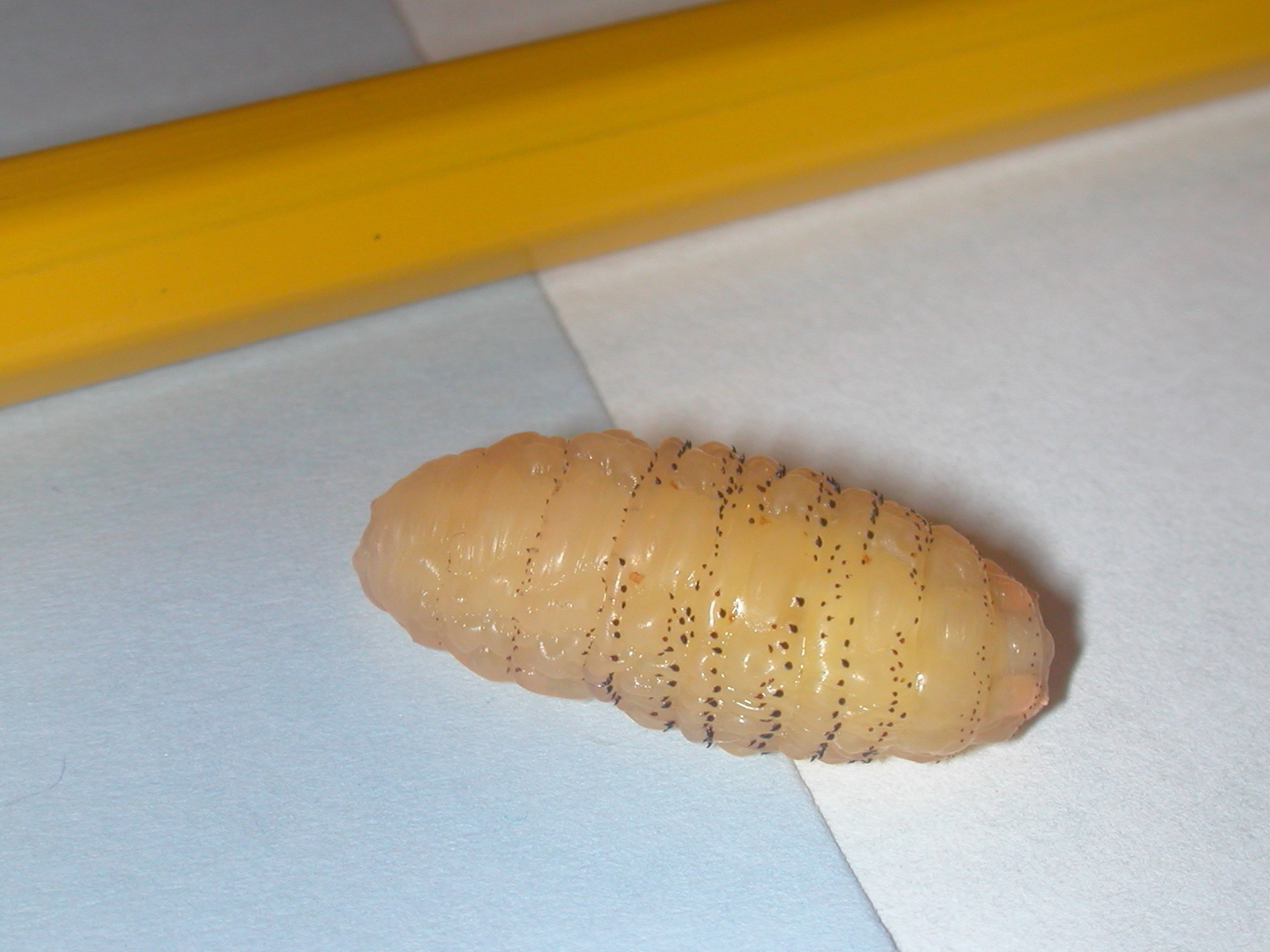
The bot fly Dermatobia hominis, that came out of my student's arm while he was sleeping. Photo: T. McGlynn

A mature bot fly larva, Dermatobia hominis, that emerged from my student’s arm while he was sleeping. He intentionally reared this one out and allowed it to pupate. Pencil is for scale. Photo: T. McGlynn

This has always troubled me. Without any additional context, it looks like the students just didn’t trust me, and thought that I’m stupid. At the very least, it shows that they trusted their own intuition over my recommendation based on a long history of experience. It shows that they followed the misinformed advice of family and friends over the judgment of the person who was responsible for the trip to the rainforest.

It shows that when it really really really counts, my guidance ain’t worth much at all to my own students.

I don’t give students this instruction without an explanation. I tell them that nearly every doctor in the US will want to cut the creature out. History shows that bot fly larvae are smarter than doctors. If you present yourself to a US doctor with a bot inside you, the predictable result is that you leave the doctor with your bot inside you. You will also leave without a large chunk of flesh that the doctor removed in a futile attempt to get the bot. Sometimes the bot is killed in the surgery, but not excised, which leads to a rotting carcass and infection, and the need for serious antibiotics. I tell them that, if they can’t get it out using the variety of techniques we’ve discussed, and they feel compelled to go to a medical professional, they must go to a vet and not to a doctor. (The students who did the opposite of my recommendation came to regret their choice, if you’re wondering.)

These bot fly incidents are convergent with a recurring incident in a non-majors laboratory that I have taught. The week before an exam, I hand out a review sheet that specifies the scope of the exam. I then tell the class:

Check out item number three on the review sheet. This is a straightforward question about osmosis. The answer is that the volume of water in the tubing will “increase.” The correct answer to this question is “increase.” Just circle the word “increase” and do not circle the word “decrease.” I’m letting you know the answer to this question now and I guarantee — the odds of this question being on the exam next week are 100%. I promise to you, with all of my heart, that this question will be on the exam word for word, and this one question will be worth 20% of your grade on this exam. You don’t want to get this question wrong, and I’m telling you about it right now. So, be sure to write down in your notes that this question will be on the exam and be sure to remember the correct answer when you see it.

The reason that I’m being really obvious about telling you about this question its that in the past, half of the class has gotten the answer to this question wrong. It’s a simple question, and it addresses the main point of the lab we conducted for more than two hours last week, but still, lot of people got it wrong last semester.

You should know that those students also were told in advance what would be on the exam. Just like I’m telling you right now. They knew that 20% of their exam hinged on remembering one word, “increase,” and still the majority of them got it wrong. I’m telling you this now because I don’t want you to suffer the same fate of those other students. DON’T BE LIKE THE STUDENTS FROM LAST SEMESTER WHO WERE FED THE ANSWER AND THEN GOT IT WRONG THE FOLLOWING WEEK. Just remember that “increase” is correct and the other word is not correct. I’d like you to remember the physical mechanism that explains this osmosis, but more than anything else I’d like you to demonstrate that you can be prepared for the exam and remember this small fact which I am hand-feeding to you right now. I promise to you this exact question will be on the exam Learn from your predecessors, don’t make their mistake. I’m giving you 20% of the exam for free right now, so write this down.

As I give this slightly overwrought speech, the students are paying attention. There is eye contact. They might be note-taking activity. Nobody’s on their phone, and nobody’s chitchatting.

When I administer the exam, more than half of the class circles “decrease” instead of “increase.” This has happened four times, and each time it happens a little piece of my heart dies.

As you can imagine, many of the students in our non-majors class are as disengaged as humanly possible. By no means is this a difficult course, even with low standards, but the fail rate for the corresponding lecture course is about 50%. The students who fail are clearly doing so because they aren’t even making the slightest effort. The reason that I keep giving students that same question over and over, and give them the correct answer over and over, is to give me some reassurance that the wretched performance by so many of the students is not my fault. I do this to grant myself absolution.

In these labs, each week is designed to give students the opportunity to develop their own experiments, find new information on their own, and work together to solve problems. This happens to some degree. But half of the students do not exert the tiniest amount of thought about doing what it takes to pass the exam. Why don’t they even try even the slightest, despite my best efforts to both inspire and feed them the right answers?

The students who fail these exams trust their own intuition, or some other model of behavior, instead of my own advice. If anybody is the person to tell you how to pass the exam, it should be the professor who is telling you the answers to the exam. But in this case, the students weren’t even bothering to look at their notes for five seconds before stepping into the exam. They’ve presumably heard from other people that work is not required for this class whatsoever, or perhaps they don’t care for some other reason. All I know is that no matter what I do, I can’t get these students to care about their grade on the exam. Some are excited about the labs, but not necessarily in passing.

So, what do the bot fly story and the osmosis story have in common? No matter how hard we try, sometimes our students won’t follow our recommendations. At least, not mine.

We are fancy-pants PhD professors, with highly specialized training. We’re paid to be the experts and to know better. That doesn’t mean that our words are prioritized over other words. Anything we might say just ends up in a stream of ideas, most of these ideas just flow out as easily as they flow in. It’s no accident that my teaching philosophy is “you don’t truly learn something unless you discover it on your own.” This is why I focus on creating opportunities for self-discovery in teaching. This is the only way in which people truly learn.

No matter what we professors might say or do about bot flies, or studying for exams, or anything else, other people will rely on their own judgment over our own. Even when the experts are overtly correct on the facts, even smart people often use misguided intuition when making important decisions, even when they are obviously wrong on the facts and the experts are overtly correct.

It’s easier to listen to other people than it is to heed their words. As a professor and research mentor, I’ve given up on the expectation of being heeded. I just work to speed up the process of self-discovery of important ideas. But, for the most part, I still don’t know how to do that. I think it’s an acquired skill, and a craft, and I think I still have a ways to go.

The first days of a new tenure-track faculty job

Standard

This is the season when some lucky ones preparing for new jobs in the fall. A few people have asked me what to expect, so I imagine even more are wondering. I’m writing from my own experience (starting 2.5 new faculty jobs), and yours have been different, so please do comment. What can you expect from the start, and what might you want to keep in mind? Here are some observations and some suggestions.

  • It’s more quiet and lonely than you might expect. There is a lot to do, but many tasks are solitary. September is a crazy time for everyone who is recombobulating from summertime adventures. Everybody will be glad to introduce themselves to you, but it won’t take very long before you’re sitting at the desk in your office, alone.
  • It’s busy. If you’re teaching more than you have in the past, be prepared to be overwhelmed. This is normal. It takes a while to figure out how to teach efficiently. At the outset, you can’t afford to not be an effective teacher, so learning how to be efficient is a work in progress, as you learn the acceptable standards in your new environment.

  • Define your boundaries for students at the outset, because your rep will spread quickly. If you want to get to know your students really well outside class, then be sure to leave your office door wide open and chat frequently with students. On the other hand, it’s easy to establish a reputation as a caring, fair and hard-working professor who doesn’t spend much time with students outside of class and office hours, if you set this at the outset. Time spent well with students can be the purpose of the job and the highest pleasure, but some other time spent with students could be a fruitless time sink. Find that line. The range of acceptable positions for that line varies hugely among institutions. So, listen and watch carefully.

  • From day one, decide how you will manage your classroom. The proliferation of communication devices has changed how students spend time in the classroom. Once the digital monster escapes from the box, you can’t put it back in without causing some degree of petulance. However, you can establish a clear pattern of expectations on the first day of class, which will be the structure that you need to help others deal with their addictions. This requires being proactive and isn’t something that you can effectively deal with mid-semester.

  • There is a huge amount of freedom. You have your ID, your email set up, your class schedule, supplies on the way to the lab. And then, you have absolutely nobody telling you what to do. This is, I argue, the most critical moment in your career – how do you spend the limited amount of time that you have? Are you focusing on writing grants, getting projects started, training new students, developing some curriculum, getting new experimental setups running, figuring out which grocery story to shop in, and how to make new friends in a new city? You can’t do all of these things at once, even if they all have to happen at some point. Your priorities will be based on your own circumstances, but don’t fall into a routine or a rut without planning. If you fall into a hole in which 100% of your work time is focused on the classroom, you might never be able to dig your way out. Manage your time at the outset. Of course you’re teaching more your first semesters as you are figuring things out. But it should not be all of the time, even at the start.

  • The most important person in the world can be your departmental admin person. Missing some office furniture? Direct deposit messed up? No book ordered for your course? Copier eating paper? Lab techs are often just as critical, too. Fortunately, I’m blessed with the most spectacular crew ever in my own department. I usually see these people because I need something, and I’m ever so thankful for the help I receive. Be sure to start off on a good foot because at crunch time, having these people in your corner is definitely priceless.

  • It takes years to understand university politics. This stuff affects you, but discussing the prospect for change might not be helpful. Most issues have long histories connected to big personalities, and until you know the stories and the individual players, don’t get involved.

  • If you’re a parent, and particularly if you’re a mom, then you’ve got to make sure that your spouse does his fair share of parenting. Even if you’re not a parent, but if you’re coupled, then you want to make sure that you aren’t doing more than your fair share of the duties at home. Oftentimes, domestic arrangements re-equilibrate with moving. If your career is as important as your spouse’s career, then less pleasant stuff done at home is an equal responsibility, too.

  • Identify senior faculty that you like and can trust, and not necessarily just in your own department. The working conditions and expectations of new faculty are different than those that have been on campus for a while. However, experience sometimes results in wisdom. When you need to learn context, it’s worthwhile to talk with someone who has already been there. Let’s say a couple students in your class are causing problems for you, or you don’t know how to ask the chair about leaving for a week to attend a conference. Or you need to find fresh undergrads to train in your lab, or you want to tap into campus funding for students but don’t know criteria the university-level committee uses when ranking applications. These are topics for your senior faculty mentors.

  • Maintain the time to keep yourself healthy. Make sure you still make the effort to prepare and eat real food, and be physically active however you have in the past. The time you put into exercising doesn’t cut your productivity, but increases it. When you feel good, you’ll work more efficiently and your mind will be more focused.

  • It’s okay to ask for help. You might be anxious about driving people crazy with a variety of minor inquiries, but you’re a newbie and it’s normal to try to figure things out. You were hired because the department already was confident that you’d do a good job, so it’s okay to ask questions that will help you out. Actually, as you make the rounds asking minor questions of people who could be of help, this can be a way to figure out who might evolve to become a trusted mentor.

This was not intended to be a comprehensive list, so additional input would be great, especially from those who have started a new job more recently than I have.

Friday recommended reads #24

Standard
IMG_2896

Little Free Library Charter #12221, photo by T. McGlynn


For a link, thanks to Bug Gwen.

The field ecology of a gut microbe inside bullet ants

Standard
The bullet ant Paraponera clavata. Image by Alex Wild.

The bullet ant Paraponera clavata. Image by Alex Wild.

This is the latest paper from my lab, which I’m really excited about. When we designed the project, several people told us that it would be useless. “It’s pointless to study the ecology of a symbiotic microbe in the wild when we have yet to specify its function inside the host.” It was only two days ago that Meg Duffy said that the microbiome is the most important recent conceptual advance in ecology, and I agree with her. That’s one of the reasons we did this project, to look at the ecology of gut microbe in the wild, which appears to be a true frontier.

There are plenty of advances that are yet to be made in the field biology of microbes, and these discoveries do not have an a priori requirement understanding of the comprehensive biology of an organism before understanding its ecology.

The microbial contents the guts of bullet ants are remarkably heterogeneous. In some colonies of bullet ants, we found oodles of a particular Bartonella microbe, closely related to those that facilitate N cycling in other animals. And most closely related (as far as we know) to other Bartonella inside ants on other distant continents. But, many bullet ant colonies lack this microbe. Perhaps not by accident, bullet ants have a remarkably varied diet, and some colonies eat more insects than anything else, and other colonies are functional herbivores. Perhaps the presence of this N-cycling microbe might be associated with – or even respond to – the trophic position of the ants?

Aren’t we getting ahead of ourselves by studying how diet affects microbes in the wild, when we don’t know what the microbes do? I say, phooey. Most of the ants that we study in tropical rainforest are just as mysterious as microbes. We don’t even know what most species of ants even eat! Nobody tells me I can’t study the ecology of ants without doing a comprehensive study of their diets and relationships to other organisms in the ecosystem. So, why do we need to know exactly what the role of microbe is in the gut of an animal before working to understand its distribution and ecology?

Working out the function of these microbes is mighty damn hard, if not impossible at the moment. But we can understand the distribution of these critters among colonies of ants an understand the environmental factors that shape its occurrence, as well as doing experiments to see how we can make incidence increase or decrease.

So, we ran an experiment that gave the ant colonies supplemental carbohydrates, or supplemental protein. (This was not easy at all, though you might think it would be. A post on this is forthcoming.) And we checked to see if how the microbes responded. It turns out that when you feed colonies sugar, this microbe becomes more prevalent. Moreover, the results from the manipulation recapitulate the ambient relationship between diet and microbial prevalence. Some colonies consistently collect more sugary nectar from the canopy than other colonies. (Learning this involved going out into the forest in the middle of the night, for an entire summer, to measure bullet ant colony diets.) The colonies that collect more nectar are more likely to have this microbe. So, we can clearly conclude that a sugary diet is predictive of the incidence of this particular Bartonella inside bullet ants.

And the stable isotopes tell an interesting story, too.

So what does this mean? While most ant species that forage in rainforest canopies are functionally herbivorous, bullet ants are true omnivores. They also don’t have the specialized obligate N-cycling microbes that the more herbivores canopy ants have. We found that the close bullet ant diets get to their competitors in the canopy, the more likely they have this facultative N-cycling microbe. If we’re trying to understand how the evolution of obligate sugar-feeding evolved among the dominant ants of rainforest canopies, then I suggest that understanding the ecology of the facultative bullet ant/Bartonella association is to get a window into the evolution this form of dietary specialization.

How this project happened inside a teaching institution

This was the Master’s thesis project of Hannah Larson. Hannah came to my lab with a specific interest in doing field ecology. Based on preliminary finds predating her arrival, Hannah and I developed this project in collaboration with Shana Goffredi, our microbial ecology collaborator. After taking courses for a semester, Hannah headed to the rainforest for eight months to conduct this project at La Selva Biological Station. Hannah found, marked and measured over a hundred bullet ant colonies (which became the start of a long-term monitoring project), and overcame a series of challenges in getting the molecular work done in a rainforest field station (with substantial help from our collaborating lab at the University of Costa Rica). Undergraduate Erica Parra is the one who (by her own choice I should point out) spent long nights in the pitch black of the rainforest at the base of actively foraging bullet ant colonies. The work was funded by an NSF-IRES grant OISE-1130156, though we scrambled for additional funds for reagents that were not in the project budget.

Reference:

Larson, H.K., S.K. Goffredi, E.L. Parra, O. Vargas, A. Pinto, T.P. McGlynn. 2014. Distribution and dietary regulation of an associated facultative Rhizobiales-related bacterium in the omnivorous Giant Tropical Ant, Paraponera clavata. Naturwissenschaften. DOI: 10.1007/s00114-014-1168-0

You can find a copy of this paper on my lab’s website.

Driftwood faculty and decisions about course content

Standard

Here’s an incident, or really just a conversation, that left a little scar on me.

Around the time I was finishing up my PhD, I was given the opportunity to give a seminar at my alma mater. I had sit-down conversations with some of my undergraduate professors. As I was somewhere in the process of starting a faculty position, this was a mind-bending role change, no longer a student but now a junior colleague of my former professors.

I took three excellent courses with one professor, whose courses were well designed, all with engaging and creative labs, and with lecture content well grounded in the primary literature. I worked somewhat hard and I learned a helluva lot, especially in Evolutionary Biology and Biogeography. He definitely had his theoretical biases (a la Gould & Lewontin), but this didn’t stop him from being an excellent instructor.

When we were chatting, he was interested in learning what I was up to, and how I ended up working on the ecology of ants. I told him that my interest started with the evolution of sociality, and that I was curious about the Hamiltonian predictions for colony structure. (When I started my dissertation, people had only just abandoned using allozymes to look at relatedness inside colonies). He tilted his head and said asked me a bit more. Before I realized what was happening, he let me know he wasn’t familiar with kin selection theory. He said that he hadn’t heard of any of the WD Hamilton papers from the 1960s. He didn’t seem think that this wasn’t a big deal, that this was just an inside baseball discussion among social insect experts. We moved on to new topic.

But it was a huge deal. If you’re not a biologist, you might not recognize this But if you are a biologist, you’ll recognize that my professor openly volunteered (to his credit?) that he was ignorant of something really foundational in his field. Frankly, nobody teaching evolutionary biology at the college level, at the time, should have been unfamiliar with the concept of kin selection.

This blew my mind in three ways. First, it’s bizarre to think that the man who started me on the path to Ecology and Evolutionary Biology didn’t have an adequate map of the territory. Second, he was a top-notch instructor and it was clear to me that we didn’t suffer much (if at all) for his lapses of awareness in the field. Third, I suddenly realized why the supposed controversies that I learned in college were actually tired arguments among everybody in grad school. My professor was merely out of date.

In hindsight, I see he was a classic example of driftwood. But not deadwood. He was a dedicated teacher and engaged evolutionary biologist, but his research was not well engaged off campus.

The stereotype of the professor who teaches outdated material is one who is retired-on-the-job, uses the same powerpoints over and over, appears bored, and uses old textbooks because they can’t bother to update the course.  That stereotype was not embodied by my Evolutionary Biology professor. But the content itself was not only stale, but it wasn’t even up to date at the outset. And he was an evolutionary biologist!

Ironically, I think the content of the course would have been more representative of introductory evolutionary biology if it was taught by someone who was not an evolutionary biologist. This instructor would have been relying more heavily on a textbook, and covered the major topics as decided by the textbook authors.

So, which one would have been better for me? Either the professor who was an amazing teacher and specialist who was aware of some topics, or one someone who was not a specialist who covered all of the bases? I think that’s an unfairly dichotomous question, so I won’t answer it. But it’s fuel for thought.

If I had to list three undergradaute-level course titles that would be in my field of expertise, they would be ecology, insect biology and tropical biology. I would clearly choose to amplify some topics over others, and these decisions would result in a course that would look very different than if it were structured by a non-specialist who was merely assigned these courses.

For example, I’m not a cracker-jack population biologist, and I don’t build life tables for my work. This is, however, bread and butter for introductory ecology courses. Since I don’t regularly work in population biology, I can’t honestly tell you whether this is an actual skill that every undergraduate biology majors needs to know. (I’m not sure it is, though some of the embedded concepts are very important.) Would I include in my class? You bet I would, because it’s in every textbook and it’s expected of everyone who finishes introductory ecology and I wouldn’t want to be responsible for underpreparing my students. Even though I’m an ecologist, I wouldn’t teach only the parts of the ecology that are my specialty. But I can see how some others can be tempted to leave life tables out of an ecology course. And, I wonder if they need to be within the   30 lessons we get to teach each semester.

Overall, I have no idea how the community collectively decides what concepts are truly important. I don’t think the K-12 approach of statewide standards is the way to go for higher education, and the culture of Assessment is still leaving us plenty of latitude, which is good. But why do we teach some things as canon, and overlook others?

I get that some topics are important. But what makes them important? What defines a field? is it the people actively doing research or the people looking at a distance? When we define the topics of lessons in our syllabi, what are the criteria we use when making our choices? I haven’t thought much about this other than “I think it’s important,” but I realize that’s not good enough.

Friday recommended reads #23

Standard

Thanks to James Waters, and Jen Biddle for links. Feel free to add to the list in the comments.

What kind of faculty job do you want?

Standard

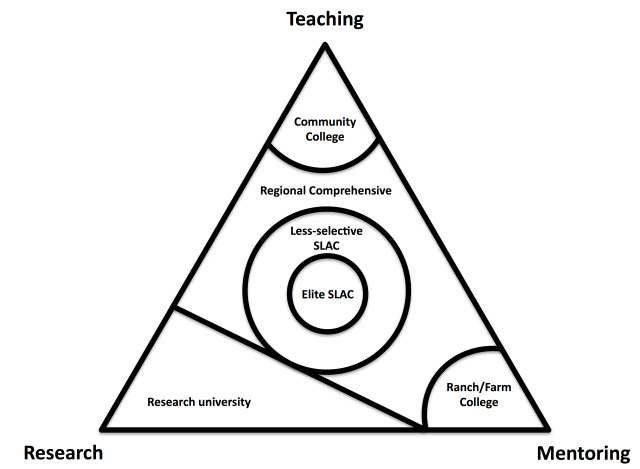
Faculty jobs involve teaching, research, and mentoring. Different kinds of universities expect faculty to conduct these activities in different proportions. What is your ideal balance? Consider the figure to find out where you belong.

ChooseYourInstittion

Figure by T McGlynn

For the uninitiated, SLAC indicates “Small Liberal Arts College.”

This figure implies a lot of mechanisms that differentiate institutions, and there are a bunch of reasons why the distribution for a regional comprehensive (where I work currently) fills in the gaps that other institutions don’t occupy.

Which classes should tenure-track faculty deprioritize?

Standard

Academia has an adjunct problem. Most of the verbiage on this topic (that I see, at least) focuses on the plight of adjunct faculty.  I agree that this matters, a lot. But, this isn’t the bottom line for the people who are the designated focus of the teaching institutions: the students.

At the top of my list of worries about adjunctification are educational quality and making sure that we do the best for our students.

I am not suggesting that the quality of classroom instruction by adjuncts is better or worse than their tenure-track colleagues. The problem for students isn’t connected to quality in the classroom. It’s about what happens — or doesn’t happen — outside the classroom.

Take, for example:

https://twitter.com/SciOfMotherhood/status/449036838234103808

There lots of explicit or implicit job expectations of tenure-track faculty, which are not expected of contingent faculty, including

  • Academic advising
  • Research with students

  • Mentorship

  • Career advising

  • Sponsorship of student organizations

  • Development of new curricula

Meanwhile, in some universities, adjuncts don’t even have a shared office space.

Nobody expects adjuncts to do the same kind of service, research and student mentorship activities that are part of the role of full-time tenure-track faculty. Tenure-track faculty are expected to interact with the same population of students throughout their undergraduate careers, especially in smaller institutions, which often sell themselves based on the close professional relationships betweens students and faculty.

In my own department, we have been dealing with one dilemma tied to the fact that we don’t have enough tenure-line faculty to teach our courses. Next semester we will, collectively, have more reassigned time for service and student mentorship that we have had in recent memory. This is great for a number of reasons, but it also means that for some courses that we normally teach ourselves, we’ll have to use non-tenure-track instructors.

Which kinds of courses are we supposed to give up ourselves and assign to adjuncts?

Here are the options:

  • Our introductory for-majors courses. We have a 3-semester intro sequence, and each of these is taught by a single tenure-track faculty member. This has been great because the all students get to know these faculty in the department by going through their course (aside from some transfer students). Though I don’t own any of these courses, I chat a lot with my colleagues who do teach these courses to identify students who could join my lab. These courses are foundational for the rest of the major, and we need to be sure that there is consistency in its instruction so that students are well prepared for the upper division. Having a rotating set of instructors in this course wouldn’t be good.
  • Upper-division speciality courses. We happen to have plenty of adjunct instructors who are qualified to teach most of these classes well. Would it be better to have the tenure-track faculty stay in the majors intro courses and leave some specialty courses to adjuncts?

  • Graduate courses. Our courses for the graduate program should, in theory, be taught by research-active faculty. However, there are so few of us that we are also needed for other parts of the curriculum. Teaching the graduate courses in a seminar format, with smaller class sizes, is lighter on the schedule than an introductory majors course, and keeping this course in the schedule can free up even more time for other activities. However, this would keep faculty from getting to know as many undergraduates.

  • Our non-majors courses lecture and labs. Like many other departments, we have pretty much already abandoned the hope of teaching these. I have taught a few sections of these courses in recent years. My rationale was that these courses which have a large proportion of Liberal Studies majors (those preparing become K-8 teachers), and teacher preparation is a priority of mine.

  • We aren’t punishing any of our students by having them work with our adjuncts, but when students are taught by our adjuncts that means we are less able to provide them with opportunities and interactions outside the classroom. These interactions are often what makes college valuable. So, which courses do we, as tenure-track faculty, give up?

    This is a hard call. We have managed to make sure that all the lectures, if not the labs, of our introductory majors courses are taught by tenure-track faculty. This helps us build a community in our department, in which the faculty who run the department are personally familiar with the students going through the major. It would be a step backward if we divested ourselves from our majors at this early stage. On the other hand, it would be great if research-active faculty continue the speciality courses in the upper division and to graduate students. Moreover, this could be an important part of continuing to support students conducting research in our labs.

    For example, I’ve been the instructor of the graduate biostatistics course for several years now. This means that, for better or worse (mostly worse), I’m the statistics guy who the students contact (and sometimes ignore) when they are designing experiments and analyzing their results. If our biostatistics course was taught by an adjunct, these students wouldn’t have that adjunct available around the department to discuss experimental design and analysis. While I don’t think I need to serve as a statistical consultant too often, I think being available for these kinds of conversation is a part of my job that I shouldn’t be giving up. If I didn’t teach this class, the students wouldn’t even be aware that I am available in this capacity.

    There isn’t a good answer to this problem, but it’s one that we’re facing. I’m really curious about how other departments of different types of decided which classes are kept by tenure-track faculty, and which ones end up being taught by adjuncts on a long-term basis. When these decisions are made, what is the currency behind the decision? Faculty scheduling, available faculty expertise, student familiarity with faculty?


    Friday recommended reads #22

    Standard


    For links, thanks to Rebecca Weinberg and Trevor Branch, and also thanks to my departmentmate HK Choi, who got me to start using Markdown. Next, I’m going to get all github and figshare on you, shave down to a handlebar mustache, and pop open a can of PBR.

    Why I prefer anonymous peer reviews

    Standard

    Nowadays, I rarely sign my reviews.

    In general, I think it’s best if reviews are anonymous.  This is my opinion as an author, as a reviewer, and as an editor. What are my reasons? Anonymous reviews might promote better science, facilitate a more even paying field, and protect junior scientists.

    The freedom to sign reviews without negative repercussions is a manifestation of privilege. The use of signed reviews promotes an environment in which some have more latitude than others. When a tenured professor such as myself signs reviews, especially those with negative recommendations, I’m exercising liberties that are not as available to a PhD candidate.

    To explain this, here I describe and compare the potential negative repercussions of signed and unsigned reviews.

    Unsigned reviews create the potential for harm to authors, though this harm may be evenly distributed among researchers. Arguably, unsigned reviews allow reviewers to be sloppy and get away with a less-than-complete evaluation, which will cause the reviewer to fall out of the good graces of the editor, but not that of the authors. Also, reviewer anonymity allows scientific competitors or enemies to write reviews that unfairly trash (or more strategically sabotage) the work of one another. Junior scientists may not have as much social capital to garner favorable reviews from friends in the business as senior researchers. But on the other hand, anonymous reviews can mask the favoritism that may happen during the review process, conferring an advantage to senior researchers with a larger professional network.

    Signed reviews create the potential for harm to reviewers, and confer an advantage to influential authors. It would take a brave, and perhaps foolhardy, junior scientist to write a thorough review of a poor-quality paper coming from the lab of an established senior scientist. This could harm the odds of landing a postdoc, getting a grant funded, or getting a favorable external tenure evaluation. Meanwhile, senior scientists may have more latitude to be critical without fear of direct effects on the ability to bring home a monthly paycheck. Signed reviews might allow more influential scientists to experience a breezier peer review experience than unknown authors.

    When the identity of reviewers is disclosed, these data may result in more novel game theoretical strategies that may further subvert the peer-review process. For example, I know there are some reviewers out there who seem to really love the stuff that I do, and there is at least one (and maybe more) who appear to have it in for me. It would only be rational for me to list the people who give me negative reviews as non-preferred reviewers, and those who gave positive reviews as recommended reviewers. If I knew who they were. If everybody knew who gave them more positive and more negative reviews, some people would make choices to help them exploit the system to garner more lightweight peer review. The removal of anonymity can open the door to corruption, including tit-for-tat review strategies. Such a dynamic in the system would further exacerbate the asymmetries between the less experienced and more experienced scientists.

    The use of signed reviews won’t stop people from sabotaging other papers. However signed reviews might allow more senior researchers to use their experience with the review system to exploit it in their favor. It takes experience receiving reviews, writing reviews, and handling manuscripts to anticipate the how editors respond to reviews. Of course, let’s not undersell editors, most of whom I would guess are savvy people capable of putting reviews in social context.

    I’ve heard a number people say that signing their reviews forces them to write better reviews. This implies that some may use the veil of their identity to act less than honorably or at least not try as hard. (If you were to ask pseudonymous science bloggers, most would disagree.) While the content of the review might be substantially the same regardless of identity, a signed review might be polished with more varnish. I work hard to be polite and write a fair review regardless of whether I put my name on it. But I do admit that when I sign a review, I give it a triple-read to minimize the risk that something could be taken the wrong way (just as whenever I publish a post on this site). I wouldn’t intentionally say anything different when I sign, but it’s normal to take negative reviews personally, so I try to phrase things so that the negative feelings aren’t transferred to me as a person.

    I haven’t always felt this way. About ten years ago, I consciously chose to sign all of my reviews, and I did this for a few years.  I observed two side effects of this choice. The first one was a couple instances of awkward interactions at conferences. The second was an uptick in the rate which I was asked to review stuff. I think this is not merely a correlative relationship, because a bunch of the editors who were hitting me up for reviews were authors of papers that I had recently reviewed non-anonymously. (This was affirmation that I did a good job with my reviews, which was nice. But as we say, being a good reviewer and three bucks will get you a cup of coffee.)

    Why did I give up signing reviews? Rejection rates for journals are high; most papers are rejected. Even though my reviews, on average, had similar recommendations as other reviewers, it was my name as reviewer that was connected to the rejection. My subfields are small, and if there’s someone who I’ve yet to meet, I don’t want my first introduction to be a review that results in a rejection.

    Having a signed review is different than being the rejecting subject editor. As subject editor, I point to reviews to validate the decision, and I also have my well-reasoned editor-in-chief, who to his credit doesn’t follow subject editor recommendations in a pro forma fashion. The reviewer is the bad guy, not the editor. I don’t want to be identified as the bad guy unless it’s necessary. Even if my review is affirming, polite, and as professional as possible in a good way, if the paper is rejected, I’m the mechanism by which it’s rejected. My position at a teaching-focused institution places me on the margins of the research community, even if I am an active researcher. Why the heck would I put my name on something that, if taken the wrong way, could result in further marginalization?

    When do I sign? There are two kinds of situations. First, some journals ask us to sign, and I will for high-acceptance rate journals. Second, if I recommend changes involving citations to my own work, I sign. I don’t think I’ve ever said “cite my stuff” when uncited, but sometimes a paper that cites me and follows up on something in my own work, and I step in to clarify. It would be disingenuous to hide my identity at that point.

    The take home message on peer review is: The veil of anonymity in peer review unfairly confers advantages to influential researchers, but the removal of that veil creates a new set of more pernicious effects for less influential researchers.

    Thanks to Dezene Huber whose remark prompted me to elevate this post from the queue of unwritten posts.

    Scientists know how to communicate with the public

    Standard

    I bet that most of us are steady consumers of science designed for the public. Books, magazines, newspaper, museum exhibits, radio, the occasional movie. The people who bring science to the masses are “science communicators.” (The phrase “science communication” is a newish one, and arguably better than “science writing,” as a variety of media involve more than just writing.)

    Nearly everything I’ve seen in science communication shares a common denominator: scientists. Science communication doesn’t amount to much without researchers. Science is a human endeavor, and it’s rarely possible to tell a compelling story without directly involving the people who did the science. As restaurant servers bring food to the table and cooks typically stay in the kitchen, science communicators bring the work of scientists to the public while scientists typically focus on publishing scientific papers.

    I interact with practitioners of this craft on the uncommon occasions when my research gets notice beyond the scientific community. (My university doesn’t send out press releases when my cooler papers come out, so the communicators need to find me.)

    When I listen to what science communicators have said to us scientists, there are two items that are a heavy and steady drumbeat:

    1. It the duty of scientists to some of our time doing science communication, and it’s also in our interests.

    2. Most scientists don’t yet know how to communicate with the public.

    I’m not so sure about #1. I have decided the second one is off mark, or at least so overgeneralized that it’s either wrong or useless.

    It may or may not be our duty to share science with the public. (Yes, I know the arguments, reviewed here, for example.) Regardless, the last interest group that I’d look to for impartial advice on this matter would be science communicators. This would be like learning about the need for propane grilling from a propane grilling salesperson. It would be like learning about K-12 energy education from a workshop funded by a petroleum company (sadly, this is happening this week in my city). Of course science communicators think that science communication is important!

    For most scientists, the division of labor between cooks and servers is just fine. (Of course there is nothing about being a technical scientist that disqualifies someone from being an effective public communicator.) There are many important things in this world, and some of us choose other things. (This next month, for what it’s worth, I’m talking to three community organizations, volunteering for an all-day science non-fair, and writing a blog post about my lab’s latest paper.) My funding agency places science communication as one potential component of broader effects, and I’m definitely listening to them. Scientists, if we want to engage the broader public, that’s great! But it would be disingenuous to tell you that it’s your duty. We all owe many things to society, and I’m cool with it if you choose, or don’t choose, to put science communication on your plate. I’m not going to be that person who is telling you what your duties are with respect to your own career. It’s up to us to forge our own trajectories and priorities.

    So we all agree that scientists that don’t spend time on science communication either are, or are not, selfish bastards.

    But, is it really true that most of us scientists aren’t capable of sharing our science effectively? I call BS on this canard.

    If there happens to be a stray professional science communicator reading this, I imagine that I just induced a few chuckles and a shake of the head. Let me write some more to clarify.

    Most of us are wholly capable of sharing our science with the public in an understandable and even interesting fashion. However, that doesn’t mean that, when interacting with the media, that we are always willing to play along. We might not want to provide the sound bite you’re looking for. We might be resisting a brief interpretation because we don’t have enough confidence that the science would end up correct in the final product. Nearly every time some scientific finding is presented to the public, it happens along with some form of a generalization. If you’re familiar with the genre of peer reviewing, you’ll know that scientists typically disdain generalizations.

    How is it that we can resist the digestion of our work for public consumption? When someone claims that one of us “doesn’t know how to communicate with the public,” I propose that this overgeneralized diagnosis can almost always be broken down into two distinct categories which might apply.

    1. We don’t want to discuss our science in broad terms for the public because we feel that we are unqualified for the task. While the popular image of the arrogant know-it-all scientist plays well, most of us are driven by the fact that we don’t understand enough about our fields of expertise. We are resistant to analogies or general statements of findings in lay terminology because it involves a generalization from our very specific findings that may be unwarranted. And, if it is warranted, then it falls outside our expertise to comment on such a broad topic. While our experiments were designed to advance knowledge on some general topic, we feel that it is not up to us to make the decision that our findings are informative on that general topic in a way to be digested outside the scientific community.
    2. We actually aren’t doing an experiment that has any general relevance to the public at large. We actually are working on minutia that will not have any broad relationship to the scientific endeavor at large. We are having trouble making a generalization about its scientific importance because it lacks a broad scientific importance.

    The prescription for diagnosis #1 is for us to become more arrogant and think that we are qualified to speak with the media about broader issues in science. For us to think that, as scientists sensu lato, we are able to speak broadly about scientific issues. Just as we teach about all kinds of scientific topics in the university classroom, we can interact with the media in the same way. And this is the kind of stuff that scientists who communicate with the public do all the time. They often talk about things outside the realm of their research training and expertise and get away with it. If we’re going to be doing science communication as practicing scientists, then we need to own the fact that we can talk about a whole bunch of scientific topics even though we’re not top experts in a subfield. For example, Richard Feynman once wrote a book chapter about ants. (I thought it was horrible way to illustrate his main point about doing amateur science, actually.)

    The prescription for diagnosis #2 is to be a better scientist. If you’re conducting an experiment that, at its roots, lacks a purpose that can be explained to a general audience, then what is the science really work? I can explain that I work on really obscure stuff (the community ecology of litter-dwelling ants, how odors affect nest movements of ants, and how is it that some colonies of ants control the production of different kinds of ants, and how much sunlight and leaf litter ants like, for starters). But I’m working on this obscure stuff to build to a generalized understanding of biodiversity, the role of predators in the evolution of defensive behavior, how ecology and evolution result in optimized allocation patterns, and responses to climate change. I am sometimes reluctant to claim that my results can be generalized to entire fields (I need to get more arrogant in that respect), but I recognize the fact that my work is designed to ask these broad questions. If you don’t have these broad questions in mind while running the experiment, I recommend a sabbatical and a visit to the drawing board. I don’t know how often this phenomenon happens, but I have met some scientists who, when asked for the broadest possible application of their work, can only talk about the effect on a subfield of a subfield that would only influence a few people. If a project, at its greatest success, can only influence a few other scientists in the whole world, then, well, you get the idea.

    Yes, scientists are good communicators. And we know how to talk to the public. We just might not think we’re the right people for the job, or that our science isn’t built for the task.

    Today is Taxonomist Appreciation Day!

    Standard

    Many fields of science are important, and many fields of science are appreciated.

    The field with the greatest importance : appreciation ratio is taxonomy.

    bhr_anders_pun2

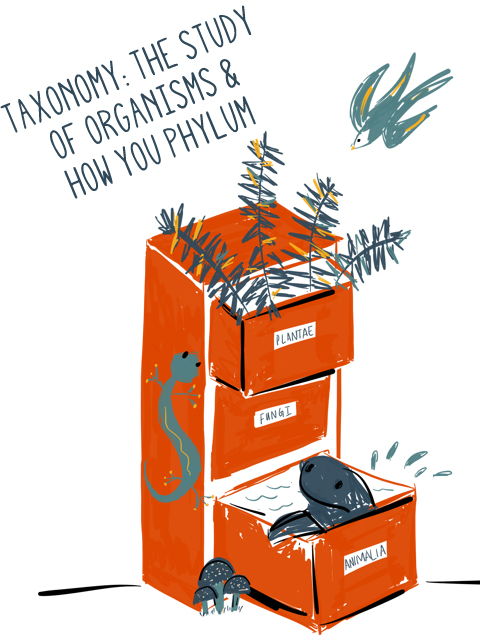
    BuzzHootRoar made this!

    Taxonomy is critical for almost everything we do in biology, but few demonstrate appreciation for the hard work and expertise that is required for useful taxonomy to happen. Let’s change that!

    We are deep in a taxonomic crisis. Our own species created the planet’s sixth major extinction event and we are lacking the expertise to understand what we are rapidly losing. Taxonomic work is the foundation for understanding how to save what we can and make plans for the future. Any fix to the taxonomic crisis requires a recognition of the essential nature of the work of taxonomists and systematists, and the value of museum collections and those who use them to explain our world. We must show taxonomists how much they’re worth to us. We need to back this up with the necessary resources, of course, but we all need to be showing them a lotta love too.

    I’d like to write a bit about the taxonomist that’s made my work possible.

    As an ecologist, most of what I do is only possible because because of the unfathomably detailed and dedicated work of one systematist and all-around-great guy, Jack Longino. I don’t even know where to begin with the awesomeness of Jack, and of what he’s done. En route to a bevy of discoveries in evolution and ecology, he’s provided a comprehensive picture of ant biology throughout Costa Rica, as well as Mesoamerica and beyond. Of course there’s always more work to do, and a lot of that is only possible because of the foundation of his natural history and systematic work.

    Jack Longino worked on the ants of La Selva Biological Station under the umbrella of the ambitious Alas Project: The Arthropods of La SelvaWhile heading up (in part) this huge project funded by a series of four NSF grants, he focused on ants. In the process, he made the most comprehensive and easy-to-use guide to identifying ants to species for anywhere in the tropics, perhaps the world. In fact, it is easier for me to train a student to identify an ant in the rainforest of Costa Rica than in my home in California, because the tools that Jack created are just so perfect to get ants to species. And when you get to a species page, you get detailed natural history notes of the biology of the species, including the rare ones. (For great examples, check out his notes on Gnamptogenys banski and one of my favorite critters, the gypsy ant Aphaenogaster araneoides.) In recent years, he’s ported over to the globally comprehensive site Antweb, and expanded his range throughout Mesoamerica and northern South America. Which is much cause for rejoicing among myrmecologists in these areas. And NPR, too.

    And, a spectacular part of all this is that he did this while serving on the faculty of The Evergreen State College. I’ve seen him in the field with students on several occasions, and he’s a thoughtful, attentive, realistic and enterprising mentor. (He’s recently moved to the University of Utah.) And whenever I have questions for him, he’s prompt, detailed and doesn’t even seem to mind. I don’t know how to make a taxonomy pun out of this, but he’s 100% class.

    So when he went on an expedition sampling ants throughout remote areas of Mesoamerica, he took a bunch of undergraduates. Some of whom made this wonderful animation showing what an ant sampling field expedition looks like:

    Acknowledgments: This year’s pun contest by BuzzHootRoar generated some great art and new attention to the importance of taxonomy for ALL of us scientists. I came up with the idea for Taxonomist Appreciation Day on a half-whim last year, but I’m serious about it. It’s an idea whose time has come. And I am so thankful for the people who’ve helped picked up the idea and shared it, including BuzzHootRoar, the NSF Division of Environmental Biology, and Alex Wild, and hopefully many more of you today. (If you’re a twitter person, #loveyourtaxonomist is the not-so-secret handshake.) The Smithsonian Department of Invert Zoology came up with an aptly timed post (beware: contains comic sans). Next year, let’s have a bigger and better Taxonomist Appreciation Day! I’m open to all kinds of ideas, in addition to the great ones of DEBrief.

    Negotiating for a faculty position: An anecdote, and what to do

    Standard

    This post is about a revoked job offer at a teaching institution that was in the news, and is also about how to negotiate for a job. I’ve written about negotiation priorities before, but this missive is about how to discuss those priorities with your negotiating partner.

    Part A: That rescinded offer in the news

    Last week, a story of outrage made the rounds. The capsule version is this: A philosopher is offered a job at a small teaching school. She tries to negotiate for the job. She then gets immediately punished for negotiating, by having the offer rescinded.

    This story first broke on a philosophy blog, then into Inside Higher Ed, and some more mainstream media, if that’s what Jezebel is. There are a variety of other posts on the topic including this, and another by Cedar Reiner.

    Some have expressed massive shock and appall. However, after reading the correspondence that caused the Dean to rescind the job offer, I’m not surprised at all. After initial conversations, the candidate wrote to the Dean:

    As you know, I am very enthusiastic about the possibility of coming to Nazareth. Granting some of the following provisions would make my decision easier.

    1) An increase of my starting salary to $65,000, which is more in line with what assistant professors in philosophy have been getting in the last few years.

    2) An official semester of maternity leave.

    3) A pre-tenure sabbatical at some point during the bottom half of my tenure clock.

    4) No more than three new class preps per year for the first three years.

    5) A start date of academic year 2015 so I can complete my postdoc.

    I know that some of these might be easier to grant than others. Let me know what you think.

    Here is what the Dean thought, in her words:

    Thank you for your email. The search committee discussed your provisions. They were also reviewed by the Dean and the VPAA. It was determined that on the whole these provisions indicate an interest in teaching at a research university and not at a college, like ours, that is both teaching and student centered. Thus, the institution has decided to withdraw its offer of employment to you.

    Thank you very much for your interest in Nazareth College. We wish you the best in finding a suitable position.

    There has been a suggestion of a gendered aspect. That viewpoint is expressed well here, among other places. (There doesn’t seem to be a pay equity problem on this campus, by the way.) I wholly get the fact that aggressive negotiation has been seen as a positive trait for men and a negative trait for women. I think it is possible that gender played a role, but in my view, the explanation offered by the Dean is the most parsimonious one. (Now, my opinion will be dismissed by some because of my privilege as a tenured white dude. Oh well.) Given the information that we’ve been provided, and interpreted in light of my experiences at a variety of teaching campuses, I find the “fit” explanation credible, even if it’s not what I would have done.

    A job offer is a job offer, and once an offer is made the employer should stand behind the offer. Then again, if some highly extraordinary events unfold before an agreement is reached, the institution can rescind the job offer. In this circumstance, is the candidate’s email highly extraordinary?

    Did this start at “negotiation” communicate so many horrible things about the candidate that the institution should have pulled its offer? The Dean’s answer to that question was, obviously, “Yes.”

    I would have answered “no.” Many others have done the yeoman’s blog work of explaining exactly how and and why that was the wrong answer to the question. I’m more interested in attempting to crawl inside the minds of the Dean and the Department that withdrew the offer. What were they thinking?

    The blog that first broke this story called these items “fairly standard ‘deal-sweeteners.’” I disagree. If I try to place myself in the shoes of the Dean and the Department, then this is how I think I might have read that request:

    I am not sure if I really want this position. If you are willing to stretch your budget more than you have for any other job candidate in the history of the college, then I might decide to take the job, because accepting it is not an easy decision.

    1) I realize that your initial salary offer was about what Assistant Professors make at your institution, but I want to earn 20% more, as much as your Associate Professors, because that’s what new faculty starting at research universities get.

    2) I’d know that 6 months of parental leave is unofficial policy and standard practice, but I want it in writing.

    3) I’d like you to hire adjuncts for an extra sabbatical before I come up for tenure. By then I’m sure I’ll need a break from teaching, even though everybody else waits until after tenure to take a sabbatical.

    4) Before I take this special extra sabbatical, I want an easier teaching schedule than everybody else in my department.

    5) I want to stay in my postdoc for an extra year, because I’d rather do more research somewhere else than teach for you. I realize that you advertised the position to fill teaching needs, but you can hire an adjunct.

    While some of these requests are the kind that I’d expect to be fulfilled by a research institution, I’m hoping that you are able to treat me like a professor from a research institution. Now that you’ve offered me this teaching job, I want my teaching obligations to be as minimal as possible. Let me know what you think.

    And the Dean did exactly that: she let her know what she thought. I’m not really joking: that’s really how I think it could be seen, inside the context of a teaching- and student-centered institution.

    Here is a more unvarnished version of what I imagine the Dean was thinking:

    Holy moly! Who do you think we are? Don’t you realize that we want to hire you to teach? I didn’t pull the salary out of thin air, and it was aligned with what other new Assistant Professors earn here. And if you want to teach here, why the heck do you want to stay in your postdoc which presumably pays less money? If you wanted to stay in your for 18 months earning a postdoc salary, instead of coming to teach for us at a faculty-level salary, then why would you even want this job at all? Also, didn’t you realize that we advertised for the position to start this year because we need someone to teach classes in September? If you have such crazy expectations now, then I can only imagine what a pain in the butt you might be for us after you get tenure. I think it’s best if we dodge this bullet and you can try to not teach at a different university. We’re looking for someone who’s excited about teaching our students, and not as excited about finding ways to avoid interacting with them.

    The fact remains that the candidate is actually seeking a teaching-centered position. However, she definitely was requesting things that an informed candidate would only ask from a research institution. I don’t think that she necessarily erred in making oversized requests, but her oversized requests were for the wrong things. They are focused on research, and not on teaching. While it might be possible that all of those requests were designed to improve the quality of instruction and the opportunities to mentor students, it clearly didn’t read that way to the Dean. We know it didn’t read that way, because the Dean clearly wrote that she thought the candidate was focused too heavily away from teaching and students. I’m not sure if that’s true, but based on the email, that perspective makes a heckvualotta sense to me.

    I’d would be more inclined to chalk the unwise requests to some very poor advice about how to negotiate. I’d would have given the candidate a call and try to figure out her reasons, and if the answers were student-centered, then I’d continue the negotiation. But I can see how a reasonable Dean, Department, and Vice President of Academic Affairs could read that email and decide that the candidate was just too risky.

    New tenure-track faculty hires often evolve into permanent commitments. You need to make the most of your pick. Hiring a dud is a huge loss, and it pays to be risk averse. If someone reveals that they might be a dud during the hiring process, the wise course of action is to pick someone who shows a lower probability of being a dud. However, once an offer is made, the interview is over.

    But according to Nazareth College, this candidate showed her hand as a total dud, and a massive misfit for institutional priorities. Though I wouldn’t have done it, I have a hard time faulting them for pulling the offer. If they proceeded any further, they would have taken the chance that they’d wind up with an enthusiastic researcher who would have been avoiding students at every opportunity. Someone who might want to bail as soon as starting. Or maybe someone who got a better job while on the postdoc and not show up the next year. The department only has four tenure-track faculty, and would probably like to see as many courses taught by tenure-line faculty as possible.

    Having worked in a few small ponds like Nazareth, I don’t see the outrageousness of these events. We really have no idea, though, because there is a lot of missing context. But we know that the Dean ran this set of pie-in-the-sky requests by the Department and her boss. They talked about it and made sure that they weren’t going to get into (legal) hot water and also made sure that they actually wanted to dump this candidate. It’s a good bet that the Department got this email and said, “Pull up, pull up! Abort!” They may have thought, “If we actually are lucky enough to fill another tenure-track line, we don’t want to waste it on someone who only wants to teach three preps before taking a pre-tenure sabbatical while we cover their courses.” I don’t know what they were thinking, of course, but this seems possible.

    Karen Kelsky pointed out that offers are rescinded more often at “less prestigious institutions.” She’s definitely on to something. Less prestigious institutions have more weighty teaching loads and fewer resources for research (regardless of the cost of tuition). These are the kinds of institutions that are most likely to find faculty job candidates who are wholly unprepared for the realities of life on the job.

    When an offer gets pulled, I imagine it’s because the institution sees that they’ve got a pezzonovante on their hands and they get out while they still can.

    At teaching institutions, nobody wants a faculty member who shies away from the primary job responsibility: teaching.

    In a research institution, how would the Dean and the Department feel if a job candidate asked the Dean for reduced research productivity expectations and a higher teaching load for the first few years? Wouldn’t that freak the Department out and show that they didn’t get a person passionate for research? Wouldn’t the Dean rethink that job offer? Why should it be any different for someone wanting to duck teaching at a teaching institution?

    I don’t know what happened on the job interview, but that email from the candidate to the Dean is a huge red flag word embroidered with script that reads: “I don’t want to teach” and “I expect you to give me resources just like a research university would.” Of course everybody benefits when new faculty members get reassigned time to stabilize. But these requests were not just over the top, they were in orbit.

    If I were the Dean at a teaching campus, what kinds of things would I want to see from my humanities job candidates? How about a guarantee for the chance to teach a specialty course? Funds to attend special conferences and funds to hire students as research assistants. Someone wanting to start early so that they could start curriculum development. Someone wanting a summer stipend to do research outside the academic year?

    Here’s the other big problem I have with the narrative that has dogpaddled around this story. It’s claimed that the job offer was rescinded because she wanted to negotiate. But that’s not the case. The job candidate was not even negotiating.

    Part B: What exactly is negotiation and how do you do it with a teaching institution?

    A negotiation is a discussion of give and take. You do this for me, I do this for you. You give me the whip, and I’ll throw you the idol.

    In the pulled offer at Nazareth College, the job candidate was attempting to “negotiate” like Satipo (the dude with the whip), but from other side of the gap.

    What the Dean received from the candidate wasn’t even a start to a negotiation. It was, “Here is everything I want from you, how much can you give to me?” That is not a negotiation. A negotiation says, “Here are some things I’m interested in from you. If you give me these things, this is what I have to offer.”

    How should this candidate have started the negotiation? Well, actually, the email should have been a request to schedule a phone conversation. What should the content of that conversation have been? How could the candidate have broached the huge requests (pre-tenure sabbatical, starting in 18 months, very few preps, huge salary)? By acknowledging that by providing these huge requests, huge output would come back.

    “Once I get a contract for my second book, could you give me a pre-tenure sabbatical to write this book?”

    “I’m concerned I won’t be able balance my schedule if I have too many preps early on. If you can keep my preps down to three per year, I’ll be more confident in my teaching quality and I should be able to continue writing manuscripts at the same time.”

    “Right now, I am working on this exciting project during my postdoc, which is funded for another year. If it’s possible for me to arrive on campus after I finish my postdoc, this work will really help me create an innovative curriculum for [a course I will be teaching]. During this postdoc, I’d be glad to host some students from the college for internships and help them build career connections.” Of course, it’s very rare a teaching institution wants to wait a whole extra year. They want someone to teach, after all! It couldn’t hurt much to ask, if you phrase it like this, verbally.

    “After running the numbers, I see that a salary of $65,000 is standard on the market for new faculty at sister institutions. But from what I’ve seen from the salary survey, this is well above the median salary for incoming faculty. If you can find the funds to bring me in at this salary, I’m okay if you trim back moving expenses. Being paid at current market rate in my field is important to me, and if you let me know what level of performance is tied to that level of compensation, I’ll deliver.”

    By no means am I a negotiation pro. What I do know comes mostly from the classic book, “Getting to Yes.” The main point of this book is that “positional negotiation” is less likely to be successful. This approach involves opposite sides taking extreme positions and then finding a middle ground. Just like asking for a huge salary, and lots of reassigned time and easy teaching.

    Getting to Yes explains how to do “principled negotiation.” In this case, you have a true negotiating partner in which you understand and respect one another’s interests. So, instead of haggling over salary like buying a used piece of furniture at a swap meet, you discuss the basis for the salary and what each of you will get out of it.

    If you are asking for a reduced teaching load, then you explain what you will deliver with this reduced teaching load (higher quality teaching and more scholarship), and what the consequences will be if you don’t get it (potential struggle while teaching and fear that you won’t have time to do scholarship). And so on. The quotes I suggested above are what you’d expect to see in a principled negotiation. The book is a bit long but there are some critical ideas in there, and I’m really glad I read it before I negotiated my current position. When it was done, both I and the Dean thought we won, and we reached a fair agreement.

    If you are in the position of receiving an academic job offer, negotiating for the best starting position is critical. You don’t have to be afraid of having the offer withdrawn as long as you’re negotiating in good faith. That mean you communicate an understanding the constraints and interests of your negotiating partner. And being sure that when you are ask for something, your reason is designed to fulfill the interests of your partner as much as yourself. So, asking for a bunch of different ways to get out of teaching responsibilities is a non-starter when your main job responsibility is teaching.

    It’s not only acceptable to negotiate when you are starting an academic job, it’s expected. The worst lesson to take from this incident is Nazareth is that there is peril in negotiation. I suggest that the lesson is that you must negotiate. And, keep in mind that negotiation is a conversation and a partnership towards a common goal. Even when it comes to money, there is a common goal: You want to be paid enough that you’ll be happy and stay, and they want you to be paid enough that you’ll stay.

    You won’t have anybody pull a job offer from you if you’re genuinely negotiating. It’s okay to ask for things that your negotiating partner can’t, or may not want to, deliver. However, what you ask for should reflect what you really truly want, and at the moment you’re asking, provide a clear rationale, so that you appear reasonable. If you’re interviewing for jobs, then I recommend picking up a copy of Getting to Yes.

    Friday recommended reads #21

    Standard

    The Guardian has written an article lauding the unheralded contributions of taxonomists and why their work is so essential. And it’s timed for the arrival of Taxonomist Appreciation Day on Wednesday, March 19th!

    Be sure to check out the illustrated taxonomy puns that have been coming out all week at BuzzHootRoar! All in preparation for Taxonomist Appreciation Day! Buzz, Hoot and Roar have topped themselves, and I am humbly appreciative that they’ve picked up the mantle of evangelizing the celebration of TAD (that’s Taxonomist Appreciation Day). They made their five illustrated puns into postcards, too! If you want to buy them, drop them a line by direct message on twitter or email. I’ve got one on my office door, and others in the mail to my favorite taxonomists!

    College is expensive, but the non-wealthy rarely pay list price. How much does college really cost for you? Here’s an interactive featuring showing what people actually pay at every college, broken down by family income levels. This is fascinating stuff.

    Powerpoint is a bane of education. This point was illustrated in a slide show by Rebecca Schuman so well, I bow to her achievement.  Here’s one line: “Powerpoint and its imitators have become the Comic Sans of instructional tools.”

    Michael Hunsacker does biomedical research on autism and other neurodevelopment disorders, to make a difference in the people’s lives and the quality of their care. He just jumped from that track to take a job as a para-eduactor to work with children at a local elementary school. His piece explaining his motivation for this change is affirming and moving.

    With the new Cosmos show, I got to thinking about the records that we stashed on Voyager 1, still flying away from us, beyond the solar system. We (as a species) put a golden record on the machine, to communicate what our planet and its people are like. Here’s an article about how the contents of the record were selected. And here is an over designed site that features the contents of the record itself.

    We should be teaching calculus in Kindergarten.

    Why we need to be conscious of white male classroom privilege.

    In the United States, Major League Soccer is going through the second week of a referee lockout. Not all of the scabs replacement refs haven’t quite been up to snuff. The referee union distributed a big fat booklet with a one-page profile of every replacement ref, with a big photo and a list detailing their (lack of) MLS experience. 

    How do people become less racist? Breadth of experiences, travel, and lots of other things, including reading literary fiction.

    On a related topic, how can we parse out political opposition to President Obama and strategic racism targeted at the President? I found this piece of writing to be very insightful and carefully constructed.

    Do you want your papers cited more? Should you phrase the title in the form of a question?

    Behavioral biologist extraordinaire Bernd Heinrich is a world class runner. Here’s a profile of his running career.

    The Cornell Lab of Ornithology just launched a comprehensive and attractive outreach site about the biology of birds. It’s cool for everybody, and particularly for families and teachers of all ages, as well as non-majors and majors courses.

    There is a great video series called The Brain Scoop, by Emily Graslie, which you might be familiar with. Just as interesting, I believe, is this article in the Chicago Reader about how her path from majoring in studio art towards museum education. (I liked this story, myself, in part, because my spouse also was a studio art major who also became a kickass museum educator.)

    Be careful which classes you take at Harvard. You might not be allowed to say even a single word in class, when a MOOC is being recorded.

    For links, thanks to Bashir, Rob Dunn, and Kate Bowles. Have a great weekend, and feel free to add new links in the comments.

    Retraction of a previous post about pseudojournals

    Standard

    On 09 April 2013, I published a post entitled, “Keeping tabs on pseudojournals.”

    I just modified that post to indicate a retraction, with the following text:

    Since I published this post, I’ve been made aware of an alternative agenda in Jeffrey Beall’s crusade against predatory publishers. His real crusade is, apparently, against Open Access publishing. This agenda is clearly indicated in his own words in an open access publication entitled, “The Open-Access Movement is Not Really about Open Access.” More information about Beall’s agenda can be found here. I am not removing this post from the site, but I am disavowing its contents as positive coverage of the work of Beall may undermine the long-term goal of allowing all scientists, and the public, to access peer-reviewed publications as easily and inexpensively as possible.

    Months ago, I saw the Beall’s paper, that tried to equate open-access publishing with poor quality scholarship. This makes no sense whatsoever, because many open access journals have rigorous peer review. (For example, I posted the reviews from my a recent-ish PLOS ONE paper of mine. No doubts about that rigor.) The suggestion that an open access publishing model is tantamount to predatory publication is not only absurd, but also is intellectually dishonest. I could only image that this position is either a result of incredibly feeble reasoning, or is politically motivated to help publishers maintain their oligarchy of the academic publishing industry.

    Regardless of the reasons, Beall’s crusade against the open access to academic research is folly and I don’t want to be associated with support for his work. Now, academia needs a strong, rational and transparent voice to combat genuine predatory publishers that lack rigorous peer review and are guilty of academic payola. It seems Jeffrey Beall doesn’t fit that bill.

    Differences between the sciences and the humanities

    Standard

    One of the great things about being on a small campus is that I have lots of opportunities to interact with colleagues in different departments and colleges. One positive side effect of being sucked into university-level obligations is that you get to know people you otherwise wouldn’t interact with.

    • Over the years, I’ve observed some huge differences differences between the research cultures of the sciences and the humanities. Most of these things are obvious, I realize.  Understanding these differences can help bridge cultural gaps.
    • In the sciences, journal articles are the primary metric of productivity and success. In the humanities, it’s books. Scientists can write books, and humanities people can write journal articles, but they’re not as important.
    • In many humanities fields, giving a paper at a conference involves actually giving a paper. Standing at a podium and reading, page after page after page. Science talks are far more informal.
    • Research in the sciences is highly collaborative. Many humanities scholars work solitarily.
    • Student mentorship happens everywhere. In the sciences, students often adopt a piece of a larger lab project, whereas in the humanities more often students work on entirely separate questions from their mentors. On average, science professors take on a greater number of student researchers than in the humanities.
    • Scientists are often expected to fund their research programs with external grants. Humanities researchers aren’t necessarily expected to bring in outside funds in order to be perceived as successful, as long as they create the research products in the end.
    • What constitutes a huge grant in the humanities is a small grant in the sciences. An award of $50,000 from the NEH or NEA is a massive success and a windfall, whereas in the sciences this is useful money but not even close to a “big.”
    • Scientists can get big pools of money to start up their labs. In the humanities, you get moving expenses, a computer, maybe some reassigned time and maybe a little bit more.
    • In the humanities, receiving a PhD from a “top 10 program” in the field is critical for professional success. Program prestige matters in the sciences, but not as much. (I couldn’t even tell you what the rankings are in ecology/evolution.)
    • The academic job market is way more messed up in the humanities. Here are two contributing factors: First, the degree of adjunctification is higher outside the sciences because tenure-line science faculty are more likely to bring in overhead to cover salary costs. Second, the job market for research scientists is more robust than for academic (say) historians. In the humanities, it’s more challenging to parlay a PhD into a salaried academic position outside a university.
    • All worthwhile doctoral programs in the sciences fund the students, so tuition and living expenses aren’t covered by loans. Graduate students in the sciences are paid to teach and do research, albeit poorly. In the humanities, PhD recipients often emerge with substantial debt.
    • Scientists need good library access to get current articles. However, physical access to great libraries is far more important in the humanities, as original papers and actual books remains important for research. The physical location of an institution, relative to an impressive library, is important for the humanities scholar.
    • Humanities scholars use the phrase “digital humanities,” and it means something to them.
    • Science professors are less likely to use elbow patches on their tweed jackets, but professors in the humanities are more likely to smoke a pipe.

    Feel free to make new contributions, or disabuse me of any mistaken notions, in the comments.

    Friday recommended reads #20

    Standard
    • There’s a paradox or a conundrum or dilemma in reckoning with rapid climate change that we are causing by dumping so much CO2 back into the atmosphere. How do we personally approach the magnitude of the crisis, and what do we say to others about it? Hope Jahren nails it. Bravo.
    • Jeremia Ory wrote a couple posts with some really interesting stats about the NIH R15 grants, traditionally the mechanism by which faculty at small teaching institutions have been funded. This is the first one and this is the second one. I thought both were really interesting and I’m not even in an NIH field.
    • Here’s a provocative interview with Philip Roth, the great American novelist, in the New York Times. He decided to stop writing novels last year, and since that time, has re-read all of his 31 novels. He has some really good insights into his own life, our country, and what it means to be a member of our species.
    •  When your course deals with sensitive topics, do you put a trigger warning in your syllabus to prepare students? This week, there were two insightful pieces on this topic, first by Tressie Cottom and the other was by Good Enough Professor. They might not say what you expect them to.
    • There has been continued discussion this week about the asymmetries in credit for the use of previously published data. The comments on Monday’s post were interesting. To date, the best thing I’ve read was this post on Simply Statisticsincluding the following paragraph:

    I’m completely sympathetic to data generators who spend a huge amount of time creating a data set and are worried they may be scooped on later papers. This is a place where the culture of credit hasn’t caught up with the culture of science. If you write a grant and generate an amazing data set that 50 different people use – you should absolutely get major credit for that in your next grant. However, you probably shouldn’t get authorship unless you intellectually contributed to the next phase of the analysis.

    For links, thanks to Stelio Chatzimanolis, Dorit Eliyahu, and Barrett Klein.

    I own my data, until I don’t.

    Standard

    Science is in the middle of a range war, or perhaps a skirmish.

    Ten years ago, I saw a mighty good western called Open Range. Based on the ads, I thought it was just another Kevin Costner vehicle. But Duncan Shepherd, the notoriously stingy movie critic, gave it three stars. I not only went, but also talked my spouse into joining me. (Though she needs to take my word for it, because she doesn’t recall the event whatsoever.)

    The central conflict in Open Range is between fatcat establishment cattle ranchers and a band of noble itinerant free grazers. The free grazers roam the countryside with their cows in tow, chewing up the prairie wherever they choose to meander. In the time the movie was set, the free grazers were approaching extirpation as the western US was becoming more and more subdivided into fenced parcels. (That’s why they filmed it in Alberta.) To learn more about this, you could swing by the Barbed Wire Museum.

    The ranchers didn’t take kindly to the free grazers using their land. The free grazers thought, well, that free grazing has been a well-established practice and that grass out in the open should be free.

    If you’ve ever passed through the middle of the United States, you’d quickly realize that the free grazers lost the range wars.

    On the prairie, what constitutes community property? If you’re on loosely regulated public land administered by the Bureau of Land Management, then you can use that land as you wish, but for certain uses (such as grazing), you need to lease it from the government. You can’t feed your cow for free, nowadays. That community property argument was settled long ago.

    Now to the contemporary range wars in science: What constitutes community property in the scientific endeavor?

    In recent years, technological tools have evolved such that scientists can readily share raw datasets with anybody who has an internet connection. There are some who argue that all raw data used to construct a scientific paper should become community property. Some have the extreme position that as soon as a datum is collected, regardless of the circumstances, it should become public knowledge as promptly as it is recorded. At the other extreme, some others think that data are the property of the scientists who created them, and that the publication of a scientific paper doesn’t necessarily require dissemination of raw data.

    Like in most matters, the opinions of most scientists probably lie somewhere between the two poles.

    The status quo, for the moment, is that most scientists do not openly disseminate their raw data. In my field, most new papers that I encounter are not accompanied with fully downloadable raw datasets. However, some funding agencies are requiring the availability of raw data. There are a few journals of which I am aware that require all authors to archive data upon publication, and there are many that support but do not require archiving.

    The access to other people’s data, without the need to interact with the creators of the data, is increasing in prevalence. As the situation evolves, folks on both sides are getting upset at the rate of change – either it’s too slow, or too quick, or in the wrong direction.

    Regardless of the trajectory of “open science,” the fact remains that, at the moment, we are conducing research in a culture of data ownership. With some notable exceptions, the default expectation is that when data are collected, the scientist is not necessarily obligated to make these data available to others.

    Even after a paper is published, there is no broadly accepted community standard that the data that resulted in the paper become public information. On what grounds do I assert this? Well, last year I had three papers come out, all of which are in reputable journals (Biotropica, Naturwissenschaften, and Oikos, if you’re curious). In the process of publishing these papers, nobody ever even hinted that I could or should share the data that I used to write these papers. This is pretty good evidence that publishing data is not yet standard practice, though things are slowly moving in that direction. As evidence, I just got an email from Oikos as a recent author asking me to fill out a survey to let them know how I feel about data archiving policies for the journal.

    As far as the world is concerned, I still own the data from those three papers published last year. If you ask me for the data, I’d be glad to share them with you after a bit of conversation, but for the moment, for most journals it seems to be my choice. I don’t think any of those three journals have a policy indicating that I need to share my dataset with the public. I imagine this could change in the near future.

    I was chatting with a collaborator a couple weeks ago (working on “paper i”) and we were trying to decide where we should send the paper. We talked about PLOS ONE. I’ve sent one paper to this journal, actually one of best papers. Then I heard about a new policy of the journal to require public archiving of datasets from all papers published in the journal.

    All of sudden, I’m less excited about submitting to this journal. I’m not the only one to feel this way, you know.

    Why am I sour on required data archiving? Well, for starters, it is more work for me. We did the field and lab work for this paper during 2007-2009. This is a side project for everybody involved and it’s taken a long time to get the activation energy to get this paper written, even if the results are super-cool.

    Is that my fault that it’ll take more work to share the data? Sure, it’s my fault. I could have put more effort into data management from out outset. But I didn’t, as it would have been more effort, and kept me from doing as much science as I have done. It comes with temporal overhead. Much of the data were generated by an undergraduate researcher, a solid scientist with decent data management practices. But I was working with multiple undergraduates in the field in that period of time, and we were getting a lot done. I have no doubts in the validity of the science we are writing up, but I am entirely unthrilled about cleaning up the dataset and adding the details into the metadata for the uninitiated. And, our data are a combination of behavioral bioassays, GC-MS results from a collaborator, all kinds of ecological field measurements, weather over a period of months, and so on. To get these numbers into a downloadable and understandable condition would be, frankly, an annoying pain in the ass. And anybody working on these questions wouldn’t want the raw data anyway, and there’s no way these particular data would be useful in anybody’s meta analysis. It’d be a huge waste of my time.

    Considering the time it takes me to get papers written, I think it’s cute that some people promoting data archiving have suggested a 1-year embargo after publication. (I realize that this is a standard timeframe for GenBank embargoes.) The implication is that within that one year, I should be able to use that dataset for all it’s worth before I share it with others. We may very well want to use these data to build a new project, and if I do, then it probably would be at least a year before we head back to the rainforest again to get that project done. At least with the pace of work in my lab, an embargo for less than five years would be useless to me.

    Sometimes, I have more than one paper in mind when I am running a particular experiment. More often, when writing a paper, I discover the need to write different one involving the same dataset (Shhh. Don’t tell Jeremy Fox that I do this.) I research in a teaching institution, and things often happen at a slower pace than at the research institutions which are home to most “open science” advocates. Believe it or not, there are some key results from a 15-year old dataset that I am planning to write up in the next few years, whenever I have the chance to take a sabbatical. This dataset has already been featured in some other papers.

    One of the standard arguments for publishing raw datasets is that the lack of full data sharing slows down the progress of science. It is true that, in the short term, more and better papers might be published if all datasets were freely downloadable. However, in the long term, would everybody be generating as much data as they are now? Speaking only for myself, if I realized that publishing a paper would require the sharing of all of the raw data that went into that paper, then I would be reluctant to collect large and high-risk datasets, because I wouldn’t be sure to get as large a payoff from that dataset once the data are accessible.

    Science is hard. Doing science inside a teaching institution is even harder. I am prone isolation from the research community because of where I work. By making my data available to others online without any communication, what would be the effect of sharing all of my raw data? I could either become more integrated with my peers, or more isolated from them. If I knew that making my data freely downloadable would increase interactions with others, I’d do it in a heartbeat. But when my papers get downloaded and cited I’m usually oblivious to this fact until the paper comes out. I can only imagine that the same thing could happen with raw data, though the rates of download would be lower.

    In the prevailing culture, when data are shared, along with some other substantial contributions, that’s standard grounds for authorship. While most guidelines indicate that providing data to a collaborator is not supposed to be grounds for authorship, the current practice is that it is grounds for authorship. One can argue that it isn’t fair nor is it right, but that is what happens. Plenty of journals require specification of individual author contributions and require that all authors had a substantial role beyond data contribution. However, this does not preclude that the people who provide data do not become authors.

    In the culture of data ownership, the people who want to write papers using data in the hands of other scientists need to come to an agreement to gain access to these data. That agreement usually involves authorship. Researchers who create interesting and useful data – and data that are difficult to collect – can use those data as a bargaining chip for authorship. This might not be proper or right, and this might not fit the guidelines that are published by journals, but this is actually what happens.

    This system is the one that  “open science” advocates want to change. There are some databases with massive amounts of ecological and genomic data that other people can use, and some people can go a long time without collecting their own data and just use the data of others. I’m fine with that. I’m also fine with not throwing my data in to the mix.

    My data are hard-won, and the manuscripts are harder-won. I want to be sure that I have the fullest opportunity to use my data before anybody else has the opportunity. In today’s marketplace of science, having a dataset cited in a publication isn’t much credit at all. Not in the eyes of search committees, or my Dean, or the bulk of the research community. The discussion about the publication of raw data often avoids tacit facts about authorship and the culture of data ownership.

    To be able to collect data and do science, I need grant money.

    To get grant money, I need to give the appearance of scientific productivity.

    To show scientific productivity, I need to publish a bunch of papers.

    To publish a bunch of papers, I need to leverage my expertise to build collaborations.

    To leverage my expertise to build collaborations, I need to have something of quality to offer.

    To have something of quality to offer, I need to control access to the data that I have collected. I don’t want that to stop after publication.

    The above model of scientific productivity is part of the culture of data ownership, in which I have developed my career at a teaching institution. I’m used to working amicably and collaboratively, and the level of territoriality in my subfields is quite low. I’ve read the arguments, but I don’t see how providing my data with no strings attached would somehow build more collaborations for me, and I don’t see how it would give me any assistance in the currency that matters. I am sure that “open science” advocates are wholly convinced that putting my data online would increase, rather than constrict opportunities for me. I am not convinced, yet, though I’m open to being convinced. I think what will convince me is seeing a change in the prevailing culture.

    There is one absurdity to these concerns of mine, that I’m sure critics will have fun highlighting. I doubt many people would be downloading my data en masse. But, it’s not that outlandish, and people have done papers following up on my own work after communicating with me. I work at a field site where many other people work; a new paper comes out from this place every few days. I already am pooling data with others for collaborations. I’d like to think that people want to work with me because of what I can bring to the table other than my data, but I’m not keen on testing that working hypothesis.

    Simply put, in today’s scientific rewards system, data are a currency. Advocates of sharing raw data may argue that public archiving is like an investment with this currency that will yield greater interest than a private investment. The factors that shape whether the yield is greater in a public or private investment of the currency of data are complicated. It would be overly simplistic to assert that I have nothing to lose and everything to gain by sharing my raw data without any strings attached.

    While good things come to those who are generous, I also have relatively little to give, and I might not be doing myself or science a service if I go bankrupt. Anybody who has worked with me will report (I hope) that am inclusive and giving with what I have to offer. I’ve often emailed datasets without people even asking for them, without any restrictions or provisions. I want my data to be used widely. But even more, I want to be involved when that happens.

    Because I run a small operation in a teaching institution, my research program experiences a set of structural disadvantages compared to colleagues at an R1 institution. The requirement to share data levies the disadvantage disproportionately against researchers like myself, and others with little funding to rapidly capitalize on the creation of quality data.

    To grow a scientific paper, many ingredients are required. As grass grows the cow, data grows a scientific paper.

    In Open Range, the resource in dispute is not the grass, but the cows. The bad guy ranchers aren’t upset about losing the grass, they just don’t want these interlopers on their land. It’s a matter of control and territoriality. At the moment, the status quo is that we run our own labs, and the data growing in these labs are also our property.

    When people don’t want to release their data, they don’t care about the data itself. They care about the papers that could result from these data. I don’t care if people have numbers that I collect. What I care about is the notion that these numbers are scientifically useful, and that I wish to get scientific credit for the usefulness of these numbers. Once the data are public, there is scant credit for that work.

    It takes plenty of time and effort to generate data. In my case, lots of sweat, and occasionally some venom and blood, is required to generate data. I also spend several weeks per year away from my family, which any parent should relate with. Many of the students who work with me also have made tremendous personal investments into the work as well. Generating data in my lab often comes at great personal expense. Right now, if we publicly archived data that were used in the creation of a new paper, we would not get appropriate credit in a currency of value in the academic marketplace.

    When a pharmaceutical company develops a new drug, the structure of the drug is published. But the company has a twenty year patent and five years of exclusivity. It’s widely claimed – and believed – that without the potential for recouping the costs of work in developing medicines that pharmaceutical companies wouldn’t jump through all the regulatory hoops to get new drugs on the market. The patent provides incentive for drug production. Some organizations might make drugs out of the goodness of their hearts, but the free market is driven by dollars. An equivalent argument could be wagered for scientists wishing for a very long time window to reap the rewards of producing their own data.

    In the United States, most meat that people consume doesn’t come from grass on the prairie, but from corn grown in an industrial agricultural setting. Likewise, most scientific papers that get published come from corn-fed data produced by a laboratory machine designed to crank out a high output of papers. Ranchers stay in business by producing a lot of corn, and maximizing the amount of cow tissue that can be grown with that corn. Scientists stay in business by cranking out lots of data and maximizing how many papers can be generated from those data.

    Doing research in a small pond, my laboratory is ill equipped to compete with the massive corn-fed laboratories producing many heads of cattle. Last year was a good year for me, and I had three papers. That’s never going to be able to compete with labs at research institutions — including the ones advocating for strings-free access to everybody’s data.

    The movement towards public data archiving is essentially pushing for the deprivatization of information. It’s the conversion of a private resource into a community resource. I’m not saying this is bad, but I am pointing out this is a big change. The change is biggest for small labs, in which each datum takes a relatively greater effort to produce, and even more effort to bring to publication.

    So far, what I’ve written is predicated on the notion that researchers (or their employers) actually have ownership of the data that they create. So, who actually owns data? The answer to that question isn’t simple. It depends on who collected it, who funded the collection of the data, and where the data were published.

    If I collect data on my own dime, then I own these data. If my data were collected under the funding support of an agency (or a branch of an agency) that doesn’t require the public sharing of the raw data, then I still own these data. If my data are published in a journal that doesn’t require the publication of raw data, I still own these data.

    It’s fully within the charge of NIH, NSF, DOE, USDA, EPA and everyone else to require the open sharing of data collected under their support. However, federal funding doesn’t necessarily necessitate public ownership (see this comment in Erin McKiernan’s blog for more on that.) If my funding agency, or some federal regulation, requires that my raw data be available for free downloads, then I no longer own these data. The same is true if a journal has a similar requirement. Also, if I choose to give away my data, then I no longer own them.

    So, who is in a position to tell me when I need to make my data public? My program officer, or my editor.

    If you wish, you can make it your business by lobbying the editors of journals to change their practices, and you can lobby your lawmakers and federal agencies for them to require and enforce the publication of raw datasets.

    I think it’s great when people choose to share data. I won’t argue with the community-level benefits, though the magnitude of these benefits to the community vary with the type of data. In my particular situation, when I weigh the scant benefit to the community relative to the greater cost (and potential losses) to my research program, the decision to stay the course is mighty sensible.

    There are some well-reasoned folks, who want to increase the publication of raw datasets, who understand my concerns. If you don’t think you understand my concerns, you really need to read this paper. In this paper, they had four recommendations for the scientific community at large, all of which I love:

    1. Facilitate more flexible embargoes on archived data
    2. Encourage communication between data generators and re-users
    3. Disclose data re-use ethics
    4. Encourage increased recognition of publicly archived data.

    (It’s funny, in this paper they refer to the publication of raw data as “PDA” (public data archiving), but at least here in the States, that acronym means something else.)

    And they’re right, those things will need to happen before I consider publishing raw data voluntarily. Those are the exact items that I brought up as my own concerns in this post. The embargo period would need to be far longer, and I’d want some reassurance that the people using my data will actually contact me about it, and if it gets re-used, that I have a genuine opportunity for collaboration as long as my data are a big enough piece. And, of course, if I don’t collaborate, then the form of credit in the scientific community will need to be greater than what happens now, which is getting just cited.

    The Open Data Institute says that “If you are publishing open data, you are usually doing so because you want people to reuse it.” And I’d love for that to happen. But I wouldn’t want it to happen without me, because in my particular niche in the research community, the chance to work with other scientists is particularly valuable. I’d prefer that my data to be reused less often than more often, as long as that restriction enabled me more chances to work directly with others.

    Scientists at teaching institutions have a hard time earning respect as researchers (see this post and read the comments for more on that topic). By sharing my data, I realize that I can engender more respect. But I also open myself up to being used. When my data are important to others, then my colleagues contact me. If anybody feels that contacting me isn’t necessary, then my data are not apparently necessary.

    Is public data archiving here to stay, or is it a passing fad? That is not entirely clear.

    There is a vocal minority that has done a lot to promote the free flow of raw data, but most practicing scientists are not on board this train. I would guess that the movement will grow into an establishment practice, but science is an odd mix of the revolutionary and the conservative. Since public data archiving is a practice that takes extra time and effort, and publishing already takes a lot work, the only way will catch on is if it is required. If a particular journal or agency wants me to share my data, then I will do so. But I’m not, yet, convinced that it is in my interest.

    I hope that, in the future, I’ll be able to write a post in which I’m explaining why it’s in my interest to publish my raw data.

    The day may come when I provide all of my data for free downloads, but that day is not today.

    I am not picking up a gun in this range war. I’ll just keep grazing my little herd of cows in a large fragment of rainforest in Sarapiquí, Costa Rica until this war gets settled. In the meantime, if you have a project in mind involving some work I’ve done, please drop me a line. I’m always looking for engaged collaborators.
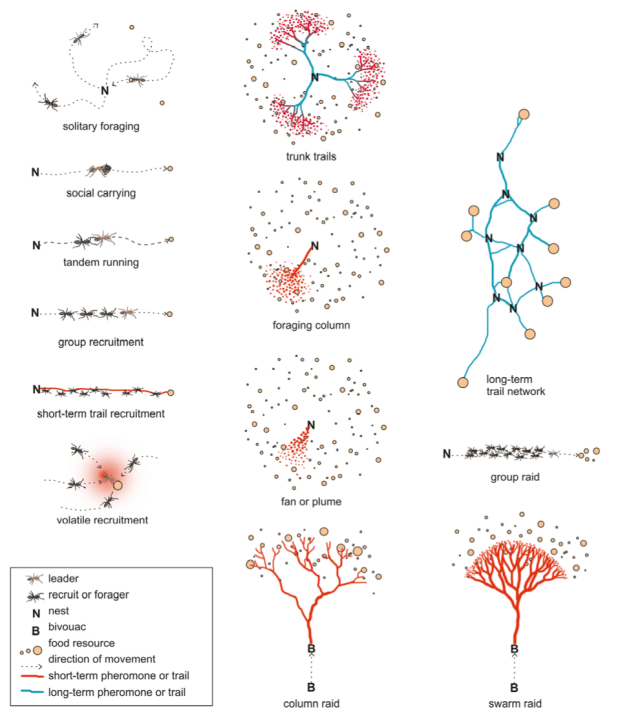
    Friday recommended reads #19

    Standard
    • The journal PLOS ONE is now requiring public access to raw datasets for all of the papers they publish. Not everyone is pleased. There are some really interesting points in this post, and some contentious comments that you might want to avoid.
    For links, thanks to Pete Rorabaugh and Rob Dunn.

    Public thesis defenses are illegal in the USA

    Standard

    In the United States, PhD students defend their thesis with a public presentation. After this presentation (or sometimes, on another day), the student has a private session with the dissertation committee to evaluate whether the student earned a doctorate.

    This practice is legal.

    In some other countries — and in some departments in the United States as well — the doctoral students are evaluated by their committees publicly after their thesis defense talk. I’m not naming departments in this post, though several have been brought to my attention in recent days.

    In the US, this practice is illegal.

    Public oral examinations violate FERPA, the Family Educational Rights and Privacy Act. Just as it is illegal to post the grades of students with personally identifying information (without prior consent), it’s illegal to administer an oral exam with spectators. I’m not a lawyer, but my reading of the plain-language summary of the bill is mighty unambiguous.

    For a thesis defense to be legal, everybody needs to be directed to leave once the public presentation is finished. Alternatively, the student and the committee retreat to a private area for the evaluation.

    As long as the defense is genuine, in which student performance is being evaluated, and there a nonzero (though infinitesimal) probability of failure, then it cannot be public unless the student has specifically waived privacy.

    I understand that the public grilling of doctoral candidates may be a time-honored tradition. If a student isn’t prepared to have their thesis publicly grilled, then the student shouldn’t be allowed to advance to this stage of the process. However, the public evaluation of the candidate’s performance for work towards the degree is simply straight-up illegal. There are a variety of legitimate reasons that a student may have for wanting to keep the evaluation process private.

    When rights protected by FERPA have been violated, students may not sue the institution for damages. However, the overt violation of FERPA can threaten federal funding. Departments that publicly evaluate the performance of doctoral candidates in public are, at least in theory, putting the university at risk.

    My have my own misgivings about public defenses as a faculty member, though it’s not about privacy. It has to do with the rigor of the process. While having a public defense might be seen as transparent and a sign of rigor, on the other hand it also can inhibit the members of the committee from providing an adequate evaluation. While there is a stereotype that professors can be vicious with arrogant questions and out to take students down a notch to inflate their own egos, these individuals aren’t that common. More often, committee members may be concerned about the appearance of collegiality and don’t want to be seen as unfairly attacking an unprepared student. If a student hasn’t truly done the work meeting the standard for the doctorate, the levy of that assessment would be unnecessarily cruel in public. Inadequate theses shouldn’t ever come to the defense stage. But by a product of flawed personalities and bad politics, this happens at times. A private defense might be the best way to deal with these occasions. Of course, a private defense also can cause an overstuffed committee member to unfairly sabotage a candidate. That is a flaw in the prevailing model in the US.

    I don’t know which one is better. But I do know which one is legal.

    Thanks to Canadians Alex Bond and Andrea Kirkwood, with whom I discussed private/public defenses on twitter. I can’t tell you anything about Canadian law, are they still a monarchy?

    Avoiding bad teaching evaluations: Tricks of the trade

    Standard

    Student evaluations are the main method used to evaluate our teaching. These evaluations are, at best, an imperfect measuring tool.

    Lots of irrelevant stuff affects evaluation scores. If you’re attractive or well dressed, this helps your scores. If you are a younger woman, you have to reckon with a distinct set of challenges and biases. If the weather is better out, you might get better evaluations, too. So, don’t feel bad about doing things to help your scores, even if they aren’t connected to teaching quality.

    My university aptly calls these forms by their acronym, “PTE”: Perceived Teaching Effectiveness. Note the word: “perceived.” Actual effectiveness is moot.

    People are aware whether or not they learned. However, superficial things can really affect perception. What our students think about the classroom experience is important. But evaluation forms are not really measuring teaching effectiveness. These evaluations measure student satisfaction more than learning outcomes. Since we are being held accountable for classroom performance based on student satisfaction, it is in our interest to pay attention to the things that can improve satisfaction.

    Here are some ways I’ve approached evaluations with an effort to avoid getting bad ones.

    • I try to teach effectively. The best foundation of perception is reality. I put some trust in my students’ ability to assess performance. If I’m doing a good job, my students should know it.
    • I work hard to demonstrate that I respect my students. It’s easy to give in to the conceit that my time is more valuable than the time of my students. When I see myself going down that dark pathway, I try to follow the golden rule, and treat the time of my students with as much concern as I would like my own time to be treated. For example, I make sure class always ends on time.
    • I emphasize fairness. On the first day of class, I let students know that life isn’t fair, but I try hard to make sure that my class done as fairly as possible. Students often volunteer gripes about their other classes, and unfairness is always the common thread in these discussions. Even if students perform poorly in a class, if they think that it was conducted fairly, then they are still usually satisfied.
    • I recall Hanlon’s Razor: “Never ascribe to malice that which is adequately explained by incompetence.” None of my students are out to get me. Ideally, they’re out for themselves. Sometimes, I’m not clear enough about expectations. When a student needs something, I approach the interaction with the default assumption that it’s my fault. And if it’s not my fault, it’s not an intentional flaw, so I can’t give students a bad time about the shortcoming.
    • I don’t engage in debates about graded assignments. I tell my students that if there is a very simple mathematical error or something I missed, they can bring it to me immediately after class. Any other errors need to be addressed with a written request by the start of the next class meeting. I’ve only gotten a few of these, and in all cases, the students were correct.
    • When a student is persistent about points, I avoid the argument whenever possible. I don’t concede unearned credit, but I don’t dismiss the concern either. Nearly all requests for grade changes are so tiny, they have a negligible on the final grade. I show, numberwise, it doesn’t seem to make a difference. I tell them that if they are right on the borderline at the end of the semester, I’ll make a note of it and we could talk about it at that time. This prevents the student from waging a futile argument, and keeps me out of the business of catering to minutia.
    • I run a tight ship. I can get annoyed by inappropriate behavior, but the students are usually even more annoyed. When someone is facebooking in the front row or monopolizes discussion, the rest of the class is usually super-pleased that I shut it down, as long I do it with respect. Classroom management is a fine art that we are rarely taught. (I’ve learned some education faculty and K-12 teachers.) I think establishing the classroom environment in the first few days is critical. I don’t enforce rules, but I develop accepted norms of behavior collaboratively on the first day of class. When things happen outside the norm, I address them promptly and, I hope, gently. When anybody (including myself) is found to be outside the norm, we adjust quickly because we agreed to the guidelines on the first day of class. I’ve botched this and have been seen as too severe on occasion, but I’d prefer to err on that side then having an overly permissive environment in which students don’t give one another the respect of their attention.
    • A classic strategy is to start out the term with extreme rigor, and lessen up as time goes on. I don’t do this, at least not intentionally, but I don’t think it’s a bad idea as long as you finish with high expectations. In any circumstance, I imagine it would be disaster to increase the perceived level of difficulty during the term.
    • I use midterm evaluations, using the university form partway through the semester, for my own use. This gives me early evidence about perceptions with the opportunity to change course, if necessary. I am open and transparent about changes I make.
    • I often use a supplemental evaluation form at the end of the term. There are two competing functions of the evaluation. The first is to give you feedback for course improvement, and the second is to assess performance. What the students might think is constructive feedback might be seen as a negative critique by those not in the classroom. It’s in our interest to separate those two functions onto separate pieces of paper. Before we went digital, I used to hold up the university form and say: “This form [holding up the scantron] is being used by the school as a referendum on my continued employment. I won’t be able to access these forms until after the next semester already starts, so they won’t help me out that much.” Then I held up another piece of paper [an evaluation I wrote with specific questions about the course] and said, “This one is constructive feedback about what you liked and didn’t like about the course. If you have criticisms of the course that you want me to see, but don’t think that my bosses need to see them, then this is the place to do it. Note that this form has specific questions about our readings, homework, tests and lessons. I’m just collecting these for myself, and I’d prefer if you don’t put your names on them.” I find that students are far more likely to evaluate my teaching in broad strokes in the university form when I use this approach, and there are fewer little nitpicky negative comments.
    • I try to avoid doing evaluations when students are more anxious about their grade, like on the cusp of an exam or when I return graded assignments. When I hand out the very helpful final exam review sheet, which causes relief, then I might do evaluations.
    • I don’t bring in special treats on the day I administer evaluations. At least with my style, my students would find it cloying, and they wouldn’t appreciate a cheap bribe attempt. Once in a long while, I may bring in donuts or something else like that, but never on evaluation day.
    • I’ve had some sections in with chronic attendance problems, in which some students would skip or show up late. On those occasions, I made a point to administer evaluations at the start of class on a day that had low attendance. I imagined that the students who weren’t bothering to attend class were less likely to give a stellar rating. Moreover, the absent students weren’t as well qualified to evaluate my performance as those sitting in class. (Of course, those attendance problems indicated that I had a bigger problem on my hands.)
    • Being likable and approachable. Among all the things that influence evaluations, I think this is the biggest one. There are many ways to be liked by your students, as a human being, but I think being liked is prerequisite to really good scores. Especially with our students who face a lot of structural disadvantages, approachability is important for the ability to do the job well. I’m not successful enough on this front. It hasn’t tanked me in evaluations, because by the end of the semester the students are comfortable with me, but that doesn’t emerge as quickly as I’d like. This is the area I need to work on the most. I am to do all the professorly things with students with the greatest needs, they need to be able to talk to me.

    Of course, some of these tips don’t apply if the evaluations are being administered online. This is a growing trend, and my university made the switch a couple years ago. (Thoughts and experiences with paper vs. online evaluations are in the ever-growing queue for future posts.)

    Are there different or additional approaches that you use for the non-teaching-performance related aspects of student evaluations?

    [update: be sure to read this comment. I think everything in this post is relevant to professors of both genders, but there are additional issues involving student biases that female professors need to deal with that I haven’t addressed. Professors need to be approachable to do their jobs. If students can’t talk to us, then that puts a low ceiling on what we can help our students achieve. However, what it means to be professional and “approachable” for a younger female professor might look really different than for an older guy. As I don’t have experience being a younger female professor, I’m not as well qualified to address this as some others. Another good reason to cruise over to Tenure, She Wrote.]

    Friday recommended reads #18

    Standard
    • Have you always wanted to trash (or praise) a paper publicly? Check out PubPeer, “the online journal club.” All of the comments also show up in PubMed, too.
    • Just like nearly every other fad in education, “flipping” a classroom is not really an innovation and not a big frickin’ deal. This is explained really well by Rebecca Schuman in her column in Slate. (Yes, Slate is click-baiting pablum, but everything Schuman has written there rocks. If you want a reality check on issues in higher education, and you are a twittery person, follow her at @pankisseskafka.)
    • I learned a number of things in this essay by Tricia Matthew, about Teaching While Black.
    • It’s conventional knowledge that the increasingly competitive job market has increased the time it takes for a postdoc to land a tenure-track position. Surprise: that’s flat-out wrong. At least in my field. For more than a couple decades, the mean PhD-to-tenure-track duration hasn’t changed at all, and is just under 4 years, among ecologists those who start tenure-track positions. Here are the data (it’s a paywalled pdf.)
    • Don’t forget that Taxonomist Appreciation Day is coming in less than a month, on March 19th! To warm us up, here’s a heartwarming and science-laden post by David Maddison called The Legacy of a Taxonomist.
    • If you’re thinking about taking someone else’s poop and shoving it up your butt, be careful, because there’s a growing call for government regulation.
    • What does the largest bat in the Neotropics eat? Other bats! Here’s a video of this discovery, and be sure to turn the volume up for crunching sounds. [update: old fact, just a new video. thanks to Dan Janzen for setting this straight.]
    • New York City has some great wildlife, especially ants. Now there’s a great new, and free, book about them written for the general public. Great for a variety of ages. Get it here. You can get a pdf or an interactive iBook.

    Anything you want to share? Please add them in the comments.

    For links, thanks to Morgan Jackson (via @BioInFocus) and Sharlene Santana (via TheBatcave_SS) and Meghan Duffy (via @duffy_ma).

    What do our grades measure? Academic savvy or actual learning?

    Standard

    Grades are a necessary evil. I record grades because it’s a required part of my job, even though the existence of grades makes my job harder.

    Grades are primarily a measure of how good students are at getting good grades, not a measure of how much they learned.

    My job is to foster curiosity and independent learning. I want students to grow by fulfilling a personally motivated need to understand. Grades inhibit that process. Grades make students focus on doing what it takes to get a good grade. That’s not a good thing.

    People learn far more deeply when the information is discovered through a self-directed process of inquiry. When students are studying for an exam, what they are doing is the exact opposite of self-directed inquiry. They’re working to anticipate what others might expect of them and they’re working to fulfill the external expectations. When I have to give an exam to students, the last thing I would ever want is for them to study by trying to anticipate what is going to be on the exam. Because then they’ll be studying to just cover their bases.

    In other words, when we make students jump through hoops, we get in the way of genuine learning. Students working towards a grade are not looking past the final exam. If none of my students are interested in the material after the exam is over, then I have earned an F for the semester.

    Students can be prepared to answer a ton of questions, on a variety of topics. They then can do what it takes to get a good grade. And then, it’s possible to not really know a damn thing about the topic months later, after the exam, when the grade is in their transcript. That’s because their relationship with the curriculum was about learning stuff to get a grade. It might have been interesting or fascinating at the time, but if the motivator is the grade, then the motivation isn’t the pressing need to understand anything.

    So, when we assign grades to students, what are we really measuring? Are we measuring effort? Are we measuring the ability to memorize stuff? Are we measuring the ability to explain things eloquently? Are we measuring the ability to anticipate what will be on an exam?

    I don’t like any of the preceding options. What I’d like my grades to measure is how well the students have mastered the central concepts in the course. The problem, however, is that all of the ways of measuring that – the mastery of the central concepts – get biased by the ability of students to do all of that other stuff in the preceding paragraph. When students are assigned grades, the outcome is determined more by their academic gamesmanship than how much they actually learned.

    Academic gamesmanship, caused by grades, gets in the way of genuine curiosity. Far too often, students get good grades only because they know how to earn good grades in the system; just as often, students who learn earn poor grades because of poor gamesmanship. The last thing I want is for the grades in my course to reflect a student’s savvy rather than learning.

    I don’t know how universal this is, but my university requires that all syllabi have clearly stated “Expected Learning Outcomes.” Grades need to reflect how well students fulfill the expected outcomes. If designed right, these outcomes can allow students the intellectual breathing room to develop their own critical thinking process about a course.

    In my opinion, the best way to liberate students from academic gamesmanship is to remove every bit of mystery from the grading process. Nothing on an exam should ever come as a surprise, nor should students be in a position in which they feel like they need to interpret what you think is important about the subject. Nor should students have to worry about cramming for a laundry list of concepts.

    Our grades can’t really measure genuine learning. But the less our grades reflect gamesmanship, the greater the chance our students will be genuinely engaged in the content.

    All faculty need academic freedom to protect their students

    Standard

    Sometimes I hear questions like, “Why is academic freedom so important? Why should university professors should have total control over what they teach?”

    Let me answer those questions with a cautionary tale.

    Last semester, a shortage of academic freedom in one department at my university caused what can only be characterized as a tragic boondoggle. This is causing an entire cohort of students to graduate one year late.

    Over fifty Biology majors were enrolled in the second semester of General Chemistry. An adjunct lecturer planned and taught this course. The tenure-track faculty in Chemistry implemented their own common internal exam to be administered to all General Chemistry students. The instructor was not privy to the contents of this exam while she was teaching this course. Consequently, over the entire semester, the lectures and homework assignments did not correspond to the material that the students were tested on at the end of the course.

    The students, who had been performing well throughout the semester, were blindsided with an exam that looked nothing like they had been studying for the whole semester. This class historically has a pass rate exceeding 80%. Last semester, however, more than 80% of the students failed. The instructor of record for this course, who taught the whole semester, did not apparently have authority over the grading of the exams, nor final authority over the grades that she was directed to submit to the university. This sounds outrageous, but also sounds like the only sensible explanation for what transpired.

    Most of these students clearly did not deserve to fail. They did not deserve an exam that did not reflect the content of the course itself. They deserved an instructor who has the authority to control the grades assigned in the course.

    The chair of the department is not making any accommodation for the students who got screwed over in her department. The chair claims that the students simply weren’t prepared for the exam. I don’t dispute that fact, but in this circumstance the lack of student preparation is the fault of the Chemistry department, not the students. The students fulfilled the academic expectations of the instructor, but that had no connection to their grade. That is flat-out unethical.

    The consequences of this F go well beyond this single course. None of the students can retake the course this semester, because those sections were filled by those who passed preceding course in the sequence.

    The soonest these victims can retake the course is one year after they were originally enrolled, but now we have twice as many students trying to take this course and the Chemistry Department refused to offer any additional sections to its victims from last semester.

    This course is a prerequisite to Organic Chemistry, which is a prerequisite for other courses. Nearly all of our majors in this section – more than fifty students – are now going to graduate at least one year later than they had planned.

    What’s the worst part of all this? It happened two months ago, and as far as I can tell, the only people who aware and troubled are the ones who have no power to change anything.

    If any of our students had families donating large sums of money to the school, this situation would have been resolved lickety-split. If anybody with authority in Chemistry actually cared about the students, this would have been fixed before the semester ended. If department had any confidence in their trained contingent faculty, then this unjust situation wouldn’t have emerged.

    The students can file a grade grievance, but that won’t fix the problem. It takes at least a year for that process to go through the system. (I served once as a “preliminary investigator” for a grade grievance claim, and the incident happened three semesters earlier.)

    You might ask, “Aren’t common exams an effective way to make sure that there is consistency in grading when section are taught by different instructors?” The answer to that question is yes. However, that consistency has a price. In this case, the price is reasonable academic progress for scores of students. Keep in mind that most of our students work long hours in addition to a full class load, and also have substantial family concerns at home. Being in school is a great challenge, and we just made made the climb to graduation even steeper.

    The required use of common exams deprives instructors of the academic freedom to evaluate their own students.

    If similar events had taken place in any of the three private institutions in which I’ve taught (as adjunct, visiting, and tenure-track), this disgrace would be unthinkable and scandalous. There would be mass protest. But at this disadvantaged university, it’s just one more injustice.

    At this point, I’m not even sure if our administrators are aware of this incident. I have a huge amount of confidence in the Dean and the President, who I imagine would do everything they can to resolve this situation, insofar as it is possible. The fact that this problem wasn’t a howling and yelling crisis at their doorstep at the end of last semester is a sad testament to the fact that our students are just accustomed to being disempowered, and they just roll with being wronged. It’s our job, as faculty, to prevent these wrongs from at the outset. That starts with giving all instructors that academic freedom over their own workload.

    If any instructor is good enough to be hired as to teach for the university, then they’re good enough to be trusted by the university to carry out their job independently. Any department that lacks the faith that its own instructors can teach appropriately has huge problems that can’t be fixed by imposing a top-down exam.

    As a postscript, I should note that common exams are not always a disaster, though I think they are inadvisable. In grad school, I used to teach three sections in a class that had more than 40 sections. All of the TAs gave the same exam, and we had little control over this exam. We didn’t even get to see it until a few days before we taught, because it was a practicum set up at the last moment. I see the need for consistency among sections taught by graduate students with little to not teaching experience. I don’t see the need, however, for this particular solution.

    How the heck was I supposed to know what to teach when I didn’t know the basis on which students were going to be evaluated? This was obviously a problem for students. (I also lacked the experience and professionalism to deal with this situation effectively.) This was mostly an annoyance, though, and the students did just fine in the end as best as I can recall. The lab was not overly detailed, and the exams weren’t overly idiosyncratic. As a novice instructor, I found the system to be unfair to both myself and the students. If instructors are teaching a course, they should be able to construct or choose their own evaluation. If for some reason that doesn’t happen, at the very least the faculty need to know exactly what is in exams before the start of the semester.

    Friday recommended reads # 17

    Standard

    What do journal impact factors really mean? For starters, impact factor predicts retraction rates better than long-term citation rates.

    Who doesn’t love critters and maps? Here’s a brand-new site with high quality biodiversity maps, by Clinton Jenkins. On my first browse, I learned that the real salamander diversity in in the Smokies:

    salamander diversity

    My family went to see the anti-consumerist Lego Movie and really liked it. Here’s an article in The New Republic, putting the competing views of the movie’s social commentary into context. (By the way, here’s the old post about female Lego field biologists.)

    My favorite new academic blog is Good Enough Professor about teaching and scholarship in the humanities, with many lessons for scientists, and everybody else, too.

    What should a manuscript review look like? The British Ecological Society put together a great pamphlet for novice reviewers (it’s a pdf.). It also would be great for giving to someone outside academia who wants to really understand what “peer-reviewed” means.

    Here is a compelling news item from NPR, about a long-term demographic study, that was depressing, discouraging, and fascinating, about how “race is socially constructed,” and not in a good way. It’s definitely worth the five-minute listen.

    We really do have to keep making the point to girls, again and again, that you really can do what you want to do. Here is a touching story about a girl discovering that she can grow up to have the career she wants.

    The thylacine went extinct a good long while ago, so I was surprised to see there is video footage of the last one.

    If you sample material from the last known individual of a tree species, and then it dies from an infection, well, that’s not a good thing.

    How do you get the public to be aware of the importance of taxonomy? I guess you could name a beetle after David Sedaris. Is that pandering?

    Some education reform knuckleheads want to impose a “college readiness exam” on students enrolled in college before they can receive a federal Pell grant. Tressie Cottom explains how this is as paternalistic and a back-door discriminatory filter like a poll tax: “If you know the kind of racialized, gendered and classist segregation that defines who is and who is not “college ready” AND you concede by ideological imperative that knowledge is a type of capital, then what is a readiness test, exactly?”

    Please add additional links you’d like to suggest in the comments.

    Thanks to @phdbee, @myrmecos, @leafwarbler, and @TrevorABranch for leads.

    Structural privilege in the world’s premier science fair

    Standard

    Three years ago, the “world’s largest pre-college science fair” was passing through town. I was asked to volunteer as a judge, and my university system was pleased to have a faculty member at the event. I was a student in the fair in 1988, too, so I was curious to see it from the other side.

    What I saw was appalling.

    After the experience was over, I got a pro forma email asking me to provide any remarks and recommendations. Here is what I sent back to the organizer, edited for length and to accommodate the uninitiated.

    May 16, 2011

    Dr. XXXXX:

    I actually do have some remarks, as I’ve been really troubled since the judging took place last week. I’d like to know what response my remarks might elicit, if any. It is my hope that my remarks are taken seriously.

    To make the very long story short, I’m troubled by what seems to me to be a systemic problem in the judging process. I’m not taking this lightly and I find this compromises the integrity of the fair in a serious way. I didn’t say much about it at the time — I was quickly dismissed — but after some detailed consideration and deliberation with colleagues, I am very concerned about the process. I am reluctant to participate as a judge again because my involvement would compromise my professional standing, if my colleagues were to know how this process took place.

    There was a shortage of judges in my category, some projects were only officially seen by 2 [which is far below the standard set by the fair; there were 30+ judges on my panel as there were many projects]. Because the finalists did not receive enough interviews to have a representative sample, the scores from the official judging sessions were thrown out, and the decisions in caucus were actually not informed whatsoever by the votes. In fact, the group voted by majority to ignore the scores, even though not all of the judges were present in the caucus.

    During the caucus process, each of the judges advocated for what they considered to be top projects for the grand, 1st place, and 2nd place awards. Each of the judges introduced what they thought to be the strength of the project and the finalist who conducted the project, and then those with experience with the finalist and project then contributed their opinions. Of course, given the breadth of projects, much of the science was outside the expertise of the judges who were assigned to a particular project. We all communicated our areas of expertise and made a point to interview students whose projects fell within out expertise, even if we were not officially assigned as judges to a particular poster.

    The basis of evaluation for most of the projects was based on the students’ abilities to articulate the purpose of the project, why they conducted the project, and what they learned from the experience. When the judges were evaluating the projects, there was a strong emphasis on shared interests and how much the finalists convinced the judges that they were personally inspired by conducting their projects. When the judges were asked why they thought certain projects should be selected, they judges emphasized that they could really relate to this student, found them likable, and found that their fascination, and decision to conduct the project, to be superb.

    These criteria are faulty in several ways. The central problem with this approach is the inherent cultural bias. Depending on the cultural background of the student, the students may be trained to not communicate great passion in their science, as they may believe that communicating inspiration would distract from the significance of the project. The cultural bias in this criterion is even more insidious because the way that a judge evaluates excitement and likability is biased towards individuals from their own cultural group. One judge who heavily advocated for a project – which won the grand award in the section — said (this is a rough quote from my notes): “My main reason for this choice is that I made a connection with her, she’s very personable and you could feel her enthusiasm for science more than the other finalists.”

    Not all projects were perfect — though some approached perfection. There were some amazing students. Clearly, the judges were looking to find areas in which some students were more superlative than others, or to find flaws. This was the area that cultural bias was most overt. The flaws of students whose ethnic backgrounds resembled the judges were overlooked, and the flaws (in some cases, incorrectly evaluated by those who were not experts in the field) in the underrepresented students were scrutinized and amplified by the judges. As one example, a few judges specifically stated that they would give a student (of similar cultural background) a “free pass” on the statistics of the project, while the statistics of other projects (by students of different cultural backgrounds) were heavily scrutinized by the same judges. This happened even though the student with the free pass had simpler statistics which were central to the finding. In this case, I cannot come to any conclusion other than the fact that it was cultural bias – and I’m working hard to keep an open mind. This was not just the case with one or two projects, but a consistent pattern that I detected near the end of the caucus session after considering many of the deliberations.

    Let me put it this way: The way the judges picked their top projects, it was a virtual impossibility for a project by a student to rise to the top of the list of finalists, if these students had an odd accent or who did not share a similar cultural background to the judges. I do not take this charge lightly, and do not make it without understanding the gravity of this charge.

    I think the number of judges is a little problematic, and the qualifications of the judges is problematic, but the prevailing problem that taints the integrity of the process is the overt cultural bias that occurred. I do not think the basis of this cultural bias — which some might simply call systemic racism — is rooted in any kind of overt racism among the judges. The judges were evaluating based on criteria that they could use, and in the absence of scientific expertise, they were drawing merely on intuition which does not work well for finalists with different cultural backgrounds.

    None — absolutely zero — of the judges came from groups that are traditionally underrepresented in the sciences. Given the ways in which top students were evaluated, I can’t imagine a scenario in which a student from an underrepresented group could have come out of the caucus with the top prize. I was surprised that I was the only person in the room who was conversant in Spanish – when the group was struggling to fairly evaluate the projects by several students who came from Puerto Rico. The translators were clearly not professional translators and had difficulty with the science and technical words (I interceded in one case, when I was walking past, to clear things up. I wish I had more time for this task but I had my own judging assignments to attend to.)

    I think this can be fixed using three approaches. First, the judges need to be experts in their scientific discipline, with advanced degrees and an active research agenda. I greatly respect and admire K-12 educators, but some of the judges with this background were not prepared to evaluate most projects, which were conducted in a university laboratory under the mentorship a Ph.D. scientist. [more on this topic here, by the way.] Second, the pool of judges should only be certified after there is adequate participation of individuals from underrepresented groups. Third, the recruitment of judges should be more robust to draw from local talent in the area – nearly none of the faculty or professional researchers in the LA area were judging in my panel, which mostly consisted of volunteer educators flying in from around the country. As you realize that Los Angeles is a highly diverse area with scientists from many backgrounds, recruiting judges representing the ethnic diversity of the city is not an unreasonable task.

    Please let me know what response there might be to my concerns.

    So, what was the response? After asking three times for a reply, this is what I eventually received:

    October 03, 2011

    As for your concerns on the number and quality of judges, I assure you that the there was no one more concerned than I was about the small number of judges who actually showed up and interviewed students. The no-show rate was considerably larger than I had anticipated.  Those that did show up, however, were well-qualified, with only a small number of exceptions, and I don’t know that any of those exceptions were in your panel.  I’d have to look at the detailed records to be sure.  I suspect, rather, that most people were being modest in their introductions if you got the impressions that they weren’t good enough to be there.

    Here was my reply:

    October 03, 2011

    Thanks for getting back to me.

    Just to be clear, my concerns were not so much about the qualifications of the judges and the degrees they hold, but rather the fact that the judging criteria – as stated by several judges in caucus – were not connected to any of the criteria specified by [the organization] and as a consequence, the judging was culturally biased.

    There were a number of students who lacked the upper-middle class white upbringing that had no chance at winning a prize because of their background. Moreover, some of the top prizes in my category were selected on the basis of their likability and enthusiasm – and their ability to connect with judges on a personal level – even though the experts in the panel found major flaws and errors in their projects that should have knocked them out of contention. I found this appalling and I couldn’t leave from the process without having expressed my concerns.

    Nobody in these panels can understand all of the projects fully – there is far too much breadth and depth. I’m not expecting this. What I did find are people who preferred to rely on their own impression of the likability of a finalists, and were inclined to disregard the opinion of the judges who were experts in particular subfields. Ultimately, the majority of the panel voted in caucus for finalists who they personally got along with, even if other judges clearly showed that these finalists had a poor understanding of their own projects or discovered that the finalists misrepresented their work.

    This reminds me the sausage factory analogy. I think it’s just best for everyone if I stop eating the sausage.

    After that? Crickets. Or frogs. The sound of silence.

    The fair passes through town again in three months. I’m torn between showing up to fight against cultural bias, but I’m tempted to steer clear. I hope they invest more heavily into diversifying the pool of judges this time around. Maybe my best contribution would be to work hard to improve the pool of judges. There is a ton of money poured into organizing this fair, and with just a little bit of it, they could invest more in efforts to get a qualified and diverse set of judges. In the meantime, I suppose my efforts judging are best spent on science fairs in local public schools.

    At the time this happened, I talked about it with one colleague of mine who was in my section (who I got to know in the day-long process of judging). She was not as concerned as myself because she didn’t perceive structural bias. She thought the judges were underprepared and over their heads, but not discriminating on the basis of ethnicity. She’s a very smart and very reasonable person, and has great judgment. So, I could be merely hypersensitive. On the other hand, the most parsimonious conclusion is probably that a room full of non-underrepresented minority judges is coming up with an unfairly biased outcome. In our current environment, anything else would be quite remarkable.

    I’ve had concerns about posting this because of non target effects on the participants in the science fair. However, as I am equally qualified to judge in several categories in the fair, the only readers who could know which particular section I was involved in would be the officials with records of the fair. Of course, it should go without saying that none of the students did anything wrong or unfair. I am only taking this to the public venue after being blown off by the people in charge. The people in the organization that puts on the fair are well-intentioned, and I would like to see opportunity extended to all.

    My aim is respectful conversation. I I hope I might be able to get a more constructive and detailed response from the organization in charge of the event. I think the the best case scenario is that the organization adopts guidelines that require effort to diversity the judging body, and invests the time and money required into making sure that these guidelines are both followed and enforced.

    Keep in mind that my own participation in the fair in 1988 was the product of capricious judging, at least at my own high school, and my own gender and ethnicity helped me get there. One could argue that that experience was one of the things that led to me becoming a scientist. So sitting on the sidelines is tantamount to silently profiting from an ongoing injustice.

    How would you size up this situation, and what would you do?