LEGO makes more women in science!

Standard

Nine months ago, I asked LEGO to make more female scientists. As a start, I cobbled together a few from spare parts at home: arachnologist, chiropterist, herpetologist, ichthyologist and ornithologist. Click through to check them out. I made them with my 10-year old son.

I never thought they’d make a chiropterist. But, now, they indeed they are making an astronomer, a chemist, and a paleontologist! Continue reading

Recommended reads #28

Standard

Submitting abstracts for conferences without having the data

Standard

I’ve developed a mechanism to make sure that I stay productive: when I submit abstracts for meetings, I promise data that I haven’t finished collecting. Of course when I give a talk, I can say almost whatever I want. Nobody’s going to cut me off if my talk doesn’t match the program.

I just realized that I always have been in the habit of submitting abstracts for projects that are so fresh, I haven’t even gotten all the numbers, much less run analyses. In grad school, that was the only option, because at one point I didn’t have anything else to say. Now, even when I have other newish finds that I’ve yet to present, I submit abstracts for projects that still lack a rudimentary answer. I do this at least once a year, writing a check for results that aren’t yet in the bank. Continue reading

One person’s story about post-PhD employment

Standard

I’m an Associate Professor at a regional state university. How did I get here? What choices did I make that led me in this direction? This month, a bunch of folks are telling their post-PhD stories, led by Jacquelyn Gill. (This group effort constitutes a “blog carnival.”) Here’s my contribution.

I went to grad school because I loved to do research in ecology, evolution and behavior. I knew when I started that I’d be better off having been (meagerly) employed for five years to get a PhD.

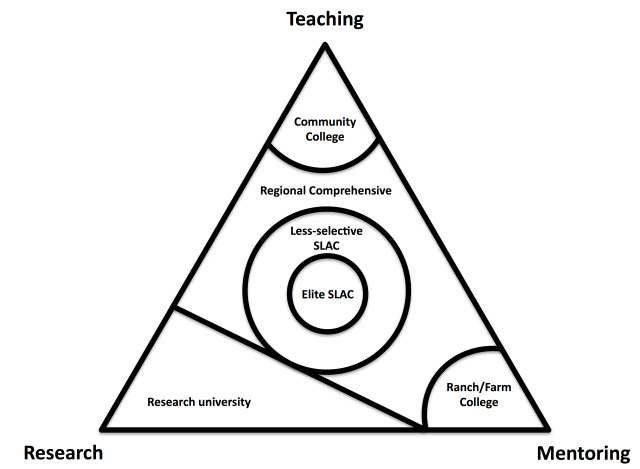
The default career mode, at least at the time, was that grad students get a postdoc and then become a professor. It was understood that not everybody would want to, or be able to, follow this path. But is still the starting place in any discussion of post-PhD employment. As time progressed in grad school, I came to the conclusion that I didn’t want to run a lab at a research university, and that I wanted an academic position that combined research, teaching and some outreach.

I liked the idea of working at an R1 institution, but there were three dealbreakers. First, I didn’t want the grant pressure to keep my people employed and to maintain my own security of employment. Second, I wanted to keep it real and run a small lab so that I could be involved in all parts of the science. I didn’t want to be like all of the other PIs that only spent a few days in the field and otherwise were computer jockeys managing people and paper. Third, I was taught in grad school that the life of an R1 PI is less family-friendly than a faculty position at a non-R1 institution. In hindsight, now that I have worked at a few non-R1 institutions, I can tell you that these reasons are total bunk. I was naïve. My reasons for avoiding R1 institutions were not valid and not rooted in reality. Even though I now realize my reasons at the time were screwed up, I was primarily looking for faculty jobs at liberal arts colleges and other teaching-centered institutions.

We muddled through a two-body problem. My spouse wasn’t an academic, but needed a large city to work. She was early enough in her career that she was prepared to move for me while I did the postdoc job hop. I wouldn’t have wanted her to uproot from a good situation. In hindsight, our moves ended up being beneficial for both of us.

As I was approaching the finish to grad school, I was getting nervous about a job. My five years of guaranteed TA support were ending. I recall being very anxious. I landed a postdoc, though the only drawback was starting four months before defending my thesis. I moved from Colorado to Texas for my postdoc, and spent the day on the postdoc and the evenings finishing up my dissertation. As a museum educator, my spouse quickly found a job in the education department at the Houston Museum of Nature and Science.

While I was applying for postdocs, I also applied for faculty positions, even though I was still ABD. And surprisingly enough, I got a couple interviews. (I think I had 2-3 pubs at the time, one of which was in a fancy journal.) I got offered a 2-year sabbatical replacement faculty position at Gettysburg College, an excellent SLAC in south central Pennsylvania. At the same time, my spouse was deciding to go to grad school for more advanced training in museum education. By far, the best choice for her was to study at The George Washington University (don’t forget the ‘The’) in Washington, D.C. This seemed like a relatively magical convergence. With uncertainty for long-term funding in my postdoc (and also no shortage of problems with the project itself), we bailed on Texas and headed back east.

We lived in Frederick, Maryland. Which at the time was the only real city between Washington DC and Gettysburg. (Since then, I’ve heard it’s been converted into an exurb of DC.) I drove past the gorgeous Catoctin mountains every day to go to work, and she took car/metro into DC to work and started grad school. We scheduled her grad school so that she’d finish up when my two-year stint at Gettysburg would be over. I taught a full courseload for the first time, and noticed that I really liked the teaching/research gig at a small college. Grad school was great for my spouse. Life was good. In my first year as a Visiting Assistant Professor, I got four tenure-track job interviews.

Through a magical stroke of fortune, I got a tenure-track job offer in my wife’s hometown, in San Diego, just 2 to 5 hours away from my family in LA (depending on traffic). The only catch was that I’d have to leave my position at Gettyburg one year early, and my wife had one year left in grad school. But, I really needed to focus on starting out my tenure-track position, and she really had to focus on grad school. She could move to DC instead of splitting the commute with me, and I could figure out San Diego without her for a year. If kids were involved, this scenario would have been a lot more complicated. If my spouse’s career was at a more advanced stage, the move from grad school to postdoc to temporary faculty to tenure-track faculty would have a lot messier and would have required more compromises. But somehow we made it work and it felt something resembling normal.

Then, after working in San Diego for seven years, we moved up to Los Angeles. I already have told that story. Which, if you haven’t read it, is a nail-biter.

As I tell the story to non-academics, they find our peregrinations rather surprising. From LA, to Boulder, to Houston, to Maryland, to San Diego, and eventually back to LA, at least for the last seven years. (In the meanwhile, I’ve been going back and forth from my field site Costa Rica on a regular basis). This frequency of moving is entirely normal in academia, even if we look like vagabonds among our friends.

What do I offer as the take-home interpretations of my post-PhD job route?

First: The geography of my tenure-track job offers was lucky. To some extent, I’ve made this luck through persistence, but having landed a job in my wife’s hometown was pretty damn incredible. And after botching the first one entirely, getting one in my hometown was amazing. Now that my spouse is at the senior staff level, openings in her specialized field of museum education are about as rare and prized as in my own field. However, we now live in a big city with many universities and many world-class museums, so we can (theoretically) move jobs without moving our home. We now are juggling a three-body problem.

Second: My early choices constrained later options. Even though I no longer am wary of an R1 faculty position, after spending several years at teaching-focused universities that is a long shot for me. (I do several people who made that move, but it’s still a rarity.) I’m confident that I can operate a helluva research program at a highly-ranked R1, but I’m too senior for an entry-level tenure-track position, and not a rockstar who will be recruited for a senior-level hire. For example, I am confident that I would totally kick butt at UCLA just up the road, but I doubt a search committee there will reach the same conclusion. I am just as pleased to be at a non-prestigious regional university, and when I do move, it’ll be because I’ll be looking for better compensation and working conditions. I’m looking at working at all kinds of universities, and I think my job satisfaction will be more tied to local factors on an individual campus rather than the type of institution.

Third: I applied for jobs that many PhD students and postdocs think are unsuitable for themselves. I spent a lot of time creating applications for universities that I’ve never heard of. I was hired as an “ecosystem ecologist” at CSU Dominguez Hills in Los Angeles. Even though I grew up in Los Angeles, the first time I ever heard of CSU Dominguez Hills is when I saw the job ad. And I’m not an ecosystem ecologist either. That didn’t keep me from spending several hours tailoring my application for this particular job. But I wouldn’t have gotten this job unless I applied, and most postdocs are not applying for jobs like the one I have now. I know this from chairing a search committee for two positions last year. That’s a whole ‘nother story.

Fourth: Is being a professor my most favorite job ever? Actually, no. My employment paradise would be a natural history museum, with a mix of research, outreach and occasional teaching. I’m not a systematist or an evolutionary biologist, so getting hired into this kind of job is not likely. However, I have had a couple interviews for curatorial-esque positions over the last ten years and was exceptionally bummed that I didn’t get them. On the balance, even large museums go through phases of financial instability. It would be hard to give up tenure for a job that might bounce me to the street because of the financial misdeeds of board members and museum leadership. I’ve seen too many talented good museum people lose positions due to cutbacks or toxic administrators. I don’t know what could get me to take off the golden handcuffs of tenure. There are some university museums that hire faculty. That would be wonderful. Maybe someday that could happen. But I am pleased with what I’m doing, and I still am amazed that there are people paying me to do what I love.

Fifth: I ruled out a number of possibilities for family reasons. There are a variety of locations where I would be able to find work but would be unworkable for my spouse. Even in the depth of a job crisis, I opted against a number of options that would’ve given me strong and steady employment.

Sixth: I am not employed as a professor because I deserve it more than others. There are others equally, and more, deserving that are underemployed compared to my position in the academic caste system. The CV I had when I got my first academic position probably wouldn’t be able to do so now, 15 years later.
The interplay of science and activism

Standard

This is a guest post by Lirael.

I’m a grad student in the sciences. I’m also an activist. I spend most of my time doing one of those two things. So Amy’s recent post got me thinking about science and activism and how they mix. What do you do when needed public attention to some issue in your field turns out to be lacking in scientific literacy (or understanding of the business of science)? How, in general, do science and politics interact? What are the implications of those interactions?

When we talk about making things political, what we typically mean is reducing them to soundbites or partisan battles. But if you think of politics in a broader sense, most things are political, or at least have political implications, including science. Study on the speed and potential effects of climate change is political. Which diseases get prioritized in research funding is political. How diseases are defined is political (look up the controversy around women, the CDC, and AIDS in the early 1990s). Robotics, with its wide variety of applications, including politically charged ones like defense, manufacturing, and agriculture, is political. Politics is about people’s lives, and science affects people’s lives – isn’t that one of the reasons that many of us got into it?

Funding isn’t apolitical either. Within some fields of math and computer science, there’s significant controversy about NSA funding. One reason that I stopped working for defense contractors was my discomfort with how the funding source affected how we were thinking about the potential applications of our own work – for instance, thinking of, and presenting, work on fast pattern classification in terms of its usefulness in missile guidance rather than its usefulness in classifying ventricular arrhythmias or diagnosing retinal disorders. Or thinking of and presenting work on indoor robot navigation in terms of military applications rather than civilian emergency assistance, room cleaning, etc. And concerns about funding and conflicts of interest, especially in a biotech context, leading to bad/biased science aren’t limited to people who are clueless about how science funding works.

The Avaaz campaign pitch has a lot of cluelessness, as we’ve noted. They don’t seem to get how science is done – they think they’re going to change the field by funding a single study? They don’t consider how their funding might be just as likely to introduce bias into the science that they fund as any other funding. They don’t explain how they’re going to find a lab to fund. They don’t appear to know the state of bee research very well, or if they do, they’ve sacrificed that in the name of a more easily accessible funding pitch. So what do scientists do with this? What do activists do with this? What’s a better model than this campaign? What can we do to help ensure that people who are committed to action on the problems that affect their lives understand the science behind it?

I’ve been active in my state’s climate justice movement over the last year, and one of the things that struck me was how many scientists there were at the protests. I’ve participated in a lot of social movements, and let me tell you, that is not something that you usually see. There was a time when I was in a group doing jail support (where you wait outside a jail for arrestees to be released so that you can give them food and water and first aid and emotional support), and a tenured physicist, who was also part of the jail support group, gave an impromptu lecture on introductory thermodynamics to a group of interested fellow protesters to pass the time. I’ve gotten rides to events with people who tell me about their research in geology or atmospheric science. One of the major local organizers is on leave from a math PhD program. I’ve been on a six-day march where one evening, after we got to our camp site, we sat around and had a Q&A with a photovoltaics guy about the current state of solar energy. These people add a lot to the movement. They participate in a variety of ways, and they also educate. The climate justice movement has been bringing scientists to teach-ins, to improve other participants’ scientific literacy, for years.

Another interesting model is the Union of Concerned Scientists , which started as a project of MIT students and faculty in 1969. They produce layperson-friendly issue briefings (including on science funding as well as on relevant science and engineering issues themselves), produce original research and analysis, run scientifically-literate petition campaigns, and much more. Many of their issue briefings contain “What You Can Do” pages for laypeople, and they have an activist toolkit on their site.

Layperson activists can play important roles in the politics of science. In the first example that pops into my head, the often-confrontational AIDS action group, ACT UP, which was not exactly known for its nuance, won lower prices per patient for AIDS treatments, accelerations in FDA review of treatments, and improved NIH guidelines for clinical trials. Were there ACT UP participants who reduced complex issues of funding, safety, and research pace, to simplistic talking points? Yes. Did they sometimes say things that were unfair to well-meaning scientists? Probably. But they got results – working together with scientist-activist mentors like organic chemist Dr. Iris Long.

If you think that a movement is trying to support a worthy cause but is missing important points (or making wrong ones) with their sloganeering, help them come up with better slogans (yes, you need slogans, not just journal articles, in any form of activism) and better talking points.

How honest should I be about my career goals? My post-PhD story.

Standard

My post-PHD journey is peppered throughout the posts I write here but I was inspired by a blog carnival over at the Contemplative Mammoth to put together a single post. After May 28th Jacquelyn Gillpromises to compile all the links, so if you’re interested in what people do after their PhDs, head on over there.

Long before I finished my PhD, my path in academia was never particularly clear. I came to research late in my undergraduate studies and at every stage I have thought: “Well this is interesting, challenging and fun, so lets see if I can find a masters/PhD/position”. I knew that at each of these filters there was a real possibility that I wouldn’t be able to find the next position. So I remained cautiously optimistic but always thought that at some point I would have to figure out what to do when I go up. Since I was aware of the possibility that I wouldn’t find a position along the academic trail, I’ve never been focused on a tenure-track position as the only career choice that will make me happy. But as I have progressed, I wonder how honest I should be about this fact.

You see I’m not convinced that I will end up as a professor. I know that it takes an incredible combination of skill and luck to land a position. Although I ended up doing a PhD in one of the top programs of my field, when I applied there were other top schools that didn’t invite me to interview. So even at that stage I was aware that there is variance in decisions and that I am not one of the applicants with a flawless CV (at that stage I had good research experience but less than top undergraduate grades and GRA scores). Last year I was one of the selected candidates to interview for two positions in Sweden. Unfortunately for me, I didn’t get either but what was interesting was that I applied for the positions with two of my colleagues. The person who got one of the positions wasn’t even invited to interview at the other and the two of us that did interview for both flipped in ranking between the two jobs. I don’t take this as a sign that the system is random but rather that when comparing good candidates, how qualities are weighted will always vary between selection committees. But of course it does worry me that I might never quite make it to the top of the list.

So given what I think is a somewhat realistic frame of mind, I have always taken the ‘let’s see what happens’ approach. That means that in conversations throughout my career I have not been dead certain that being a professor is my one and only goal. But when I’m honest about my uncertainty, I find that it can be mistaken for a lack of desire or drive. Like hinting that you are aware that there are few permanent professor positions and the reality is that you might not get one means you aren’t interested in continuing in academia.

To be clear: I love my job. I am sometimes afraid to admit how much I enjoy it, like a kid not wanting to jinx my chances. Sure there are lots of things that stress me out about this path but when I take a moment to think about it, I love my job. I love being able to think about new questions and new problems all the time. I love teaching and getting students excited about the world around them. I love the challenges I face that force me to grow and learn all the time. I love to write and present findings at conferences. I love talking to people about their work and collaborating. As a career, I can’t think of any better and I truly hope that I can keep on doing what I’m doing.

But here’s the catch: I’m not willing to sacrifice everything to achieve a tenure track position. I have a family that I need to consider if we make a move for a position, but I also have a family that I want to spend time with. For me that means I work less than I could and that is certainly is reflected in my publication rate. So when I look at my CV, I see that I could do better but I also know that I don’t want to trade-off my happiness now for some uncertain happiness in the future when I have tenure.

So should I be honest about my uncertainty? I have become wary of talking too frankly because I don’t want the perception to be that I’m not dedicated. Thus far I have been fortunate that I have been able to keep going in academia and I haven’t seriously considered other options. I might have to do that when my current funding runs out but for now I continue on working towards an eventual permanent position.

So for me, my post-PhD story doesn’t have an ending. I still feel in flux and don’t know where I will end up, geographically or otherwise. But for now I’m enjoying the ride.

How much do you let students design projects?

Standard

Now is the time of year when we work with students on designing summer research projects. How do you decide exactly what their project is, and how the experimental design is structured? This is something I struggle with.

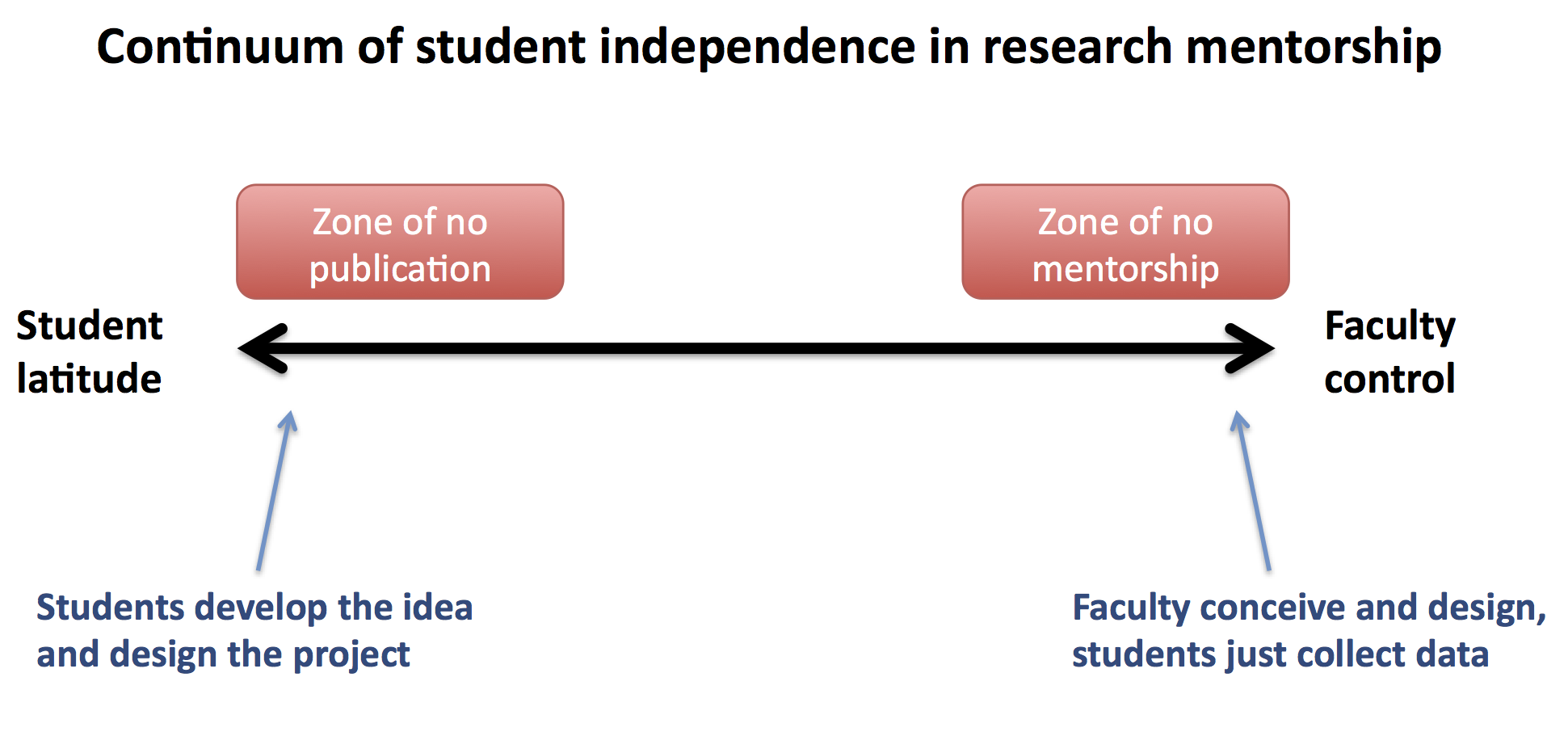
ContinuumStudentIndependence

Image by T.McGlynn

In theory, quality mentorship (involving time, patience and skill) can lead a student towards working very independently and still have a successful project. Oftentimes, though, the time constraints involved in a summer project don’t allow for a comprehensive mentoring scheme that facilitates a high level of student independence. Should the goal of a student research project be training of an independently-thinking scientist or the production of publishable research? I think you can have both, but when push comes to shove, which way do you have to lean? I’ve written about this already. (Shorter: without the pubs, my lab would run out of dough and then no students would have any experiences. As is said, your mileage may vary.)

A well-designed project will require a familiarity with prior literature, experimental design, relevant statistical approaches and the ability to anticipate the objections that reviewers will have once the final product goes out for review. Undergraduates are typically lacking in most, if not all, of these traits. Sometimes you just gotta tell the student what will work and what will not, and what is important to the scientific community and what is not. And sometimes you can’t send the student home to read fifteen papers before reconsidering a certain technique or hypothesis.

When students in the lab are particularly excited about a project beyond my mentorable expertise, or beyond the realm of publishability, I don’t hesitate to advise a new course. I let them know what I hope students get out a summer research experience:

  • a diverse social network of biologists from many subfields and universities
  • experience designing and running an experiment

  • a pub

All three of those things take different kinds of effort, but all three are within reach, and I make decisions with an effort to maximize these three things for the students. Which means that, what happens in my lab inhabits the right side of the continuum, sometimes on the edge of the ‘zone of no mentorship’ if I take on too many students.

You might notice one thing is missing from my list: conceive an experiment and develop the hypotheses being tested.

Students can do that in grad school if they want. Or in the lab of a different PI. I would rather have a students design experiments on hypotheses connected to my lab that I am confident can be converted into papers, rather than work on an experiments of the students’ own personal interest. (Most of my students become enamored of their experimental subnets pretty quickly, though.)

This approach is in the interest of myself to maintain a productive lab, but I also think that being handed a menu of hypotheses instead of a blank slate is also in the long-term interest of most students. I’m not keen on mentoring a gaggle of students who design their own projects when these projects are only for their edification, and not for sharing with the scientific community. That kind of thing is wonderful for the curriculum, but not for my research lab.

Other people have other approaches, and that is a Good Thing. We need many kinds of PIs, including those that give students so much latitude that they will have an opportunity to learn from failure. And also those that take on 1-2 students at a time and work with them very carefully. I like the idea of thinking about my approach to avoid falling into a default mode of mentorship. Does this scheme make sense, and if it does, where do you fit in and how have you made your choices? I would imagine the nature of your institution and the nature of your subfield — and how much funding is available — structures these choices.

Recommended reads #27

Standard
  • A worthwhile manifesto: “Why I teach Plato to plumbers.”
  • An exceptionally well-told story, of a too-uncommon interaction, by Valéria M. Souza, “Can you get me into college?” You really will have appreciated having read this story. Seriously.

  • If you liked stories as good as the one in the link above, try picking up a copy of one of the back issues of The Best Nonrequired Reading series. For several years, it was edited by Dave Eggers with a bunch of high school students in San Francisco who found amazing pieces of writing and compiled a volume. (The most recent, and final, volume apparently had Michael Chabon’s kid in the group.) But I don’t think all of the participants came from such a background, given the mission of the 826 Valencia writing center where the work was done.

  • Have you wondered exactly how corrupt football coaches always get away with funneling money under the table to their players without getting caught by the NCAA? This long-form article explains the intricate scheme in great detail, and is fascinating.

  • Students totally love it when we distribute lecture powerpoint files to help them study. Here is a particularly cogent argument by Chris Buddle about why this is inadvisable.

  • Measured thoughts on how we share links. David Perry suggests if you choose to share links with others via social media (facebook, twitter, pinterest, and all the others), it is more thoughtful to share original content from the little guys, instead of that one link that everybody sees over and over again. For example, in the last two days, I would wager that you’ve probably already seen at least one link to that cat who saved the toddler who was being attacked by the dog. Which is why I’m not linking to it here. Even though it was interesting. I’d rather do everything I can to get you to read that story by Dr. Souza that I linked to up above.

  • There was what I thought was a great post in Dynamic Ecology this week by Angela Moles and Jeff Ollerton, about the oft-assumed but unsupported notion that the tropics have stronger and more specialized interactions than in the temperate zone. The discussion in the comments is worthwhile, too. One of the commenters who works on this topic, Carina Baskett, took exception to not just calling this topic a Zombie Idea, but also to any claims that there are Zombie Ideas. She wrote a rebuttal on another site. Baskett presents a very different vision about what scientific debate should look like on the internet. She wrote that Moles and Ollerton were “irresponsible and polarizing” and used “inflammatory language.”  Whereas, I just didn’t see that in a case of Rashomon. Baskett saw that Moles and Ollerton were trying to quash debate and suppress ideas from people such as herself, whereas I saw the whole point of their post was to generate ongoing discussion in the scientific community. Of course if authors are taking a stand on one side of a scientific issue, they argue for that point with the best arguments they can muster. Baskett doesn’t think she was outargued on the science, but rather that the authority of the blog has the ability to unfairly prejudice the scientific populace against her work. Without using the phrase, she essentially argued that academic blogs are bully pulpits, and implied that the authors held a claim to “the final authority on how to define, test, and interpret an area of science.” In other words, science bloggers should refrain from certain forms of argumentation because they are unproductive. I never would have anticipated that Moles and Ollerton post would drive a researcher on the topic to “cry foul,” as Baskett wrote. So, it seems I have a blind spot about certain ways in which people can get touchy about academic discussions in blogs, even when written in a collegial and professional manner. Which makes me wonder how often others think I’m being adversarial — or even working to squash discussion — on the occasions when I’m actually trying to engender discussion and be inclusive. I’ve written a lot of opinions about how I think science should be done, how I teach,  what approaches to teaching are more efficient or more effective, and on scads of other things. I clearly come from a certain point of view, but on any academic or pedagogical topic, I mean to convince others with argument rather than shut down the arguments of others. And I readily see that what works for me can’t work for everybody. Looking at Baskett’s response to Moles and Ollerton, which I never would have anticipated, makes me wonder if there is anybody out there who thinks that I use this site as a bully pulpit, when it is intended as a town square. If I need to shape up and be more aggressive in inclusive language, I’d appreciate the input. Also, please share any other interesting links you wish, just in case you feel compelled to share that cat-saving-the-toddler-from-the-dog video.

For links, thanks to HK Choi and Cedar Reiner.

Learning from a kindergarten teacher

Standard

Teaching has some perennial questions: How do you engage students? How do you make a classroom run smoothly? How does mutual respect make a better working environment? How does curiosity lead to learning? How do you get groups of students to work together effectively? How do you design a lesson that flows conceptually and addresses key ideas?

To figure out some of these answers, in all sincerity, I suggest hanging out in the classroom of a high quality kindergarten teacher at work. My kid has had some remarkable teachers. Just interacting with them over the years on an infrequent basis, I think I’ve picked up as many tips and ideas as I have from my university-level colleagues.

Now that my sole heir is heading off to middle school, I haven’t visited kindergartens too often of late. Last week, though, was our last Open House at his elementary school, and we always make a point to cruise by our kid’s former teachers, see what’s going on in their classrooms, and to say Hi and Thanks.

Every time I have a short chat with his former Kindergarten teacher, I get a pick-me-up and often pick up ideas. She has couple decades more experience then myself — and unimaginably more contact hours. On our last visit, she was explaining the changes that she’s making as the state is shifting to new standards.

She explained to me that the students are now reading more nonfiction in her class. She is doing some of the assignments that she used from previous years, but in addition she is requiring the students to do non-fiction reading and assignments prior to their fictional projects. For example, before writing a fictional story about a particular animal, they would read non-fiction about that animal and do a report on what they learned. Then they’d do a fictional story about these animals.

She told me that she’s always learning something new. In this case, she learned that the quality of the fictional projects was improved by the prior experience with the nonfictional projects. More knowledge led to more creativity. That’s pretty cool.

What I liked about this little story even more is that it comes from the most-experienced amazingly perfect-as-far-as-I-can-tell teacher, who tells me new things that she’s learning about teaching.

I imagine that the reason she is such a a good teacher, is because she always has been working to improve, and no matter how good she is, she still is both open to and working at learning new ways to do things better. At the end of what has felt like a long semester, that’s inspirational.

I’m at a different place on the improvement curve, as I’m well aware of far too many things that I need to improve in my teaching. But I’ve been thinking, well, maybe I have the routine down solid enough for now. Watching great teachers at work puts me on notice: I should be wary whenever I feel that equilibrium can emerge from stasis. This is another sign I should take that overdue sabbatical.

We’re number 33!

Standard

We’re number 33!

According to the latest rankings by Time Magazine, my current university — California State University Dominguez Hills — is ranked #33 in the nation. Among more than 2,500 colleges and universities.

As people on campus have been quick to point out, Harvard is several spots below us. (If you’re curious, UC Riverside comes out as #1. California public universities are featured quite well on this list.).

How the heck could this be? This survey used new variables that the current US federal government is using to classify universities on how well they serve their students. It takes into account cost, graduation rate, and rates of student aid. If you remove graduation rate from the equation, we come in at #4. Here’s the take on it from the CSUDH campus.

What does this mean, and what does this change?

I think the only thing it means is something we’ve already known: College rankings reflect the values that you put into the equations. Colleges with massive endowments and extraordinarily high rates of alumni giving have done well in the rankings that have been the common currency, used by the US News and World Report. If you measure affordability and accessibility, then you get entirely different results, reflecting entirely different values.

If you look at the differences that we make in the lives of our students, we deliver. Moreover in many cases, the differences that we make would not have been made unless we made them. As we prepare for graduation this upcoming weekend, this is something that’ll be on the forefront of my mind.

What does this change? As far as I know (and this is not too extensive in this regard) this could be one of the first national quantitative rankings that doesn’t place our campus in the bottom quarter. Some — though not that many — of my colleagues on campus have a severe inferiority complex about our place of work. It is true that we are under-resourced, which manifests in many limitations. We have always said, “We serve our students well!” and now it’s nice to have this form of external validation.

This also is more than just window dressing, because to some extent these rankings can drive federal policies. I think they were just invented so that the predatory for-profit “universities” can’t use public money for private profit. But at least on our campus, this is a win, and we’ll take it.

Did you hear about this ranking? How did your campus fare? What do you think these Time rankings mean and don’t mean?

Is grad school a good time to have a baby?

Standard

I have no clear answer and I had my daughter just after finishing my fourth year…

A post on having kids in grad school has been on my roster basically since I started blogging. I sometimes get asked this question because I had a baby in grad school. While contemplating what to write, I realised I actually know quite a few mothers who started their families in grad school. Some have gone on to continue their careers in academia while others made the decision to leave. Although motherhood plays a part of their personal stories, the mothers I know are not unlike the general population of grad students I came through with, who are all also trying to find their way and decide what to do with their lives and careers.

So last year, I decided that to ask all the people I knew who had babies in grad school about their experiences and what advice they would give to the question “Is grad school a good time to have a baby?”. The one thing that these parents all have in common is an enthusiasm for the idea and a lack of follow through (including me!). I posed the question but then got caught up with other things as I’m wont to, just like I’m sure all the other parents who said they’d like to contribute but ended up being far too busy to write about it. Instead of pestering them after having dropped the ball before, I thought I would write my own perspective first.

What follows is a modified email that I sent to a female grad student who directly asked me for advice on whether grad school was a good time to have a baby. One thing that did come to mind when thinking about this question is that I come from a supportive department in this respect and it clearly shows in the number of grad school babies that born there. So my answer to the question is coloured with the privilege of support, both from my advisor and department. Many are not so lucky.

My advice and perspective is also skewed towards mothers, although I know grad school dads as well. Part of the challenge of having a baby during grad school for a woman is, well, having the baby. Although parenting can be a lot more equal pretty quickly as long as both parents make an effort for it to be, the burden of pregnancy and breastfeeding (if you can/do breastfeed) falls squarely on the mother. There are real physical aspects of this time that means extra support and consideration for mothers that I think shouldn’t be ignored. You’ll see some of that perspective in what follows.

Here is my advice from a couple of years ago to a fellow grad student* pondering having a baby before finishing:

I seriously feel unqualified to offer advice–somehow I managed to make it through but I’m still not sure how. So I’m not sure I have wisdom but here are a few thoughts. First, they always say there is never a good time to have kids and although its true, you should never let that stop you. It is a tough thing to plan and it is always more of a crazy disruptive thing then you imagine it will be. But it is also amazing so if you want it I would say give it a try–you will always make it work somehow–sometimes things go a little slower than planned or differently than planned but that is all part of it. I think you will make your priorities happen–if you want the baby and want the PhD, you will make it work. My story was that I did manage to have a double TA at the end and that helped a lot. But I did it in the opposite direction from (another grad student)–I took off a semester (‘writing’)/had Maiken and then double TAed. Somehow I managed to come back, double TA and finish. I think that had a lot to do with the fact that my committee was very forgiving—I am still working through publishing my chapters and sometimes I am amazed they let me go**. And of course, having a supportive spouse is huge–I couldn’t have done it without my partner’s help.

I think everyone’s situation is unique though. I thought I would do some writing when I was off but I did next to nothing those first few months. The birth was a lot harder than I had hoped (I had to have an emergency c-section). The recovery took more out of me than I thought–emergency means bigger cut and it was a while before I could even get out of bed normally. I also did not do well with the sleep deprivation so that made it tough to think and function–the hormones also can make you a little crazy and seriously effect your brain function. No one told me that I would be more forgetful once I became pregnant, for example…. Not to scare you but things can go in unexpected ways and although it is totally doable, pregnancy/breast feeding, etc is definitely a draining experience–but you will roll with those things as they come and they shouldn’t stop you. And many people have it much easier than me and hopefully you will too!

Ultimately, the decision should be up to you and your partner, so in some ways, I don’t think you need to talk to anyone officially until it is certain you are having a baby. Then the logistics can be worked out as they need to be and my experience with the department is that they are pretty supportive. My opinion is that it is your right to have a baby so they need to deal with it and they want you to graduate so they’re going to work with you to make that happen. When I passed 3 months, I went to my advisor and then my committee and the department chair. I basically started by saying I was pregnant and I had a rough outline of a plan of how to finish up. My biggest request was the double TA*** and they were good enough to give me that. I think they thought I was a little crazy and that I would not manage moving to Sweden, having a baby, coming back and defending but they were definitely supportive. I did lose one committee member because they wasn’t around when I needed to defend but everyone was fine with that and since I had four members I didn’t need to replace them. I guess you just should be prepared to be a little flexible and figure out what is feasible but I think it is definitely possible to manage it.

Having a baby is always going to be a huge disruption of everything else in your life and they only continue to be that. But grad school isn’t a bad time to start. You’re time is actually pretty flexible. So even though it was crazy busy, I’d do it again. The writing/stress of finishing always seems about the same to me, whether or not you have a baby (at least from watching other people). You basically fill up the time. When you have something else so huge going on, you are forced to work more efficiently and not worry about it so much. Revisions can always go on forever, when you don’t have forever, you basically have to stop. Part of the reason I am still working on things from my PhD is because I am trying for good journals so that is also a choice…

Anyway, personally, I wouldn’t ask permission/talk to anyone that I thought would try to dissuade me from doing it, at least if they were in a position of power. If they try to say it isn’t for the best and then you do get pregnant you’re possibly creating unnecessary tension. But once you are pregnant, it isn’t like they can advise you not to be. So the discussion will hopefully be more productive and positive about how to make it work.

I hope this ramble makes some sense. Follow your hearts, do what feels right and it will work out.****

So in short, is grad school a good time to have a baby? It was for me.***** I have a wonderful/stubborn/imaginative/annoying/beautiful/challenging/creative daughter and so far a career in science that I love. I wouldn’t change any of it. But having a baby is a deeply personal choice and I don’t think anyone can truly answer for another whether any particular time is ‘good’ or not.


*I’m happy to say said grad student now has a lovely daughter and PhD degree.

**Impostor syndrome alert: I had one published chapter and three manuscripts at the time of my defence. Not such an uncommon combination…but I had high expectations of myself and was disappointed that I hadn’t submitted more at that point.

***My salary support was through TAships and doing all my teaching duties in one semester instead of spread across two meant that I could come to Sweden and be with my partner during the first few months of my daughters life (her due date coincided with the start of the fall semester)

****I tend to live by this philosophy, although the ‘working out’ might not be how you first imagined.

*****A recent twitter conversation about grad school stipends directly relates to the finances of being a parent in grad school. I didn’t have to support my family on my stipend, nor was I a single parent, important distinctions.

https://twitter.com/hormiga/status/464122673912496129

https://twitter.com/hormiga/status/464122985574436864

Don’t go to grad school! and other fairy tales

Standard

The fitness of organisms is measured by their reproduction. Successful scientists make more scientists. Successful professors make more professors, so the story goes.

With some folks, honoring a successful academic pedigree is almost a fetish. And it’s not just something that happens at research institutions, For those of us at teaching-focused institutions, sending students on to PhD programs is a source of pride, and often seen as a sign of successful mentorship.

On a day to day basis working with students, there are two huge facts that overshadow my mentoring relationships:

The first fact is that faculty positions are hard to get. Even if you’re very good, there is a huge amount of luck involved in grabbing the brass ring. Many PhD students and postdocs recommend that undergraduate professors not encourage their students to go to graduate school, because of the state of the academic job market. (Of course, there is no PhD problem, there is just an attitude problem.)

The second fact is that, in the United States, blacks and Latinos are scarce in ecology, and in science as a whole. We really do need to increase the representation of these groups in science. That means we need to send more of these students to grad school. This isn’t just an equity problem, it’s also a crisis for the future of scientific enterprise in the country.

My university student body is 90% minority, according to our newly invested president, if such a thing is mathematically possible. If anybody is in a position to “change the face of biology” as one friend of mine put it, then I’m in that place.

This could be seen as a dilemma: If I am trying to help out the field of ecology by diversifying it, I need to send as many of my talented students as possible to grad school. However, because job prospects in academia are so dim, then I’d be sabotaging the success of my students if I send them to grad school!

Katana_cross_section_diagram_showing_different_zones_of_hardness

Cross-section of a not-double-edged sword.

I don’t buy into that dilemma. I think what is good collectively for diversity in science also is good for the students of mine who do go on to earn their PhDs. This sword only has one edge, which I realize is not necessarily a common sword. (A katana, I just learned, has only a single edge, as you can see.

I take money from the federal government with the promise that I’ll be a part of the pipeline to grad school. Consequently, I provide cool research opportunities to students and if they want to go to grad school, I think that’s great. But I don’t steer them in that direction, even though I provide a rental car for free.

I’ve been told that I’m doing a bad thing to my students by sending them off to grad school. I’m just tuning those voices out. Because those voices don’t know me, they don’t know my students, and they don’t know what the alternatives are for my students. For every one of my students who has passed through my lab and gone to grad school, I have a high degree of confidence that they are, or will be, better off for having received a PhD. I can understand how in the humanities, going into debt to get a PhD is a silly or stupid proposition. But some of my former students earning their PhDs are making more money from their relatively small graduate stipend than many members of their families are earning by working full-time back home. They aren’t taking out student loans, and they are getting experience with research, teaching, writing and problem-solving that will be useful in a great variety of possible jobs.

Most important for their career prospects, my students are building a social network that will help them find employment after receiving their PhDs. They will have developed practice hobnobbing with people from wealthier social classes. Even if they didn’t have a friggin’ PhD, they still have spent years in a professional milieu which otherwise would have been inaccessible. Of course they have to know that the odds of getting a tenure-track position are small, and they need to have an open mind with respect to their careers.

Our students should also know that they have more and better options with a PhD than without one, considering the social capital at their disposal when starting out on the job market. They shouldn’t be told they won’t get a job, when most people do.

Let’s put the employment options post-PhD into context with data. Nearly all PhD recipients in biology are gainfully employed, and the number of tenure-track faculty, industry and government researchers, and those with other non-research/teaching jobs greatly outnumber those that end up in non-tenure track academic positions. There are too many contingent faculty, and this is a problem for universities, but the existence of adjuncthood as a possible career option doesn’t mean that opting for a PhD is a bad choice. There is a far greater fraction of unemployed lawyers than unemployed Biology PhDs.

Unemployment rates for those that don’t go to grad school are worse for those who do. And the situation is even worse for first generation college students, who lack the social capital to get their first opportunities. So, no, I won’t be telling my students they can’t get a job if they earn a Ph.D. I’ll just tell them that they’ll be lucky if they land a tenure-track position and that they shouldn’t plan on that from the outset.

“What’s going to be on the exam?”

Standard

Do you love it when students waste office hours with questions that don’t help them learn? Do you want to cultivate anxious emails from students sent at 3 in the morning?  Do you want your students to wager their grades by guessing what you think is the most important material?

Then don’t tell your students what is going to be on the exam.

It is entirely legitimate for a student to be told the basis of their evaluation. Students take a course, and earn a grade. They should be made aware, as specifically as possible, the foundation for this grade before they do what it takes to earn it. The less they know about the basis of their evaluation, the less fair we are to our students.

The more specific you are about what is on the exam, the happier the students will be. Moreover, specificity gives you control over the material that they will study. I have often heard colleagues frustrated that students aren’t focusing on studying the right material, or asking the right questions while studying. I seriously don’t get these questions from students, and I think that both they and myself are better off for it.

If students ask you what will be on the exam, please don’t reply, “Whatever I think is important.” That just will help the students who are better mind readers. (Which are probably those with a social and cultural background most similar to yourself.)

If students ask you what will be on the exam, please don’t reply, “Everything in the lectures and everything in the chapters.” This vague set of expectations will prevent students from focusing on facts and concepts which are most important, and may lead to some students wasting their time on minutia.

The more vague you are about what will be on the exam, the less control you have over what they study. The worry about the mysterious contents of the exam detracts from learning. Our value in the classroom isn’t our content knowledge itself, but our expertise that allows us to parse the useful, meaningful and relevant. Asking the students to master too much information will result in no mastery at all.

Several years ago, I decided that the exam guesswork was a bad thing. Now, I administer three types of exams, all of which are designed to remove guesswork on the part of students:

  • I give students a full list of potential exam questions in advance. I then select a subset of these questions for the exam itself, choosing at random, haphazardly, or with a specific rationale. Here is an example of one, from a non-majors Environmental Biology lecture course.
  • I give students a comprehensive exam preparation sheet, one or two weeks before the exam. I give them a solemn promise that everything on the exam will be covered by one or more items on the review sheet. Sometimes these items are very narrow but other times they could be rather open-ended. But they are never intended to be vague. I tell the students that if any question on the exam isn’t based on one of these review items, then I’ll drop it from the exam. I am also tempted to hand these out at the beginning of the semester, but I call too many audibles to make this a wise choice. Here is an example of one, from the first exam in a biostatistics course. You’ll note that there’s a lot of material on there. I can’t ask questions to cover every one of those items. But I can make sure that students study them all, but also make the scope narrow enough that it is do-able.

  • I can give a take-home exam. I only do this if I’m blessed with a small class. Because are a variety of problems associated with take-home exams, I typically only do this with a small graduate course.

One of the more annoying questions that a student can ask is, “What’s going to be on the exam?” I just have to answer that with a single piece of paper.

Sometimes some students will email me, “What’s the answer to number 8 on the exam prep sheet,” or they’ll write me an answer and ask me how it meets my expectations. I make a point to not evaluate their responses or give them any information, unless I do so for the entire class. I might clarify a question or an item, if a student doesn’t understand the words.  Under all circumstances, I assiduously avoid evaluating providing privileged information for the students who feel more comfortable with approaching me for private studying advice, because that would be unfair to the students who don’t email me. I might send a reply to a question to the entire course.

I always schedule time during a class session prior to the exam so that students can ask me questions about any of the review items. Sometimes this lasts just a few minutes, and sometimes the bulk of the class period. (I do not hold separate reviews outside regular class hours, as I’ve mentioned before.) Usually when students email me a question, I ask them to save it for class, so that everyone can benefit from their question. But most of the review session is me saying, “I’m not going to reteach that entire lesson, but this is the nutshell version.”

The better I construct the exam prep information, the less time we spend in review during class, and the more time students spend studying with each other, which is where the real learning takes place.

Recommended reads #26

Standard
  • Here is a summary of a study that tracked time budgets of faculty members. I find it to be shockingly spot on, though I have made an effort to not work for more than a couple hours on weekends.

  • On NPR, Frank Deford had an insightful, if crotchety,  three-minute piece on changes in the perception of sports and its reporting. You can read or listen to it here.

  • The urban legend was true, about Atari throwing unpurchased copies of their famously horrible E.T. game cartridges into the landfill.

  • Last week, nearly a score of Sherpa mountaineers died in a single event, while establishing a climbing route for their clients paying for a route up to the top of Mt. Everest. This tragedy has fueled the long overdue conversation about the ethics of paying people to put their lives on the line for the glory of reaching the top of the world. The climbing season has ended as the Sherpas have taken time to reflect and mourn their losses. Of course, you can always climb if you’re willing to risk your own life while carrying your own gear up the mountain. The Sherpas now have published a rather moderate list of demands to make the situation a little less exploitative.

  • Dynamic Ecology ran four posts this week, all by Meg Duffy, about stereotype threat and what we can do to promote the development of all scientists. She provided many simple, concrete, useful and easy recommendations about what we can do about the problem. The first post is an introduction to the stereotype threat. The second one says what we can do to counter stereotype thread. The third explains how some people avoid engaging in these issues for fear of being criticized, and the fourth is a transcript of a Neil deGrasse Tyson remark about the path of greatest resistance as black science student, from a panel discussion that went viral last week. Every post is not only interesting, but also important. The talk:action ratio on this topic by individual PIs is outrageously low, and by reading these posts, we can learn how to do better, regardless of where we work.

  • You presumably heard last week that the US Supreme Court decided that affirmative action is, or at least can be, illegal, in a 6-2 decision. The dissent by Justice Sonia Sotomayor is, in the literal sense of the word, epic. It’s definitely worth your while to read the original document. The bunk by Scalia, Roberts and Breyer precede her statement, which starts about halfway through the document.

  • In case you’ve somehow missed it, you might want to ask: Has The Whale Exploded Yet?. But it looks like it’s deflating non-explosively. I’m sorry to disappoint you.

  • Tomorrow (the first Saturday in May) is Free Comic Book Day! Head to your local comic store! The more people you bring, the more free comics you get. There will be a line, and it probably will be worthwhile, if only to savor the company of the characters in line.

  • Along the same line, I just read the 14-year old book Reinventing Comics by Scott McCloud. (This a followup to the classic required-reading book, Understanding Comics). It’s ostensibly about the business of publishing comics, the conflicting interests in comic publishing, the emergence of online comics, and is full of ideas about the causes and consequences of an oligarchy of for-profit publishers. While this might not be fully relevant to the comics industry anymore, oh my GOSH the parallels with current state of affairs scientific publishing are remarkable. I think anybody wishing to get a fresh outside perspective on the relationships among authors, funding agencies, publishers, open access journals and the executives running for-profit publishers really would benefit from reading this. I might write a post about it in the future, but that shouldn’t stop you from buying this book. (I got mine used at Goodwill for two bucks, but you can get a copy for 6 bucks online.)

  • Are you Just starting out on your dissertation? Why not write it up in comic book form, like Nick Sousanis?

  • I added The Wall of The Dead, hosted by Richard Conniff, to the blogroll. It is a memorial listing naturalists who have fallen in the line of work. I regrettably report the addition of Subramanian Bupathy to the list, as Madhu Katti reported this week on twitter. Dr. Bupathy was the Head of Conservation Biology at the Sálim Ali Centre for Ornithology and Natural History. 

I must be the worst statistics professor

Standard

Several times a year, students contact me to tell me that I was the worst professor ever.

To be precise, former biostatistics students contact me with the simplest, and often ignorant, statistics questions. These questions are so basic that it is clear that I have failed in my job as a stats professor.

With a basic dataset, a student might ask, “what test should I use?”  Last month I had a student drop by my office with a result of p = 0.0071 to ask me to tell him whether or not his result is significant. Without a hint of irony.

If you taught comparative vertebrate anatomy, how would you feel if a recent student of yours came into your office and pointed at his biceps, and then asked, “What muscle is this?” This is how I feel when students come to me for statistical consulting.

My one-semester graduate biostatistics class doesn’t go into much depth and covers the standard, mostly univariate, frequentist statistical approaches that you find in similar courses. We spend a decent chunk of the course on probability, experimental design and why people do statistical tests and what the results mean. We spend a lot of time – and by a lot I mean a lot – on what p-values are, and the relationships among probability, null hypotheses, variance, distributions, and errors. (And when I say we spend time on it, I don’t mean that I lecture a lot about it. I mean students actively figure this stuff out. And their exams show that, at least at the time, they really understand it.) I am convinced that, at the end of the semester, that these students really understand the main concepts.

But then they don’t understand it after the course is over.

If a student came to me and said, “I realize that we didn’t learn how to do a GLM in class but from my reading I think that might be the best choice here, and I was wondering if you had the time to talk about it,” I’d ask her to pull up a chair. But when a student says, “I know I was in your class a couple years ago, but I’m looking at this dataset that I already collected and I don’t know where to start,” I’m not going to lift the paperwork that is probably occupying all three chairs in my office.

The hypothetical students-who-forgot-the-name-of-the-biceps-muscle are professional frustrations, and evidence of educational failure, for three reasons:

  1. They forgot something really simple. Though the name of muscle is a mere fact, is one thing you’d expect a student in a vertebrate anatomy course to remember, if not know before even starting the course.
  2. The students were intellectually lazy and didn’t decide to look up the answer, but instead just asked a former professor.
  3. The students demonstrated a personal lack of regard for the professor’s effort in teaching the course, by showing unawareness of the fact that the professor expects students to remember basic facts after the course ends and also empowered them to look up basic information. Or to put it in fake-biblical terms: the students had the temerity to think that we are there to feed them fish sandwiches instead of showing them how to fish and how to bake bread. In my view, this extends beyond personal laziness, by showing that the students don’t bother to show that they respect our role as teachers.

On the bright side, there is one positive aspect of the fact that students come in to ask me dumb stats questions. They think positively enough about my course that they think that I’m useful for statistical advice. That’s not much of an upside, but hey, it’s all I’ve got as far as I can see.

I’m long past taking this personally. I don’t get insulted when students come to me asking me to reteach a very basic concept of probability that we studied for a whole semester. I see that this is their problem, and not mine. I don’t take it home with me. There’s a 0% probability that this issue will keep me from sleeping. However, if I’m trying to be more effective at my job, then I need to confront the issue raised by these interactions. It’s a form of teaching assessment, in which I’m doing poorly. (Some students do thank me quite generously for what they learned in the course, and I’m not forgetting that input either.)

How do I handle these outrageous questions? It varies, because I haven’t (yet) developed an a priori approach to the situation. In some cases, I might simply chimp grin a bit and say something like “you really don’t recall how to test a null hypothesis?” or “So you’re telling me that you haven’t been able to find anything about what to do when your independent variables are categorical and your response is continuous?”

The bulk of the class is biomedically-oriented Master’s students who have some need for statistics with their thesis but don’t think that they’ll need to practice stats for everyday use. So, each semester, I make a point of saying at the outset, “When you design your thesis experiments, you’re welcome to consult with me about the process. But if you don’t discuss your stats with me before collecting your data, then there won’t be much I can do to help you.” I’ve had to remind a couple students of this fact, one of whom had a horribly pseudoreplicated design. And another who failed to run a necessary control.

While I’m not the most amazing professor, I don’t genuinely think I’m the worst, either. I just think that some students think it’s acceptable to offload course material from their brain as soon as the course is over, and do not feel obligated to go back to the hardware store if they lost the tools that they picked up during the course. And among students who are stats-phobic and math-phobic, which is a sizable fraction of the population in the course, they’re just glad they survived. It’s particularly frustrating because my guiding principle in this course is to teach a small number of fundamental concepts in a way that they are supposed to stick with the students for a long time. At least in this class, I know it isn’t happening, with at least some of them. I honestly don’t know what I can do, if anything, to make sure that students really remember what a null hypothesis looks like and what a p-value means. But it is clear that some of them genuinely forget it, presumably because they think it’s not important.

So, when I teach this class again in the fall, I have to find a way to make biostats personally important, with students who don’t see the usefulness of stats in their professional future. Wish me luck.


More backyard reflections: connections between farming and fieldwork

Standard

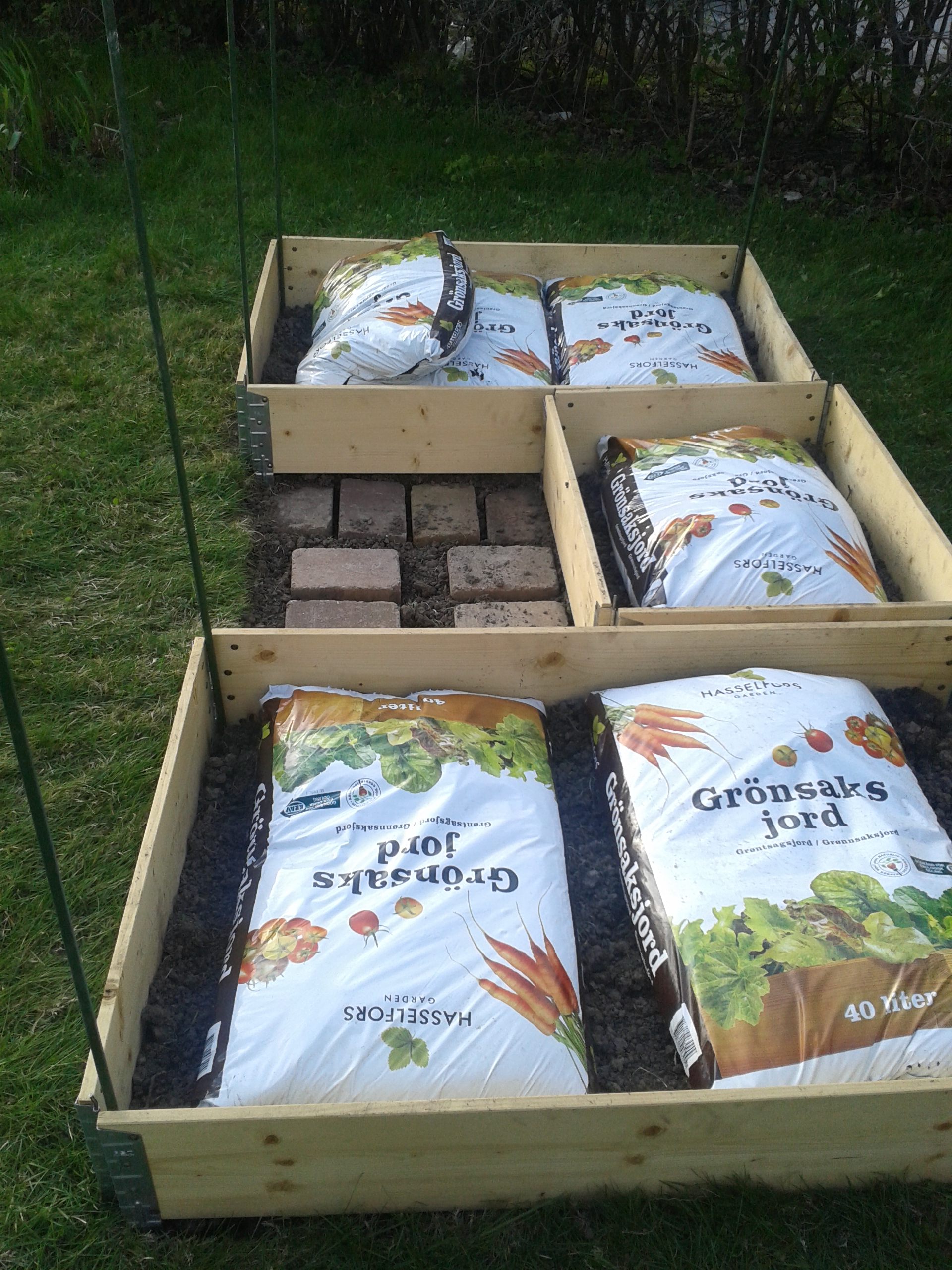
The weekend was beautiful and I spent a good portion of it in the backyard digging up grass. The plan is to have a small raised garden for vegetables, nothing too extensive but enough to plant a few things and enjoy them straight from the earth. You can’t get more local than that. As happens when doing something physical, my mind wandered. I had some “help” from my 4 year old but she would quickly bore of the repetitive nature of the task at hand so I was often left to my own devises.

Beginning of the vegetable plot. Looks easy but my body can attest to the amount of digging it took!

Beginning of the vegetable plot. Looks easy but my body can attest to the amount of digging it took!

Not surprisingly, digging in the dirt got me thinking about the summer I turned 20 and spent 5 months on an organic farm. It was an interesting summer, where I learned a lot but I had no idea I was preparing for a future as a field ecologist. That summer I was a bit lost. I had gone to university for a single semester before dropping out (finances being a major factor) and spent the next year or so working at various service jobs in Vancouver. I knew those weren’t things I wanted to do forever but I wasn’t sure what it was that I wanted. So I headed back across the country to Nova Scotia to live and work on a farm very near where I had spent some of my childhood. The memories of exactly how this plan came to be are foggy for me now (think my mother subtlety encouraged the Nova Scotia angle) but however it came about I ended up living on an organic farm, working for $50/week with three other exploring (or lost depending on how you want to look at it) young women.

Before working on a farm I had a romantic notion that maybe farming was one of things I’d want to do with my life. Farming cured that even though I absolutely loved the summer doing it1. What I saw though was the stress of worrying about the weather, the pests and all the other things that can go wrong. The funny thing is that I face lots of the same problems these days, just in a different context. I’ve lost experiments to deer browsing, mowing and bad weather. One major lesson I took from those farming days is to diversify and protect the truly important “crops” (experiments). I usually have a few field experiments/a few more replicates/etc running ‘just in case’2. A lot of the ‘just in case’ also makes good ecological sense. It is important to know, for example, if the patterns you see are consistent in different populations. It also helps when the deer eat all your plants in one of the populations; at least you still have some data to work with. Protection like fencing is also sometimes a critical part of ecological experiments. If you want to examine plant-insect interactions for example then it doesn’t help if the deer eat everything. If you want to eat the tasty vegetables you plant and know there is at least one hare that prowls your yard, fencing it is.

In plant ecology, often experiments require planting out particular populations or communities. There is the raising of the seeds, planting of the individuals, harvesting of the data and the stress of choosing the right time to do all these things. Sometimes you get it wrong. I always loved this story of a large planting that got hit by a frost; smart and experienced researchers don’t throw up their hands when the frost kills half your plants. If they’re lucky there is variation in survival and they write a paper about that instead.3 However, these decisions aren’t without consequence. While I was a grad student, I witnessed another’s unfortunate loss of an entire experiment to frost shortly after planting one summer.4 So the stress that I thought I was turning away from when I finished at the farm is actually a regular part of my summers. Maybe my income isn’t so directly tied to the harvest as on a farm but if experiments and papers are the currency that allows me to keep going as a scientist, then I’ve definitely paid the price of random events throughout the years.

I learned a lot that summer but probably most things were really about me. I learned I had stamina and that I could push my body and mind to keep going. I learned that I could tolerate bad weather and good to get the job done.5 I learned to laugh at rain and hailstorms and freezing weather and heat that makes you feel like passing out every time you get up.6 I learned that no matter how well you prepare, sometimes you just need to drop everything and change directions. Perhaps most importantly I learned that I liked being out there each day and being proud of what we accomplished. And I learned that some of the best friendships come from sharing the good and the bad of fieldwork (/farm work).

These days I don’t spend 5 months outside maintaining plants and collecting data but when I get to get outside, it is often reminiscent of those farm days. But perhaps that is only since I’ve found myself doing a lot of work in old fields…

And perhaps since I’m not outside toiling in the fields all summer, I have the opportunity/energy to grow my own garden. I know my little garden isn’t enough to even provide for our family. It is really a luxury hobby. But I am growing it because I also want my daughter to have a sense of what it takes to grow food. I want her to be able to recognise what the plants many vegetables come from look like, not just what vegetables look like presented in the store. She’ll probably not grow up to be an ecologist but I want her to appreciate the living world around her, both the wild bits and the tamed.


Ecological Life Lessons:

1Try something before you decide! Seriously, think you want to be an ecologist? Then go work in a lab, if you can’t do that, volunteer. Or if volunteering/work aren’t options, take as many courses as you can that expose you to research experience and get on board for a research project/honours/whatever they call it at your institution. The important thing is to get exposure to what ecologists are really doing on a day-to-day basis. Of course, this advice applies to anyone looking to invest a lot of time in training for a job, not just ecologists. But familiarity of the process of research is a really good thing before you start a masters/PhD program.

2The opposite lesson is to avoid spreading yourself too thin. My PhD student has been collecting data like mad and has a lot of really good hints at what is going on in her system but this year we’ve decided that she needs to do less of the different kinds of things and concentrate on a few key studies that will wrap up her experiments nicely. Right now there is a lot of data but often not sufficient to truly say what is going on. Sometimes this is hard to avoid (e.g. we didn’t know that the variation in the things we’re looking at is so great that it is making it hard to detect whether there is a signal in the data) and she’s also had her fair share of run-ins with the deer and mowers.

3I haven’t yet had the opportunity to turn a disaster into an opportunity at this scale but I certainly look at my failed experiments to see if anything is there.

4Learn from other’s misfortune, as well as your own. As a grad student, you’re actively learning how to run your own research but you’re also surrounded by a bunch of people doing the same thing. Talk to them! Hearing about their successes and failures can be just as important as doing the things yourself. This can apply to teaching, writing, analyses, fieldwork, labwork and the list goes on. These days if I know someone who’s done something that is new to me I ask them for advice. There is always so many tricks that make life simpler, once you’ve figured them out.

5Fieldwork is often not for the faint of heart. Know your limitations. I know I need sleep and I don’t function very well without it. More than that, I work pretty poorly at night. So I won’t ever take up a project looking at night pollination. Cool stuff but I know that it would drain me in ways that super strenuous work during the day never would.

6When things get tough you basically have two options: laugh or cry (or get really sour and unpleasant and take it out on those around you). I prefer to laugh (or at least try to), makes for a better field season.

A mountain of progress still needed for equity in science

Standard

Most senior scientists aren’t from ethnic backgrounds underrepresented in the sciences, and don’t train many scientists from these backgrounds either. The day-to-day issues facing black and Latino students in the US might be on the minds of people in charge, but the people in charge don’t face the same day-to-day challenges.

I haven’t experienced those problems myself (as a tenured white dude), though I do I work in a minority-serving and Hispanic-serving institution. So, it’s my job to understand and to do what I can to provide the best opportunities for my students.

Nonetheless, mentoring students from underrepresented groups doesn’t validate one’s ideas about equity and diversity in science. To illustrate this point, let’s look at the recent comments of Michael Rich, the PhD advisor of Neil deGrasse Tyson (who is arguably the most famous living scientist, and definitely the most famous living black scientist):

I think my colleagues would agree that no overt barriers based on race, gender, etc. remain. (In fact, incoming graduate classes tend to be 50-50 in terms of gender and there are many special programs to help under represented minorities.)

Now, before we decry Dr. Rich for being horribly wrong, let’s give him the benefit of the doubt. After all, he might have been on crack, or stoned, or taking psychotropic mediation when he wrote that. It’s also possible that he was jet lagged from space-time travel from an alternate universe and he hadn’t gotten his bearings settled back to our own dimension.

But if he wasn’t on drugs or returning from another reality, then he’s bearing a massive anchor of delusion and seclusion. I guess he hasn’t asked any black men, any women or Latinos about how they feel about overt barriers. I guess he hasn’t chatted much with his famous former PhD student.

Dr. Rich observes a 50:50 ratio of men to women in graduate classes, but he’s not bothering to look at the proportion of women in permanent academic positions. Or how many women are selected to win awards.

Dr. Rich sees special programs for minorities, but he is ignoring the conditions that necessitate these programs. Black Americans comprise more than 12% of our population. So, I’m guessing that the proportion of black students in his program is at least ten percent, right? Are 10% of senior scientists black?

Oh, there’s a helluva lot of work to do. We are nowhere near equity. This is so damn obvious that I feel stupid even writing it.

But I have to write it, because Michael Rich, and those who share his views, aren’t just failing to fix the problem. They are part of the problem we need to fix. Those of us who are pushing up from the grassroots for equity and access need those senior faculty to validate the need for change. Those of us who are training students at the K-12 and undergraduate levels need people in graduate programs to not only recognize, but take concrete steps, to support and recruit minority students starting their science careers.

A lot of senior scientists feel just like Dr. Rich. I’ve heard it far too often. We need to inoculate the current generation of scientists in training against these toxic views of Dr. Rich. It’s probably too late to change Dr. Rich’s mind, as there’s nothing we can say that his famous former graduate student hasn’t already said or embodied. But we can keep pushing to move this mountain shovel by shovel. And we can advocate for heavy equipment that can really move the mountain.

In my undergrad years, my college president was a unicorn. Or, something almost as unique as a unicorn: A black electrical engineer. From Kansas. The story of John Slaughter is mighty amazing. When he recounted his path, from childhood, to grad school, to professor, to university president, I was both inspired and amazed by his tenacity in an environment that was unrelentingly opposed towards his progress in the direction of his choice.

Dr. Slaughter has long been retired. In the emerging generation of STEM leaders, Dr. Neil deGrasse Tyson is yet another unicorn.

If one of my black students ends up being a global ambassador for her discipline, will she be a unicorn?

According to Dr. Rich, those problems have already been fixed. Of course, he’s flat out wrong, though I wish he wasn’t.

Ant foraging diversity: a simple and elegant explanation

Standard

Science can be creative and elegant.

To illustrate this fact, I want to bring to your attention a groundbreaking review paper that was recently published in Myrmecological News, written by Michele Lanan of the University of Arizona.

Usually the terms “groundbreaking” and “review paper” aren’t paired with one another. Review papers usually codify existing ideas, propose some new ones that may fall flat. And, if you chat with an editor, you’ll learn that good reviews really improve a journal’s impact factor.

Then there’s this amazing review I loved so much I had to write this post about it. Even if you don’t know a thing about ants, I’m betting you’ll love how the paper draws a clear and simple explanation from complex interacting phenomena.

Ant people are asked about foraging behavior quite often. How and why do ants make trails? Why do some species make trails and others don’t? Until now, our answers were vaguely correct but relied heavily on generalizations. Now, after Michele Lanan scoured pretty much every paper that’s ever collected data on foraging behavior and ecology, we have a quantitative and robust explanation that is powerfully simple and elegant.

We’ve known that foraging behaviors are structured by that ways in which food is available. Among all ants, there’s a huge variety of foraging patterns. Some are opportunistic hunter-gatherers, others are nomadic raiders, and some use trunk trails, as in the figure below. These patterns reflect differences in food availability.

Figure by M. Lanan

Figure from M. Lanan 2014, Myrm News 20:50-73.

How, exactly, is it that the properties of food availability can predict how ants forage? In an analytically robust and predictable manner, that works for all ants throughout the phylogeny? It doesn’t require an n-dimensional hyperspace to understand foraging patterns of ants. It only needs a 4-dimensional space.

figafromms

Figure from M. Lanan 2014, Myrm News 20:50-73.

Lanan took into account four properties of food items: size, spatial distribution, frequency of occurrence, and depletability. She arranged these variables along four axes (as on the right), and showed how this this 4-dimenstional space foraging patterns in the figure above.

How do these foraging patterns distribute across the major ant subfamilies? Are some lineages more variable than others, and what might account for these differences? What other beautiful figures and photographs are in the review that illustrate the relationship between spatiovariability of food and foraging biology? As they say on Reading Rainbow, you’ll have to read the review to find out!

Reference: Lanan, M. 2014. Spatiotemporal resource distribution and foraging strategies of ants (Hymenoptera: Formicidae). Myrmecological News 20: 50-73.

As a disclaimer, I should mention that the author of this paper is a collaborator and friend of mine. And she is leading The Ants of the Southwest short course this summer which I’m also teaching — and spaces are still available!

But that’s not why I’m featuring this paper. I am enthusiastic about this paper because it so obviously resulted from a labor of love for the ants, and is a culmination of years of reflection. This is just a downright gorgeous piece of science, and the more people that see it — and the more recognition that the author gets — the better.

Save the bees, but maybe not this way

Standard

I’m all for saving bees. Heck they’re some of the most important players in the plant systems I study. No bees means no sex for my plants, so there’s that. And I generally have a soft spot for bees. While I was an undergraduate my first real experience in research was working in Mark Winston’s bee lab. I was one of those all round research assistants who moved between projects as the need arose. It was a great experience and the fact that I’m still doing research speaks to that. Maybe it is why I have gone on to study mainly bee-pollinated plants but that is speculation for another day.

So when a few weeks ago I saw a new campaign at Avaaz.org to save the bees, my first thought was: great! It is nice to see an important ecological question gaining attention and donations. But then I read on.

Although I am aware that many ecological issues are political ones, the Avaaz campaign demonstrates how complex issues can lose out when they are made political. Of course it is easy to sell simple ideas and I’m also all for communicating science in ways that everyone can understand. However, much is lost if you translate things down to easily digested political selling points.

So here is what I find distasteful about this campaign to save the bees. First there is the message that we need to fight ‘big pharma’ to stop the use/over-use of pesticides. Now, although you could argue lots of things about whether it is right or wrong/effective or not to stop pesticide use, as a political message I don’t think there is anything wrong with this idea per se. However, the drive suggests that this action will save the bees. By using bees to sell the fund-raiser, a direct link is made between global bee declines (‘environmental holocaust’ as they put it) and pesticides. Now before anyone jumps at this, I am aware that there are lots of studies out there that do show negative effects of pesticides for bees. Back in that summer working with bees, I helped one grad student maintaining bees for her study that showed sub-lethal behavioural effects of pesticides. I’ll admit that I’m not up on this set of literature but I am fairly certain that most scientists wouldn’t leap to the conclusion that all that we need to do is get rid of pesticides and the world will be buzzing again. What is happening with bee populations world-wide and the domesticated honeybee are complex issues, unlikely to be so simply solved.

The second problem I had reading the Avaaz page was their second mission is to raise funds for a scientific study. As stated on the page: “Avaaz may be the only crowdsourced funding model in the world able to raise enough to fund the world’s first large scale, grass-roots supported, totally independent study of what’s killing our bees, that decisively challenges the junk science of big pharma.” (emphasis theirs). And to top it off: “The need is urgent, and if we can’t do this, it’s not clear who can.”

As a scientist, I find this completely offensive. There is so much wrong with this call, I’m not sure where to start. On the one-hand they suggest that the research being done now is ‘junk science’ funded by big pharma. It almost seems silly to write a counter-argument to this, there are scientists all over the world studying bees and many directly trying to address things like how pesticides affect bees. That grad student I helped out? Funded by ‘big pharma’. Even if we accept the hypothesis that science on bee declines, pesticide effects, etc has been ‘junk’, where are they going to find the apparently reputable scientists that will carry out the research to solve the problem once and for all? Who are these scientists? Maybe it is just me but if I was going to give my money for research, I’d want to know who it was going to, especially if they’re expected to deliver on the promise of this campaign. For me the portrayal of scientists as both the bad guys in the back pocket of pharmaceutical companies and the heroes coming in to save the day is both offensive and depressing.

But let’s say the money raised here would be able to solve what is happening to ‘the bees’. Even if that is true, raising money for science is in conflict with the first mission of the campaign. Either you are searching for the answer for what is really happening or you have already concluded that bees are dying due to pesticides. You can’t have it both ways. And beyond the issue of actually understanding why bees may be declining, there are already many scientists addressing these problems from a myriad of angles. For something so complex, it is highly unlikely that any one single study will ever be able to determine what is killing the bees like promised here. Science is generally a collaborative effort and the portrayal of science here suggests a poor grasp of how it is done.

So far I have been intentionally vague about what I mean by ‘bees’ because Avaaz is as well. But I see this as another real problem in distilling down such a broad subject down to a single political issue. For example, the fact the in North America (and elsewhere) honeybees are an introduce farm-animal is often glossed over. Of course, understanding colony collapse and other problems facing honeybees is important; honeybees can be critical domestic animals that provide a huge service in our food production. However, understanding issues with honeybees may or may not provide any answers to our understanding of wild bees. It would be like studying cows to try to understand deer populations or chickens to assess songbirds. Sure there may be links but they are different beasts. So confounding honeybees with bees as a whole is problematic.

So in short, I’d love to see more emphasis on understanding ecological problems and see interest in pollinators as a real positive. So much of our world depends on the interactions between plants and pollinators but reducing complex ecological questions down to single-issue conspiracy theory campaigns may do more harm than good in the long run. It also belittles all the great science that is already going on.

Update (April 23): Jeff Ollerton has added his thoughts over on his blog: http://jeffollerton.wordpress.com/2014/04/23/these-things-arent-to-study-theyre-to-turn-up-very-loud-and-say-hey-once-upon-a-time-everything-was-just-as-easy-as-this/ and there are a bunch of great comments below. All worth a read!


After one year as a Visiting Assistant Professor

Standard

This is a guest post by Carrie Woods, a Visiting Assistant Professor at Colgate University. This is a follow up to her post from last year, about starting out in a VAP position.

I just completed my last lecture of my first year as a Visiting Assistant Professor at a liberal arts University. Each semester I got to design my own course and teach three lab sections of a general biology course called Ecology, Evolution, and Diversity. Having graduated in August 2013, this was my first experience in designing and teaching my own course and it was absolutely amazing.

I did stumble a bit at the beginning though. In the fall I taught Plant Physiology, a junior level course of my own design, and had a bumpy start trying to figure out how to teach. Given that all of my post-secondary education has been at research I universities, I assumed the most familiar teaching format I knew – standing in front of students, powerpoint up, throwing information and numbers at them. That was my first lecture. I blew through what I thought would take me three lectures in one hour.

Then I did what anyone in my position would have done: sought advice from fellow faculty. This is a top-notch liberal arts university after all, and I am surrounded by teaching gurus. Within a couple of hours and several meetings with different faculty post-first lecture, I completely changed how I thought about teaching. As per the advice of the faculty, I abandoned my powerpoints (except for complicated images and figures) and returned to the most basic method of teaching: the chalkboard.

My second lecture, I asked what they had learned from my first lecture and, after many mumbles and looks of confusion, I decided to start from scratch and re-teach the first lecture. I was honest and open about it and told them that if I was doing something that confused them, I wanted them to let me know. I used a socratic method and got them engaged and involved by asking questions constantly. I used the chalkboard to write and explain key concepts. The classroom transformed into an open and engaged learning environment. I was happier, my students were happier, and my teaching was way better. The learning curve wasn’t just steep, it was 180°!

Through my Masters and Ph.D., I had so many opportunities to TA courses as a graduate student that I realized my teaching skills were developed for running labs. So the lab sections of the biology course that I ran were much smoother than my Plant Phys course. I shadowed the faculty member who was the coordinator for the course, by which I mean I went to every MWF lecture and to her Monday lab so that my Tuesday, Thursday, and Friday afternoon labs went smoothly. Although it took quite a large time commitment, I learned a lot by doing this and incorporated the same questioning and engaging teaching methods from my classroom into the labs.

With new skills in hand and great feedback from my students in the fall, I designed a CORE science course on agriculture called Food for Thought this spring. By far, this has been my most rewarding teaching experience. The class is for freshmen and sophomores in any discipline. I only have three students from biology the rest being from varying departments – political science, economics, philosophy, English, and sociology. Students discovered biology through the history of agriculture and current farming practices. We examined environmental impacts of farming, GMOs, and had a continuous debate about the global food crisis and how to feed the world. This class (again!) taught me how to be an effective teacher because of the new challenge of teaching non-biology students. The course went so well that I have students knocking on my door asking if I could teach it again in the fall so they could take it. I am so touched.

I am so grateful to have had this experience. I am a much more effective and creative teacher and would recommend this job to anyone looking to better their teaching skills. I liked it so much that I have decided to stay for another year.

Recommended reads #25

Standard

Note: this weekly feature is transitioning to a biweekly feature (meaning in this case: every two weeks). This is a great crop over the last week, but I think I can have a better list by doing it less frequently.

For a link, thanks to Mark Martin.


Public higher education is not a reward for hard work

Standard

Here in California, there was a measure to officially restore affirmative action to the public university admissions process.

(The movement navigated through our state senate, but then the popular narrative is that the Asian-American community tanked it before public had a chance to vote on it. More here.)

Whenever white folks (or non-Hispanic European, or whatever ‘white’ means nowadays) are opposed to affirmative action, they’re called out on privilege and are told to share fairly with everybody.  This is justifiable in my view. Now, in California, the politicians associated with the Asian community are allied with the white folks that are against affirmative action. Considering that there is no shortage of Asian-Americans getting into our public universities, concerns about privilege should be extended to this demographic category as well.

The status quo remains: we continue to have an underrepresentation of blacks and Latinos in our public universities in California.

Some people get upset because affirmative action decreases their own opportunity. (I know how this feels. In my high school class, the only white person who got into UC Berkeley was the valedictorian. But everybody who was a member of one of the protected categories got in. (This was a small number, because I was at a mostly white private school. I wasn’t poor by any measure, but I was one of the poorest kids at this school.) I didn’t like it, because I didn’t think it was fair. And, well, life isn’t fair. That’s especially true for people who have don’t have avenues for opportunity despite hard work. Like the students who are systematically excluded from our public universities.

Taxpayers should fund K-12 public education because in a civil society, education should be a right and not a privilege. Moreover, we want an educated populace for the betterment of our entire community. And education for everybody in an equitable fashion is an engine of prosperity.

The same principle applies to our public universities.

As a taxpayer in California, I am not (partially) funding the undergraduate education of students because they worked hard. I don’t want to use my money to reward people who deserve it. I’m not giving out prizes for performance. I don’t want my state legislators to do that either.

I want to spend our public dollars in a way that improves the welfare of the state and its populace. I want a state that provides the best education to all of its people. I want my kid to go to school with students that all have a real chance to attend our state’s top universities. And frankly, without affirmative action, most of the children in our school district will have a hard time getting into UC Berkeley because of the systematic disadvantages that they’ve been facing since fetushood.

So, if you’re mad that someone with extraordinarily high grades can’t get into the publicly funded university of their choice, you can stuff it. I want everybody in the state of California to get admitted to our best universities (whichever ones those might be). If you don’t want to share our state universities with fellow Californians that have experienced a long history of disenfranchisement, then you aren’t deserving of a publicly-funded education.

This issue has nothing to do with immigration. It has nothing to do with “hard work.” It has to do with making sure that those the potential to succeed are given the capacity to do so, and that this happens as equitably as possible. That’s the point of affirmative action, because if you base admissions based on grades and test scores, you are perpetuating an inequity. If you don’t see the inequities among our public schools based on socioeconomic and ethnic dividing lines, you’re blind. Without affirmative action, we codify these inequities into the access to universities.

Even the opponents of affirmative action understand this point, unless they’re stupid or ignorant. But they might not like it because it hurts their own demographic group. Yeah, my kid (of Irish-Italian-German-British heritage) has a lower chance of getting into his favorite UC campus because of his background. And I’m okay with that. Because I want him to inherit a state in which people of all backgrounds have access to opportunity, even when they come from underfunded school districts whose students lack a way to get ahead. As people have explained for many decades, you can’t pull yourself by your bootstraps if you don’t have any boots. This is self-evident to all but those with boots.

Since we’ve been failing at providing equal access to quality public education at the K-12 level, the least we can do is to try to make things more fair when it comes to access to higher education.

It’s not about how hard your kid has worked. It’s about the priorities for our state. I don’t want a state that systematically disenfranchises major segment of its populace. I guess if you do want that systematic disenfranchisement, then feel free to fight affirmative action. But don’t try to fool yourself by arguing that it’s about fairness and equity. That’s a transparent sham. If you buy into the fairness and equity argument, then you need to spend some time volunteering in a high-need public school district to remove your blinders of privilege.


Our expert advice remains unheeded

Standard

Once in a while, tropical biologists get bot flies. We sometimes find this out while were are in the field. But on five occasions, my students have returned to the US, and then discovered that they are hosting a bot. They all contacted me for advice. I told them a few things, but the most important one was:

Whatever you do, don’t go see a doctor. That could be disastrous.

Nonetheless, three of these students went to the doctor.

The bot fly Dermatobia hominis, that came out of my student's arm while he was sleeping. Photo: T. McGlynn

A mature bot fly larva, Dermatobia hominis, that emerged from my student’s arm while he was sleeping. He intentionally reared this one out and allowed it to pupate. Pencil is for scale. Photo: T. McGlynn

This has always troubled me. Without any additional context, it looks like the students just didn’t trust me, and thought that I’m stupid. At the very least, it shows that they trusted their own intuition over my recommendation based on a long history of experience. It shows that they followed the misinformed advice of family and friends over the judgment of the person who was responsible for the trip to the rainforest.

It shows that when it really really really counts, my guidance ain’t worth much at all to my own students.

I don’t give students this instruction without an explanation. I tell them that nearly every doctor in the US will want to cut the creature out. History shows that bot fly larvae are smarter than doctors. If you present yourself to a US doctor with a bot inside you, the predictable result is that you leave the doctor with your bot inside you. You will also leave without a large chunk of flesh that the doctor removed in a futile attempt to get the bot. Sometimes the bot is killed in the surgery, but not excised, which leads to a rotting carcass and infection, and the need for serious antibiotics. I tell them that, if they can’t get it out using the variety of techniques we’ve discussed, and they feel compelled to go to a medical professional, they must go to a vet and not to a doctor. (The students who did the opposite of my recommendation came to regret their choice, if you’re wondering.)

These bot fly incidents are convergent with a recurring incident in a non-majors laboratory that I have taught. The week before an exam, I hand out a review sheet that specifies the scope of the exam. I then tell the class:

Check out item number three on the review sheet. This is a straightforward question about osmosis. The answer is that the volume of water in the tubing will “increase.” The correct answer to this question is “increase.” Just circle the word “increase” and do not circle the word “decrease.” I’m letting you know the answer to this question now and I guarantee — the odds of this question being on the exam next week are 100%. I promise to you, with all of my heart, that this question will be on the exam word for word, and this one question will be worth 20% of your grade on this exam. You don’t want to get this question wrong, and I’m telling you about it right now. So, be sure to write down in your notes that this question will be on the exam and be sure to remember the correct answer when you see it.

The reason that I’m being really obvious about telling you about this question its that in the past, half of the class has gotten the answer to this question wrong. It’s a simple question, and it addresses the main point of the lab we conducted for more than two hours last week, but still, lot of people got it wrong last semester.

You should know that those students also were told in advance what would be on the exam. Just like I’m telling you right now. They knew that 20% of their exam hinged on remembering one word, “increase,” and still the majority of them got it wrong. I’m telling you this now because I don’t want you to suffer the same fate of those other students. DON’T BE LIKE THE STUDENTS FROM LAST SEMESTER WHO WERE FED THE ANSWER AND THEN GOT IT WRONG THE FOLLOWING WEEK. Just remember that “increase” is correct and the other word is not correct. I’d like you to remember the physical mechanism that explains this osmosis, but more than anything else I’d like you to demonstrate that you can be prepared for the exam and remember this small fact which I am hand-feeding to you right now. I promise to you this exact question will be on the exam Learn from your predecessors, don’t make their mistake. I’m giving you 20% of the exam for free right now, so write this down.

As I give this slightly overwrought speech, the students are paying attention. There is eye contact. They might be note-taking activity. Nobody’s on their phone, and nobody’s chitchatting.

When I administer the exam, more than half of the class circles “decrease” instead of “increase.” This has happened four times, and each time it happens a little piece of my heart dies.

As you can imagine, many of the students in our non-majors class are as disengaged as humanly possible. By no means is this a difficult course, even with low standards, but the fail rate for the corresponding lecture course is about 50%. The students who fail are clearly doing so because they aren’t even making the slightest effort. The reason that I keep giving students that same question over and over, and give them the correct answer over and over, is to give me some reassurance that the wretched performance by so many of the students is not my fault. I do this to grant myself absolution.

In these labs, each week is designed to give students the opportunity to develop their own experiments, find new information on their own, and work together to solve problems. This happens to some degree. But half of the students do not exert the tiniest amount of thought about doing what it takes to pass the exam. Why don’t they even try even the slightest, despite my best efforts to both inspire and feed them the right answers?

The students who fail these exams trust their own intuition, or some other model of behavior, instead of my own advice. If anybody is the person to tell you how to pass the exam, it should be the professor who is telling you the answers to the exam. But in this case, the students weren’t even bothering to look at their notes for five seconds before stepping into the exam. They’ve presumably heard from other people that work is not required for this class whatsoever, or perhaps they don’t care for some other reason. All I know is that no matter what I do, I can’t get these students to care about their grade on the exam. Some are excited about the labs, but not necessarily in passing.

So, what do the bot fly story and the osmosis story have in common? No matter how hard we try, sometimes our students won’t follow our recommendations. At least, not mine.

We are fancy-pants PhD professors, with highly specialized training. We’re paid to be the experts and to know better. That doesn’t mean that our words are prioritized over other words. Anything we might say just ends up in a stream of ideas, most of these ideas just flow out as easily as they flow in. It’s no accident that my teaching philosophy is “you don’t truly learn something unless you discover it on your own.” This is why I focus on creating opportunities for self-discovery in teaching. This is the only way in which people truly learn.

No matter what we professors might say or do about bot flies, or studying for exams, or anything else, other people will rely on their own judgment over our own. Even when the experts are overtly correct on the facts, even smart people often use misguided intuition when making important decisions, even when they are obviously wrong on the facts and the experts are overtly correct.

It’s easier to listen to other people than it is to heed their words. As a professor and research mentor, I’ve given up on the expectation of being heeded. I just work to speed up the process of self-discovery of important ideas. But, for the most part, I still don’t know how to do that. I think it’s an acquired skill, and a craft, and I think I still have a ways to go.

Backyard science

Standard

Spring is springing in Sweden and I’m finally out from under my grant writing load. It is pretty easy to complain about writing grants and I am not innocent in this respect. But it is also an opportunity to explore new ideas and topics. This year I decided to try at the more applied government funding agency which I haven’t attempted before.

I generally do basic science. Sure some of my research might one day shed light on a practical problem but I’m in it trying to understand the world around me. So in previous years I haven’t felt my research fit with the more applied funding sources and didn’t want to jam a square peg into a round hole as it were. If I don’t see a real way that my research fits into a funding agencies goals then I didn’t see the point of sending something there. But this year was different because I started thinking about research questions that interested and excited me and were directly relevant to a more applied grant.

So here’s the steps that have lead me to thinking about a new field and exploring the possibility for grant funding. To begin, last year we bought our first house. I have always wanted to have my own garden and it is a true delight. We moved in mid-summer so we didn’t change so much last year but I was actively adding bee-friendly plants and pondering how to get rid of more grass. The former owners left us with a number of lovely flowerbeds that are starting their spring routine now but there is still an abundance of lawn. At the same time as I was contemplating increasing diversity in our backyard, I was also looking for a system to study here in Sweden. I want to work with nectar-rewarding flowers and was looking around for possibilities.

I started noticing fireweed popping up here and there in my travels. I knew the plant from living and working in North America (it is the study system of my master’s committee member, Brian Husband) and a fair amount is known about its nectar production. Perfect. But when I was looking and asking around for potential locations for populations, I wasn’t finding any local large populations. Instead I was seeing patches in and around the towns I live and work. This got me to thinking about the ecology of these urban dwellers. How does natural selection on floral traits work in an urban context? There are a number of flowering plants that thrive and reproduce in urban environments and this got me thinking about all the same kinds of questions I usually apply to ‘wild’ populations.

I causally started looking into the literature to see what was known about flowers and plant-pollinator interactions in urban landscapes. As I read, I discovered that there is a fair amount known about the ecology of these interactions (hence ‘urban ecology’ as a field of study) but much less is understood about how urbanization affects evolution. So I had fun exploring a new body of literature and saw a niche where my skill set could provide some answers.

I’m not sure that I’ll convince the funding agency to give me the money to do so but I have convinced myself that urban evolutionary ecology is a topic I’d like to explore further. I have some pilot projects planned for this year and I’ll see where they lead. I also have another grant application exploring the more basic questions of evolution of signals and reward in fireweed, so in some ways the funding gods will decide which way my research focus goes for the next few years. One of the outcomes for me is that I am more seriously thinking that applying for grants can be the motivation for thinking in new ways or on new topics. Maybe a little desperation (for funding, the next position, etc) can be a good thing and maybe for me I can find some of the answers in my own backyard. For now I’m happy that major grant writing can be set aside for a bit and I can enjoy the spring.

The first days of a new tenure-track faculty job

Standard

This is the season when some lucky ones preparing for new jobs in the fall. A few people have asked me what to expect, so I imagine even more are wondering. I’m writing from my own experience (starting 2.5 new faculty jobs), and yours have been different, so please do comment. What can you expect from the start, and what might you want to keep in mind? Here are some observations and some suggestions.

  • It’s more quiet and lonely than you might expect. There is a lot to do, but many tasks are solitary. September is a crazy time for everyone who is recombobulating from summertime adventures. Everybody will be glad to introduce themselves to you, but it won’t take very long before you’re sitting at the desk in your office, alone.
  • It’s busy. If you’re teaching more than you have in the past, be prepared to be overwhelmed. This is normal. It takes a while to figure out how to teach efficiently. At the outset, you can’t afford to not be an effective teacher, so learning how to be efficient is a work in progress, as you learn the acceptable standards in your new environment.

  • Define your boundaries for students at the outset, because your rep will spread quickly. If you want to get to know your students really well outside class, then be sure to leave your office door wide open and chat frequently with students. On the other hand, it’s easy to establish a reputation as a caring, fair and hard-working professor who doesn’t spend much time with students outside of class and office hours, if you set this at the outset. Time spent well with students can be the purpose of the job and the highest pleasure, but some other time spent with students could be a fruitless time sink. Find that line. The range of acceptable positions for that line varies hugely among institutions. So, listen and watch carefully.

  • From day one, decide how you will manage your classroom. The proliferation of communication devices has changed how students spend time in the classroom. Once the digital monster escapes from the box, you can’t put it back in without causing some degree of petulance. However, you can establish a clear pattern of expectations on the first day of class, which will be the structure that you need to help others deal with their addictions. This requires being proactive and isn’t something that you can effectively deal with mid-semester.

  • There is a huge amount of freedom. You have your ID, your email set up, your class schedule, supplies on the way to the lab. And then, you have absolutely nobody telling you what to do. This is, I argue, the most critical moment in your career – how do you spend the limited amount of time that you have? Are you focusing on writing grants, getting projects started, training new students, developing some curriculum, getting new experimental setups running, figuring out which grocery story to shop in, and how to make new friends in a new city? You can’t do all of these things at once, even if they all have to happen at some point. Your priorities will be based on your own circumstances, but don’t fall into a routine or a rut without planning. If you fall into a hole in which 100% of your work time is focused on the classroom, you might never be able to dig your way out. Manage your time at the outset. Of course you’re teaching more your first semesters as you are figuring things out. But it should not be all of the time, even at the start.

  • The most important person in the world can be your departmental admin person. Missing some office furniture? Direct deposit messed up? No book ordered for your course? Copier eating paper? Lab techs are often just as critical, too. Fortunately, I’m blessed with the most spectacular crew ever in my own department. I usually see these people because I need something, and I’m ever so thankful for the help I receive. Be sure to start off on a good foot because at crunch time, having these people in your corner is definitely priceless.

  • It takes years to understand university politics. This stuff affects you, but discussing the prospect for change might not be helpful. Most issues have long histories connected to big personalities, and until you know the stories and the individual players, don’t get involved.

  • If you’re a parent, and particularly if you’re a mom, then you’ve got to make sure that your spouse does his fair share of parenting. Even if you’re not a parent, but if you’re coupled, then you want to make sure that you aren’t doing more than your fair share of the duties at home. Oftentimes, domestic arrangements re-equilibrate with moving. If your career is as important as your spouse’s career, then less pleasant stuff done at home is an equal responsibility, too.

  • Identify senior faculty that you like and can trust, and not necessarily just in your own department. The working conditions and expectations of new faculty are different than those that have been on campus for a while. However, experience sometimes results in wisdom. When you need to learn context, it’s worthwhile to talk with someone who has already been there. Let’s say a couple students in your class are causing problems for you, or you don’t know how to ask the chair about leaving for a week to attend a conference. Or you need to find fresh undergrads to train in your lab, or you want to tap into campus funding for students but don’t know criteria the university-level committee uses when ranking applications. These are topics for your senior faculty mentors.

  • Maintain the time to keep yourself healthy. Make sure you still make the effort to prepare and eat real food, and be physically active however you have in the past. The time you put into exercising doesn’t cut your productivity, but increases it. When you feel good, you’ll work more efficiently and your mind will be more focused.

  • It’s okay to ask for help. You might be anxious about driving people crazy with a variety of minor inquiries, but you’re a newbie and it’s normal to try to figure things out. You were hired because the department already was confident that you’d do a good job, so it’s okay to ask questions that will help you out. Actually, as you make the rounds asking minor questions of people who could be of help, this can be a way to figure out who might evolve to become a trusted mentor.

This was not intended to be a comprehensive list, so additional input would be great, especially from those who have started a new job more recently than I have.

Friday recommended reads #24

Standard
IMG_2896

Little Free Library Charter #12221, photo by T. McGlynn


For a link, thanks to Bug Gwen.

The field ecology of a gut microbe inside bullet ants

Standard
The bullet ant Paraponera clavata. Image by Alex Wild.

The bullet ant Paraponera clavata. Image by Alex Wild.

This is the latest paper from my lab, which I’m really excited about. When we designed the project, several people told us that it would be useless. “It’s pointless to study the ecology of a symbiotic microbe in the wild when we have yet to specify its function inside the host.” It was only two days ago that Meg Duffy said that the microbiome is the most important recent conceptual advance in ecology, and I agree with her. That’s one of the reasons we did this project, to look at the ecology of gut microbe in the wild, which appears to be a true frontier.

There are plenty of advances that are yet to be made in the field biology of microbes, and these discoveries do not have an a priori requirement understanding of the comprehensive biology of an organism before understanding its ecology.

The microbial contents the guts of bullet ants are remarkably heterogeneous. In some colonies of bullet ants, we found oodles of a particular Bartonella microbe, closely related to those that facilitate N cycling in other animals. And most closely related (as far as we know) to other Bartonella inside ants on other distant continents. But, many bullet ant colonies lack this microbe. Perhaps not by accident, bullet ants have a remarkably varied diet, and some colonies eat more insects than anything else, and other colonies are functional herbivores. Perhaps the presence of this N-cycling microbe might be associated with – or even respond to – the trophic position of the ants?

Aren’t we getting ahead of ourselves by studying how diet affects microbes in the wild, when we don’t know what the microbes do? I say, phooey. Most of the ants that we study in tropical rainforest are just as mysterious as microbes. We don’t even know what most species of ants even eat! Nobody tells me I can’t study the ecology of ants without doing a comprehensive study of their diets and relationships to other organisms in the ecosystem. So, why do we need to know exactly what the role of microbe is in the gut of an animal before working to understand its distribution and ecology?

Working out the function of these microbes is mighty damn hard, if not impossible at the moment. But we can understand the distribution of these critters among colonies of ants an understand the environmental factors that shape its occurrence, as well as doing experiments to see how we can make incidence increase or decrease.

So, we ran an experiment that gave the ant colonies supplemental carbohydrates, or supplemental protein. (This was not easy at all, though you might think it would be. A post on this is forthcoming.) And we checked to see if how the microbes responded. It turns out that when you feed colonies sugar, this microbe becomes more prevalent. Moreover, the results from the manipulation recapitulate the ambient relationship between diet and microbial prevalence. Some colonies consistently collect more sugary nectar from the canopy than other colonies. (Learning this involved going out into the forest in the middle of the night, for an entire summer, to measure bullet ant colony diets.) The colonies that collect more nectar are more likely to have this microbe. So, we can clearly conclude that a sugary diet is predictive of the incidence of this particular Bartonella inside bullet ants.

And the stable isotopes tell an interesting story, too.

So what does this mean? While most ant species that forage in rainforest canopies are functionally herbivorous, bullet ants are true omnivores. They also don’t have the specialized obligate N-cycling microbes that the more herbivores canopy ants have. We found that the close bullet ant diets get to their competitors in the canopy, the more likely they have this facultative N-cycling microbe. If we’re trying to understand how the evolution of obligate sugar-feeding evolved among the dominant ants of rainforest canopies, then I suggest that understanding the ecology of the facultative bullet ant/Bartonella association is to get a window into the evolution this form of dietary specialization.

How this project happened inside a teaching institution

This was the Master’s thesis project of Hannah Larson. Hannah came to my lab with a specific interest in doing field ecology. Based on preliminary finds predating her arrival, Hannah and I developed this project in collaboration with Shana Goffredi, our microbial ecology collaborator. After taking courses for a semester, Hannah headed to the rainforest for eight months to conduct this project at La Selva Biological Station. Hannah found, marked and measured over a hundred bullet ant colonies (which became the start of a long-term monitoring project), and overcame a series of challenges in getting the molecular work done in a rainforest field station (with substantial help from our collaborating lab at the University of Costa Rica). Undergraduate Erica Parra is the one who (by her own choice I should point out) spent long nights in the pitch black of the rainforest at the base of actively foraging bullet ant colonies. The work was funded by an NSF-IRES grant OISE-1130156, though we scrambled for additional funds for reagents that were not in the project budget.

Reference:

Larson, H.K., S.K. Goffredi, E.L. Parra, O. Vargas, A. Pinto, T.P. McGlynn. 2014. Distribution and dietary regulation of an associated facultative Rhizobiales-related bacterium in the omnivorous Giant Tropical Ant, Paraponera clavata. Naturwissenschaften. DOI: 10.1007/s00114-014-1168-0

You can find a copy of this paper on my lab’s website.

Driftwood faculty and decisions about course content

Standard

Here’s an incident, or really just a conversation, that left a little scar on me.

Around the time I was finishing up my PhD, I was given the opportunity to give a seminar at my alma mater. I had sit-down conversations with some of my undergraduate professors. As I was somewhere in the process of starting a faculty position, this was a mind-bending role change, no longer a student but now a junior colleague of my former professors.

I took three excellent courses with one professor, whose courses were well designed, all with engaging and creative labs, and with lecture content well grounded in the primary literature. I worked somewhat hard and I learned a helluva lot, especially in Evolutionary Biology and Biogeography. He definitely had his theoretical biases (a la Gould & Lewontin), but this didn’t stop him from being an excellent instructor.

When we were chatting, he was interested in learning what I was up to, and how I ended up working on the ecology of ants. I told him that my interest started with the evolution of sociality, and that I was curious about the Hamiltonian predictions for colony structure. (When I started my dissertation, people had only just abandoned using allozymes to look at relatedness inside colonies). He tilted his head and said asked me a bit more. Before I realized what was happening, he let me know he wasn’t familiar with kin selection theory. He said that he hadn’t heard of any of the WD Hamilton papers from the 1960s. He didn’t seem think that this wasn’t a big deal, that this was just an inside baseball discussion among social insect experts. We moved on to new topic.

But it was a huge deal. If you’re not a biologist, you might not recognize this But if you are a biologist, you’ll recognize that my professor openly volunteered (to his credit?) that he was ignorant of something really foundational in his field. Frankly, nobody teaching evolutionary biology at the college level, at the time, should have been unfamiliar with the concept of kin selection.

This blew my mind in three ways. First, it’s bizarre to think that the man who started me on the path to Ecology and Evolutionary Biology didn’t have an adequate map of the territory. Second, he was a top-notch instructor and it was clear to me that we didn’t suffer much (if at all) for his lapses of awareness in the field. Third, I suddenly realized why the supposed controversies that I learned in college were actually tired arguments among everybody in grad school. My professor was merely out of date.

In hindsight, I see he was a classic example of driftwood. But not deadwood. He was a dedicated teacher and engaged evolutionary biologist, but his research was not well engaged off campus.

The stereotype of the professor who teaches outdated material is one who is retired-on-the-job, uses the same powerpoints over and over, appears bored, and uses old textbooks because they can’t bother to update the course.  That stereotype was not embodied by my Evolutionary Biology professor. But the content itself was not only stale, but it wasn’t even up to date at the outset. And he was an evolutionary biologist!

Ironically, I think the content of the course would have been more representative of introductory evolutionary biology if it was taught by someone who was not an evolutionary biologist. This instructor would have been relying more heavily on a textbook, and covered the major topics as decided by the textbook authors.

So, which one would have been better for me? Either the professor who was an amazing teacher and specialist who was aware of some topics, or one someone who was not a specialist who covered all of the bases? I think that’s an unfairly dichotomous question, so I won’t answer it. But it’s fuel for thought.

If I had to list three undergradaute-level course titles that would be in my field of expertise, they would be ecology, insect biology and tropical biology. I would clearly choose to amplify some topics over others, and these decisions would result in a course that would look very different than if it were structured by a non-specialist who was merely assigned these courses.

For example, I’m not a cracker-jack population biologist, and I don’t build life tables for my work. This is, however, bread and butter for introductory ecology courses. Since I don’t regularly work in population biology, I can’t honestly tell you whether this is an actual skill that every undergraduate biology majors needs to know. (I’m not sure it is, though some of the embedded concepts are very important.) Would I include in my class? You bet I would, because it’s in every textbook and it’s expected of everyone who finishes introductory ecology and I wouldn’t want to be responsible for underpreparing my students. Even though I’m an ecologist, I wouldn’t teach only the parts of the ecology that are my specialty. But I can see how some others can be tempted to leave life tables out of an ecology course. And, I wonder if they need to be within the   30 lessons we get to teach each semester.

Overall, I have no idea how the community collectively decides what concepts are truly important. I don’t think the K-12 approach of statewide standards is the way to go for higher education, and the culture of Assessment is still leaving us plenty of latitude, which is good. But why do we teach some things as canon, and overlook others?

I get that some topics are important. But what makes them important? What defines a field? is it the people actively doing research or the people looking at a distance? When we define the topics of lessons in our syllabi, what are the criteria we use when making our choices? I haven’t thought much about this other than “I think it’s important,” but I realize that’s not good enough.

Friday recommended reads #23

Standard

Thanks to James Waters, and Jen Biddle for links. Feel free to add to the list in the comments.

What kind of faculty job do you want?

Standard

Faculty jobs involve teaching, research, and mentoring. Different kinds of universities expect faculty to conduct these activities in different proportions. What is your ideal balance? Consider the figure to find out where you belong.

ChooseYourInstittion

Figure by T McGlynn

For the uninitiated, SLAC indicates “Small Liberal Arts College.”

This figure implies a lot of mechanisms that differentiate institutions, and there are a bunch of reasons why the distribution for a regional comprehensive (where I work currently) fills in the gaps that other institutions don’t occupy.