
The US National Science Foundation has changed a rule for their Graduate Fellowships. As of next year, grad students can only make one attempt at landing a graduate fellowship, which is intended to increase the proportion of awards going to undergraduates. Continue reading
Uncategorized
The case for open book exams
StandardIn the sciences, most exams are a closed-book affair. Is this a good thing?
 On some tests, I’ve allowed students a 3×5 card, or a one page “cheat sheet.” This is usually met with relief, or joy, or gratitude. When I tell students that they can bring in their textbook for the exam, they get even more relieved.
I might say, “Don’t be so happy, because this just raises the bar for what I’m asking on the exam.” But then, my students say that they feel like it’s not useful for them to have to memorize stuff. And they would prefer solving problems and applying information in novel ways. Even if memorizing stuff is important, it causes a lot of anxiety. Continue reading
Natural history, synthesis papers and the academic caste system
StandardIt’s been argued that in ecology, like politics, everything is local.
You can’t really understand ecological relationships in nature, unless you’re familiar with the organisms in their natural environment. Or maybe not. That’s probably not a constructive argument. My disposition is that good ecological questions are generated from being familiar with the life that organisms out of doors. But that’s not the only way to do ecology. Continue reading
Recommended reads #71
Standard Kapow! Ecology. A weekly comic strip featuring ecological research, by Luke O’Loughlin.
“To reduce sexual harassment in scientific training, scientists should embrace the norm that trainers not date trainees.”
Did predation spark the Cambrian explosion? Continue reading
I think I might be a successful nag
StandardHas Small Pond Science helped increase broader awareness and respect for university scientists and students working outside the R1 environment?
I think, well, maybe, a little bit. Enough to keep me from closing shop. There are a lot of known unknowns, but I’ll focus on some known knowns. Continue reading
Image attribution in presentations
StandardDo you provide attribution for images in your lectures and presentations? If you don’t, here are some reasons why you should.
They say a picture is worth a thousand words. Apparently that’s not enough for a citation. Continue reading
There are many pathways to becoming a great teacher
StandardI’ve seen a lot of great teachers in the classroom. And they all teach differently from one another.
So, to become a great teacher, you don’t have to follow a set of prescribed steps. If someone is telling you that a certain teaching approach is required to be great, then skepticism is warranted. You can be a great teacher by using an approach that is all your own. (You can also use your own approach and be a nightmare. Your mileage may vary.)
Recommended reads #70
StandardIn 1951, The Explorers Club in Manhattan had a big fancy dinner, with a main course of mammoth, which was found frozen in Alaska. Some claimed it might have been giant ground sloth. Well, some of that meat was saved in a museum, and was just sequenced, so we found out which one it was. It turns out it was neither an extinct mammoth nor an extinct ground sloth. But it was an endangered species.
I’ve found the toy I want to print for myself with a 3D printer.
Nalini Nadkarni reflects on surviving a fifty foot fall from the forest canopy. Continue reading
What is creativity and how creative are scientists?
StandardAs often happens to me, I have a post idea banging around in my head (or sometimes started on the page) but before I fully flesh it out, some amazing scientists post about the idea even better than I was thinking. Sometimes that inspires me to finish my own post and put it up, others times I let it drop because what has been said feels like it fills the niche.
This week was no different. But reading the connected posts actually speaks to the topic itself so I’m inspired to write my own piece.
I’ve been thinking a lot about creativity and what is novel in science. There are two great posts on creativity (Experimenting with Creativity) and novel ideas (Where do ideas come from and what counts as “novel”?). Both are worth the read.
My own inspiration started outside science with a gift of a colouring book this Christmas. I haven’t coloured in years and here was the opportunity to try again. Perhaps it would even allow me to create a kind of meditative peace to deal with all the unknowns of unemployment*. The book sat around for a few weeks (we had a puzzle to finish) but I eventually picked up the pencils and a picture and went for it. Is colouring in someone else’s lines creative? I’m sure it isn’t nearly as creative as drawing the original outline but the act of colouring is not without choices. Obviously what colour you use is a choice but also how to combine them, how hard to press, whether to use texture all affect the outcome. Here’s an example of the independent choices made by me and my six year old daughter for the same picture:
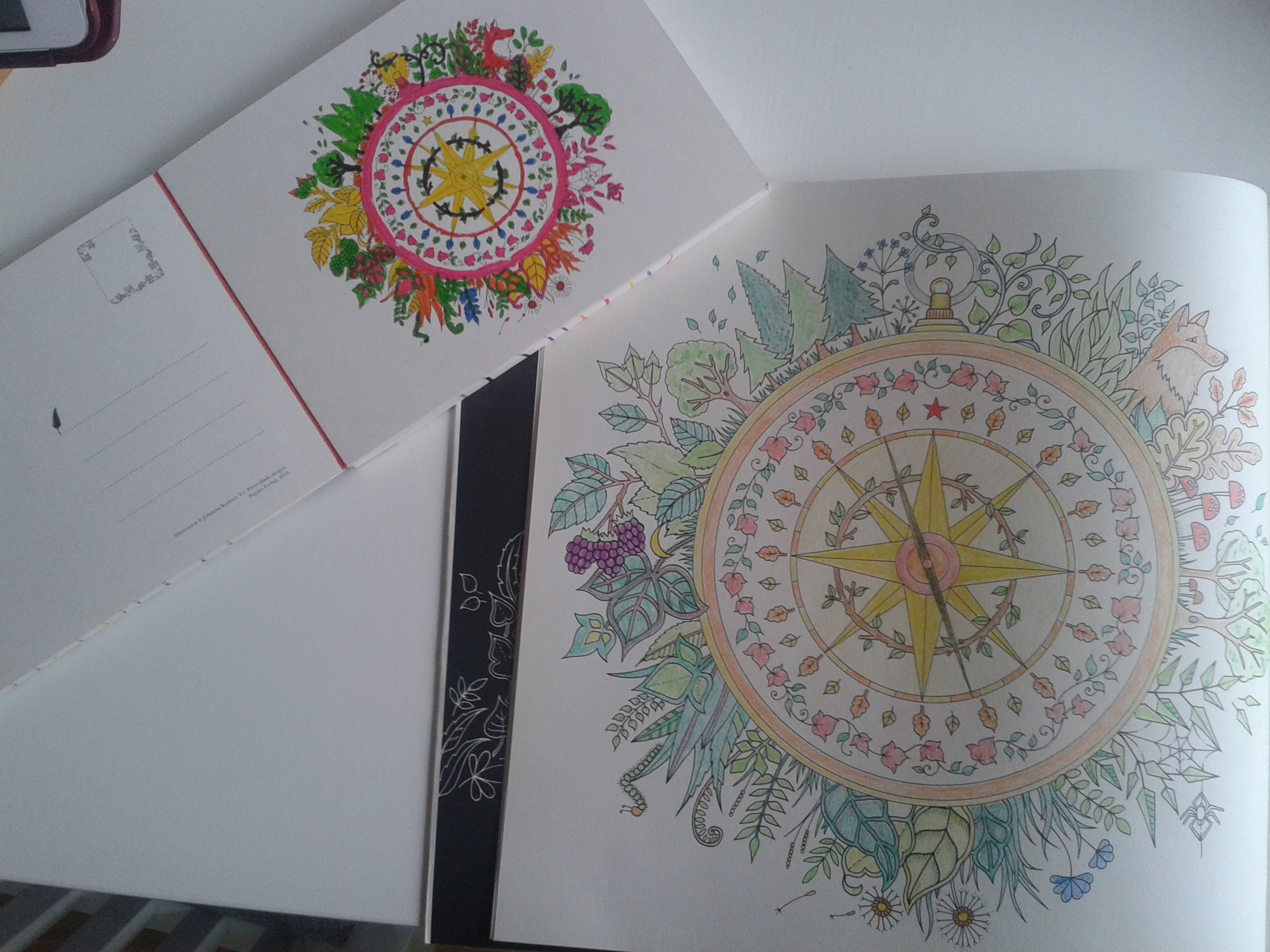
Can you guess which one is mine and which the 6-year-olds?
Do you write your recommendation letters?
StandardThis is a question for both the people requesting letters of recommendation, and those who are signing the letters of recommendation.
About a month ago, a blog post-ish thing was published in Science, that was griping about a not-rare phenomenon. Sometimes when junior scientists ask for letters of recommendation, they’re asked to write a first draft of the letter. This is, allegedly, “minor fraud.” Continue reading
Firing scientists for sexual misconduct is not enough
StandardWhen Jason Lieb was a professor at the University of North Carolina, he was sleeping with one of his own graduate students. He was investigated by UNC for sexual harassment, and then left for Princeton. He left Princeton within a year, and was hired by the University of Chicago. The search committee at Chicago was fully aware that he was having sex with his own graduate student at UNC, because Lieb told them this fact. And they hired him anyway. Continue reading
Shooting down a widely held scientific myth
Standard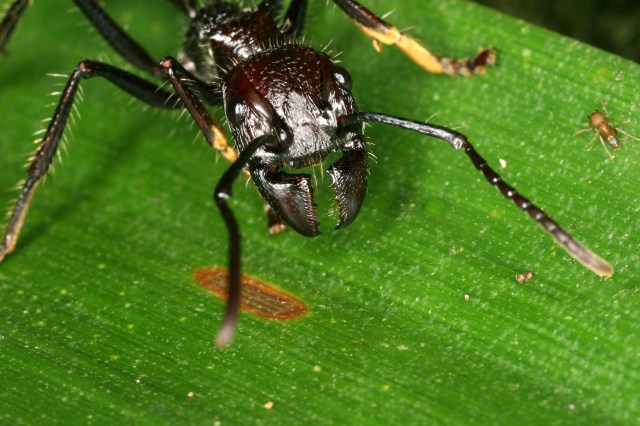
Bullet ant image by Benoit Guenard
Science is full of ideas that people somehow accept to be true, just because people say it’s true. We’ve all heard wonderful just-so stories that are waiting to be dispelled by data.
Let me tell you about three myths.
The first myth was that gastric ulcers are caused by stress. All kinds of medical treatments were predicated on this notion. When a researcher figured out that gastric ulcers were caused by bacterial infection, it was considered so outlandish that he had to infect himself to convince the medical research community. (In 2005, the Nobel Prize was awarded for this finding.)
For the second myth, consider the three-toed sloth. For about a century, it’s been said they specialize on Cecropia leaves. One twist on the story is that that the trees are tastier to sloths because they have weaker chemical defenses, because the plants are defended by ants. Then, in the 1970s, two biologists radio-tracked sloths for a couple years in Panama and found that yes, they eat Cecropia, along with many other plant species. If you track them with radio collars, then you get to see that they are not Cecropia specialists.
The people who radio-tracked the sloths did not receive a Nobel Prize. Continue reading
Recommended reads #69
StandardBlurred lines in academia–what is work?
StandardWhile navigating the unemployment system in Sweden, I’ve discovered that I need to report every month what I’ve been doing to find a job. It includes applying for jobs of course but also training. I should also include working on my CV, networking and other activities that improve my employability. I’ve also been warned that one shouldn’t “work” during this time and all work has to be reported (you can work for up to 75 days and keep your unemployment status).
All of this has me reflecting on what work is in academia.

It seems to me that few other professions have the same structure as academic research. Continue reading
The tyranny of the 9-month position
StandardI’m convinced that 9-month positions are bad for pretty much everybody. Especially driftwood faculty.
This week I was having a conversation with folks at Charles Sturt University* in Australia, which has a bunch of wonderful ecologists. This is the middle of the summer break here in Oz**, and classes don’t start back up for at least another month or so. But there wasn’t any problem catching everybody for lunch at work. They were writing grants, or papers, or getting other stuff done. Do you know why they were on campus? Because they were working. They were getting paid to work. Over the summer break.
This might sound normal to you. But for readers outside the US, you might not realize that this is not the status quo in US universities. By default, faculty at US universities are employed for nine months. Or maybe ten months. Continue reading
Can on-line networking replace the traditional kind?
StandardA few weeks ago Terry wrote about going to conferences, networking and social capital. The post struck home for me for a couple of reasons. First, I agree wholeheartedly with the diffuse benefits that come from interacting with people at conferences. I’ve made friends, started collaborations, been invited to give departmental seminars and gotten paper invitations, all of which I am sure wouldn’t have happened if I hadn’t given a talk and talked to people at conferences. Of course, there are challenges to these intense social and scientific interactions too (e.g. the conference hangover) but conferences are a really important part of developing your scientific career. Continue reading
It gets busier.
Standard I couple years ago, there was a careers-in-science discussion on an OTS field course. (I was visiting faculty — I am rarely asked, but definitely love to join up when I am available.) I honestly don’t remember if I was on the ‘panel’ or in the audience. I do remember when the topic came up about how busy you are as a grad student and beyond. Continue reading
Recommended reads #68
StandardA lecture from the lectured. This is a superb piece from students responding to that op-ed piece in the New York Times, which said that lecturing is all that and a bag of chips, whereas active learning stinks like poo.
Why your students forgot everything on your powerpoint slides.
Ten easy ways you can support diversity in academia.
An astrophysicist at Caltech, who sexually harassed his own students, was put on unpaid leave with additional major consequences. The story about what he did is flabbergasting. He fired his own student because he fell in love with her:
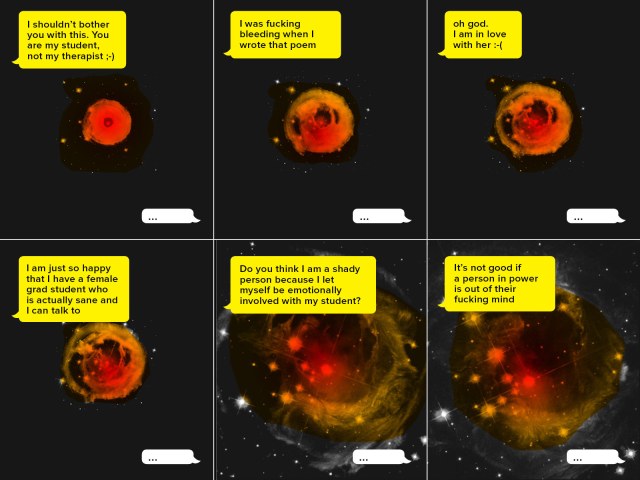
These are texts from the sexual harasser to his graduate student; the image is from the linked Buzzfeed article.
First week off the job-life as an unemployed academic
StandardThis week I am officially unemployed. What does life as an unemployed academic look like? Well, in the first place not so very different from an employed one.
Sweden has a long school break so we’re just getting back into the swing of things here (read the kid is back at school). This is also the first week that I am officially without a contract and have to face the reality that came with grant decisions in November. But work as an academic doesn’t really stop when the money does. I have two masters students and a PhD to see through their defences this year so at the very least, I will continue to help them with their research and writing. Of course I also have a bunch of unfinished projects that I would like to invest in and get published. All this adds up to me doing lots of things that I would normally do as a part of my job. Continue reading
Yet even more sincere answers to stupid questions
StandardPeople write the craziest things into google, and then land on Small Pond Science.
Here’s a selection of some of these searches, and the best I can do to answer the queries. The queries are verbatim, in italics. I’ve done this three times before, but it’s been a while. If you’re wondering about the title of the post, I guess you’ve never been a regular reader of Mad magazine.
Who you know really matters
StandardPeople say that it can be important to go to conferences once in a while because “networking” is important.
I wouldn’t put it that way. I would say that, for junior scientists, attending a conference regularly is critical because knowing people in your field is necessary for academic success. This is particularly true if you don’t have prestigious connections.
It’s not what you know, it’s who you know. It’s a cliché, but it’s one I’ve seen affirmed time and again. Continue reading
Undergraduate research is many things
StandardConversations about “undergraduate research” often involve dispelling misconceptions.
Undergraduate research is not one thing.
What is undergraduate research? It is research that involves undergraduates. That’s all, nothing else. If you want it to mean something else, you might have to spell it out.
Top 10 Small Pond Science posts of 2015
StandardSmall Pond Science had a good year. Most readers have joined within the last year, so let’s recap with the Top Ten Posts of 2015:
10. Educating the ignorant masses, Eli Broad style
9. Authorship when the first author is the senior author
8. Will work for food: How volunteer “opportunities” exploit early-career scientists Continue reading
Recommended reads #67
StandardWhat does the Paris Agreement mean? After a a few decades of knowing about the greenhouse effect as a real and serious thing, we as a species we are now finally trying to do something about it. Here are the three things I want to share about the Agreement:
A blog post by an economist with a detailed-enough take on the actual substance of the Paris Agreement, a little deeper than what you’d get in the newspaper.
How did the Paris agreement happen? This is a story about the French Foreign Minister and his masterful approach to negotiation.
Brenda the Civil Disobedience Penguin explains the Paris climate agreement: “The interesting thing is not so much what is in this agreement but the fact that they made it at all. It is the first time the voice of the climate movement has outweighed that of the fossil fuel lobby. And the free market is finally following the money.”
Meg Urry published an important commentary in Nature:
Every major criterion on which scientists are evaluated, for hiring, promotion, talk invitations or prizes, has been shown to be biased in favour of (white) men. These include authorship credit, paper citations, funding, recruitment, mentoring and tenure.

A little story about how minds change
StandardA funny little thing happened in our last departmental meeting of the semester.
We meet for 2-3 hours at a time, about once per month. Conversation usually meanders. (Hey, I just work there.)
So this time we were talking about the assessment paperwork that we have to do. After discussing how the documentation required by the university is mostly useless to us, we were wondering what we could do that would actually be useful.
I threw an idea out, that we should know how our majors perform using other universities as a benchmark. And there’s a test that many universities use called the Major Field Test. And we could easily have our graduating students complete it during our capstone course.
The funny part is that everybody thought it was a good idea. It sounds like we’re doing it next semester.
What’s so amazing? Well, about five or so years ago, I said pretty much the same thing in the same context. At that time, everybody in the room just crapped all over the idea. It would cost money, ETS is evil, it wouldn’t be helpful information, and we couldn’t find a way to motivate the students to do well.
What’s changed from five years ago to now? Well, some people have retired, and we have some new people. But the same people who hated the idea five years ago thought it was a good one now.
I can’t really explain it. People change, circumstances change, and slight changes in the environment and how an idea is presented can have chaotic influences on the outcome. I don’t think I’m a better salesman than I was five years ago. It’s just a different moment and a different outcome. Huh.
I just thought I’d just share this little slice-of-professor-life that could have a moral-of-the-story if you wanted to look for one.
By the way, now that Small Pond Science has taken a few trips round the sun, I’ve noticed that traffic really drops in January — so posting will slow down accordingly for the next month. I imagine folks are in the same boat I am: holiday work hangover, a new semester, and using weeks off to both vacation and then get stuff done. (I’m spending a whole week just with family, and then am working on grants, and traveling to the field with students for a couple weeks.) Be sure to find some time to take a restful break!
Should I stay or should I go now?
StandardOr maybe an alternative title could be “The Accidental Academic”.
This November I heard back from the two main Swedish funding agencies that I didn’t receive a grant this round. For me this means not only that I don’t have funds to run my lab, but also that I don’t have a position for myself. Because my temporary professor position is coming to an end, no grant also means no funding for my salary and I’m transitioning to being an unemployed academic.
So, should I stay or should I go now? The question has been rattling round in my head ever since I got the grant rejections. Continue reading
Live tweeting at academic conferences: time to move on?
Standard Guest post by Ian Lunt.
In popular culture, peak beard has been defined as the point in time when the rate of beard destruction exceeds the rate of beard production. By extension, peak tweet can be defined as the time when the rate of tweet production far exceeds the rate of potential consumption.
In 2015, a sizable ecology conference exceeded peak tweet. Attendees live-tweeted far more messages than readers could feasibly find or read. Which creates a quandary we haven’t before had to face:
Now that live-tweeting has mainstreamed, how can we increase the utility of conference tweeting to improve outreach?
Collaboration keeps your research program alive
StandardIf you look at scientists in teaching-focused institutions who have robust research programs, there’s one thing they tend to have in common: They have active collaborations with researchers outside their own institution. Continue reading
Recommended reads #66
StandardShort answers to hard questions about climate change. This is the best short summary of the state of our knowledge that I think I’ve read lately. Definitely built for sharing.
A conversation about writing, between Osita Nwanevu and Ta-Nehisi Coates.
A conversation about space and science between Chris Hadfield and Randall Munroe.
A conversation about climate change between Bill Clinton and Neil deGrasse Tyson. This is good stuff. Continue reading
If you have a bad advisor in grad school
StandardA couple weeks ago, I emphasized that most PhD advisors are really good.
In a haphazardly conducted poll, one in four people reported their PhD advisor that was not caring or helpful. Crappy advisors may not be the norm, but we still have 1 in 4 too many.
I’ve seen a variety of situations, choices, and outcomes over the years, and would like to share some thoughts with grad students who are experiencing a bad PI. I’m hoping those of you who have gone through nasty experiences might be able share insights as well. I’ve just been a bystander, and there should be many more voices than my own.
When dealing with a bad PI, I think there are two big questions:
- What can be done to ameliorate the situation?
- When should you bail on your PI and move to a new lab or even a new institution?
 Small Pond Science