
I just saw this, and I think everybody needs to see this. Here it is:
Uncategorized
Running an unfunded seminar series, and traveling to speak for one
StandardDo you have a funded seminar series? How often can you bring in outside speakers? Do you wish you had the opportunity to bring in people more often? Continue reading
Academic advising and academia
StandardI’ve recently talked about the hidden labor of academic advising, and also the need to provide an education in academia and academic culture. I think it’s important to discuss how these two things intersect. If we are trying to bring more first-gen and minoritized folks into this academic sphere, then one of the first steps is making sure that folks know* what it means to be a professor, what it means to do research, and what it means to go to grad school. Because I think the typical undergrad really has no idea about this stuff when they go to college, and the sooner they are aware of this, the sooner they have the possibility of choosing this route (or choose against it, of course).
Let me illustrate this with an example. From a conversation that I have had so many times, with so many students.
I do a lot of advising for students who are pursuing teaching careers. And in the past, I’ve served on a lot of interview panels for students seeking to join the Noyce Scholars programs that we run at CSU Dominguez Hills. Here’s a thing I’ve heard, something like:
“I want to be a professor. I want to teach at in a university. I suppose I could teach high school for a while, and then after a while I can get my advanced degree and find a university position.”
I hear this all the time. I mean, it’s possible I’ve heard this a hundred times. Definitely more than 50. At least in the population of students I work with, it’s apparently a very common career plan. It sounds entirely sensible and reasonable in a lot of ways. I don’t think it’s based on many assumptions, but it’s not informed by the hidden curriculum.
It sounds entirely sensible and reasonable. There’s just information that these students don’t have. In a single conversation, it’s not really healthful to dive into all of the ways that this isn’t a common career path that would be feasible for most folks**.
Because so many people of our undergrads have this idea of a career plan, then I can infer pieces of the hidden curriculum that our students aren’t aware of:
-What the job of a professor at a 4-year institution is beyond teaching
-What it’s like doing research, and what research is
-That earning a PhD in a STEM field while teaching a in full time K-12 position is somewhere between extremely difficult to impossible, and that leaving that solidly-paying job for a graduate stipend could be perhaps just as difficult
-How grad school admissions works
-The odds of getting a position as a professor after finishing graduate school
There’s no reason that anybody in college would be expected to know this stuff unless they’ve been in a social role where they would just absorb this stuff from their environment. But for most of my students, I suspect we as their professors are the people who they know best who have PhDs. So that means it’s on us to provide this cultural knowledge so that people know the options they have in front of them.
So I’m sitting in my office with a student who has just finished on semester of lower division biology. And is interested in becoming a professor. And who has no prior exposure to research. They haven’t expressed an interest in research, because they haven’t really been aware that this is even one of the options open to them. They’re into organismal biology (including plants! and bugs! and chemistry! Three things that go so well together!), and so we talk about finding opportunities to do some research. About applying to REUs. About finding a chance to work in someone’s lab. About how students can get paid to do research. And that if you are interested in doing a PhD, this is the perfect time to get the research experienced needed to land into grad school.
I could have limited my advising for this student to the pathway towards teaching biology at the high school level. Which is not any less than being a professor, it’s just different. But I would really like this student to be able to make that choice. And a real choice is a fully informed choice. And you can’t make that fully informed choice based on a conversation, it takes some tangible experience to know the many differences are between K-12 teaching and the professoriate, and what each of these professional routes looks like.
When people talk about increasing diversity in STEM, what that really means is changing the fundamental composition of the pool of people who are applying to grad school, who are applying for postdocs, and who are applying for faculty positions. To change the composition of that pool, we have to bring people into higher ed who don’t even have grad school on their radar. I’ve met so many students in their last semester of college who are only learning that research is cool, and what grad school is. Those conversations have to happen early earlier than that. And opportunities need to be presented earlier. Which means that when these students are applying to your labs and your REU programs, it’s your job to provide that training. This is a lot of work. That’s okay, because, as someone one said, nothing truly worth doing comes easily. I’m not sure how true that is (after all, going out for eggplant parmesan tonight sounds very worth doing, and it’s not that difficult), but maybe it applies this this situation.
*To be clear, it’s just as important for folks in academia such as myself to evolve so that it shouldn’t be necessary for people to adopt a different identity and conform to the homophilous mold of academia. It’s our job to make this “pipeline” more accessible and remove these barriers tied to social capital. But still, folks gotta know what the career pathway looks like.
**I know of a few people who were K-12 teachers before getting their PhD in a STEM field and them became a professor in a STEM department. (Though think this is common in Education, right?) But in STEM this definitely not a standard approach and the capacity to do so often involves leveraging a substantial amount of financial and familial privilege. This seems to be a little more common for community college positions, maybe?
Gender inequity at every step of publishing
StandardI sat down to my laptop this morning and was looking forward to getting to work. But then I looked at the news.
And I saw this:
https://twitter.com/NeedhiBhalla/status/1194052022355386368
The Royal Society of Chemistry (RSC) came out with a report last week about biases against women in the publication process. The highlights — or rather, the lowlights — are in the story in Nature about this report. It’s a one-minute read, please read it. Continue reading
Recommended reads #160
StandardThis might as well be straight from a science fiction novel, but it’s our reality: Scientists around the world have banded together to write a major warning to everybody on the planet about the climate emergency (again).
Critically acclaimed horror film of the 2010s, or your PhD program?
The unseen labor of writing reference letters Continue reading
Retooling at mid-career
StandardAt mid-career, a lot of the research techniques and approaches that people in use today today didn’t exist when we were in grad school.
When I started my own lab around the turn of the century, we didn’t have R but there was S, microsatellites were a cutting edge technology replacing allozymes, the browser we used was Netscape Navigator, GPS units couldn’t get a read through a dense forest canopy, phones were only used for calling people, the number of genomes we had sequenced was around zero, and Transcriptomics might have been a ska band.
This post tells you about a couple routes for funding to retool.
Academic advising by tenure-track faculty
StandardBased on some recent conversations, I’m realizing that an underappreciated piece of professoring is academic advising. I don’t think I’ve written about it on here yet (?), but a substantial piece of work by faculty in our department is advising our majors. Just like the unseen labor of writing recommendation letters, doing quality academic advising is very important but how much and how well we do this (or not) generally gets overlooked.
If you’re at a small liberal arts college or a smaller regional state university, then you probably are doing a lot of advising. Continue reading
Look in your own backyard
StandardMetaphorically, that is.
What can you do to increase the representation of minoritized people in your department and in your lab?
Well, the big answer to the question is that anything worthwhile takes work. This is not just worthwhile, it’s important. So, it will require effort on your part. And it means challenging yourself to learn new things, and instead of just adopting new practices, but are open to a new mindset, which means aligning your actions with your values. That’s hard work.
But do you want an easy win? Do you want a practical piece of advice, about something you can do that will work? Continue reading

Recommended reads #159
StandardHitman 2’s new game lets you quit being an assassin and become an ornithologist: “Here’s how it works: After using your trusty piano wire to kill an ornithologist and swap into his cargo shorts and binoculars, all you have to do is press X to toss aside your silenced pistol, point out the nest of a plum-throated cotinga to your research assistant, and embark on a full-fledged research career in the King’s College Avian Biology Department.”
Color me surprised. A new study claims that in laboratory-oriented fields, mentoring from postdocs is impactful for PhD students, but not for mentoring from the PI. And that PI tend to ignore established best practices for mentoring, and just go from the hip based on their own prior personal experiences. (As a disclaimer, I haven’t actually read this article, by the way, just saying what the abstract and folks have been saying. Since it’s in a fancy journal, be primed to expect big claims that may or may not be appropriately generalized from the actual findings.)
Working from affirmation, not for affirmation. Continue reading
Be careful with human examples when teaching animal behavior
StandardYou may or may not have heard of this weekend’s debacle from the Proceedings of the National Academy of Sciences (They promoted a paper using images of women appearing to have an orgasm. Though the paper was an ovulation experiment in rabbits. Do they have any women involved in the social media process over there? Yikes.) I hold the new EIC in high regard, and I imagine she’ll get to the bottom of this. But it reminds me of a thing I’ve been meaning to address here for a while.
I suspect a lot of us are teaching animal behavior and behavioral ecology very badly, whenever it comes to our own species. Continue reading
Reviewing manuscripts as an early career scientist
StandardI find this weird, but apparently, some journals in some academic fields don’t allow grad students or postdocs to serve as peer reviewers. I do get the idea that professional experience and expertise should be required to conduct a peer review. They’re called “peer” reviews for a reason.
Then, the question is: are early career scientists our peers? Continue reading
On the urgent need for climate action
StandardYou’ve probably seen clips. But please watch the whole speech, it’s less than five minutes.
Thanks. Here are some unordered thoughts (some that I’ve adopted from others). Continue reading
Do R1s or PUIs have higher research expectations?
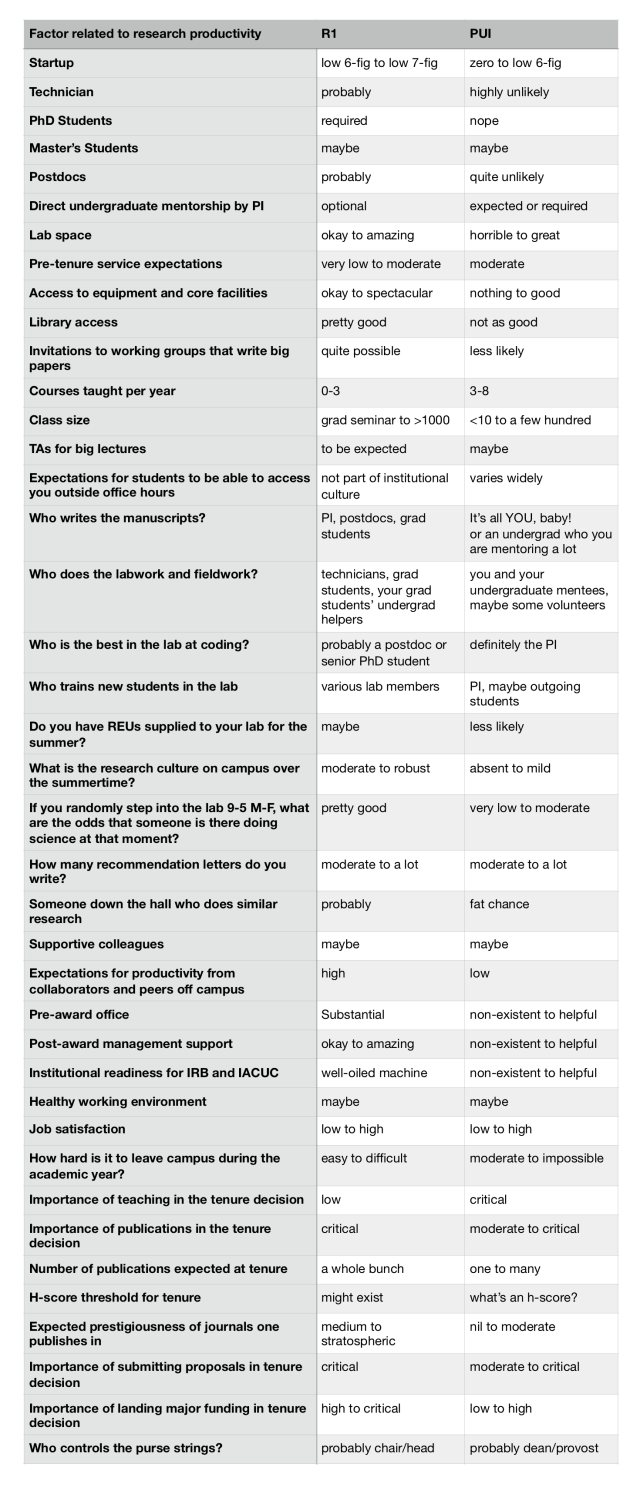
StandardWell, of course, major research institutions (R1s) expect more research to come out of their labs than primarily undergraduate institutions (PUIs). But, after you take into account the circumstances of each kind of position, who experiences a higher relative demand for research productivity? At which kind of institution is it harder to meet the scholarship criteria for tenure?
Well, let’s compare various factors related to research productivity at these kinds of institutions*.

Recommended reads #158
Standard“Dr. Kathryn Milligan-Myhre works in the field of host-microbe interactions. In this mSphere of Influence article, she reflects on the people and scientific ideas that influenced her journey from a small town in Alaska to a faculty position at the University of Alaska Anchorage.”
“If you are, like me, someone who studies things that are not humans and you’re interested in studying humans, you absolutely need to talk to people who do that for a living.” Continue reading
On unearned authorship by advisors of graduate students
StandardAuthorship is weird. As an instrument to attribute of credit, it’s far too coarse whenever the number of authors is greater than one.
Authorship is a slippery concept, because you can’t really define what constitutes a substantial contribution, in a way that can apply generally. Continue reading
How to get students to go to departmental seminars?
StandardWhat is a good and equitable way to get more undergraduates to attend departmental seminars? Continue reading

Recommended reads #157
StandardPlay The Game, or Change The Rules?
StandardI feel a dilemma — or rather, a tradeoff — when I think about investing time, money, and effort into supporting undergraduates to gain admission to graduate programs.
On one hand, we all know that the system is rigged, such that students who come from whiter and wealthier backgrounds have a huge leg up. Continue reading
On enjoying science, and life, each day at a time
StandardA few years ago, I started running. I like running. It’s a good time to think, or to not think. After a run and a shower, I’m more energized. Continue reading
EEB Mentor Match 2019
StandardThis is the announcement of EEB Mentor Match for 2019!
We are pairing up students applying for graduate school and graduate fellowships with more experienced academics who have been through the process. If you’re an undergraduate or recent graduate who feels that you could benefit from more support, this is for you! Continue reading
Recommended reads #156
StandardAn open letter about sexual harassment and retaliation at UC Irvine.
Among the many layers of horrible events In These United States, the dismantling of the USDA, via translocating the agency to Kansas City (though where in Kansas City, they have no idea), is not getting much attention. Here’s a recent update on this from the Washington Post.
A big meta analysis is showing that, as the ocean warms, fisheries decline. Every degree celsius corresponds to a 5% loss in biomass. Continue reading
Are your undergrads getting enough data science?
StandardScience moves faster than curriculum. This means we are leaving some of our students behind. Continue reading
How much should student registration cost at conferences?
StandardLet’s say you’re a grad student heading off to the annual 5-day conference in your field. You’re giving a poster, you are scheduled to have coffee with a person whose work you admire, you’ll be seeing a some old friends, and you’re there to learn about the newest work in your field.
Then, you get contacted by the people who run the conference. They’re wondering if you want to work — during the conference — at a rate of $14 per hour. Continue reading

Recommended reads #155
StandardIt’s never going to be perfect, so just get it done.
Stats on tenure-track hires in Ecology and Evolution, in which Dr. Fox combs though a lot of CVs.
Yet another piece of research showing that “learning styles” is not a thing. Continue reading
Please take a look at what’s happening in Alaska
StandardI admit it’s hard to keep track of the many avenues of malfeasance from the federal government, and a variety of state governments. But if you’re in higher education, I think it behooves us all to look at what’s happening in Alaska. Continue reading
Massive editorial failures harm authors and readers
StandardHave you heard of the newly published misogynist paper in the American Journal of Emergency Medicine? Here’s the start of the abstract:
It is unknown whether female physicians can perform equivalently to male physicians with respect to emergency procedures. Endotracheal intubation is one of the most critical procedures performed in the emergency department (ED). We hypothesized that female physicians are not inferior to male physicians in first-pass success rate for this endotracheal intubation.
There has been much outrage. But hold on. This might not be what it might look like.
Continue reading

Recommended reads #154
Standard53 essential tech-bro terms explained (It’s like the Devil’s Dictionary)
In ecology and zoology, the number of women authors on papers with male senior authors is shockingly low. I mean, yeah, you’d expect an effect of gender, but, I mean, wow, this is worse than I would have imagined:
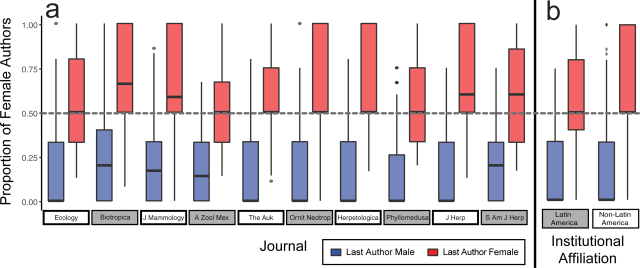
Figure from Salerno et al. 2019, comparing proportion of women authors in papers with male or female senior authors
Being a professor is too many jobs, perhaps?
StandardSome while ago, a colleague mentioned how his job as a professor was a “triple position.” Teaching well is a full time job. Doing research well is a full time job. And the service that we do, if done well, can or should be a full time job. We professors have three jobs rolled into one salary (and a 9-month one at that)!
This has been a lot of food for thought. I’ve come to realize that for nearly everything I do for the university on part-time basis, there are people who do that work on a full-time basis with a higher degree of specialization. Continue reading
Better recruitment of postdocs and grad students
StandardRemember when I was saying that junior scientists of color are more likely to get ignored when they send their CVs to PIs they want to work with? A couple weeks ago, a paper came out with some substantial data validating concerns about this problem. Continue reading
 Small Pond Science