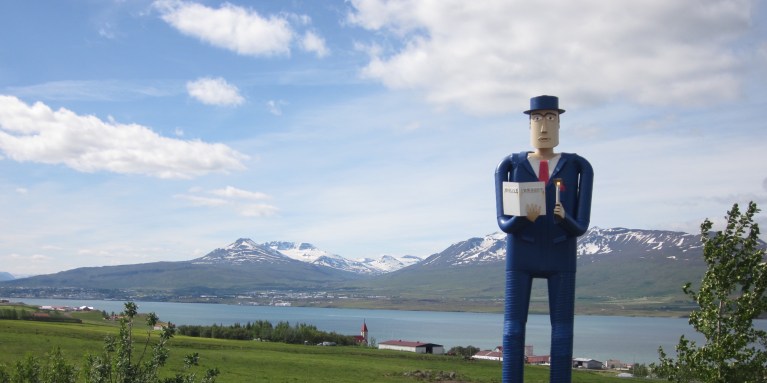
I’ve been on mostly-vacation for the past week. I thought I’d share something different. Some of my favorite museums are ones that usually don’t make it to the top of must-do lists. If you find yourself in the vicinity of one of these, you might be in for a treat. Continue reading
How can track record matter in double-blind grant reviews?
StandardWe should have double blind grant reviews. I made this argument a couple weeks ago, which was met with general agreement. Except for one thing, which I now address.
Some readers said that double-blind reviews can’t work, or are inadvisable, because of the need to evaluate the PI’s track record. I disagree with my whole heart. I think we can make it work. If our community is going to make progress on diversity and equity like we keep trying to do, then we have to make it work.
We can’t just put up our hands and say, “We need to keep it the same because the alternative won’t work” because the status quo is clearly biased in a way that continues to damage our community. Continue reading
Recommended Reads #80
Standard“America’s early aerospace engineers ignored computers because they considered programming to be women’s work.”
Can the liberal arts save the sciences?
What happens when a husband and wife take the exact same job. Continue reading
Saying “see you later, sometime” to the rainforest
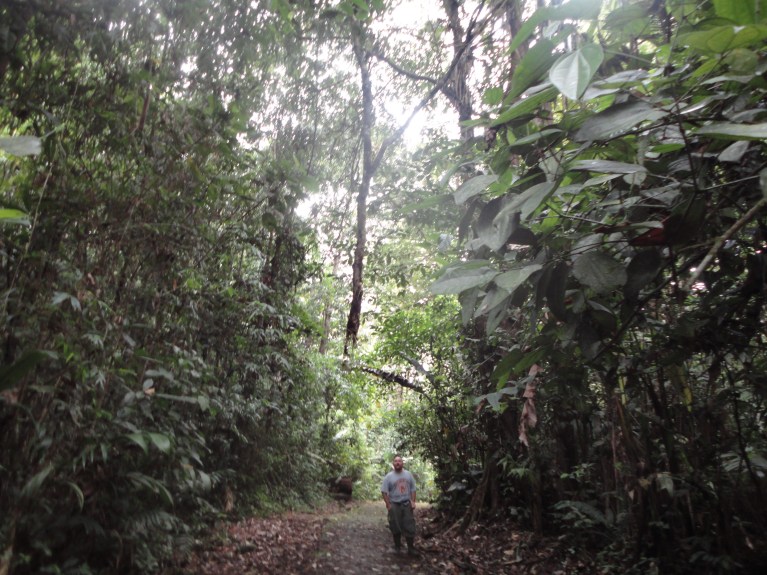
StandardI just got back home from a few weeks of fieldwork in the rainforest. Most of the science I’ve done over the years has been based out of a smallish patch of land in Costa Rica: La Selva Biological Station. It’s a special place.
There’s a lot to be said for becoming intimate with just one place, to develop ideas and make discoveries that wouldn’t be made by those just passing through. Continue reading
Why not double-blind grant reviews?
StandardIn some academic fields, double-blind reviews of manuscripts for peer-reviewed publication is the norm. It’s no surprise that people who study human behavior use double-blind review. They must be on to something that most of us in the “hard” sciences haven’t picked up yet. Continue reading
Recommended reads #79
StandardThings the world’s most and least privileged people say. Including “I don’t vote — the system is too corrupt!”
A comprehensive and entrancing visualization of wind, weather and ocean conditions around the world. A data-rich lava lamp.
NIH gave an endowment to San Diego State University. Not a grant or a contract, but an endowment. This is a thing?
How to build a society of equally involved parents Continue reading
The lost opportunity cost of overcommitment
StandardMy sabbatical officially started a few days ago. I was half-expecting a kind of weight to lift. But my brain isn’t letting me have any of that.
For the last year or so, I’ve been stockpiling things “for sabbatical.” Now, I’m looking at the weight of that list. Continue reading
Using blogs for sharing negative results
StandardI’ve now been blogging for a little over three years. I’m no longer a newbie, but clearly am not an old-timer. Nonetheless, I’ve seen the standard topics of the scientific “blogosphere” (for lack of a better word) get cycled through again, and again. These are topics that are often important to our community, dealing with equity, justice, accessibility, and leadership. That said, I feel like blogs can do more, and serve our own academic communities better. Continue reading
Recommended reads #78
Standard
Who wore it better? David Bowie or nudibranch? This is fabulous, in the classic sense of the word.
This is a compelling read about the most accomplished woman climber of Everest. And the compelling part isn’t so much about Everest.
Pros and cons of teaching in an active learning classroom.
The tighter the money, the less innovative the science. This is a convincing argument. Continue reading
A small private college financial bubble?
StandardI bought a house in late 2001. People thought I was crazy to pay what I did, but still, in less than five years, I could’ve sold that house for double what I paid. But just two years later, if I wanted to sell it, I would have taken a loss. Continue reading
Self-funding your research program
StandardIn the last few months, something has been on my mind. I’ve brought up the topic a few times, with some research scientists who hold tenured faculty positions. It would go along these lines:
I’m thinking of funding all of my research out of my salary. If I imagine a scenario in which…
- I take a 20% cut in salary
- I get that money in research support
- I don’t spend any more time writing grants
… it just makes me happy.
Every time I’ve brought it up, this was the response.
“I’ve been thinking about doing this, too.”
I was pretty much amazed. I thought it was just me. Continue reading
Recommended reads #77
Standard“Natural history: an approach whose time as come, passed, and needs to be resurrected.”
A reconsideration of “new conservation.” Also, if you’re not familiar, this has an explanation of what “new conservation” is. Man, conservation biology is an ideological and theoretical and practical mess. Holy crap. I’m not a fan of Mongabay for a variety of reasons, but this seems worthwhile.
This has really made the rounds because it’s fascinating, if not a surprise: Continue reading
What is press-worthy scholarship?
StandardAs I was avoiding real work and morning traffic, there were a bunch of interesting things on twitter, as usual. Two things stood out.
First was a conversation among science writers, about how to find good science stories among press releases. I was wondering about all of the fascinating papers that never get press releases, but I didn’t want to butt into that conversation. Continue reading
How does college selectivity affect the jobs of professors?
StandardSometimes when I talk about teaching — and interactions with students in general — folks don’t really get where I’m coming from. Faculty experiences vary a lot from campus to campus.
I was talking with some folks in recent months about the different kinds of faculty jobs, and how to figure out what you want in a faculty position at a teaching institution. One person was arguing that the selectivity of undergraduate admissions was an important factor. At first, I disagreed, but on reflection, I see that selectivity of admissions is associated with a number of things that affect your day-to-day experience as a professor. Continue reading
On the ballooning of spiders and deep evolutionary branches
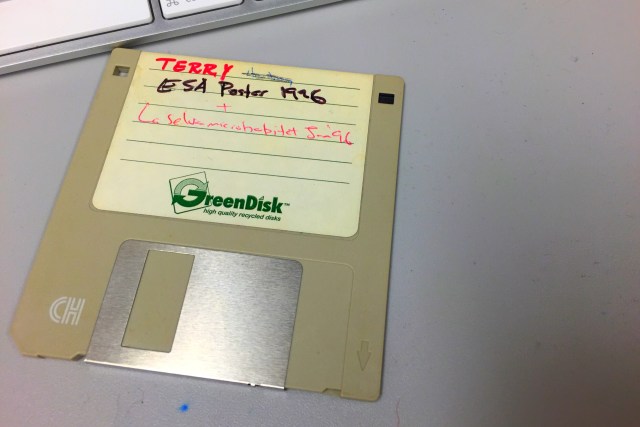
StandardTo keep track of projects, I use a sophisticated app called Moleskine. But early on in grad school, when I had a new project, I created a disk for everything related to that project. Like this:

One of these disks was labelled “Ballooning Spiders.” I had an idea for a side project that I humored for a few days.
I thought the ballooning behavior of spiders was pretty awesome. I still think the ballooning behavior of spiders is pretty awesome. I imagined it was quite likely that spiders could balloon across entire oceans. (Twenty years later, we know that’s true.) Continue reading
Parade of professors or solo scholar?
StandardThere are two basic models for teaching courses and the norm varies a lot depending on the type of ecology course. A single professor was responsible for the majority of classes I took as an undergraduate. However, these days the courses I’m involved with are done by a series of professors for particular subtopics. The contrast has me thinking about the pluses and minuses of these approaches. Continue reading
Recommended reads #76
StandardCards against humanities. You read that right, not humanity, Humanities.
This Puliter Prize-winning story by Kathryn Schulz about The Really Big One that will arrive in the Pacific Northwest. The letter for its entry into the Pulitzer competition said, “Schulz’s piece brings the seismological science to you, making it as plain and painless as a cake recipe. Yet it also leaves you with a visceral sense of what a full-margin Cascadian earthquake could feel like–and what its human toll could be. No surprise that the story has at last focused public attention on the need for precautionary measures. As of this writing, the piece–many months after publication–remains perched high on our Web site’s Most Read list. ‘The Really Big One’ brilliantly demonstrates how feature writing–drawing upon reporting, research, and most of all, the well-judged potency of prose–can rock our world.” So, yeah, read this article.
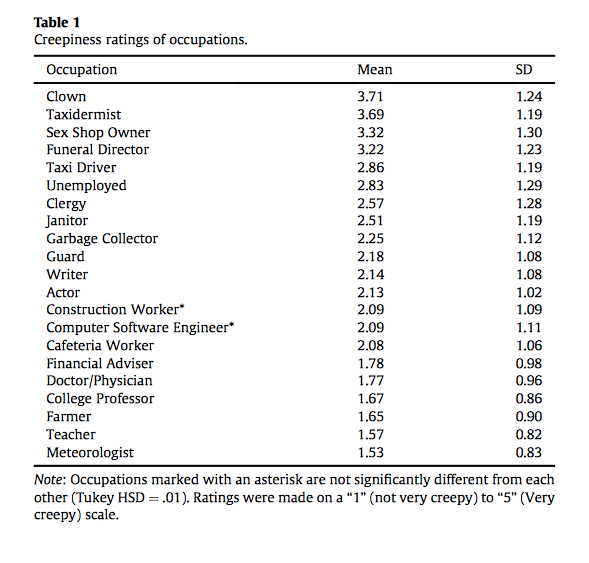
College professors aren’t that creepy. (Notwithstanding recent revelations from UC Berkeley further down this list.) Obviously, clowns are creepy. Gotta disagree about taxidermists though.
Impatience with the peer review process
StandardScience has a thousand problems, but the time it takes for our manuscripts to be peer reviewed ain’t one. At least, that’s how I feel. How about you?
I hear folks griping about the slow editorial process all the time. Then I ask, “how long has it been?” And I get an answer, like, oh almost two whole months. Can you believe it? Two months?!” Continue reading
NSF’s Water Man award
StandardWhen I was a tween, a cutsey feel-good book was a bestseller: All I Really Need to Know I Learned in Kindergarten. If we learn to solve problems as kids, that should help us solve similar problems as adults.
Let’s do a kindergarten-level exercise in math and pattern recognition. Can you figure out what shape comes next?

If you said star, you’re right! Congrats!
Let’s do another one. What shape do you expect to find next?

If you said star again, then that means you’re two for two. Good job!
Let’s look for another pattern:

What do you think comes next? If you guessed
, then you’re right! Your pattern recognition skills are fantastic! Continue reading
Using a grant writer
StandardI’m working on a couple biggish grants at over the next couple months. I’m doing something that I haven’t done before, at least not as a PI. I’m working with grantwriters, under the support of my university. These are for grants to support a bunch of people doing a variety of things, with many organizational components that are only tangentially connected to the science. Continue reading
Recommended reads #75
Standard“Mistakes I’ve made as an early career researcher”
A recent story in the New York Times is explaining how it looks like that Chinese go at digging a canal across Nicaragua looks unlikely. Thank goodness, as this would’ve been an environmental tragedy.
Chic in Academia: Assembling affordable outfits for professional women Continue reading
Education research denialism in university STEM faculty
StandardScientists regularly contend with irrational denialism of simple facts. In our classrooms, communities and the media, we hear patently absurd things like:

This is the logo of the Flat Earth Society.
- The world isn’t getting hotter, or even if it is, it’s not from carbon emissions.
- Humans didn’t evolve from nonhuman ancestors.
- Transgenic foods are unsafe.
- Vaccines cause autism.
Any scientist who operates on the basis of evidence will regard those ideas as total bunk*.
But, as I’ve mentioned before, people aren’t rational beings. Especially when their emotions are involved (and they usually are), they’re not prone to think an expert is correct if their intuition tells them otherwise.
So I am not entirely surprised, but I am disheartened, when scientists are guilty of their own flavor of denialism: Education Research Denialism. Continue reading
Recommended Reads #74
Standard
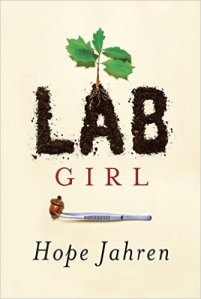
Have you ordered a copy of Hope Jahren’s Lab Girl yet?
Here’s my review on Goodreads. A more professional review comes from the head of book reviews at the New York Times, who raved about it. And this is not a woman who raves about books. She says: Lab Girl “does for botany what Oliver Sacks’s essays did for neurology, what Stephen Jay Gould’s writings did for paleontology.” Continue reading
NSF Graduate Fellowship timing doesn’t help the undergrads who need the help
StandardNSF just announced their Graduate Fellowship (GRFP) awardees. Continue reading
My path to science
StandardTwo years ago, Meg Duffy told the the story of her path to ecology. It’s a good story, why not go over and read it? I think it might be useful for more folks to tell their own stories. Here’s mine, about how I became an ecologist, with specialities in tropical biology and social insects.
As a kid, I didn’t collect bugs and I wasn’t a nature geek. Continue reading
Recommended Reads #73
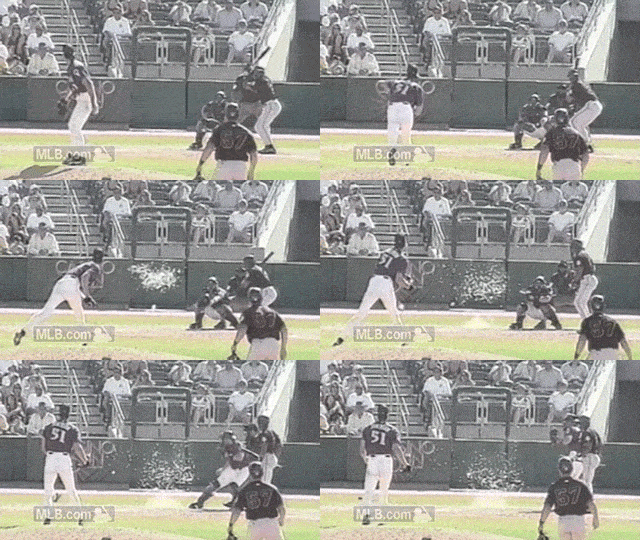
StandardCan you believe it’s been fifteen years since Randy Johnson vaporized a mourning dove with a 100 mph fastball? Here are some ornithologists looking back on this unfortunate chance encounter.

What are office hours for?
StandardWhat do you think office hours are for?
Office hours are drop-in* hours for students to see their professors. How should you spend this time?
If you don’t have students in your office, then you should probably be writing. Because we always should probably be writing, right? Or analyzing. Or doing a weekly browse of tables of contents. Or something else productive. If you’re me, you should be cleaning your office.
But let’s say students appear** for office hours, how are they supposed to be used? Here are some reasons students visit: Continue reading
“Open Science” is not one thing
Standard“Open Science” is an aggregation of many things. As a concept, it’s a single movement. The policy changes necessary for more Open Science, however, are a conglomerate of unrelated parts.
I appreciate, and support, the prevailing philosophy of Open Science: “the movement to make scientific research, data and dissemination accessible to all levels of an inquiring society.” Transparency is often, though not always, good. Continue reading
Recommended reads #72
StandardThis student adds a woman in science to Wikipedia every time she’s harassed online. This keeps her busy.
Time management is the key to happiness: “Organization saves time mostly because it averts crises.” I think this is not an overstatement.
A grading rubric for job talks at small liberal arts colleges. This meshes with my experience pretty well. Continue reading
NSF makes its graduate fellowships more accessible
StandardThe US National Science Foundation has changed a rule for their Graduate Fellowships. As of next year, grad students can only make one attempt at landing a graduate fellowship, which is intended to increase the proportion of awards going to undergraduates. Continue reading