Strategies for mentoring undergraduate researchers
To the heroes of Brazil’s National Museum

Last week was not easy for me, schedule-wise. It was the first week of classes for my campus, my son’s third week back to school, and I was solo parenting, while my spouse was traveling for work.
So what did I do? I made things a bunch harder on myself, and spent the majority of the week at the LA Convention Center, to participate in the Leadership Training for Climate Reality. Continue reading
I once said in the late 1990s, “Shoot me if I ever talk about getting a cell phone.” But the world evolved, and so do we. So, this semester, I’m entirely out of the classroom, and am taking on a part-time acting administrative role. I’ll be applying for the longer-term slot, too.
Four and a half years ago, I wrote on this site:
If I ended up taking on a half-time administrative job at my university, there’s no way the job would end up being a half-time gig. Even if I somehow only spent twenty hours per week working at it (and fat chance at that), far more hours would be sucked away by the seven administrative sausage-makers taking up space in my head. I’d be worrying about preventing one person from trying to gain access to another person’s budget. I’d try to sort out who I could cajole to join a committee. My calendar would have deadlines for reports popping up. Even when not in meetings with people who wear suits, I wouldn’t be able to eliminate the conversations with suits from my consciousness.
I want to think about manuscript revisions, my next lesson, the next grant and keeping tabs on the projects students are doing over the year. This last semester had more admin work than I’m used to, and regardless of the time I spent on it, the administrative stuff handicapped everything else. I could be a part-time administrator by the clock, but not by the brain.
Why would I be doing this? What is the world coming to? I’m not entirely sure, but let me make some sense of this for both you and me.
I’m now acting for the moment as the Director of the Office of Undergraduate Research. Someone stepped down, and I stepped into it, so to speak, until the campus does a more official search. But I think I want to do this for more than a few weeks, and maybe for a few years, if the campus will have me.
Why would I let myself take on this kind of role, and divide my time even further, preventing me from focusing on my research, my own students, and other goals? Not to mention being a responsible parent and spouse? Here I am flouting the advice of EO Wilson, who advised junior scientists to avoid being involved in university governance. But I’m not fond of pulling up the ladder from junior scientists. My work calendar is radically different from what it looked like five years ago, when I adamantly wanted to keep all so many competing interests out of my head so that I could focus on research, teaching and mentorship. It turns out that staying out of admin hasn’t been a recipe for focus. I still have ended up in a variety of leadership roles on campus, and I’ve become more engaged off campus. I think that by stepping into this role, I will be able to have more focus — and in directions that I think will be most effective. If I’m going to be taking on leadership roles, I might as well make it part of my actual job.
I’m still a faculty member — my office is still in my department, and I definitely have an ambitious research agenda, which is as much a part of my workload as it has always been. Let’s see how it goes over the next few months.
There are a lot of students who are enrolled in institutions that lack the resources to provide the mentorship that they need. And, there are so many PhD students and postdocs who would be interested in gaining more experience mentoring undergrads who would benefit from the experience. How about we put them together? Continue reading
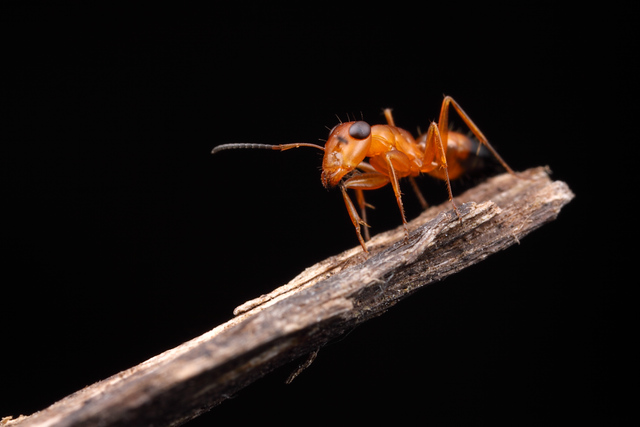
It’s been a while since I posted about some of the science I’ve been doing, so here’s a fun natural history story for a change.
If you have the fortune of being in the northern end of Australia, you’ll find some ants at your feet that appear to be under a strobe light, paradoxically in the light of day. These gorgeous ants (see above) are colloquially known as strobe ants (genus Opisthopsis). They’re remarkably common, and definitely catch your eye. Continue reading
This post is for your questions. Do you have a question? Ask it in the comments. Continue reading

The illusion of objectivity in the classroom
The 2004 lecture that convinced David Attenborough to make a big deal about climate change
When you prep a course, how many times would you like to teach it?
A beautiful essay about settling in to a faculty position for the long haul, and why we do what we do. Continue reading
You might not have noticed, but near the end of last year, at the end of one of the recommended reads, I mentioned I was starting an informal experiment, to not run comments on the site. Here’s a very informal report on this very informal experiment. Continue reading
There’s a remark that I see once a while in reviews, something along the lines of: “The authors should have their work edited by a native English speaker.”
Please stop staying this. I think it’s a problem, for three reasons: Continue reading
How do undergraduate students wind up in labs doing research? What’s the best way to identify students to bring into the lab? Continue reading

A legal arbitrator decided that Ryerson University (in Canada) is not allowed to use Student Evaluations of Teaching in tenure and promotion cases because they can be “downright biased and unreliable.” Here is the document itself.
A guide to managing grief while in grad school Continue reading
Women so often are asked: “How do you juggle family, career, and everything else?” But men are rarely asked about balancing family and career, with the implicit assumption that they aren’t spending substantial time or effort on family affairs. I think this doesn’t represent the actual state of affairs in many households, though it is still true that the average guy doesn’t do his fair share of parenting and household work.
Women-in-science who are parents are typically cast as moms by public and professional eyes, while men-in-science who are parents are not cast as dads. This sets up unrealistic and unfair expectations. Continue reading
Faculty job application season is building. If you’re applying for jobs, how much time are you going to invest into the process, and how many applications will you be sending out? Continue reading

I’m back from vacation! Anyhoo, a funny thing happens to me every summer.
Campus has an eerie quiet. There are plenty of people around, but compared to the academic year, there are relatively few students. So if I’m walking from the parking lot, or buying lunch in the union because I was lazy, I might bump into someone. Because I serve on a semiplethora of committees, I know folks in lots of roles on campus.
There’s a pretty good chance they’ll ask me: “What are you doing here? Are you teaching a summer course?” Continue reading
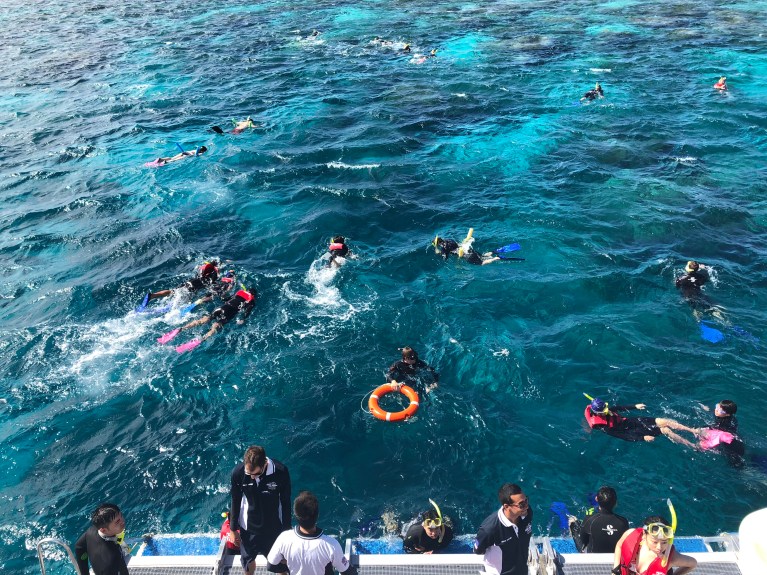
I celebrated my 46th birthday last week by going snorkeling on the Great Barrier Reef. It was bittersweet. I’ve been trying to process the experience, and I think I’ve found a measure of peace, but little comfort. Continue reading
I want to share a quick story about something slightly stupid that I did some years ago, while teaching. Continue reading
This week, the National Academy of Sciences released a report on gender harassment and sexual misconduct in our profession. There are a number of findings that might surprise you. Here are selected reads related to this report.
Does your institution foster a culture of sexual harassment? Continue reading
I don’t have a post for you today. Instead, please read some of the stories at MeTooSTEM.
It’s important for us all to understand the prevalence, mechanisms, and consequences of sexual harassment in our profession. Let’s hear about it directly from those who have been impacted. Continue reading
I’m in the field right now. Which means that I’m among many fellow academics, from a wide range of institutions, because we’re working out of La Selva Biological Station to do a short project. At the moment are faculty and grad students from a range of Latin American universities, and USian institutions including a regional state university, small liberal arts college, tribal college, HBCU, military academy, state research university, and some researchers from other kinds of organizations. Many of these folks are old friends, so being here is a great pleasure.
We’re here to run experiments to answer some specific research questions, but just as important, we’re here for the academic training of undergraduates. The two goals are quite complementary. You would think that what the students are getting is research training. They are getting that, but they’re also getting another kind of training: an introduction to the culture, conventions, and social mores of becoming an academic scientist. Continue reading
This is a spectacular and moving essay: Our Houses Became Boats: Surviving Hurricane Maria and salvaging my career in its aftermath
I’m back down at the field station in Costa Rica (missing my family quite a bit) and I had a very minor realization while having dinner among my students. It’s definitely a cliché of sorts, but I realized that the t-shirt I was wearing was older than some of my students.
I know this because the t-shirt had a specific date on it Continue reading
Apparently, there are some editors of academic journals who will readily send manuscripts out to “non-preferred reviewers” — the specific people that authors specify who they don’t want to receive the paper for review.
I think this is all kinds of messed up. Continue reading

One hundred twenty nine. I’ve been doing this, every other week, for a while now.
Students learn by doing, not from listening.
The extraordinary life and death of the world’s oldest spider.
A spectacular commencement address by George Saunders. Continue reading
I’ve noticed that junior scientists tend to be really picky about conflicts of interest, whereas senior scientists don’t tend to be sticklers. Continue reading
Once in a while, I look at the statistics for this site and I get to see some of the search terms that folks use to arrive here. Sometimes these are questions that may have gone unanswered. So, here are some of these queries, and my replies. (I’ve done this plenty before by the way, though it’s been a while.) For each search term, I provide a response. (The title, by the way, is an homage to MAD’s “snappy answers to stupid questions.”
how to destroy a bad graduate advisor
Tell them you’re planning to become a sales rep after you finish your dissertation.
how to get out of academic dishonesty
I guess you should lie? Continue reading

(image: first Matilija poppy of the season)
Early luck in grant funding has massive long-term effects on future funding (and here’s the original paper)
Are fieldwork studies being relegated to second place in conservation science?
This is shameful to the extreme: How the University of Minnesota hides its professors’ sexual harassment Continue reading
Some while ago, I wrote about experiences serving on NSF panels, just to demystify the experience for folks who haven’t been on panels. I received feedback that this was helpful, so I thought I’d turn some focus on one aspect of review that I think merits additional attention.
Continue reading
In science, we’re used to suboptimal methods — because of limited time, resources, or technology. But one of our biggest methodological shortcomings can be fixed as soon as we summon the common will. The time is overdue for us to abolish 5% as a uniform and arbitrarily selected probability threshold for hypothesis testing. Continue reading

 Small Pond Science