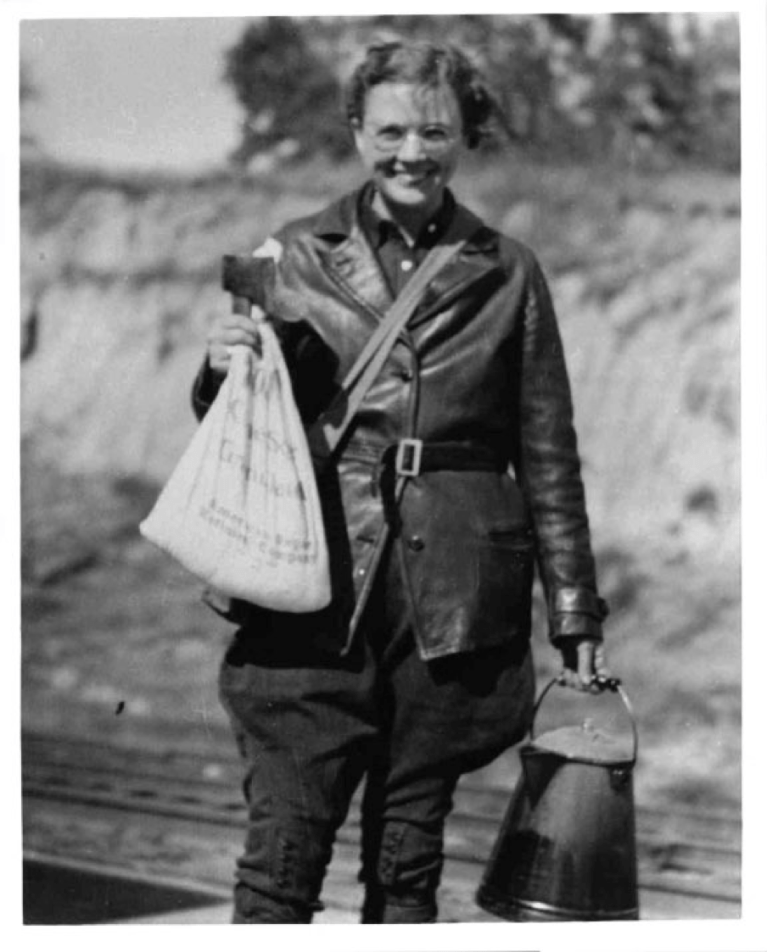
Ada Lovelace Day lands on Tuesday, 10 October. Here’s a post to honor Mary Talbot. She was a pioneer whose contributions were undervalued in her time, and that condition has persisted to our own time. Here’s a small attempt to rectify that situation. Continue reading
Bringing ecology blogging into the scientific fold
Standard
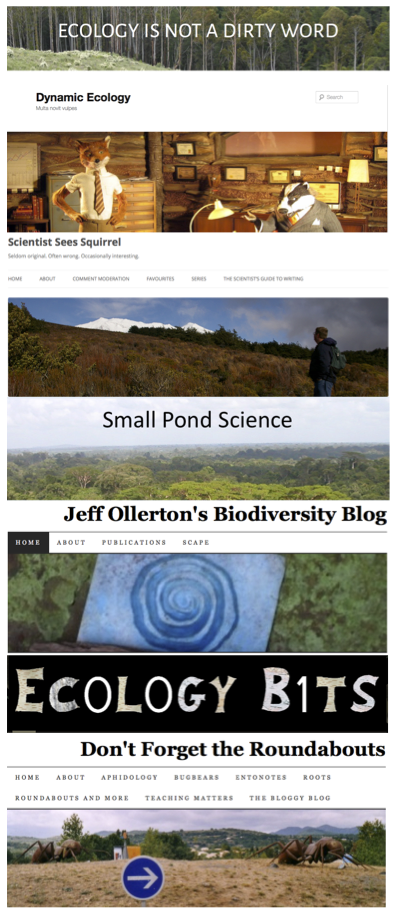
We’re co-authors on a new paper on “Bringing ecology blogging into the scientific fold: measuring reach and impact of science community blogs”. Of course we encourage you to go ahead and read the paper, because it doesn’t just have our perspectives but is the work of a collection of great bloggers. You can read what our coauthors make of our new paper, too: Manu Saunders of Ecology is Not a Dirty Word, Jeff Ollerton’s Biodiversity Blog, Meg Duffy from Dynamic Ecology, Simon Leather’s Don’t Forget the Roundabouts, Stephen Heard’s Scientist Sees Squirrel, and Margaret Kosmala’s Ec0l0gy B1ts.
If you don’t get to read the publication, our main take home is that there is a large group of people who do read science community blogs, and the influence of these blogs is larger than many realize. Continue reading
Are REU programs as amazing as their reputations?
StandardI know a lot of scientists who got their start from an REU (Research Experiences for Undergraduates) program. One summer as an REU has the potential to be transformational.
Advancing science in the US (and elsewhere) requires us to fund undergraduate research, and ensure that undergraduate researchers have thoughtful and attentive mentorship. We already spend a lot of money on training students – and I’d like to make sure that these efforts have the biggest bang for the buck. We are focused on broadening representation, but we haven’t seen the changes we need. Can we make REU programs* more effective? Continue reading
Recommended reads #113
StandardThis is the best explainer ever about social class in universities. Please read and share, especially with the graduate admissions committee.
Service as leadership
StandardLast week, I was at a workshop and a fellow participant made an observation that really caught our attention. They explained:
In universities, faculty usually have three types of duties: “scholarship,” “teaching,” and “service.” In their national lab, the job doesn’t include service. Instead, all of the stuff that we would call service, they call “leadership.”
Service is a bad thing. Leadership is a good thing. But what is the difference between university service and university leadership? Maybe if we called it “leadership” instead of “service,” it might be perceived as something more valuable and worthwhile.
At moment, at least for me, a cranial lightbulb turned on. Continue reading
What does “undergraduate research” mean to you?
StandardI’ve seen people talk past one another when discussing undergraduate research. This is usually because each person in the conversation has a radically different notion about what constitutes undergraduate research. Continue reading
Recommended reads #112
StandardCan you pick the bees out of this lineup? No really, can you?
The NSF-DEB blog has a post about the new guidelines for graduate fellowships, which have a deadline next month.
President Trump’s War on Science. This is an important comprehensive editorial from the Editorial Board of the New York Times. Continue reading
Recommendations for making science inclusive, and how to talk about it with others
StandardYou’re reading Small Pond Science right now — but a lot of our colleagues don’t read anything resembling a blog. So, for them, I’ve just published a short peer-reviewed paper about how this site addresses a common theme: how to promote equity and inclusion, especially for students in minority-serving institutions.
Think of it as a blog post, but with a lot of useful references in peer-reviewed journals and with the bright and shiny veneer of legitimacy from journal that’s been in print for more than a century. And hopefully fewer typos. Continue reading
Deadlines for undergraduates in research
StandardStudents might not be aware of the time horizons of applications for opportunities. Oftentimes, these things need more advance planning than expected.
Here I suggest timelines for undergraduates doing research and applying to grad school, particularly within the United States. Please make sure that students working with you are aware of these deadlines.
Applying to graduate school
You should be deep into grad school applications at the start of the Fall, one year before you plan to start grad school. Continue reading
Not waiting for the dinosaurs to retire
StandardI hear this a lot: “Bad behavior in academia comes from the guys who have been around for a long time. Times have changed, and they’re stuck in the old ways. We can’t change these guys, but they’re on their way out — and once they retire, things will get better.”
In some narrow cases — an isolated department here or there — this might be true. But as a general principle, I think it’s deeply mistaken. Continue reading
Recommended reads #111
StandardTo ban or not to ban laptops?
StandardSome folks want to ban laptops from their classrooms, and others are okay with laptops.
This is a perennially annoying discussion in higher ed today. But I think it’s an important issue because it has the potential to really affect learning.
What do I do? Here’s the language in my syllabus for this semester: Continue reading
Censorship or business as usual?
StandardThere’s a screenshot of an email from the Department of Energy that is making the rounds. I’d like to add some context to this for folks who haven’t dealt with this kind of stuff directly.
Based on my experience with federal agencies, I regard this as simultaneously outrageous and mundane. Continue reading
EEB Mentor Match to help underrepresented students get graduate fellowships
StandardI’ve griped about how undergraduates from wealthy private institutions and public research universities get the lion’s share of graduate fellowships. This happens for some obvious reasons of course, and I’m pleased to introduce a scheme that — with your help — can contribute to fixing this situation.
To get right to it: I’m teaming up with Meghan Duffy to pair up mentors with students from Minority-Serving Institutions (MSIs) to give them guidance and support as they put together their fellowship applications. (Meg has been the leader on this.)
To participate, see this post from Dynamic Ecology where she describes the project. Continue reading
Deadline awareness for everybody
StandardI and my family are now up in Oregon to experience the total solar eclipse. Which will be amazing.
This trip wasn’t hard to plan, but only because we were ready many moons ahead of time. I asked for my buddy’s spare bedroom about a year ago. Also, it’s the first official day of classes on my campus. My spouse’s work has a big exodus for the eclipse, no big deal there, but for our son, that’s the day that the big assignments from summer reading are due. So we all had to sort things out ahead of time.
This is the kind of planning that we need to build for students who we are advising and mentoring. Because applying for opportunities is far, far more than just filling out a form, and students who are not savvy to the mechanics of higher education may not appreciate this reality. Continue reading
Recommended reads #110
StandardThis, I think, is ingenious and next-level stuff: Designing malware to hack bioinformatics software by coding it into the DNA of organisms that get sequenced! Which, in the future, maybe could be a real problem?
This is old news, but not to me. In Holland there is (was?) a place that used a misting spray of synthetic DNA that could be used to identify folks who committed robberies.
Now that it’s start-of-semester-get-your-syllabus-ready season, let me remind you of this useful course workload estimator, to make sure that your expectations are well calibrated relative to the number of units associated with a course. Continue reading
Requiem for a sabbatical
StandardI haven’t had any service or teaching duties on my campus since May 2016. That ends today. I know, boo-hoo. Now I’m looking back at what sabbatical did for me and what I did for sabbatical. Continue reading
What are best ways to learn R?
Standard
Over my year of sabbatical, I planned to become comfortably proficient with data manipulation and analysis with R. I’m getting there. (I was doing a lot more over sabbatical of course, but this was one of my main objectives.) I figure it’ll take at least a few more manuscripts to get comfortable. As I really should be cranking out a dissertation’s worth of stuff in the next year, I have plenty of opportunity to get better, and the rate limiting step for me is sorting out the code. Continue reading
Recommended reads #109
StandardThe campus free speech issue isn’t about free speech
StandardWhen toxic hatemongers* want to speak on our campuses, they don’t have an intellectual discussion in mind — they merely see a win/win situation to promote their own brand. Continue reading
What’s up with preprints?
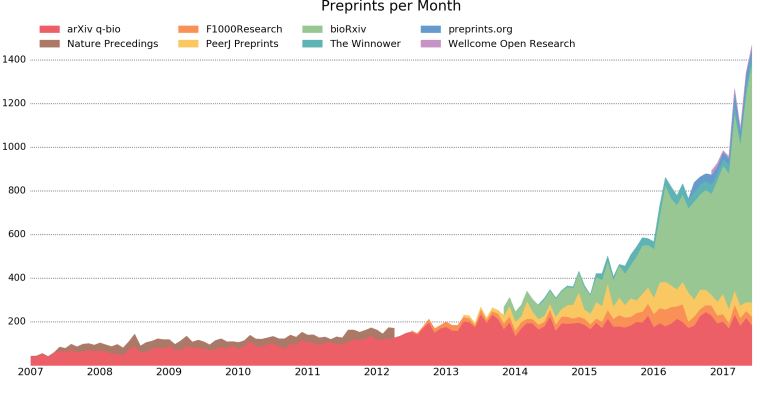
StandardPreprints are not a standard practice in biology. Nowadays, most papers that get published in peer-reviewed journals were not uploaded to a public preprint server.
Maybe this is changing? It looks like preprints are starting to take off. It’s not clear if this is a wave that will sweep the culture of the field, or just a growing practice among a small subset. Continue reading
Recommended reads #108
StandardWow. This opinion piece written by a scientist, who is a whistleblower working in the Department of Interior, is both important and landmine. They essentially reassigned him — and many other senior scientists — to work in the mailroom. Far away from home. We knew in advance that our new federal government was going to be anti-science, and in places like this, it’s as clear as ever. If you haven’t seen this yet, it’s a short op-ed and a key piece of information if you’re trying to stay even the slightest informed about science policy in the US kleptocracy.
This one-minute clip of a US congress member asking a NASA scientist whether it is possible that a civilization was on Mars thousands of years ago is also a must-see. Continue reading
The writing curse of negative data
StandardSummer is sometimes a contemplative time for me. It used to be long hours in the field would give me time to think but now it is just as often that I’m weeding my garden or some other summer activity. Lately I’ve been thinking a lot about negative results. Continue reading
Safety in the field
StandardHere is a reminder: safety comes first.
I recently heard some reports from a student who was working with lab group in the field — the group was unprepared for injuries, and hadn’t developed adequate precautions for some major risks. Continue reading
Recommended reads #107
Standard“Rather than teaching students to fail, I want them to learn to define their own personal rules for the game.”
A sense of duty to teach climate change. (Amy Harmon of the NYT has another spectacular piece.) Continue reading
Thinking critically about the ways we help our students
Standard
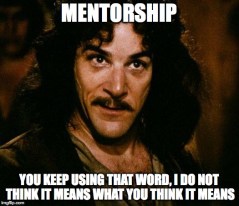
Folks can throw around the word “mentoring” rather sloppily. Which can lead students to being told that they’re being mentored, when they’re not.

I’ve seen a bit more of this while reviewing a variety of formal “mentorship plans” (in the context of panel service). A lot of people get what mentorship is about. But a good fraction of the plans weren’t so much about mentorship as they were about supervision — they said what the “mentee” would be doing for the “mentor,” but not specific about how the “mentor” would be supporting the specific needs of the “mentee.”
So what is mentorship and what isn’t? I volunteer an example for your consideration: Continue reading
We need to stop calling professional development a “pipeline”
StandardWhen we talk about increasing the representation of women and ethnic minorities in STEM, the path towards a professional career is often characterized as a “pipeline.”
The pipeline metaphor is so entrenched, it affects how people think about our deep-rooted problems. This metaphor has become counterproductive, because it fails to capture the nature of the problem that we are trying to solve. Even if we were to magically repair all of the so-called “pipeline,” we still would have what some would call “pipeline issues.”
What are the problems with the pipeline metaphor? Continue reading
Recommended reads #106
StandardThe case against using Turnitin in your own classroom.
When teaching for understanding is pitted against teaching for doing well on the test.
Stop the presses!!! Here is a shocking new finding: A new meta-analysis shows that student evaluations of teacher performance are unrelated to student learning. Continue reading
The people you work with predict whether you’re happy at work
StandardWhat most affects the quality of life for academics? I’ll put this question another way: at the end of the workday, when we go home, what is it that makes our day go well? What allows us to be happy and satisfied on a daily basis at work? How does this translate into long-term job happiness? Continue reading
How bad is the loss of NSF dissertation improvement grants?
StandardLast week, NSF announced they have stopped awarding DDIGs – the Doctoral Dissertation Improvement Grants in the divisions of Environmental Biology and Integrative Organismal Systems.
How bad is this decision? In the words of Jane Lubchenco: